Tag Archives: 12 Tribes of Israel

The Chosen Ones Series: Seek His Will for Your Life

Chosen ones, seeking the will of the Most High is the highest calling of a believer’s life, for purpose is not discovered in ambition but in obedience. The world teaches us to chase success, status, and self-fulfillment, but Scripture teaches us to seek God’s will above all things, knowing that His plan is eternal, perfect, and aligned with our true destiny (Romans 12:2, KJV).

God’s will is not hidden in mystery to torment us, but revealed progressively to those who desire Him sincerely. The Most High does not guide the proud, the distracted, or the double-minded; He leads those who humble themselves and hunger for righteousness (Matthew 5:6, KJV).

The first way to seek God’s will is through prayer and communion. Prayer is not merely asking for blessings, but aligning your spirit with God’s mind. Through prayer, the believer learns to listen more than speak, and to submit rather than demand (Jeremiah 33:3, KJV).

The second way is through studying the Word of God. Scripture is the primary revelation of God’s will. If something contradicts the Word, it is not God’s will, no matter how appealing it seems (Psalm 119:105, KJV).

The third way is through fasting and spiritual discipline. Fasting weakens the flesh and strengthens spiritual sensitivity. Many cannot hear God clearly because their flesh is too loud and their spirit too weak (Matthew 17:21, KJV).

The fourth way is through obedience in small things. God does not reveal big assignments to people who ignore small instructions. Faithfulness qualifies you for clarity (Luke 16:10, KJV).

The fifth way is through godly counsel. The Most High often speaks through wise and spiritually grounded people. Isolation breeds deception, but wise counsel brings stability (Proverbs 11:14, KJV).

The sixth way is through patience and waiting. God’s will unfolds in seasons, not instantly. Many people rush into decisions and later pray for God to fix what they never asked Him about (Isaiah 40:31, KJV).

The seventh way is through surrender of personal desires. God’s will cannot be followed while clinging to ego, pride, or personal agendas. True guidance begins where self ends (Proverbs 3:5–6, KJV).

The eighth way is through inner peace and conviction. God’s will brings spiritual peace, even when the assignment is difficult. Confusion, chaos, and anxiety are not the voice of God (Colossians 3:15, KJV).

The ninth way is through observing spiritual fruit. God’s will produces righteousness, humility, growth, and love—not pride, greed, or destruction (Matthew 7:16, KJV).

The tenth way is through aligning your life with service. God’s will is always connected to serving others, not just enriching yourself. Purpose is found in impact, not comfort (Mark 10:45, KJV).

Seeking God’s will requires dying to the culture of self-worship and individualism. The modern world glorifies personal dreams, but Scripture calls believers to die daily and live for God’s glory (Luke 9:23, KJV).

Many people remain spiritually stuck because they want God to bless their plans instead of submitting to His. But God does not exist to serve human ambition; humans exist to serve divine purpose (Job 42:2, KJV).

The will of God often requires separation from people, environments, and habits that no longer align with your calling. Growth always involves pruning (John 15:2, KJV).

God’s will may not always be comfortable, but it will always be meaningful. It may involve sacrifice, rejection, or obscurity, but it will never be empty (2 Corinthians 4:17, KJV).

Those who seek God’s will develop spiritual discernment. They learn to recognize when opportunities are distractions and when closed doors are protection (1 Thessalonians 5:21, KJV).

When you seek God’s will, provision follows purpose. You do not chase resources; resources are assigned to your obedience (Matthew 6:33, KJV).

God’s will is not about becoming famous, wealthy, or admired, but about becoming aligned, obedient, and useful in His kingdom (Romans 8:28, KJV).

The chosen are not chosen for comfort but for calling. They are shaped by trials, refined by waiting, and strengthened by faith (James 1:2–4, KJV).

Those who truly walk in God’s will become spiritually anchored. They are not easily swayed by trends, pressure, or public opinion because their identity is rooted in divine instruction (Galatians 1:10, KJV).

Ultimately, seeking God’s will is seeking God Himself. Purpose is not found in destinations, careers, or titles, but in intimacy with the Creator who formed you before you were born (Jeremiah 1:5, KJV).

To seek the Most High’s will is to choose eternal alignment over temporary pleasure, divine purpose over human praise, and spiritual obedience over worldly success. This is the path of the chosen.

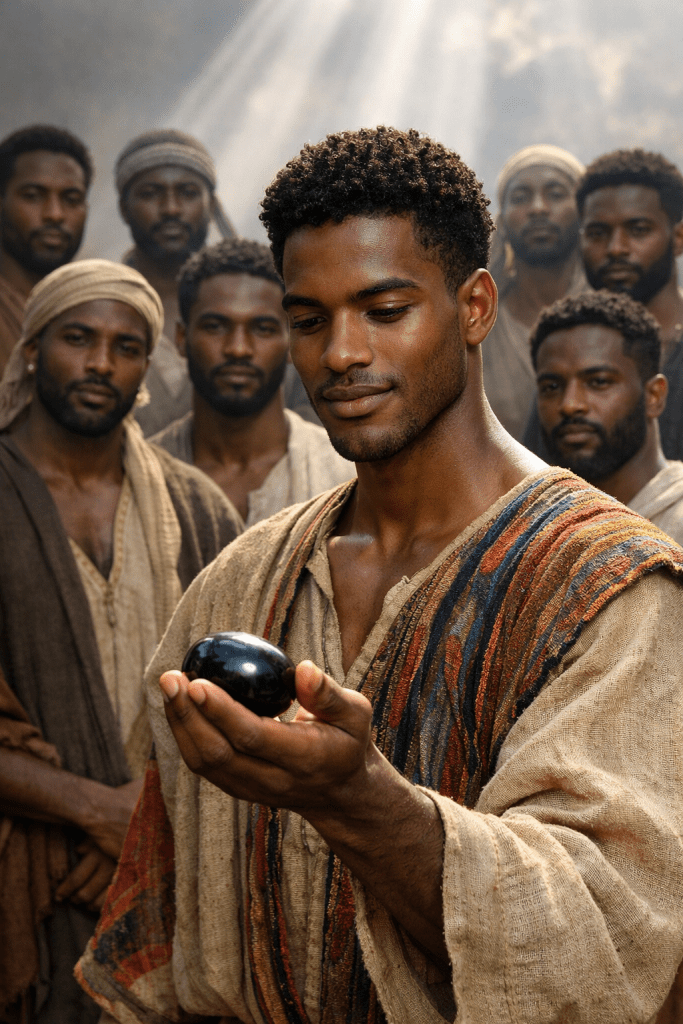
The Onyx Stone: A Family Affair — Joseph and His Brothers.

Onyx, dark as the midnight sky yet polished with hidden light,
a stone of mystery shaped by time and pressure,
a gem that carries both beauty and burden,
whispering of destinies forged through suffering,
and of souls refined in the fire of betrayal.

Onyx holds deep symbolic meaning in the biblical tradition, representing endurance, spiritual depth, and divine remembrance. In Scripture, onyx is one of the stones set in the high priest’s breastplate, engraved with the names of the tribes of Israel, signifying that each tribe was carried before God in sacred memory.

Joseph, the eleventh son of Jacob and the firstborn of Rachel, stands as one of the most compelling figures among the twelve tribes of Israel. His life narrative is not merely historical but theological, illustrating divine providence, generational conflict, and the mystery of chosenness within a fractured family system.

According to rabbinic and later symbolic traditions, Joseph is associated with the onyx stone, reflecting both his dark trials and radiant destiny. Onyx becomes a metaphor for Joseph’s life—polished through suffering, yet ultimately exalted through divine purpose.

Joseph’s story begins with favor, as he is given the coat of many colors by his father, a garment symbolizing distinction, authority, and emotional preference. This visible sign of love ignites jealousy among his brothers, sowing the seeds of betrayal long before the act itself unfolds.

The dreams Joseph receives intensify this conflict. In his visions, the sun, moon, and stars bow before him, along with sheaves of grain belonging to his brothers. These dreams are not merely youthful imagination but prophetic revelations that foreshadow his future role as a ruler and preserver of life.

Yet divine insight does not shield Joseph from human cruelty. His brothers, consumed by envy, conspire against him, stripping him of his garment and casting him into a pit before selling him to Midianite traders for silver, effectively turning family into traffickers and blood into profit.

This act of betrayal reflects one of the Bible’s deepest moral tensions: how God’s purpose often unfolds through human sin. Joseph is innocent, yet he becomes the vessel through which divine redemption will later flow, revealing the paradox of suffering as preparation.

Joseph’s descent into Egypt marks the beginning of his transformation. Though enslaved, he maintains integrity, resisting moral compromise even when falsely accused and imprisoned. His righteousness becomes a quiet rebellion against despair.

In prison, Joseph’s gift of dream interpretation resurfaces, proving that divine calling cannot be silenced by circumstance. His spiritual insight becomes the very instrument that elevates him from prisoner to prince.

Pharaoh’s dreams of famine and abundance position Joseph as a savior figure, entrusted with authority over Egypt’s economy. He rises not by lineage but by wisdom, embodying the principle that divine favor transcends social status.

Joseph’s beauty is also noted in Scripture, described as fair in form and appearance, making him both desired and tested. His physical attractiveness parallels his spiritual calling, showing how outward beauty can coexist with inner discipline.

When famine strikes, Joseph’s brothers unknowingly come before him in search of food, fulfilling the very dreams they once mocked. Their bowing becomes not an act of submission to a man, but to the divine orchestration behind his life.

Joseph’s emotional response reveals the complexity of forgiveness. He weeps privately, torn between memory and mercy, justice and compassion. His power is not in revenge, but in restraint.

The moment of reconciliation becomes one of the Bible’s most profound theological revelations. Joseph declares that what his brothers meant for evil, God intended for good, reframing trauma as testimony.

This declaration does not erase the pain of betrayal but redeems it. Joseph becomes the preserver of the family that once sought his destruction, turning the wound into a wellspring of survival.

Onyx, in this context, becomes more than a gemstone; it is a symbol of Joseph himself—darkened by suffering, refined by pressure, and set in divine memory as part of Israel’s eternal identity.

The family affair of Joseph is not merely about sibling rivalry but about generational inheritance, divine election, and moral responsibility. His story challenges the illusion of fairness and exposes the deeper logic of providence.

Joseph’s life reveals that destiny is not destroyed by betrayal, but often activated by it. The pit becomes the passageway, the prison becomes the platform, and the wound becomes the witness.

Through Joseph, the tribe associated with onyx emerges as a testament to spiritual endurance. He becomes a living stone in the architecture of Israel’s story, bearing both the scars of rejection and the seal of divine favor.

Onyx thus stands as a sacred metaphor for Joseph’s journey, reminding readers that God often engraves glory upon the darkest surfaces, and that what is polished by suffering may one day shine in sovereignty.


References
The Holy Bible, King James Version. (2017). Hendrickson Publishers. (Original work published 1611).
Exodus 28:9–12, 28:20 (KJV).
Genesis 37–50 (KJV).
Alter, R. (2018). The Hebrew Bible: A translation with commentary. W. W. Norton & Company.
Sarna, N. M. (1989). Genesis: The traditional Hebrew text with the new JPS translation. Jewish Publication Society.
Brown, F., Driver, S. R., & Briggs, C. A. (2001). The Brown-Driver-Briggs Hebrew and English lexicon. Hendrickson.

Genetics of a People: Deuteronomy 28 and the Diaspora.

Photo by Innocent Khumbuza on Pexels.com

The story of a people is written not only in sacred texts and historical records, but also in the very code of their DNA. For descendants of the African diaspora, the intersection of Scripture and science reveals a profound truth: identity cannot be erased, no matter the depth of dispersion or oppression. Deuteronomy 28, one of the most sobering chapters of the Hebrew Scriptures, outlines blessings for obedience and curses for disobedience. Many have drawn parallels between its prophetic warnings and the lived experiences of Africans scattered through the transatlantic slave trade.

The Bible declares, “And the LORD shall scatter thee among all people, from the one end of the earth even unto the other” (Deuteronomy 28:64, KJV). Historically, this scattering is vividly mirrored in the forced displacement of millions of Africans from West and Central Africa to the Americas, Europe, and beyond. Genetic studies confirm these origins: Y-DNA haplogroup E1b1a (E-M2) and mtDNA lineages such as L2 and L3 are dominant among African Americans and Afro-Caribbean populations, directly tying them to regions historically involved in the slave trade (Salas et al., 2002; Tishkoff et al., 2009).

What is striking is how prophecy, history, and genetics intersect. Deuteronomy 28:68 warns of a return to Egypt “with ships,” a verse many connect with the Middle Passage. Ships became the vessels of bondage, scattering families and bloodlines across continents. Yet even in this rupture, the genetic markers remain unbroken—silent witnesses of survival. Each haplogroup is a testimony that no empire, chain, or auction block could erase God’s covenantal design.

The diaspora, then, is not simply a tragic result of history; it is a prophetic unfolding. Genetics confirms dispersion, but Scripture provides meaning. In the double helix of DNA, one sees both the curse of scattering and the promise of eventual regathering. As Isaiah declares, “He shall set up an ensign for the nations, and shall assemble the outcasts of Israel” (Isaiah 11:12, KJV). The science of ancestry maps the scattering; the Word of God points toward the gathering.


📖 References

  • Holy Bible, King James Version.
  • Salas, A., Richards, M., De la Fe, T., Lareu, M. V., Sobrino, B., Sánchez-Diz, P., … & Carracedo, Á. (2002). The making of the African mtDNA landscape. American Journal of Human Genetics, 71(5), 1082–1111.
  • Tishkoff, S. A., Reed, F. A., Friedlaender, F. R., Ehret, C., Ranciaro, A., Froment, A., … & Williams, S. M. (2009). The genetic structure and history of Africans and African Americans. Science, 324(5930), 1035–1044.

Weaponizing Scripture: How the Bible Was Used to Justify Enslavement

This photograph is the property of its respective owner. No copyright infringement intended

Weaponizing Scripture was one of the most devastating tools used to sustain the transatlantic slave system. The Bible, a text meant to proclaim liberation, justice, and the dignity of humanity, was distorted into an instrument of control. Enslavers did not merely use chains and whips; they used theology, selectively interpreted and strategically taught, to shape belief, obedience, and identity.

European slaveholders understood that physical domination alone was insufficient. To maintain long-term control, they needed mental and spiritual submission. Christianity, when stripped of its liberatory core, became a mechanism for conditioning enslaved Africans to accept suffering as divinely ordained rather than violently imposed.

One of the most common tactics was the selective reading of Scripture. Enslavers emphasized verses that appeared to support servitude while suppressing passages that spoke of freedom, justice, and God’s judgment against oppression. This manipulation created a counterfeit Christianity that served the empire rather than God.

A frequently cited passage was Ephesians 6:5, “Servants, be obedient to them that are your masters” (KJV). This verse was taught without context, stripped of its historical setting, and severed from the broader biblical narrative. Enslavers ignored that the same chapter commands masters to act justly and warns that God shows no partiality.

Similarly, Colossians 3:22 and 1 Peter 2:18 were weaponized to portray submission to abuse as holy obedience. These verses were never intended to endorse racialized, chattel slavery, yet they were recast to sanctify lifelong bondage based on skin color, a concept entirely foreign to the biblical world.

At the same time, enslavers deliberately removed or discouraged engagement with texts that threatened their power. The book of Exodus, which narrates God’s deliverance of an enslaved people, was often censored or reframed. Moses was rarely preached as a liberator, and Pharaoh’s defeat was downplayed or spiritualized to avoid political implications.

In many plantations, enslaved Africans were given a heavily edited text known as the “Slave Bible.” This version removed large portions of the Old Testament and New Testament passages that emphasized freedom, equality, or divine justice. What remained was a hollowed-out gospel engineered for compliance.

This theological distortion extended beyond omission into outright deception. Enslavers taught that Black people were cursed by God, often invoking a twisted interpretation of the so-called “Curse of Ham” in Genesis 9. This lie ignores the text itself, which never condemns Ham’s descendants to perpetual slavery and never mentions race.

By redefining God as a white authoritarian figure aligned with European power, enslavers reshaped spiritual imagination. Blackness became associated with sin, inferiority, and divine disfavor, while whiteness was falsely aligned with righteousness and authority. This inversion was not biblical; it was ideological.

Such misuse of Scripture produced mental slavery, a condition where the enslaved internalized the oppressor’s theology. Over time, some came to believe their suffering was God’s will, that resistance was rebellion against heaven, and that liberation was spiritually dangerous.

Yet even under these conditions, enslaved Africans demonstrated remarkable theological resistance. Through spirituals, coded language, and communal worship, they reclaimed biblical themes of deliverance, judgment, and hope. Songs about crossing Jordan, escaping Egypt, and seeing the promised land were not metaphorical escapism; they were theological protest.

The Bible itself consistently condemns man-stealing, the foundation of chattel slavery. Exodus 21:16 declares that kidnapping a human being and selling them is a capital crime. This verse alone dismantles the moral legitimacy of the slave trade, yet it was systematically ignored.

The prophets repeatedly denounce exploitation of the poor and vulnerable. Isaiah, Jeremiah, and Amos all portray God as hostile toward nations that enrich themselves through oppression. These texts reveal that the God of Scripture sides with the crushed, not the conqueror.

Jesus’ ministry further exposes the lie of slaveholding theology. Christ announced His mission as one to “preach deliverance to the captives” and to set the oppressed free (Luke 4:18). Any theology that sanctifies captivity directly contradicts the words of Christ Himself.

The apostolic message affirms spiritual equality among believers. Galatians 3:28 declares that there is neither slave nor free in Christ, undermining any doctrine that elevates one group over another. While early Christians lived within existing social systems, the gospel planted seeds that inevitably challenged them.

Weaponized Scripture also served to fracture Black identity. African spiritual systems were demonized, ancestral memory was erased, and biblical literacy was restricted. This was not evangelism; it was cultural warfare masquerading as salvation.

The long-term consequences of this distortion persist today. Many descendants of the enslaved wrestle with inherited religious trauma, mistrust of Christianity, or internalized inferiority rooted in centuries of theological abuse. This is one of slavery’s most enduring scars.

Yet the Bible itself is not the enemy. The problem has never been Scripture, but who interprets it, how it is taught, and whose interests it serves. When read holistically, the Bible exposes slavery as sin and oppression as rebellion against God.

Reclaiming Scripture requires restoring context, history, and truth. It demands confronting how Christianity was used as a colonial tool while also recognizing how Black faith communities preserved the liberating heart of the gospel against all odds.

Weaponized Scripture enslaved bodies for centuries, but redeemed Scripture continues to awaken minds. When the Bible is freed from manipulation, it testifies not to chains, but to justice, dignity, and divine judgment against every system built on human suffering.


References

Cone, J. H. (1975). God of the oppressed. New York, NY: Seabury Press.

Douglas, K. B. (1994). The black Christ. Maryknoll, NY: Orbis Books.

Haynes, S. R. (2002). Noah’s curse: The biblical justification of American slavery. Oxford, UK: Oxford University Press.

Raboteau, A. J. (2004). Slave religion: The “invisible institution” in the antebellum South. New York, NY: Oxford University Press.

The Holy Bible, King James Version. (1769/2017). Cambridge Edition.

Wilmore, G. S. (1998). Black religion and Black radicalism (3rd ed.). Maryknoll, NY: Orbis Books.

The Seeds of the Promise.

This artwork is the property of its respective owner. No copyright infringement intended.

The story of God’s chosen people is deeply rooted in Scripture, prophecy, and history. Deuteronomy 28 (KJV) outlines blessings for obedience and curses for disobedience, serving as both a covenant promise and a prophetic warning. Many within the African diaspora identify their struggles and resilience with these verses, seeing themselves as the “seeds of the promise,” scattered across the earth yet preserved by God’s hand. Like trees planted by rivers of living water, they endure oppression, displacement, and hardship while continuing to grow, flourish, and bear fruit.

The Seeds and the Promise
Seeds carry potential and continuity. Spiritually, the descendants of Israel are seeds of the covenant God made with Abraham (Genesis 17:7, KJV). Psychologically, seeds represent identity and generational transmission. Black people, despite systemic oppression, have carried cultural, spiritual, and intellectual seeds across continents, preserving language, rhythm, faith, and resilience. These seeds testify to survival against all odds.

Deuteronomy 28 and the Black Experience
The curses in Deuteronomy 28:15–68 resonate profoundly with the history of Black people. Enslavement, scattering across nations, oppression by enemies, and loss of identity parallel the transatlantic slave trade and subsequent struggles of the African diaspora. Verse 68 speaks of returning to Egypt “again with ships,” a striking image that mirrors the ships that carried millions into bondage. Many interpret these prophecies as evidence that Black people are part of God’s chosen covenant people.

Trees Planted by Living Water
Psalm 1:3 (KJV) describes the blessed man as being “like a tree planted by the rivers of water, that bringeth forth his fruit in his season.” This metaphor speaks to endurance and divine sustenance. Despite centuries of slavery, segregation, and systemic oppression, Black communities have remained rooted in faith, producing leaders, artists, scholars, and prophets who have blessed the world. The psychology of Black resilience reveals a deep wellspring of spiritual and cultural resources that mirror this biblical imagery.

Psychologically, Black people have carried generational trauma from enslavement, colonization, and racism. Yet, alongside trauma exists resilience—expressed through music, oral tradition, communal bonds, and faith in God. Na’im Akbar (1984) noted that African-descended people maintain strength by reclaiming identity, resisting oppression, and drawing on spirituality. This resilience is evidence of the “living water” that sustains God’s chosen, nourishing them in the face of systemic attempts to uproot them.

The history of Black people stretches far beyond the African continent. Evidence of African presence is found in ancient Israel, Mesopotamia, and early Christian communities. African contributions shaped global civilizations through science, mathematics, philosophy, and theology. From the Kingdom of Kush to the Moors in Spain, Black history reveals a legacy of leadership and brilliance that extends into the Americas, the Caribbean, and beyond. These contributions reveal a scattered yet resilient people, reflecting the biblical narrative of God’s chosen seed dispersed among nations.

Being chosen does not mean privilege without responsibility; it means bearing the covenant of obedience. Deuteronomy 7:6 (KJV) declares, “For thou art an holy people unto the LORD thy God: the LORD thy God hath chosen thee to be a special people unto himself, above all people that are upon the face of the earth.” This chosenness is marked not only by blessings but also by trials meant to refine and bring the people back to God. Black people’s journey through slavery, segregation, and systemic oppression mirrors this refining fire.

The transatlantic slave trade attempted to erase identity, yet language, song, and spirituality preserved the covenant consciousness of the people. Spirituals like “Go Down, Moses” encoded biblical identity, likening the plight of enslaved Africans to the Israelites in Egypt. This connection shows how deeply the promise of God was embedded in the psychology of Black communities, even in the darkest times.

Conclusion
The seeds of the promise remain alive in God’s chosen. Though scattered, bruised, and oppressed, they continue to grow like trees planted by the rivers of water, sustained by the living Word of God. Black history—beyond Africa and into the Americas, Europe, and beyond—bears witness to the fulfillment of prophecy and the preservation of a covenant people. To live as God’s chosen is to embrace both identity and responsibility, walking in obedience, resilience, and faith. The story of the seeds of the promise is not only a history lesson—it is a living testimony of God’s hand upon His people.


References

  • Akbar, N. (1984). Africentric Social Sciences for Human Liberation. Journal of Black Studies.
  • The Holy Bible, King James Version (KJV).

The Bible Series: “”Joseph”” The Faithful Dreamer and His Eternal Legacy.

This photograph is the property of its respective owner. No copyright infringement intended.

Joseph, the eleventh son of Jacob, was born to Rachel, Jacob’s beloved wife, and immediately marked as a child of promise (Genesis 30:22–24, KJV). From his earliest years, he demonstrated a spirit favored by God and recognized by his father, who bestowed upon him the coat of many colors, a garment symbolizing both love and divine favor (Genesis 37:3, KJV). Yet this symbol of distinction also stirred deep envy among his brothers, planting seeds of rivalry that would shape Joseph’s early trials.

Each of the twelve sons of Jacob, founders of Israel’s tribes, had a corresponding precious stone on the High Priest’s breastplate, representing God’s covenant with them. Joseph’s stone was onyx, described in Exodus 28:20: “And the fourth row a beryl, and an onyx, and a jasper: they shall be set in gold in their inclosings” (KJV). Onyx symbolizes resilience, layered strength, and divine protection, foreshadowing Joseph’s ability to endure hardship while preserving his faith and integrity. The stone’s complex beauty reflects his life: layered with trials yet polished by God’s providence.

Joseph’s early life was defined by extraordinary dreams, foretelling that he would rise above his family: “Behold, I have dreamed a dream more; and, behold, the sun and the moon and the eleven stars made obeisance to me” (Genesis 37:9, KJV). These dreams fueled his brothers’ jealousy, motivating them to betray him. They initially plotted to kill him, but ultimately sold him into slavery to Midianite traders, demonstrating the destructive power of envy (Genesis 37:18–28, KJV).

Sold to Potiphar, an officer of Pharaoh, Joseph’s character quickly distinguished him. Despite being a foreigner and a slave, he found favor in Potiphar’s sight, “and the Lord was with Joseph, and he was a prosperous man” (Genesis 39:2, KJV). Joseph’s diligence and faithfulness exemplify how God’s presence can elevate and sustain His servants even in adversity.

Potiphar’s wife tested Joseph’s moral integrity, attempting to seduce him. Joseph resisted, declaring, “How then can I do this great wickedness, and sin against God?” (Genesis 39:9, KJV). His refusal highlights the principle that consecration is not only about obedience but also about protecting the sanctity of the body and the soul from defilement.

False accusations led to Joseph’s imprisonment, yet even there God’s favor remained. “But the Lord was with Joseph, and shewed him mercy, and gave him favour in the sight of the keeper of the prison” (Genesis 39:21–23, KJV). Joseph’s life demonstrates that God’s providence can operate through trials, shaping character, wisdom, and resilience.

Joseph’s God-given gift of dream interpretation became central to his rise. He accurately interpreted the dreams of Pharaoh’s servants in prison (Genesis 40:8, KJV), and later Pharaoh’s troubling dreams of seven years of plenty followed by seven years of famine (Genesis 41:15–32, KJV). This prophetic insight elevated him to second-in-command over Egypt, entrusted with the nation’s resources during a time of impending crisis.

His administration during the famine revealed extraordinary wisdom, foresight, and humility. “Thou shalt be over my house, and according unto thy word shall all my people be ruled” (Genesis 41:40, KJV). Joseph’s leadership saved Egypt and positioned him to fulfill God’s covenant promises to his family, demonstrating that consecrated service benefits both the individual and God’s broader plan.

The famine brought Joseph’s brothers to Egypt seeking sustenance. Initially unrecognized, Joseph tested their hearts to discern repentance (Genesis 42–44, KJV). His careful discernment, mercy, and wisdom underscore the spiritual maturity cultivated through suffering.

Ultimately, Joseph revealed his identity, saying, “I am Joseph; doth my father yet live?” (Genesis 45:3, KJV). His forgiveness reconciled his family, turning their envy and betrayal into instruments of divine providence. Joseph exemplified how God can transform human malice into salvation and blessing.

Joseph’s personal gifts—wisdom, discernment, humility, and prophetic insight—were manifestations of God’s Spirit (Genesis 41:16, KJV). These gifts allowed him to preserve nations, restore his family, and serve as a model of faithfulness. His consecrated life demonstrates that spiritual gifts function best when aligned with obedience and trust in God.

His marriage to Asenath and the birth of Ephraim and Manasseh ensured his lineage and the continuation of God’s covenant through his descendants (Genesis 41:45; 41:50–52, KJV). The tribes of Ephraim and Manasseh inherited prominence in Israel, reflecting the enduring blessing of Joseph’s faithfulness and the symbolic double portion often associated with the firstborn.

Joseph’s onyx stone reflects his layered resilience. Like the stone, his life endured pressures of betrayal, slavery, and false accusation, emerging strengthened and polished. Onyx symbolizes moral fortitude, protection, and divine favor, qualities that Joseph embodied throughout his trials.

The tribes of Ephraim and Manasseh illustrate Joseph’s enduring legacy. Ephraim, often a leading tribe, and Manasseh, settled east of the Jordan, both carried forward Joseph’s influence, demonstrating how God multiplies the faithfulness of one servant into blessings for generations.

Spiritually, Joseph’s life reveals the principle of refinement through adversity. God used suffering to cultivate patience, wisdom, and discernment in him. His faithfulness in small matters, like serving in Potiphar’s house and prison, prepared him for enormous responsibilities, showing that consecration is a process shaped by trials.

Forgiveness and reconciliation were central to Joseph’s legacy. By forgiving his brothers, he preserved covenantal unity, demonstrating that divine leadership is rooted not only in authority but in mercy and relational wisdom (Genesis 50:17, KJV).

Joseph’s prophetic dreams, from youth through adulthood, symbolized God’s sovereign plan. While initially misunderstood and resented, these dreams guided him toward his destiny, revealing that God’s guidance often unfolds gradually and through trials (Genesis 37:5–11, KJV).

The onyx stone, embedded in the High Priest’s breastplate, represents the visible presence of God’s covenant, mirrored in Joseph’s life as a conduit of divine providence. Just as the stone endures layers of pressure and emerges brilliant, Joseph’s integrity and faithfulness shone through adversity, blessing nations and securing his family’s survival.

Joseph’s trials and triumphs exemplify God’s providential care. Romans 8:28 parallels his story: “And we know that all things work together for good to them that love God, to them who are the called according to his purpose” (KJV). Every betrayal and hardship in Joseph’s life served a higher purpose, demonstrating God’s sovereignty.

In conclusion, Joseph’s life, marked by divine favor, prophetic insight, moral integrity, and leadership, serves as a model of faithfulness and consecration. His onyx stone symbolizes resilience, divine protection, and layered beauty revealed through trials. Through his sons, Ephraim and Manasseh, his legacy endured, blessing Israel for generations. Joseph exemplifies how God transforms adversity into purpose, and how consecrated obedience produces enduring spiritual fruit.

E1B1A: The DNA of Greatness — Tracing the Seed of Israel.

Photo by Muhammad-Taha Ibrahim on Pexels.com

The Y-DNA haplogroup E1B1A is one of the most significant genetic markers in the study of human ancestry, particularly among African populations. Its prevalence in sub-Saharan Africa, especially among West and Central Africans, points to deep historical roots that connect modern descendants to ancient African civilizations. Understanding E1B1A provides insight into the lineage often associated with the biblical Seed of Israel.

Genetic studies indicate that E1B1A likely originated in East Africa and spread westward thousands of years ago. This haplogroup is notably dominant among people of the African diaspora, particularly those whose ancestors were forcibly brought to the Americas during the transatlantic slave trade (Henn et al., 2008). Its prevalence underscores the continuity of African ancestry across continents and centuries.

From a biblical perspective, the Seed of Israel carries promises of covenant, blessing, and nationhood. Scriptures emphasize that God’s covenantal blessings were passed down through the lineages of Abraham, Isaac, and Jacob (Genesis 17:7). Genetic markers like E1B1A offer a modern framework for tracing this lineage in historical and contemporary populations.

The dispersion of E1B1A aligns with historical accounts of migration and conquest. African kingdoms such as Ghana, Mali, and Songhai housed populations with high frequencies of this haplogroup. Their social, economic, and cultural achievements demonstrate a continuity of intelligence, leadership, and resilience—qualities associated biblically with the Israelites (Deuteronomy 28:1–14).

The biblical narrative situates the Israelites as a chosen people, set apart for divine purpose. The connection of E1B1A to African populations reinforces the argument that the original Israelites were of African descent. Psalm 105:6–11 recounts God’s covenant with Abraham and his seed, highlighting the enduring lineage that extends into modern African-descended populations (KJV).

Historically, the transatlantic slave trade severed cultural and genealogical continuity, obscuring the direct lineage of African descendants in the Americas. Despite this disruption, genetic markers like E1B1A provide scientific evidence of enduring heritage and ancestral connection, affirming the biblical promise of the preservation of Israel’s seed (Jeremiah 31:35–37).

Anthropological studies of E1B1A reveal patterns of societal structure, migration, and adaptation. Populations with this haplogroup historically established powerful kingdoms, engaged in sophisticated trade networks, and developed rich cultural traditions. These accomplishments reflect the divine favor and resilience described in Deuteronomy 28:12–13.

The association between E1B1A and leadership traits is notable. Historically, men with this lineage often held positions of authority, governance, and military command. This aligns with the biblical depiction of Israelite men as leaders, judges, and warriors chosen to uphold God’s law and protect their communities (Joshua 1:6–9).

E1B1A also connects to spiritual heritage. The Israelites were entrusted with God’s laws, ethical codes, and covenantal responsibilities. The resilience of African-descended populations, despite centuries of oppression, slavery, and displacement, mirrors the biblical narrative of enduring faith and divine preservation (Psalm 105:8).

Culturally, E1B1A populations have preserved elements of African identity, including language, music, and communal structures, even across diasporic contexts. These cultural continuities serve as living testimony to the endurance of the Seed of Israel, reflecting values emphasized in biblical instruction (Exodus 12:14).

Genetics and scripture intersect in demonstrating continuity and purpose. While DNA provides biological evidence, the Bible provides spiritual and moral context, framing the lineage as not only preserved but chosen and blessed by God (Genesis 28:13–15). Together, these perspectives illuminate the depth of African heritage.

The study of E1B1A challenges Eurocentric historical narratives that have often obscured African achievements. Recognizing the genetic, cultural, and spiritual legacies of E1B1A populations restores historical truth and affirms the presence of the Israelites in Africa (Deuteronomy 28:68).

The distribution of E1B1A among diasporic populations underscores the persistence of identity despite adversity. African-descended people in the Americas, Caribbean, and Europe carry markers of ancient lineage, testifying to the survival of Israel’s seed against historical forces of erasure (Isaiah 49:15–16).

Spiritual reflection on E1B1A emphasizes responsibility and calling. Those who carry this lineage are encouraged to embody principles of justice, wisdom, and leadership, reflecting the covenantal blessings promised to Israel (Proverbs 4:7). The DNA serves not merely as inheritance but as a blueprint for purpose.

Education and awareness of genetic heritage foster empowerment. Understanding the connection between E1B1A and biblical Israel allows African-descended populations to reclaim narratives of dignity, history, and destiny, reinforcing self-worth and communal pride (Jeremiah 33:3).

Modern research on E1B1A includes advanced genetic mapping and population studies. These studies reveal migration patterns, admixture, and historical continuity, providing scientific validation for long-held ancestral knowledge and oral traditions (Henn et al., 2012).

The resilience of E1B1A populations in the face of slavery, colonialism, and systemic oppression demonstrates a living manifestation of biblical promises. Their endurance exemplifies faithfulness and divine protection, echoing Deuteronomy 31:6.

Understanding E1B1A also highlights the intersection of biology, history, and theology. DNA does not exist in isolation—it interacts with culture, belief, and community. Recognizing this interplay enriches both scientific and spiritual understanding of human identity.

Mentorship and intergenerational transmission of knowledge are vital. Passing down awareness of lineage, cultural heritage, and spiritual responsibility ensures that the lessons embedded in E1B1A continue to guide descendants of Israel (Proverbs 22:6).

In conclusion, E1B1A is more than a genetic marker; it is a testament to endurance, heritage, and divine purpose. Tracing this lineage illuminates the biblical Seed of Israel, connecting modern African-descended populations to their ancestral covenant. Recognizing and embracing this inheritance empowers individuals and communities to embody the greatness, resilience, and responsibility embedded in their DNA.


References

Henn, B. M., Botigué, L. R., Gravel, S., Wang, W., Brisbin, A., Byrnes, J. K., … & Bustamante, C. D. (2012). Genomic ancestry of North Africans supports back-to-Africa migrations. PLOS Genetics, 8(1), e1002397. https://doi.org/10.1371/journal.pgen.1002397

Henn, B. M., Cavalli-Sforza, L. L., & Feldman, M. W. (2008). The great human expansion. Proceedings of the National Academy of Sciences, 105(36), 13471–13476. https://doi.org/10.1073/pnas.0805312105

Hunter, M. (2007). The persistent problem of colorism: Skin tone, status, and inequality. Sociology Compass, 1(1), 237–254. https://doi.org/10.1111/j.1751-9020.2007.00014.x

The Holy Bible, King James Version. (n.d.). Genesis 17:7; 28:13–15; Exodus 12:14; Deuteronomy 28:1–14, 28:68, 31:6; Psalm 105:6–11; Isaiah 49:15–16; Proverbs 4:7; 22:6. King James Bible Online. https://www.kingjamesbibleonline.org

The Bible Series: Joseph’s Journey – Integrity in the Face of Temptation.

Joseph, son of Jacob, is one of the most remarkable figures in the Old Testament, celebrated for his steadfast integrity, unwavering faith, and divine insight. His life illustrates the intersection of human vulnerability and God’s providence, revealing how integrity can sustain one through trials, temptation, and betrayal. Joseph’s journey begins in Canaan, as the favored son of Jacob, where his early dreams of prominence foreshadowed a destiny shaped by divine orchestration (Genesis 37:3-11, KJV).

The beauty of Joseph, as described in Scripture, was not merely physical. Genesis 39:6 (KJV) notes that “the LORD blessed the Egyptian’s house for Joseph’s sake; and the blessing of the LORD was upon all that he had in the house, and in the field.” His countenance, demeanor, and charisma reflected a harmony of spiritual favor and personal presence. This external attractiveness was intertwined with moral and spiritual virtues, making him admired by those around him while simultaneously inciting envy.

Joseph’s beauty and favored status with his father generated jealousy among his brothers. Their resentment led to betrayal: Joseph was sold into slavery, stripped of familial protection, and sent to Egypt (Genesis 37:28, KJV). From the outset, Joseph’s life demonstrates a paradox familiar to many of God’s faithful: blessings can attract both opportunity and opposition. His response to betrayal set the tone for the integrity that would define his journey.

In Egypt, Joseph’s initial trials were compounded by Potiphar’s household. Despite being a slave in a foreign land, he quickly distinguished himself through diligence, wisdom, and reliability (Genesis 39:4, KJV). His integrity was evident in his work ethic and his ability to maintain trust, establishing his reputation for righteousness. Joseph’s commitment to ethical conduct, even in servitude, exemplifies the principle that integrity is not situational but rooted in character.

The pivotal test of Joseph’s moral fortitude came through temptation. Potiphar’s wife attempted to seduce him repeatedly, but Joseph steadfastly resisted, declaring, “How then can I do this great wickedness, and sin against God?” (Genesis 39:9, KJV). This declaration highlights the inseparable link between faith and moral action. Joseph’s refusal was not merely a personal decision; it was an affirmation of his loyalty to God above human desire.

Joseph’s rejection of sin had immediate consequences. Falsely accused, he was imprisoned despite his innocence (Genesis 39:20, KJV). Yet even in confinement, Joseph’s integrity and divine favor were evident. He quickly gained the trust of the prison keeper and earned responsibility over all inmates, demonstrating that virtuous character transcends circumstance (Genesis 39:22-23, KJV).

The narrative of Joseph illustrates a recurrent biblical theme: integrity often carries cost but yields long-term reward. While betrayal and false accusation caused temporary suffering, these challenges positioned Joseph for greater divine purpose. The testing of his character cultivated patience, wisdom, and humility—qualities necessary for leadership in the broader trajectory of God’s plan (Genesis 41:39-41, KJV).

Joseph’s gift of interpreting dreams was another arena in which integrity intersected with divine favor. When he accurately interpreted the dreams of Pharaoh’s cupbearer and baker, his insight reflected spiritual discernment and reliance on God rather than self-interest (Genesis 40:8, KJV). His interpretations were not for personal gain but a faithful service to God, a hallmark of his unwavering moral compass.

The story emphasizes the theme of providence. Although Joseph’s brothers acted out of malice, God’s hand was evident in every event, preparing Joseph for leadership over Egypt and the preservation of Israel during famine (Genesis 50:20, KJV). Joseph’s integrity, patience, and moral clarity enabled him to serve effectively, demonstrating that ethical steadfastness aligns with divine destiny.

In the broader context of temptation, Joseph’s life is instructive for understanding the relationship between desire, discipline, and divine alignment. Resisting immediate gratification or ethical compromise often requires foresight, trust, and moral courage. Joseph’s ability to maintain integrity in the face of repeated provocations exemplifies a spiritual principle that transcends historical and cultural context.

Joseph’s life also illustrates the interplay between humility and influence. Despite his elevated position, he consistently attributed success to God rather than personal skill or cunning (Genesis 41:16, KJV). Integrity in leadership, as Joseph demonstrates, involves recognizing one’s dependence on divine guidance while exercising authority responsibly.

His relationship with his brothers later reveals the transformative power of integrity. Rather than seeking revenge, Joseph extended forgiveness and provision during famine (Genesis 45:4-11, KJV). His ability to maintain righteousness while exercising authority shows how moral character enhances leadership, fostering reconciliation and social restoration.

Joseph’s stewardship in Egypt demonstrates the practical application of integrity. He managed resources wisely, planned for future scarcity, and implemented equitable policies to sustain a nation (Genesis 41:46-57, KJV). Integrity, in Joseph’s example, is not passive virtue but active diligence and wise governance.

Temptation recurs in Joseph’s story beyond sexual advances, extending to political and social pressures. He navigated complex relationships with Pharaoh, Egyptian officials, and foreign emissaries, maintaining ethical discernment while fulfilling divine purpose. Joseph’s life illustrates that integrity requires consistency across all spheres of life, not just in moments of overt moral challenge.

Theological reflections on Joseph highlight that integrity is integrally linked to trust in God. His unwavering faith and ethical conduct in the midst of hardship align with Psalm 112:1-3 (KJV), which praises the man who fears the Lord, highlighting the blessings of righteousness, security, and influence. Joseph embodies the principle that personal integrity attracts divine favor and societal trust.

Joseph’s narrative also underscores the redemptive potential of suffering. His trials, though painful, shaped character, fortified patience, and deepened reliance on God (Romans 5:3-5, KJV). Integrity in adversity does not prevent trials but transforms them into instruments of spiritual and practical preparation.

Joseph’s capacity for foresight, mercy, and resourcefulness reflects the holistic nature of integrity. He combined ethical steadfastness with practical wisdom, demonstrating that moral character is both internal and relational—affecting not only oneself but entire communities.

The beauty of Joseph is reflected in the congruence of his physical presence, moral character, and spiritual alignment. He was handsome in appearance, attractive in demeanor, and noble in spirit (Genesis 39:6, KJV). This holistic beauty symbolizes the harmony between divine favor, human virtue, and natural gifts—a reflection of God’s grace in shaping character and presence simultaneously.

Ultimately, Joseph’s journey teaches that integrity is not situational; it is a lifelong practice rooted in God-centered values. It involves courage to resist temptation, patience through trials, wisdom in leadership, and humility before God. His life affirms that divine purpose is inseparable from ethical consistency, and that steadfastness in virtue enables both personal fulfillment and communal restoration.

Joseph’s story serves as a model for believers navigating moral challenges today. His journey reminds us that temptation is inevitable, suffering may be unjust, and yet, with faith and integrity, one can fulfill God’s calling. The alignment of character, courage, and divine guidance creates a life that not only endures trials but also shapes history for generations.

The Life of Joseph:

  • Joseph born to Rachel; favored son; given a coat of many colors
  • Include a small icon of a colorful coat

Dreams of Prominence (Genesis 37:5-11) – Green

  • Joseph shares dreams of leadership; brothers’ jealousy begins
  • Icon: Sun, moon, and stars representing dreams

Betrayal by Brothers (Genesis 37:18-28) – Red

  • Brothers sell Joseph into slavery; deception
  • Icon: Hands exchanging silver coins

Potiphar’s House / First Temptation (Genesis 39:1-12) – Red

  • Joseph excels as a slave; resisted Potiphar’s wife
  • Icon: House with a warning symbol

Imprisonment (Genesis 39:19-23) – Red

  • Falsely accused and imprisoned, retains integrity
  • Icon: Prison bars

Cupbearer and Baker Dreams (Genesis 40:1-23) – Green

  • Joseph interprets dreams in prison; God’s gift revealed
  • Icon: Scroll or dream bubble

Pharaoh’s Dreams & Promotion (Genesis 41:1-41) – Green

  • Interprets Pharaoh’s dreams; appointed ruler of Egypt
  • Icon: Egyptian crown

Famine Management (Genesis 41:46-57) – Blue

  • Implements food storage plan; demonstrates wisdom and integrity
  • Icon: Grain or storehouse

Reunion with Brothers (Genesis 42:1-38; 45:1-15) – Blue

  • Forgives brothers; provides for family; maintains righteousness
  • Icon: Handshake or olive branch

Jacob’s Family Settles in Egypt (Genesis 46:1-34) – Blue

  • Entire family preserved; God’s plan fulfilled
  • Icon: Tent or family group

Joseph’s Death and Legacy (Genesis 50:22-26) – Green

  • Maintains faith until death; prophetic blessing for Israel
  • Icon: Tomb or folded hands

Through his life, Joseph illustrates the timeless principle that God’s providence operates in concert with human integrity. By faithfully maintaining righteousness, resisting temptation, and trusting divine timing, one embodies the essence of spiritual calling, reflecting both the beauty of virtue and the power of God’s design.


References

The Holy Bible, King James Version.

Childs, B. S. (2001). Introduction to the Old Testament as Scripture. Fortress Press.

Hamilton, V. P. (1990). The Book of Genesis, Chapters 18–50. Eerdmans.

Sailhamer, J. H. (1992). Genesis: The Expositor’s Bible Commentary. Zondervan.

Motyer, J. A. (2008). The Message of Genesis 1–11. InterVarsity Press.

Kitchen, K. A. (2003). On the Reliability of the Old Testament. Eerdmans.

The Royal Remnant: The Lost Tribes and the Black Biblical Lineage.

Photo by Qarim Zam on Pexels.com

The story of Black people across the globe is not merely a social or historical narrative—it is a divine chronicle written in the pages of prophecy. From the deserts of Egypt to the plantations of the Americas, the descendants of Israel have walked a path that mirrors the covenantal pattern of exile, punishment, and eventual restoration. Scripture foretells not only their scattering but also their awakening, for God never breaks His promises to His people.

The Book of Deuteronomy outlines blessings for obedience and curses for disobedience. Among these prophecies lies a haunting resemblance to the Black experience in the Americas. “And the LORD shall bring thee into Egypt again with ships, by the way whereof I spake unto thee, thou shalt see it no more again: and there ye shall be sold unto your enemies for bondmen and bondwomen, and no man shall buy you” (Deuteronomy 28:68, KJV). Egypt in this verse is symbolic of bondage, and the only people in history taken into slavery by ships are those transported during the transatlantic slave trade.

This prophecy provides the foundation for a larger spiritual revelation—that many descendants of enslaved Africans may in fact be members of the Lost Tribes of Israel. Historians, anthropologists, and theologians have begun to reexamine the migratory patterns of ancient Hebrew peoples across Africa, tracing their presence through language, ritual, and oral tradition. This is not conjecture but continuity—the living memory of a covenant people scattered yet preserved.

The Igbo, Yoruba, Ashanti, and other West African tribes bear customs and names reminiscent of ancient Israelite traditions. Among the Igbo, for instance, circumcision on the eighth day, dietary laws resembling Leviticus, and reverence for the Almighty as Chukwu echo biblical faith. (Parfitt, 2002). Similarly, the Lemba of Southern Africa have priestly oral traditions tracing their lineage to Israel and possess DNA markers linked to the ancient Kohanim priesthood (Thomas et al., 2000).

These African traditions were not mere imitations—they were continuations. Before the European slave ships arrived, West Africa was already home to thriving spiritual nations influenced by ancient Hebraic customs. The presence of Hebrew inscriptions, Star of David-like symbols, and Torah-based laws among precolonial communities suggests that remnants of Israel had long found refuge across the African continent after successive dispersions.

Following the Assyrian captivity (2 Kings 17:6), the northern tribes of Israel were scattered across regions extending into Africa. Centuries later, after the destruction of Jerusalem in 70 A.D. by Rome, historians like Josephus record that many Jews fled into Africa to escape persecution. From North Africa they migrated westward, establishing communities throughout the Sahel and beyond. (Josephus, Antiquities of the Jews, Book 12).

Thus, the enslavement of Africans in the Americas was not a random historical tragedy—it was the culmination of prophetic dispersion. The slave routes from ports such as Elmina, Ouidah, and Luanda became the corridors of divine consequence. The people carried away in chains were not merely Africans—they were a covenant people fulfilling the ancient warnings of Deuteronomy 28:64: “And the LORD shall scatter thee among all people, from the one end of the earth even unto the other…”

Within the Americas, this scattered remnant endured unspeakable suffering—lynchings, colonization, systemic racism, and cultural erasure. Yet, through it all, they retained spiritual fire. The spirituals sung in bondage were coded psalms of deliverance—“Go Down Moses,” “Swing Low, Sweet Chariot”—rooted in Israelite longing for freedom. The very identity of the enslaved became intertwined with biblical hope: that the God who delivered Israel from Egypt would again deliver His people.

This connection between Africa and Israel is not a fabrication of modern Black consciousness—it is a restoration of historical truth. Early European explorers such as Portuguese chroniclers of the 15th century noted Jewish-like customs among tribes they encountered on the West African coast. Missionaries and colonial administrators often destroyed or suppressed these practices, labeling them pagan to maintain control. Yet remnants survived in song, name, and ritual, awaiting rediscovery.

In rediscovering their divine lineage, many African Americans and people of the diaspora have found spiritual and psychological healing. Identity is power. To know that one is not cursed but chosen, not inferior but covenantal, transforms despair into destiny. As Isaiah wrote, “Yet now hear, O Jacob my servant; and Israel, whom I have chosen… Fear not: for I have redeemed thee, I have called thee by thy name; thou art mine” (Isaiah 43:1, KJV).

The world has long hidden this revelation under layers of colonial theology and racial hierarchy. Eurocentric Christianity disconnected the descendants of slaves from their biblical roots, teaching them submission rather than sovereignty. The same Bible that empowered liberation was used to justify bondage. Yet, God’s Word endures beyond manipulation—truth has a way of resurrecting itself.

Rediscovering the Black biblical lineage also redefines the meaning of salvation history. If the children of Israel were scattered among all nations, then the gathering of the lost tribes is a sign of the approaching redemption. The awakening of Black consciousness and return to the covenant represents not racial supremacy, but divine restoration. As Jeremiah declared, “For, lo, the days come, saith the LORD, that I will bring again the captivity of my people Israel and Judah” (Jeremiah 30:3, KJV).

Anthropological data further supports the idea of ancient Hebrew migration into Africa. Linguistic parallels between Hebrew and West African dialects—such as the Igbo “Elohim” (Chukwu Abiama) or Yoruba terms for covenantal purity—indicate shared ancient roots. Cultural anthropologists note that these traditions often predate European influence, suggesting transmission through ancient Semitic-African interaction (Daniels, 2019).

DNA studies, while limited and controversial, provide intriguing evidence. The Lemba’s priestly gene (the Cohen Modal Haplotype) matches that found among Jewish priests in the Middle East. Although not all African groups carry this specific marker, the presence of such genetic continuity among select tribes implies a wider Israelite dispersion than previously acknowledged (Thomas et al., 2000).

In America, the prophetic echoes of Deuteronomy 28 resonate vividly: the yoke of iron, the loss of heritage, the separation of families, the economic exploitation, and the social degradation. “Thy sons and thy daughters shall be given unto another people… and thou shalt be only oppressed and crushed alway” (Deuteronomy 28:32–33, KJV). These verses describe not an ancient myth but the lived reality of the African diaspora.

The systemic racism, Jim Crow laws, and police brutality that plague the Black community today are extensions of the same captivity spirit. Though the chains have become invisible, the system still thrives on economic inequality, mass incarceration, and cultural erasure. Yet, even in captivity, the covenant people awaken. God promised restoration to those who remember His commandments and turn back to Him. “If they shall bethink themselves… and return unto thee with all their heart” (1 Kings 8:47–48, KJV).

Spiritual reawakening among descendants of the diaspora is evidence of prophecy unfolding. Across the world, people of African descent are reclaiming Hebrew names, keeping Sabbaths, and studying Torah through a Hebraic lens. This is not rebellion against Christianity but a return to the roots of faith before it was westernized. It is a restoration of covenant identity in the light of truth.

The revelation of Black biblical lineage challenges both religion and history to tell the truth. It demands that we see Christ not as a European savior, but as a man of the people who looked like those despised by the world. “And his feet like unto fine brass, as if they burned in a furnace, and his voice as the sound of many waters” (Revelation 1:15, KJV). Representation in Scripture is not cosmetic—it is cosmic.

This knowledge must not produce arrogance but humility. If the Black race is indeed among the covenant people, then the responsibility is great. To be chosen is to be called to holiness, justice, and service. The covenant demands obedience and righteousness. The purpose of restoration is not to exalt a race but to glorify the Creator through the redeemed.

The return of the royal remnant also signifies the return of divine order. As family, faith, and morality are restored among the descendants of the diaspora, so too does the presence of God return to dwell among His people. The true revolution is not political—it is spiritual. God is raising a generation who will know Him not through tradition, but through truth.

Our ancestors sang, “We shall overcome.” That was not just hope—it was prophecy. The awakening happening today among the scattered tribes is the fulfillment of that faith. The dry bones of Ezekiel’s vision are rising. “Behold, O my people, I will open your graves, and cause you to come up out of your graves, and bring you into the land of Israel” (Ezekiel 37:12, KJV).

As this knowledge spreads, the nations tremble, for it unravels centuries of deception. The world built on lies cannot stand when the truth of divine identity rises. Black people across the diaspora are no longer ashamed—they are awakening as the royal remnant of prophecy.

In the end, this revelation is not about color but covenant. The Most High is gathering His children from every corner of the earth. Yet it begins with those who suffered most, for through their suffering, they preserved the testimony of faith. The story of the Black biblical lineage is thus the story of redemption—of a people refined through fire to reveal divine glory.

The Awakening: The Spiritual Return of the Scattered Tribes

The story of the Black diaspora is one of exile, survival, and covenantal destiny. Centuries of slavery, colonialism, and systemic oppression sought to erase identity, yet Scripture promised that the covenant people would be restored. “For, lo, the days come, saith the LORD, that I will bring again the captivity of my people Israel and Judah” (Jeremiah 30:3, KJV). The modern awakening among Black believers signals the spiritual return of the scattered tribes, fulfilling ancient prophecy in both soul and society.

The dispersion of Israel, first through Assyrian conquest and later Roman destruction, scattered the tribes across nations. Some fled into Africa, others across Asia and Europe. These movements were not mere historical happenstance but divinely ordained exile. Ezekiel 37:21–22 proclaims, “I will take the children of Israel from among the heathen… and I will make them one nation in the land” (KJV). The scattered tribes would not be lost forever—they would awaken in their time.

In the Americas, the transatlantic slave trade completed this prophetic scattering. Africans, many of whom were descendants of the Lost Tribes, were transported across the ocean under conditions that mirrored biblical bondage. Deuteronomy 28:68 foresaw this: “And the LORD shall bring thee into Egypt again with ships… and there ye shall be sold unto your enemies for bondmen and bondwomen” (KJV). The diaspora became a living testament to divine prophecy.

The modern spiritual awakening begins with recognition—acknowledgment that Black people are not outsiders in God’s plan, but heirs of covenant promise. Afrocentric biblical studies, Hebraic Israelite movements, and revivalist churches have sparked this recognition, teaching that identity is both spiritual and historical. To know oneself as part of God’s chosen lineage is to reclaim lost authority and purpose.

The awakening manifests in reclaiming religious practice that aligns with Scripture rather than colonial reinterpretation. Observance of Sabbaths, dietary laws, and biblical festivals reflects a return to covenantal roots. These practices are not antiquarian; they reconnect the scattered tribes to God’s commands and to one another across the diaspora. “Sanctify yourselves therefore, and be ye holy: for I am the LORD your God” (Leviticus 11:44, KJV).

Through worship, song, and prayer, the spirit of the people awakens. Spirituals sung by enslaved ancestors contained coded knowledge of redemption. Today, gospel, contemporary Christian music, and prophetic praise continue this tradition, echoing the covenantal identity of a people once scattered but never forsaken.

Education serves as both instrument and catalyst for this awakening. Knowledge of African kingdoms, Hebraic lineage, and diaspora history empowers believers to view themselves through God’s lens. Moses commanded, “Hear, O Israel… and thou shalt teach them diligently unto thy children” (Deuteronomy 6:4–7, KJV). Awareness of spiritual heritage restores agency and counters centuries of erasure.

The awakening is also communal. The scattered tribes are not merely individuals but a body, called to reunite in identity, purpose, and mission. Psalm 133:1 declares, “Behold, how good and how pleasant it is for brethren to dwell together in unity” (KJV). Through fellowship, mentoring, and intergenerational teaching, the covenant people begin to experience wholeness.

Prophecy also informs the socio-political aspect of awakening. Economic empowerment, civil rights, and social justice are spiritual acts when pursued in covenantal consciousness. Isaiah 1:17 exhorts, “Learn to do well; seek judgment, relieve the oppressed, judge the fatherless, plead for the widow” (KJV). Spiritual restoration is inseparable from action that restores dignity to the oppressed.

The transatlantic slave trade and centuries of oppression left psychological scars. The awakening heals these wounds by restoring memory and affirming divine identity. Jeremiah 31:16–17 promises, “I will turn their mourning into joy… they shall obtain joy and gladness” (KJV). Spiritual revival brings mental and emotional restoration to a people long traumatized.

Afrocentric scholarship validates these spiritual insights, connecting African history to biblical prophecy. The Igbo, Yoruba, Lemba, and other tribes maintain customs reminiscent of Israelite law, demonstrating continuity of faith despite displacement (Parfitt, 2002; Thomas et al., 2000). This historical awareness underpins the modern awakening.

The spiritual return also corrects religious misrepresentation. For centuries, Europeanized Christianity erased Black biblical identity. The awakening challenges these narratives, demonstrating that Christ’s ministry and covenant were never exclusively European. Revelation 1:14–15 describes Christ’s hair “like wool” and feet “as if they burned in a furnace” (KJV), affirming a reflection of the African lineage in Scripture.

Diaspora movements emphasize prophetic education. Young Black believers are being taught Hebrew language, Torah study, and historical context. This literacy fosters spiritual authority and communal cohesion. Hosea 4:6 warns, “My people are destroyed for lack of knowledge” (KJV). Knowledge of covenant identity is a shield against spiritual and social oppression.

Family and generational restoration are central to awakening. Broken families, a legacy of slavery and systemic oppression, are rebuilt when the covenant identity is embraced. Proverbs 22:6 instructs, “Train up a child in the way he should go: and when he is old, he will not depart from it” (KJV). Spiritual teaching preserves lineage not just biologically but covenantally.

The awakening embraces cultural heritage. Music, dance, and art reflecting African and Israelite traditions become vehicles for spiritual remembrance. Festivals, Sabbath gatherings, and communal meals recall biblical practices, linking the scattered tribes across continents. “And they shall teach no more every man his neighbour… but they shall all know me, from the least of them unto the greatest” (Jeremiah 31:34, KJV).

Spiritual gifts and prophetic revelation emerge in this context. Believers report visions, dreams, and callings reminiscent of biblical patterns, signaling divine confirmation of lineage. Joel 2:28–29 promises, “I will pour out my spirit upon all flesh… and your old men shall dream dreams” (KJV). The awakening is not symbolic alone; it is supernatural.

Economic and social empowerment accompany spiritual revival. As Deuteronomy 28 promises blessings for obedience, the re-engagement of Black communities in commerce, education, and governance becomes a fulfillment of divine covenant. Restoration is holistic, addressing body, mind, and spirit.

The awakening confronts systemic racism directly. Police brutality, mass incarceration, and educational inequities are challenged not only through social activism but through covenantal consciousness. Exodus 23:9 warns, “The stranger that dwelleth with you shall be unto you as one born among you, and thou shalt love him as thyself” (KJV). True restoration requires justice aligned with divine law.

Prophetic movements reconnect African Americans to continental Africa, fostering pan-African awareness. Pilgrimages, exchanges, and heritage tours cultivate identity, bridging the diaspora to ancestral lands. Acts 17:26 declares, “And hath made of one blood all nations of men” (KJV), emphasizing unity and restoration.

The awakening cultivates intergenerational leadership. Elders, pastors, and scholars mentor youth in covenant knowledge, spiritual discipline, and community responsibility. 1 Timothy 4:12 encourages, “Let no man despise thy youth; but be thou an example of the believers” (KJV). Leadership ensures the survival of covenant identity.

Healing of trauma is both spiritual and psychological. The acknowledgment of ancestral suffering, coupled with divine affirmation, restores dignity. Isaiah 61:3 promises “the garment of praise for the spirit of heaviness” (KJV). Spiritual awakening transforms grief into joy and sorrow into purpose.

Community reconciliation is central. Colorism, denominational divides, and social class fractures are addressed through covenantal teaching. Ephesians 4:3 exhorts, “Endeavouring to keep the unity of the Spirit in the bond of peace” (KJV). Restoration is collective, not merely individual.

The awakening also reclaims prophetic voice. Preachers, teachers, and leaders speak with authority rooted in covenant lineage. Their message challenges societal lies and reinforces divine destiny. Micah 6:8 instructs, “He hath shewed thee, O man, what is good; and what doth the LORD require of thee… to walk humbly with thy God” (KJV).

Faith-based activism emerges as a natural outgrowth. Communities engage in service, political advocacy, and social reform as acts of covenant obedience. Galatians 5:13 reminds, “Use not liberty for an occasion to the flesh, but by love serve one another” (KJV). Spiritual restoration and social action are inseparable.

Art, music, and literature reflect this awakening, bridging cultural memory with covenant identity. The preservation and celebration of African traditions alongside biblical practices reinforce continuity and destiny. Psalm 78:4 emphasizes, “We will not hide them from their children, shewing to the generation to come the praises of the LORD” (KJV).

The awakening is visible globally. African communities, Caribbean nations, and African American populations are engaging in spiritual revival simultaneously, demonstrating prophetic fulfillment. Isaiah 49:22 declares, “I will lift up mine hand to the nations, and set up my standard to the people” (KJV). The scattered tribes are returning.

Personal transformation accompanies communal revival. Individuals embrace covenant identity, moral responsibility, and spiritual discipline. Romans 12:2 exhorts, “Be ye transformed by the renewing of your mind” (KJV). Spiritual awakening begins internally before manifesting externally.

Prophetic fulfillment is ongoing. Modern recognition of Israelite lineage among African descendants aligns with biblical promises of restoration. Ezekiel 36:24–25 states, “I will take you from among the heathen… and sprinkle clean water upon you” (KJV). The spiritual return is literal and symbolic.

The awakening also emphasizes repentance. Spiritual restoration is contingent upon turning from falsehood and sin, embracing covenant obedience. 2 Chronicles 7:14 prescribes, *“If my people… shall humble themselves, and pray… then will I hear from heaven, and will forgive their sin, and embracing covenant obedience. 2 Chronicles 7:14 prescribes, “If my people… shall humble themselves, and pray… then will I hear from heaven, and will forgive their sin, and will heal their land” (KJV).

As the royal remnant rises, hope becomes tangible. Communities once demoralized are empowered, spiritually equipped, and historically informed. Deuteronomy 32:10 affirms, “He found him in a desert land, and in the waste howling wilderness; he led him about, he instructed him, he kept him as the apple of his eye” (KJV). God has never abandoned His people.

The awakening unites history, prophecy, and practice. African Americans and continental Africans reclaim cultural memory while embracing spiritual truth. Psalms 126:1–2 declares, “When the LORD turned again the captivity of Zion, we were like them that dream” (KJV). Dreams of restoration become reality.

The spiritual return empowers leadership, advocacy, and stewardship. Communities embrace covenant responsibility, ensuring that the royal remnant is both preserved and active. Proverbs 29:18 notes, “Where there is no vision, the people perish” (KJV). Covenant vision restores purpose.

Ultimately, the awakening is both prophetic and personal. Every believer who understands their lineage contributes to the restoration of the scattered tribes. Isaiah 11:12 declares, “He shall set up an ensign for the nations, and shall assemble the outcasts of Israel” (KJV). The scattered tribes are awakening, returning to the covenant, and fulfilling divine prophecy.

The royal remnant rises, not in vengeance but in victory. We remember who we are: a chosen generation, a royal priesthood, a holy nation. The chains of slavery have become the symbols of survival. The story is no longer about oppression but restoration. For the God of Israel has not forgotten His people.


References

  • The Holy Bible, King James Version (KJV).
  • Asante, M. K. (2003). Afrocentricity: The Theory of Social Change. African American Images.
  • Ben-Jochannan, Y. (1970). African Origins of Major Western Religions. Alkebu-Lan Books.
  • Daniels, B. (2019). Hebrew Identity in Africa: Cultural and Linguistic Evidence. Journal of Africana Studies.
  • Josephus, F. (75 CE). Antiquities of the Jews.
  • Parfitt, T. (2002). The Lost Tribes of Israel: The History of a Myth. Phoenix Press.
  • Thomas, M. G., Parfitt, T., et al. (2000). Y Chromosomes Traveling South: The Cohen Modal Haplotype and the Origins of the Lemba. American Journal of Human Genetics, 66(2), 674–686.
  • Williams, C. (1987). The Destruction of Black Civilization. Third World Press.
  • Wilkerson, I. (2020). Caste: The Origins of Our Discontents. Random House.

The Marriage Series: What Is the Divine Design for Marriage?

Marriage, in its truest and holiest form, is not a cultural invention but a divine institution created by God Himself. From the very beginning, the Word establishes marriage as a sacred covenant between man, woman, and God. Genesis 2:24 (KJV) declares, “Therefore shall a man leave his father and his mother, and shall cleave unto his wife: and they shall be one flesh.” This verse reveals the divine order—leaving, cleaving, and becoming one—symbolizing a covenantal union built on love, commitment, and divine purpose. God designed marriage to mirror His relationship with humanity, where love, leadership, and submission are not acts of dominance or weakness but reflections of divine harmony.

The husband’s role in marriage is one of leadership, protection, and sacrificial love. Scripture defines this role in Ephesians 5:25 (KJV): “Husbands, love your wives, even as Christ also loved the church, and gave himself for it.” This commandment elevates the husband’s authority to a spiritual responsibility rather than a privilege. His leadership is not to control but to cover—spiritually, emotionally, and physically. Just as Christ laid down His life for the church, the husband is called to lead through humility, service, and unwavering love.

The wife’s role complements the husband’s leadership through honor, respect, and nurturing support. Ephesians 5:22 (KJV) instructs, “Wives, submit yourselves unto your own husbands, as unto the Lord.” This submission does not imply inferiority but divine order. The word “submit” in the Greek, hupotassō, means to “align under” or “support in order.” God’s design is cooperative, not competitive. The wife is the helper, as stated in Genesis 2:18 (KJV): “I will make him an help meet for him.” Her role brings balance, wisdom, and grace to the marriage, functioning as the heart while the husband operates as the head.

God’s divine design for marriage also reflects unity and equality in purpose. Galatians 3:28 (KJV) reminds us, “For ye are all one in Christ Jesus.” While husband and wife have distinct functions, both stand equal in value before God. Their roles are not hierarchical in worth but differentiated in assignment. This divine complementarity ensures that marriage thrives on mutual respect, spiritual partnership, and divine alignment rather than worldly power dynamics.

A husband who honors his wife as God commands recognizes her as his spiritual equal and his divine gift. 1 Peter 3:7 (KJV) instructs, “Likewise, ye husbands, dwell with them according to knowledge, giving honour unto the wife, as unto the weaker vessel, and as being heirs together of the grace of life.” The phrase “weaker vessel” refers not to fragility but to delicacy—she is to be handled with care, not control. When a man truly walks in God’s order, his leadership becomes a shield of love, not a sword of dominance.

For the wife, her power lies not in competition but in her influence. A virtuous woman builds her home through wisdom and prayer. Proverbs 14:1 (KJV) declares, “Every wise woman buildeth her house: but the foolish plucketh it down with her hands.” A godly wife understands that her strength is spiritual, her voice carries weight, and her influence shapes generations. Submission, in this divine framework, becomes an act of faith and trust in God’s structure, not in man’s perfection.

The divine design of marriage requires that Christ be the foundation. Without God at the center, marriage becomes a battle of egos rather than a union of souls. Ecclesiastes 4:12 (KJV) teaches, “A threefold cord is not quickly broken.” The three strands represent husband, wife, and God—an unbreakable bond forged by divine covenant. When a couple prays together, studies Scripture together, and serves God together, their unity becomes unshakable against the storms of life.

The husband’s headship is often misunderstood as superiority, yet Scripture clarifies its meaning. Ephesians 5:23 (KJV) states, “For the husband is the head of the wife, even as Christ is the head of the church.” Headship means leadership rooted in love, not control. Just as Christ leads by serving, so must a husband lead by example—protecting, providing, and guiding with humility. The husband who abuses authority violates divine order and corrupts the covenant he was called to honor.

Likewise, a wife’s submission is not silent compliance but active partnership. In Proverbs 31, the virtuous woman is entrepreneurial, strong, and wise. Her husband trusts her judgment and praises her for her diligence. This demonstrates that biblical submission is about alignment, not suppression. She works alongside her husband to fulfill God’s purpose for their household, proving that divine marriage celebrates both strength and servanthood.

The divine design of marriage is rooted in covenant, not contract. A contract is conditional, but a covenant is eternal. Malachi 2:14 (KJV) warns against betrayal, saying, “The LORD hath been witness between thee and the wife of thy youth… yet is she thy companion, and the wife of thy covenant.” Marriage is a sacred oath before God, binding two souls in purpose and promise. When couples honor this covenant, they reflect God’s faithfulness and grace in their daily lives.

In God’s order, love must be the governing principle of marriage. 1 Corinthians 13:4–7 (KJV) beautifully describes love’s nature—patient, kind, selfless, and enduring. Without love, authority becomes tyranny, and submission becomes slavery. But with love, leadership and honor flow naturally. When both husband and wife operate from a foundation of divine love, their marriage becomes a living testimony of God’s character.

Communication also reflects the spiritual health of a marriage. James 1:19 (KJV) advises, “Let every man be swift to hear, slow to speak, slow to wrath.” A godly husband listens to his wife’s heart, not just her words, while a godly wife communicates with grace, not criticism. Mutual understanding transforms disagreement into growth, and prayer transforms tension into peace.

Another element of divine marriage is forgiveness. Ephesians 4:32 (KJV) commands, “Be ye kind one to another, tenderhearted, forgiving one another, even as God for Christ’s sake hath forgiven you.” Every covenant requires grace. Without forgiveness, offenses accumulate like spiritual toxins, suffocating love. A couple anchored in God’s grace forgives quickly and loves deeply, knowing that mercy sustains union.

Financial harmony is another dimension of biblical marriage. Proverbs 27:23 (KJV) instructs, “Be thou diligent to know the state of thy flocks, and look well to thy herds.” God calls husbands to provide and manage resources wisely, and wives to steward them with prudence. Money should be a tool for purpose, not a weapon for power. When both partners honor God with their resources, lack turns into abundance and conflict into cooperation.

Intimacy, too, is sacred in the divine design of marriage. 1 Corinthians 7:3–4 (KJV) reminds both spouses of mutual responsibility: “Let the husband render unto the wife due benevolence: and likewise also the wife unto the husband.” Marital intimacy is not carnal indulgence but spiritual union—an expression of love, respect, and covenant renewal. It symbolizes the merging of two souls, sanctified by divine blessing.

Parenthood extends this covenantal love into legacy. Psalm 127:3 (KJV) states, “Lo, children are an heritage of the LORD.” Marriage creates the foundation for godly generations, where both parents model faith, discipline, and love. The home becomes a miniature church, and the family becomes a reflection of God’s kingdom order.

When husband and wife fulfill their divine roles, they reveal Christ’s relationship with the Church. The husband represents Christ, who leads in love and sacrifice; the wife represents the Church, who follows with reverence and devotion. Together, they display divine unity. This symbolism reminds believers that marriage is not merely relational—it is spiritual.

The Virtuous Wife and the Godly Husband: A Blueprint for Covenant Love

The divine institution of marriage was designed not as a mere social contract but as a covenant — a sacred bond reflecting the eternal relationship between Christ and His Church (Ephesians 5:25–32, KJV). In today’s culture, where commitment is often fleeting and self-interest dominates, the biblical model of marriage stands as both a challenge and a calling. The virtuous wife and the godly husband are not archaic ideals; they are living blueprints for divine partnership — two souls aligned with God’s purpose, serving one another in love, respect, and spiritual harmony.

The virtuous wife, as described in Proverbs 31, embodies strength, wisdom, and faithfulness. She is not defined by submission to man but by her submission to God. Her strength flows from her fear of the Lord (Proverbs 31:30, KJV), and her value is beyond rubies. She builds her home with diligence, speaks with kindness, and nurtures with both tenderness and truth. Her beauty is not in outward adornment but in her godly character — a reflection of divine wisdom manifest in daily life.

In parallel, the godly husband mirrors the sacrificial love of Christ. Ephesians 5:25 (KJV) commands, “Husbands, love your wives, even as Christ also loved the church, and gave himself for it.” His leadership is not tyranny but stewardship — to lead, protect, and provide through humility and service. The true measure of a husband is not in dominance but in his ability to reflect Christ’s compassion, patience, and enduring love within the covenant.

The union between the virtuous wife and godly husband is not about perfection but spiritual alignment. Each fulfills a divine role: the husband leads through love, and the wife supports through wisdom. Together, they form a unified front against the adversary’s schemes, exemplifying what Ecclesiastes 4:12 (KJV) declares: “And if one prevail against him, two shall withstand him; and a threefold cord is not quickly broken.” The “threefold cord” — husband, wife, and God — symbolizes the unbreakable bond of divine partnership.

Covenant love demands accountability and intentional growth. The husband must cultivate his wife’s spirit as a gardener tends a vineyard, ensuring she blossoms in her calling. Likewise, the wife nurtures her husband’s strength through encouragement and faith, helping him rise into the fullness of his purpose. In this holy exchange, both partners are refined and perfected through the process of love.

The decline of biblical marriage in modern times stems largely from the erosion of spiritual understanding. Many have replaced divine order with personal preference, confusing lust for love and commitment for convenience. Yet, the covenant of marriage is sacred, designed to reflect the eternal unity between God and His people. When couples align with this heavenly order, they not only strengthen their union but also become living testimonies of God’s faithfulness.

A godly marriage thrives on prayer, forgiveness, and selflessness. It is not void of struggle, but it is fortified by grace. The virtuous wife prays for her husband’s covering, and the godly husband intercedes for his family’s peace. Together, they build altars of faith in their home, knowing that spiritual warfare requires unity and devotion. This sacred partnership transforms their household into a sanctuary of divine presence.

The world may celebrate independence, but marriage according to God celebrates interdependence — two becoming one flesh (Genesis 2:24, KJV). In this divine mystery, individuality is not erased but perfected. The man finds strength in his wife’s counsel, and the woman finds safety in her husband’s love. Their union becomes a reflection of heaven’s order on earth, radiating divine purpose and peace.

When husband and wife honor their covenant, they model Christ’s unbreakable love to the next generation. Their children witness stability, reverence, and faith in action. The virtuous wife’s example teaches sons how to respect women and daughters how to value themselves; the godly husband’s example teaches them both what true love and leadership look like. Thus, the family becomes a seed of divine restoration in a world that desperately needs it.

The virtuous wife and the godly husband are not separate entities but one spirit in divine harmony. Their marriage becomes a living ministry — a covenant built not on emotion but on eternal truth. As the Apostle Paul wrote, “Let all things be done with charity” (1 Corinthians 16:14, KJV). Through love rooted in God’s Word, they manifest covenant love — a love that endures storms, transcends time, and mirrors the glory of the Creator who joined them together.

Satan attacks marriage because it mirrors divine order. Broken homes weaken the reflection of God’s covenant. Therefore, couples must guard their union with prayer, purity, and persistence. The Word commands, “What therefore God hath joined together, let not man put asunder” (Mark 10:9, KJV). Every marriage under God’s design becomes a fortress against spiritual decay.

Ultimately, the divine design of marriage is not about power—it is about purpose. It teaches love through service, unity through humility, and holiness through covenant. When husband and wife walk in their God-given roles, they transform their union into a ministry that glorifies the Creator who authored it.

References (KJV Bible)

  • Genesis 2:18, 24
  • Proverbs 14:1
  • Proverbs 18:22
  • Ecclesiastes 4:12
  • Ephesians 5:22–25
  • 1 Peter 3:7
  • Galatians 3:28
  • Malachi 2:14
  • 1 Corinthians 7:3–4
  • 1 Corinthians 13:4–7
  • James 1:19
  • Ephesians 4:32
  • Proverbs 27:23
  • Psalm 127:3
  • Mark 10:9
  • Proverbs 31:10–31
  • Ephesians 5:22–33
  • Ecclesiastes 4:12
  • Genesis 2:24
  • 1 Corinthians 16:14
  • Colossians 3:18–19
  • 1 Peter 3:1–7
  • Proverbs 14:1
  • Malachi 2:14–16
  • Matthew 19:6