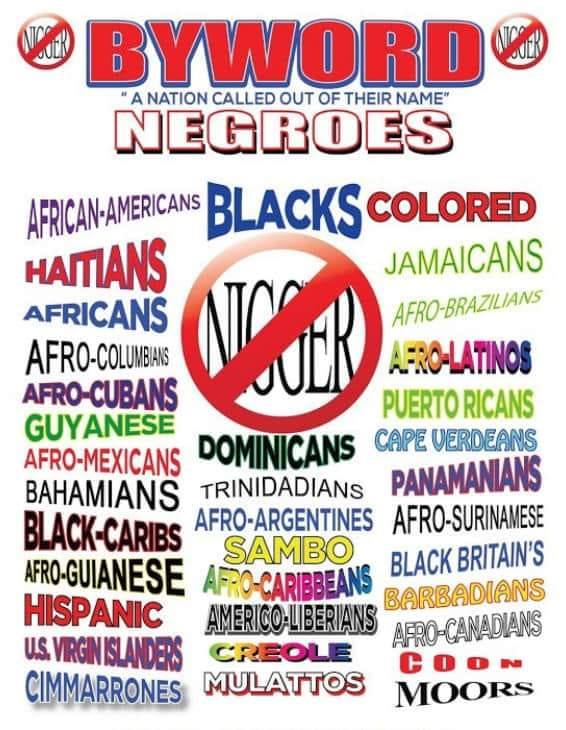
Who Do They Say We Are?

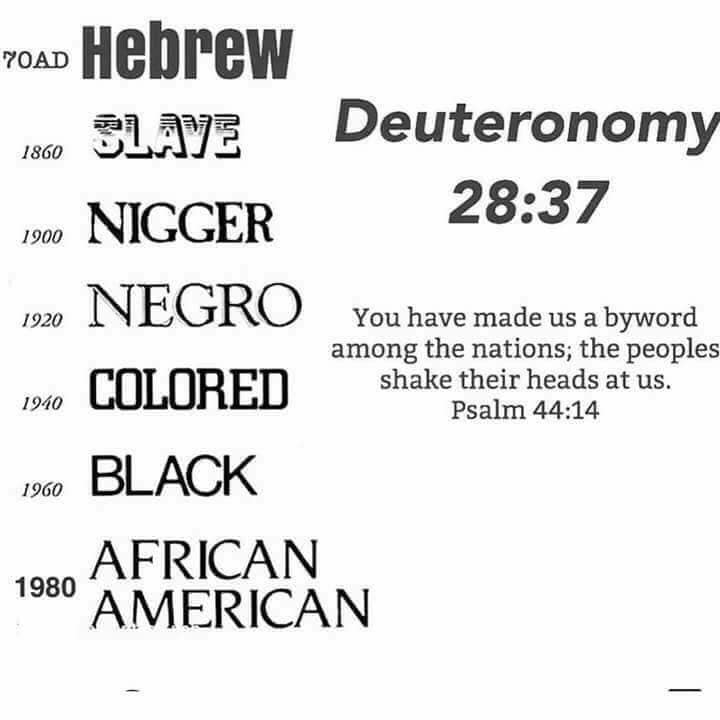
And thou shalt become an astonishment, a proverb, and a byword, among all nations whither the Lord shall lead thee. Deuteronomy 28:37

NIGGERS * SPICS *COONS * DARKIES * BLACK * UGLY * MULATTOS *FEEBLE MINDED * UNFIT * IMBECILES * IMMORAL * CRIMINAL * CATTLE * SLAVES
NEGROES * AFRO THIS OR THAT *MONKIES *  SAVAGES * COLORED *JUNGLE BUNNIES * DIRT *JIGABOOS * ANIMALS *WET BACKS * SPOOKS *SAMBOO * ASIATIC BLACK
MIXED * BIRACIAL* MULTIRACIAL * BURNT And so forth… Code words used to establish slavery.

We exist under the myriad complexities of slavery even today

1619-1834 Slaves
1834-1892 Coons/Colored
1892-1934 Niggers/Niggas
1934-1970 Boy/Africans
1970-1983 Afro Americans
1983-2002 Black Americans
2002-2016 African Americans 

The answer: Romans 12:1

“I beseech you therefore, brethren, by the mercies of God, that ye present your bodies a living sacrifice, holy, acceptable unto God, which is your reasonable service.”

Darkism Uncovered: An Exclusive Interview with the First Darkism Activist, Rashida Strober.

 In the landscape of American performance arts and racial activism, few figures have emerged with the visceral intensity and unapologetic candor of Rashida Strober. A Florida native and self-proclaimed “Dark-Skin Activist,” Strober has galvanized national and international attention for her groundbreaking work that brings the realities of colorism and Black female marginalization into sharp, theatrical relief. Her life story, an intricate blend of tragedy, survival, and triumph, reflects the collective struggle of dark-skinned Black women across the African diaspora—especially those who have borne the brunt of beauty hierarchies predicated upon Eurocentric standards.

Rashida Strober, “The Dark-Skin Activist,” stands unapologetically in her truth—bold, brilliant, and unbreakable—redefining beauty and power for melanated women around the world.

From the depths of childhood abuse and social alienation to the heights of creative excellence and advocacy, Strober’s work transcends the stage and touches the pulse of systemic injustice. She is not merely a performer but a prophetess of truth, using her voice, pen, and body as sacred instruments to declare: dark skin is not a defect; it is divine.


A Life Marked by Pain and Power

Born in St. Petersburg, Florida, Rashida Strober was the only girl among five brothers. Her early life was plagued with ridicule, economic instability, and trauma. At school, she endured brutal mockery from classmates and peers, frequently labeled with slurs such as “black and ugly,” “monkey mouth,” and “African booty scratcher.” These insults reflected a pervasive social pathology: colorism—a hierarchical system of discrimination that privileges light skin over dark within and beyond Black communities (Hunter, 2007).

At the tender age of 14, Strober found herself homeless, a victim of sexual exploitation and neglect. Yet even in these dark corridors of despair, her dream of becoming an actress refused to die. With relentless determination, she earned her GED, secured stable employment, saved for housing, and enrolled in college. Eventually, she obtained a Master’s degree in Political Science from the University of South Florida.

Her story is an empirical counter-narrative to the myth of Black inferiority, one that aligns with the scriptural exhortation from the Apocrypha:

“For gold is tried in the fire, and acceptable men in the furnace of adversity.” (Ecclesiasticus [Sirach] 2:5, KJV Apocrypha)


Theater as Activism: From Pain to Platform

Rashida’s foray into theater was not merely artistic; it was revolutionary. In 2006, she wrote, produced, and starred in The Ice Cream Lady’s Dream, a deeply autobiographical one-woman show chronicling her harrowing yet triumphant journey. That same year, she launched A Dark Skin Woman’s Revenge, a play that ignited a global conversation about the emotional, romantic, and professional struggles of dark-skinned women. Through this theatrical masterpiece, Strober enacted multiple characters, each representing distinct facets of pain and power in the lives of melanated women.

Her ability to inhabit various psychological states, particularly in her role as Georgana Nelson—a mentally ill dark-skinned woman subjected to systemic and familial abuse—earned her the 2012 Playwrights Red Carpet Award for Actress of the Year. Her performance resonates with the biblical lamentation:

“Woe is me now! for the Lord hath added grief to my sorrow; I fainted in my sighing, and I find no rest.” (Baruch 3:1, KJV Apocrypha)

Strober is also the founder of ICLD Productions and creator of Dark Skin TV, the first internet show exclusively focused on issues affecting dark-skinned women. Her authorship includes five books, notably Darkism, in which she deconstructs the covert and overt mechanisms of skin-tone discrimination in contemporary society.


Interview with Rashida Strober from my book – The Brown Girl Dilemma,

Q: What are a few of your experiences as a dark-skinned woman?
Rashida: I remember being called the blackest and ugliest girl in school by a boy I referred to as “Seedy.” That incident left a psychological mark. Even now, I sometimes fear being around Black men because I wonder if they see me as ugly, too.

Q: Who had the greatest impact on your life?
Rashida: My seventh-grade teacher, Mattie Everette. She saw something in me when others didn’t.

Q: What do you think is the solution to the light-skinned/dark-skinned divide?
Rashida: Pure honesty. We must own the fact that dark-skinned beauty discrimination exists. Only then can we address it.

Q: What is something people don’t know about you?
Rashida: I was homeless. I was raped. I’ve known pain intimately, but I’ve also known deliverance.


Colorism and the Mirror of Self-Perception

As a light-skinned Black woman, I have come to recognize the complex interplay between privilege and empathy within my lived experience. While residing in Germany, I was frequently complimented on my appearance—initially attributing this affirmation solely to conventional beauty. However, with time and reflection, I realized that these perceptions were also shaped by the societal preference for lighter skin, revealing an unspoken privilege I had long overlooked.

This observation is critical, for it highlights the intersectional burden of shade-based bias. Lighter skin has, historically, functioned as both social currency and silent enabler in systems of intra-racial bias (Russell, Wilson, & Hall, 1992).

This admission is not an indictment but a confession that aims to dismantle the binary of blame. As the writer aptly states: “We are all of the colors… if one of a different shade is honored, it should be applied to all.”

This resonates with the biblical wisdom from the Apocrypha:

“Look not upon me, because I am black, because the sun hath looked upon me: my mother’s children were angry with me; they made me the keeper of the vineyards; but mine own vineyard have I not kept.” (Song of Solomon 1:6, KJV)


Conclusion: The Revolution Must Be Humanized

The Rashida Strober story is not an isolated narrative—it is emblematic of a broader societal ailment that refuses to reconcile beauty with Blackness unless whiteness is somehow attached. Her journey confronts the world with an unsettling truth: the battle against white supremacy begins with confronting the enemy within—the colonial gaze that still inhabits our mirrors, our schools, our relationships, and our institutions.

Through her voice, Strober urges us not to pity her, but to stand with her. To see the light in the dark. To dismantle the walls of pigmentocracy. And to teach a new generation of Black girls that their value does not come from Eurocentric molds, but from their Creator and their culture.

As Ecclesiasticus affirms:

“Give not thy soul unto a woman to set her foot upon thy substance. Seek not out things that are too hard for thee… but in the multitude of the wise is the welfare of the world.”
(Ecclesiasticus 7:24; 3:21; 6:24, KJV Apocrypha)


References

  • Ecclesiasticus (Sirach), KJV Apocrypha
  • Rachida Strober, Darkism
  • The Brown Girl Dilemma, 2017
  • Song of Solomon, KJV
  • Hunter, M. (2007). The Persistent Problem of Colorism: Skin Tone, Status, and Inequality. Sociology Compass, 1(1), 237–254.
  • Russell, K., Wilson, M., & Hall, R. (1992). The Color Complex: The Politics of Skin Color Among African Americans. Harcourt Brace.

Dilemma: Vanity

She enters rooms like storms of flame,
Hoping all will gasp her name.
With eyes that hunt and lips that lure,
She craves the gaze, intense and pure.

She stalks the hearts of wandering men,
Their weakness feeds her strength again.
She bares her flesh to mask her soul,
A fractured crown, a queen unwhole.

In mirrors, lies become her truth—
A hollow shrine adorned in youth.
She longs for love she’s never earned,
From hollow praise her heart has burned.

To be adored, to be revered,
To silence every inner fear.
She wears ambition like perfume,
And scatters pride through every room.

Her confidence, a shallow stream,
A desperate echo of a dream.
For every compliment she stores,
A thousand doubts still flood her shores.

She buys devotion, buys disguise,
In name-brand lies and jeweled eyes.
But all her wealth cannot conceal
The ache no man or cloth can heal.

Her gaze is laced with lustful fire,
A serpent’s charm, a carnal choir.
Men fall like stars into her snare,
Not knowing demons dwell in there.

She drinks the worship, sweet and bold,
As if her breath could turn to gold.
The ground she walks becomes her stage,
A goddess trapped within a cage.

And in the hush of darkened rooms,
Where silence drowns perfume and plumes,
One truth remains, as shadows creep—
Vanity never lets one sleep.

She is the idol, clothed in skin,
A monument to secret sin.
She smiles—but hides a curse within…
And her name… is Vanity.

🔍 What is Vanity?

Vanity is an excessive concern with one’s appearance, abilities, or social status—often rooted in pride, insecurity, or narcissism.

“Vanity of vanities, saith the Preacher, vanity of vanities; all is vanity.”
Ecclesiastes 1:2, KJV

Vanity is not just external beauty obsession; it’s a spiritual emptiness, a pursuit of admiration or validation that distracts from one’s divine identity and purpose.


🪞 Narcissism & Vanity in Today’s Culture

In psychology, narcissism is characterized by grandiosity, a need for admiration, and a lack of empathy. In today’s society, this manifests through:

  • Self-obsession on social media

  • Posting revealing photos for attention and likes

  • Seeking external validation over inner peace

  • Hypersexualization for profit and approval

  • Low self-esteem disguised as confidence

“In the last days, people will be lovers of themselves, lovers of money, boastful, proud…”
2 Timothy 3:1-5


📱 Social Media & the Rise of Vanity

Social media platforms (like Instagram or TikTok) have created a performance-based culture, where women—and men—seek approval through:

  • Physique-focused selfies 📸

  • Revealing clothing for likes 👍

  • Sexualized dances for followers 👯‍♀️

  • Paid validation via OnlyFans or similar sites 💵

This breeds dopamine addiction, where attention becomes an emotional drug.

“Let your beauty not be external… but the hidden person of the heart, with the incorruptible beauty of a gentle and quiet spirit…”
1 Peter 3:3-4 (ESV)


💔 The Psychological Toll of Vanity

Vanity often masks deep-rooted trauma or insecurity, leading to:

  • Low self-worth

  • Eating disorders (anorexia, bulimia, binge eating)

  • Depression and body dysmorphia

  • Sexual objectification

  • Shame after validation fades

Psychologist Dr. Jean Twenge (2013) links the “selfie generation” to growing mental health issues and narcissistic traits.


💃 How Did Women in the Past Dress?

Historically, women dressed modestly, valuing dignity over seduction. Biblical and ancient cultures saw clothing as an extension of morality and identity, not a tool of temptation.

“In like manner also, that women adorn themselves in modest apparel, with shamefacedness and sobriety…”
1 Timothy 2:9 (KJV)

Biblical women like Ruth, Esther, and Mary were praised for character, not cleavage. They influenced nations through virtue, wisdom, and obedience, not sensual display.


👗 What Does It Mean to Dress Like a Lady?

To be ladylike is to:

  • Dress elegantly and modestly

  • Represent God’s image with honor

  • Avoid clothing that provokes lust or dishonor

  • Reflect inner beauty outwardly

“Charm is deceitful and beauty is vain, but a woman who fears the Lord is to be praised.”
Proverbs 31:30


🚫 Why Abstain from Sex Until Marriage?

Sex outside of marriage leads to:

  • Soul ties

  • Shame or guilt

  • Emotional instability

  • Unwanted pregnancies

  • Disease and spiritual disconnect

“Flee from sexual immorality. Every other sin a person commits is outside the body…”
1 Corinthians 6:18-20

“Marriage is honorable in all, and the bed undefiled: but whoremongers and adulterers God will judge.”
Hebrews 13:4 (KJV)


🛐 Deliverance from Vanity & Eating Disorders

1. Repent and Realign with God

  • Acknowledge that worth comes from being made in God’s image (Genesis 1:27).

  • Confess insecurities and ask for healing (Psalm 34:18).

2. Renew Your Mind

  • Avoid comparisons (2 Corinthians 10:12)

  • Meditate on the Word daily (Romans 12:2)

3. Fast from Social Media

  • Break from toxic platforms

  • Curate content that uplifts spiritually and mentally

4. Surround Yourself with Godly Women

  • Build a circle that encourages holiness, not hype

5. Seek Professional Help if Needed

  • Eating disorders often require therapy, nutritionists, and spiritual counseling


🛑 Advice to Women on Showing Their Bodies Online

Dear sister,

Your body is a temple, not a display shelf. You are more than your curves, your lashes, your followers.

  • When you reveal your body for likes, you are leasing your soul for approval.

  • God sees your worth even in sweatpants and silence.

  • Real love sees you clothed in dignity, not desperation.


📚 References

  • Twenge, J. M. (2013). The narcissism epidemic: Living in the age of entitlement. Atria Books.

  • American Psychological Association. (2022). Eating disorders. https://www.apa.org/topics/eating-disorders

  • Tishkoff, S. A., et al. (2009). The genetic structure and history of Africans and African Americans. Science, 324(5930), 1035–1044. https://doi.org/10.1126/science.1172257

  • Holy Bible, King James Version (KJV)

  • Holy Bible, English Standard Version (ESV)


The Marriage Series: The Sacred Roles of Husband and Wife.

Photo by Aj Collins Artistry on Pexels.com


The Sacred Role of a Husband: A Biblical Perspective

A Husband is the head and the foundation of the family, he ungirds the family. 

Marriage, as designed by the Most High, is a sacred covenant modeled after the divine relationship between Christ and His Church. Within this spiritual union, the husband bears a significant role—one of leadership, love, provision, and spiritual guidance. According to the Apostle Paul, “For the husband is the head of the wife, even as Christ is the head of the church: and He is the savior of the body” (Ephesians 5:23, KJV). This headship, however, is not a position of domination, but of sacrificial leadership—rooted in love, service, and humility.

Headship and Leadership

The concept of male headship is reaffirmed in Paul’s epistle to the Corinthians: “But I would have you know, that the head of every man is Christ; and the head of the woman is the man; and the head of Christ is God” (1 Corinthians 11:3, KJV). Here, divine order is established, not to elevate man in pride, but to empower him in responsibility. The role of the husband is not to control, abuse, or neglect his wife, but to guide her spiritually and emotionally. As Dr. Peters notes, the Most High places the spiritual weight of the home upon the shoulders of the man, calling him to be priest, provider, and protector—not an authoritarian figure, but a servant-leader modeled after Christ (Peters, 2023).

Loving as Christ Loves

The command for husbands to love their wives is not optional—it is foundational. “Husbands, love your wives, even as Christ also loved the church, and gave himself for it” (Ephesians 5:25, KJV). This is not mere affection but a love that sanctifies, edifies, and protects. As Christ sacrificed Himself to present the Church “without spot, or wrinkle,” so too must a husband nurture his wife in holiness and honor (Ephesians 5:26-27). Loving one’s wife as one’s own body means nourishing her emotionally, spiritually, and physically (Ephesians 5:28-29).

Dr. Peters stresses that a godly husband affirms his wife continually, seeks to meet her unspoken needs, and washes her with the Word of God—just as Christ did for His disciples (John 13:4-5). Through acts of service, listening, prayer, and biblical instruction, a husband builds up the heart and soul of his wife, fulfilling his divine duty.

The Biblical Blueprint of a Husband

To walk in divine alignment, a godly husband must embody six core principles:

  1. Leadership (Priesthood of the Home): Initiating spiritual guidance, prayer, and biblical instruction (Deuteronomy 6:6-7).

  2. Provision: Financial responsibility rests on the husband, as Scripture states: “If any provide not for his own… he hath denied the faith, and is worse than an infidel” (1 Timothy 5:8, KJV).

  3. Discipline and Self-Control: God placed man in Eden “to dress it and to keep it” (Genesis 2:15, KJV), symbolizing responsibility and diligence.

  4. Servanthood: True leadership imitates Christ’s humility. “He that is greatest among you shall be your servant” (Matthew 23:11, KJV).

  5. Spiritual Instruction: Teaching one’s wife and children the commandments and ways of the Most High (Proverbs 22:6).

  6. Emotional and Physical Protection: “Giving honor unto the wife, as unto the weaker vessel… that your prayers be not hindered” (1 Peter 3:7, KJV).

A Godly Legacy

A man is called to leave behind a righteous inheritance—not merely in material wealth, but in spiritual impact. “A good man leaveth an inheritance to his children’s children” (Proverbs 13:22, KJV). Prioritizing the wife over all other human relationships reflects the command to “leave his father and his mother, and shall cleave unto his wife: and they shall be one flesh” (Genesis 2:24, KJV). In so doing, the husband models Christ’s commitment and becomes the cornerstone of generational blessings.

Furthermore, as fathers, men are instructed to raise their children in “the nurture and admonition of the Lord” (Ephesians 6:4, KJV), avoiding harshness but promoting spiritual growth (Colossians 3:21).

Conclusion: A Reflection of Divine Love

To be a godly husband is to be a reflection of divine love on earth. It means to “accommodate your life to the life of the gift God has given you—your wife,” as Dr. Peters wisely expresses. At the judgment seat of Christ, may husbands be found faithful—having led, loved, and served their families with holiness and humility. Let every husband declare as Adam did, “This is now bone of my bones, and flesh of my flesh” (Genesis 2:23, KJV), acknowledging his wife not as property, but as a partner in purpose and faith.


The Role of a Godly Wife: A Biblical Blueprint

A godly wife is one who fears the Lord, seeking His will over the approval of others. Proverbs 31:30 declares, “Favour is deceitful, and beauty is vain: but a woman that feareth the Lord, she shall be praised.” Her reverence for the Most High compels her to walk in wisdom, avoiding decisions that compromise her future purpose in God’s plan. Her day begins with prayer and often fasting, aligning herself with the will of the Most High. Her body is a temple of the Holy Spirit (1 Corinthians 6:19-20), and she lives with the awareness that she was bought with a price. Therefore, she honors the Lord in her conduct, speech, and motives.

Luke 12:31 reminds her to “seek ye the kingdom of God; and all these things shall be added unto you.” She is a woman who understands order and calls her husband “lord” as Sarah did, showing reverence and respect (1 Peter 3:6). When her husband is faithful, provides, and protects, she understands she is blessed and expresses gratitude, knowing that such a man is rare and highly favored. A virtuous woman is a crown to her husband (Proverbs 12:4) and contributes to a peaceful and joyful home.

The Help Meet

Genesis 2:18 states, “And the Lord God said, It is not good that the man should be alone; I will make him a help meet for him.” The wife is not a background character; she is central to God’s plan, made to complete her husband. When she sees areas of weakness in him, she steps in as the helper God designed her to be. If her husband falls short, her role is to uplift and assist him—not to criticize, but to build. This is the divine assignment of a help-meet.

Submission to Her Husband

Ephesians 5:22-23 commands, “Wives, submit yourselves unto your own husbands, as unto the Lord. For the husband is the head of the wife.” Submission is not agreement on every issue, but recognition of her husband’s divine position. She submits as unto the Lord, understanding that obedience to God includes reverencing her husband (Ephesians 5:33). This posture of submission brings harmony, ensuring that her prayers are not hindered and her home functions according to God’s design.

Attributes of a Virtuous Wife

A virtuous wife does good to her husband all the days of her life (Proverbs 31:12). She supports his ministry, prays with him, anoints him, and speaks life over him. She never belittles or embarrasses him but treats him with the dignity due to a fellow heir of the Kingdom. Her compliments uplift his spirit: “You are a mighty man of valor,” “my provider,” “my king.” Her praise, like incense, builds him up and encourages godly confidence.

Modesty and Appearance

1 Timothy 2:9 instructs women to “adorn themselves in modest apparel.” Her clothing and demeanor reflect a meek and quiet spirit, which is of great value in God’s eyes (1 Peter 3:4). She dresses for her husband and not the world, maintaining her physical health and cleanliness. Her modesty is not repression, but reverence—honoring God and her spouse.

Housekeeping and Hospitality

The home is a reflection of her stewardship. “Godliness is next to cleanliness,” and her diligence in keeping the house in order shows respect for her husband’s labor. A clean home fosters peace, and she prioritizes this as an act of love and honor.

Parenting

Titus 2:4-5 and 1 Timothy 5:14 instruct wives to love their husbands and children, be keepers at home, and guide the household. She is deeply involved in raising the next generation, not outsourcing this duty to others. She supports her husband in parenting, contributing to a godly legacy.

Feeding the Household

Proverbs 31:15 shows that a virtuous wife “giveth meat to her household.” She learns to cook and provides meals with love and diligence. Her commitment extends to ensuring her family is nourished, not only physically but spiritually.

Conclusion

There is no perfect marriage, but when both spouses fulfill their divine roles, the Most High brings increase. A godly wife is a powerful force in her husband’s life and in her home. She fasts, prays, submits, and nurtures with grace. She exemplifies biblical womanhood and stands as a beacon of holiness, love, and wisdom to the world.

References

King James Bible. (n.d.). Authorized King James Version. Retrieved from https://www.kingjamesbibleonline.org/


Dilemma: Singleness, Widowhood, and Purity.

Photo by Sherman Trotz on Pexels.com

Singleness, Widowhood, and Purity: A Hebraic Israelite Reflection on Divine Timing and Purpose

1. Singleness as a Sacred Gift

Singleness is not a curse—it is a consecrated gift from the Most High. It offers an undivided opportunity for devotion, clarity, and spiritual intimacy. As the Psalmist declares, “I will lift up mine eyes unto the hills, from whence cometh my help” (Psalm 121:1, KJV). In the stillness of singleness, the believer can focus wholeheartedly on the things of YAH without the distractions of earthly partnership.

Yahawahshi (Jesus) Himself affirmed the spiritual blessing of singleness when He said, “All men cannot receive this saying, save they to whom it is given” (Matthew 19:11, KJV). Similarly, Apostle Paul echoed this sentiment: “For I would that all men were even as I myself. But every man hath his proper gift of God” (1 Corinthians 7:7, KJV). This gift is not for everyone, but for those whom the Most High has graced with it, it becomes a sacred calling.

As Brother Emmanuel Sdi beautifully reflects:

“I love being single. I get to spend all my time with the Most High. No pressure, just sheer happiness.”

2. The Virtues of Singleness

Singleness offers a distinct advantage in fulfilling divine assignments. Apostle Paul articulates this in his epistle to the Corinthians, asserting that “he that is unmarried careth for the things that belong to the Lord, how he may please the Lord” (1 Corinthians 7:32, KJV). The absence of marital obligations allows one to be wholly available to the service and ministry of the Most High.

It is not merely about freedom from marital conflict, but about spiritual focus. The weight and responsibilities of marriage are significant, and not to be entered into lightly (Matthew 19:6). While the institution of marriage is honorable, it requires time, sacrifice, and energy that can divide a person’s focus. A single person, in contrast, may travel, serve, and worship with unburdened liberty.

Sister Lena Garth reflects this truth poignantly:

“I don’t envy those married people having to deal with each other’s problems… Doing my mission work is easier, and if I were married, it would be harder, I imagine.”

3. The Challenges of Singleness

Despite its benefits, singleness presents profound emotional and spiritual challenges. The Scripture affirms, “It is not good that the man should be alone; I will make him an help meet for him” (Genesis 2:18, KJV). Companionship, intimacy, and support are natural and necessary human desires, and the lack thereof can lead to emotional voids, sexual temptation, and spiritual fatigue.

Paul acknowledges the battle: “But if they cannot contain, let them marry: for it is better to marry than to burn” (1 Corinthians 7:9, KJV). Loneliness, if unchecked, may lead to destructive habits such as masturbation, pornography, and emotional despair. This requires vigilance: “Flee fornication” (1 Corinthians 6:18, KJV). Practical strategies such as accountability partners, prayer, fasting, and community engagement can fortify the soul in times of trial.

ZakaYah Banath Yasharahla shares an unfiltered, passionate testimony of the feminine struggle in modernity:

“To hell with this independent woman, I don’t need no man, do bad all by myself thing… I’m ready to be dependent on my king… I’m tired of having to defend myself from males outside my home… I want to be the feminine, soft, sweet, quiet, nurturing, skilled in home economics, family-oriented virtuous woman that Yah designed me to be.”

Her testimony underscores the deep yearning many women experience—not merely for marriage, but for alignment with their created role under divine order. It also illustrates the psychological, emotional, and spiritual cost of living outside that sacred design.

4. The Eternal View of Singleness

Not all singles will marry in this life—but no follower of YAH is alone for eternity. Earthly marriage is a temporary picture of a much greater reality: the marriage between the Messiah and His bride—the assembly of the faithful. Revelation 19:7 proclaims, “Let us be glad and rejoice… for the marriage of the Lamb is come, and his wife hath made herself ready.” This eschatological hope gives eternal meaning to the single life.

Brother Samuel Geitz, at age 40, reflects with both longing and hope:

“I look forward to getting married, but at 40 it seems so hard to find someone in the truth. I pray that I will experience marriage before I die. Pray for me to find my Sarah.”

His statement is a blend of realism and righteous hope. The wait may be long, but the reward is worth the wait when one’s desire aligns with divine timing.


The Six Commandments for the Set-Apart Woman

  1. Seek the Most High Above All
    • The Bible is your blueprint. Meditate on His Word day and night (Joshua 1:8).
  2. Remain Under Parental Covering (When Possible)
    • In ancient Israel, daughters remained with their families until betrothal (Exodus 22:16–17). This tradition offered protection and moral guidance.
  3. Beware of Spiritual Manipulation
    • Test every spirit (1 John 4:1). Not every man who claims, “The Most High told me you’re my wife,” is sent by YAH. Pray for discernment.
  4. Maintain Physical and Mental Health
    • Our bodies are temples of the Holy Spirit (1 Corinthians 6:19–20). Eat well, rest, exercise, and remain spiritually sober.
  5. Adorn Yourself in Modesty
    • Modesty is dignity (1 Timothy 2:9–10). It honors both YAH and your future husband.
  6. Preserve Your Purity Until Marriage
    • “Present your bodies a living sacrifice, holy, acceptable unto God” (Romans 12:1, KJV). Your body is not a bargaining chip—it is a sacred offering.

Final Word

Being single, widowed, or unmarried is not a mark of shame—it is a station ordained by the Most High for purpose, purification, and preparation. Whether waiting for a mate, recovering from loss, or walking a lifelong path of celibacy, know that you are not forgotten. As Isaiah 54:5 reminds us: “For thy Maker is thine husband; the Lord of hosts is his name.”

Wait with hope, walk in holiness, and serve with gladness.


References:

  • Holy Bible, King James Version. (1769). Thomas Nelson.
  • Apostle Paul. (ca. 55 AD). First Corinthians.
  • Isaiah. (ca. 740–681 BC). Book of Isaiah.
  • Revelation. (ca. 95 AD). Book of Revelation.
  • Harris, J. (2006). Sacred Singleness: The Set-Apart Life for Women. Multnomah.
  • Piper, J. (2011). This Momentary Marriage: A Parable of Permanence. Crossway.

The Biblical Composition of Man: The Spirit, The Soul, and The Body.

Photo by Elu012bna Aru0101ja on Pexels.com

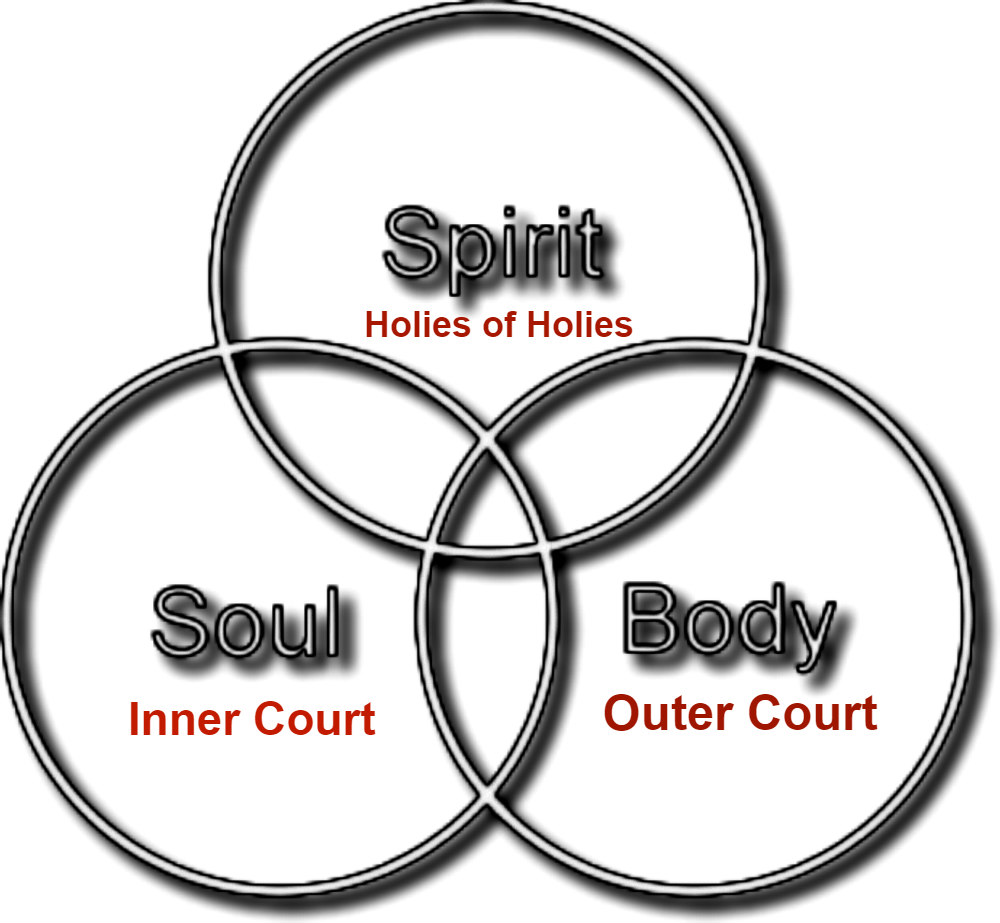
The human constitution, as divinely designed, consists of three distinct yet interwoven components: the spirit, the soul, and the body. The body is the earthly vessel, formed from dust, which enables our engagement with the physical world. The soul is the seat of our intellect, will, and emotions—our personal essence and moral identity. The spirit, breathed into man by God Himself (Genesis 2:7), is the eternal faculty by which we commune with the Divine. Together, these elements form the totality of our being, intricately woven to reflect the image of God (1 Thessalonians 5:23; Hebrews 4:12). To understand this triune nature is to begin grasping the sacred mystery of human life and destiny.”


The Biblical Composition of Man: Spirit, Soul, and Body

The Bible presents man as a triune being made in the image of God (Genesis 1:26). According to 1 Thessalonians 5:23 (KJV), the Apostle Paul wrote:

“And the very God of peace sanctify you wholly; and I pray God your whole spirit and soul and body be preserved blameless unto the coming of our Lord Jesus Christ.”

This verse affirms that the human person consists of three distinct elements:

  1. The Body – the physical, visible aspect.

  2. The Soul – the seat of emotions, will, and personality.

  3. The Spirit – the eternal, God-conscious part that allows communication with God.

Hebrews 4:12 also distinguishes between soul and spirit:

“For the word of God is quick, and powerful… piercing even to the dividing asunder of soul and spirit, and of the joints and marrow, and is a discerner of the thoughts and intents of the heart.”
(Hebrews 4:12, KJV)

This clearly shows that soul and spirit are not the same. While often used interchangeably in modern speech, biblically they refer to different aspects of the human essence.


II. What Is the Spirit According to the KJV Bible?

The spirit (Hebrew: ruach; Greek: pneuma) is the life-giving breath from God.

“The spirit of man is the candle of the Lord, searching all the inward parts of the belly.”
(Proverbs 20:27, KJV)

“Then shall the dust return to the earth as it was: and the spirit shall return unto God who gave it.”
(Ecclesiastes 12:7, KJV)

Here, Scripture teaches that the spirit is what gives life and returns to God upon death. It is not the soul—it is the divine spark, the animating force from God.


III. What Is the Soul According to the KJV Bible?

The soul (Hebrew: nephesh; Greek: psuchē) is the seat of emotions, reasoning, and identity. It represents the “personhood” of a human.

“And the LORD God formed man of the dust of the ground, and breathed into his nostrils the breath of life; and man became a living soul.”
(Genesis 2:7, KJV)

The soul is conscious, moral, and eternal. It experiences joy, sorrow, fear, and decision-making. After death, the soul continues to exist.

“Fear not them which kill the body, but are not able to kill the soul: but rather fear him which is able to destroy both soul and body in hell.”
(Matthew 10:28, KJV)

This verse clearly distinguishes between body and soul, with the soul being capable of eternal destination—either heaven or hell.


IV. What Happens at Death?

The Bible teaches that death is the separation of the spirit from the body.

“For as the body without the spirit is dead, so faith without works is dead also.”
(James 2:26, KJV)

At death:

  • The body returns to dust (Genesis 3:19).

  • The spirit returns to God (Ecclesiastes 12:7).

  • The soul enters a place of waiting, either comfort or torment.


V. Afterlife in the Apocrypha

The Apocryphal books, while not part of the canon for all denominations, offer deep insights into Jewish beliefs about the soul after death.

2 Esdras 7:78-88 (Apocrypha) outlines what happens to the soul:

“Now, concerning death, the teaching is: When the decisive decree has gone out from the Most High that a person shall die, as the spirit leaves the body… it returns to him who gave it, first adoring the glory of the Most High… the souls of the righteous are in the hand of God, and no torment shall touch them…”

In contrast:

“But the way of sinners is hard… they shall wander in torments and be in anguish seven ways…”

This aligns with Luke 16:19–31, the parable of the rich man and Lazarus, where Jesus describes two destinations after death: Abraham’s bosom (comfort) or Hades (torment).


VI. The Purpose of the Soul and Spirit

The soul is judged for moral and spiritual decisions, while the spirit connects with God.

“The soul that sinneth, it shall die.”
(Ezekiel 18:20, KJV)

The spirit returns to God, but if the soul is unredeemed by Christ, it is condemned (John 3:18).


VII. Summary: Key Differences

Element Nature Function Destination After Death
Body Physical World interaction Returns to dust (Genesis 3:19)
Soul Emotional / Personal Identity, Emotion, Will Judgment: Heaven or Hell (Matthew 10:28)
Spirit Spiritual Life-giving force; connection with God Returns to God (Ecclesiastes 12:7)

VIII. Conclusion

The KJV Bible and Apocryphal writings clearly present a tripartite view of humanity. The body decays, the spirit returns to God, and the soul awaits judgment. The spirit is not the same as the soul, although deeply connected. Understanding this distinction helps us grasp the eternal nature of our being and the urgency of repentance and spiritual transformation in this life. Ultimately, the destiny of the soul is determined not by status or knowledge, but by one’s relationship with God through Christ.


Key Scriptures to Meditate On (KJV)

  • Genesis 2:7

  • 1 Thessalonians 5:23

  • Ecclesiastes 12:7

  • Matthew 10:28

  • Luke 16:19–31

  • 2 Esdras 7:78–88 (Apocrypha)


Dilemma: Materialism

Photo by Gustavo Fring on Pexels.com

Set your affections on things above, not on things on the earth. Colossians Chapter 3:4 KJV

Materialism, the Illusion of Wealth, and the Erosion of the Soul: A Biblical and Societal Critique

In an era driven by consumption and appearance, materialism has become a defining trait of modern society. Rooted in the philosophy that material possessions and physical comfort are the highest values, materialism not only distorts personal identity but also undermines spiritual integrity, economic wisdom, and communal relationships. It is the manifestation of what Scripture warns against: the “lust of the flesh, the lust of the eyes, and the pride of life” (1 John 2:16, KJV). This worldly trinity seduces countless individuals into a cycle of comparison, covetousness, and consumption, often at the expense of their spiritual and financial well-being.

The Definition and Roots of Materialism

Materialism is the excessive desire for and preoccupation with material possessions and wealth as measures of success, status, and happiness (Kasser, 2002). In capitalist societies like America, this ideology is perpetuated by consumer culture, which equates worth with ownership. Advertisements, social media, and celebrity influence all push the narrative that happiness is found in luxury brands, real estate, or technology, rather than in character, relationships, or faith. The Apostle Paul warned that “they that will be rich fall into temptation and a snare… for the love of money is the root of all evil” (1 Timothy 6:9–10, KJV). This Scripture does not condemn wealth itself but the idolatry of it.

Financial Illiteracy and the Performance Trap

Many people today are financially prosperous on paper, yet economically impoverished in practice. Earning six figures is not enough to prevent debt when spending is governed by image rather than wisdom. Emmanuel Valerio notes, “Many people are making over 100k a year, and they’re still struggling with bills… They don’t understand financial freedom” (Valerio, 2023). Financial instability is often a byproduct of trying to “keep up with the Joneses,” a societal sickness driven by ego, envy, and insecurity. Christ warned, “No man can serve two masters… Ye cannot serve God and mammon” (Matthew 6:24, KJV).

The Psychology of Comparison and Social Status

Social comparison theory, introduced by Leon Festinger (1954), reveals the psychological mechanism that fuels materialism. People assess their worth by measuring themselves against others, leading to upward comparisons that breed dissatisfaction, and downward comparisons that foster arrogance or pity. The ego—driven by fear, pride, and insecurity—seeks validation through visible success. But Solomon, the wisest king, dismantled this illusion: “Vanity of vanities… all is vanity” (Ecclesiastes 1:2, KJV). True joy is not found in possessions but in purpose and obedience to God.

Biblical Condemnation of Covetousness

The Bible consistently warns against the dangers of valuing possessions above the presence of God. The story of the rich young ruler (Luke 18:18–30) illustrates the spiritual cost of material obsession: though moral and wealthy, he could not surrender his possessions to follow Christ. Likewise, the parable of Lazarus and the rich man (Luke 16:19–31) shows that temporal luxury is no guarantee of eternal reward. The rich man’s opulence blinded him to justice and mercy, leading to eternal torment, while Lazarus, poor in the world’s eyes, inherited the Kingdom.

The American Dream or a Delusion?

The so-called “American Dream”—a suburban home, luxury vehicles, and lavish vacations—often becomes a nightmare for many. The pressure to project success has pushed families into crippling debt and spiritual emptiness. The testimony of Terry Walker, who found himself $200,000 in credit card debt, reveals the high price of pride and pretense. “Now I am worse than an infidel, can’t provide for my family,” he laments. Paul admonishes in 1 Timothy 5:8 that “if any provide not for his own… he hath denied the faith.”

The Illusion of Wealth and Social Favoritism

Materialism breeds a culture of favoritism and hypocrisy. As shown in James 2:2–4, society tends to honor the outwardly rich while marginalizing the poor: “Are ye not then partial in yourselves, and are become judges of evil thoughts?” This bias promotes division in both the church and the world, violating the “royal law” to love one’s neighbor as oneself (James 2:8). We must remember that God “looketh on the heart” (1 Samuel 16:7, KJV), not on garments, brands, or bank balances.

How to Escape the Bondage of Materialism

Freedom from materialism begins with a renewed mind and heart. Romans 12:2 instructs, “Be not conformed to this world: but be ye transformed by the renewing of your mind.” Practical steps include learning financial stewardship (Proverbs 21:20), practicing generosity (Luke 6:38), and meditating on eternal treasures (Matthew 6:19–21). Giving to those in need disarms the hold of greed, reminding us that “a man’s life consisteth not in the abundance of the things which he possesseth” (Luke 12:15).

Conclusion

Materialism is not just a financial issue; it is a spiritual and psychological stronghold that enslaves the soul. It seduces the ego, distorts priorities, fractures families, and robs individuals of divine purpose. As Cornel West remarked, “We have a market-driven society so obsessed with buying and selling… with power and pleasure and property.” To overcome this, we must prioritize eternal values over temporary things. “What shall it profit a man, if he shall gain the whole world, and lose his own soul?” (Mark 8:36, KJV). The true riches are found in wisdom, compassion, and a life centered on God, not goods.


References

Festinger, L. (1954). A theory of social comparison processes. Human Relations, 7(2), 117–140.

Kasser, T. (2002). The High Price of Materialism. MIT Press.

The Holy Bible, King James Version.

Valerio, E. (2023). The Truth Movement. [Facebook post].

The SABBATH

The True Sabbath: A Divine Covenant from Sunset to Sunset

Photo by Nothing Ahead on Pexels.com

What Is the Sabbath According to the KJV Bible?

The Sabbath—from the Hebrew word Shabbat, meaning “to cease” or “to rest”—is the seventh day of the week, a sacred time set apart by the Most High for rest and spiritual renewal. It is not merely a day of physical inactivity, but a holy convocation, a divine appointment (Leviticus 23:3 KJV) wherein the people of Yahuah (God) are called to pause from labor and delight in His presence.

According to Genesis 2:2-3 (KJV):

“And on the seventh day God ended his work which he had made; and he rested on the seventh day… And God blessed the seventh day, and sanctified it.”

This divine ordinance was later codified in the Ten Commandments:
Exodus 20:8-11 (KJV):

“Remember the sabbath day, to keep it holy… the seventh day is the sabbath of the LORD thy God: in it thou shalt not do any work…”

The biblical reckoning of a day begins at evening (sundown)—not at midnight or sunrise—based on Genesis 1:5:

“And the evening and the morning were the first day.”

Thus, the true Sabbath begins at Friday sundown and ends at Saturday sundown, encompassing the seventh day in its entirety.

When Is the Sabbath According to the Bible?

According to the King James Version (KJV) of the Bible, the Sabbath is the seventh day of the week, which begins at sundown on Friday and ends at sundown on Saturday. This is based on Hebraic timekeeping, where a biblical “day” starts in the evening, not at midnight.


🔹 Biblical Proof the Sabbath Is the Seventh Day

Genesis 1:5 (KJV):

“And the evening and the morning were the first day.”
This verse shows that a day begins at evening (sundown) and ends the next evening.

Exodus 20:8–11 (KJV):

“Remember the sabbath day, to keep it holy… But the seventh day is the sabbath of the LORD thy God…”
The Sabbath is explicitly identified as the seventh day, not the first.

Leviticus 23:32 (KJV):

“From even unto even, shall ye celebrate your sabbath.”
This confirms that Sabbaths are to be observed from evening to evening, meaning from sundown to sundown.


🔹 Modern Understanding: Friday Sundown to Saturday Sundown

Based on the biblical calendar:

  • The Sabbath begins at sunset on Friday (usually around 6:00–7:00 PM depending on your location and time of year)
  • It ends at sunset on Saturday

This 24-hour period is the seventh day of the biblical week.


🔹 Is Sunday the Sabbath?

No. Sunday is the first day of the week, not the seventh. Nowhere in the Bible is Sunday called the Sabbath. The shift from Saturday to Sunday observance came centuries later, starting with Emperor Constantine in 321 CE, who legalized Sunday worship for political and pagan reasons—not biblical authority (see Daniel 7:25).


🔹 Sabbath Summary

  • Day: The seventh day (Saturday)
  • Timing: From Friday evening (sundown) to Saturday evening (sundown)
  • Commanded: In the Ten Commandments (Exodus 20)
  • Established: At Creation (Genesis 2:2–3)
  • Not Sunday (the first day of the week)

Misplaced Sabbath: Sunday Worship and Historical Manipulation

The observance of Sunday, the first day of the week, as the Sabbath has no scriptural foundation. Nowhere in the KJV Bible are believers commanded to sanctify the first day. The early assembly of believers (Hebrews 4:9, Acts 13:42-44) continued to observe the Sabbath until political and ecclesiastical forces imposed change.

In 321 CE, Emperor Constantine, a known sun-worshipper, enacted a law mandating Sunday as the day of rest:

“On the venerable day of the sun let the magistrates and people residing in cities rest…”

This decree was later enforced by the Roman Catholic Church, culminating in laws forbidding Sabbath observance on Saturday under penalty of death. Many faithful who chose obedience to Yahuah were martyred, burned, or exiled for resisting what Scripture calls the “traditions of men” (Mark 7:7-9 KJV).


Catholic Admissions: Changing the Day Without Biblical Authority

The Catholic Church has historically admitted this unauthorized change:

“The Pope has power to change times, to abrogate laws…”
Decretal De Translat. Episcop. Cap.

“The Church is above the Bible, and this transference of Sabbath observance from Saturday to Sunday is proof positive of the fact.”
Catholic Record, London, Ontario, Sept. 1, 1923

“Nowhere in the Bible is Sunday sanctified… the Scriptures enforce the religious observance of Saturday, a day which we [Catholics] never sanctify.”
James Cardinal Gibbons, The Faith of Our Fathers, p. 89

“The holy day, the Sabbath, was changed from Saturday to Sunday… not from any directions noted in the Scriptures, but from the church’s sense of its own power.”
St. Catherine Catholic Church Sentinel, May 21, 1995

These admissions confirm that Sunday worship is an institutional tradition, not a biblical mandate.


A Sign Between Yah and His People

The Sabbath is more than a day—it is a sign of covenant between Yahawahshi and His chosen people.

Ezekiel 20:20 (KJV):
“And hallow my sabbaths; and they shall be a sign between me and you, that ye may know that I am the LORD your God.”

To keep the Sabbath is to identify with the Most High, to walk in His commandments, and to separate from worldly customs.

Constantine and the Sabbath: How Pagan Politics Replaced a Divine Commandment

Who Was Constantine?

Flavius Valerius Constantinus, known as Constantine the Great, was the Roman Emperor from 306 to 337 CE. He is widely remembered for being the first Roman emperor to profess Christianity and for his pivotal role in shaping the political and religious structure of what would become Roman Catholic Christianity.

Though often hailed as a Christian reformer, Constantine’s policies were driven as much by political expediency as religious conviction. He sought unity in a fractured empire, and in doing so, he blended pagan traditions with elements of the early Messianic faith (followers of Yahusha/Jesus), fundamentally altering the course of religious history.


Constantine and the Sunday Law

In the year 321 CE, Constantine issued a civil decree declaring:

“On the venerable day of the sun let the magistrates and people residing in cities rest, and let all workshops be closed.”
Codex Justinianus, Book 3, Title 12, Law 3

This was the first official law mandating Sunday observance across the Roman Empire—not as a biblical Sabbath, but as a continuation of pagan sun worship, specifically honoring the Roman sun-god Sol Invictus (“the unconquered sun”).

Constantine’s Religious Values and Motives

Though Constantine claimed to have converted to Christianity after a vision before the Battle of the Milvian Bridge in 312 CE, he retained many pagan practices throughout his life. He continued to:

  • Mint coins bearing the image of Sol Invictus
  • Hold the title Pontifex Maximus, the high priest of Roman paganism
  • Worship at pagan temples
  • Blend Roman deities with Christian symbols for political unity

Constantine’s value for the Sabbath was non-existent in its original Hebraic form. Rather than sanctifying the seventh day (Saturday), as commanded in Exodus 20:8–11 (KJV), Constantine sought to displace it with Sunday, the traditional day of sun-god worship. This move:

  • Appealed to the pagan majority, who already honored the sun
  • Distanced the Christian sect from its Jewish roots, which were being persecuted
  • Unified religious practices under one empire-wide schedule

The Impact on Sabbath Observance

Although many early believers (including Gentile converts) continued to keep the Saturday Sabbath well into the 4th and 5th centuries, Constantine’s decree became the foundation for institutional Sunday worship.

Following Constantine’s precedent, the Council of Laodicea (circa 364 CE) officially forbade believers from observing the Sabbath, stating:

“Christians must not Judaize by resting on the Sabbath, but must work on that day, honoring rather the Lord’s Day [Sunday]… if any be found to be Judaizers, let them be anathema from Christ.”

This marked the transition from biblical Sabbath observance to the enforced observance of Sunday, a man-made tradition devoid of scriptural support.


Constantine’s Legacy: Replacing Commandments with Tradition

Constantine’s decisions fundamentally altered the commandments given by Yahuah, fulfilling the warning found in Daniel 7:25 (KJV):

“And he shall speak great words against the most High, and shall wear out the saints of the most High, and think to change times and laws…”

This prophecy aligns precisely with Constantine’s actions: changing the time of the Sabbath and replacing the law of Yahuah with imperial decree.

By aligning Christianity with state power and pagan custom, Constantine:

  • Institutionalized Sunday worship
  • Set the stage for the Roman Catholic Church’s dominance
  • Led millions into unwitting disobedience of the Fourth Commandment

A Call Back to the Ancient Path

Constantine’s legacy serves as a sober reminder that human authority can never override the eternal law of Yahuah. The true Sabbath—from Friday sundown to Saturday sundown—remains unchanged, blessed, and sanctified since the foundation of the world (Genesis 2:3 KJV).

Isaiah 58:13-14 (KJV):
“If thou turn away thy foot from the sabbath, from doing thy pleasure on my holy day… Then shalt thou delight thyself in the Lord…”

The distortion of the Sabbath is not merely a historical footnote; it is a matter of spiritual fidelity. In returning to the seventh-day Sabbath, believers reject the traditions of men and embrace the covenant of the Most High, walking in obedience and truth.


Would you like this turned into a PDF lesson, a teaching slide deck, or an annotated sermon outline with scripture breakdowns and historical references?

Ask ChatGPT

Final Reflection: Returning to the Ancient Paths

Today, millions gather on Sunday believing they are honoring the Most High, yet they have forsaken His commanded rest. As they leave their sanctuaries, unchanged and disconnected from truth, their souls remain empty, and their sins unrepented.

Jeremiah 6:16 (KJV):
“Thus saith the LORD, Stand ye in the ways, and see, and ask for the old paths… and ye shall find rest for your souls.”

Keeping the true Sabbath, from Friday sundown to Saturday sundown, is a revolutionary act of faith, a return to divine order in an age of confusion.

Let the people of Yahuah rise, not in rebellion against man, but in obedience to the Most High, keeping His Sabbath holy, walking in truth, and forsaking the commandments of men.



Dilemma: Modesty

Photo by Speak Media Uganda on Pexels.com

Modest dressing refers to clothing choices that express dignity, humility, and self-respect, avoiding overly revealing or provocative attire. It is a conscious effort to present oneself in a way that does not draw sexual attention or objectify the body, but instead honors one’s character, values, and spiritual identity.

From a biblical and moral standpoint, modesty is not merely about how much skin is covered—it is about intention, discretion, and the desire to reflect inner virtue. Modesty embodies a heart posture of reverence, especially before God.

“In like manner also, that women adorn themselves in modest apparel, with shamefacedness and sobriety; not with broided hair, or gold, or pearls, or costly array; but (which becometh women professing godliness) with good works.”
1 Timothy 2:9–10, KJV

Cultural Application & a Modern Example

In the age of hypersexualized media, modesty can feel countercultural. Yet, some women in the public eye maintain elegance and dignity through modest fashion.

One example is Meghan Markle, Duchess of Sussex (especially during her early royal years). She is often praised for wearing sophisticated, understated outfits—dresses with high necklines, long sleeves, and below-the-knee lengths—demonstrating that class and beauty are not mutually exclusive. Another consistent example is Lupita Nyong’o, whose red carpet appearances often exude grace, simplicity, and cultural pride while honoring her body and heritage.

Other notable figures include:

  • Kate Middleton (Princess of Wales)
  • Yuna (Malaysian singer) – who wears a hijab and stylish, full-coverage outfits
  • Tabitha Brown – actress and influencer known for combining spirituality, kindness, and a modest appearance

These women illustrate that fashion can be beautiful and bold without being revealing.

The Power of Modesty: Respect from Men

When a woman dresses modestly, she often commands a different kind of attention—not one based on lust or fantasy, but on admiration, respect, and curiosity about her mind, values, and personality.

Modest clothing sends a message: “I am not for consumption—I am for covenant.”
It distinguishes a woman not by how much she reveals, but by what she reserves for the sacred.

“Let thine eyes look right on, and let thine eyelids look straight before thee. Ponder the path of thy feet, and let all thy ways be established.”
Proverbs 4:25–26, KJV

A God-fearing man—one with integrity and vision—will be drawn to a woman’s discretion, not her display. He values character, not curves alone. When a woman covers her body, it invites honorable conversation, deeper connection, and reinforces self-worth.

The Apocrypha echoes this ideal:

“A modest wife adds charm to charm, and no balance can weigh the value of a chaste soul.”
Ecclesiasticus (Sirach) 26:15, RSVCE / Similar in KJV Apocrypha

In an era where minimal clothing is often mistaken for confidence and empowerment, I find myself drawn to a different standard—one rooted in elegance, restraint, and self-respect. As Ayesha Curry once remarked, “Everyone’s into barely wearing clothes these days, huh? Not my style. I like to keep the good stuff covered up for the one who matters.” Her words echo a truth rarely celebrated in modern culture: modesty is not repression—it is discernment.

The classy woman still exists, even in the age of social media where visibility is often equated with value, and the exposure of skin is seen as a currency for attention. While such displays may attract fleeting admiration or superficial engagement, one must ask: how many of these individuals embody the qualities that build lasting relationships, emotional depth, or covenant-level commitment?

Rather than allowing Hollywood or popular culture to define femininity, I look to women like Audrey Hepburn, whose timeless style and modest sophistication continue to inspire across generations. I first encountered Hepburn in the late 1990s, unaware of her legacy, but her grace, poise, and understated beauty captivated me. She exemplifies a kind of feminine dignity that transcends trends—a quiet power rooted not in exposure, but in character.


In today’s culture, women are often encouraged to equate their value with physical beauty, sensuality, and the strategic display of their bodies. Society subtly—and at times overtly—suggests that a woman’s influence lies in the sway of her hips, the exposure of her curves, and the ability to captivate a man’s attention with a single provocative glance. Even more troubling, this narrative is sometimes perpetuated by other women—even mothers—who advise young women to dress seductively as a means of gaining male validation.

Yet, there is something deeply admirable, even revolutionary, about a woman who chooses to present herself with humility, modesty, and reverence in a world obsessed with external appearance. To maintain dignity amid the noise of a culture that tells you to perform as if you have no Creator, no compass, and no soul—that is the mark of a rare and radiant spirit. Such a woman is a light in darkness, a witness to something greater than herself. Though she may be few in number, she exists—I am living proof.

To the woman who finds no shame in exposing her body through tight, revealing garments that draw attention to her chest, thighs, or even her intimate anatomy—please take a moment to reflect. Ask yourself honestly: What spirit is motivating these choices? Our actions, attire, and attitudes not only reflect our inner condition, but they influence others—especially the younger, more impressionable women and girls who look up to us, even if silently. Every young sister should be viewed as a daughter whose soul is worth protecting.

There is no virtue in flaunting what is common to all women. Breasts, thighs, and curves are not unique—what distinguishes you is not the physical, but the quality of your character. A man can find physical appeal anywhere, but what he cannot easily find is a woman who embodies both strength and virtue—a woman whose life reflects the attributes of the Most High. As the Scripture says:

“Favour is deceitful, and beauty is vain: but a woman that feareth the Lord, she shall be praised.”
Proverbs 31:30, KJV

Character will sustain a relationship where physical attraction alone cannot. If you observe closely, many women who project overt sensuality often lack stability in their relationships and homes. By contrast, a woman clothed in wisdom and modesty not only honors herself but fosters spiritual order and generational influence.

Clothing that leaves nothing to the imagination—tight jeans, leggings, short dresses—does not empower. Rather, it reduces a woman to mere visual consumption. This kind of gratuitous exposure is the fashion equivalent of oversharing, and while it may attract attention, it rarely commands respect. We must recognize this: you know what you are doing, and so does the Most High, who sees the heart and will judge accordingly.

“In like manner also, that women adorn themselves in modest apparel, with shamefacedness and sobriety…”
1 Timothy 2:9, KJV

Fashion, while often defended as self-expression, can be an outward manifestation of inner brokenness or rebellion. When our clothing choices are designed to provoke lust or manipulate attention, they reveal not freedom, but a spiritual disorder—a departure from our original, sacred design.

Let us then return to modesty, not as repression, but as a form of worship, a testimony of self-respect, and a reflection of the image of the Most High within us. May our beauty be inward, incorruptible, and timeless.

 
To be treated like a lady you must dress like a lady. Mothers teach your daughters to be respectful ladies to cover their bodies which is pleasing in the eyes of the Most High. This photograph is the property of its respective owners.


A Hidden Wisdom: Virtue Above Vanity

Let me unveil a timeless yet often unspoken truth: the superficial admiration of men—whether in social media comments or passing glances—does not equate to genuine respect. A multitude of likes from lustful men, mesmerized by curves, painted faces, and exposed thighs, does not signify honor. In reality, such attention frequently degrades rather than uplifts; in their carnal minds, the woman becomes not a cherished vessel of virtue, but an object for consumption—a “whore,” a “thot,” or a fleeting fantasy in the thoughts of whoremongers.

“Give not thy mind over to harlots, that thou lose not thine inheritance.”
Ecclesiasticus (Sirach) 9:6, KJV Apocrypha

Many women today desire to feel beautiful and admired—it is natural. But the pursuit of respect, dignity, and lasting love must surpass the fleeting thrill of sexual validation. Beauty, in its most noble and sacred form, is found in modesty. A righteous man, one who fears the Most High, will never truly love a woman whose value is solely rooted in physical display. For a man who honors God seeks not the body alone, but the mind, the soul, and the spirit of a woman.

“Favour is deceitful, and beauty is vain: but a woman that feareth the Lord, she shall be praised.”
Proverbs 31:30, KJV

Let this be known: true power is not found in the revealing of one’s body, but in the concealing of one’s worth for one deserving. A woman does not need to parade her flesh to prove her femininity. She need not sleep with a man to earn affection, nor should she raise her voice to be heard, nor lower a man to feel elevated. She does not need to argue to demonstrate intelligence, nor seduce to gain appreciation. Her worth is affirmed in silence, in virtue, and in her pursuit of righteousness.

“There is a shame which bringeth sin; and there is a shame which is glory and grace.”
Ecclesiasticus (Sirach) 4:21, KJV Apocrypha

The woman of virtue is not moved by temporary admiration but is rooted in sacred discipline. She treasures chastity, guards her body, and seeks wisdom as her adornment.

“As the sun when it ariseth in the high heaven; so is the beauty of a good wife in the ordering of her house.”
Ecclesiasticus (Sirach) 26:16, KJV Apocrypha

Dear sister, understand this: a man of God—a true king—does not chase sensual images. He is drawn to the woman who knows her worth and walks in the commandments of the Most High. He seeks a helpmeet, not a harlot; a Proverbs 31 woman, not an Instagram model.

“A silent and loving woman is a gift of the Lord; and there is nothing so much worth as a mind well instructed.”
Ecclesiasticus (Sirach) 26:14, KJV Apocrypha

You do not need to unbutton your blouse to open a man’s heart. You do not need to spread your legs to be cherished. But you must open your Bible and saturate yourself in the Word of Life—for in that discipline, your king will find you.

True queens are not self-proclaimed—they are heaven-ordained.


Examples of “Modest Dressing”


All photographs are the property of their respective owners.


Conclusion

Modesty is not oppression; it is protection, preservation, and proclamation of one’s inner worth. In a world obsessed with exposure, the woman who veils her body unveils her value. She is a beacon of wisdom in a culture of vanity.

Where faith, history, and truth illuminate the Black experience.