This photograph is the property of its respective owner. No copyright infringement intended.
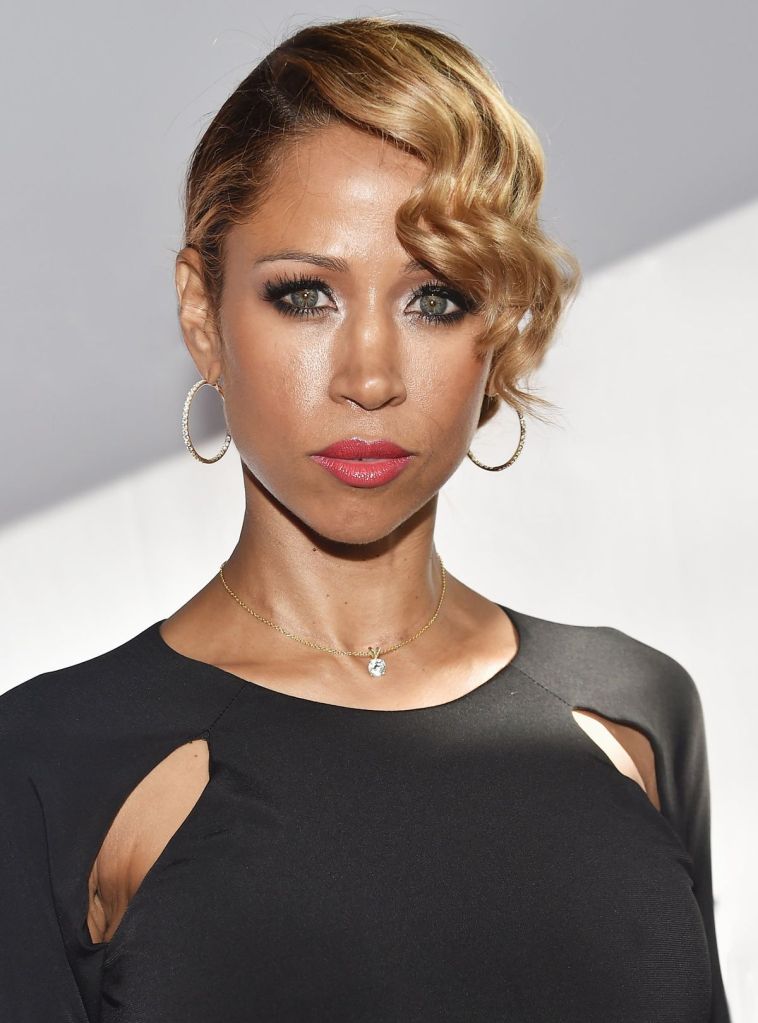
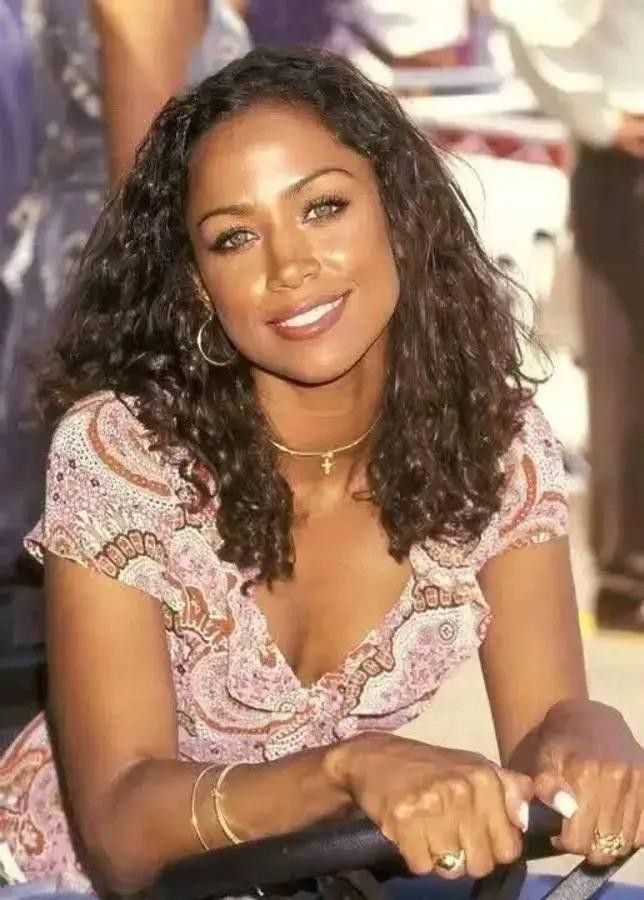
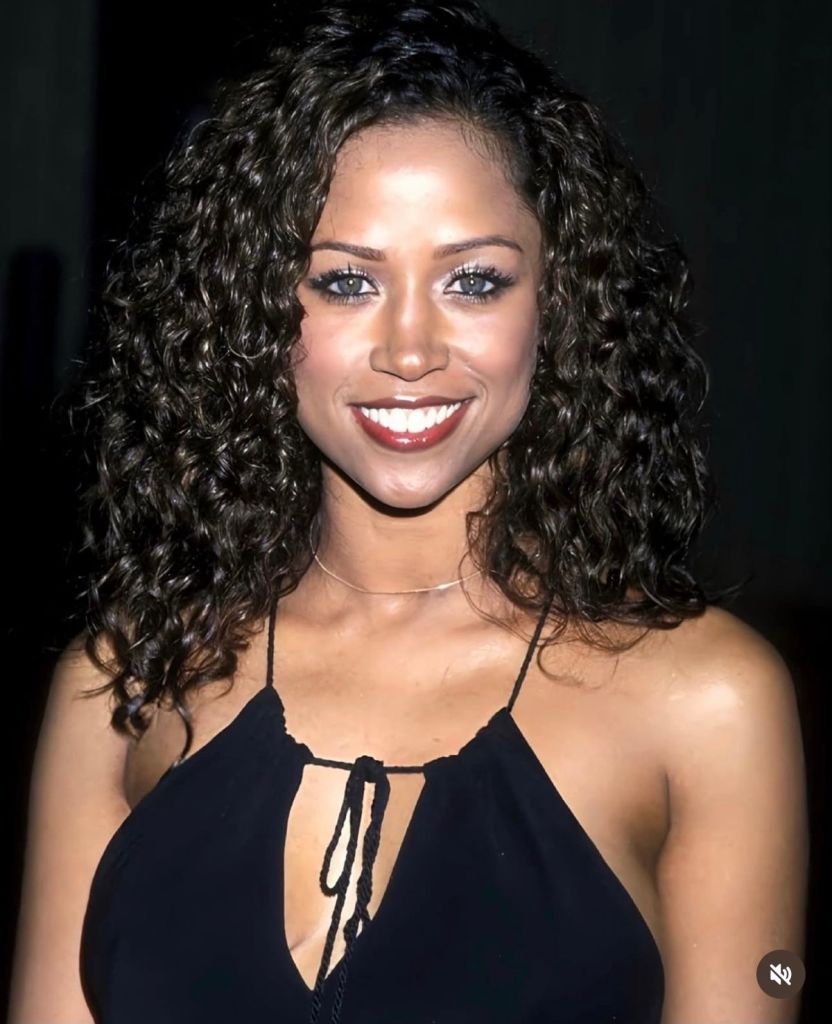
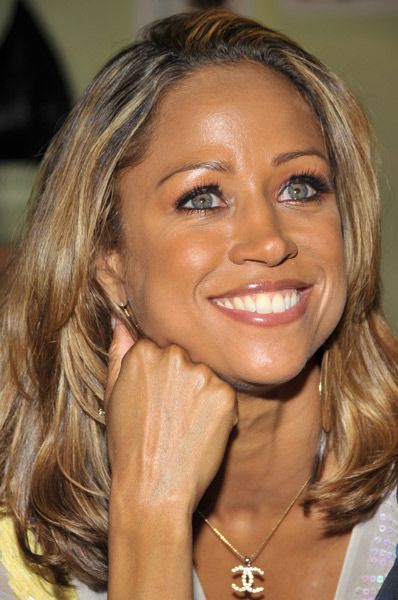
Stacey Dash is an actress and former television personality whose career spans film, television, and political commentary. Born Stacey Lauretta Dash on January 20, 1967, in the Bronx, New York, she rose to prominence in the 1990s as one of Hollywood’s most recognizable light-skinned Black actresses, known for her youthful appearance, symmetrical features, and refined on-screen charisma.
Dash was raised in a culturally diverse household. Her father is African American, and her mother is of Mexican and Afro-Bajan (Barbadian) descent. This blended heritage contributed to her distinctive look—high cheekbones, almond-shaped, striking green eyes, radiant complexion, and a delicate facial structure that often allowed her to portray characters younger than her actual age. Her beauty became one of her defining industry trademarks.
This photograph is the property of its respective owner.
She began her acting career in the mid-1980s, making her television debut in the NBC crime drama Crime Story (1985). Her first film appearance came in Enemy Territory (1987), followed by roles in films such as Moving, Mo’ Money, and Renaissance Man. These early roles positioned her within urban and mainstream cinema, but she had yet to achieve breakout stardom.
Her defining breakthrough came in 1995 with the teen comedy Clueless, where she portrayed Dionne Davenport alongside Alicia Silverstone. Although Dash was in her late twenties at the time, she convincingly played a fashionable high school student. The film became a cultural phenomenon, and Dionne’s stylish, witty, and confident persona cemented Dash as a pop-culture icon of the 1990s. She later reprised the role in the television adaptation of Clueless (1996–1999).
Throughout the late 1990s and early 2000s, Dash appeared in films such as View from the Top, Gang of Roses, and Paper Soldiers, as well as television programs including The Game and Single Ladies. She also appeared in music videos, most notably in Kanye West’s “All Falls Down,” which reintroduced her to a younger generation of viewers.
This photograph is the property of its respective owner. No copyright infringement intended.
In addition to acting, Dash transitioned into political commentary in the 2010s, becoming a contributor for Fox News. This career pivot sparked significant public discourse and polarized opinions, impacting her public image and altering the trajectory of her entertainment career.
In her personal life, Dash has been married multiple times and is the mother of two children. Despite public scrutiny and media attention surrounding her relationships and political views, she has remained a figure of fascination due to her longevity in public consciousness.
While Dash has not received major Academy-level awards, Clueless remains a cult classic, and her character Dionne continues to be referenced in discussions of 1990s fashion and teen cinema. Her cultural influence is tied heavily to that era’s aesthetic and the representation of affluent, stylish Black teen femininity in mainstream film.
This photograph is the property of its respective owner.
Why is she considered an “Ebony Doll”? The phrase, when used respectfully, reflects admiration for her polished features, petite frame, smooth complexion, and doll-like facial symmetry. She embodied a glamorous, fashion-forward image that blended softness with confidence. Her presence in Clueless especially presented a portrayal of a young Black woman who was affluent, articulate, stylish, and socially powerful—an image not commonly centered in 1990s teen films.
Stacey Dash represents a specific moment in Black pop culture history: the era of glossy, MTV-influenced cinema, high-fashion teen comedies, and multicultural casting that subtly shifted representation. Whether through admiration or controversy, her visibility has been enduring.
She remains a figure associated with timeless 1990s beauty, cultural conversation, and a defining cinematic role that continues to resonate decades later.
References
IMDb. (n.d.). Stacey Dash – Filmography and Biography. Wikipedia contributors. (n.d.). Stacey Dash. Paramount Pictures archives. Clueless (1995). Fox News archives (2014–2017 contributor records).
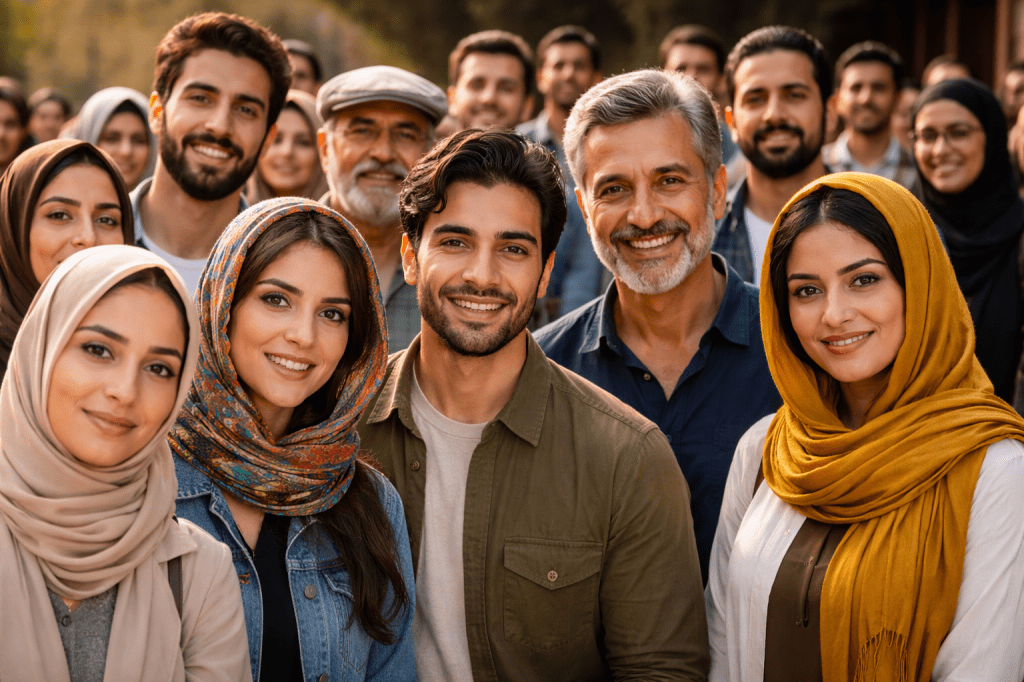
The people known today as Iranians trace their civilizational roots to the ancient world of the Near East, where empire, language, and lineage intersected in profound ways. Historically called Persians in Western sources, they descend from Indo-Iranian tribes who migrated onto the Iranian plateau in the second millennium BCE, forming the cultural and political foundation of what would become one of antiquity’s most influential empires.
The term “Aryan” originally derived from the Old Iranian word arya, meaning “noble” or “freeborn,” and was a self-designation used by early Indo-Iranian peoples. It appears in ancient inscriptions such as those of Darius I, who referred to himself as an Aryan and of Aryan lineage. In its original linguistic and cultural context, the term denoted Indo-Iranian identity, not the racial ideology later misappropriated in modern Europe.
The Iranian tribes included the Medes, Persians, Parthians, and others who settled across the plateau. The Medes first established a significant kingdom, followed by the rise of the Achaemenid Persians under Cyrus the Great, whose empire stretched from India to the Mediterranean. This imperial formation shaped the geopolitical landscape of the ancient Near East.
Biblically, the Persians are explicitly mentioned in the Hebrew Scriptures. The books of Ezra, Nehemiah, Daniel, and Esther occur within the Persian imperial context. The decree of Cyrus allowing the Jewish exiles to return to Jerusalem is recorded in Ezra 1:1–4, marking a pivotal moment in post-exilic restoration.
The Achaemenid Empire, often associated with the biblical “kings of Persia,” included rulers such as Xerxes I, commonly identified with Ahasuerus in the Book of Esther. This period demonstrates the direct intersection between Iranian imperial authority and Jewish covenant history.
From a genealogical standpoint, many biblical scholars associate the Persians and Medes with the descendants of Japheth, specifically through Madai (Genesis 10:2), who is traditionally linked to the Medes. The Table of Nations situates Madai among Japheth’s sons, suggesting an Indo-European lineage consistent with linguistic evidence.
Linguistically, Iranians belong to the Indo-Iranian branch of the Indo-European language family. Modern Persian (Farsi) evolved from Old Persian, written in cuneiform, and later Middle Persian (Pahlavi). Today, Persian remains the official language of Iran, alongside recognized minority languages such as Azeri, Kurdish, and Balochi.
The name “Iran” itself derives from “Ērān,” meaning “land of the Aryans.” In 1935, under Reza Shah Pahlavi, the country formally requested that the international community refer to it as Iran rather than Persia, reflecting indigenous historical terminology.
Iran’s religious identity transformed dramatically in the seventh century with the Islamic conquest, shifting from Zoroastrianism to Islam. Today, Iran is predominantly Twelver Shi’a Muslim, and religion plays a foundational role in its political system.
The current president of Iran is Masoud Pezeshkian, elected in 2024. A cardiac surgeon by training and a longtime parliamentarian, Pezeshkian has positioned himself as a reform-minded figure advocating for economic stabilization and measured diplomatic engagement.
Iran’s political system, however, vests ultimate authority in the Supreme Leader, currently Ali Khamenei, who oversees military, judicial, and strategic state functions. The presidency operates within this theocratic framework.
The relationship between Iran and the United States has been strained since the 1979 Islamic Revolution, which overthrew the U.S.-backed Shah and led to the hostage crisis at the American embassy in Tehran. Diplomatic relations were severed, and tensions have persisted for decades.
Key flashpoints include Iran’s nuclear program, regional proxy conflicts, and economic sanctions. The 2015 Joint Comprehensive Plan of Action (JCPOA) temporarily eased tensions before the U.S. withdrawal in 2018, reigniting sanctions and diplomatic friction.
Recent developments continue to center on nuclear negotiations, internal economic pressures, and regional security dynamics involving Israel and Gulf states. Iran remains a central actor in Middle Eastern geopolitics due to its strategic location, military capabilities, and energy resources.
Historically, Iran’s power derived not only from military strength but also from administrative sophistication. The Achaemenids pioneered systems of provincial governance (satrapies), infrastructure development, and cultural tolerance that influenced later empires, including Rome.
In prophetic literature, Persia appears in the Book of Daniel as part of the Medo-Persian Empire symbolized by the ram with two horns (Daniel 8). This imagery reflects the dual Medo-Persian authority that followed Babylon’s fall.
Ethnically, modern Iranians are diverse, encompassing Persians, Azeris, Kurds, Lurs, Arabs, and others. While the Indo-Iranian linguistic heritage aligns historically with Japhetite classifications in biblical ethnography, contemporary genetic and cultural realities reflect centuries of migration and intermarriage.
The Parthian and later Sassanian empires continued Persian imperial traditions until the Arab conquests. These dynasties preserved Iranian cultural identity even as religious transformations reshaped the region.
Iran’s strategic influence today stems from energy reserves, regional alliances, and ideological positioning within the Shi’a world. It exerts influence through political networks in Iraq, Syria, Lebanon, and Yemen, shaping Middle Eastern power balances.
The question of whether Iranians descend from Shem or Japheth remains a matter of theological interpretation rather than modern genetics. Traditional biblical scholarship associates the Medes with Japheth through Madai, yet Iran’s historical interactions with Semitic peoples—including Assyrians, Babylonians, and Hebrews—demonstrate intertwined destinies rather than isolated bloodlines.
Thus, the Iranians stand in Scripture not as peripheral figures but as imperial actors through whom divine providence unfolded restoration and prophetic vision. Their story bridges Genesis genealogies, prophetic symbolism, imperial governance, and contemporary geopolitics—an enduring testament to how ancient bloodlines and modern nationhood intersect within sacred and secular history.
References
The Holy Bible, King James Version.
Briant, P. (2002). From Cyrus to Alexander: A History of the Persian Empire. Eisenbrauns.
Curtis, V. S., & Stewart, S. (2005). Birth of the Persian Empire. I.B. Tauris.
Frye, R. N. (1984). The History of Ancient Iran. C.H. Beck.
Kuhrt, A. (2007). The Persian Empire: A Corpus of Sources from the Achaemenid Period. Routledge.
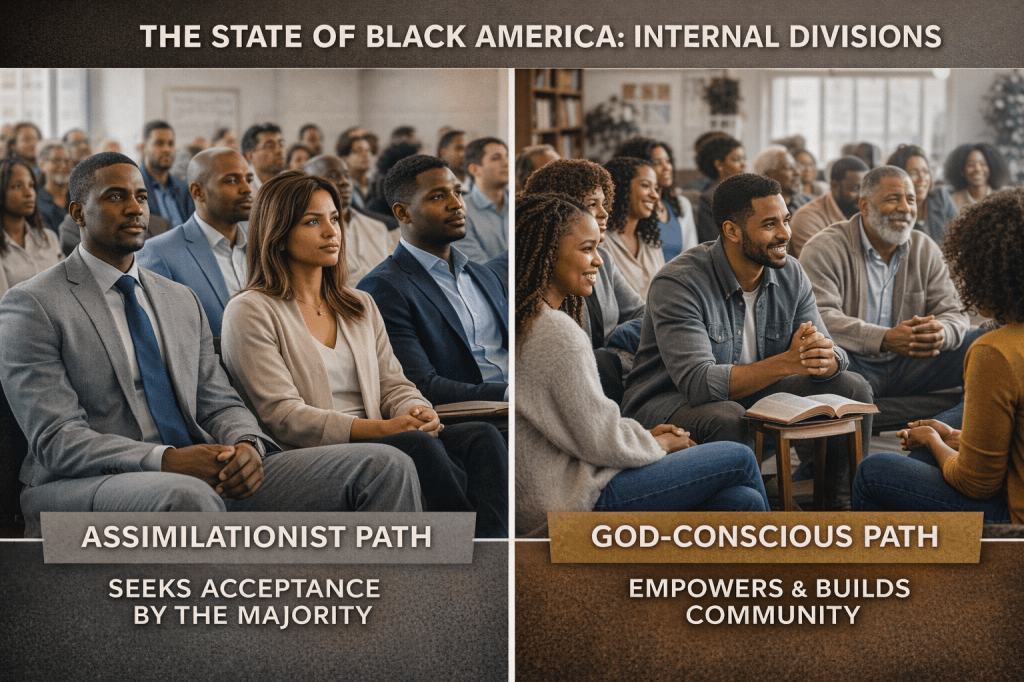
Throughout history, oppressed communities have wrestled with two primary survival responses: assimilation into the dominant power structure or resistance through identity preservation and collective empowerment. Within the African American experience in the United States, this tension has manifested in visible ideological and behavioral distinctions shaped by slavery, segregation, systemic racism, and theological interpretation.
The legacy of American chattel slavery created not only economic devastation but psychological fractures. Scholars such as Frantz Fanon (1967) argued that colonized people often internalize the worldview of the colonizer as a survival mechanism. This internalization can result in identification with the dominant culture as a means of perceived safety or advancement.
In the American context, the character “Uncle Tom,” from Harriet Beecher Stowe’s novel Uncle Tom’s Cabin, became a cultural symbol—though often misinterpreted—of perceived submission to white authority. Over time, the term evolved into a pejorative label describing individuals believed to prioritize white approval over communal solidarity.
Assimilation, however, must be examined sociologically rather than emotionally. Sociologist W.E.B. Du Bois described “double consciousness” as the tension Black Americans feel between their African heritage and American citizenship (Du Bois, 1903). For some, minimizing racial conflict or denying systemic racism is not necessarily ignorance but an adaptation strategy shaped by generational trauma.
Research in racial identity development theory, particularly by William E. Cross Jr., shows that Black identity formation progresses through stages. Some individuals remain in earlier phases characterized by assimilationist leanings or a preference for proximity to dominant culture standards.
Internalized racism, defined as the acceptance of societal beliefs about Black inferiority, has been documented extensively in psychological literature (Pyke, 2010). These dynamics often manifest in beauty standards, speech patterns, cultural preferences, and political alignments.
At the same time, it is overly simplistic to categorize individuals as entirely unaware of racism. Many who emphasize cross-racial harmony may genuinely believe that integration and meritocracy are viable pathways toward equality.
Conversely, there exists another path rooted in cultural preservation, spiritual consciousness, and collective empowerment. This path emphasizes group solidarity, historical awareness, and theological identity.
The Black church historically functioned as the epicenter of resistance and social organization. Leaders such as Martin Luther King Jr. articulated liberation through Christian ethics grounded in agape love and justice.
Similarly, figures like Malcolm X emphasized self-respect, self-defense, and psychological decolonization. Though their methods differed, both leaders promoted dignity and communal uplift.
Theologically, many Black faith traditions interpret biblical narratives as parallel to the African American experience. The Exodus story and passages like Deuteronomy 28 have been understood as frameworks for interpreting suffering and covenant identity.
God-conscious empowerment emphasizes spiritual rebirth alongside cultural restoration. It teaches that liberation is not merely political but moral and spiritual.
Community builders focus on economic cooperation, educational advancement, and intergenerational teaching. The philosophy echoes the principles of collective economics articulated by Marcus Garvey and the Universal Negro Improvement Association.
Intra-community conflict, however, often undermines these efforts. Social dominance theory suggests marginalized groups can replicate hierarchical thinking internally (Sidanius & Pratto, 1999).
The call for unity does not mean uniformity. It requires shared goals centered on dignity, spiritual awareness, and structural progress.
Teaching children cultural literacy and historical truth is central to empowerment. Scholars like Carter G. Woodson argued that miseducation perpetuates subjugation.
Spiritual formation also plays a role. Biblical anthropology emphasizes identity in both flesh and spirit, reinforcing inherent worth beyond societal labels.
God-conscious frameworks encourage reconciliation within the community before external transformation.
This perspective rejects self-hatred while also avoiding racial supremacism. It affirms dignity without dehumanizing others.
Economic empowerment initiatives, cooperative models, and entrepreneurship align with this restorative vision.
Psychologically, collective pride correlates with higher resilience and well-being among marginalized populations (Neblett et al., 2012).
Faith-based empowerment movements often stress repentance from destructive behaviors such as internal violence, colorism, and fragmentation.
The metaphor of “needles in a haystack” captures the rarity of individuals fully committed to spiritual discipline and communal sacrifice.
Such builders prioritize generational legacy over short-term validation.
They recognize racism as structural rather than merely interpersonal, supported by scholarship from Michelle Alexander in The New Jim Crow.
At the same time, they resist fatalism. Faith sustains hope amid systemic obstacles.
Christ-centered identity reframes suffering through redemptive theology rather than victimhood.
Recognizing oneself as chosen does not imply superiority but covenant responsibility.
The call to stop fighting one another echoes both biblical admonition and sociological necessity.
Group progress historically required strategic unity, as evidenced during the Civil Rights Movement.
Yet even within movements, ideological differences persisted, illustrating the complexity of Black thought.
Ultimately, these two paths are not fixed identities but developmental positions shaped by history, psychology, and theology.
Healing requires compassion, education, and spiritual maturity.
Rather than condemnation, transformation must be the goal.
The future of Black empowerment lies not in caricatures but in consciousness, character, and Christ-centered community building.
References
Alexander, M. (2010). The New Jim Crow.
Cross, W. E. (1991). Shades of Black: Diversity in African-American Identity.
Du Bois, W. E. B. (1903). The Souls of Black Folk.
Fanon, F. (1967). Black Skin, White Masks.
Neblett, E. W., et al. (2012). Racial identity and psychological health.
Pyke, K. (2010). What is internalized racial oppression? Sociological Perspectives, 53(4), 551–572.
Sidanius, J., & Pratto, F. (1999). Social Dominance: An Intergroup Theory of Social Hierarchy and Oppression.
Woodson, C. G. (1933). The Mis-Education of the Negro.
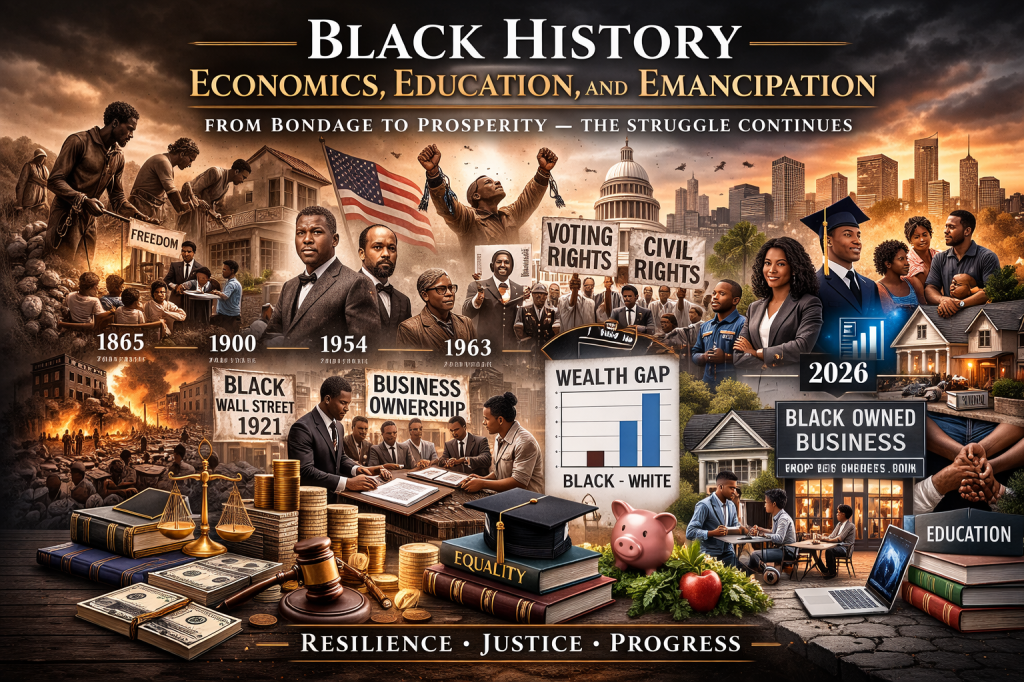
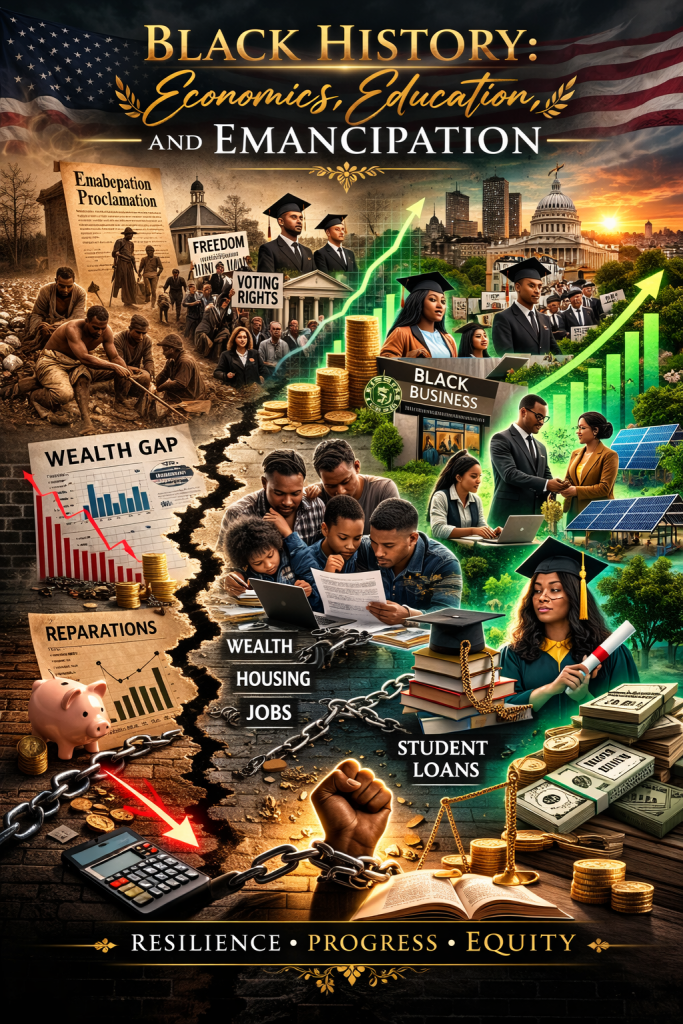
Black history in the United States is not merely a litany of events; it is the story of a people’s persistent struggle for dignity, self-determination, and economic justice. From the systemic deprivations of slavery to the present day, the economic condition of Black Americans has been profoundly shaped by centuries of exclusion, exploitation, and resistance (McKinsey & Company, 2025). The interplay of economic opportunity, access to education, and emancipation has defined both individual lives and collective possibilities.
The legacy of slavery and Reconstruction laid the groundwork for persistent racial inequalities. Even at the formal end of slavery in 1865, Black Americans held virtually no wealth; over a century and a half later, that gap persists. Black households possess only a small fraction of national wealth compared with White households, illustrating how historical racial injustice still translates into economic precarity (LendingTree, 2026; Brookings Institution, 2024).
Structural discrimination continues to influence economic outcomes through labor markets that systematically disadvantage Black workers. Black Americans are overrepresented in lower-wage occupations and underrepresented in higher-paying managerial and professional roles, reinforcing income inequality (McKinsey & Company, 2019). This occupational segregation, rooted in historical discrimination, limits economic mobility and widens the wealth gap across generations.
Education has long been touted as a pathway to economic advancement, yet disparities in educational access and outcomes persist. Predominantly Black school districts receive significantly less funding than predominantly White districts, perpetuating cycles of unequal opportunity and limiting access to high-quality schooling (Black Wall Street Organization, 2025). In this context, education becomes not simply a means of individual uplift but a battleground for equity.
Higher education, while expanding enrollment for Black students over recent decades, also exposes students to disproportionate levels of debt. Black college graduates carry higher student loan burdens than their White counterparts, constraining their capacity to accumulate wealth through homeownership, savings, and investments (Black Wall Street Organization, 2025). Thus, the very institution that promises empowerment can become another vector of economic strain.
Despite the barriers, African Americans have demonstrated remarkable resilience. Historic models of Black economic self-help—mutual aid societies, Black-owned banks, business collectives, and cooperative enterprises—reflect a long tradition of economic self-determination. Yet these efforts have often faced hostile responses, from discriminatory lending practices to overt violence, as in the destruction of Black Wall Street in 1921 (Black Wall Street Organization, 2025).
Homeownership remains a key indicator of wealth building in America, yet the Black homeownership rate lags significantly behind that of White Americans, reflecting a century of housing discrimination and unequal access to mortgage capital (Washington Post, 2026). Even when Black families do own homes, properties often appraise for lower values due to enduring patterns of segregation and appraisal bias, further limiting generational wealth accumulation.
As of recent data, Black homeownership stands well below the rate for White families, and median wages for Black workers are substantially lower across industries. Black workers commonly earn about 70 percent of what White workers earn in comparable sectors, underscoring persistent wage disparities (LendingTree, 2026). These gaps are not accidental; they reflect longstanding structural inequities embedded in the economy.
Economic Data Tables: Black–White Disparities (2025–2026)
Median Household Income & Wealth
Indicator
Black Households
White Households
Source
Median Household Income (2024)
~$56,020
~$88,010
LendingTree (2026)
Median Household Wealth (% of U.S. total)
~3.4%
~83.5%
LendingTree (2026)
Racial Wealth Ratio (White : Black)
~8:1
—
ZipDo (2026)
Median Wealth (Black vs White)
~$24,100 vs $188,200
—
ZipDo (2026)
Employment & Labor Market Disparities
Indicator
Black Workers
White Workers
Source
Unemployment Rate (Q3, 2025)
~7.8%
~3.8%
LendingTree (2026)
Black Unemployment (Nov 2025 spike)
8.3%
—
Reuters (2025)
Earnings Gap (Median wages)
~70–75% of White wages
100%
WorldMetrics (2026)
Homeownership & Wealth Building
Indicator
Black Households
White Households
Source
Homeownership Rate (2026)
~43.6%
~70.3%
Washington Post (2026)
Homeownership Gap (Historical Persistence)
Negligible improvement over decades
—
Washington Post (2026)
Access to Favorable Mortgage Terms
Higher denial & bias
Lower denial
LendingTree (2026)
These data illustrate several core structural truths:
Persistent Racial Wealth Gap: Black households hold a disproportionately small share of U.S. total wealth (about 3.4%), even though Black Americans represent ~13–14% of the population. Meanwhile, White households control over 80% of the national wealth. Economic inequality is thus not only about income but also about historical asset accumulation and generational transfer of wealth.
Income Inequality Across Sectors: Black workers earn approximately 70–75 cents for every dollar earned by White workers across major sectors, with the gap widening in higher‑paying occupations.
Employment Barriers: The unemployment rate for Black Americans in late 2025 and early 2026 was more than double the national rate, a persistent pattern indicating structural labor market discrimination and vulnerability during economic contractions.
Homeownership & Wealth Building: Black homeownership remains far below White rates, with only about 44% of Black households owning homes — a primary vehicle for middle‑class wealth — compared with around 70% of White households. Appraisal bias, mortgage denial disparities, and historical segregation play significant roles in this enduring gap
The wealth gap also manifests in broader national terms: White Americans hold the vast majority of U.S. wealth, while Black Americans hold only a small sliver despite representing a significant portion of the population (LendingTree, 2026). This imbalance illustrates how historical exclusion has compounded over time, making wealth accumulation a generational challenge.
In the labor market of 2025–2026, the unemployment rate for Black Americans has risen disproportionately higher than the national average, signaling troubling economic trends that scholars and civil rights analysts describe as a “Black recession.” Black unemployment climbed to levels nearly double those of White workers amid broader economic slowdown and policy reversals that eroded programs designed to address racial inequality (State of the Dream Report, 2026).
Economic policy and labor market shifts have gutted diversity and inclusion initiatives in federal agencies, removing support mechanisms that previously helped mitigate racial disparities in employment. As a result, Black workers have borne the brunt of federal job cuts, particularly Black women, who historically are overrepresented in public sector employment (State of the Dream Report, 2026).
The racial wealth gap is not simply an issue of income but of cumulative assets: investments, property equity, business ownership, and inheritance. White families disproportionately benefit from stock market gains and home equity appreciation, while Black families have historically had limited access to these primary vehicles of wealth growth (Investopedia, 2025). This structural imbalance inhibits intergenerational economic security.
The persistence of these disparities challenges the myth that formal emancipation was sufficient to equalize economic outcomes. Rather, emancipation began a long struggle against structural barriers that have constrained Black economic agency. This ongoing reality reveals that legal freedom without equitable economic opportunity remains incomplete.
Economic suffering among Black Americans in 2026 highlights the continuing legacy of these structural inequalities. Rising unemployment, growing wealth concentration among white households, and barriers to capital for Black entrepreneurs all point to an economy in which racial disparities remain entrenched. Scholars argue that the effects of these disparities are so profound that closing the racial wealth gap could significantly benefit the U.S. economy as a whole (McKinsey & Company, 2019).
Educational disparities remain deeply intertwined with economic outcomes. Black students often attend schools with fewer resources, lower teacher salaries, and less access to advanced coursework, hindering academic achievement and future earnings potential. These inequities underscore how education and economic status are mutually reinforcing.
At the same time, economic inequality among Black communities intersects with health, housing, and social stability. The lack of access to quality healthcare increases medical expenses and economic vulnerability, and housing instability remains a persistent threat for families with limited economic resources (Black Wall Street Organization, 2025).
Yet, in spite of systemic barriers, Black economic empowerment initiatives continue to evolve. Black-owned businesses, though smaller and less capitalized than their White counterparts, represent a significant force for community development. Support for entrepreneurship and access to capital remain key strategies for building Black economic resilience (Black Wall Street Organization, 2025).
Historically and in the present day, education has served as both a means of empowerment and a site of struggle. The promise of education as a path to economic freedom remains contested, as disparities in funding, access, and outcomes continue to shape life chances for Black Americans.
To confront the entrenched economic disparities of 2026 and beyond, scholars and policy advocates emphasize the need for structural reforms that address labor market discrimination, broaden access to capital, and ensure equitable educational opportunity. Without such reforms, the legacy of racial economic inequality will persist, limiting the full realization of emancipation.
In sum, Black history—rooted in economics, education, and emancipation—is a testament to both the enduring injustice of systemic exclusion and the persistent struggle for full economic citizenship. The story of Black America’s economic journey reveals deep structural challenges but also the resilience and ingenuity that have propelled this nation toward a more inclusive future.
Lost sons grow up in a world more connected than ever, yet relationally barren. Platforms provide community templates, while life often fails to provide community itself. Scripture speaks to men without a rooted vision: “My people are destroyed for lack of knowledge” (Hos. 4:6, KJV).
The digital age did not create male disorientation, but it amplified it. Grievance found microphones, immaturity found markets, and wound-identity found a home page. “The simple believeth every word” (Prov. 14:15, KJV), and the internet has mastered the discipling of simplicity.
Masculinity without covenant becomes performance without purpose. It boasts of control but lacks calling, command but not mission, influence but not inheritance. “A bastard shall dwell in Ashdod” (Zech. 9:6, KJV), a prophetic metaphor echoed by many scholars referencing fatherless identities displaced from spiritual lineage.
Many lost boys are algorithm-raised, not father-raised. Their rites of passage are viral, not sacred, horizontal, not prophetic; social, not spiritual. God offers the contrast: “I will be a father unto you” (2 Cor. 6:18, KJV).
Digital male movements frequently frame women as rivals, not recipients, obstacles, not co-heirs. Yet scripture orders unity, not hierarchy: “That they all may be one” (John 17:21, KJV).
Covenantal masculinity defined strength through obedience. But modern masculinity defines strength through ego-visibility. God rebukes this posture: “Pride goeth before destruction” (Prov. 16:18, KJV).
The loud male voices online echo confidence without conviction. Their identities are outspoken but not examined. But scripture demands the introspection they avoid: “Examine yourselves, whether ye be in the faith” (2 Cor. 13:5, KJV).
Many boys build masculinity on grievance because grievance feels powerful. Pain becomes political, loneliness becomes polemical, rejection becomes rhetoric. Yet scripture prescribes healing, not amplification: “He healeth the broken in heart, and bindeth up their wounds” (Psa. 147:3, KJV).
Love is dandified as weakness in digital male spaces. Yet biblical masculinity is not fragile toward softness, it fathers through it. “Fathers, provoke not your children to wrath: but bring them up” (Eph. 6:4, KJV).
The manosphere provides discipleship without doctrine, obedience without God, brotherhood without rebuke, and masculinity without cross. But scripture anchors manhood in Christ’s model: “Not as lords over God’s heritage” (1 Pet. 5:3, KJV).
Masculinity without covenant elevates voice and buries responsibility. But scripture centers provision as evidence of faith: “If any provide not for his own… he hath denied the faith” (1 Tim. 5:8, KJV).
Without a covenant, men build kingdoms that collapse under ego rather than a covenant that endures under God. Scripture calls for divine architecture over human ambition: “Except the Lord build the house, they labour in vain that build it” (Psa. 127:1, KJV).
Many men seek validation from followers rather than formation from fathers. They desire influence without instruction. But scripture re-anchors formation: “As iron sharpeneth iron, so a man sharpeneth the countenance of his friend” (Prov. 27:17, KJV).
Yet without older iron, younger iron dulls itself. Peer-sharpening-peer without covenant leads to abrasion, not formation. “They have rejected knowledge, I also will reject thee” (Hos. 4:6, KJV). The rejection is of direction, not of men, but the consequence still settles in identity.
Digital male communities promise masculine resurgence through dominance psychology, economic status, or adversarial identity politics. But scripture places rulership inward first: “He that ruleth his spirit is better than he that taketh a city” (Prov. 16:32, KJV).
The lost sons of the digital age create identity nationalism without covenantal citizenship. Their belonging is ideological, not covenantal, vocal, not obedient, outspoken, not submitted. But the biblical masculine model is radical submission to God. “Submit yourselves therefore unto God” (James 4:7, KJV).
The emotional dilemma of lost sons becomes spiritual dilemma when unresolved boys adopt identities that rival holiness itself. Pain becomes worldview before scripture becomes worldview.
Masculinity that grows without covenant eventually fathers loud movements but not healthy lineage. Its fruit is rhetoric, not restoration. But scripture promises regeneration: “A tree is known by his fruit” (Matt. 12:33, KJV). The internet bears fruit, but not every orchard is holy.
Many boys desire brotherhood but find battalion. They desire identity but find ideology. They desire purpose but find a platform. God offers the inversion: covenant before crowd, spirit before stage, rebuke before rebuild, fathering before fame.
Masculinity without covenant becomes an echo, not a root. It reverberates but does not anchor. Yet God anchors manhood firmly in divine identity formation. “The Lord hath made all things for himself” (Prov. 16:4, KJV).
The greatest dilemma is that men want transformation into unbreakable instead of transformation into new. But scripture centers re-creation, not hardness: “If any man be in Christ, he is a new creature” (2 Cor. 5:17, KJV).
Real manhood is not the absence of wound but the presence of covenant. Healing does not erase masculinity; it legitimizes it through spiritual lineage rather than digital doctrine.
The digital age gives men unlimited microphones, but the covenant gives men unlimited inheritance. True restoration is not a rise in voice but a rise in obedience, nurture, alignment, covenant, and soul shepherding through scripture.
References
American Psychological Association. (2017). Guidelines for Psychological Practice With Boys and Men. APA.
Baumeister, R. F. (1991). Meanings of Life. Guilford Press.
Berger, J. M. (2018). Extremism and grievance communities online: Group identity and psychological belonging. International Centre for Counter-Terrorism, 9(2), 1–25.
Ging, D. (2019). Online masculine communities and the discipling of male grievance ideology. Social Media + Society, 5(2), 1–14.
hooks, b. (2004). The Will to Change: Men, Masculinity, and Love. Washington Square Press.
Kimmel, M. (2013). Angry White Men: American Masculinity at the End of an Era. Nation Books.
Ribeiro, M., Ottoni, R., West, R., Almeida, V., & Meira Jr., W. (2020). The evolution of the manosphere across digital platforms. Proceedings of the International AAAI Conference on Web and Social Media, 14, 196–207.
Van Valkenburgh, S. P. (2021). Neoliberal masculinity and anti-feminist identity movements in the digital era. Men and Masculinities, 24(1), 84–103.
The Holy Bible, King James Version. (1611). Cambridge University Press.
Colorism continues to shape the lives of Black people across the globe, creating a hierarchy where lighter skin is often valued above darker skin. This hierarchy influences perceptions of beauty, social status, economic opportunity, and even self-worth (Hunter, 2007).
The roots of colorism are deeply historical. During slavery and colonization, lighter-skinned Africans were often given preferential treatment, assigned domestic roles, and sometimes even granted freedom, while darker-skinned Africans labored in the fields and were systematically dehumanized. These practices embedded the association of lightness with privilege (Williams, 1987).
The media has perpetuated this bias for generations. Hollywood films, advertisements, and television shows historically cast lighter-skinned Black actors in leading, romantic, and heroic roles, while darker-skinned actors were relegated to secondary or villainous roles. Such representation shapes public perception and influences the self-esteem of viewers (Bogle, 2016).
The psychological effects of colorism are profound. Darker-skinned individuals often report higher rates of depression, lower self-esteem, and feelings of inadequacy compared to their lighter-skinned peers. Internalized messages about beauty and desirability can create lifelong struggles with identity and confidence (Hill, 2002).
Colorism also affects romantic relationships. Studies indicate that lighter-skinned women and men are often preferred as partners, while darker-skinned individuals face marginalization. These biases are rooted in historical hierarchies that equate proximity to whiteness with social desirability (Wilder, 2010).
In the workplace, colorism manifests in income and promotion disparities. Research shows that darker-skinned Black men and women often earn less than their lighter-skinned counterparts, even with equivalent qualifications and experience. This shade-based wage gap highlights ongoing systemic inequities (Goldsmith, Hamilton, & Darity, 2006).
Schools are microcosms where colorism begins early. Dark-skinned children are more likely to face teasing, social exclusion, or harsher disciplinary measures. These early experiences shape their academic performance and social confidence (Monk, 2014).
Family and community attitudes play a significant role in either perpetuating or challenging colorism. Compliments that favor lighter skin, such as “You’re pretty for a dark-skinned girl,” reinforce hierarchy, while affirmations of all shades foster resilience and self-love (Russell, Wilson, & Hall, 2013).
Language and terminology also reinforce hierarchy. Terms like “high yellow,” “redbone,” and “chocolate” often carry implicit judgments. Changing this language is a necessary step in dismantling social biases and cultivating inclusive beauty standards (Charles, 2003).
Social media has become a double-edged sword. While it can perpetuate light-skinned beauty ideals, movements such as #MelaninPoppin and #DarkSkinIsBeautiful celebrate deep-skinned beauty and provide visibility to those historically marginalized. These campaigns foster community pride and affirmation.
Religious and spiritual frameworks can help counteract internalized bias. Scriptures like Song of Solomon 1:5 — “I am black, but comely” — affirm that dark skin is beautiful and worthy of celebration. Churches can encourage young women and men to see all shades as reflections of God’s design (James 2:1-4).
Media literacy programs are essential tools for combating the weight of hue. Teaching children and adults to critically evaluate film, television, and advertising helps them resist internalizing harmful colorist norms and fosters appreciation for a wider range of beauty standards.
Empowerment programs targeting youth help counteract the negative effects of colorism. Workshops, mentorship, and historical education about African ancestry instill pride in melanin-rich skin and encourage healthy self-perception (Hall, 1992).
Feminist scholars argue that colorism intersects with sexism and racism, amplifying the oppression of dark-skinned women. Addressing this intersectionality is crucial for holistic liberation and equity within the Black community (Hunter, 2007).
Representation matters not only for women but for men as well. Dark-skinned Black men face societal prejudice that can affect perceptions of attractiveness, trustworthiness, and professional capability. Affirming men of all shades helps dismantle hierarchical standards that harm the entire community.
Black fathers and male mentors have a critical role. By affirming dark-skinned daughters, nieces, and younger women in their communities, men can actively challenge societal preferences for lighter skin and foster confidence in the next generation (Harris, 2015).
Economic and professional equity initiatives are equally important. Organizations must address unconscious bias in hiring, promotions, and pay scales to ensure that darker-skinned individuals are not disadvantaged due to complexion. Equitable policies disrupt systemic inequalities rooted in colorism.
Education about the historical and cultural origins of colorism provides tools for resistance. Teaching children about African leaders, inventors, and cultural figures with dark skin fosters pride and counters centuries of negative messaging (Smedley, 1999).
Therapeutic interventions, including counseling and support groups, can help individuals address internalized colorism. Healing requires acknowledging past trauma, challenging negative beliefs, and embracing one’s natural complexion.
Breaking the shade hierarchy is a lifelong process that requires conscious effort, education, and representation. By affirming beauty across all skin tones, fostering inclusive media, and challenging biases, the Black community can reduce the weight of hue and empower future generations.
References
Bogle, D. (2016). Toms, Coons, Mulattoes, Mammies, and Bucks: An Interpretive History of Blacks in American Films. Bloomsbury.
Charles, C. (2003). Skin Bleaching, Self-Hate, and Black Identity in Jamaica. Journal of Black Studies, 33(6), 711–728.
Goldsmith, A., Hamilton, D., & Darity, W. (2006). Shades of Discrimination: Skin Tone and Wages. American Economic Review, 96(2), 242–245.
Hall, R. E. (1992). Bias Among African Americans Regarding Skin Color: Implications for Social Work Practice. Research on Social Work Practice, 2(4), 479–486.
Harris, A. (2015). The Influence of Fathers on the Self-Esteem of African American Daughters. Journal of Black Psychology, 41(3), 257–276.
Hill, M. (2002). Skin Color and the Perception of Attractiveness Among African Americans. Social Psychology Quarterly, 65(1), 77–91.
Hunter, M. (2007). The Persistent Problem of Colorism: Skin Tone, Status, and Inequality. Sociology Compass, 1(1), 237–254.
Monk, E. P. (2014). Skin Tone Stratification among Black Americans, 2001–2003. Social Forces, 92(4), 1313–1337.
Russell, K., Wilson, M., & Hall, R. (2013). The Color Complex: The Politics of Skin Color Among African Americans. Anchor Books.
Smedley, A. (1999). Race in North America: Origin and Evolution of a Worldview. Westview Press.
Williams, E. (1987). Capitalism and Slavery. UNC Press.
Wilder, J. (2010). Revisiting “Color Names and Color Notions”: A Contemporary Examination of the Language and Attitudes of Skin Color among Young Black Women. Journal of Black Studies, 41(1), 184–206.
Timeless Brown Beauty, Unshakable Talent, and Cultural Icon
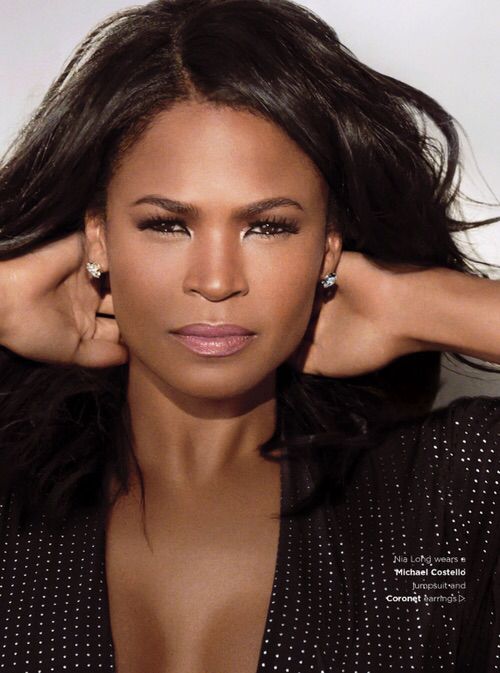
This photograph is the property of its respective owner. No copyright infringement intended.
Nia Long is widely celebrated as one of Hollywood’s most luminous actresses—her elegant brown skin, classic features, and magnetic presence have earned her the affectionate status of a Black Hollywood “It Girl.” Born on October 30, 1970, in Brooklyn, New York, Long grew up steeped in creative influence; her mother was a printmaker and teacher, and her father a poet and educator. She cultivated her talents early, studying acting and performing in television roles before breaking through in one of the defining films of Black cinema, Boyz n the Hood (1991), which showcased her ability to inhabit characters with depth and authenticity that resonated deeply with audiences nationwide.
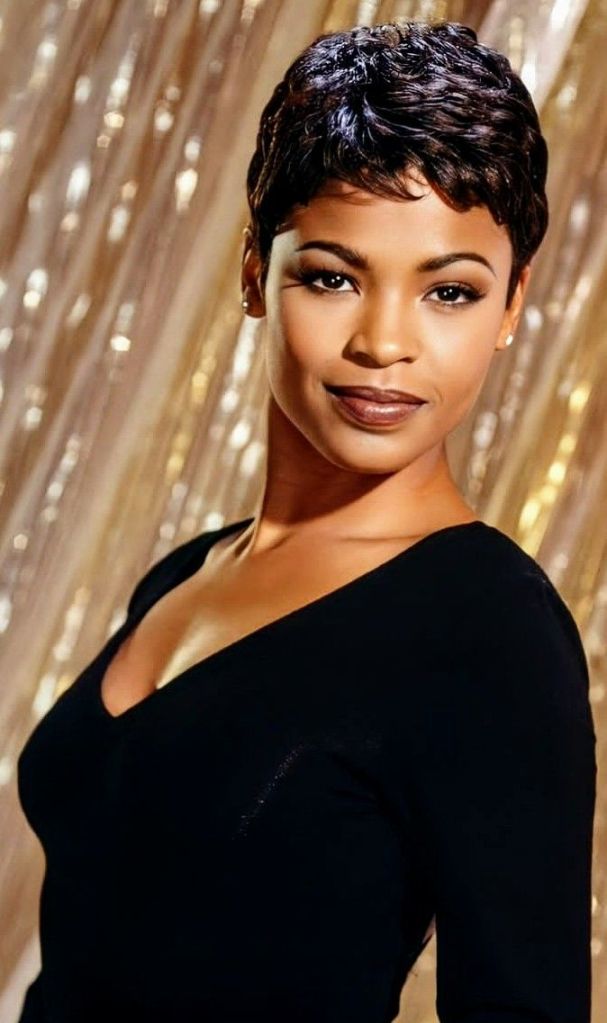
Long’s career is marked by versatility and longevity that few performers achieve. After Boyz n the Hood, she transitioned fluidly between gritty dramas like Love Jones (1997) and ensemble favorites like Friday (1995), Soul Food (1997), and the Best Man franchise, earning critical praise and becoming a beloved fixture in both film and television. She also garnered accolades, including multiple NAACP Image Awards and a Black Reel Award for her work, and her portrayal of Officer Sasha Monroe on Third Watch earned her two NAACP Image Awards for Outstanding Actress in a Drama Series—proof of her dramatic range and respected craft.
This photograph is the property of its respective owner. No copyright infringement intended.
People have often cited Long’s beauty as timeless and magnetic—her brown skin, expressive eyes, and poised elegance convey an all‑American allure that transcends passing trends. Her aesthetic has matured with grace; in 2025, she was named the first North America Brand Ambassador for Estée Lauder Companies, a partnership that celebrates authentic beauty and self-expression in later adulthood—a powerful statement against ageist beauty norms. She also starred in a striking 2024 shapewear campaign for SKIMS, reinforcing her status as a fashion and beauty icon whose confidence and poise continue to inspire across generations.
Beyond aesthetics, Long has navigated Hollywood’s challenges with resilience and conviction. As a brown‑skinned woman in an industry long defined by narrow beauty standards and racial bias, she consistently chose roles that expanded representation and humanized Black women with nuance, strength, and complexity. From classic sitcoms such as The Fresh Prince of Bel‑Air to contemporary hits like NCIS: Los Angeles, Empire, and Dear White People, Long has refused to be typecast, demonstrating breadth and intentionality in her choices. Off‑screen, she has ventured into production and behind‑the‑camera work, and she continues to develop meaningful projects that reflect her artistic vision and lived experience.
In every sense, Nia Long’s career exemplifies timeless beauty fused with artistic integrity. Her gorgeous brown skin and striking features are just the surface of a deeper legacy—one of cultural impact, emotional intelligence, and transcendent talent. She is not just an actress; she is an enduring symbol of Black beauty, power, and representation in Hollywood and beyond.
Navigating life as a brown-skinned girl is a journey of constant negotiation—between societal expectations, personal identity, and cultural beauty standards. From childhood, brown girls are acutely aware of how their skin tone situates them within the hierarchy of desirability, both within and outside their communities. Lighter skin is often idealized, celebrated in media, and equated with elegance, intelligence, and worth, while darker tones can be stigmatized or rendered invisible. This color-coded hierarchy, often internalized through subtle comments, media representation, and historical legacies of slavery and colonization, profoundly shapes self-perception and social mobility (Hunter, 2007; Rockquemore & Brunsma, 2002). The result is a dual challenge: the desire to be accepted by mainstream standards and the need to cultivate self-love in the face of systemic bias.
Beauty and fashion industries have historically perpetuated narrow ideals, often favoring Eurocentric features and lighter skin tones, creating a constant tension for brown girls striving to see themselves reflected in the world. Hair texture, eye color, and even body shape are scrutinized through these cultural lenses, further complicating identity formation (Banks, 2018; Russell-Curry, 2019). Social media has added another layer: while platforms provide spaces for celebration and community, they also amplify unrealistic beauty standards and comparison culture. For many brown girls, the pursuit of “acceptable” beauty involves a careful balance between embracing natural features and negotiating external pressures to conform.
Yet, alongside these challenges, a growing movement of empowerment and self-definition is reshaping the narrative. Brown girls are reclaiming their stories, embracing melanin-rich beauty, and celebrating cultural heritage through art, fashion, and activism. Figures like Lupita Nyong’o, Yara Shahidi, and Naomi Campbell exemplify this reclamation, showing that brown skin is not a limitation but a hallmark of strength, resilience, and beauty (Taylor, 2016; Wade & Ferree, 2016). Community-based mentorship, literature, and online collectives further reinforce positive identity development, encouraging brown girls to define beauty on their own terms rather than internalizing external biases.
Love and acceptance, both personal and communal, are central to this journey. Families, peers, and cultural institutions play a pivotal role in fostering confidence, while representation in media and leadership positions helps validate experiences and aspirations. Psychologically, embracing one’s skin tone correlates with higher self-esteem, reduced internalized colorism, and greater social confidence (Keith & Herring, 1991; Monk, 2015). Beyond the Shade is, therefore, more than a conversation about skin—it is about the holistic affirmation of identity, the courage to resist limiting narratives, and the celebration of brown girls as complex, beautiful, and powerful individuals in every sphere of life.
References
Banks, I. (2018). Hair matters: Beauty, power, and Black women’s consciousness. New York University Press.
Hunter, M. (2007). The persistent problem of colorism: Skin tone, status, and inequality. Sociology Compass, 1(1), 237–254.
Keith, V. M., & Herring, C. (1991). Skin tone and stratification in the Black community. American Journal of Sociology, 97(3), 760–778.
Monk, E. P. (2015). The cost of color: Skin color, discrimination, and health among African Americans. American Journal of Sociology, 121(2), 396–444.
Rockquemore, K. A., & Brunsma, D. L. (2002). Beyond Black: Biracial identity in America. Sage Publications.
Russell‑Curry, A. (2019). Shades of identity: Colorism, Black girlhood, and embodied performance. Journal of Gender Studies, 28(2), 147–161.
Taylor, K.-Y. (2016). How we get free: Black feminist visions of liberation. University of Minnesota Press.
Wade, L., & Ferree, M. M. (2016). Gender: Ideas, interactions, institutions (3rd ed.). W.W. Norton & Company.
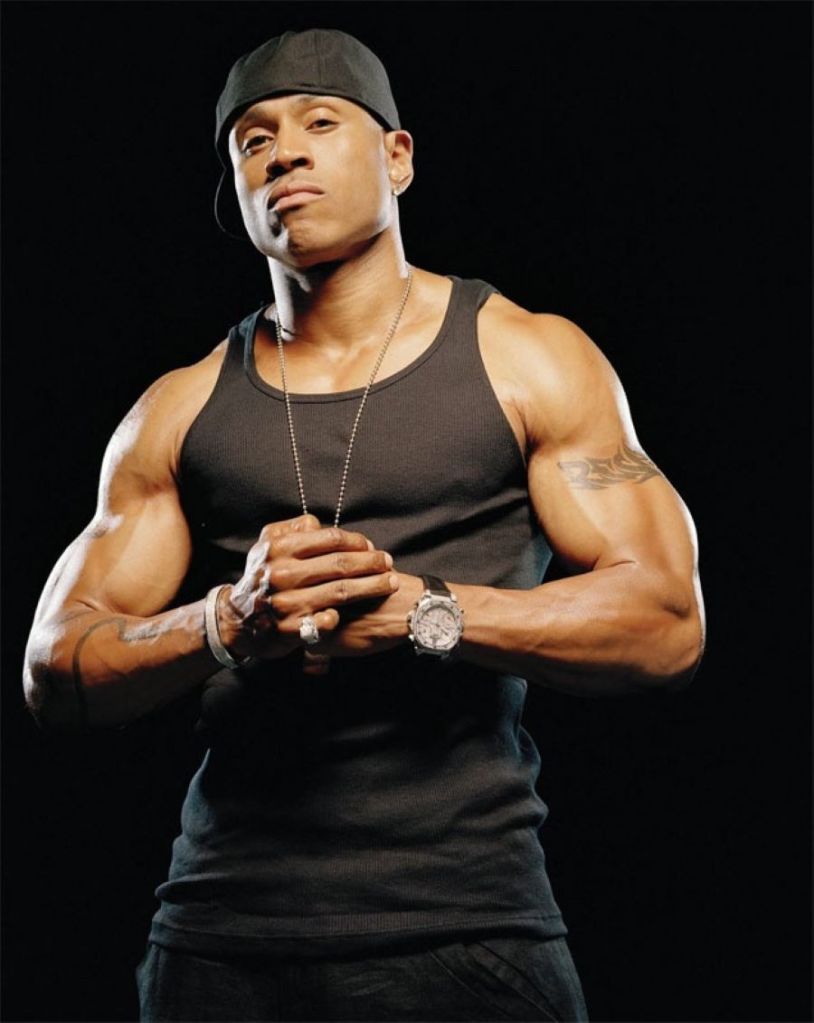
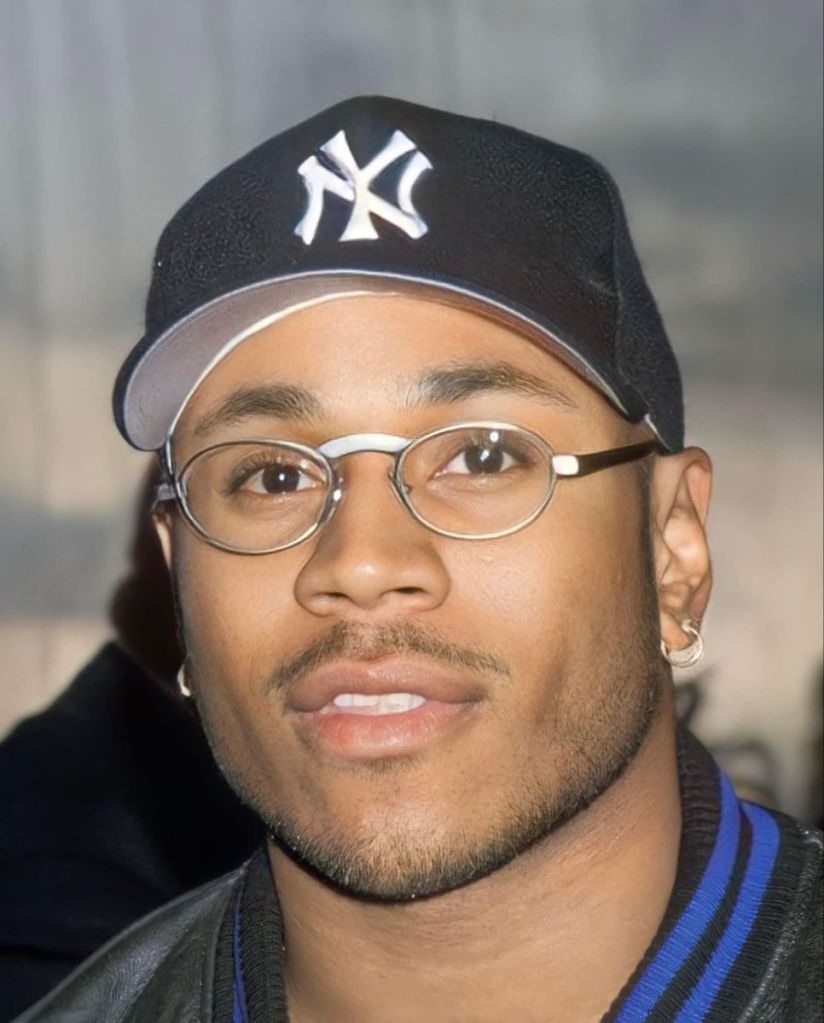
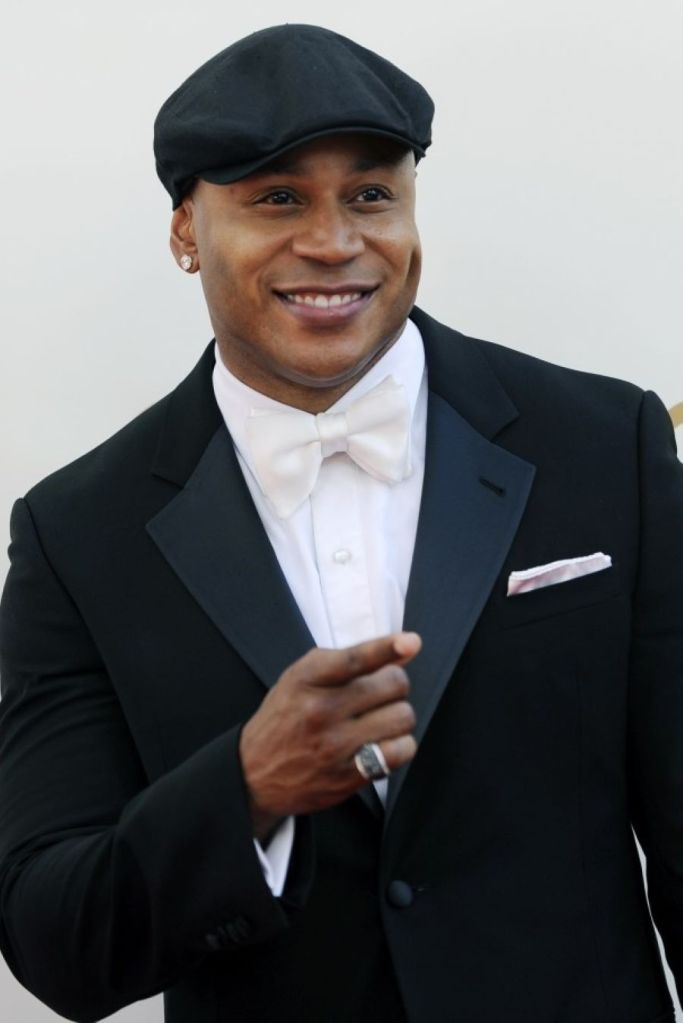
The Rapping Peanut-Butter Colored Adonis, one of the pioneers and GOATs of Rap Music,and timeless swagger.
LL Cool J—born James Todd Smith on January 14, 1968, in Queens, New York—emerged from humble beginnings to become one of hip-hop’s most enduring architects. Raised in a working-class household in the Hollis neighborhood, he began writing rhymes at age nine and was recording demos by his early teens. His breakthrough came in 1984 when he signed with the pioneering label Def Jam Recordings, co-founded by Russell Simmons and Rick Rubin. His debut album, Radio (1985), helped solidify the commercial viability of rap music, blending street lyricism with crossover appeal. From the outset, LL Cool J projected confidence, charisma, and lyrical precision—qualities that would earn him the title many fans bestow upon him: one of the GOATs of rap.
Throughout the late 1980s and 1990s, LL Cool J became synonymous with versatility. He balanced hard-edged battle rhymes with romantic ballads like “I Need Love,” proving that vulnerability could coexist with bravado in hip-hop masculinity. Albums such as Bigger and Deffer (1987) and Mama Said Knock You Out (1990) elevated him into rap royalty, with the latter earning a Grammy Award and cementing his comeback narrative. His accolades include multiple Grammy Awards, NAACP Image Awards, and in 2021, induction into the Rock and Roll Hall of Fame—a historic milestone recognizing his foundational role in shaping mainstream hip-hop. His Kennedy Center Honors recognition further affirmed his cultural impact beyond music.
Beyond the microphone, LL Cool J built a formidable acting career. His filmography includes roles in Deep Blue Sea (1999), Any Given Sunday (1999), and S.W.A.T. (2003). On television, he achieved long-running success starring as Sam Hanna in the hit CBS series NCIS: Los Angeles (2009–2023), a role that introduced him to a new generation of viewers and showcased his disciplined, commanding screen presence. His transition from rap pioneer to respected actor demonstrated rare longevity in an industry known for rapid turnover. Few artists have sustained relevance across four decades while maintaining credibility in both music and film.
Physically, LL Cool J has long been celebrated as a striking figure in entertainment—a peanut-butter–hued Adonis with a sculpted physique that redefined hip-hop sex appeal in the late twentieth century. His commitment to fitness, often displayed through sleeveless performances and confident stage presence, challenged stereotypes of rappers and expanded the image of Black male desirability in mainstream media. Yet beneath the aesthetic admiration lies a consistent narrative of discipline and devotion. Married since 1995 to Simone Smith, whom he often describes as his foundation, he is a devoted husband and father to their four children. His story—rooted in Queens grit, maternal encouragement, lyrical hunger, and spiritual grounding—embodies perseverance. LL Cool J is not merely a rapper or actor; he is a cultural institution whose artistry, humility, and longevity continue to shape the architecture of hip-hop and Black masculinity in American popular culture.
LL Cool J belongs in the Masculine Perfection series because he epitomizes the ideal of manhood in both form and presence. With his peanut-butter complexion, sculpted physique, and commanding aura, he embodies physical perfection while exuding confidence, discipline, and charisma. His music redefined Black male aesthetic in hip-hop, blending strength, vulnerability, and emotional intelligence, while his acting career demonstrates gravitas, control, and versatility on screen. Beyond his striking appearance, his humility, devotion to family, and sustained excellence over four decades make him a paragon of refined power, resilience, and timeless appeal—a man whose beauty, talent, and character are “drop-dead fine” and worthy of celebration as the ultimate masculine ideal.
References
LL Cool J. (2023). Biography. Rock & Roll Hall of Fame.
Rock and Roll Hall of Fame. (2021). LL Cool J Inductee Profile.
Dyson, M. E. (2007). Know What I Mean? Reflections on hip-hop. Basic Civitas Books.
Forman, M., & Neal, M. A. (Eds.). (2012). That’s the joint!: The hip-hop studies reader (2nd ed.). Routledge.
Grammy Awards. (n.d.). LL Cool J – Artist Profile. The Recording Academy.
CBS. (2009–2023). NCIS: Los Angeles series archives and cast biography.
Smith, S., & Cool J, L. L. (2022). Public interviews and award acceptance speeches compiled in media archives.
Across the evolving landscape of Western cinema and fashion, certain women have emerged not merely as stars, but as aesthetic archetypes—faces that defined decades, influenced global standards, and embodied what their eras called “perfection.” From the violet-eyed mystique of Elizabeth Taylor to the sculpted intensity of Angelina Jolie, the swan-like refinement of Audrey Hepburn, and the porcelain prominence of Brooke Shields—hailed as the face of the 1980s—these women collectively represent a lineage of luminous white femininity that Hollywood elevated into myth. Their beauty was not incidental to their fame; it was central to their branding, their marketability, and their enduring mystique.
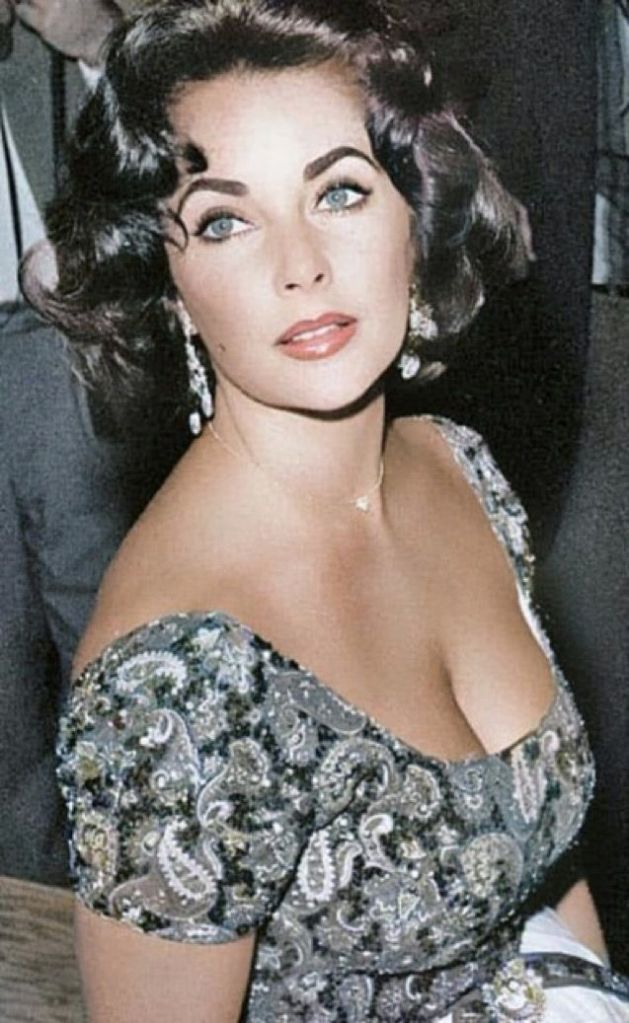
Elizabeth Taylor
Violet Eyes, Diamond Fire, and a Beauty That Ruled an Era
This photograph is the property of its respective owner. No copyright infringement intended.
Elizabeth Taylor was born on February 27, 1932, in London, England, to American parents, and rose to prominence as one of the most luminous screen icons of Hollywood’s Golden Age. From her earliest performances in films such as National Velvet (1944), she possessed a rare magnetism—an arresting combination of innocence and intensity that matured into one of cinema’s most legendary presences. Taylor’s beauty became the subject of global fascination, particularly her naturally dark hair, porcelain complexion, and famously rare violet-blue eyes, often enhanced by a double row of eyelashes caused by a genetic mutation (distichiasis). Studios framed her as the embodiment of aristocratic glamour, yet her screen performances—especially in Cat on a Hot Tin Roof (1958) and Butterfield 8 (1960)—proved she was not merely ornamental, but an actress of formidable emotional power.
Taylor’s artistry earned her two Academy Awards for Best Actress, first for Butterfield 8 (1960) and later for Who’s Afraid of Virginia Woolf? (1966), a performance widely regarded as one of the greatest in American cinema. In that latter role, she deliberately shed the polished veneer of conventional beauty, gaining weight and embracing harsh realism to portray Martha, a volatile and wounded wife, demonstrating that her greatness transcended physical appearance. Her peers often remarked that the camera did not simply capture her; it adored her. Director George Stevens once noted that Taylor possessed a face “made for the close-up.” At the same time, media coverage of the mid-twentieth century routinely described her as “the most beautiful woman in the world,” a superlative repeated in magazines across Europe and America.
Beyond the screen, Taylor’s life was inseparable from spectacle. Her eight marriages—including two to actor Richard Burton—fed public fascination, framing her as a romantic heroine whose passions were as brilliant as her jewels. Indeed, her love of extraordinary gemstones became legendary; pieces such as the Taylor-Burton Diamond and the La Peregrina Pearl were not merely accessories but symbols of opulence and self-possession. Yet her identity as an “Ivory Doll” transcends adornment. She represented a Eurocentric ideal of mid-century glamour—radiant skin, symmetrical features, regal bearing—yet she infused that ideal with depth, vulnerability, and unapologetic sensuality. In an era that often reduced women to aesthetic objects, Taylor wielded beauty as power.
Elizabeth Taylor was considered extraordinary not only because she conformed to classical Western standards of loveliness, but because she animated them with intensity, resilience, and emotional authenticity. Her beauty was described as almost mythic—“too much and yet perfect,” wrote contemporary critics—suggesting that she seemed sculpted rather than born. Even as fashions changed, her image endured as a benchmark of cinematic glamour. To call her an Ivory Doll is to acknowledge how she embodied and defined a particular archetype of luminous white femininity in Hollywood’s imagination—untouchable, jeweled, and unforgettable—yet unmistakably human beneath the brilliance.
Angelina Jolie
Sculpted Beauty, Untamed Spirit, and a Face That Redefined Modern Glamour
This photograph is the property of its respective owner. No copyright infringement intended.
Angelina Jolie was born on June 4, 1975, in Los Angeles, California, the daughter of Academy Award–winning actor Jon Voight and actress Marcheline Bertrand. Emerging in the 1990s with an unconventional intensity, Jolie quickly distinguished herself from traditional Hollywood ingénues. Her breakthrough role in Girl, Interrupted (1999) earned her an Academy Award for Best Supporting Actress, solidifying her reputation as a performer capable of raw psychological depth. Yet it was her portrayal of Lara Croft in Lara Croft: Tomb Raider (2001) that crystallized her global image: bold, statuesque, and unmistakably striking. Her full lips, high cheekbones, luminous pale complexion, and piercing gaze were hailed by media outlets as embodying a contemporary evolution of classical beauty—sensual yet severe, delicate yet formidable.
Jolie’s beauty has often been described as sculptural and otherworldly, evoking Renaissance portraiture infused with modern edge. Critics and fashion editors repeatedly referred to her as one of the most beautiful women in the world, with magazines such as People and Vanity Fair placing her atop annual beauty rankings. Unlike the soft glamour of Old Hollywood, Jolie’s aesthetic projected intensity—an almost feline poise that seemed to challenge the camera rather than merely invite it. Director Clint Eastwood once remarked on her emotional authenticity before the lens, while collaborators noted her ability to command attention in stillness. Her presence in films such as Mr. & Mrs. Smith (2005) and Maleficent (2014) reinforced her image as a woman whose beauty carried an undercurrent of danger and sovereignty.
Her personal life amplified public fascination. High-profile marriages to actors Billy Bob Thornton and Brad Pitt, along with her role as a mother to six children from diverse cultural backgrounds, positioned her at the intersection of glamour and global humanitarianism. Jolie’s extensive advocacy work with the United Nations High Commissioner for Refugees (UNHCR) reframed her public identity beyond aesthetics, aligning beauty with conscience and moral engagement. In 2013, her public disclosure of a preventive double mastectomy due to a BRCA1 gene mutation further reshaped cultural conversations about women’s health, courage, and bodily autonomy—revealing vulnerability beneath the polished exterior.
Angelina Jolie is considered an Ivory Doll not simply because she reflects Western standards of physical allure, but because she embodies a modern archetype of pale, high-fashion elegance fused with intellectual gravity and emotional complexity. Her features—often described as symmetrical to near mathematical precision—became templates in cosmetic and fashion industries, influencing trends in lip augmentation and facial contouring. Yet what renders her extraordinary is the paradox she carries: ethereal beauty combined with visible scars of experience, cinematic grandeur intertwined with humanitarian conviction. She stands as a figure through whom contemporary culture reimagined white femininity—not fragile porcelain, but carved marble—resilient, luminous, and enduring.
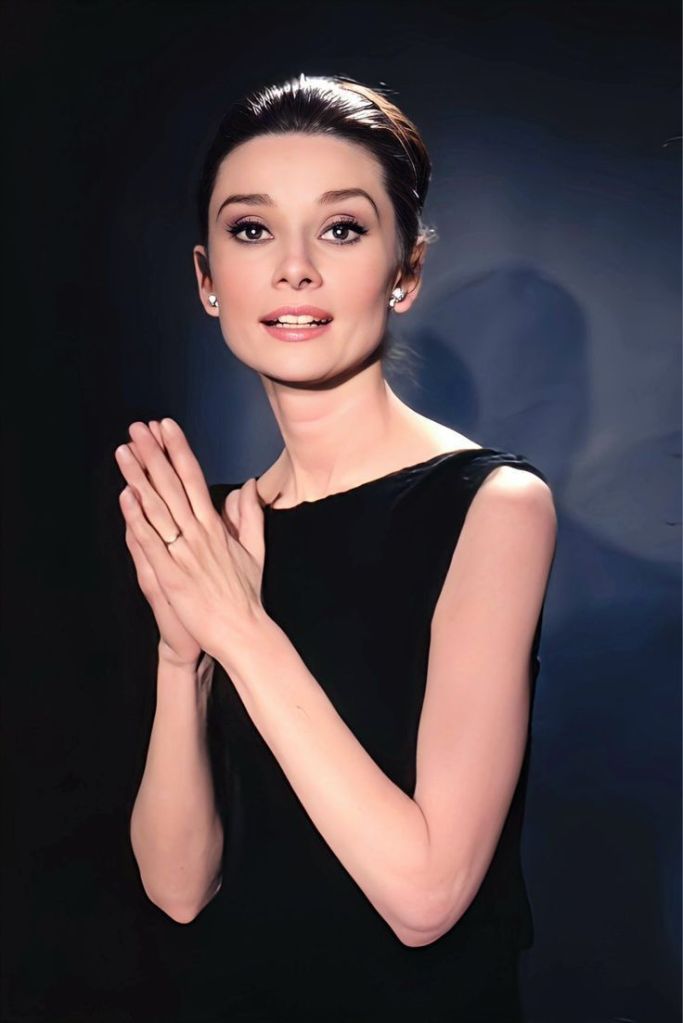
Audrey Hepburn
Swan-Necked Elegance, Timeless Grace, and the Poetry of Simplicity
This photograph is the property of its respective owner. No copyright infringement intended.
Audrey Hepburn was born on May 4, 1929, in Ixelles, Belgium, and rose to international prominence as one of the most refined and enduring icons of twentieth-century cinema. Emerging from the shadows of World War II Europe, where she endured hardship during the Nazi occupation of the Netherlands, Hepburn brought to Hollywood not only delicacy of frame but resilience of spirit. Her breakthrough performance in Roman Holiday (1953) opposite Gregory Peck earned her the Academy Award for Best Actress, instantly positioning her as a new archetype of feminine beauty—slender, luminous, and disarmingly natural. In an era dominated by voluptuous glamour, Hepburn’s big doe eyes, arched brows, and swan-like neck introduced a minimalist elegance that redefined aesthetic standards.
Her collaboration with designer Hubert de Givenchy further immortalized her image, particularly in Breakfast at Tiffany’s (1961), where the black Givenchy dress became a symbol of chic restraint and cosmopolitan poise. Hepburn’s beauty was frequently described as “elfin” and “ethereal,” marked not by excess but by proportion and grace. Critics emphasized her expressive eyes and gamine silhouette, suggesting that her allure emanated from movement and manner as much as physical symmetry. Unlike the sultry magnetism of contemporaries, Hepburn’s presence conveyed innocence blended with intelligence—a quiet radiance that seemed to glow from within rather than demand attention.
Hepburn’s accolades extended beyond her Academy Award to include multiple BAFTA Awards, a Tony Award, and a posthumous Presidential Medal of Freedom for her humanitarian work. Later in life, she served as a Goodwill Ambassador for UNICEF, drawing upon her childhood experiences of hunger to advocate for vulnerable children worldwide. Public admiration for her beauty thus became inseparable from admiration for her compassion. Writer Dominick Dunne once observed that Hepburn possessed “a face that mirrored kindness,” reinforcing the perception that her loveliness was inseparable from moral refinement. In cultural memory, she remains less a figure of spectacle and more an embodiment of cultivated grace.
Audrey Hepburn is considered an Ivory Doll not merely because she reflected mid-century European ideals of pale, delicate femininity, but because she refined them into something enduring and aspirational. Her extraordinary quality lay in paradox: fragility paired with fortitude, simplicity elevated to haute couture, and understatement transformed into legend. She did not overwhelm the gaze; she invited it gently. In doing so, she expanded Hollywood’s conception of beauty—proving that elegance need not shout to be unforgettable, and that true radiance is as much character as countenance.
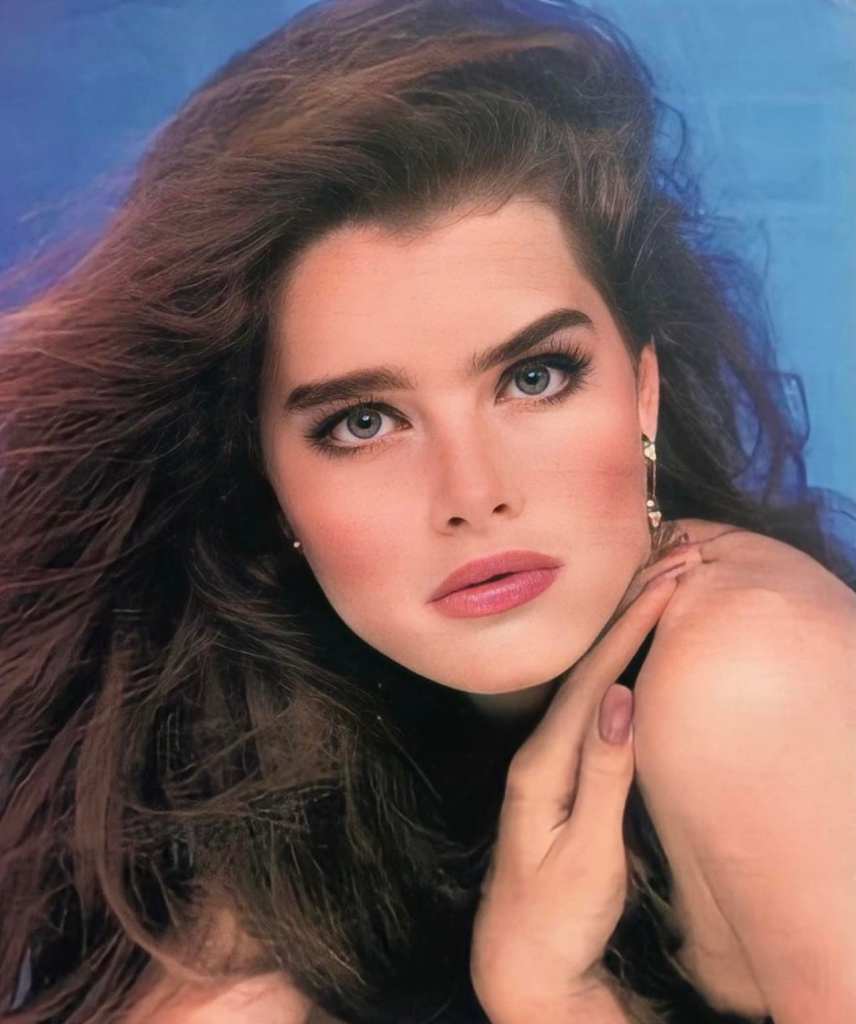
Brooke Shields
The Face of the ’80s—Porcelain Beauty, Power Brows, and Cultural Provocation
This photograph is the property of its respective owner. No copyright infringement intended.
Brooke Shields was born on May 31, 1965, in New York City, and emerged as one of the most recognizable faces of late twentieth-century popular culture. A child model before she was a teenager, Shields entered the public imagination with striking force—tall, poised, and possessed of luminous fair skin framed by famously bold eyebrows that would become her signature. Her early film roles, particularly in Pretty Baby (1978) and The Blue Lagoon (1980), ignited both acclaim and controversy, placing her at the intersection of innocence and sensuality. By the early 1980s, she was widely heralded as “the face of the ’80s,” a supermodel-actress whose image saturated fashion campaigns, magazine covers, and television screens with unprecedented ubiquity.
Her Calvin Klein jeans advertisements—most notably the provocative line, “You want to know what comes between me and my Calvins? Nothing”—became emblematic of the era’s bold commercial aesthetic and cemented her status as a cultural phenomenon. Photographers and designers praised her classical proportions, alabaster complexion, and expressive eyes, often comparing her to Renaissance portraiture infused with modern attitude. Shields’ beauty was described as both wholesome and daring, a duality that allowed her to navigate film, fashion, and Broadway with equal visibility. Unlike fleeting trends, her look defined a decade’s visual language, influencing everything from eyebrow styles to the merging of high fashion with youth culture.
Shields’ career extended beyond modeling into acting and academia; she later graduated from Princeton University, challenging stereotypes that beauty and intellect were mutually exclusive. Public commentary on her appearance frequently emphasized symmetry and camera magnetism—qualities that made her a favorite of photographers such as Richard Avedon and Francesco Scavullo. At the height of her fame, media outlets routinely listed her among the world’s most beautiful women, framing her as an icon of American glamour during a period of cultural excess and stylistic experimentation. Even as public scrutiny surrounded aspects of her early career, Shields’ composure and longevity demonstrated resilience beneath the porcelain exterior.
Brooke Shields is considered an Ivory Doll not simply because she embodied Eurocentric ideals of fair-skinned, classical femininity, but because she became the definitive aesthetic emblem of a transformative decade. Her extraordinary quality lay in her ability to project vulnerability and confidence simultaneously—soft features underscored by an unwavering gaze. As the face of the ’80s, she symbolized youth, luxury, and media saturation in equal measure. In cultural memory, her image remains suspended in time: luminous, sculpted, and unmistakably emblematic of an era when beauty became both brand and battleground.
Yet beauty, in their cases, functioned as more than symmetry and complexion. It became narrative. Taylor’s opulence shimmered with diamonds and drama; Hepburn’s elegance whispered restraint and cultivated grace; Shields’ youthful glamour fused innocence with provocation; Jolie’s angular features suggested power and modern autonomy. Each woman reflected the aesthetic and psychological needs of her generation. Their faces appeared on magazine covers, film posters, couture campaigns, and philanthropic platforms, shaping global conversations about desirability, womanhood, and aspiration. They were described in superlatives—“the most beautiful woman in the world,” “timeless,” “otherworldly,” “iconic”—phrases that reveal how deeply society invests meaning in physical form.
To call them “Ivory Dolls” is not merely to reference complexion, but to identify a particular cultural positioning: elevated, polished, displayed, and often idealized as delicate yet untouchable. The term gestures toward how Western media historically framed pale femininity as the aesthetic benchmark—porcelain skin illuminated under studio lights, features sculpted into classical proportion, bodies adorned in couture and jewels. In this framing, beauty becomes both privilege and burden: a pedestal that amplifies admiration while intensifying scrutiny. These women were celebrated, commodified, protected, and critiqued—sometimes all at once.
Together, they form a gallery of cinematic and cultural memory—figures whose appearances shaped industries and influenced generations of women’s self-perception. Their extraordinary quality was not solely a matter of genetic fortune, but of the interplay among image, performance, media narrative, and public imagination. In studying their beauty, one is not merely studying faces; one is examining how power, race, glamour, commerce, and femininity converge in the construction of iconography. The Ivory Dolls, then, are more than beautiful women—they are mirrors reflecting what their societies chose to exalt, preserve, and remember.
While Elizabeth Taylor, Angelina Jolie, Audrey Hepburn, and Brooke Shields did not always frame their public identities around race-specific discourse, their documented actions—ranging from civil rights support to global humanitarian advocacy and cross-cultural engagement—reflect patterns of inclusion and compassion rather than hostility toward Black people.
References
Brown, S. (2022). Elizabeth Taylor: The grit and glamour of an icon. Lyons Press.
Parish, J. R. (2011). Elizabeth Taylor: Hollywood’s last star. Wiley.
Spoto, D. (1995). A passion for life: The biography of Elizabeth Taylor. HarperCollins.
Turan, K. (2011, March 23). Elizabeth Taylor dies at 79; legendary actress won 2 Oscars. Los Angeles Times.
Biskind, P. (2010). Star: How Warren Beatty seduced America. Simon & Schuster.
Jolie, A. (2013, May 14). My medical choice. The New York Times.
Parish, J. R. (2017). Hollywood beauties: The evolution of screen glamour. McFarland.
UNHCR. (2022). Angelina Jolie’s humanitarian advocacy and global impact. United Nations High Commissioner for Refugees.
Dunne, D. (2004). Too much money. Crown Publishers.
Hepburn, S. (2015). Audrey Hepburn: An elegant spirit. Atria Books.
Spoto, D. (2006). Enchantment: The life of Audrey Hepburn. Harmony Books.
United Nations Children’s Fund (UNICEF). (1993). Audrey Hepburn’s humanitarian legacy. United Nations.
Shields, B. (2014). There was a little girl: The real story of my mother and me. Dutton.
Shields, B. (2021). Brooke Shields is not allowed to get old: Thoughts on aging as a woman. Flatiron Books.
Trebay, G. (2021, November 8). Brooke Shields on aging, beauty and survival. The New York Times.
Vogue Archive. (1980–1985). Brooke Shields cover features and fashion editorials. Condé Nast.
Where faith, history, and truth illuminate the Black experience.
THE BROWN GIRL DILEMMA
Where faith, history, and truth illuminate the Black experience.




 THE BROWN GIRL DILEMMA