
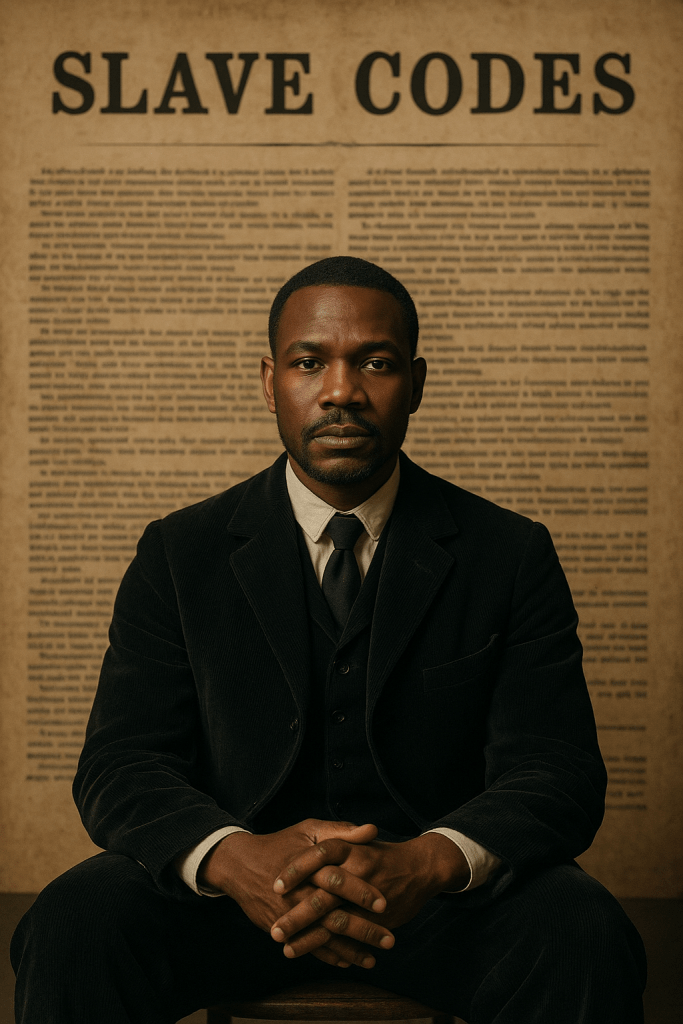
The institution of slavery in the Americas was not sustained by force alone but was codified through laws designed to regulate every aspect of enslaved Africans’ lives. These laws, known as slave codes, were crafted to protect the economic interests of slaveholders and to enforce racial hierarchy. The dilemma lies in how these codes dehumanized an entire race while simultaneously creating a legal system that institutionalized racism and justified the oppression of millions of African people (Higginbotham, 1978).
Slave codes emerged in the 17th century as colonial powers sought to control the growing African populations brought through the transatlantic slave trade. The first formalized set of slave codes appeared in Barbados in 1661, serving as a model for other colonies, including Virginia and South Carolina. These laws defined enslaved Africans not as human beings but as property—chattel—to be bought, sold, and inherited (Hall, 1992).
One of the most striking aspects of the slave codes was their comprehensive control over enslaved people’s daily lives. They restricted movement, prohibited literacy, and punished gatherings. Enslaved individuals were forbidden from assembling without white supervision, owning property, or testifying in court against white people (Berlin, 2003). These measures ensured that enslaved Africans remained socially, politically, and economically powerless.
The Virginia Slave Codes of 1705 marked a turning point in colonial America. This legislation legally solidified racial slavery by declaring that all imported non-Christian servants were to be enslaved for life. It also mandated that the status of the child followed that of the mother, guaranteeing that slavery would perpetuate across generations (Morgan, 1975). This legal structure created a hereditary caste system that positioned Blackness as synonymous with bondage.
Religious justifications often accompanied these codes. Many European colonists invoked Christianity as a moral defense for enslavement, claiming that slavery “civilized” Africans and exposed them to the gospel. However, the same laws barred the baptism of enslaved individuals from granting them freedom, illustrating the hypocrisy of such reasoning (Raboteau, 1978).
Punishments under the slave codes were brutal and served to instill fear. Whipping, branding, mutilation, and even death were common responses to resistance or attempted escape. These punishments were public spectacles meant to deter others from rebellion. The system used violence as both punishment and psychological warfare (Genovese, 1974).
The dilemma of the slave codes also extended to poor white laborers. While these laws primarily targeted Africans, they simultaneously elevated whiteness as a privileged status. Poor whites, who might otherwise have aligned with enslaved Africans due to shared economic hardship, were instead granted social superiority through racial distinction (Roediger, 1991).
This legal racial divide ensured that class solidarity among the oppressed was nearly impossible. By creating a buffer of racial privilege, the slave codes prevented the unity that could have challenged the planter elite. In this way, the laws not only oppressed Black people but also manipulated white identity for the benefit of the ruling class.
Slave codes also restricted education, fearing that literacy would inspire rebellion or awareness of rights. Enslaved individuals caught reading or writing could face severe punishment. By denying education, the system sought to suppress intellect and self-awareness among the enslaved population (Cornelius, 1991).
Religion, however, became a space of resistance. Despite prohibitions, enslaved Africans created secret worship gatherings known as “hush harbors,” blending African spiritual traditions with Christian teachings. These gatherings subverted the slave codes’ attempt to control their souls, showing that faith could serve as a form of rebellion (Raboteau, 1978).
The economic motivation behind the codes cannot be overstated. The laws protected the immense profits generated by slave labor on plantations. The human cost of this wealth accumulation was deliberately ignored, replaced by a moral rationalization that framed Africans as less than human. This economic greed formed the foundation for modern racial capitalism (Baptist, 2014).
Rebellion was the greatest fear of slaveholders, and thus the codes expanded after every insurrection. Following uprisings like the Stono Rebellion (1739) and Nat Turner’s Rebellion (1831), colonies tightened restrictions—limiting movement, banning assembly, and empowering militias to patrol enslaved communities (Egerton, 2004). The more resistance occurred, the harsher the legal controls became.
These codes were not isolated to the colonial period. After the Civil War, similar restrictions resurfaced through “Black Codes,” which sought to control freedmen by limiting their rights to work, vote, and move freely. Thus, the spirit of the slave codes lived on, transitioning from slavery to segregation (Litwack, 1998).
The legal legacy of slave codes profoundly shaped American law enforcement and criminal justice. Laws that once criminalized Black freedom evolved into modern systems of racial profiling, mass incarceration, and economic disenfranchisement. This continuity reveals how deeply the ideology of control was embedded in American governance (Alexander, 2010).
Psychologically, the slave codes inflicted generational trauma. They taught Black people that their lives were subject to constant surveillance and punishment. At the same time, they conditioned white society to associate authority with dominance over Black bodies, a mindset that still lingers in systemic racism today (hooks, 1992).
The slave codes also stripped enslaved people of family integrity. Enslaved marriages had no legal recognition, and children could be sold away at any moment. This destruction of kinship ties was another method of control, ensuring emotional dependency on slaveholders rather than familial bonds (Gutman, 1976).
Despite the overwhelming control, enslaved Africans continuously resisted—through work slowdowns, escapes, sabotage, and the preservation of culture. Their defiance proved that no law could extinguish the human will for freedom. Even within the confines of the slave codes, they found ways to reclaim their humanity (Franklin & Schweninger, 1999).
The dilemma of the slave codes challenges America’s moral conscience. These laws expose the hypocrisy of a nation that declared liberty and justice while codifying racial slavery. They reveal how systemic racism was not accidental but carefully engineered and legally enforced.
Understanding the history of the slave codes is essential to confronting present-day inequalities. They remind us that the struggle for justice requires dismantling the legal and psychological remnants of slavery that persist in modern institutions. The codes may have been abolished, but their legacy continues to echo through every system built upon their foundation.
References
Alexander, M. (2010). The New Jim Crow: Mass Incarceration in the Age of Colorblindness. New Press.
Baptist, E. E. (2014). The Half Has Never Been Told: Slavery and the Making of American Capitalism. Basic Books.
Berlin, I. (2003). Generations of Captivity: A History of African-American Slaves. Harvard University Press.
Cornelius, J. D. (1991). “When I Can Read My Title Clear”: Literacy, Slavery, and Religion in the Antebellum South. University of South Carolina Press.
Egerton, D. R. (2004). He Shall Go Out Free: The Lives of Denmark Vesey. Rowman & Littlefield.
Franklin, J. H., & Schweninger, L. (1999). Runaway Slaves: Rebels on the Plantation. Oxford University Press.
Genovese, E. D. (1974). Roll, Jordan, Roll: The World the Slaves Made. Pantheon Books.
Gutman, H. G. (1976). The Black Family in Slavery and Freedom, 1750–1925. Vintage Books.
Hall, N. A. T. (1992). Slave Society in the British Leeward Islands at the End of the Eighteenth Century. Yale University Press.
Higginbotham, A. L. (1978). In the Matter of Color: Race and the American Legal Process. Oxford University Press.
hooks, b. (1992). Black Looks: Race and Representation. South End Press.
Litwack, L. F. (1998). Trouble in Mind: Black Southerners in the Age of Jim Crow. Knopf.
Morgan, E. S. (1975). American Slavery, American Freedom: The Ordeal of Colonial Virginia. W. W. Norton & Company.
Raboteau, A. J. (1978). Slave Religion: The “Invisible Institution” in the Antebellum South. Oxford University Press.
Roediger, D. R. (1991). The Wages of Whiteness: Race and the Making of the American Working Class. Verso
 THE BROWN GIRL DILEMMA