Category Archives: the brown girl dilemma

Why is Active or Covert Racism Unacceptable while Passive Racism is Acceptable?

Racism continues to be a deep moral, social, and structural challenge in modern societies. One useful way to approach it is by distinguishing among active (overt) racism, covert (hidden) racism, and passive racism (inaction or indifference). Understanding these distinctions helps clarify why some forms of racism are more visible and widely condemned while others persist with relative tolerance—and why that tolerance is itself problematic.

Active racism—or overt racism—is characterized by intentional, explicit actions or attitudes meant to discriminate, demean or exclude individuals because of their race. Examples include using a racial slur, refusing service because someone is Black, or endorsing segregationist policies. These are usually socially unacceptable, easily identifiable, and often illegal in many jurisdictions. Researchers describe overt racism as “actions which have as their stated or explicit goal the maintenance of the system of racism and the oppression of those in the targeted racial groups.” Fourmilab+2PMC+2

Covert racism (also referred to as hidden, subtle, or indirect racism) involves actions, policies or attitudes that may appear race‑neutral but have racially disparate effects, or are motivated by bias that is concealed. It is socially less obvious, and thus often harder to challenge. As defined, “covert racism is a form of racial discrimination that is disguised, hidden or subtle” and operates through passive or seemingly passive means. EBSCO+2Diversity Social+2 Because it is less visible it can persist without full public scrutiny, yet its impact is real and deep.

Passive racism refers to the failure to act against racist behaviour, structures or systems. It is a form of complicity, often through silence or inaction: choosing not to challenge a racist joke, not questioning a biased hiring decision, or simply accepting the status quo. One definition frames passive racism as “beliefs, attitudes, and actions that contribute to the maintenance of racism, without openly advocating violence or oppression.” Fourmilab+1

The question arises: if active and covert racism are unacceptable, why is passive racism frequently tolerated, even by those who identify as antiracist? One reason is visibility: active racism is clear, easily condemned, and often subject to legal or social sanction. Covert racism is harder but still involves discernible actions or policies. Passive racism, however, is ambiguous—silence, omission, or indifference—making it easier for institutions and individuals to ignore or rationalize.

Furthermore, passive racism is tolerated because many in society carry implicit biases and prefer to see themselves as “not racist” rather than actively antiracist. As one critique puts it: “standing on a moving sidewalk and letting it carry you” (Tatum, 1997) is passive racism. Learn to be Antiracist+1 The comfort of inaction is compelling—actively opposing racism requires energy, risk, and change; passive support or silence demands little.

Another factor is that systems and institutions are designed in ways that embed racial advantage without explicit racist intent. These systems rely on passive participation. When the majority does not speak out or challenge inequitable practices, they perpetuate structural racism. For example, when whites in hiring, housing, or policing default to “business as usual,” racial disparities persist even in the absence of conscious discriminators.

Let us compare some examples. Active racism: a store clerk telling a Black customer “we don’t serve your kind here.” Covert racism: a company policy that requires extra credentialing primarily disadvantaging Black applicants though the policy is framed as neutral. Passive racism: a colleague witnessing a racially charged remark and failing to object, thereby allowing the culture of bias to continue. These distinctions highlight different levels of culpability and agency.

The harm of passive racism is often underestimated. Because it lacks the overt maliciousness of active racism, it seems less urgent—but its cumulative effect is substantial. When individuals repeatedly encounter non‐responses to bias, when institutions consistently fail to act, the message is clear: the status quo remains acceptable. Over time, passive racism sustains the racial hierarchy, undermines trust, and deepens intergenerational harm.

Scholarly literature confirms that covert and passive forms of racism are significant barriers to racial equity. For example, critical reviews show that subtle forms of racism—including “inaction” when witnessing racial bias—contribute to stress, decreased wellbeing, and reduced trust in institutions among racialised groups. PMC+1 In other words, what is less visible is often just as destructive.

From a theological or moral perspective, one might say that passive racism is unacceptable because it violates core commitments to justice, solidarity and dignity. To remain silent in the face of injustice is morally complicit. As the biblical injunction “learn to do right; seek justice, correct oppression” (Isaiah 1:17) suggests, inaction in the face of wrongdoing is itself a moral failing.

One might ask: if passive racism is so harmful, why do many institutions emphasise only overt racism? Legal frameworks and policies tend to address explicit discrimination, which is easier to document and litigate. Covert and passive racism—because of its ambiguity or lack of intent—are more difficult to address through traditional regulation. That regulatory gap contributes to the tolerance of inaction.

In workplaces, passive racism may mean failing to promote or protect Black employees when bias is evident, allowing micro‑aggressions to accumulate without intervention. Covert racism may appear as patterns of under‑hiring or exclusion masked as “poor fit” or “culture mismatch.” The former is tolerated, the latter disguised—but both enable inequality. CultureAlly+1

In housing, for instance, active racism might include refusing to rent to a Black family. Covert racism might involve setting rental minimums or credit score thresholds that disproportionately exclude Black renters and are justified as neutral. Passive racism might manifest when neighbours or managers see unequal treatment but do nothing. The net effect is generational disadvantage in home ownership, wealth accumulation and neighbourhood quality.

In criminal justice, active racism includes use of racial slurs by police, overt profiling. Covert racism may be policies that lead to higher stop‐rates in Black neighbourhoods under the guise of “crime prevention.” Passive racism is the failure of bystanders, community leaders or institutions to challenge disproportionate policing, thus allowing it to continue. Such passivity amplifies racial trauma. Diversity Social+1

It is also worth noting that many people prefer passive racism because it allows them to believe they “aren’t racist” while not actively confronting their privilege, biases or complicity. This self‐comforting stance sustains racial inequities. Active or covert racism forces a confrontation; passive racism avoids it.

Ethically, passive racism is unacceptable for three main reasons. First, it sustains harm by omission—silence is not neutral. Second, it places the burden on victims to continually challenge discrimination rather than holding institutions accountable. Third, it blocks systemic transformation because change requires action, not just lack of hostile intent.

One might argue that passive racism is “less bad” than active harmful racist acts. But the distinction between degrees of harm does not excuse tolerance. When societal structures rely on millions of passive decisions—“I did nothing,” “I did not challenge it”—the result is a continuing system of inequality. The sum of many passive contributions is substantial.

In conclusion, active and covert racism are widely condemned precisely because their violations of dignity and justice are clear and actionable. But passive racism is too often tolerated because it is invisible, indirect, and socially acceptable. Yet the moral imperative remains: to achieve racial justice, one must not only refrain from hostile acts, but actively resist racist systems, challenge covert bias, and refuse the easy path of passivity. Silence or inaction is no longer an option.

References

Amodio, D. M. (2001). The implications of implicit social cognition for judgments and behavior toward others. Personality and Social Psychology Review, 5(1), 3‑20.

Baskin, A. (2023). Covert racism. Research Starters – Social Sciences & Humanities. EBSCO. Retrieved from https://www.ebsco.com/research-starters/social-sciences-and-humanities/covert-racism EBSCO

CultureAlly. (n.d.). Overt vs. covert racism – Definition & comparison. Retrieved from https://cultureally.com/blog/overtvscovertracism CultureAlly

Diversity for Social Impact. (2025). Over­t racism vs covert racism – Understand meanings and implications. Retrieved from https://diversity.social/covert-overt-racism/ Diversity Social

Learn To Be Antiracist. (n.d.). Glossary of terms. Retrieved from https://www.learntobeantiracist.com/glossary Learn to be Antiracist

Orr, A. J. (2024). Overt/expressed vs covert discrimination. Research Starters – Sociology. EBSCO. EBSCO

Umbrella Collective. (2024, June 10). Passive vs active anti‑racism: What it is and why it matters. Retrieved from https://www.umbrellacollective.org/blog/2024/6/10/passive-vs-active-anti-racism-what-it-is-and-why-it-matters/ Umbrella Collective
Sacred Femininity: A Woman’s Becoming

This photograph is the property of its respective owner. No copyright infringement intended.

Sacred femininity is not merely an aesthetic—it is a divine revelation. It speaks of the eternal essence that God placed within woman when He formed her from man’s rib and breathed into her the breath of life (Genesis 2:21–23, KJV). This sacredness is not defined by worldly ideals but by divine purpose. It is the glory of creation’s balance, the embodiment of wisdom, compassion, and strength hidden in softness.

The becoming of a woman is both spiritual and ancestral. It is the long pilgrimage from brokenness to wholeness, from survival to sovereignty. For the Black woman, this journey carries generational echoes—cries from foremothers who birthed nations in chains yet sang freedom into existence. Her becoming is not a new story, but a continuation of an ancient one written on papyrus, in the sands of Kemet, and in the margins of a slave Bible.

To become sacred is to remember. The modern world has taught women to perform, to compete, and to commodify their beauty, yet sacred femininity calls her to return—to the Edenic origin where she was not objectified but ordained. She is not the temptation; she is the temple. Her beauty is not vanity—it is divinity made visible.

In a culture that profits from insecurity, sacred femininity is resistance. When a woman reclaims her worth beyond her body, she dismantles a billion-dollar industry of comparison and control. Her holiness becomes protest; her modesty becomes power. The act of self-love becomes an altar where she meets God.

The Black woman’s becoming cannot be divorced from the historical dehumanization of her image. From the Jezebel stereotype that sexualized her body to the Mammy caricature that muted her soul, she has had to rebuild her identity from ashes. Yet like the phoenix, she rises—clothed not in the garments of oppression but in the robe of righteousness (Isaiah 61:10, KJV).

Becoming sacred means understanding that pain has purpose. Every trial, heartbreak, and injustice becomes a teacher. Through tears, she learns the language of faith. Through struggle, she births endurance. Through silence, she finds her voice. The womb of womanhood is not only physical—it is spiritual, birthing dreams, nations, and legacies.

Sacred femininity is not submission to man—it is submission to God. When a woman walks in divine order, her power multiplies, not diminishes. Submission, in its biblical sense, is alignment—a woman aligned with God’s purpose becomes a mirror of His grace. Her femininity is not fragile; it is fortified by faith.

This becoming is also a healing—a spiritual reclamation of what was stolen. For centuries, the Black woman’s body was a battlefield, her womb exploited, her image distorted. But through divine awakening, she begins to see herself as God sees her: fearfully and wonderfully made (Psalm 139:14, KJV). Her melanin is no longer a mark of marginalization but a manifestation of majesty.

The sacred woman knows that beauty is both physical and metaphysical. Her glow is not from cosmetics but from consecration. Her elegance is not performed but possessed. Proverbs 31 describes her not as a passive figure but as an enterprising, wise, and fearless force—a woman whose value is far above rubies.

To become sacred is to unlearn survival and embrace sovereignty. Many women have learned to endure, but few have learned to reign. Sacred femininity teaches her to sit on her throne, not as an idol of vanity, but as a vessel of virtue. It is the spiritual homecoming of the daughter of Zion.

The woman’s becoming is deeply tied to her community. She is both nurturer and nation-builder. From Harriet Tubman guiding souls to freedom, to contemporary queens leading boardrooms and ministries, her divine assignment remains the same: to restore what was broken, to heal what was wounded, and to give life where death was declared.

Sacred femininity also redefines strength. It is not the hardness that the world celebrates but the softness that sustains. It is the ability to forgive without forgetting, to love without losing oneself, and to stand without shouting. Strength, in its purest form, is sanctified gentleness.

Her becoming is also prophetic. Each generation of women births a new revelation of what it means to walk in God’s image. Eve introduced life, Ruth embodied loyalty, Esther demonstrated courage, Mary carried divinity, and today’s woman carries their collective anointing—an inheritance of faith and fire.

In the modern age, sacred femininity stands as a rebuke to artificial empowerment. The world tells women that power is found in dominance and detachment, but the sacred woman knows that true power flows from humility, holiness, and harmony. Her authority is not granted by man but ordained by heaven.

For Black women, this sacred identity also means rejecting colorism, texturism, and the colonial beauty codes that fractured sisterhood. Each shade of melanin, each curl pattern, each ancestral feature reflects a facet of God’s creative genius. Her hair is her crown; her complexion, her covenant.

Sacred femininity restores balance between the masculine and feminine principles of creation. It honors the divine order in relationships, family, and leadership—without erasing individuality or equality. It calls men and women to walk in spiritual unity, where love becomes leadership and service becomes strength.

The woman’s becoming is both internal and eternal. It is a daily practice of prayer, purpose, and purification. She must shed the old self like snakeskin—ego, shame, and fear—to step into her divine assignment. In doing so, she becomes both priestess and prophet of her destiny.

Sacred femininity is also communal; it cannot thrive in isolation. Women heal when they gather—when sisters speak life into one another instead of competing for validation. The circle of sisterhood is an altar where collective healing takes place, a sacred echo of the matriarchal wisdom that once guided nations.

Ultimately, A Woman’s Becoming is not a final arrival but an eternal evolution. To become sacred is to live in constant renewal—to be water and fire, gentle yet unyielding. Every season of her life, from maiden to matriarch, reveals a deeper reflection of God’s glory within her.

In her becoming, she learns that holiness is not perfection but presence—the awareness of God within her. She is both the daughter and the dwelling place, the reflection and the revelation. And when she finally sees herself through divine eyes, she becomes what she was always meant to be: sacred, sovereign, and whole.


References

  • The Holy Bible, King James Version. (n.d.).
  • hooks, b. (2000). All About Love: New Visions. William Morrow.
  • Cooper, B. C. (2018). Eloquent Rage: A Black Feminist Discovers Her Superpower. St. Martin’s Press.
  • Lorde, A. (1984). Sister Outsider: Essays and Speeches. Crossing Press.
  • Walker, A. (1983). In Search of Our Mothers’ Gardens: Womanist Prose. Harcourt.
  • Collins, P. H. (2000). Black Feminist Thought: Knowledge, Consciousness, and the Politics of Empowerment. Routledge.

Dilemma: Slave Codes

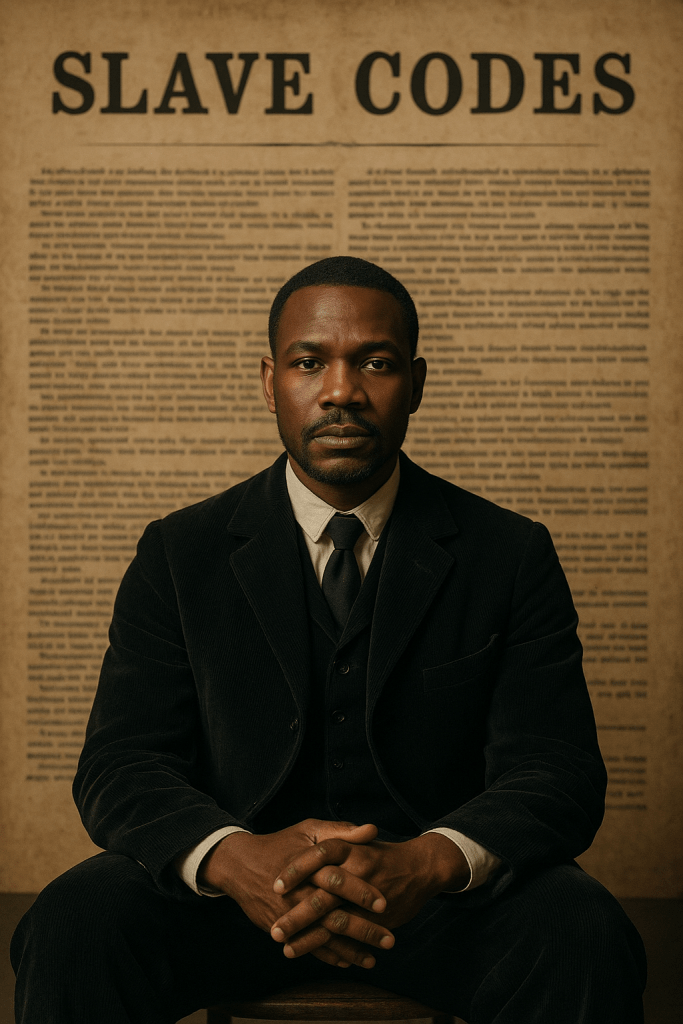
The institution of slavery in the Americas was not sustained by force alone but was codified through laws designed to regulate every aspect of enslaved Africans’ lives. These laws, known as slave codes, were crafted to protect the economic interests of slaveholders and to enforce racial hierarchy. The dilemma lies in how these codes dehumanized an entire race while simultaneously creating a legal system that institutionalized racism and justified the oppression of millions of African people (Higginbotham, 1978).

Slave codes emerged in the 17th century as colonial powers sought to control the growing African populations brought through the transatlantic slave trade. The first formalized set of slave codes appeared in Barbados in 1661, serving as a model for other colonies, including Virginia and South Carolina. These laws defined enslaved Africans not as human beings but as property—chattel—to be bought, sold, and inherited (Hall, 1992).

One of the most striking aspects of the slave codes was their comprehensive control over enslaved people’s daily lives. They restricted movement, prohibited literacy, and punished gatherings. Enslaved individuals were forbidden from assembling without white supervision, owning property, or testifying in court against white people (Berlin, 2003). These measures ensured that enslaved Africans remained socially, politically, and economically powerless.

The Virginia Slave Codes of 1705 marked a turning point in colonial America. This legislation legally solidified racial slavery by declaring that all imported non-Christian servants were to be enslaved for life. It also mandated that the status of the child followed that of the mother, guaranteeing that slavery would perpetuate across generations (Morgan, 1975). This legal structure created a hereditary caste system that positioned Blackness as synonymous with bondage.

Religious justifications often accompanied these codes. Many European colonists invoked Christianity as a moral defense for enslavement, claiming that slavery “civilized” Africans and exposed them to the gospel. However, the same laws barred the baptism of enslaved individuals from granting them freedom, illustrating the hypocrisy of such reasoning (Raboteau, 1978).

Punishments under the slave codes were brutal and served to instill fear. Whipping, branding, mutilation, and even death were common responses to resistance or attempted escape. These punishments were public spectacles meant to deter others from rebellion. The system used violence as both punishment and psychological warfare (Genovese, 1974).

The dilemma of the slave codes also extended to poor white laborers. While these laws primarily targeted Africans, they simultaneously elevated whiteness as a privileged status. Poor whites, who might otherwise have aligned with enslaved Africans due to shared economic hardship, were instead granted social superiority through racial distinction (Roediger, 1991).

This legal racial divide ensured that class solidarity among the oppressed was nearly impossible. By creating a buffer of racial privilege, the slave codes prevented the unity that could have challenged the planter elite. In this way, the laws not only oppressed Black people but also manipulated white identity for the benefit of the ruling class.

Slave codes also restricted education, fearing that literacy would inspire rebellion or awareness of rights. Enslaved individuals caught reading or writing could face severe punishment. By denying education, the system sought to suppress intellect and self-awareness among the enslaved population (Cornelius, 1991).

Religion, however, became a space of resistance. Despite prohibitions, enslaved Africans created secret worship gatherings known as “hush harbors,” blending African spiritual traditions with Christian teachings. These gatherings subverted the slave codes’ attempt to control their souls, showing that faith could serve as a form of rebellion (Raboteau, 1978).

The economic motivation behind the codes cannot be overstated. The laws protected the immense profits generated by slave labor on plantations. The human cost of this wealth accumulation was deliberately ignored, replaced by a moral rationalization that framed Africans as less than human. This economic greed formed the foundation for modern racial capitalism (Baptist, 2014).

Rebellion was the greatest fear of slaveholders, and thus the codes expanded after every insurrection. Following uprisings like the Stono Rebellion (1739) and Nat Turner’s Rebellion (1831), colonies tightened restrictions—limiting movement, banning assembly, and empowering militias to patrol enslaved communities (Egerton, 2004). The more resistance occurred, the harsher the legal controls became.

These codes were not isolated to the colonial period. After the Civil War, similar restrictions resurfaced through “Black Codes,” which sought to control freedmen by limiting their rights to work, vote, and move freely. Thus, the spirit of the slave codes lived on, transitioning from slavery to segregation (Litwack, 1998).

The legal legacy of slave codes profoundly shaped American law enforcement and criminal justice. Laws that once criminalized Black freedom evolved into modern systems of racial profiling, mass incarceration, and economic disenfranchisement. This continuity reveals how deeply the ideology of control was embedded in American governance (Alexander, 2010).

Psychologically, the slave codes inflicted generational trauma. They taught Black people that their lives were subject to constant surveillance and punishment. At the same time, they conditioned white society to associate authority with dominance over Black bodies, a mindset that still lingers in systemic racism today (hooks, 1992).

The slave codes also stripped enslaved people of family integrity. Enslaved marriages had no legal recognition, and children could be sold away at any moment. This destruction of kinship ties was another method of control, ensuring emotional dependency on slaveholders rather than familial bonds (Gutman, 1976).

Despite the overwhelming control, enslaved Africans continuously resisted—through work slowdowns, escapes, sabotage, and the preservation of culture. Their defiance proved that no law could extinguish the human will for freedom. Even within the confines of the slave codes, they found ways to reclaim their humanity (Franklin & Schweninger, 1999).

The dilemma of the slave codes challenges America’s moral conscience. These laws expose the hypocrisy of a nation that declared liberty and justice while codifying racial slavery. They reveal how systemic racism was not accidental but carefully engineered and legally enforced.

Understanding the history of the slave codes is essential to confronting present-day inequalities. They remind us that the struggle for justice requires dismantling the legal and psychological remnants of slavery that persist in modern institutions. The codes may have been abolished, but their legacy continues to echo through every system built upon their foundation.


References

Alexander, M. (2010). The New Jim Crow: Mass Incarceration in the Age of Colorblindness. New Press.
Baptist, E. E. (2014). The Half Has Never Been Told: Slavery and the Making of American Capitalism. Basic Books.
Berlin, I. (2003). Generations of Captivity: A History of African-American Slaves. Harvard University Press.
Cornelius, J. D. (1991). “When I Can Read My Title Clear”: Literacy, Slavery, and Religion in the Antebellum South. University of South Carolina Press.
Egerton, D. R. (2004). He Shall Go Out Free: The Lives of Denmark Vesey. Rowman & Littlefield.
Franklin, J. H., & Schweninger, L. (1999). Runaway Slaves: Rebels on the Plantation. Oxford University Press.
Genovese, E. D. (1974). Roll, Jordan, Roll: The World the Slaves Made. Pantheon Books.
Gutman, H. G. (1976). The Black Family in Slavery and Freedom, 1750–1925. Vintage Books.
Hall, N. A. T. (1992). Slave Society in the British Leeward Islands at the End of the Eighteenth Century. Yale University Press.
Higginbotham, A. L. (1978). In the Matter of Color: Race and the American Legal Process. Oxford University Press.
hooks, b. (1992). Black Looks: Race and Representation. South End Press.
Litwack, L. F. (1998). Trouble in Mind: Black Southerners in the Age of Jim Crow. Knopf.
Morgan, E. S. (1975). American Slavery, American Freedom: The Ordeal of Colonial Virginia. W. W. Norton & Company.
Raboteau, A. J. (1978). Slave Religion: The “Invisible Institution” in the Antebellum South. Oxford University Press.
Roediger, D. R. (1991). The Wages of Whiteness: Race and the Making of the American Working Class. Verso

Beloved, Bloom

Beloved, you were never meant to wither beneath the weight of the world’s expectations. You were designed to bloom — to rise in divine timing, nourished by the light of God’s love. Too often, women hide their radiance, comparing their growth to another’s garden. But the Creator plants each of us with purpose and grace. The same God who paints sunsets and commands the ocean waves has written your name in His garden of glory. Bloom where you are, with what you have, and let your fragrance fill the earth with faith, strength, and softness. You are not behind; you are becoming. 🌿✨

Beloved, you were never meant to fade in the shadows of comparison or shrink beneath the expectations of the world. You were created in divine brilliance, hand-sculpted by the Master Gardener who saw beauty and purpose in your becoming. Every woman has a season of blooming — a sacred time when God allows her roots to deepen before her petals unfold. It is not a race of perfection but a journey of transformation, where faith waters the soul and patience strengthens the stem of character.

The Bible says, “To every thing there is a season, and a time to every purpose under the heaven” (Ecclesiastes 3:1, KJV). Your season of bloom may not look like another woman’s, and that’s by design. The Lord orchestrates the timing of your growth so that when you rise, your light cannot be dimmed. Even in your waiting season, you are growing in unseen places — the soil of prayer, humility, and surrender.

To bloom, beloved, is to trust God with your process. Flowers do not open in one day; they unfold gradually under the warmth of the sun. Likewise, God gently unfolds your purpose as you abide in Him. Jesus declared, “I am the vine, ye are the branches… without me ye can do nothing” (John 15:5, KJV). Your bloom is sustained only when your heart remains connected to the true Vine. In a world that praises independence and self-made glory, divine femininity calls you to a higher posture — dependence on God, where strength is wrapped in softness and confidence flows from spiritual intimacy.

There will be pruning seasons, times when God removes what no longer serves your growth. The pruning may hurt, but it is holy. Just as a gardener trims to promote new life, God removes relationships, habits, and mindsets that block your flourishing. “Every branch that beareth fruit, he purgeth it, that it may bring forth more fruit” (John 15:2, KJV). Don’t resist His hands — they are shaping you for greater beauty.

Blooming also means embracing your divine identity. You are not defined by what you have lost or by who walked away. You are the daughter of a King who clothes you in grace and adorns you with wisdom. The world may value outward beauty, but God treasures the inward glow — the gentle and quiet spirit that reflects His presence. “Favour is deceitful, and beauty is vain: but a woman that feareth the Lord, she shall be praised” (Proverbs 31:30, KJV).

As you bloom, remember that your petals are meant to bless others. The fragrance of your faith, the kindness in your speech, and the strength of your love can inspire those still in their seed stage. Every trial you’ve endured, every tear you’ve sown, becomes nourishment for another woman’s growth. You are both the flower and the gardener — growing while helping others rise.

Beloved, do not rush your season. The Lord is perfecting you in His timing. When you surrender your fears and doubts to Him, He makes beauty out of brokenness and turns delay into destiny. “The Lord will perfect that which concerneth me” (Psalm 138:8, KJV). Your bloom will come, radiant and purposeful, testifying to the faithfulness of the One who planted you.

So, lift your face to the Son. Stand tall in your faith. Spread your petals of purpose and let your life be the proof of God’s goodness. You were never meant to blend into the background; you were created to bloom beautifully, boldly, and belovedly — in Him. 🌷

Chasing Sunlight: A Brown Girl’s Story

Sarah’s story begins in the quiet corners of classrooms and office hallways, where her brown skin often made her feel invisible. From an early age, she learned that the world had unspoken hierarchies: the lighter you were, the more likely you were to be seen, heard, and admired. Her rich, cocoa-toned complexion, which her family celebrated as beautiful, was often met with dismissal or subtle derision outside the home.

In school, Sarah noticed how teachers and peers unconsciously prioritized lighter-skinned girls. Compliments, opportunities to lead projects, and social inclusion seemed to favor those with golden undertones. Brown-skinned girls like her were praised for effort, rather than natural beauty or intelligence. It was the first seed of a lesson she would carry into adulthood: that society often measures worth by proximity to whiteness.

As she grew older, Sarah’s experiences in dating mirrored her school years. Men often overlooked her, gravitating toward lighter-skinned women. Subtle remarks—“You’d be prettier if your skin were lighter” or “I just prefer fair skin”—eroded her confidence. She began to internalize these biases, wondering if she was less lovable, less desirable, less enough, simply because of the hue of her skin.

The workplace proved no less challenging. Despite her qualifications and professional accomplishments, Sarah frequently encountered barriers she suspected were tied to appearance. Promotions, recognition, and networking opportunities often seemed to favor colleagues with lighter skin, more Eurocentric features, or “more approachable” aesthetics according to managers’ biases. Every overlooked achievement reinforced the cruel lesson that brown skin could be a subtle yet persistent disadvantage.

Media representation compounded the pressure. Television, films, and advertisements consistently highlighted lighter-skinned women as ideal. Sarah rarely saw women who looked like her celebrated for beauty, intellect, or power. When she did, such as Lupita Nyong’o or Viola Davis on a red carpet, it felt aspirational but also bittersweet: a reminder of how rare recognition could be.

Family and friends offered support, but society’s lens was difficult to escape. Sarah developed resilience, learning to navigate environments where her skin tone was often an unspoken barrier. She refined her personal style, cultivated skills, and asserted herself in conversations, slowly building an internal shield against pervasive colorism.

Romantic relationships were especially fraught. Potential partners, influenced by societal standards, sometimes preferred lighter-skinned women or treated her with hesitation. Comments that were casual to others—“You’d be more attractive if…”—cut deeply, shaping her perception of worth and desirability. Her heartbreaks were compounded by the realization that attraction could be clouded by prejudice rather than genuine connection.

Despite these challenges, Sarah discovered her own definition of beauty. She learned to see her brown skin as radiant, her features as distinctive and regal. High cheekbones, full lips, and rich skin tone became her markers of resilience and identity, rather than limitations. Each day of self-affirmation chipped away at the weight of societal judgment.

In her career, Sarah faced systemic hurdles but refused to let bias dictate her trajectory. She sought mentors who recognized talent beyond appearance, joined professional networks that celebrated diversity, and used setbacks as fuel for growth. Over time, her skills, intelligence, and authenticity began to command respect and recognition, proving the falsehood of superficial standards.

The journey was not linear. There were moments of doubt, tears, and frustration when mirrors and mirrors of society seemed to reflect inadequacy. Yet Sarah learned that the sunlight she chased was not external validation but self-acceptance. Beauty, competence, and worth were inherent, not conditional on societal preference for lighter skin.

Friendships with other brown and dark-skinned women became a source of strength. Shared experiences of colorism, overlooked potential, and romantic challenges created bonds of solidarity. Through community, Sarah realized she was not alone in navigating a world that often underestimated women of her shade.

Social media became both a battleground and a lifeline. While she saw persistent stereotypes online, she also found movements celebrating melanin-rich beauty, such as #MelaninPoppin and #BrownGirlMagic. These communities reinforced pride in her skin tone and offered examples of women succeeding despite systemic biases.

Sarah’s story illuminates the intersection of colorism, gender, and societal expectation. It reflects how beauty hierarchies—rooted in colonial history, media representation, and cultural bias—continue to shape opportunities in love, career, and self-perception. Her journey underscores the psychological toll of being devalued for traits intrinsic to identity.

Yet the narrative is not one of defeat. Sarah’s resilience embodies the reclamation of self-worth. Each accomplishment, each affirmation, each refusal to conform to superficial expectations represents a triumph over systemic and interpersonal bias. Her story exemplifies how internalized beauty standards can be challenged and redefined.

In love, Sarah learned to prioritize partners who saw her fully—not as an abstraction of societal ideals, but as a woman of complexity, intelligence, and radiance. Her romantic experiences shifted from seeking validation to demanding respect and authenticity. She discovered that relationships founded on bias could never satisfy the soul.

Career-wise, she became an advocate for equity, mentoring younger women and challenging organizational biases. Her brown skin, once perceived as a barrier, became a symbol of perseverance and excellence. Through her visibility and advocacy, she contributed to changing perceptions, one professional space at a time.

Sarah’s experience reflects broader societal patterns. Research shows that colorism affects hiring, promotion, dating preference, and social perception for brown and dark-skinned women globally (Hunter, 2011; Lewis & Lockwood, 2018). Her story is both personal and emblematic of structural inequities tied to historical beauty hierarchies.

The psychological impact of colorism is profound. Feelings of inadequacy, internalized bias, and social anxiety are common among women whose skin tones fall outside dominant beauty ideals (Banks, 2018). Sarah’s journey exemplifies both the challenge and the potential for reclamation through self-knowledge and supportive communities.

Over time, Sarah cultivated rituals of self-care and self-affirmation that reinforced pride in her appearance. She learned to embrace hair texture, skin tone, and facial features as elements of identity and heritage, resisting the pervasive pressure to conform to Eurocentric ideals.

The story of Sarah also illustrates intergenerational transmission of beauty values. She observed how her mother and grandmother navigated similar biases, offering lessons in resilience, self-respect, and dignity despite societal prejudice. Cultural heritage became a source of strength and grounding.

Sarah’s narrative challenges the notion that beauty is universal. It demonstrates that social standards, often influenced by race, history, and power, determine who is valued and why. Yet individual agency allows women like Sarah to define beauty on their own terms, asserting worth independent of external validation.

Community recognition, professional achievement, and personal love became Sarah’s metrics of worth. She discovered that external approval—once seen as essential—was secondary to self-respect and cultural pride. Her journey represents a broader reclamation of aesthetics for women historically devalued for melanin-rich skin.

Through advocacy, mentorship, and storytelling, Sarah contributes to reshaping societal perceptions. By publicly affirming the beauty and value of brown-skinned women, she creates space for others to see themselves as worthy, attractive, and powerful, challenging entrenched hierarchies of desirability.

Sarah’s story is also a call for systemic change. Organizations, media, and institutions must interrogate implicit bias in hiring, marketing, and representation to dismantle color-based inequities. Her journey demonstrates how personal resilience intersects with structural reform in the pursuit of equity.

Her brown skin, once a source of marginalization, becomes her signature, her identity, and her power. Every compliment, achievement, and acknowledgment she receives is now rooted in authenticity, not conditional acceptance. Sarah’s story transforms pain into pride.

In conclusion, Chasing Sunlight: A Brown Girl’s Story reflects the intersection of colorism, gender, and societal hierarchy. Sarah’s journey from feeling overlooked to embracing her worth illuminates the resilience, beauty, and power of brown-skinned women. Her story is a testament to the enduring strength of identity, culture, and self-love.


References

  • Banks, Ingrid. (2018). The Melanin Millennium: African Aesthetics in the Modern World.
  • Hunter, Margaret L. (2011). Buying Racial Capital: Skin-Bleaching and Cosmetic Surgery in Black and African Communities. Social Text.
  • Lewis, J., & Lockwood, E. (2018). Colorism, Beauty, and Media: Social Perceptions of Black Women. Journal of African American Studies.
  • Byrd, Ayana D., & Tharps, Lori L. (2014). Hair Story: Untangling the Roots of Black Hair in America. St. Martin’s Press.
  • Collins, Patricia Hill. (2000). Black Feminist Thought: Knowledge, Consciousness, and the Politics of Empowerment. Routledge.
  • hooks, bell. (1992). Black Looks: Race and Representation. South End Press.

Dilemma: Racial Profiling

Racial profiling is one of the most pervasive forms of systemic racism in modern society. At its core, it refers to law enforcement, institutions, or individuals targeting or treating people differently primarily because of their race, ethnicity, or national origin, rather than their behavior or credible evidence. (ACLU, n.d.)

The term has its roots in historical forms of discrimination, including slave patrols and discriminatory policing in the post-slavery United States. Over time, it evolved into a widespread practice used to justify surveillance, stops, and searches of Black communities disproportionately.

Racial profiling is not limited to policing. It manifests in education, housing, lending, employment, retail spaces, and travel, affecting Black individuals at almost every stage of life. The cumulative impact is systemic disadvantage and heightened exposure to social, economic, and legal risks.

In law enforcement, studies consistently show that Black people are more likely to be stopped, searched, and arrested than their White counterparts. For example, research using large-scale smartphone location data found that police presence is disproportionately concentrated in Black neighborhoods, independent of crime rates. (Chen et al., 2021)

Traffic stops provide a clear example. Black drivers are more likely to be stopped, searched, and ticketed than White drivers, even when controlling for behavior and location. (Phillips et al., 2017) These interactions reinforce the perception that Black individuals are inherently suspicious, perpetuating mistrust between communities and law enforcement.

Data from the Kaiser Family Foundation shows that nearly 70% of Black Americans report experiencing discrimination or police mistreatment in their lifetime, with almost half stating they felt their lives were in danger during these encounters. (KFF, 2020)

The psychological impact of racial profiling is profound. Exposure to profiling increases stress, anxiety, and trauma among Black individuals. Research shows that both direct and vicarious experiences of profiling contribute to long-term mental health disparities. (PubMed, 2020)

In the workplace, racial profiling can take the form of heightened scrutiny, biased disciplinary actions, and assumptions of incompetence. Black employees often report feeling monitored or distrusted by supervisors and colleagues based solely on racial assumptions.

Educational settings also reflect these patterns. Black students are disproportionately disciplined, searched, or subject to zero-tolerance policies. This early exposure to profiling shapes perceptions of authority and social justice, affecting educational outcomes and long-term life trajectories.

Retail environments often engage in what is called “shopping while Black.” Black shoppers are more likely to be followed, questioned, or suspected of theft compared to White shoppers. Local studies indicate that such profiling contributes to feelings of exclusion and social marginalization.

Housing policies also reflect profiling. Landlords, property managers, and neighborhood associations may treat Black applicants as higher risk, enforce codes more strictly in Black neighborhoods, or limit access to desirable housing. These practices contribute to residential segregation and wealth disparities.

Lending institutions also profile Black borrowers. Studies demonstrate that Black applicants are more likely to be denied loans, offered higher interest rates, or subjected to stricter scrutiny, even when controlling for income and creditworthiness. (Federal Reserve, 2019)

In travel and airports, profiling manifests as disproportionately high rates of stops and security screenings of Black travelers. For example, a news report highlighted that Black passengers at major U.S. airports faced more frequent detentions than their share of overall travelers. (People, 2023)

The legal system is deeply affected by profiling. Black defendants are more likely to face harsher charges, longer sentences, and pretrial detention compared to White defendants. Profiling perpetuates inequities in criminal justice outcomes, reinforcing structural racism.

Community trust is eroded when profiling is widespread. Black communities often report fear and suspicion of authorities, limiting cooperation and civic participation. This distrust has long-term consequences for social cohesion and public safety.

Profiling also exacerbates economic disparities. Encounters with law enforcement and legal systems disrupt employment, schooling, and economic productivity, perpetuating cycles of poverty in Black communities.

The historical roots of profiling, including slave patrols and Jim Crow policing, continue to shape modern practice. These legacies demonstrate how profiling is less an isolated problem and more a systemic feature of racialized institutions.

Structural factors, including zoning, policing budgets, and data collection practices, perpetuate profiling. Lack of transparency and accountability in stop-and-search procedures allows discriminatory practices to continue largely unchecked.

Policy interventions are critical. Mandatory data collection on stops, searches, and arrests, coupled with community oversight and bias training, can mitigate racial profiling. Redress mechanisms for victims are essential to ensure accountability.

Technology can both help and harm. While data analytics may identify discriminatory patterns, surveillance technologies, facial recognition, and predictive policing often disproportionately target Black neighborhoods, exacerbating profiling.

Education and public awareness campaigns are necessary to reduce the social acceptability of profiling. Community engagement, anti-bias training, and advocacy for civil rights strengthen resilience against discriminatory practices.

Culturally, racial profiling affects Black identity and experience. The cumulative stress of profiling contributes to racial battle fatigue, affecting physical health, mental health, and social cohesion. (Clark et al., 1999)

Media representation shapes perception. Over-representation of Black people in crime reporting reinforces stereotypes and justifies profiling in the public imagination. Counter-narratives are critical to challenging systemic bias.

Racial profiling is an ethical dilemma. It violates principles of justice, fairness, and equal protection under law. The practice undermines democratic norms and perpetuates intergenerational trauma.

Ultimately, racial profiling affects every facet of life for Black people: safety, employment, education, health, housing, and community life. Combating it requires structural, cultural, and legal interventions.

References

American Civil Liberties Union. (n.d.). Racial profiling | Race and criminal justice. Retrieved from https://www.aclu.org/issues/racial-justice/race-and-criminal-justice/racial-profiling

Chen, M. K., Christensen, K. L., John, E., Owens, E., & Zhuo, Y. (2021). Smartphone data reveal neighborhood-level racial disparities in police presence. arXiv. Retrieved from https://arxiv.org/abs/2109.12491

Clark, R., Anderson, N. B., Clark, V. R., & Williams, D. R. (1999). Racism as a stressor for African Americans: A biopsychosocial model. American Psychologist, 54(10), 805–816.

Federal Reserve. (2019). Discrimination in lending: Evidence and policy. Retrieved from https://www.federalreserve.gov/publications/files/2019-discrimination-lending.pdf

Kaiser Family Foundation. (2020, June 18). Poll: 7 in 10 Black Americans say they have experienced incidents of discrimination or police mistreatment in their lifetime. Retrieved from https://www.kff.org/racial-equity-and-health-policy/press-release/poll-7-in-10-black-americans-say-they-have-experienced-incidents-of-discrimination-or-police-mistreatment-in-their-lifetime-including-nearly-half-who-felt-their-lives-were-in-danger/

Phillips, C., Goel, S., et al. (2017). A large-scale analysis of racial disparities in police stops across the United States. arXiv. Retrieved from https://arxiv.org/abs/1706.05678

PBS NewsHour. (2016, August 31). Nearly a quarter of young Black people say they’ve been harassed by police, poll finds. Retrieved from https://www.pbs.org/newshour/nation/young-black-adults-less-trusting-police-poll-finds/

People. (2023). Tyler Perry calls out racial profiling of Black airport travelers. Retrieved from https://people.com/tyler-perry-calls-out-racial-profiling-of-black-airport-travelers-8659849

PubMed. (2020). Racial interactions and health consequences: A systematic review. Retrieved from https://pubmed.ncbi.nlm.nih.gov/32253746/

Dilemma: The “N” Word

The N‑word is a linguistic atomic bomb: it is capable of inflicting instantaneous injury, yet its power depends on historical context, speaker identity, and audience. It embodies centuries of subjugation, hatred, and oppression, and no neutral intent can erase that history.”
— Randall Kennedy, The N Word: Who Can Say It, Who Shouldn’t, and Why (2007, Beacon Press)

The word commonly referred to as the “N‑word” occupies one of the most charged spaces in the English language, carrying with it a history of slavery, segregation, dehumanisation, and ongoing racial violence. Its use, whether overt or subtle, signals more than mere insult—it implicates power, identity, culture, and memory. The dilemma lies in how the term continues to resonate, be contested, be reclaimed, and to injure.

Originally derived from the Latin niger (black), the term entered the English lexicon as “negro” (black person) and then evolved into “nigger”, a pejorative term whose first recorded uses as a slur date back to the seventeenth century. AAIHS+3PBS+3AA Registry+3 Even though a linguistic transformation occurred, the historic weight of racialised domination never abated. The term became embedded within the lexicon of white supremacy as a tool of dehumanisation.

In its historic usage, the slur served to mark Black persons as inferior, as property, as objects of violence and contempt. Through slavery, lynching, Jim Crow segregation, and systemic disenfranchisement, the word was more than an insult—it was an instrument of terror. AAIHS+2The Washington Post+2 To call someone this word was to place them at the lowest rung of society, to deny their humanity, to reduce them to a racialised subordinate.

Its meaning, however, is not fixed. Recent scholarship emphasises that context matters: the same lexical form may carry different pragmatic values depending on speaker identity, target, setting, intonation and community. A study of various uses of the slur in film and African American intra‑group settings argues that context determines nuance. PMC+1 In other words, the slur’s semantics are entangled with social and cultural dynamics.

When a non‑Black person uses the word towards a Black person, the meaning is rarely neutral. Given the historical legacy, it almost always signals contempt, racial threat or dominance. The slur thus acts as a linguistic embodiment of racial hierarchy—reinforcing what scholar Randall Kennedy called the “atomic bomb of racial slurs.” PBS+1 The emotional weight carried by the utterance cannot be divorced from the structural history.

Within the Black community, some use a variant ending in “‑a” (i.e., “nigga”) as a form of intra‑group address, signalling camaraderie, shared suffering, and cultural belonging. But this intra‑group appropriation remains contested. On one hand, it is reclamation; on the other, it is still rooted in a lexicon of oppression. PMC+1 This duality captures the complexity of language, identity, and power.

From a sociolinguistic and psychological perspective, the impact of the slur is substantial. Hearing or being addressed with the word has been associated with increased stress, lowered self‑esteem, internalised stigma, and social alienation. A qualitative study of African Americans’ feelings toward the word found strong negative reactions when used by non‑Black persons, and ambivalent or contextually bounded responses when used within the Black community. ScholarWorks The marker of difference and devaluation is thus deeply internalised.

The ethical and theological dimensions are equally weighty. If humanity is grounded in the imago Dei (Genesis 1:27) and dignity is recognized as universal, then the use of a slur that denies that dignity is a moral wrong. The N‑word becomes not merely a linguistic issue but a theological one: the denial of image, the denial of voice, the denial of equal worth. The Christian prophetic tradition that calls for justice (Isaiah 1:17; Amos 5:24) compels an interrogation of how language participates in oppression.

At a cultural level, the proliferation of the slur in media, music (especially hip‑hop), literature, and everyday speech complicates its mitigation. One analysis noted that the N‑word appears half a million times a day in social‑media use of the variant “nigga”. The Washington Post+1 This saturation suggests the word is both hyper‑present and normalized in certain contexts, even as it remains banned or taboo in others.

This juxtaposition—between taboo and normalization—underscores the dilemma. For many youth, especially across racial lines, the word may carry diminished sting or may function as slang. Yet for many older generations and for persons subjected to its historical brutality, the word still evokes chains, lynchings, segregation, and racial terror. The generational and intra‑community divide is thus real and significant. Learning for Justice

Moreover, the double standard inherent in discourse is explicit. Many educators and scholars note that Black persons may face fewer consequences (or different ones) when using the variant among themselves, whereas non‑Black persons often face condemnation, social censure, or institutional discipline. Lester, for instance, taught a college‐level course on the N‑word and observed that discussions often revolved around this double standard. Learning for Justice+1 The question of who may legitimately say the word is itself a question of power and membership.

In workplaces, educational institutions, and legal settings, the slur can trigger claims of hostile work environment, harassment, or discriminatory bias. Courts have grappled with whether intra‑racial use by Black workers can also constitute actionable harassment, demonstrating that the slur remains legally potent. Digital Commons@DePaul The law recognises that language can be a vehicle of structural oppression.

Language scholarship emphasises that slurs are performative: they do things—they wound, intimidate, exclude, subordinate. The N‑word performs historical violence, racial demotion, and cultural silencing. It enacts through sound and symbol what structural racism does through policy and practice. The reclamation rhetoric tries to invert that performance, to transform a scar into a badge—but the original wound remains.

Why do people use the N‑word today? Several motivations exist. Some non‑Black speakers may use it in ignorance of its history, other speakers may use it deliberately as taunt or threat. Sometimes it is used for shock, rebellion or humour (though harm remains). Within the Black community, usage may serve as marker of intimacy or cultural identity. But the asymmetry of power remains: when the speaker is non‑Black, the word seldom escapes the baggage of hate. The refusal of some non‑Black persons to recognise the word’s history is itself an expression of racial insensitivity.

When directed at Black persons in peer or social settings by non‑Black persons, the word often functions as a racial insult, an invocation of threat, or a reaffirmation of inferior status. Its use is fundamentally interlinked with racial hostility because of the long history of its deployment in violence, exclusion and demeaning treatment. It is an instrument of racial harm.

In interpersonal relations it also fosters distrust, emotional injury and intergenerational trauma. The repeated hearing or expectation of the word can condition psychological hyper‑vigilance, identity stress and a sense of perpetual othering. The phenomenon of “racial battle fatigue” resonates here: Black individuals develop cumulative stress responses to recurrent micro‑ and macro‑aggressions, among which the N‑word is a symbolic anchor.

At the community level, the ubiquity of the word among youth, popular culture and digital spaces intersects with structural inequalities and racial hierarchies. The word’s presence signals that racial devaluation remains socially acceptable in many contexts. This undermines collective efforts to build inclusive institutions and equal dignity. The normalization of the slur—especially when used casually—reduces the social impetus for change.

From a historical vantage, the N‑word is deeply tied to structural racism: from its evolution during the era of slavery, where it served as a descriptor of enslaved Africans, to the post‑emancipation era where it reinforced segregation and Jim Crow disenfranchisement, to the present where it persists in linguistic and cultural domains. The scholarly review of its history emphasises its continuity across centuries of racial subordination. AA Registry+1

Critically, the mere elimination of the word does not eliminate the racism behind it. Some commentators argue that focusing solely on “banning the word” distracts from addressing the power structures that allowed the word to thrive. One scholar argued that eradicationists confuse the form of the word with the conditions of its use. PMC In other words, the slur is a symptom, not the root, of racial devaluation.

In light of your interest in theology, genetics, identity and historical injustice, the N‑word invites reflection on how language intersects with inherited trauma, communal identity and racialised bodies. For example, when Black lineages (including Y‑DNA haplogroups such as E1b1a) are reclaimed and celebrated, the presence of a slur undermines the narrative of dignity restoration, reminding us that language remains a battleground for identity.

In conclusion, the dilemma of the N‑word is not simply a lexical matter—it is deeply social, historical, psychological, cultural and structural. Its significance lies in the interplay of language and power, identity and trauma, resistance and reclamation. Addressing the issue meaningfully requires attention not only to who uses the word, but the reasons behind its use, the relational context, the historical weight, and the healing work that must accompany language transformation.

References
Lester, N. A. (2011). Straight talk about the N‑word. Learning for Justice. Retrieved from https://www.learningforjustice.org/magazine/fall-2011/straight-talk-about-the-nword Learning for Justice
Rahman, J. (2014). Contextual determinants on the meaning of the N word. Philosophy & Social Criticism, 40(2), 123‑141. https://doi.org/10.1177/0191453714550430 PMC
Kennedy, R. (2007). The N Word: Who Can Say It, Who Shouldn’t, and Why. Beacon Press. (Referenced in Kennedy’s public commentary). Digital Commons@DePaul+1
National Association for the Advancement of Colored People. (2014). NAACP official position on the use of the word “nigger” and the “N‑word.” Retrieved from https://naacp.org/resources/naacp-official-position-use-word-nigger-and-n-word NAACP
“Analysis of the Reclamation and Spread of the N‑word in Pop Culture.” (n.d.). Undergraduate Showcase. Retrieved from https://www.journals.uc.edu/index.php/Undergradshowcase/article/download/4116/3123 Journals at UC
“A brief history: The word nigger.” African American Registry. (n.d.). Retrieved from https://aaregistry.org/story/nigger-the-word-a-brief-history/ AA Registry

Steps to Move from Your Current Self to Your Ideal Self. #GodisGuide

Psychology, Biblical Perspective, and Pathways to Growth

Photo by Godisable Jacob on Pexels.com

Many people experience a tension between their current self and the ideal version of themselves. Psychologically, this is referred to as the self-discrepancy theory, which suggests that gaps between one’s actual self and ideal self can lead to feelings of frustration, disappointment, and low self-esteem (Higgins, 1987). Spiritually, the Bible acknowledges this struggle, urging believers to pursue transformation while remaining patient with their current state: “And be not conformed to this world: but be ye transformed by the renewing of your mind” (Romans 12:2, KJV).

The first step in resolving this tension is self-awareness. Understanding your current habits, beliefs, and emotional patterns provides clarity about where change is needed. Psychology emphasizes that reflective practices—journaling, mindfulness, and therapy—help individuals recognize strengths and weaknesses (Brown & Ryan, 2003). Biblically, “Examine yourselves, whether ye be in the faith; prove your own selves” (2 Corinthians 13:5, KJV) encourages honest self-assessment.

Often, the gap between who you are and who you want to be is fueled by limiting beliefs and fear of failure. Cognitive psychology teaches that self-limiting thoughts create mental barriers to growth (Beck, 2011). The Bible also addresses doubt and fear: “For God hath not given us the spirit of fear; but of power, and of love, and of a sound mind” (2 Timothy 1:7, KJV). Overcoming fear requires faith, intentional action, and reframing negative beliefs.

Goal setting and vision are essential tools for bridging the gap. Clear, achievable goals create measurable steps toward the ideal self. Psychologists suggest using the SMART framework—specific, measurable, attainable, relevant, time-bound—to structure growth (Locke & Latham, 2002). Spiritually, “Write the vision, and make it plain upon tables, that he may run that readeth it” (Habakkuk 2:2, KJV) reinforces the power of clarity and planning.

Habits and discipline shape the bridge between present and future self. Behavioral psychology demonstrates that small, consistent actions compound over time to produce transformation (Duhigg, 2012). Biblically, “But let patience have her perfect work, that ye may be perfect and entire, wanting nothing” (James 1:4, KJV) reminds us that consistent effort and spiritual endurance are necessary for growth.

Another critical aspect is resilience and self-compassion. Transitioning to a higher version of oneself often involves setbacks and mistakes. Psychology shows that self-compassion mitigates shame and promotes persistence (Neff, 2003). Scriptures encourage resilience: “Blessed is the man that endureth temptation: for when he is tried, he shall receive the crown of life” (James 1:12, KJV). Embracing setbacks as learning experiences allows progress to continue.

Mentorship and community support play a transformative role. Surrounding oneself with individuals who embody the qualities you aspire to cultivates accountability and inspiration. Psychologists affirm that social modeling accelerates behavior change (Bandura, 1997). Biblically, “Iron sharpeneth iron; so a man sharpeneth the countenance of his friend” (Proverbs 27:17, KJV) highlights the importance of supportive relationships in personal development.

7 Steps to Move from Who You Are to Who You Want to Be

  1. Cultivate Self-Awareness
  • Reflect on strengths, weaknesses, and habits.
  • 2 Corinthians 13:5 (KJV): “Examine yourselves, whether ye be in the faith; prove your own selves.”
  • Psychology: Self-awareness improves emotional intelligence and decision-making (Brown & Ryan, 2003).
  1. Clarify Your Vision and Goals
  • Write down what your ideal self looks like and set achievable milestones.
  • Habakkuk 2:2 (KJV): “Write the vision, and make it plain upon tables.”
  • Psychology: SMART goals increase motivation and measurable progress (Locke & Latham, 2002).
  1. Overcome Fear and Limiting Beliefs
  • Identify negative self-talk and replace it with faith-filled affirmations.
  • 2 Timothy 1:7 (KJV): “For God hath not given us the spirit of fear; but of power, and of love, and of a sound mind.”
  • Psychology: Cognitive restructuring reduces mental barriers to growth (Beck, 2011).
  1. Develop Consistent Habits
  • Daily small actions compound over time to create transformation.
  • James 1:4 (KJV): “Let patience have her perfect work, that ye may be perfect and entire, wanting nothing.”
  • Psychology: Habit formation shapes long-term behavior (Duhigg, 2012).
  1. Practice Resilience and Self-Compassion
  • View setbacks as learning opportunities rather than failures.
  • James 1:12 (KJV): “Blessed is the man that endureth temptation: for when he is tried, he shall receive the crown of life.”
  • Psychology: Self-compassion promotes persistence and reduces shame (Neff, 2003).
  1. Seek Mentorship and Support
  • Surround yourself with individuals who inspire and challenge you positively.
  • Proverbs 27:17 (KJV): “Iron sharpeneth iron; so a man sharpeneth the countenance of his friend.”
  • Psychology: Social modeling and support accelerate personal growth (Bandura, 1997).
  1. Anchor Yourself in Faith and Reflection
  • Pray, meditate, and trust God’s plan during your transformation.
  • Romans 12:2 (KJV): “Be not conformed to this world: but be ye transformed by the renewing of your mind.”
  • Psychology: Mindfulness and spiritual grounding reduce stress and maintain focus (Brown & Ryan, 2003).

In conclusion, feeling stuck between who you are and who you want to be is a universal human experience. By cultivating self-awareness, overcoming fear, setting goals, establishing disciplined habits, practicing resilience, and seeking supportive relationships, individuals can navigate the tension toward growth. Integrating biblical faith and psychological strategies provides a holistic pathway to becoming the best version of oneself, reminding us that transformation is both a spiritual and mental journey.


References

  • The Holy Bible, King James Version.
  • Bandura, A. (1997). Self-efficacy: The exercise of control. W.H. Freeman.
  • Beck, J. S. (2011). Cognitive behavior therapy: Basics and beyond (2nd ed.). Guilford Press.
  • Brown, K. W., & Ryan, R. M. (2003). The benefits of being present: Mindfulness and its role in psychological well-being. Journal of Personality and Social Psychology, 84(4), 822–848.
  • Duhigg, C. (2012). The power of habit: Why we do what we do in life and business. Random House.
  • Higgins, E. T. (1987). Self-discrepancy: A theory relating self and affect. Psychological Review, 94(3), 319–340.
  • Locke, E. A., & Latham, G. P. (2002). Building a practically useful theory of goal setting and task motivation: A 35-year odyssey. American Psychologist, 57(9), 705–717.
  • Neff, K. D. (2003). Self-compassion: An alternative conceptualization of a healthy attitude toward oneself. Self and Identity, 2(2), 85–101.

Dilemma: Exalted by God, Diminished by the World

The dilemma of Black people is not merely historical — it is spiritual, psychological, and prophetic. It exists in the tension between divine identity and earthly rejection. It is the paradox of being a people endowed with brilliance, purpose, and sacred legacy, yet consistently challenged by social systems designed to suppress that brilliance. As Scripture declares, “For the Lord shall judge His people, and repent Himself for His servants, when He seeth that their power is gone” (Deuteronomy 32:36, KJV). The struggle has been seen and known by God.

This dilemma begins with divine intention. Black people embody creativity, resilience, and spiritual depth reflected in ancient civilizations, rich oral traditions, and unparalleled cultural influence. From Nubia to Mali, from Cush to Kemet, from Ethiopia to Judah, the African presence stands as a foundational pillar of global civilization (Diop, 1974). Yet as greatness rose, so did opposition — echoing the biblical notion that “many are the afflictions of the righteous” (Psalm 34:19, KJV).

Despite oppression, the Black spirit remains unbroken. Enslavement sought to steal identity, but instead sharpened emotional intelligence, cultural unity, and faith. On plantations, the enslaved held secret worship, trusting the God of deliverance just as Israel trusted Him in Egypt. They sang songs of freedom, echoing Moses: “Let my people go” (Exodus 5:1, KJV). Even bondage could not silence purpose.

One layer of this dilemma is invisibility. Black contributions are foundational to music, science, agriculture, theology, and medicine, yet rarely acknowledged (Asante, 1988). The world consumes our culture but often refuses to honor us as creators. We are celebrated as aesthetic, yet ignored as intellectual. We are loved for rhythm, but resisted for righteousness. We stand out — yet are told to “fit in.”

Another dimension is psychological warfare. Colonial propaganda attempted to convince us that we were inferior. Yet, biblically, the Most High often elevates the humble and chosen through adversity. “The last shall be first, and the first last” (Matthew 20:16, KJV). The struggle is not evidence of weakness, but a spiritual signpost of destiny.

Meanwhile, colorism emerged as a tool of division — a wound born of white supremacy’s hierarchy, weaponizing complexion to fracture unity. Yet Scripture teaches, “If a house be divided against itself, that house cannot stand” (Mark 3:25, KJV). Healing begins with rejecting systems that were never meant to define us.

We carry the burden of representation — expected to succeed flawlessly while being denied equal opportunity. This emotional weight mirrors Christ, who bore rejection while carrying divine purpose. “He was despised and rejected of men” (Isaiah 53:3, KJV). Our pain parallels prophecy.

Still, the world is threatened by Black excellence. When we rise in intellect, innovation, or leadership, systems shift uneasily, exposing the foundation of racial fear (Bell, 1992). This fear is not rooted in truth, but insecurity — because when a people gifted by God awaken, worldly powers tremble.

We live in dual consciousness — as W.E.B. Du Bois described — constantly balancing self-worth with societal judgment. Yet while society may try to define us, God declares our worth: “Ye are a chosen generation, a royal priesthood” (1 Peter 2:9, KJV). Our identity comes from heaven, not history books distorted by colonial pens.

Our existence challenges the world because we symbolize survival. We rose from chains to chart-topping music, from plantations to presidencies, from illiteracy laws to Ph.D. halls. Our story is not tragedy, but testimony. Every generation rises stronger than the last.

The dilemma also lies in being seen yet unseen. Black culture is everywhere — fashion, language, sports, beauty standards — yet our humanity is still debated. We are applauded on stages, yet targeted in streets. Loved on screens, yet feared in real life. A contradiction the world refuses to reconcile.

Economically, systems were built on our labor while denying us wealth (Muhammad, 2020). Our innovation created industries — cotton, music, sports — yet generational wealth disparities remain. Still, we thrive, build, and rise — a modern Joseph story, from pit to prominence.

Spiritually, Black people possess innate faith power. We pray with depth, worship with sincerity, love with intensity, and forgive with divine strength. Yet forgiveness has often been weaponized against us, urging peace without justice. But Scripture says, “Judgment also will I lay to the line, and righteousness to the plummet” (Isaiah 28:17, KJV).

Despite trauma, we create joy. We turn pain into poetry, oppression into art, and struggle into innovation. This alchemy of resilience is divine gifting — proof of God’s breath in us. We are living Psalms.

The world expects us to forget history, yet demands we perform excellence. But remembrance is biblical: “Thou shalt remember all the way which the Lord thy God led thee” (Deuteronomy 8:2, KJV). Memory is power. Our story is sacred.

The dilemma is also internal — unlearning lies, unbinding trauma, reclaiming divinity. Healing is both spiritual and psychological. As we restore identity, we rise into purpose. As we honor ancestry, we step into prophecy.

And still, hope remains our inheritance. Through storms, we remain anchored in God’s promise. “No weapon that is formed against thee shall prosper” (Isaiah 54:17, KJV). Not then. Not now. Not ever.

Our dilemma is not defeat — it is destiny unfolding. The world struggles to categorize what God has crowned. Oppression could not erase us. Misrepresentation could not distort us. Time could not silence us. We are history’s evidence and tomorrow’s blueprint.

We are not merely survivors — we are restorers. Rebuilders. Carriers of ancient wisdom and future vision. Our existence is revolutionary, our presence prophetic, our identity divine.

So stand tall, Black soul. Your legacy did not begin in chains; it began in crowns. Your struggle is not failure; it is refinement. Your identity is not determined by man; it is sealed by God. The dilemma is real — but so is the calling.

For buried gold is not forgotten — it is waiting for appointed time. And our time is rising.


Key Scriptures (KJV)

  • Psalm 34:19
  • Exodus 5:1
  • Matthew 20:16
  • Mark 3:25
  • 1 Peter 2:9
  • Isaiah 54:17

References

Asante, M. K. (1988). Afrocentricity.
Bell, D. (1992). Faces at the Bottom of the Well.
Diop, C. A. (1974). The African Origin of Civilization: Myth or Reality.
Muhammad, K. G. (2020). The Condemnation of Blackness.
Holy Bible, King James Version.

Beauty in the Eyes of Truth: Debunking Satoshi Kanazawa’s Racist “Study” on Black Women.

When Satoshi Kanazawa published his article, “Why Are Black Women Less Physically Attractive Than Other Women?” in 2011 on Psychology Today’s blog The Scientific Fundamentalist, he set off a firestorm of global outrage. His so-called “research” claimed that Black women were “objectively less attractive” than women of other races based on statistical data. What he called “scientific evidence” was, in reality, a misuse of data, steeped in racial bias, colonial beauty standards, and poor methodology.

Kanazawa drew from a database called the Add Health survey, which included self-reported ratings of physical attractiveness by interviewers. However, these interviewers were not trained in objective aesthetic assessment — they were individuals influenced by their own biases, cultural norms, and Eurocentric ideals of beauty. Instead of acknowledging this obvious flaw, Kanazawa treated subjective opinions as biological fact, thereby perpetuating pseudoscience.

The title alone — “Why Are Black Women Less Physically Attractive” — betrayed a racist premise. It positioned Black women as a scientific question to be explained rather than human beings deserving of dignity. This type of racial pseudoscience has roots in 19th-century eugenics, which sought to justify white supremacy through “biology.” In Kanazawa’s case, the problem wasn’t science — it was the misuse of science to validate prejudice.

The article provoked an immediate global backlash. Black women scholars, writers, and readers flooded Psychology Today with demands for its removal. Within days, the post was taken down and disavowed by the publication. The London School of Economics publicly condemned Kanazawa’s statements, suspended him from teaching duties, and launched an investigation into his conduct. Psychology Today later issued an apology for publishing the article at all, acknowledging that it failed editorial standards and promoted harmful racial stereotypes.

Satoshi Kanazawa was not a random internet blogger — he was a university lecturer and evolutionary psychologist who often courted controversy. He had previously published inflammatory posts suggesting that African nations were “less intelligent” due to genetics, and that men were “more rational” than women. His work consistently displayed a pattern of racial and gender bias disguised as evolutionary psychology, leading many experts to label his theories as “scientific racism.”

But why did he specifically target Black women? Because Black women have historically been positioned at the intersection of both racism and sexism — where both systems of oppression overlap. Kanazawa’s post reflected a broader societal narrative that devalues Black womanhood while glorifying Eurocentric beauty. From slavery-era stereotypes of the “mammy” and “jezebel” to modern media’s glorification of lighter skin and straighter hair, his article fed into a centuries-old lie: that whiteness equals beauty, and Blackness does not.

Yet the truth is exactly the opposite. The concept of beauty is not objective, and it certainly cannot be reduced to statistical averages. Beauty is in the eye of the beholder, as Proverbs 31:30 (KJV) reminds us: “Favour is deceitful, and beauty is vain: but a woman that feareth the Lord, she shall be praised.” The Most High never created one standard of beauty — He created diversity as a reflection of His glory.

The melanin-rich skin of Black women is a divine masterpiece of strength and radiance. Scientifically, melanin protects against ultraviolet radiation, delays aging, and carries powerful antioxidant properties. Spiritually, melanin symbolizes resilience and divine design — “I am black, but comely,” declares the Shulamite woman in Song of Solomon 1:5 (KJV), affirming that her dark skin is beautiful in the eyes of God.

Kanazawa’s so-called “findings” crumble under both scientific and spiritual truth. Studies since then have proven that perceptions of beauty are culturally constructed and heavily influenced by exposure, familiarity, and societal power dynamics. When media and academia have long centered white features as the norm, it’s no surprise that biases emerge in subjective surveys. The real issue is not the appearance of Black women — it’s the conditioning of the observers.

The damage from Kanazawa’s article, however, was not purely academic. It caused emotional harm to millions of Black women and girls who saw themselves being demeaned in the name of science. But out of that pain came power — Black women writers, scholars, and activists began challenging not just Kanazawa, but the entire structure of racialized beauty standards. Movements like #BlackGirlMagic and The Melanin Movement emerged to celebrate the uniqueness, intelligence, and glory of Black femininity.

The Bible teaches that every human is “fearfully and wonderfully made” (Psalm 139:14, KJV). There is no hierarchy in God’s creation, only purpose. The notion that any race of women could be “less attractive” defies both the natural order and divine truth. God does not rank beauty — He defines it by character, spirit, and righteousness.

Satoshi Kanazawa’s downfall serves as a lesson in accountability. His attempt to use science to degrade a people group backfired and exposed how racism still lurks in academic institutions. The removal of his article and suspension from LSE marked an important moment in the fight against institutional racism disguised as research.

To this day, Psychology Today has never republished the post, and Kanazawa’s reputation remains stained by his unethical approach. His legacy is a warning: intelligence without morality becomes manipulation. Data without empathy becomes oppression.

The truth is simple — Black women do not need validation from biased scientists or manipulated statistics. Their worth is intrinsic, God-given, and undeniable. Their features — full lips, textured hair, radiant skin — are not deviations from beauty but divine blueprints of creation.

In a world still influenced by Eurocentric ideals, it is critical to remember that beauty is not comparative — it is collective. Every shade and feature tells the story of a God who delights in variety.

Satoshi Kanazawa’s article was not science; it was prejudice cloaked in data. Its removal was an act of justice. And its legacy reminds us that truth and beauty cannot be measured by biased eyes — only by the Creator who made all flesh in His image.

Black Women Are Divine: The Truth About Melanin and Beauty Beyond Eurocentrism

For centuries, the beauty of the Black woman has been misunderstood, misrepresented, and mischaracterized. Western ideals — rooted in colonialism and white supremacy — have attempted to distort what God Himself called “good.” Yet, the truth remains: the Black woman is not an accident of biology, nor a deviation from beauty’s standard. She is divine design — formed with intention, wrapped in melanin, and crowned with resilience.

The Eurocentric gaze has long defined beauty through a narrow lens — lighter skin, straight hair, delicate features. But this standard was born not of truth, but of hierarchy. It emerged during colonization when European men sought to establish dominance by devaluing darker skin. To elevate whiteness, they had to diminish Blackness. And so, the war against Black womanhood became not just physical, but psychological.

But the Most High made no mistake. Genesis 2:7 (KJV) says, “And the LORD God formed man of the dust of the ground, and breathed into his nostrils the breath of life.” The dust of the ground is brown — the color of earth, rich in nutrients and minerals. In the same way, the skin of the Black woman carries the essence of creation itself. Her melanin is not a flaw; it is the fingerprint of God’s first masterpiece.

Melanin is the biological evidence of divine wisdom. It absorbs light, protects from radiation, preserves youth, and enhances the body’s connection to natural energy. Spiritually, it symbolizes endurance and divine covering. Isaiah 60:2 (KJV) proclaims, “For, behold, the darkness shall cover the earth… but the LORD shall arise upon thee, and his glory shall be seen upon thee.” The darkness that covers the Black woman is not a curse — it is glory manifested.

Every curl, every coil, every shade of brown tells a sacred story. Black hair, often stigmatized under European ideals, is in fact a marvel of design — coiled to protect the scalp, regulate heat, and retain moisture in tropical climates. It grows toward the heavens as a living symbol of strength and connection to the divine. 1 Corinthians 11:15 (KJV) declares, “If a woman have long hair, it is a glory to her.” Black hair, in all its natural forms, is an expression of that glory.

The lie of Eurocentric beauty has long told Black women they must alter themselves to be accepted — straighten their hair, lighten their skin, shrink their bodies, and quiet their voices. But these are not acts of self-love; they are symptoms of systemic programming. Romans 12:2 (KJV) warns, “And be not conformed to this world: but be ye transformed by the renewing of your mind.” To renew the mind is to remember divine truth: that you were already perfect in the eyes of your Creator.

Science, when freed from bias, testifies to the same truth. Melanin not only defines skin tone but also enhances vision, strengthens the immune system, and synchronizes the body’s natural rhythm with the sun. It is, quite literally, life-giving carbon — the same element found in stars, soil, and all living things. To possess melanin is to carry the universe within.

The Black woman’s lips, full and expressive, symbolize nourishment and truth. Her hips, wide and strong, represent creation and continuation of life. Her eyes, deep and radiant, reflect wisdom and empathy. Her skin, luminous and resilient, tells the story of survival through centuries of oppression — yet still she glows. Isaiah 61:3 (KJV) calls her a woman “to give unto them beauty for ashes.” She has walked through fire, yet she remains gold.

Historically, European colonialism labeled African features as “primitive” while simultaneously fetishizing them. This hypocrisy continues in modern media, where non-Black women are praised for features that originate in Black beauty — full lips, curvy bodies, sun-kissed skin. Yet when the Black woman bears them naturally, she is too often told she is “too much.” This contradiction exposes the world’s envy of what it cannot reproduce: divine authenticity.

To understand the sacredness of melanin is to understand covenant. Deuteronomy 7:6 (KJV) declares, “For thou art an holy people unto the LORD thy God: the LORD thy God hath chosen thee to be a special people unto himself.” The melanin in the Black woman is more than pigment — it is purpose. It connects her to the elements of the earth and the energy of creation. She embodies both survival and sanctity.

The Black woman is also the cradle of civilization. Archaeological and genetic evidence affirms that humanity’s maternal ancestry traces back to Africa — to the very women whose descendants are still walking the earth. The mitochondrial DNA of all humans today originates from an African mother scientists call “Mitochondrial Eve.” Long before Eurocentric ideals existed, the Black woman was the standard — the mother of nations.

Yet despite being the mother of humanity, she has been vilified, hypersexualized, and devalued. But God always restores what man destroys. Psalm 113:7 (KJV) reminds us, “He raiseth up the poor out of the dust, and lifteth the needy out of the dunghill.” The modern awakening of Black womanhood — in faith, culture, and scholarship — is that divine lifting in action.

To the Black woman, you are not defined by social metrics or colonial constructs. You are defined by the Word of God and the truth of creation. Your strength does not make you hard; your beauty does not make you vain; your melanin does not make you less. It makes you chosen.

Black woman, your skin is anointed with the same carbon that fuels the stars. Your heart beats with the rhythm of ancient drums. Your voice carries the tone of prophets and poets. Your presence testifies that the Creator’s design is intentional, balanced, and breathtaking.

Let no man or magazine define you. Let no algorithm rank you. Let no false science demean you. For you were not created to fit into the mold of European fantasy — you were shaped by divine reality. You are living evidence of God’s brilliance and endurance.

In a world obsessed with imitation, your authenticity is rebellion. In a society obsessed with whiteness, your blackness is truth. And in a culture obsessed with erasure, your existence is resistance. You are, and always will be, the living expression of the Most High’s creativity.

As Psalm 45:13 (KJV) says, “The king’s daughter is all glorious within: her clothing is of wrought gold.” Black woman, your skin is that gold. It shines not because others approve of it, but because Heaven does.

The world’s definition of beauty is fleeting, but yours is eternal. Your melanin, your essence, your truth — all are divine signatures. You are not less than. You are the blueprint.

KJV References:
Genesis 2:7; Isaiah 60:2; 1 Corinthians 11:15; Romans 12:2; Psalm 139:14; Song of Solomon 1:5; Deuteronomy 7:6; Psalm 113:7; Isaiah 61:3; Psalm 45:13; Proverbs 31:30; Revelation 7:9. Genesis 1:27; Psalm 139:14; Song of Solomon 1:5; Proverbs 31:30; Romans 2:11; James 2:1; 1 Samuel 16:7; Galatians 3:28; Revelation 7:9.