Category Archives: the brown girl dilemma

✨ The Power of Becoming: How to Break Generational Boxes and Step Into Your True Identity ✨

There comes a moment in life when a person quietly realizes that they have outgrown the version of themselves others created. The labels placed on them no longer fit. The expectations others had for them feel too small. The box they were born into becomes suffocating, and the spirit begins to whisper that it is time to evolve. This awakening is the beginning of becoming.

Every person is shaped by their upbringing, their environment, their culture, and their wounds. Identity is often inherited long before it is ever chosen. Families pass down not just traditions, but fears. Communities pass down not just values, but limitations. And society passes down not just opportunities, but stereotypes. For many, the journey of adulthood becomes the slow unraveling of everything that tried to define them.

The process of becoming requires courage. It demands that a person confront the voices that told them who they could not be. It calls them to look in the mirror and see possibility instead of restriction. Scripture teaches, “Be ye transformed by the renewing of your mind…” (Romans 12:2, KJV). Transformation begins internally long before it ever becomes visible externally.

Generational boxes often feel comfortable because they are familiar. People learn to play the roles they were assigned: the strong one, the quiet one, the responsible one, the overlooked one, the helper, the fixer, the dreamer with dreams too big for the room they were placed in. But God never intended for these temporary roles to become permanent identities. When God calls someone to destiny, He breaks the boxes of yesterday to make room for tomorrow.

Becoming requires healing. Many people carry the weight of childhood labels—“too sensitive,” “too loud,” “not smart enough,” “not pretty enough,” “not favored enough,” “not chosen enough.” These lies shape self-perception. They create internal ceilings. But healing dismantles every lie. Healing reminds the soul that it is worthy of taking up space. It whispers what God said all along: “Ye are fearfully and wonderfully made…” (Psalm 139:14, KJV).

As people evolve, they often fear outgrowing those they love. They worry that stepping into a new identity will create distance. But the truth is simple: outgrowing people is not betrayal—it is transformation. When a seed becomes a tree, it doesn’t apologize to the soil. Growth is not an offense; it is a necessity. God calls His children upward, not backward.

Becoming also means releasing old versions of the self that were built on survival. Many people learned to shrink themselves to stay safe, quiet themselves to stay accepted, or dim their brilliance to stay unnoticed. But when God begins a new work in someone’s life, shrinking becomes impossible. “Enlarge the place of thy tent…” (Isaiah 54:2, KJV) is not a suggestion; it is a command to expand.

Stepping into true identity requires embracing divine purpose. Every gift, every talent, every instinct, and every passion is evidence that God intentionally crafted each life. Nothing is random. Nothing is accidental. The calling on a person’s life is written in their spirit, and becoming is the process of aligning with that calling. When God declares, “Behold, I will do a new thing…” (Isaiah 43:19, KJV), it means the old version of self is no longer sufficient for the assignment ahead.

Becoming does not mean perfection. It means movement. It means choosing growth over fear. It means walking with God through the unknown. Like clay in the hands of the potter, identity is shaped, reshaped, stretched, and refined. What emerges is stronger, wiser, and more aligned with truth.

When a person begins to break generational boxes, they also break generational curses. They give the next generation permission to live boldly. They model what it means to step into purpose. They become the first in their family to heal, to dream, to rise, to thrive. The courage of one becomes the blueprint for many.

Becoming also invites a new relationship with God. When people stop defining themselves by their wounds and start defining themselves by His Word, they step into spiritual maturity. The journey becomes less about who they were and more about who He is. Identity becomes rooted in His promises rather than personal history.

The fullness of becoming is found in surrender. It is releasing the old storylines and embracing God’s narrative. It is letting go of fear to walk in faith. It is shedding insecurity to walk in confidence. It is trading comfort for calling. God makes all things new—including identity. “If any man be in Christ, he is a new creature…” (2 Corinthians 5:17, KJV).

Every person has a moment when destiny calls their name. Some whisper. Some roar. Some come through heartbreak. Others arrive through revelation. But the call is always the same: become the version of yourself that God designed, not the version the world demanded.

This is the beauty of becoming. It is freedom. It is a rebirth. It is spiritual elevation. It is stepping boldly into purpose with fire in the heart and God at the center. And once a person begins to walk in their true identity, they never again fit inside the boxes they were once placed in.


References

Biblical (KJV)

2 Corinthians 5:17
Isaiah 43:19
Isaiah 54:2
Psalm 139:14
Romans 12:2Erikson, E. H. (1993). Childhood and society. W.W. Norton.
Hooks, B. (2000). All about love: New visions. William Morrow.
Myers, D. G. (2014). Psychology (11th ed.). Worth Publishers.
Tolle, E. (2004). The power of now: A guide to spiritual enlightenment. New World Library.
Wilson, S. (2021). The psychology of self-worth in women. Oxford Press.

Melanin Manuscript: The Story Written in Brown Skin

The construct of “self” is multidimensional, but within melanated populations, selfhood is often somatically indexed—experienced and interpreted through embodied markers such as skin pigmentation, hair texture, and phenotypic inheritance. These markers operate both as identity anchors and sociopolitical targets within racialized hierarchies (Cross, 1991).

Human pigmentation is a product of evolutionary epigenetics, wherein melanin concentration reflects adaptive responses to ultraviolet radiation exposure across geographic lineages. The result is not a genetic defect or deviation from beauty, but a biological brilliance that protects DNA integrity and resists photodamage (Jablonski & Chaplin, 2010).

Despite its biological advantages, brownness has historically endured semiotic distortion, recoded within colonial discourse as inferior, primitive, or occupationally servant-bound. This manufactured semiology exemplifies the psychology of domination, where identity scriptwriting becomes an instrument of societal control (DiAngelo, 2018; Fanon, 1952/2008).

In developmental psychology, the internalization of color narratives begins early. The Clarks’ doll studies revealed that children within oppressed groups are psychologically conditioned to prefer dominant-group aesthetics, demonstrating the emotional and cognitive consequences of white supremacist value systems on self-image formation (Clark & Clark, 1947).

The psychological burden of being “othered” is especially pronounced for brown-skinned women, who frequently navigate contradictions between heritage-based belonging and global media infrastructures that elevate whiteness as normative femininity. This is not a deficit in brown women, but an indictment on systems that reward proximity to whiteness and punish distance from it (Hunter, 2007).

From a theological standpoint, Scripture presents a counter-archive to colonial identity distortion. Genesis records humanity being formed from the dust, rooting creation in the brownness of origin. Thus, melanated skin aligns ontologically with the earth-tone prototype of the first human form (Genesis 2:7, KJV).

Further, Psalmic anthropology affirms that God views His craftsmanship not through societal metrics but divine intentionality; melanation is not incidental but God-coded precision (Psalm 139:14, KJV).

Song of Solomon introduces a pivotal exegetical disruption to colorist beauty politics. The Bride self-identifies as “black, but comely,” confronting complexion prejudice with confidence, divine desirability, and aesthetic dignity long before modern identity theory conceptualized affirmation frameworks (Song of Solomon 1:5, KJV).

Melanin also operates symbolically as an ancestral quill, recording collective survival strategies, familial memory, spiritual inheritance, and psychological resistance. It is both ink and armor—a text written on and a shield defending the carriers of the narrative (DeGruy, 2005).

Psychological resilience literature contends that adversity generates identity expansion through adaptive compensation, emotional complexity, spiritual dependency, and cognitive reorganization. In this way, hardship becomes psychological weight-training for destiny (Masten, 2014; Duckworth, 2016).

Scripturally, identity outgrowth follows a death-to-self pattern. Paul’s theology of self-graduation instructs believers to put off the “old man,” implying transformation as identity departure, not identity addition (Ephesians 4:22-24, KJV; Colossians 3:9-10, KJV).

This reflects a divine psychology of change: growth is not the improvement of the old self but burial of it, so God-authentication can govern new existence (Galatians 2:20, KJV).

Cognitive psychology reveals that belief systems operate as identity scaffolding; replacing former mental strongholds reconstructs future self-behavior. Scripture preempts this through meditation and spoken-word cognition, showing that cognitive reframing is not new science but old Scripture (Joshua 1:8, KJV; Proverbs 23:7, KJV).

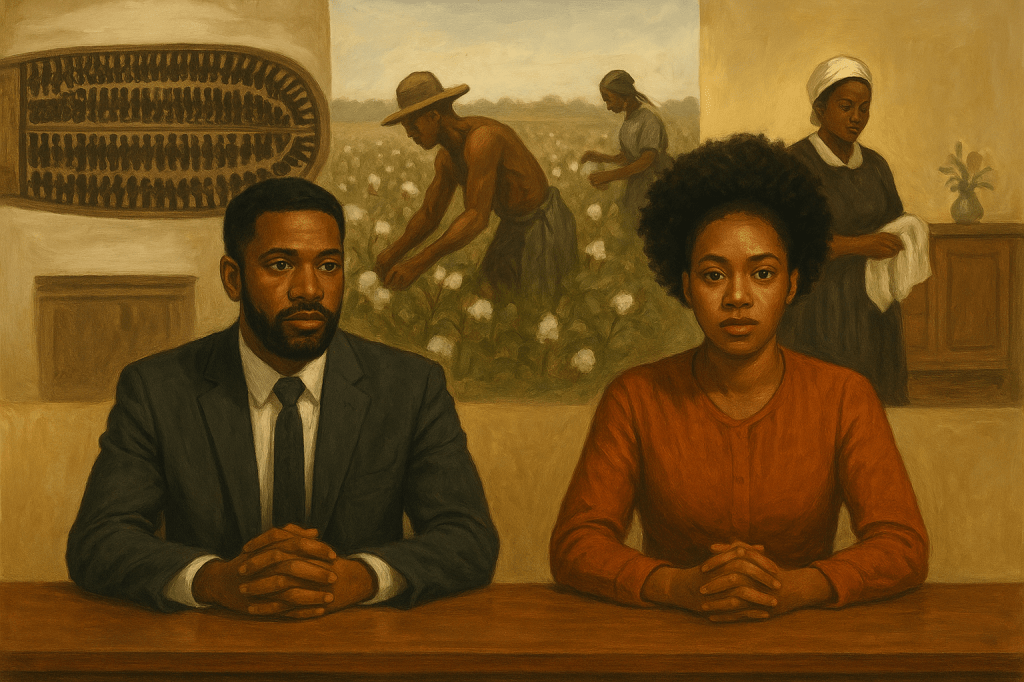
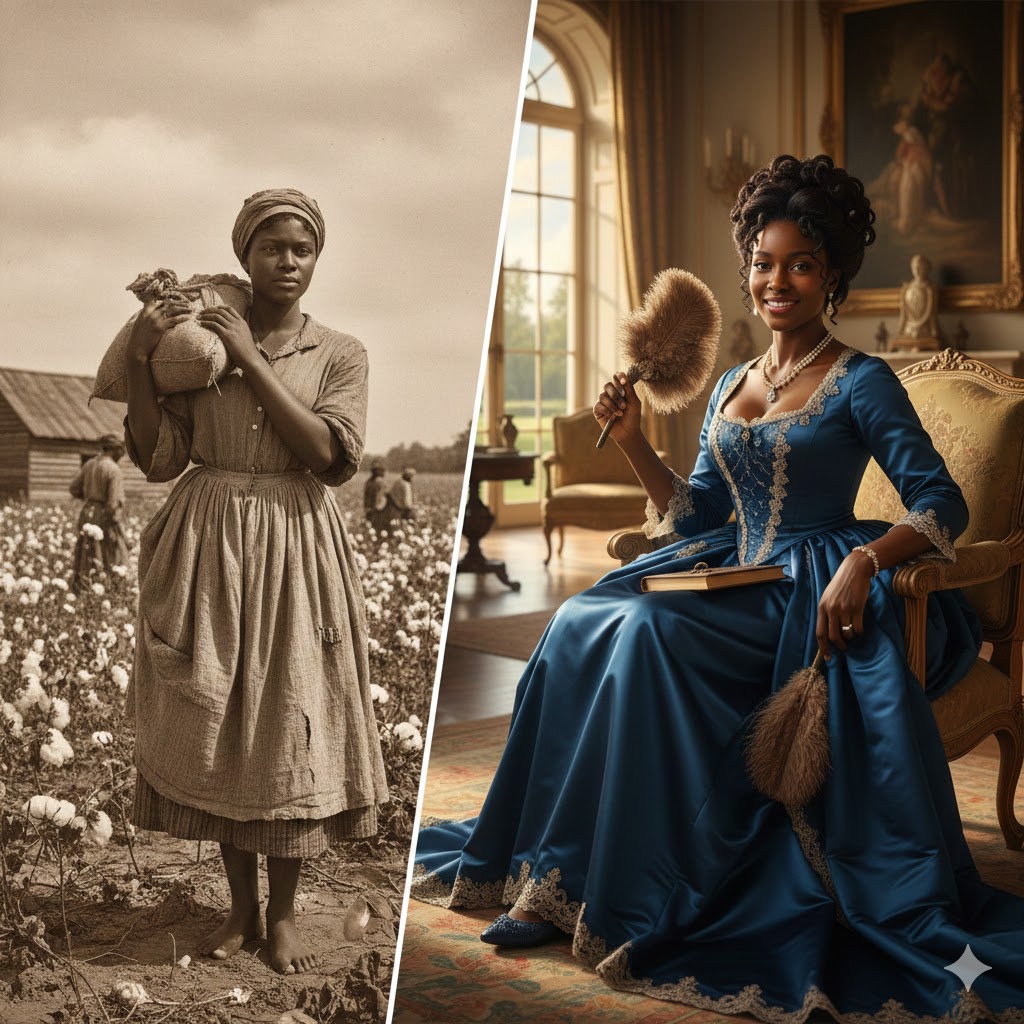
The racialization of skin tone also created intragroup class stratifications where enslaved Africans were divided by labor assignment and social access. Those in the field received the sun’s unfiltered glare, while those in the house received comparative visual proximity to whiteness, birthing the psychological pathology now called colorism (Byrd & Tharps, 2014).

Modern psychological literature affirms that colorism operates differently than racism, functioning intragroup and extracting value based on gradation rather than race membership itself, producing unique intimacy-based identity harm (Hunter, 2007).

Brown-skinned identity outgrowth constitutes psychological rebellion against narrated misreadings, external hierarchies, aesthetic excommunication, and internalized doubt.

Faith-based identity reclamation exemplifies the psychology of self-authorship; what is spoken over the self repeatedly becomes believed by the self eventually (Romans 10:17, KJV; Beck, 1976).

Suffering, identity contamination, and hiddenness often precede purpose unveiling in Scripture—Joseph was pit-pressed before palace-positioned, Job was stripped before doubled, Christ was crucified before coronated (Genesis 41, KJV; Job 42:10, KJV; Philippians 2:8-11, KJV).

Thus, brownness is both testimony and teleology. The biological ink is ancient, but the story is ongoing, edited by God, interrupted by glory, fortified by hardship, and reclaimed through divine language (Romans 8:28-18, KJV).

The manuscript of melanin cannot be erased—it can only be read, misread, or reclaimed. But the Author Himself is God, and He calls His work “very good” (Genesis 1:31, KJV).


References

Beck, A. T. (1976). Cognitive Therapy and Emotional Disorders. International Universities Press.

Byrd, A. D., & Tharps, L. L. (2014). Hair Story: Untangling the Roots of Black Hair in America. St. Martin’s Press.

Clark, K. B., & Clark, M. P. (1947). Racial identification and preference in Negro children. In T. M. Newcomb & E. L. Hartley (Eds.), Readings in Social Psychology (pp. 169–178). Holt.

Cross, W. E. (1991). Shades of Black: Diversity in African-American Identity. Temple University Press.

DeGruy, J. (2005). Post-Traumatic Slave Syndrome. Uptone Press.

Duckworth, A. L. (2016). Grit: The Power of Passion and Perseverance. Scribner.

Fanon, F. (2008). Black Skin, White Masks. Grove Press. (Original work published 1952)

Hunter, M. (2007). The persistent problem of colorism: Skin tone, status, and inequality. Sociology Compass, 1(1), 237–254.

Jablonski, N. G., & Chaplin, G. (2010). Human skin pigmentation as an adaptation to UV radiation. Journal of Human Evolution, 58(5), 390–397.

The Holy Bible: King James Version (Authorized 1611/1769).

Dilemma: 400 years later…

The arrival of the first documented Africans to the shores of what would become the United States began in 1619, initiating a 400-year historical continuum that cannot be reduced to a single era or chapter but must be read as an unfolding system of captivity and racial stratification rooted in both economic exploitation and social demonization. The transatlantic slave trade expanded across the Americas over the next two centuries, cementing a global architecture of forced labor that built Western wealth while systematically devastating African communities and fracturing family lineage. This reality fulfills the ancient warning that curses follow a disobedient and oppressed people, for scripture foretold a nation that would experience alien ruin, humiliation, and subjugation: “The stranger that is within thee shall get up above thee very high; and thou shalt come down very low” (Deuteronomy 28:43, KJV).

Slavery did not begin by accident but by law, religion, and commerce. By the mid-1600s, colonial legislatures had codified Africans and their descendants into permanent hereditary servitude, legally positioning Black bodies as property rather than persons, creating a condition where captivity could be inherited like a surname. Plantations multiplied across the Southern colonies, where cotton would later emerge as “king,” demanding labor on a scale that turned land into empire and humans into fuel. Yet the Bible condemns the very foundation of such enterprise: “He that stealeth a man, and selleth him… shall surely be put to death” (Exodus 21:16, KJV). The theft was never the land alone — it was identity, labor, movement, and posterity.

Even after the Thirteenth Amendment of 1865 formally abolished chattel slavery, its exception clause allowed a rapid pivot into criminalized bondage, birthing the era of convict leasing, where Black men were arrested on arbitrary charges, leased to corporations, and worked under conditions nearly indistinguishable from plantation labor. The cotton field remained, only relabeled. This legislative loophole reframed chains as “justice,” transforming freedom into illusion. Scripture again provides clarity: “The wicked walk on every side, when the vilest men are exalted” (Psalm 12:8, KJV). When power itself is corrupt, deliverance cannot be legal alone — it must also be spiritual.

Reconstruction offered a brief but luminous disruption of bondage. Black Americans built schools, entered political office, established land ownership, and reconnected fragments of stolen ancestry. But progress provoked terror, and by 1877, federal retreat enabled Southern states to regenerate racial hierarchy through Jim Crow laws, insulating white privilege and criminalizing Black mobility. Between 1870 and 1950, thousands of Black Americans were lynched in public acts of racial terrorism, not as random violence but as a national message: Black advancement would be met with blood. The psalmist described this spirit precisely: “They have said, Come, and let us cut them off from being a nation” (Psalm 83:4, KJV). The objective was erasure.

The Great Migration (1916–1970) relocated millions of Black families from the agricultural South to the industrial North, seeking wages rather than whipping posts, safety rather than spectacle deaths. But northern opportunity carried its own forms of apartheid: redlining maps, restricted labor unions, segregated schools, employment ceilings, and policing systems that followed Black communities like a shadow. The physical field changed, but the captivity matured into systems rather than signposts. Scripture declared the emotional condition of displaced people longing for justice and homeland: “By the rivers of Babylon, there we sat down, yea, we wept” (Psalm 137:1, KJV).

The 1960s Civil Rights Movement confronted segregation at its legal roots, demanding equal access to education, voting, housing, and public participation. Its leaders spoke like prophets disrupting empires: “Let judgment run down as waters, and righteousness as a mighty stream” (Amos 5:24, KJV). Yet many of the same state systems that resisted abolition resisted civil rights — governors blocking doors, officers turning hoses, lawmakers filibustering dignity. Progress was wrestled, never gifted.

Following civil rights legislation came a new form of containment — the War on Drugs, hyper-policing, and mass incarceration. From the 1980s onward, prisons expanded faster than schools, sentencing laws grew harsher, and policing strategies militarized, targeting Black neighborhoods with a disproportionality that mirrors an economic draft. Men descended from sharecroppers became inmates leased through labor programs inside industrial prisons. The plantation evolved into a complex, adaptable organism. As Proverbs illuminated the mechanics of inequality: “The rich ruleth over the poor” (22:7, KJV). For Black America, poverty was not incidental but intentional infrastructure.

In modern expression, hatred manifests not in auction blocks but in algorithms, policing districts, wage gaps, and judicial disparities. Hate crimes continue at alarming frequency, motivated by the same racial animus that once governed slave patrols, lynch mobs, and segregated institutions. Police brutality killings operate as extrajudicial punishments disproportionately borne by Black citizens, echoing the terror logic of the past. “They break in pieces thy people, O Lord, and afflict thine heritage” (Psalm 94:5, KJV). The cries are the same; only the arenas differ.

Reparations promised in 1865 through “40 acres and a mule” never materialized nationally, representing not only a breach of contract but a breach of justice. No federal reparative policy has been enacted despite centuries of documented theft, labor extraction, and structural disenfranchisement. The field and the counter today form an economic diptych — continuity rather than contrast: from unpaid cotton labor to underpaid service labor, from stolen land to inaccessible mortgages, from patrolled movement to policed existence, from literal chains to institutional ones.

The psychological captivity is often strongest. Media systems still export narratives that position Black identity as inferior, criminal, or disposable, reproducing a cognitive caste system that shapes public perception, opportunity distribution, and even self-esteem. Solomon teaches that perception becomes self-governing: “As he thinketh in his heart, so is he” (Proverbs 23:7, KJV). When a people lives under 400 years of negative mirrors, liberation must reconstruct the mind, not only the nation.

Understanding the Biblical “400-Year” Hardship Motif

In the Bible, long periods of suffering are often tied to exile, purification, oppression, and divine timing, not arbitrary catastrophe. The closest explicit reference to 400 years appears in Genesis 15:13–14 (KJV), where God tells Abram:

“Know of a surety that thy seed shall be a stranger in a land that is not theirs, and shall serve them; and they shall afflict them four hundred years; And also that nation, whom they shall serve, will I judge: and afterward shall they come out with great substance.”

This passage establishes three key principles:

  1. Suffering within foreign lands can be part of divine assignment — “a land that is not theirs.”
  2. The suffering serves a formative purpose for a chosen lineage — Abram’s seed is not destroyed, but shaped.
  3. The timeline ends with judgment of the oppressor and advancement of the oppressed — “I will judge” + “come out with great substance.”

Other biblical exiles follow similar structure, though without the number 400 attached. Israel’s bondage in Egypt, Judah’s exile into Babylon, and the scattering of tribes under imperial conquest all follow a recognizable pattern:

  • Identity is attacked
  • Oppression is used as endurance training
  • God times deliverance to align with spiritual readiness rather than political apology
  • Restoration is communal, covenantal, and spiritual before material

(Deuteronomy 30:3–5, Jeremiah 29:10–14, Psalm 126:1-3, KJV)

Thus, when people today speak of “400 years later,” they are usually drawing a parallel between African-descended suffering in America (beginning in 1619) and the Genesis 15 captivity framework, combining historical trauma with biblical typology. This is a symbolic theological claim, not a literal prophetic decree.

Du Bois (1903) noted that Black history in America has often been interpreted through a dual lens of diaspora and spiritual yearning, mirroring Hebraic exile themes. This interpretive tradition became especially strong in the African-American church and in later Afro-Hebraic movements. (Du Bois, 1903; Wilkerson, 2010)


Why 2025 Is Being Discussed as the “Cycle’s End”

The belief that “the 400-year test ends in 2025” is an example of contemporary sacred-historical reinterpretation, similar to how different generations calculated messianic or jubilee timelines in their own eras. The Bible shows that humans frequently attach chronology to hope:

  • Daniel expected restoration after 70 years because Jeremiah prophesied it (Daniel 9:2, KJV)
  • Israelites expected the Messiah based on timeline readings of prophets (Luke 3:15, KJV)
  • The Jubilee cycle (Leviticus 25) shaped conversations of liberation and return

Likewise, many Black thought movements today use 1619 → 2019/2025 as a rhetorical timeline to emphasize:

  • How long has injustice persisted
  • How delayed deliverance feels
  • How captivity keeps evolving
  • The moral debt owed to Black descendants has not been acknowledged or repaired

(Rothstein, 2017; Stevenson, 2014)

However, the Bible consistently teaches that God’s deliverance is not triggered by the clock alone, but by covenant remembrance and collective turning toward Him:

“Then ye shall call upon me, and ye shall go and pray unto me, and I will hearken unto you. And ye shall seek me, and find me, when ye shall search for me with all your heart.”
(Jeremiah 29:12-13, KJV)

This shows that spiritual awakening precedes systemic reversal in God’s economy.


What Has Changed vs. What Hasn’t

What has changed since 1619:

  • Black Americans are no longer enslaved as legal property
  • Literacy, land ownership, political office, scholarship, and cultural expression are possible
  • The Bible is now read by Black communities rather than read at them

(Woodson, 1933; Du Bois, 1903)

What has not changed at the root level :

  • Violence against Black bodies continues through hate-motivated crimes
  • Law enforcement injustice appears through disproportionate lethal force and brutality
  • No federal reparative restoration has been enacted for descendants of slavery
  • The wealth gap persists, restricting intergenerational mobility
  • Oppression remains structural, not individual alone
  • Bondage evolved from chains on bodies → chains on systems → chains on narratives → chains on economics → chains on mobility and life expectancy

(Muhammad, 2011; Rothstein, 2017; Stevenson, 2014)

Biblically, this mirrors a shift like captivity rather than the removal of it. Egypt began as physical bondage, but later exile became psychological, political, and spiritual scattering.


Yet transformation, though unfinished, remains possible. The biblical arc of exodus shows that freedom is not immediate but fought for, walked into, prayed into, and inherited by those who refuse to remain Egypt-minded. “Stand fast therefore in the liberty wherewith Christ hath made us free, and be not entangled again with the yoke of bondage” (Galatians 5:1, KJV). Black America has been made free in spirit — the labor left is to be made free in systems, policies, safety, economy, body, and legacy.

Bondage persists, but so does chosen resistance. The cotton field, the counter, the classroom, the courtroom, the wealth gap, the police district — these are the new Red Seas, new wildernesses, and new pleas for divine justice. Deliverance is still in motion. Liberation has begun, but emancipation is still the mission. And the question is no longer “Were we enslaved?” but “Why are the chains so adaptive, and where will exodus lead next?”

References

Bibb, H. (1849). Narrative of the Life and Adventures of Henry Bibb, an American Slave. Author.

Du Bois, W. E. B. (1903). The Souls of Black Folk. A. C. McClurg & Co.

Equal Justice Initiative. (2022). Lynching in America: Confronting the Legacy of Racial Terror (3rd ed.). Author.

Feagin, J. (2020). The racism: A short history (2nd ed.). Routledge.

Genovese, E. D. (1976). Roll, Jordan, Roll: The World the Slaves Made. Pantheon Books.

Higginbotham, A. L. (1978). In the Matter of Color: Race and the American Legal Process. Oxford University Press.

King James Bible. (1611). King James Version (KJV).

King, M. L., Jr. (1963). “I Have a Dream.” Speech presented at the March on Washington for Jobs and Freedom, Washington, D.C.

Muhammad, K. G. (2011). The Condemnation of Blackness: Race, Crime, and the Making of Modern Urban America. Harvard University Press.

National Archives. (2024). 13th Amendment to the U.S. Constitution: Abolition of Slavery (except as punishment for crime). U.S. Government.

Rothstein, R. (2017). The Color of Law: A Forgotten History of How Our Government Segregated America. Liveright Publishing.

Smith, S. (2016). Generations of captivity: A history of African-American slavery. Journal of Cultural History, 12(4), 45–67.

Stevenson, B. (2014). Just Mercy: A Story of Justice and Redemption. Spiegel & Grau.

Wilkerson, I. (2010). The Warmth of Other Suns: The Epic Story of America’s Great Migration. Random House.

Woodson, C. G. (1933). The Mis-Education of the Negro. Associated Publishers.

Exodus 21:16 – “He that stealeth a man, and selleth him… shall surely be put to death.”

Deuteronomy 28:37 – “Thou shalt become an astonishment, a proverb, and a byword, among all nations.”

Deuteronomy 28:43 – “The stranger that is within thee shall get up above thee very high; and thou shalt come down very low.”

Proverbs 22:7 – “The borrower is servant to the lender.”

Proverbs 23:7 – “As he thinketh in his heart, so is he.”

Psalm 12:8 – “The wicked walk on every side, when the vilest men are exalted.”

Psalm 83:4 – “Let us cut them off from being a nation.”Psalm 94:5 – “They break in pieces thy people, O Lord, and afflict thine heritage.”

Galatians 5:1 – “Stand fast therefore in the liberty wherewith Christ hath made us free, and be not entangled again with the yoke of bondage.”

Negroid Type: From Pseudoscience to Sacred Heritage

The term Negroid has long been one of the most controversial concepts in the study of human variation. Once used by anthropologists to categorize people of African descent, it has since become emblematic of the pseudo-scientific ideologies that underpinned racism, colonialism, and slavery. Yet, beyond its misuse, the study of African physical diversity, genetics, and spirituality reveals a deeper truth: the African phenotype represents the foundation of humanity itself.

Origins of the Term
The classification “Negroid” emerged in the late eighteenth and nineteenth centuries as part of the typological system developed by European naturalists such as Johann Friedrich Blumenbach. Blumenbach (1779) divided humankind into five “races”: Caucasoid, Mongoloid, Malayan, American, and Negroid. These categories, though influential, were based on superficial physical traits such as skin color, hair texture, and cranial measurements—not on actual biological lineage.

Scientific Racism and Colonial Expansion
Throughout the nineteenth century, the concept of the Negroid type became weaponized to justify slavery, imperialism, and racial hierarchy. Scientists like Samuel George Morton and Josiah C. Nott collected skulls and measured crania, falsely concluding that Africans had smaller brains and thus lesser intelligence. These ideas, later termed “scientific racism,” provided a veneer of legitimacy to the transatlantic slave trade and segregationist ideologies (Gould, 1996).

The Myth of Racial Purity
Racial typologies assumed that human groups were biologically distinct and hierarchically ordered. However, modern genetics has decisively refuted the notion of “pure races.” The Human Genome Project revealed that all humans share over 99.9% of their DNA, and that genetic variation within Africa is greater than that found between all other continents combined (Tishkoff et al., 2009). Thus, Africa is not a singular type, but the cradle of all human diversity.

Anthropological Evolution
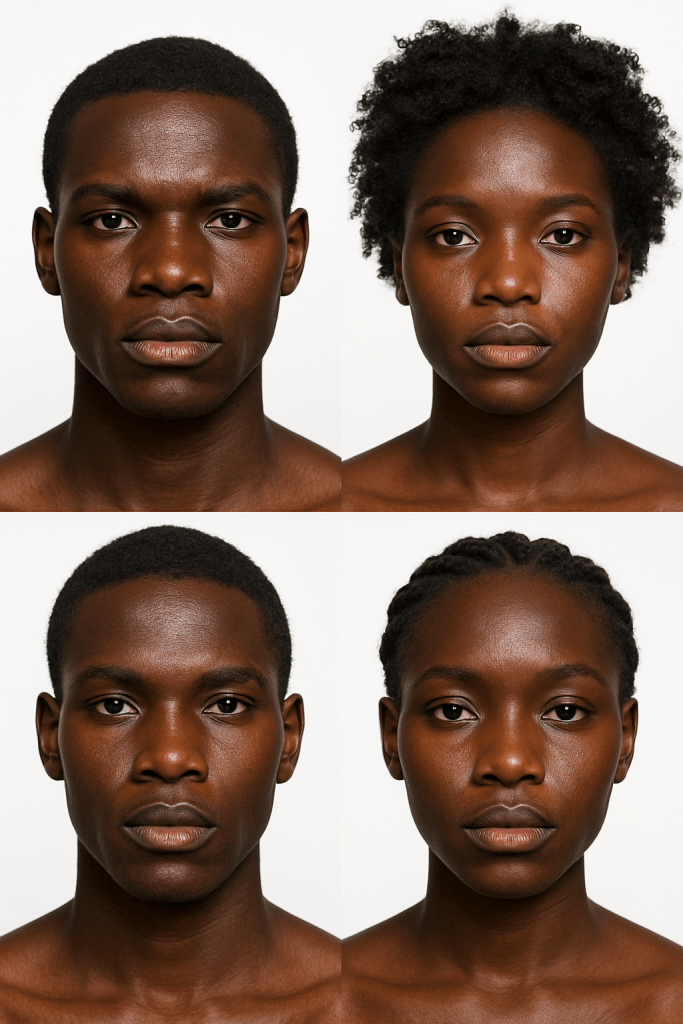
Contemporary anthropology has moved away from fixed racial typologies toward an understanding of clinal variation—continuous, overlapping patterns of traits shaped by environment and adaptation. Features once associated with the so-called Negroid type—broad noses, full lips, dark skin, and tightly curled hair—are now recognized as adaptive responses to tropical climates, offering protection against ultraviolet radiation and dehydration (Jablonski, 2004).

Reclaiming the African Image
Despite its colonial misuse, many Afrocentric scholars have sought to reclaim the imagery associated with African phenotypes. The so-called Negroid features are not markers of inferiority but signatures of ancestral distinction and beauty. From the pyramids of Kemet to the kingdoms of Mali, Songhai, and Benin, these features have been celebrated in sculpture, iconography, and divine representation (Diop, 1974).

Theological Dimensions
In biblical interpretation, several theologians and Hebraic scholars suggest that many of the ancient Israelites and patriarchal figures were people of African or Afro-Asiatic descent (Hotep, 2012). Scriptures such as Jeremiah 8:21 and Song of Solomon 1:5 (“I am black but comely”) reflect an awareness of dark skin within sacred contexts. The “Negroid” image thus becomes not merely anthropological but theological—a reflection of divine creation in melanin.

The Melanin Doctrine
Melanin, the pigment responsible for skin color, has become central to Afrocentric spirituality and scientific theology. It is viewed not only as a biological substance but as a symbol of resilience, energy absorption, and divine intelligence. Modern science supports its importance as a natural protector against solar radiation and free radicals, granting both physiological and psychological strength (Barnes, 1998).

The Role of Genetics
Genetic anthropology has revealed that haplogroups such as E1B1A, prevalent among West and Central Africans, trace back tens of thousands of years and connect to ancient migrations across the Nile Valley and the Levant. This lineage further challenges Eurocentric narratives by demonstrating that African ancestry is central to the genesis of civilization, language, and spirituality (Keita & Boyce, 2005).

African Beauty and the Divine Aesthetic
Throughout art, history, and media, features once denigrated under “Negroid typology” have reemerged as powerful symbols of divine beauty. Full lips, coiled hair, and rich melanin have become icons of aesthetic authenticity. Artists, scholars, and theologians alike now celebrate these traits as reflections of the Imago Dei—the image of God expressed through African physiognomy.

The Psychological Aftermath of Typology
The lasting effects of racial classification systems manifest in colorism, internalized racism, and self-rejection among people of African descent. The colonial distortion of beauty and worth has caused generational trauma. However, through education, cultural pride, and spiritual renewal, many communities are redefining blackness as a state of sacred dignity rather than inherited shame (hooks, 1992).

Decolonizing Anthropology
To move forward, anthropology must continue to deconstruct Eurocentric frameworks and amplify African epistemologies. Decolonized scholarship acknowledges that Africa is not a peripheral contributor to human evolution—it is the epicenter. This perspective redefines the so-called Negroid type not as a scientific label but as an ancestral spectrum of human origin and identity.

The Biblical Lineage of Nations
Several biblical genealogies align with African migrations. Ham, the progenitor of Cush, Mizraim, and Canaan, is traditionally associated with African civilizations. Afro-Hebraic interpretations propose that the original Israelites shared ancestral links with these Afro-Asiatic peoples, connecting scriptural heritage to African identity (Ben-Yehuda, 2018).

Africa as Mother of Civilization
Civilizations such as ancient Nubia, Egypt, and Ethiopia challenge Western assumptions of white antiquity. These empires exhibited complex governance, literacy, architecture, and theology millennia before Europe’s Renaissance. Thus, the “Negroid” type, once portrayed as primitive, is historically proven to be the architect of civilization itself (Diop, 1974).

The Curse Narrative Debunked
The misuse of the biblical “curse of Ham” narrative historically justified slavery and segregation. However, critical exegesis reveals no divine condemnation of blackness; rather, this interpretation was fabricated to sustain white supremacy (Goldenberg, 2003). Modern theology restores the African presence in scripture as one of blessing, innovation, and covenantal purpose.

The Beauty of Diversity Within Africa
The African continent hosts immense phenotypic and cultural diversity—from the tall Nilotic peoples to the compact Bantu and the ancient Khoisan. Such variety proves the inadequacy of “Negroid” as a unifying label. Instead, Africa embodies a mosaic of adaptation, creativity, and divine design, representing the full expression of human potential.

The Modern Genetic Synthesis
Modern population genetics reinforces that all non-African peoples descend from small groups of Africans who migrated out of the continent roughly 60,000 years ago. Thus, every human phenotype, whether European or Asian, carries ancestral African DNA. Humanity, in essence, is a global expression of African origin (Stringer, 2016).

Cultural Redemption and Reeducation
To reclaim African identity, education must confront the falsehoods of racial hierarchy. Cultural and genetic literacy can restore self-worth among diasporic peoples. The truth that humanity originated in Africa dismantles the lie of inferiority and honors the spiritual narrative of creation found in Genesis: “And God formed man of the dust of the ground.”

Spiritual Anthropology
Beyond science, spiritual anthropology recognizes that the human form is a vessel of divine wisdom. The so-called Negroid type, with its radiant melanin and ancestral features, becomes a living testimony to divine craftsmanship. Through faith, knowledge, and cultural restoration, African descendants rediscover their sacred lineage as both biological and spiritual heirs of humanity.

Conclusion
The term Negroid type should no longer signify a scientific category but a journey—from misclassification to reclamation, from pseudoscience to sacred truth. Africa is not merely the continent of blackness; it is the womb of the world. By reinterpreting the narrative through historical critique, Afrocentric pride, and theological revelation, we affirm that to study the African face is to gaze upon the mirror of creation itself.


References (APA 7th Edition)

Barnes, J. (1998). Melanin: The key to freedom. Black Classic Press.
Ben-Yehuda, Y. (2018). Hebrew Israelites and the African connection: An Afrocentric biblical interpretation. Africana Studies Review, 12(3), 45–62.
Blumenbach, J. F. (1779). On the natural varieties of mankind. Göttingen.
Diop, C. A. (1974). The African origin of civilization: Myth or reality. Lawrence Hill Books.
Goldenberg, D. M. (2003). The curse of Ham: Race and slavery in early Judaism, Christianity, and Islam. Princeton University Press.
Gould, S. J. (1996). The mismeasure of man. W. W. Norton & Company.
hooks, b. (1992). Black looks: Race and representation. South End Press.
Hotep, U. (2012). The African origins of the Hebrew people. Kemet University Journal of African Spirituality, 8(2), 33–58.
Jablonski, N. G. (2004). The evolution of human skin and skin color. Annual Review of Anthropology, 33, 585–623.
Keita, S. O. Y., & Boyce, A. J. (2005). Genetics, history, and identity: The case of the African peoples. American Anthropologist, 107(1), 12–23.
Stringer, C. (2016). The origin of our species. Penguin Books.
Tishkoff, S. A., et al. (2009). The genetic structure and history of Africans and African Americans. Science, 324(5930), 1035–1044.

Shadows of Preference: Navigating Male Gaze and Colorism. #thebrowngirldilemma

Photo by Craig Adderley on Pexels.com

When preference becomes shadow, Brown girls shine their own light.

Beauty and desirability have always been mediated through the male gaze, but for Brown girls, the gaze is not neutral. It is filtered through colorism, a hierarchy of skin tone preference that privileges lighter complexions and Eurocentric features while marginalizing darker ones. Within this system, Brown beauty often becomes invisible, reduced to stereotypes or subject to conditional acceptance. The politics of attraction reveal that desirability is not simply a matter of individual taste but is shaped by historical legacies, media representation, and cultural bias (Hunter, 2007).

Desirability and Disparity: The Psychology of Attraction in Color

Psychologically, colorism affects how beauty is perceived and valued. Research on implicit bias reveals that individuals often associate lighter skin with attributes like femininity, softness, and sophistication, while darker skin is unfairly linked to aggression, masculinity, or undesirability (Maddox & Gray, 2002). These biases operate beneath conscious awareness, shaping the subconscious foundations of attraction and reinforcing a hierarchy that leaves Brown girls fighting for visibility and validation.

Attraction, in this context, becomes less about personal chemistry and more about navigating social scripts. Social comparison theory demonstrates that when Brown girls consistently encounter cultural messages that devalue their features, they may internalize these standards, resulting in diminished self-esteem and struggles with self-image (Festinger, 1954). The disparity in desirability is thus not a reflection of actual beauty but of distorted cultural conditioning that dictates what is celebrated and what is dismissed.

At the same time, many men who uphold colorist preferences are unaware of the psychological roots of their attraction. They may describe their choices as “just a preference,” but preferences are not created in a vacuum. They are shaped by exposure, cultural conditioning, and the historical privileging of whiteness and lightness. This creates a disparity where Brown girls are simultaneously admired for their strength, style, and resilience but overlooked in romantic desirability.

When Love Meets Color: Dating, Bias, and the Brown Girl Experience

The dating world is often where colorism is most starkly revealed. Studies on partner selection show that lighter-skinned women are more likely to be perceived as suitable for marriage, while darker-skinned women are often relegated to roles of casual relationships or fetishized encounters (Robinson & Ward, 1995). For Brown girls, this translates into painful experiences of rejection, where bias masquerades as taste, and love becomes entangled with structural inequity.

Brown girls often share testimonies of being overlooked in favor of lighter-skinned counterparts, not because of incompatibility but because of ingrained notions of prestige and desirability attached to skin tone. This bias fractures the experience of dating, making it not only about personal compatibility but also about negotiating one’s place within a racially stratified beauty economy. The sting of rejection becomes heavier when it is tied not to personality or values but to features that reflect ancestry and identity.

Yet, despite these barriers, many Brown women redefine love and attraction on their own terms. By rejecting narrow definitions of beauty, they cultivate self-confidence, embrace cultural pride, and seek partners who see beyond colonial legacies of preference. Campaigns such as #UnapologeticallyBrown and #MelaninPoppin amplify this resistance, creating communities where Brown women affirm each other’s worth, beauty, and desirability. Love, when rooted in authenticity rather than bias, becomes both possible and revolutionary.

Toward a New Standard

Ultimately, navigating the male gaze and colorism requires both societal change and personal reclamation. As long as colorist standards define desirability, Brown girls will continue to wrestle with invisibility and inequity. However, when beauty hierarchies are exposed, challenged, and dismantled, attraction can be reimagined as a space of inclusivity and truth. Love that honors the full spectrum of skin tones and features is not only more just but also more deeply human.


References

Festinger, L. (1954). A theory of social comparison processes. Human Relations, 7(2), 117–140.

Hunter, M. (2007). The persistent problem of colorism: Skin tone, status, and inequality. Sociology Compass, 1(1), 237–254.

Maddox, K. B., & Gray, S. A. (2002). Cognitive representations of Black Americans: Reexploring the role of skin tone. Personality and Social Psychology Bulletin, 28(2), 250–259.

Robinson, T. N., & Ward, J. V. (1995). African American adolescents and skin color. Journal of Black Psychology, 21(3), 256–274.

Brown Horizons: A Confessional Journey for the Brown Boy and Girl.

To the brown boy and the brown girl — this is your confession, your hymn, your horizon. The world has too often told you that your color was a limitation when, in truth, it is your liberation. The richness of your skin is not a shadow; it is a sunrise — the dawn of a story that began long before the world learned to misname your beauty.

For too long, brown children have lived between two worlds — too light for one, too dark for another. You have been told to straighten your curls, soften your tone, and hide your brilliance to be accepted. Yet, in all of this shaping and shrinking, your soul has cried out for one simple truth: “Who am I when I am not trying to fit in?”

You are the hue of history, the color of continents, the reflection of God’s creativity. You were formed from the same soil that birthed civilizations — from the Nile rivers to the Nubian sands, from the valleys of India to the islands of the Caribbean. When the sun kisses your skin, it does not burn — it remembers. You are the living proof of God’s design, wrapped in melanin and memory.

The brown boy carries the weight of expectation — to be strong but not soft, bold but not broken. Yet inside him is a river of unspoken emotion, running deep with dreams and fears he rarely names. The world calls him “angry” when he is simply aching — aching to be seen, to be loved, to be enough. But God whispers, “You are my son, in whom I am well pleased” (Mark 1:11, KJV). His worth is not earned by achievements but inherited by grace.

The brown girl, too, has been burdened by mirrors that distort her reflection. Her curls are called “wild,” her skin “too dark,” her voice “too loud.” But in her laughter echoes the rhythm of creation, and in her eyes burns the light of resilience. She is the descendant of queens who wore gold not for vanity but for remembrance — symbols of divine favor and strength. “I am black, but comely,” she declares (Song of Solomon 1:5, KJV), not in apology, but in affirmation.

This confessional journey is not about shame but awakening. It is about remembering who you were before the world defined you — before colorism, colonization, and comparison blurred your vision. It is about reclaiming the joy of being brown — the joy of existing in a body that carries sunlight in its DNA.

To the brown boy: you are not invisible. You are brilliance waiting to be recognized. You are leadership in motion, not the sum of stereotypes. Learn to love your reflection without seeking permission. Let the Spirit of God be your mirror, for He will show you what the world refuses to see — a king in the making, a vessel of purpose, a protector born from promise.

To the brown girl: you are not too much; you are more than enough. The world may misunderstand your glow, but heaven celebrates it. Every freckle, curl, and curve is poetry in flesh. Your melanin is sacred art — kissed by creation, approved by eternity. Let your confidence be your crown and your humility its jewels.

And to both — learn that healing comes when you no longer measure your worth by their gaze. You are not competing with lighter or darker shades; you are completing the spectrum of beauty God designed. Your color is not an accident — it is an assignment.

This journey is confessional because healing requires honesty. It’s okay to admit you’ve felt unseen, unloved, or underestimated. But it’s also necessary to remember that your worth was written long before society formed its opinions. Your story began with “Let there be light,” and the light has never left you.

As you look toward the horizon — that endless meeting of heaven and earth — know that you are standing at the intersection of both. You are divine dust and eternal breath. The horizon does not choose one color; it holds them all in harmony. So, too, must you hold all parts of yourself — the pain, the pride, the promise.

Brown horizons are not boundaries; they are beginnings. They remind us that our color connects us to creation’s oldest truth — that from the soil came life, and from that life came light. To the brown boy and the brown girl: bloom boldly. Speak truth. Walk with dignity. Love without apology.

Your hue is holy. Your heritage is heaven’s art.
You are not becoming the light.
You are the light — kissed by the sun, kept by God, and destined for glory.


References

  • “I am black, but comely, O ye daughters of Jerusalem” — Song of Solomon 1:5
  • “Ye are the light of the world. A city that is set on an hill cannot be hid.” — Matthew 5:14
  • “And God said, Let there be light: and there was light.” — Genesis 1:3
  • “I will praise thee; for I am fearfully and wonderfully made.” — Psalm 139:14
  • “This is my beloved Son, in whom I am well pleased.” — Mark 1:11

Brown Girl Blues: “Brown Girls Are Loud,” They Say….

Photo by Polina Tankilevitch on Pexels.com

The assertion that “Brown girls are loud” functions as both a stereotype and a silencing mechanism. This phrase, often uttered casually or as social commentary, conceals a deeper historical bias against women of color who assert themselves vocally or emotionally. The term “loud” becomes a racialized label that delegitimizes self-expression while maintaining Eurocentric standards of femininity and decorum (Collins, 2000).

For centuries, the voices of Black and brown women have been controlled, muted, or mocked. Under slavery, colonization, and segregation, their words were often dismissed as irrational or impertinent. Today, these historical prejudices persist through modern stereotypes like the “angry Black woman” or the “fiery Latina,” both of which frame passionate communication as emotional instability (Walley-Jean, 2009). Thus, “loudness” becomes a weaponized term used to reassert social hierarchies.

To be called “loud” is rarely about volume; it is about visibility. When women of color speak confidently or express emotion, they challenge the systems designed to keep them silent. This so-called loudness is, in essence, a refusal to disappear. It is the sound of resistance echoing across generations who were denied speech.

The racialization of voice and tone stems from colonial constructs of civility. Western norms associated femininity with quietness, politeness, and restraint — ideals rooted in white, patriarchal structures (hooks, 1981). Any deviation from this mold was deemed unruly or primitive. For brown women, whose cultural communication styles are often rich in rhythm, gesture, and emotion, this framework was particularly limiting.

The result is tone-policing: a subtle but pervasive form of control where the manner of a woman’s speech overshadows the content of her message. In classrooms, workplaces, and media, brown women are often told to “calm down,” “lower their voices,” or “speak professionally.” These directives disguise racial discomfort as etiquette (Pittman, 2012).

In educational spaces, this dynamic begins early. Studies show that Black girls are more likely to be disciplined for “disruptive behavior” even when engaging in classroom discussion (Morris, 2016). What is interpreted as rudeness or defiance is often simple participation, filtered through racial bias. The message received is clear: intellectual curiosity and emotional expression are dangerous when spoken in a brown voice.

Over time, many young women of color internalize this message. They learn to perform quietness as a form of protection — softening their tone, diluting their opinions, and practicing invisibility to avoid social punishment. This self-censorship comes at the cost of authenticity and mental well-being (Jones & Norwood, 2017).

The workplace continues this narrative of containment. Brown women who are assertive in leadership are often labeled “intimidating” or “difficult.” The corporate world rewards those who fit neatly within the norms of “professionalism,” which are historically white and male-centered (Wingfield, 2010). Thus, emotional expressiveness and cultural authenticity are misread as unprofessionalism rather than strength.

Yet the so-called “loudness” of brown women has fueled some of the most transformative movements in history. From Sojourner Truth’s “Ain’t I a Woman?” speech to Fannie Lou Hamer’s testimony during the Civil Rights Movement, loudness has always been synonymous with liberation (Guy-Sheftall, 1995). The voice has functioned as both weapon and witness.

In artistic and spiritual traditions, voice is sacred. Within African and Afro-diasporic communities, song and speech have long served as vessels for memory and survival. From the griots of West Africa to the blues singers of the American South, the act of speaking — or singing — truth aloud is a form of cultural continuity (Gates, 1988).

Brown women’s expressiveness must therefore be understood within this historical continuum. Their tone is not aggression but ancestral resonance. The cadence, warmth, and emotionality of their voices carry centuries of resilience. To misinterpret that as loudness is to mishear history itself.

Media representations, however, continue to distort this narrative. Television and film often portray brown women as “sassy,” “overly dramatic,” or “ghetto,” reinforcing the myth that they lack emotional control (Gray, 2013). These depictions not only shape public perception but also influence how brown women see themselves.

Representation, as bell hooks (1992) reminds us, is a site of struggle. When brown women are consistently portrayed as one-dimensional caricatures, the world forgets that their “loudness” has context — a response to generations of silence and misrepresentation.

Nevertheless, modern movements in art and media are reclaiming the narrative. Figures like Issa Rae, Viola Davis, and Michaela Coel embody unapologetic authenticity, turning what was once labeled as “too much” into a badge of power. Their presence affirms that loudness and grace can coexist.

Community also plays a crucial role in healing the internal wounds caused by tone-policing. Safe spaces where brown women can speak freely — whether through sister circles, creative writing, or therapy — allow them to rediscover the sound of their unfiltered voices. These spaces become sanctuaries of affirmation.

Spiritual traditions, especially within the African diaspora, have long affirmed the power of voice. In the Black church, for example, “call and response” reflects communal validation — a sacred rhythm where one voice calls forth another. This cultural form rejects Western silence and instead celebrates collective expression (Lincoln & Mamiya, 1990).

The intersection of race, gender, and expression requires a reimagining of what it means to communicate effectively. Emotional expression should not be pathologized but valued as an indicator of passion, creativity, and humanity (Lord, 2000).

Moreover, educators and employers must practice cultural humility — learning to interpret communication through a multicultural lens rather than penalizing difference. This shift from tolerance to understanding is essential to dismantling linguistic bias.

For brown girls and women, unlearning internalized shame takes courage. It involves reclaiming the parts of oneself that were silenced, mocked, or misunderstood. It is a journey toward self-definition, where voice becomes both therapy and testimony.

Healing means allowing oneself to be “too much” in a world that demands less. It means crying loudly, laughing deeply, and speaking boldly — not for validation but liberation.

Cultural pride also strengthens this reclamation. By reconnecting with heritage, language, and tradition, brown women remember that expressiveness is not a flaw but a legacy. Their voices echo the resilience of ancestors who refused silence even when the cost was life itself.

When society tells brown women to quiet down, it is not requesting peace but compliance. Loudness, then, becomes a form of protest — an assertion of life in the face of erasure.

The “Brown Girl Blues” encapsulates the emotional dissonance of being seen yet unheard. It is the ache of visibility without validation, of expression met with resistance. Yet it also symbolizes beauty — the soulful rhythm of survival set to the melody of truth.

To be called “loud” is to be told that your presence disrupts. But disruption births change. In reclaiming the label, brown women transform insult into empowerment, noise into narrative, and stereotype into song.

Today’s brown girls stand on the shoulders of those who dared to speak when speaking was forbidden. Their loudness is not rebellion — it is inheritance.

The world must learn to listen differently. To hear not volume, but value. To perceive not threat, but truth.

For when brown girls speak, they do not merely raise their voices; they raise history. Their sound reverberates through time as proof that silence never saved anyone.

So, the next time the world says, “Brown girls are loud,” the answer should be unapologetic: “Yes, we are — and the world is finally listening.”


References

Collins, P. H. (2000). Black feminist thought: Knowledge, consciousness, and the politics of empowerment. Routledge.

Gates, H. L. (1988). The signifying monkey: A theory of African-American literary criticism. Oxford University Press.

Gray, H. (2013). Cultural moves: African Americans and the politics of representation. University of California Press.

Guy-Sheftall, B. (Ed.). (1995). Words of fire: An anthology of African-American feminist thought. The New Press.

hooks, b. (1981). Ain’t I a woman: Black women and feminism. South End Press.

hooks, b. (1992). Black looks: Race and representation. South End Press.

Jones, C., & Norwood, K. (2017). Aggressive, angry, and affirming: Black women’s labor, speech, and resistance. Communication and Critical/Cultural Studies, 14(3), 253–273.

Lincoln, C. E., & Mamiya, L. H. (1990). The Black church in the African American experience. Duke University Press.

Lord, A. (2000). Sister outsider: Essays and speeches. Crossing Press.

Morris, M. W. (2016). Pushout: The criminalization of Black girls in schools. The New Press.

Pittman, C. T. (2012). Racial microaggressions: The narratives of African American women in the workplace. The Journal of Black Psychology, 38(2), 185–205.

Walley-Jean, J. C. (2009). Debunking the myth of the “angry Black woman”: An exploration of anger in young African American women. Black Women, Gender + Families, 3(2), 68–86.

Wingfield, A. H. (2010). Are some emotions marked “whites only”? Racialized feeling rules in professional workplaces. Social Problems, 57(2), 251–268.

The Weight She Carries, the Grace She Wears

The Black woman stands at the intersection of history and hope, burden and brilliance. Her story is not merely a narrative of survival but a testament to a grace that refuses to die. “The Weight She Carries, the Grace She Wears” is more than a title—it is a reflection of the spiritual, emotional, and generational load she bears with a strength that confounds the world.

Her weight begins with history. From the chains of the transatlantic slave trade to the ongoing echoes of structural racism, Black women have been positioned at the crossroads of inequality. Yet, despite this, they have carried their families, communities, and faith through the wilderness with a dignity that defies explanation.

Spiritually, the Black woman’s strength mirrors biblical archetypes—Deborah’s courage, Ruth’s loyalty, Esther’s wisdom, and Mary’s faithfulness. But her journey is not only rooted in scripture; it is lived daily as she navigates systems that underestimate her while demanding her labor, compassion, and excellence.

The emotional weight she carries often remains unseen. She is expected to be strong, even when she is breaking. She wipes her own tears because the world frequently overlooks them. Still, she rises each day wrapped in a grace that comforts others even as she longs to be comforted.

Her grace is not passive. It is an active, intentional form of resilience. Black women have learned to turn pain into poetry, pressure into purpose, and silence into strength. This grace becomes her shield in a world that too often devalues her body, her voice, and her brilliance.

Identity plays a central role in her journey. She must negotiate a sense of self in a culture that stereotypes her—labeling her angry, intimidating, or “too much.” Yet she understands that authenticity is her liberation. Her identity becomes an act of resistance, a declaration that she will not shrink to make others comfortable.

The weight she carries includes the expectations of family. Many Black women become the backbone of their households, holding everyone together emotionally and spiritually. They nurture while often receiving no nurturing in return. Still, they love deeply, passionately, and sacrificially.

Economically, she bears the weight of wage gaps, limited opportunities, and the constant pressure to outperform to be seen as equal. Despite this, she continues to ascend—educating herself, building businesses, owning property, and creating generational wealth.

Her weight also includes the complexities of beauty. She is judged, compared, imitated, and criticized, yet she remains the blueprint. Society borrows from her style while denying her credit. Still, she walks with elegance, redefining beauty on her own terms.

Mentally, she balances the demands of work, relationships, self-care, and spirituality. She carries generational trauma while trying to build generational healing. The pressure to be “strong” often limits her ability to be vulnerable, yet her vulnerability is part of her transformative power.

In relationships, she gives deeply. Yet at times, she finds herself loving men still learning to love themselves. Her heart becomes both sanctuary and battlefield. Even in heartbreak, she wears her grace like a garment, believing that love—real love—is still worth waiting for.

Spiritually, she is the prayer warrior of her family, the intercessor who calls heaven down in the midnight hour. Her weight includes the responsibility to hold onto faith for everyone who has forgotten how to believe. And she does this not for applause, but because she knows God sustains her.

The grace she wears is not perfection—it is perseverance. It is her ability to keep moving forward even when she is exhausted. Her grace is her ability to forgive, to heal, to rebuild, and to hope again.

She navigates the world with a quiet intelligence, an instinctive wisdom passed down through generations of women who survived storms she will never see. Her grace becomes an inheritance, a legacy, a spiritual garment sewn with threads of sacrifice and love.

Her weight is also joy. Black women carry a capacity for laughter, creativity, and connection that fuels communities. She creates music, art, hair culture, language, and movements that shape cultures globally. Under her weight is a fire that no oppression can extinguish.

Psychologically, she navigates complex terrain—battling microaggressions, stereotypes, workplace politics, and the chronic stress of racism. Yet she cultivates coping strategies rooted in faith, community, sisterhood, and self-affirmation.

The grace she wears shows up in motherhood, whether she has biological children, spiritual children, or community children. She becomes a teacher, a mentor, a guide, shaping futures simply through her presence, her words, and her wisdom.

Her weight is also her purpose. She understands that her life is not random; it is intentional. Her gifts are needed, her voice is needed, her leadership is needed. Everything she carries prepares her for everything she is becoming.

Ultimately, the Black woman remains one of humanity’s greatest miracles. The weight she carries would break many, yet the grace she wears teaches the world what resilience truly looks like. She is not defined by her burdens but by her ability to rise above them.

Her story will always be one of power, beauty, faith, and transformation. For everything she carries, she continues to shine. And for every weight she bears, she wears a grace the world cannot comprehend.


References

Beauboeuf-Lafontant, T. (2009). Behind the mask of the strong Black woman: Voice and the embodiment of a costly performance. Temple University Press.

Collins, P. H. (2000). Black feminist thought: Knowledge, consciousness, and the politics of empowerment (2nd ed.). Routledge.

Gillum, T. (2019). Exploring Black women’s emotional labor and resilience in contemporary society. Journal of Black Psychology, 45(3), 179–197.

Harris-Perry, M. (2011). Sister citizen: Shame, stereotypes, and Black women in America. Yale University Press.

hooks, b. (2000). All about love: New visions. William Morrow.

Jones, C. (2021). The psychological burdens of strength: Black women and emotional wellness. Journal of Women’s Health, 30(6), 867–873.

Eugenics – History, Meaning, and Impact on Black Communities

Eugenics is a social philosophy and movement that seeks to improve the genetic quality of a human population through selective breeding. It emerged in the late 19th century as scientists and social reformers debated how to apply principles of heredity to human societies. Proponents believed that traits such as intelligence, health, and moral character could be enhanced while undesirable traits could be reduced.

The modern concept of eugenics was popularized by Francis Galton, a British scientist and cousin of Charles Darwin, in the 1880s. Galton argued that human intelligence and morality were hereditary and that society should encourage reproduction among people with “desirable” traits and discourage it among those with “undesirable” traits.

The American Eugenics Society (AES) was one of the main organizations promoting eugenics in the United States, and its founders included prominent figures such as Madison Grant, Harry H. Laughlin, Charles Davenport, and others. These eugenics advocates actively pushed for sterilization laws, restrictive marriage policies, and other social measures that disproportionately harmed marginalized communities, particularly those deemed “unfit” by their standards. Alan F. Guttmacher, who later became president of Planned Parenthood, was also deeply involved in the eugenics movement, serving as vice-president of the American Eugenics Society. Other early proponents included Raymond Pearl, a biologist who promoted the application of eugenic principles to public health to improve the so-called “hereditary quality” of populations.

In the United States, eugenics gained traction in the early 20th century. Organizations promoted sterilization laws and marriage restrictions targeting people deemed “unfit.” This included those with mental illness, disabilities, or criminal records. Eugenics became intertwined with public health, social policy, and notions of racial hierarchy.

The eugenics movement reached its extreme in Nazi Germany, where the ideology justified forced sterilizations, euthanasia programs, and the Holocaust. The pseudoscientific principles of eugenics were used to legitimize genocide under the guise of improving the human race.

In the U.S., eugenics was applied through policies that disproportionately affected Black people, Indigenous communities, and other marginalized groups. Forced sterilizations in the South often targeted Black women, limiting reproductive freedom and reinforcing systemic racism. These programs were justified as public health measures but were deeply rooted in racial prejudice.

Eugenics is not just a historical concept; modern debates around genetics, reproductive technologies, and population control carry echoes of eugenic thinking. Some critics argue that policies promoting selective reproduction or targeting certain populations continue to have racial and social implications.

Bill Gates has been associated with modern population and health initiatives that some critics claim have eugenic undertones. Gates’ funding of global vaccination programs and reproductive health initiatives in developing countries has been controversial, with conspiracy theories misrepresenting these efforts as attempts to control population growth.

Despite controversy, Gates and his foundation emphasize voluntary health care, vaccination, and family planning programs to reduce preventable deaths, improve maternal health, and promote economic development. Mainstream public health experts generally reject eugenic interpretations of these programs, framing them as humanitarian efforts.

The term “eugenics” carries negative connotations because of its historical misuse to justify oppression, discrimination, and genocide. It highlights the dangers of applying genetic ideas to social policy without ethical safeguards or respect for human rights.

Historically, eugenics has been used to reinforce white supremacy. In the U.S., laws inspired by eugenic thinking sought to limit reproduction among Black communities, portraying them as genetically “inferior” while promoting reproduction among white populations.

Eugenic ideology often masked economic and social control as scientific progress. By presenting sterilization, restrictive marriage laws, and contraception as scientific measures, governments and organizations could legitimize discriminatory policies.

In the early 20th century, the American Eugenics Society and similar organizations lobbied for sterilization laws that disproportionately targeted Black women in states like North Carolina, Virginia, and Alabama. These programs continued into the 1970s.

The history of eugenics demonstrates how science can be misapplied when combined with prejudice. Policies that appear neutral can have devastating effects on marginalized populations if they are grounded in biased assumptions about genetic worth.

Modern genetics and reproductive technologies present ethical challenges reminiscent of past eugenics programs. Discussions around gene editing, CRISPR, and designer babies raise questions about equity, consent, and the value of human life.

Eugenics also influenced early birth control movements. Figures like Margaret Sanger used eugenic arguments to promote contraception, arguing that controlling reproduction could improve society. Critics highlight that these campaigns often targeted Black and poor communities disproportionately.

Racialized medical experimentation, including the Tuskegee Syphilis Study, can be viewed in the broader context of eugenic thinking. Black Americans were frequently subjected to coercive medical interventions justified by claims of improving population health.

The concept of “population control” has historically been entangled with eugenics. Policies aimed at reducing birth rates among poor or marginalized groups have often mirrored earlier eugenic logic.

What Bill Gates Has Actually Said About Population Control

  1. The Key Quote
    • In a 2010 TED Talk (“Innovating to Zero”), Gates said: “The world today has 6.8 billion people. That’s headed up to about nine billion. Now, if we do a really great job on new vaccines, health care, reproductive health services, we could lower that by, perhaps, 10 or 15 percent.” PolitiFact+1
    • He was not saying he wants to kill people, but that improving health could reduce future population growth by reducing child mortality. AAP+1
  2. What He Means by “Lowering” Population Growth
    • According to him, improved health (via vaccines, healthcare, reproductive health) means fewer children die, and when parents are confident their children will survive, they tend to have smaller families. Snopes+2Yahoo+2
    • This is a common demographic pattern: as child mortality drops, birth rates often decline. PolitiFact+1
  3. Clarifications & Misinterpretations
    • Multiple fact-checkers (e.g., PolitiFact, Africa Check) say that Gates has been misquoted or misrepresented: he’s not advocating for forced population reduction, but explaining a long-term demographic trend. PolitiFact+1
    • AAP FactCheck notes that the viral “population control” clip is taken out of context, and he was talking about future population growth, not reducing the current population by 15%. AAP
    • LeadStories also reports that there is no evidence Gates said he wanted to do population reduction in a malicious or coercive way; rather, his focus is on health programs that may indirectly slow growth. Lead Stories
  4. Why He Brings It Up
    • In his TED Talk, population is one factor in his equation for reducing carbon emissions. He’s making a broader argument: sustainable development involves not just energy, but health and social systems. PolitiFact
    • He has said improving public health is part of his philanthropy goals — not to “shrink humanity,” but to improve quality of life so that demographic transitions naturally occur. Snopes
  5. Historical Comments on “Population Control”
    • In a 1997 interview in George magazine, Gates talked about “population control,” but again in the sense of improving health rather than reducing population by force. Snopes
    • In fact, his foundation has invested heavily in both vaccines and reproductive health services. These efforts reflect a strategy to help people control their fertility voluntarily — not through coercion.

Why Some People Think He Meant Something Else

  • Some conspiracy theories misrepresent his comments as advocating genocide or forced mass sterilizations.
  • These theories often splice together clips (e.g., his TED Talk) to suggest he is admitting to a sinister “depopulation” plan.
  • But credible fact-checkers point out that these are distortions: his statements focus on lowering growth rates, not killing people. FactCheck.org+2Snopes+2

  • Yes, Gates has spoken about “lowering population growth” — but in the context of public health, not killing or coercive methods.
  • His argument is that when more children survive (because of vaccines, healthcare), families choose to have fewer children, which over time stabilizes or slows population growth.
  • Many of the more sinister interpretations (like “populations will be reduced by 15% through vaccines”) misunderstand or misrepresent what he said, according to independent fact-checkers.

Eugenics is a philosophy and social movement that seeks to improve human populations through selective reproduction. While proponents claimed it was a scientific effort to “enhance” society, in practice it disproportionately targeted marginalized groups, especially Black communities. The ideology framed Black bodies as inferior and their reproduction as a social problem, reinforcing systemic racism under the guise of science.

In the United States, eugenics gained popularity in the early 20th century. Policies included forced sterilizations, marriage restrictions, and institutionalization of those labeled “unfit.” Black women were disproportionately targeted, often sterilized without consent, reflecting the racialized hierarchy underpinning these laws. Such acts violated the biblical principle that every human life is made in God’s image (Genesis 1:27) and worthy of dignity and protection.

The American Eugenics Society and state governments used eugenic rhetoric to justify these measures. Black communities were portrayed as genetically inferior, while white populations were encouraged to reproduce freely. This racialized approach echoes the warnings in Proverbs 31:8-9 to defend the rights of the oppressed and speak up for those who cannot protect themselves.

Medical experimentation on Black Americans, such as the Tuskegee Syphilis Study, is another manifestation of eugenics’ racial impact. Black men were denied treatment for syphilis to observe disease progression, illustrating how pseudoscientific reasoning dehumanized Black bodies. Such practices violated the biblical call to justice, compassion, and protection for the vulnerable (Psalm 82:3-4).

The reproductive health movement, including early birth control advocacy, was also intertwined with eugenic ideology. Figures like Margaret Sanger promoted contraception using eugenic reasoning, targeting poor and Black communities under the guise of social reform. Although presented as “empowerment,” these efforts often reinforced control over Black reproduction, echoing systemic oppression rather than offering genuine autonomy.

Eugenics also influenced family planning policies in the mid-20th century. Black women were coerced or pressured into sterilization programs in states such as North Carolina, Virginia, and Alabama. These programs were presented as public health initiatives but were racially discriminatory, reflecting social prejudice and a disregard for human dignity, in direct contradiction to biblical justice (Micah 6:8).

The concept of “population control” has historically carried eugenic undertones. Black communities were often seen as overpopulated or “problematic” in policy discourse, and interventions such as forced sterilization and targeted contraception perpetuated racial inequality. Scripture consistently condemns oppression and injustice (Isaiah 1:17), highlighting the moral failure of these programs.

Modern reproductive and genetic technologies, while potentially beneficial, risk echoing historical patterns if ethical safeguards are ignored. Conversations about gene editing, population health, and family planning must consider racial equity, ensuring that Black communities are not coerced or marginalized in the name of scientific progress.

Bill Gates’ public statements about “reducing population growth” have been controversial, particularly among critics who see echoes of eugenic logic. Gates has clarified that he refers to voluntary health interventions that reduce child mortality, which naturally leads to smaller family sizes, not coercion or extermination. However, the historical context of Black communities experiencing population control measures underscores the need for vigilance and ethical oversight.

Education about the history of eugenics is essential for Black communities. Understanding how policies and medical programs have been used to control Black bodies helps communities make informed decisions about healthcare, reproductive choices, and consent. Proverbs 2:6 reminds us that knowledge and wisdom are key to discernment and protection from harm.

The legacy of eugenics in Black communities extends beyond individual harm. It has shaped public health, social policy, and trust in medical institutions. Generational trauma and skepticism toward healthcare interventions often stem from historical abuses, reinforcing the need for ethical, transparent, and community-centered health initiatives.

Religious and moral frameworks provide guidance for evaluating these issues. The Bible emphasizes the sanctity of life, the equality of all humans, and the responsibility to defend the vulnerable. Oppression, coercion, and discrimination in the name of science violate these principles, making eugenics fundamentally incompatible with Christian ethics (James 2:1-4; Matthew 25:40).

Eugenic rhetoric often framed Black people as a social problem rather than as individuals with inherent worth. This dehumanization facilitated policies that stripped reproductive rights, health autonomy, and basic dignity from Black communities, contradicting God’s command to love our neighbors and protect the weak (Luke 10:27).

Community advocacy and historical reckoning are critical. Recognizing the abuses of eugenics helps Black communities assert reproductive sovereignty, demand accountability from institutions, and resist policies that perpetuate racial inequality. Scripture repeatedly affirms that justice must be pursued and wrongs addressed (Isaiah 58:6-7).

The intersection of race, science, and ethics underscores the importance of consent, transparency, and equity in health and reproductive policies. Eugenics demonstrates how scientific authority can be misused to reinforce social hierarchies, highlighting the ongoing need for vigilance and moral guidance.

Modern population health initiatives must be evaluated critically to prevent unintended echoes of historical eugenics. Policies should prioritize voluntary access, informed consent, and the welfare of all individuals, particularly marginalized communities, aligning with biblical principles of justice and mercy (Micah 6:8; Proverbs 31:8-9).

Public health, when guided by ethics and respect for human dignity, can empower Black communities rather than oppress them. Historical awareness ensures that innovations in medicine, genetics, and reproductive health do not repeat past harms.

Ultimately, understanding eugenics from the Black perspective reveals the deep intersection of race, science, and morality. It challenges us to confront historical injustices, defend human dignity, and ensure that ethical and biblical principles guide all policies affecting reproduction and health.


  • Ethical reflection on eugenics emphasizes the importance of consent, equity, and human dignity. Modern societies must critically evaluate reproductive and genetic technologies to avoid repeating historical injustices.

Public understanding of eugenics is essential to ensure that scientific advancements benefit all humans without discrimination. Education, transparency, and ethical oversight are key to preventing abuses.

In contemporary discourse, references to eugenics serve as warnings about the misuse of science for social engineering. Awareness of its history is vital to recognize and resist modern forms of racial and reproductive oppression.

Eugenics remains a powerful example of how science can be co-opted to justify inequality. Studying its history helps societies navigate the complex intersections of genetics, ethics, and social policy, particularly regarding marginalized populations.


References

  • Wikipedia, “Eugenics” (en.wikipedia.org)
  • Wikipedia, “Francis Galton” (en.wikipedia.org)
  • Stern, A.M. (2005). Eugenic Nation: Faults and Frontiers of Better Breeding in Modern America. University of California Press.
  • Lombardo, P.A. (2011). Three Generations, No Imbeciles: Eugenics, the Supreme Court, and Buck v. Bell. Johns Hopkins University Press.
  • Kevles, D.J. (1995). In the Name of Eugenics: Genetics and the Uses of Human Heredity. Harvard University Press.
  • Planned Parenthood and Eugenics historical overview (plannedparenthood.org)
  • Gates Foundation, Global Health Initiatives (gatesfoundation.org)
  • Roberts, D. (1997). Killing the Black Body: Race, Reproduction, and the Meaning of Liberty. Vintage Books. FactCheck.org, “Video Targets Gates With Old Clip, Misleading Edit” FactCheck.org
  • PolitiFact, “Bill Gates didn’t say he wanted to use vaccines to reduce the population” PolitiFact
  • Snopes, “Bill Gates ‘Admit’ Vaccinations Are Designed So Governments Can ‘Depopulate’ the World?” Snopes
  • Africa Check, “No, Bill Gates is not practising population control through vaccines” Africa Check
  • AAP FactCheck, “Bill Gates vaccination TED Talk hasn’t been ‘scrubbed’” AAP
  • LeadStories, “Fact Check: Bill Gates Did NOT Discuss Population Reduction …” Lead Stories
  • Snopes, “Did Bill Gates Tell George Magazine … Over-Populated Planet …” Snopes
  • Yahoo / Fact‑check, “Missing context on Bill Gates 2010 quote about population sustainability” Yahoo Roberts, D. (1997). Killing the Black Body: Race, Reproduction, and the Meaning of Liberty. Vintage Books.
  • Wikipedia, “Eugenics” (en.wikipedia.org)
  • Stern, A.M. (2005). Eugenic Nation: Faults and Frontiers of Better Breeding in Modern America. University of California Press.
  • Lombardo, P.A. (2011). Three Generations, No Imbeciles: Eugenics, the Supreme Court, and Buck v. Bell. Johns Hopkins University Press.
  • Wikipedia, “Francis Galton” (en.wikipedia.org)
  • Gates Foundation, Global Health Initiatives (gatesfoundation.org)
  • PolitiFact, “Bill Gates Didn’t Say He Wanted to Use Vaccines to Reduce the Population” (politifact.com)
  • Snopes, “Bill Gates ‘Admit’ Vaccinations Are Designed So Governments Can ‘Depopulate’ the World?” (snopes.com) Wikipedia, “Eugenics” (https://en.wikipedia.org/wiki/Eugenics)
  • Wikipedia, “American Eugenics Society” (https://en.wikipedia.org/wiki/American_Eugenics_Society)
  • Wikipedia, “Alan F. Guttmacher” (https://en.wikipedia.org/wiki/Alan_Frank_Guttmacher)
  • Wikipedia, “Raymond Pearl” (https://en.wikipedia.org/wiki/Raymond_Pearl)

The Storms of Life — Blame it on the Rain

Life’s storms are universal—unpredictable seasons that shake foundations, test faith, and reveal character. No one escapes them, and yet they shape each of us in uniquely profound ways. Scripture reminds us, “Man is born unto trouble, as the sparks fly upward” (Job 5:7, KJV). Hardship is not abnormal; it is part of the human experience.

Storms serve as great teachers. They unveil truths about ourselves that calm seasons hide. When everything feels steady, we assume we are strong. But trials expose what is weak, fragile, or built on sand. Jesus warned that only the house built on the rock withstands the rain, floods, and winds (Matthew 7:24–27, KJV).

These storms also humble us. They remind us that life is not controlled by our will alone. Circumstances can shift in a moment—illness strikes, relationships break, finances collapse, grief visits unexpectedly. In these moments, we echo the psalmist: “From the end of the earth will I cry unto thee, when my heart is overwhelmed” (Psalm 61:2, KJV).

Storms create patience. Waiting for breakthrough often takes longer than we desire. Yet Scripture teaches, “Tribulation worketh patience; and patience, experience; and experience, hope” (Romans 5:3–4, KJV). Growth is often slow, but it is steady.

They bring clarity. Storms strip away distractions, revealing what is truly important. Many discover that people they trusted cannot weather storms with them. But God reassures, “I will never leave thee, nor forsake thee” (Hebrews 13:5, KJV). Real priorities rise to the surface when life shakes.

Storms challenge identity. They force us to confront who we are apart from titles, accomplishments, and comfort. The question becomes not “Why me?” but “Who is God shaping me to become?” Scripture reminds us that trials refine: “I have refined thee… I have chosen thee in the furnace of affliction” (Isaiah 48:10, KJV).

Storms test faith. Belief becomes more than words; it becomes endurance. When answers delay, faith must deepen. Peter wrote that our trials purify faith like gold in fire (1 Peter 1:7, KJV). Storms separate shallow belief from surrender.

They increase empathy. People who have suffered tend to love more deeply. Pain creates compassion. Paul said God comforts us so we can comfort others (2 Corinthians 1:4, KJV). Suffering softens the heart when we allow it to.

Storms build resilience. Each time we survive a storm, we gain strength for the next one. David wrote, “It is good for me that I have been afflicted; that I might learn thy statutes” (Psalm 119:71, KJV). Victory teaches us how strong God already made us.

Storms also reveal hidden wounds. Sometimes God allows shaking so buried pain can finally surface. Healing often begins with disruption. Jesus frequently led people into uncomfortable truths before transformation occurred (John 4, KJV).

They expose false foundations. Some relationships, plans, or dreams collapse quickly under pressure because they were weak from the beginning. This is not meant to destroy but to protect. God removes what cannot hold us so He can replace it with what will.

Storms highlight the necessity of community. Even Moses needed Aaron and Hur to hold up his arms (Exodus 17:12, KJV). No one was created to endure alone. Support becomes sacred in seasons of struggle.

Storms teach surrender. When we reach the limits of our strength, control, and understanding, surrender becomes a spiritual release. Jesus Himself prayed, “Not my will, but thine, be done” (Luke 22:42, KJV). Surrender aligns us with divine wisdom.

Storms redirect destiny. Many life-changing purposes emerge from hard seasons. Joseph’s imprisonment positioned him for influence. What was meant for evil became good (Genesis 50:20, KJV). Painful paths often lead to powerful futures.

Storms are temporary. No matter how heavy, they pass. Scripture assures us, “Weeping may endure for a night, but joy cometh in the morning” (Psalm 30:5, KJV). Hope returns. Light breaks. Seasons shift.

Storms produce testimonies. Surviving becomes a story that blesses others. Scripture emphasizes that believers overcome “by the word of their testimony” (Revelation 12:11, KJV). Your storm becomes someone else’s survival guide.

Storms cultivate spiritual maturity. They deepen prayer life, sharpen discernment, and strengthen trust. James wrote, “The trying of your faith worketh patience” (James 1:3, KJV). Growth requires pressure.

Storms reveal hidden strength. God often shows us who we are through what we endure. He tells us, “My strength is made perfect in weakness” (2 Corinthians 12:9, KJV). Storms introduce us to the warrior within.

And finally, storms remind us that God is in control—even when life seems out of control. He speaks to winds and waves (Mark 4:39, KJV). He commands storms to cease. And even when He allows them, He sustains us through every moment. When the storms pass, we realize we didn’t just survive—we transformed.


📚 References

American Psychological Association. (2020). Publication manual of the American Psychological Association (7th ed.). APA.

Frankl, V. E. (2006). Man’s search for meaning. Beacon Press.

Harvey, J. H., & Miller, E. D. (2017). Loss and trauma: General and close relationship perspectives. Journal of Social and Personal Relationships, 24(6), 983–990.

Neff, K. (2011). Self-compassion: The proven power of being kind to yourself. HarperCollins.

Seligman, M. E. (2011). Flourish: A visionary new understanding of happiness and well-being. Free Press.

Taylor, S. E. (2012). Health psychology (8th ed.). McGraw-Hill.