Category Archives: the brown girl dilemma

Reclaiming womanhood, one talk at a time and Sacred conversations for chosen women.

Womanhood is a divine calling, yet in today’s world, the essence of being a woman is often misunderstood, diluted, or attacked. Society bombards women with unrealistic standards, distorted narratives, and conflicting messages about their worth. Reclaiming womanhood requires intentional reflection and sacred dialogue that restores the true identity of a woman in God (Proverbs 31:30, KJV).

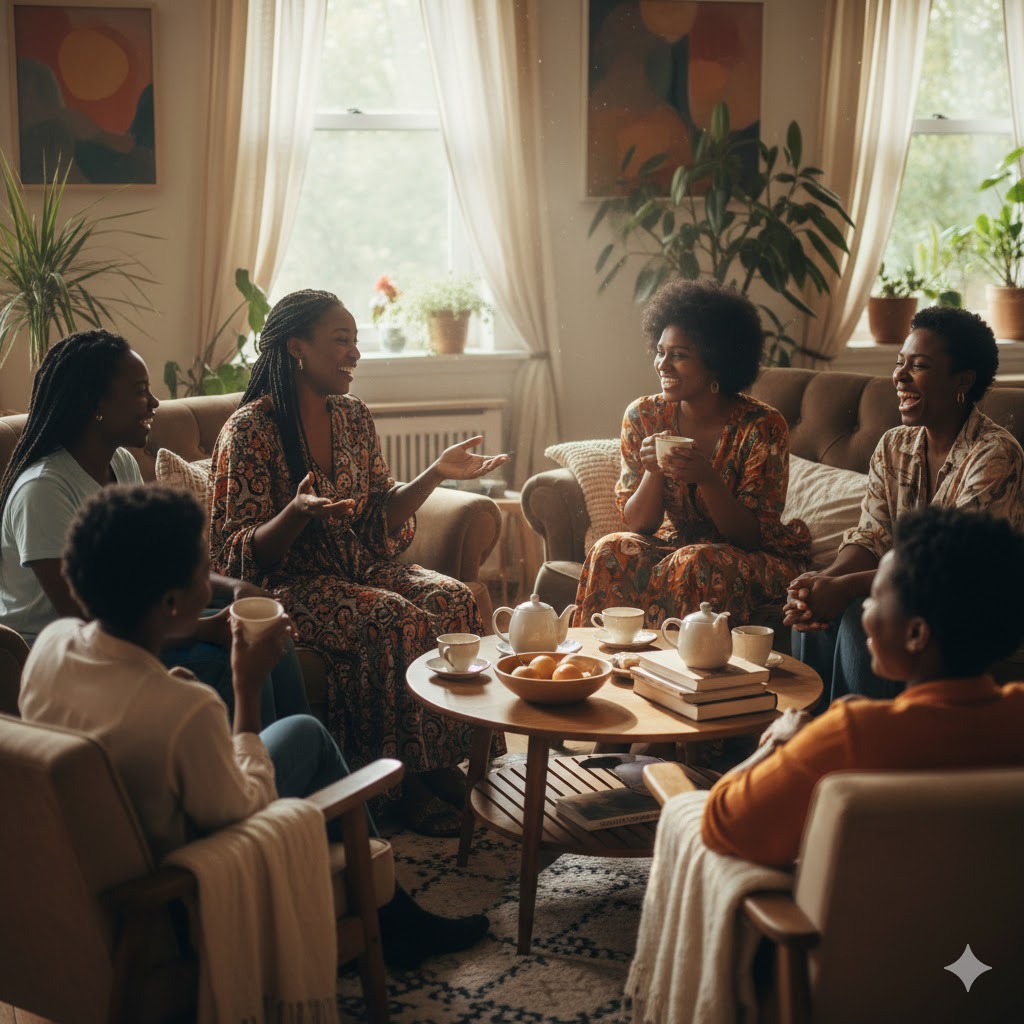
Each conversation among women carries the power to heal, uplift, and instruct. When women gather to speak honestly about their struggles, triumphs, and spiritual journeys, they create a sacred space where true understanding flourishes. This is why “one talk at a time” can transform communities and hearts alike (Ecclesiastes 4:9-10, KJV).

Chosen women are called to embrace their divine purpose. As Proverbs 31:30 (KJV) reminds us, “Favor is deceitful, and beauty is vain: but a woman that feareth the LORD, she shall be praised.” Spiritual alignment and reverence for God form the foundation of authentic womanhood.

Reclaiming womanhood begins with self-awareness. Women must confront internalized messages of inadequacy, inferiority, or shame. Sacred conversations provide a mirror, allowing women to reflect on their identity beyond societal pressures (Titus 2:3-5, KJV).

These dialogues encourage women to distinguish between cultural expectations and God-given purpose. The pressure to conform to materialism, appearance, or social trends often distracts women from spiritual and personal growth (Romans 12:2, KJV).

Mentorship is a vital element in reclaiming womanhood. Older, wiser women sharing their experiences help younger women navigate life’s challenges. Titus 2:3-5 (KJV) highlights this, instructing older women to guide younger women in love, wisdom, and virtue.

True sacred conversations involve vulnerability. When women openly discuss failures, heartbreak, and doubts, they normalize the struggles inherent to life. This transparency fosters empathy and strengthens communal bonds (James 5:16, KJV).

Reclaiming womanhood also involves breaking generational curses. Many women inherit narratives of fear, submission, or limitation. Through intentional dialogue and prayer, women can release these patterns and step into empowerment (Exodus 20:5-6, KJV).

Emotional intelligence is nurtured through these sacred exchanges. Women learn to navigate conflict, express feelings with grace, and cultivate resilience in both personal and professional spheres (Proverbs 16:32, KJV).

Faith is central to sacred conversations. Prayer, scripture, and spiritual reflection guide women toward discernment, purpose, and courage. A woman grounded in God’s word is equipped to resist the pressures of the world (Psalm 119:105, KJV).

Body image and self-worth are recurring topics in these talks. Society often ties a woman’s value to appearance, but sacred conversations emphasize character, spirit, and heart as markers of true beauty (1 Samuel 16:7, KJV).

Relationships are another critical area. From friendships to romantic partnerships, women gain insight into healthy boundaries, respect, and divine alignment. Understanding one’s worth ensures that women do not settle for toxic or unfulfilling connections (Proverbs 13:20, KJV).

Professional life and ambition are often sidelined in cultural narratives of womanhood. These discussions empower women to pursue vocations, leadership, and entrepreneurship while maintaining integrity and spiritual grounding (Colossians 3:23-24, KJV).

Self-care and holistic wellness are essential aspects of reclaiming womanhood. Women are encouraged to prioritize mental, physical, and spiritual health without guilt or apology (1 Corinthians 6:19-20, KJV).

Overcoming fear and anxiety is often a central focus. Sharing personal testimonies of victory over fear inspires courage in others, reinforcing that chosen women are called to be bold and resilient (Joshua 1:9, KJV).

Forgiveness and grace are recurring themes. Women are taught to forgive themselves and others, releasing bitterness and embracing freedom. This process is central to emotional and spiritual liberation (Ephesians 4:32, KJV).

Community and sisterhood flourish through these dialogues. When women unite under shared values and purpose, they create networks of support that extend beyond the conversation itself (Hebrews 10:24-25, KJV).

Reclaiming womanhood also means challenging societal stereotypes. Women are encouraged to define their identities, pursue leadership, and cultivate excellence while remaining humble and spiritually grounded (Philippians 2:3-4, KJV).

Sacred conversations honor the diversity of experiences among women. By listening and learning from one another, women develop empathy, wisdom, and a deeper understanding of God’s design for their lives (Proverbs 27:17, KJV).

Ultimately, reclaiming womanhood, one talk at a time, restores dignity, purpose, and divine alignment. Chosen women who engage in sacred dialogue embody strength, grace, and faith, becoming beacons of inspiration for future generations. These conversations are not merely words—they are catalysts for transformation, empowerment, and the fulfillment of God’s calling on womanhood (Psalm 46:5, KJV).


References

Holy Bible, King James Version. (1611). Thomas Nelson.

Guthrie, D. (1994). The NIV application commentary: Proverbs. Grand Rapids, MI: Zondervan.

Wright, C. J. H. (2002). Old Testament ethics for the people of God. Downers Grove, IL: InterVarsity Press.

Aune, D. E. (2013). Reconsidering the role of women in the Bible: Biblical theology for contemporary women. New York, NY: Continuum.
Overcoming Colorism

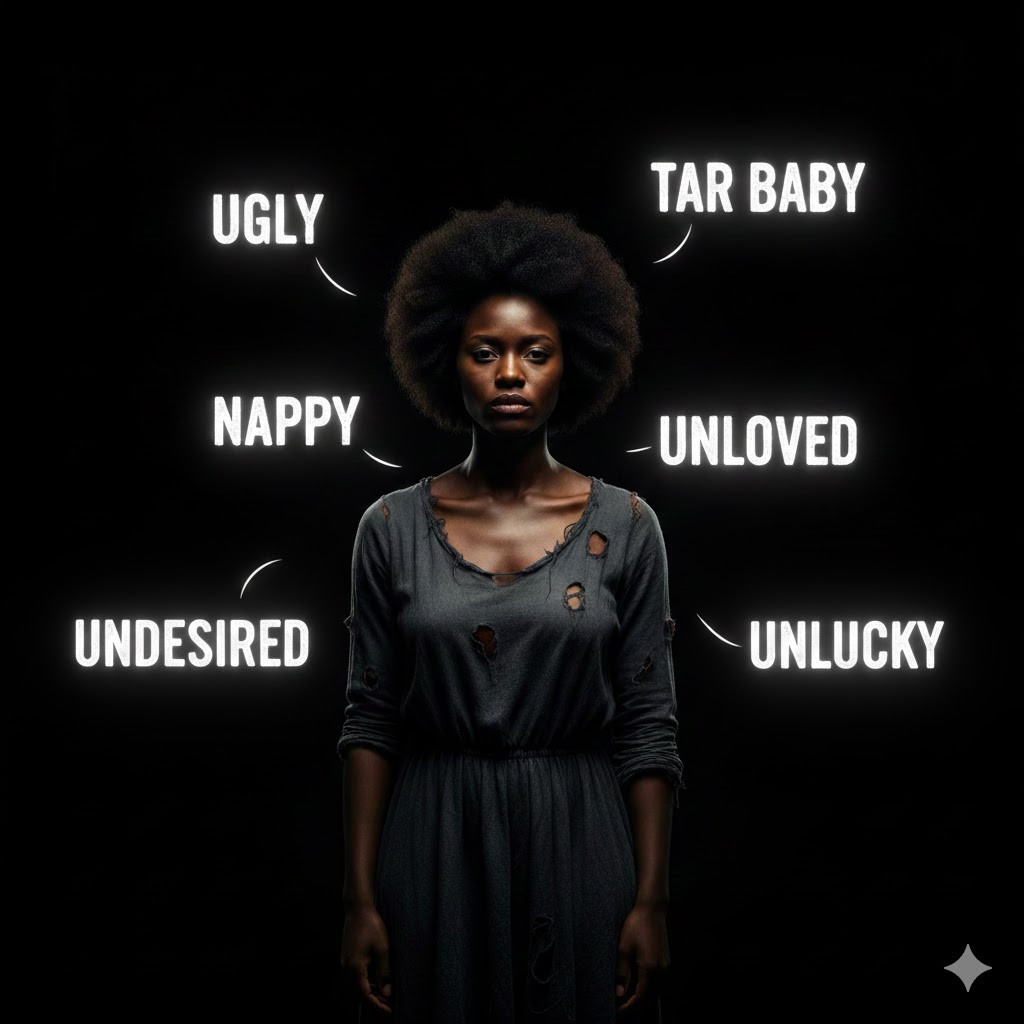
Overcoming colorism requires confronting a system that was never accidental but intentionally engineered to rank human worth by shade. Colorism is the internalization of white supremacist ideology, operating within communities of color to privilege lightness and punish darkness. Healing begins with truth—acknowledging that colorism is not preference, personality, or coincidence, but a learned hierarchy rooted in historical violence.

Colorism was born in slavery and colonialism, where proximity to whiteness determined access to safety, labor conditions, and social value. These hierarchies were imposed by force, reinforced by law, and justified by distorted theology. Over time, what began as external control became internal belief, passed down as culture rather than recognized as trauma.

The first step in overcoming colorism is naming it without defensiveness. Silence protects systems, not people. When communities deny colorism, they allow it to operate unchecked in families, churches, schools, and relationships. Scripture affirms that truth is the pathway to freedom, not comfort (John 8:32, KJV).

Healing requires rejecting the lie that colorism is harmless. Research consistently demonstrates that skin tone affects income, education, sentencing, marriage prospects, and mental health (Hunter, 2007; Monk, 2014). These outcomes reveal colorism as structural inequality, not individual insecurity.

Psychologically, overcoming colorism demands deprogramming. Racialized hierarchies shape self-concept from early childhood, influencing whom people admire, desire, and trust. Proverbs reminds us that as a person thinks in their heart, so they become (Proverbs 23:7, KJV). Without intentional intervention, internalized bias reproduces itself unconsciously.

Families play a central role in dismantling colorism. Differential treatment of children based on skin tone communicates worth long before identity is formed. Overcoming colorism requires equal affirmation, protection, and expectation for all children, regardless of shade. What is nurtured in the home either heals or deepens generational wounds.

Education is another critical site of resistance. Schools must address colorism explicitly, not merely racism. Darker-skinned children are disciplined more harshly and underestimated academically, while lighter-skinned peers receive grace and encouragement. Equity requires awareness, accountability, and structural correction.

Media literacy is essential for overcoming colorism. Representation shapes desire and self-perception. When lighter skin dominates narratives of beauty, success, and love, hierarchy is normalized. Challenging these images and elevating diverse representations disrupts the feedback loop that trains bias.

In romantic relationships, overcoming colorism requires honesty about attraction. Preferences are not neutral when they consistently mirror oppression. Scripture warns against lust shaped by the eyes rather than righteousness (1 John 2:16, KJV). Desire itself must be examined, not defended.

Church spaces must also confront colorism. Partiality based on appearance directly violates biblical law. James condemns favoritism as sin, regardless of cultural norms (James 2:1–9, KJV). Overcoming colorism in faith communities is not optional; it is obedience.

Spiritually, colorism contradicts creation theology. Humanity was made in God’s image, not graded by complexion (Genesis 1:27, KJV). To esteem one shade above another is to dispute God’s craftsmanship and substitute colonial aesthetics for divine truth.

Overcoming colorism also requires addressing shame. Dark-skinned individuals often carry internalized rejection that manifests as self-doubt or overcompensation. Healing involves affirming that darkness is not deficiency but depth, origin, and beauty. African history affirms Blackness as foundational, not marginal (Diop, 1974).

For lighter-skinned individuals, overcoming colorism involves acknowledging unearned advantage without guilt or denial. Recognition is not accusation; it is responsibility. Scripture teaches that to whom much is given, much is required (Luke 12:48, KJV).

Community accountability is essential. Jokes, compliments, and casual comments often reinforce hierarchy. Overcoming colorism means interrupting harmful language and refusing to normalize shade-based value systems, even when they appear subtle or affectionate.

Psychological research affirms that intentional exposure to counter-stereotypical imagery and narratives reduces implicit bias. This aligns with the biblical principle of renewing the mind rather than conforming to inherited patterns (Romans 12:2, KJV).

Overcoming colorism also demands structural change. Institutions must examine hiring practices, promotion criteria, disciplinary policies, and representation. Individual healing cannot substitute for systemic accountability.

Forgiveness is part of the process, but forgiveness without truth is denial. Scripture teaches that repentance precedes restoration. Communities must grieve the damage colorism has caused before reconciliation can occur.

The dismantling of colorism restores unity. Hierarchy fractures solidarity, but truth repairs it. When shade no longer determines worth, collective strength increases, and internal conflict diminishes.

Overcoming colorism is not about reversing hierarchy but abolishing it. Liberation is not achieved by making darkness dominant, but by eliminating dominance altogether.

Ultimately, overcoming colorism is a moral, psychological, and spiritual imperative. God is no respecter of persons (Acts 10:34, KJV). Any system that contradicts this truth must be confronted and dismantled.

When colorism is overcome, communities move closer to wholeness. What replaces hierarchy is not sameness, but dignity. And dignity, once restored, becomes the foundation for justice, unity, and healing.


References

The Holy Bible, King James Version. (1611). Various passages.

Hunter, M. (2007). The persistent problem of colorism: Skin tone, status, and inequality. Sociology Compass, 1(1), 237–254.

Monk, E. P. (2014). Skin tone stratification among Black Americans. Social Forces, 92(4), 1317–1337.

Monk, E. P. (2019). The color of punishment: African Americans, skin tone, and the criminal justice system. Ethnic and Racial Studies, 42(10), 1593–1612.

Russell, K., Wilson, M., & Hall, R. (1992). The color complex: The politics of skin color among African Americans. Anchor Books.

Fanon, F. (1952). Black skin, white masks. Grove Press.

Cross, W. E. (1991). Shades of Black: Diversity in African-American identity. Temple University Press.

Diop, C. A. (1974). The African origin of civilization: Myth or reality. Lawrence Hill Books.

Wilkerson, I. (2020). Caste: The origins of our discontents. Random House.

Dilemma: Light-Skin Privilege

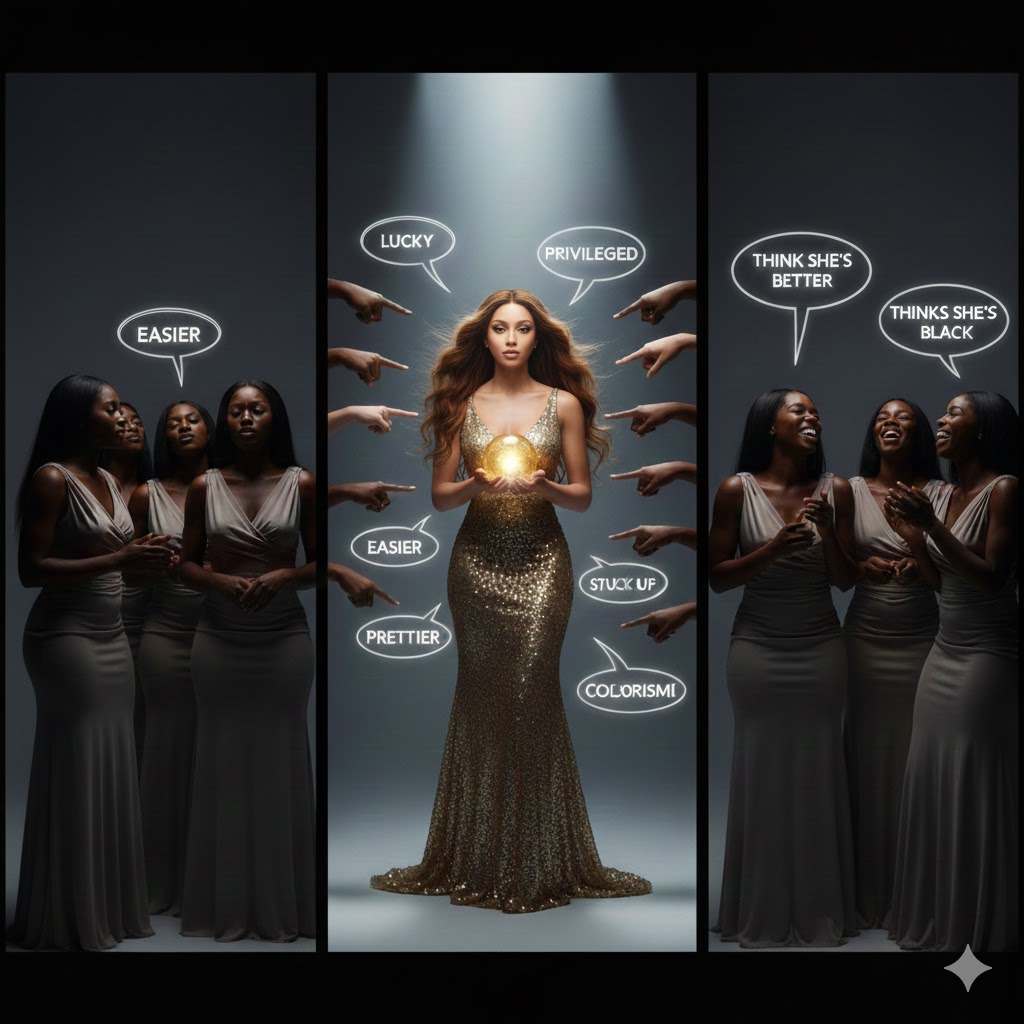
Light skin privilege refers to the systemic advantages afforded to lighter-skinned individuals within communities of color, particularly among Black people, due to proximity to whiteness. Unlike individual bias, light skin privilege is structural, psychological, and generational. It operates quietly, often denied by those who benefit from it, yet its effects are measurable across beauty standards, economic outcomes, social treatment, and intimate relationships.

This privilege did not emerge naturally within Black communities. It was manufactured during European colonization and chattel slavery, where whiteness was constructed as superior and Blackness as inferior. Lighter skin, often produced through rape and coercion, was weaponized as a marker of status, creating a hierarchy that mirrored white supremacy itself.

During slavery, lighter-skinned enslaved people were more frequently assigned to domestic labor, received marginally better treatment, and were sometimes granted access to education. These differences were intentional strategies designed to fracture unity and cultivate internal division. Privilege was used as control, not compassion.

After emancipation, these hierarchies were absorbed into Black social life. Light skin became associated with refinement, femininity, intelligence, and safety. Dark skin, by contrast, was framed as aggressive, excessive, or undesirable. These associations were reinforced through religion, pseudoscience, and Eurocentric aesthetics.

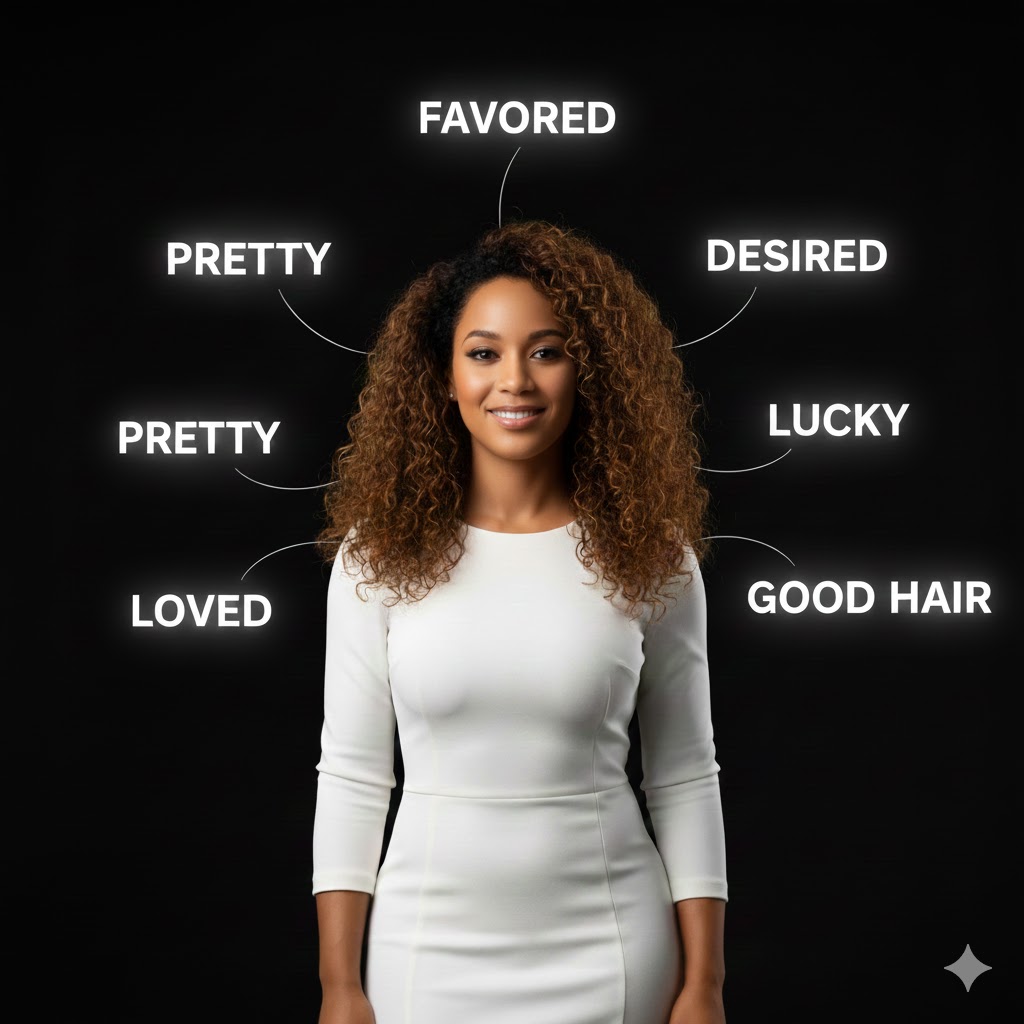
Beauty culture remains one of the most visible sites of light skin privilege. Lighter-skinned women are consistently perceived as prettier, softer, and more desirable, regardless of facial symmetry or physical features. Research confirms that skin tone alone significantly affects perceived attractiveness (Hunter, 2007).

This bias extends into romantic relationships and marriage markets. Lighter-skinned women receive more marriage proposals and are more frequently viewed as suitable long-term partners, while darker-skinned women are often fetishized, overlooked, or relegated to temporary desire (Russell et al., 1992).

Light skin privilege also shapes assumptions about personality. Lighter-skinned individuals are more likely to be described as kind, trustworthy, and pleasant. This reflects the psychological “halo effect,” where physical appearance influences moral judgment (Eagly et al., 1991).

These perceptions produce material benefits. Lighter-skinned people are more likely to receive gifts, favors, leniency, and informal mentorship. Their mistakes are forgiven more readily, while darker-skinned individuals are punished more harshly for similar behavior.

In the job market, light skin privilege is well-documented. Lighter-skinned Black employees earn higher wages, receive more promotions, and are perceived as more professional and competent than darker-skinned peers with identical credentials (Monk, 2014).

Light-skinned men benefit from a different expression of privilege. They are more often seen as intelligent, articulate, and leadership-oriented. Dark-skinned men, by contrast, are stereotyped as threatening, criminal, or volatile, regardless of behavior.

Dark skin penalty refers to the systematic disadvantages imposed on darker-skinned individuals across social, economic, and relational domains. It is the inverse of light skin privilege and functions as punishment for visible distance from whiteness. This penalty affects employment, education, marriage, policing, and mental health, often beginning in childhood and compounding across a lifetime.

Colorism functions as an internal caste system that ranks people within the same racial group. Like caste, it is inherited, normalized, enforced socially, and resistant to challenge. By replicating colonial hierarchy internally, colorism ensures oppression continues even without direct white enforcement.

These stereotypes have deadly consequences. Dark-skinned men experience harsher policing, longer prison sentences, and greater surveillance. Skin tone has been shown to influence sentencing outcomes even within the same racial category (Monk, 2019).

Within families, light skin privilege is often introduced early. Lighter-skinned children may be praised more, protected more, and spoken of as “the pretty one” or “the smart one,” while darker-skinned siblings are disciplined more harshly or emotionally neglected.

Relatives may invest more resources and expectations into lighter-skinned children, assuming greater future success. Darker-skinned children internalize these messages, shaping self-esteem, ambition, and emotional health well into adulthood (Cross, 1991).

Church spaces are not exempt. Lighter skin is often overrepresented in leadership, visibility, and marriageability narratives. Yet Scripture explicitly condemns partiality based on appearance (James 2:1–9, KJV).

Biblically, light skin privilege violates God’s law. “The Lord is no respecter of persons” (Acts 10:34, KJV). Favoritism rooted in skin tone is sin, regardless of cultural normalization.

Psychologically, light skin privilege fractures Black unity. It redirects rage inward, turning community members against one another rather than confronting the system that created the hierarchy. Fanon identified this as internalized colonialism (Fanon, 1952).

Healing requires naming privilege without defensiveness. Acknowledging benefit does not equal guilt, but denial perpetuates harm. Scripture calls for truth as the first step toward freedom (John 8:32, KJV).

Families, institutions, and communities must intentionally dismantle these hierarchies. Silence sustains injustice. Preference is not neutral when it aligns consistently with oppression.

The dilemma of light skin privilege is not about reversing hierarchy but abolishing it. Liberation requires rejecting shade-based worth entirely and restoring divine valuation rooted in humanity, righteousness, and character.

Until light skin privilege is confronted spiritually, psychologically, and structurally, inequality will persist within communities already burdened by racism. God’s justice demands better.

References

The Holy Bible, King James Version. (1611). Various passages.

Russell, K., Wilson, M., & Hall, R. (1992). The color complex: The politics of skin color among African Americans. Anchor Books.

Hunter, M. (2007). “The persistent problem of colorism: Skin tone, status, and inequality.” Sociology Compass, 1(1), 237–254.

Monk, E. P. (2014). “Skin tone stratification among Black Americans.” Social Forces, 92(4), 1317–1337.

Monk, E. P. (2019). “The color of punishment: African Americans, skin tone, and the criminal justice system.” Ethnic and Racial Studies, 42(10), 1593–1612.

Cross, W. E. (1991). Shades of Black: Diversity in African-American identity. Temple University Press.

Eagly, A. H., et al. (1991). “What is beautiful is good, but…” Psychological Bulletin, 110(1), 109–128.

Fanon, F. (1952). Black skin, white masks. Grove Press.

Wilkerson, I. (2020). Caste: The origins of our discontents. Random House.

Dilemma: Dark Skin Penalty

The dark skin penalty refers to the systematic disadvantages imposed on individuals with darker complexions within societies shaped by white supremacy and colonial hierarchy. Unlike overt racism, this penalty operates subtly, often normalized as preference or coincidence, yet its consequences are profound and measurable. It represents the inverse of light skin privilege and functions as a social tax placed on visible Blackness.

Historically, the dark skin penalty was engineered during slavery and colonialism, where darkness was equated with inferiority, savagery, and danger. European racial ideology constructed Blackness as a problem to be controlled, while lighter skin was positioned as closer to civility and trustworthiness. These ideas were enforced through law, theology, and violence.

Within slavery, darker-skinned enslaved people were disproportionately assigned to the most brutal labor, exposed to harsher punishment, and denied even marginal privileges afforded to lighter-skinned individuals. Darkness became associated with disposability, while lighter skin functioned as a buffer within the racial caste system.

After emancipation, these hierarchies did not dissolve. They were absorbed into Black communities as internalized beliefs. Dark skin came to symbolize struggle, unattractiveness, and threat, while lightness symbolized opportunity. This psychological inheritance transformed external oppression into internal policing.

Beauty standards remain one of the most visible expressions of the dark skin penalty. Darker-skinned women are frequently excluded from dominant beauty narratives, described as less feminine, less soft, or less desirable. Empirical research confirms that darker skin is rated as less attractive due to entrenched Eurocentric aesthetics (Hunter, 2007).

In romantic and marital contexts, darker-skinned women experience higher rates of rejection and lower likelihood of marriage offers. They are often sexualized without being valued for long-term partnership, reflecting a dehumanizing pattern rooted in colonial hypersexualization (Russell et al., 1992).

Darker-skinned men also bear a severe penalty. They are more likely to be perceived as aggressive, criminal, or intellectually inferior. These stereotypes follow them into schools, workplaces, and public spaces, shaping expectations and treatment regardless of behavior.

The criminal justice system magnifies this penalty. Studies demonstrate that darker-skinned Black men receive longer sentences and harsher punishment than lighter-skinned Black men for similar crimes, revealing that skin tone itself influences legal outcomes (Monk, 2019).

In the job market, darker skin correlates with lower wages, fewer promotions, and higher unemployment rates. Employers often unconsciously associate darker skin with incompetence or danger, despite identical credentials (Monk, 2014). Professionalism becomes racially coded.

Educational environments also reflect this bias. Darker-skinned children are disciplined more harshly, perceived as less capable, and tracked into lower academic pathways. Early exposure to penalty shapes confidence and long-term achievement.

Within families, the dark skin penalty is often reinforced through differential treatment. Darker-skinned children may receive less praise, harsher discipline, or fewer resources, while lighter-skinned siblings are protected and celebrated. These dynamics communicate worth long before language can articulate it.

The psychological consequences are severe. Dark-skinned individuals face higher risks of depression, anxiety, and diminished self-esteem due to chronic devaluation. Fanon described this as epidermalization of inferiority, where the body itself becomes a site of shame (Fanon, 1952).

Media representation compounds the penalty. Darker-skinned people are underrepresented or typecast as villains, aggressors, or side characters, while lighter-skinned individuals dominate narratives of love, success, and heroism. Repetition normalizes hierarchy.

Spiritually, the dark skin penalty contradicts biblical truth. Scripture affirms that God is no respecter of persons and judges by the heart rather than appearance (1 Samuel 16:7; Acts 10:34, KJV). Color-based judgment is therefore a moral failure.

The Bible explicitly condemns partiality. James warns that favoring one person over another based on external markers makes one guilty of sin (James 2:1–9, KJV). Colorism violates divine law as surely as overt injustice.

The dark skin penalty fractures communal solidarity. It redirects pain inward, encouraging comparison and resentment rather than collective resistance. This fragmentation benefits oppressive systems by weakening unity.

Healing requires intentional confrontation of these biases. Naming the penalty dismantles denial. Silence allows harm to masquerade as normalcy. Scripture teaches that truth precedes freedom (John 8:32, KJV).

Cultural restoration demands redefining beauty, intelligence, and worth outside colonial frameworks. African history and theology affirm darkness as original, powerful, and divine in its own right (Diop, 1974).

Psychological healing must accompany social reform. Therapeutic approaches that address racial trauma align with Scripture’s call for renewal of the mind (Romans 12:2, KJV). Without healing, internalized penalty persists even in success.

The abolition of the dark skin penalty requires both structural change and spiritual repentance. Institutions must address bias, and individuals must unlearn inherited hierarchies. Liberation is incomplete without both.

Ultimately, the dark skin penalty is not a reflection of deficiency but of distortion. It reveals the depth of colonial damage, not the worth of those who bear it. Divine justice demands its dismantling.

Until dark skin is affirmed as fully human, fully beautiful, and fully worthy, inequality will continue to reproduce itself within oppressed communities. God’s standard remains unchanged: all flesh stands equal before Him.


References

The Holy Bible, King James Version. (1611). Various passages.

Russell, K., Wilson, M., & Hall, R. (1992). The color complex: The politics of skin color among African Americans. Anchor Books.

Hunter, M. (2007). “The persistent problem of colorism.” Sociology Compass, 1(1), 237–254.

Monk, E. P. (2014). “Skin tone stratification among Black Americans.” Social Forces, 92(4), 1317–1337.

Monk, E. P. (2019). “The color of punishment.” Ethnic and Racial Studies, 42(10), 1593–1612.

Fanon, F. (1952). Black skin, white masks. Grove Press.

Cross, W. E. (1991). Shades of Black: Diversity in African-American identity. Temple University Press.

Diop, C. A. (1974). The African origin of civilization: Myth or reality. Lawrence Hill Books.

Wilkerson, I. (2020). Caste: The origins of our discontents. Random House.

The Elephant in the Room: Racism

Racism remains the elephant in the room—visible, disruptive, and damaging—yet persistently denied or minimized in public discourse. It is not merely a collection of individual prejudices but a system of power that organizes opportunity, value, and belonging along racial lines. Its endurance lies not only in overt hostility but in silence, deflection, and the refusal to name it plainly.

Historically, racism was constructed to justify conquest, enslavement, and exploitation. European colonial expansion required an ideology that could reconcile Christian morality with economic brutality. Race became that justification, transforming human difference into a hierarchy of worth and rationalizing domination as destiny.

In the United States, racism was institutionalized through slavery, segregation, and discriminatory law. Even after formal barriers fell, the architecture of inequality remained intact. Housing policy, education funding, labor markets, and policing continued to reproduce racial disparity without explicit racial language.

One of racism’s most effective strategies is normalization. When inequality is framed as natural or cultural, responsibility disappears. Outcomes are blamed on behavior rather than barriers, allowing systemic harm to persist without accountability.

Psychologically, racism operates by shaping perception. Implicit bias research shows that people absorb racial stereotypes regardless of intent. These unconscious associations influence decisions in hiring, discipline, medical care, and sentencing, often without the decision-maker recognizing the bias at work.

Racism also fractures identity. W. E. B. Du Bois described this as double consciousness—the internal conflict of seeing oneself through the eyes of a society that devalues you. This fracture exacts a psychological toll that compounds across generations.

Colorism functions as racism’s internal extension. By privileging proximity to whiteness within communities of color, it reproduces hierarchy without external enforcement. This internalization demonstrates how deeply racism penetrates social life and self-concept.

Economically, racism concentrates disadvantage. Racial wealth gaps are not the result of spending habits but of historic exclusion from asset-building opportunities such as homeownership, education access, and fair wages. These gaps persist because policy choices continue to protect accumulated advantage.

In the criminal justice system, racism manifests through surveillance, sentencing disparities, and differential use of force. Black and Brown communities experience policing not as protection but as occupation, a reality documented across decades of empirical research.

Education systems mirror these inequalities. Schools serving marginalized communities are underfunded, overpoliced, and underestimated. Expectations shape outcomes, and racism lowers the ceiling long before potential can be demonstrated.

Healthcare outcomes reveal another dimension. Racial bias contributes to higher maternal mortality, undertreatment of pain, and reduced access to quality care. These disparities are not biological but structural, rooted in unequal treatment and mistrust born of history.

Media representation reinforces racial narratives. Whiteness is normalized as universal, while Blackness is often framed through pathology or exception. Repetition turns stereotype into common sense, shaping public opinion and policy priorities.

Faith communities are not exempt. Scripture condemns partiality, yet churches have often mirrored racial segregation and silence. James warns that favoritism is sin, not culture (James 2:1–9, KJV), calling believers to repentance rather than rationalization.

The Bible confronts racism at its root by affirming shared humanity. “And hath made of one blood all nations of men” (Acts 17:26, KJV) dismantles every racial hierarchy. Racism is therefore not only social injustice but theological error.

Resistance to naming racism often masquerades as calls for unity or civility. Yet unity without truth is denial. Healing requires confession, and confession requires naming harm without euphemism.

Psychologically, confronting racism provokes discomfort, particularly for those who benefit from the status quo. Defensiveness protects identity but stalls progress. Growth demands the humility to listen without centering oneself.

Structural change is essential. Individual goodwill cannot substitute for policy reform. Fair housing, equitable education funding, healthcare access, and accountable policing are necessary to dismantle systemic harm.

Education that tells the full truth is also critical. Sanitized history sustains ignorance, while honest history equips societies to avoid repetition. Memory is a moral responsibility.

Hope lies not in denial but in courage. Communities that confront racism directly build stronger solidarity and more durable justice. Silence fractures trust; truth repairs it.

Ultimately, racism persists because it is tolerated. What is unchallenged becomes tradition. Scripture teaches that justice is not optional but required: “What doth the Lord require of thee, but to do justly, and to love mercy, and to walk humbly” (Micah 6:8, KJV).

The elephant in the room will not leave on its own. It must be named, confronted, and removed. Only then can societies move from performative concern to transformative justice, grounded in truth, accountability, and shared humanity.


References

The Holy Bible, King James Version. (1611). Various passages.

Du Bois, W. E. B. (1903). The souls of Black folk. A. C. McClurg & Co.

Fanon, F. (1952). Black skin, white masks. Grove Press.

Alexander, M. (2010). The new Jim Crow: Mass incarceration in the age of colorblindness. The New Press.

Wilkerson, I. (2020). Caste: The origins of our discontents. Random House.

Bonilla-Silva, E. (2017). Racism without racists. Rowman & Littlefield.

Pager, D., & Shepherd, H. (2008). “The sociology of discrimination.” Annual Review of Sociology, 34, 181–209.

Williams, D. R., & Mohammed, S. A. (2013). “Racism and health I.” Behavioral Medicine, 39(2), 47–56.

The Skin They Can’t Ignore: Brown Girls in a World of Whiteness. #thebrowngirldilemma

Photo by Bash Mutumba on Pexels.com

Brown skin has always carried a meaning that transcends the surface. In a world structured around whiteness as the dominant social, cultural, and economic standard, brown girls are both a threat and a testimony. Their very presence challenges hierarchies of beauty, power, and worth. Unlike invisibility or erasure, their skin is something that cannot be ignored. It is marked, politicized, and constantly in conversation with systems designed to uphold whiteness as the default. This tension defines the lived experience of the “brown girl dilemma.”

The Construction of Whiteness as Standard

Whiteness functions not merely as a racial category but as an invisible yardstick against which all others are measured. In Eurocentric societies, beauty standards idealize pale skin, straight hair, and narrow features, rendering darker skin tones as deviations (Hooks, 1992). Brown girls are raised in a world where whiteness is positioned as the default image of femininity and desirability, forcing them into a constant negotiation between self-love and societal rejection.

The Colonial Inheritance of Skin Politics

The privileging of whiteness is not accidental; it is the result of colonial history. Colonizers created color hierarchies to maintain control, privileging lighter skin as closer to European ideals while casting darker skin as inferior. This legacy persists globally, from Latin America to South Asia to the African diaspora, where skin-lightening industries thrive. Brown girls, carrying the deep hues of ancestry, inherit not only beauty but also the burden of colonial prejudice.

Hyper-Visibility of Brown Skin

Despite attempts to marginalize them, brown girls’ skin is inescapable to the world around them. It is fetishized in music, commodified in fashion, and policed in schools and workplaces. Curly hair, full lips, and curves—once mocked—are now profitable when marketed on non-brown bodies. This hyper-visibility is not affirmation but appropriation, where features of brown girls are celebrated only when detached from the bodies that carry them.

Invisibility in Institutions

Yet, paradoxically, while their skin is hyper-visible, their humanity is often invisible. Brown women are underrepresented in media, overlooked in corporate leadership, and ignored in policymaking. The very skin that cannot be ignored becomes the justification for exclusion: too dark, too ethnic, too “other” to belong. This institutional invisibility reflects what Du Bois (1903) called “double consciousness,” the constant tension between self-perception and how one is perceived under whiteness.

The Burden of Representation

Because brown skin is so visible, brown girls often carry the weight of representation. In classrooms, workplaces, or public platforms, they are expected to “speak for all” or embody a flawless image. Mistakes are magnified, success is tokenized, and mediocrity is not an option. Their skin, already politicized, makes them symbols before they are seen as individuals. This burden creates both exhaustion and resilience.

The Psychology of Skin and Self-Worth

Psychologically, growing up in a world of whiteness shapes how brown girls see themselves. Studies reveal that children of color often internalize colorist messages, associating lighter skin with intelligence, beauty, and social acceptance (Russell, Wilson, & Hall, 1992). The result is an identity negotiation where brown girls must learn to reclaim the skin that society teaches them to devalue. Self-love becomes not merely emotional but political—a radical act of survival.

Scriptural Counter-Narratives

While society diminishes brown skin, scripture affirms it. In the Song of Solomon 1:5, the woman declares, “I am black, but comely, O ye daughters of Jerusalem.” This verse resists cultural stigmas, affirming that darkness is not deficiency but beauty. Similarly, Psalm 139 reminds every believer that they are “fearfully and wonderfully made.” For brown girls, these verses act as counter-narratives, dismantling whiteness as the sole standard of worth.

Cultural Resistance through Beauty Movements

The rise of natural hair movements, melanin-positive campaigns, and brown-skinned influencers represents a collective resistance against whiteness. Hashtags such as #MelaninMagic and #BlackGirlJoy reframe brown skin as divine, radiant, and unignorable. These movements not only celebrate aesthetic diversity but also dismantle internalized shame, allowing brown girls to embrace the very skin once weaponized against them.

Global Dimensions of Brownness

The struggle of brown girls extends beyond U.S. borders. In India, dark-skinned women face exclusion from marriage markets; in Brazil, Afro-descendant women face racialized violence; in Africa, skin bleaching is normalized as a ticket to opportunity. These global dimensions highlight that the issue is not isolated but systemic—brown skin is a global site of struggle against the idol of whiteness.

Liberation through Self-Definition

Ultimately, the skin they cannot ignore becomes the skin that redefines itself. Liberation for brown girls lies not in seeking approval from a world of whiteness but in reclaiming the power of their skin as heritage, beauty, and resistance. Each affirmation of melanin, each refusal to conform to Eurocentric standards, is a declaration: brown skin is not marginal, it is central.

Conclusion

In a world where whiteness dominates, brown girls live with the paradox of being unignorable yet unvalued. Their skin is the canvas upon which colonial legacies, beauty standards, and societal fears are projected. Yet, that same skin holds resilience, beauty, and divinity that whiteness cannot erase. To live in brown skin is to bear a heavy inheritance, but also to embody an undeniable truth: the skin they cannot ignore will always speak, resist, and shine.


References

  • Collins, P. H. (2000). Black feminist thought: Knowledge, consciousness, and the politics of empowerment. Routledge.
  • Du Bois, W. E. B. (1903). The souls of Black folk. A.C. McClurg & Co.
  • Hooks, B. (1992). Black looks: Race and representation. South End Press.
  • Russell, K., Wilson, M., & Hall, R. (1992). The color complex: The politics of skin color among African Americans. Harcourt Brace Jovanovich.
  • The Holy Bible, King James Version.

Moral Arc of the Universe: Divine Justice

The phrase “the moral arc of the universe bends toward justice” has become a modern axiom for hope amid oppression, yet its roots reach far deeper than contemporary rhetoric. Embedded within sacred texts, prophetic traditions, and moral philosophy is the conviction that justice is not accidental but woven into the structure of reality itself.

Divine justice, unlike human justice, is not limited by courts, time, or political power. Scripture presents justice as an attribute of God’s very nature, inseparable from righteousness, truth, and mercy. This justice unfolds across generations, often slowly yet inevitably.

In the Hebrew Bible, justice is portrayed as a covenantal concept. Blessings and consequences are tied to moral obedience, emphasizing that societies reap what they sow. The God of Israel is repeatedly described as one who “loveth judgment” and refuses to overlook oppression.

The suffering of the oppressed occupies a central place in biblical theology. From the cries of the Hebrews in Egypt to the laments of the prophets, divine justice is activated by injustice, violence, and exploitation of the vulnerable.

Justice in Scripture is not merely punitive but restorative. The aim is not destruction for its own sake but correction, repentance, and the reordering of moral life. Judgment clears space for renewal.

Throughout history, empires have mistaken dominance for permanence. Biblical narratives consistently challenge this illusion, portraying the downfall of powerful nations as the natural consequence of arrogance and cruelty.

The prophets functioned as moral witnesses, confronting kings, priests, and systems that exploited the poor. Their warnings reveal that injustice carries an expiration date, even when it appears entrenched.

Divine justice operates on a timeline that frustrates human impatience. Generations may suffer before justice manifests, yet Scripture insists that delay is not denial. Time itself becomes an instrument of reckoning.

The transatlantic slave trade represents one of history’s most profound moral violations. Millions were reduced to property, families were destroyed, and human dignity was systematically denied. Such injustice stands in direct opposition to divine order.

Though slavery was legally abolished, its moral consequences continue through economic inequality, social stratification, and psychological trauma. Divine justice addresses not only the original sin but its lingering effects.

In biblical thought, God hears blood crying from the ground. This imagery conveys that suffering leaves a moral residue in the earth itself, demanding response beyond human tribunals.

Justice also requires remembrance. Forgetting injustice enables repetition, while memory honors the victims and resists moral amnesia. Scripture repeatedly commands remembrance as an ethical duty.

The arc of justice is often revealed through reversal. The humbled are lifted, and the exalted are brought low. This pattern disrupts linear narratives of power and success.

Human participation in divine justice is not optional. Prophets, apostles, and reformers are called to act as agents of righteousness, aligning their lives with God’s moral will.

Faith without justice is portrayed as hollow. Ritual, prayer, and worship lose meaning when divorced from ethical action, particularly toward the marginalized.

Divine justice affirms the worth of those deemed disposable by society. In this sense, justice is inseparable from dignity, restoring value where it has been denied.

The moral arc bends not because humanity wills it so, but because justice is embedded in creation by divine decree. History bends under moral weight.

Hope in divine justice does not excuse passivity. Rather, it empowers perseverance, anchoring resistance in the assurance that oppression is temporary.

Justice, in biblical vision, culminates not only in judgment but in peace. Shalom represents restored relationships between God, humanity, and creation.

The moral arc of the universe ultimately testifies that injustice is unsustainable. Divine justice, though patient, is inexorable, affirming that truth, accountability, and restoration will prevail.


References

The Holy Bible, King James Version. (1611/1769).

Cone, J. H. (1997). God of the oppressed. Orbis Books.

Heschel, A. J. (2001). The prophets. Harper Perennial Modern Classics.

King, M. L., Jr. (1968). Where do we go from here: Chaos or community? Beacon Press.

Niebuhr, R. (1932). Moral man and immoral society. Charles Scribner’s Sons.

The Soul Journal of a Black Man and Woman Around the World.

The soul journal of a Black man and woman around the world is not written with ink alone, but with memory, blood, prayer, and survival. It is a living record of a people who have traversed continents, oceans, and empires while carrying culture, faith, and identity within their bodies. Across Africa, the Americas, Europe, the Caribbean, and the Middle East, Black existence has been shaped by displacement and resilience, loss and continuity.

At the center of this journal is the soul—what Scripture calls the inner being. The Bible teaches that the soul bears witness to suffering and joy alike: “All my bones shall say, Lord, who is like unto thee” (Psalm 35:10, KJV). For Black men and women, the soul has often been the final refuge when the body was owned, policed, or violated by systems of domination.

The Black man’s global journey has been marked by labor without rest and strength without recognition. From plantations to ports, from mines to factories, his physicality was exploited while his humanity was denied. Yet Scripture affirms that manhood is not defined by chains or caricatures but by divine purpose: “Be watchful, stand firm in the faith, act like men, be strong” (1 Corinthians 16:13, KJV).

The Black woman’s soul journal bears a distinct weight. She has carried nations in her womb while being denied protection for her own body. Her labor—both visible and invisible—built households, economies, and cultures across the world. Proverbs declares, “Strength and honour are her clothing; and she shall rejoice in time to come” (Proverbs 31:25, KJV), a truth often delayed but never erased.

Across the African continent, the soul journal begins with memory—languages, names, spiritual systems, and kinship structures that predate colonization. These roots testify that Black identity did not begin in slavery but in civilization. Archaeology and history confirm advanced African societies long before European contact (Diop, 1974).

The transatlantic slave trade violently interrupted this continuity, scattering Black men and women across the globe. Families were torn apart, yet culture survived in fragments—songs, rhythms, proverbs, and prayers. The Bible’s lament echoes this experience: “By the rivers of Babylon, there we sat down, yea, we wept, when we remembered Zion” (Psalm 137:1, KJV).

In the Americas, the soul journal records a theology forged under oppression. Enslaved Africans encountered Christianity through the lens of white supremacy, yet reinterpreted Scripture through lived suffering. The Exodus story became a mirror, and the God who heard Israel’s cry was recognized as the same God who heard theirs (Cone, 1975).

In the Caribbean and Latin America, Black men and women blended African spirituality with imposed European religion, creating syncretic expressions that preserved ancestral memory. These practices were often demonized, reflecting fear of Black autonomy rather than theological concern. The soul journal notes resistance disguised as worship.

In Europe, Black existence has often been rendered invisible, yet the soul journal persists through migration, art, and intellectual contribution. From Moorish Spain to modern Britain and France, Black men and women have shaped culture while being excluded from national narratives (Olusoga, 2016).

The psychological dimension of the soul journal reveals trauma carried across generations. Studies on intergenerational trauma align with biblical understanding that wounds can echo beyond one lifetime (Yehuda et al., 2016; Exodus 20:5). Yet the same Scripture affirms that healing can also be inherited through righteousness.

For Black men, the soul journal often records the struggle between vulnerability and survival. Societies that criminalize Black masculinity discourage emotional expression, yet Scripture calls men to wisdom, gentleness, and discipline of the heart (Micah 6:8, KJV).

For Black women, the journal documents a tension between strength and exhaustion. The “strong Black woman” trope conceals pain while demanding endless resilience. Christ’s invitation—“Come unto me, all ye that labour and are heavy laden, and I will give you rest” (Matthew 11:28, KJV)—speaks directly to this burden.

Love and partnership appear throughout the journal as acts of defiance. Black love has survived forced breeding, family separation, and economic sabotage. Song of Solomon’s celebration of Blackness—“I am black, but comely” (Song of Solomon 1:5, KJV)—stands as a biblical affirmation of beauty long denied.

Faith remains a central entry in the soul journal. Prayer circles, hush harbors, mosques, churches, and ancestral rituals all reflect a longing for divine justice. Hebrews affirms that faith is evidence of things unseen, a truth embraced by people forced to hope beyond visible circumstances (Hebrews 11:1, KJV).

The journal also records anger—righteous anger born of injustice. Scripture does not silence this emotion but warns against its corruption into bitterness (Ephesians 4:26–27, KJV). Protest, art, and scholarship have become vessels through which anger is refined into purpose.

Across the diaspora, creativity serves as both memory and medicine. Music, literature, dance, and visual art document experiences history often omits. Du Bois described this as “double consciousness,” a constant negotiation between self-perception and imposed identity (Du Bois, 1903).

Healing emerges in the journal as a collective task. Community, storytelling, and truth-telling become sacred acts. Psychology affirms what Scripture already taught—that confession, lament, and restoration are essential to wholeness (Psalm 34:18, KJV).

The soul journal ultimately resists erasure. Despite colonization, racism, and global displacement, Black men and women continue to name themselves, love one another, and seek God. Revelation’s vision of every nation and people before the throne affirms that Black souls were never peripheral to divine history (Revelation 7:9, KJV).

This journal is unfinished. Each generation adds pages through endurance and hope. What binds its entries together is not merely suffering, but a sacred insistence on life. As Scripture declares, “We are troubled on every side, yet not distressed… cast down, but not destroyed” (2 Corinthians 4:8–9, KJV).


References

The Holy Bible, King James Version. (1611). Various passages.

Cone, J. H. (1975). God of the oppressed. Orbis Books.

Diop, C. A. (1974). The African origin of civilization: Myth or reality. Lawrence Hill Books.

Du Bois, W. E. B. (1903). The souls of Black folk. A. C. McClurg & Co.

Fanon, F. (1952). Black skin, white masks. Grove Press.

Olusoga, D. (2016). Black and British: A forgotten history. Pan Macmillan.

Wilkerson, I. (2020). Caste: The origins of our discontents. Random House.

Yehuda, R., et al. (2016). “Holocaust exposure induced intergenerational effects on FKBP5 methylation.” Biological Psychiatry, 80(5), 372–380.

The Blue Vein Society

The Blue Vein Society refers to a color-based social hierarchy that emerged within Black communities, privileging lighter skin tones—particularly those through which veins were visibly apparent—over darker complexions. This phenomenon did not originate organically from African societies but was instead a byproduct of slavery, colonialism, and racial caste systems imposed by Europeans in the Americas. It represents one of the most enduring psychological and social legacies of white supremacy, internalized and perpetuated within oppressed communities long after formal systems of bondage ended.

The roots of the Blue Vein Society trace back to chattel slavery in the United States, where proximity to whiteness often determined one’s survival, labor conditions, and access to marginal privileges. Enslaved Africans with lighter skin, frequently the result of sexual violence by slave masters, were more likely to be assigned domestic labor rather than fieldwork. Over time, these distinctions became codified into informal social classes, creating divisions that mimicked the racial hierarchies established by white enslavers.

After emancipation, these hierarchies did not disappear. Instead, they were repackaged within Black social institutions such as churches, fraternities, sororities, social clubs, and marriage norms. The Blue Vein Society emerged as a literal and symbolic gatekeeping mechanism, where light skin functioned as social capital. The ability to pass the “blue vein test” became shorthand for perceived refinement, intelligence, and respectability—values defined by Eurocentric standards.

Psychologically, the Blue Vein Society reflects internalized racism, a condition in which oppressed people absorb and reproduce the values of their oppressors. Frantz Fanon famously described this process as the colonization of the mind, where Black people come to see themselves through white eyes (Fanon, 1952). Skin tone became a visible marker through which worth was assigned, reinforcing a false hierarchy that contradicted both biological reality and spiritual truth.

The impact on Black people has been profound and generational. Darker-skinned individuals—especially women—have historically faced disproportionate discrimination in employment, marriage prospects, media representation, and social mobility. Colorism fractured Black unity, redirecting communal energy away from collective liberation and toward internal competition. This division weakened resistance to systemic oppression by fostering mistrust and resentment within the community.

The Bible speaks directly against such partiality. Scripture states, “My brethren, have not the faith of our Lord Jesus Christ, the Lord of glory, with respect of persons” (James 2:1, KJV). The Blue Vein Society stands in direct opposition to this command, elevating physical appearance over righteousness, character, and obedience to God. In doing so, it replaces divine standards with worldly hierarchies rooted in sin and pride.

White supremacy played a central role in the creation and maintenance of colorism. European colonizers constructed racial categories that equated whiteness with purity, civility, and intelligence, while associating darkness with savagery and inferiority. These ideas were reinforced through pseudo-scientific racism, Christianized slavery, and legal systems that privileged lighter-skinned Black people as buffers between white elites and darker masses (Painter, 2010).

White women, in particular, were instrumental in policing racial boundaries. Historical records show that white women often weaponized accusations of impropriety or assault against Black men while simultaneously enforcing rigid beauty standards that upheld whiteness as feminine ideal. Their role in shaping social norms further entrenched color hierarchies that Black communities later internalized and replicated.

The psychology behind the Blue Vein Society is rooted in survival trauma. Under slavery and Jim Crow, proximity to whiteness could mean reduced violence, better treatment, or access to education. What began as a coerced adaptation eventually hardened into a belief system. Over time, trauma responses became cultural norms, passed down as “preferences” rather than recognized as wounds.

Biblically, this distortion mirrors the sin of esteeming the outward appearance over the heart. “But the Lord said unto Samuel, Look not on his countenance…for the Lord seeth not as man seeth; for man looketh on the outward appearance, but the Lord looketh on the heart” (1 Samuel 16:7, KJV). Colorism violates this principle, substituting skin tone for spiritual discernment.

The Blue Vein Society also distorted Black theology. Eurocentric depictions of Christ, angels, and biblical figures reinforced the idea that holiness itself was light-skinned. This imagery shaped religious consciousness, subtly suggesting that proximity to God required proximity to whiteness. Such theology alienated darker-skinned believers from seeing themselves fully reflected in the divine image.

Sociologically, colorism functioned as a form of social control. By fragmenting Black communities along shade lines, white supremacy ensured that collective resistance would be weakened. Divide-and-conquer strategies did not end with emancipation; they evolved into psychological warfare, where Black people policed one another on behalf of an oppressive system.

Modern manifestations of the Blue Vein Society persist in media, dating culture, and beauty industries. Skin bleaching, preferential casting, and algorithmic bias all reflect the same hierarchy under new names. Though less explicit, the underlying message remains unchanged: lighter is better. This continuity reveals that the problem is structural, not merely individual.

Healing requires both historical truth-telling and spiritual repentance. The Bible calls God’s people to tear down strongholds, including mental ones: “Casting down imaginations, and every high thing that exalteth itself against the knowledge of God” (2 Corinthians 10:5, KJV). Colorism is one such stronghold that must be confronted as sin and deception.

Education plays a critical role in dismantling these beliefs. Understanding African history prior to European contact reveals societies where beauty, leadership, and divinity were not defined by lightness. Reclaiming this knowledge helps restore dignity to those marginalized by colonial aesthetics.

Collective healing also requires rejecting white validation as the measure of Black worth. The Blue Vein Society thrives where whiteness is still seen as the standard. True liberation demands redefining value through Black-centered, God-centered frameworks rather than Eurocentric approval.

Scripture affirms the unity and equal worth of all people descended from Adam. “And hath made of one blood all nations of men for to dwell on all the face of the earth” (Acts 17:26, KJV). This verse dismantles every color-based hierarchy, declaring them contrary to God’s design.

The dismantling of the Blue Vein Society is not merely a social project but a moral and spiritual imperative. It requires courage to confront uncomfortable truths, humility to unlearn inherited biases, and faith to believe that restoration is possible. Black unity cannot be achieved without addressing the internal fractures caused by colorism.

Ultimately, the Blue Vein Society stands as evidence of how deeply white supremacy penetrated the Black psyche—but it also testifies to the possibility of healing. By exposing its origins, rejecting its lies, and returning to biblical truth, Black communities can move toward wholeness, dignity, and collective strength rooted not in skin tone, but in divine identity.


References

Fanon, F. (1952). Black skin, white masks. Grove Press.

James, W. (2005). The souls of Black folk. Barnes & Noble Classics. (Original work published 1903)

Painter, N. I. (2010). The history of white people. W. W. Norton & Company.

Russell, K., Wilson, M., & Hall, R. (1992). The color complex: The politics of skin color among African Americans. Anchor Books.

The Holy Bible, King James Version. (1611). Various passages.

Wilkerson, I. (2020). Caste: The origins of our discontents. Random House.

Du Bois, W. E. B. (1935). Black reconstruction in America. Free Press.

Brown Girl Blooming

Brown girl blooming is the sacred story of becoming—an unfolding that resists erasure and outgrows every attempt to confine it. Her bloom is not accidental but intentional, watered by ancestors who endured storms she will never fully see. She rises with the memory of those who survived, those who fought, and those who refused to let the world define their worth. Her beauty grows from lineage, truth, and unbreakable Black resilience.

Brown girl blooming means learning to love the soil you were planted in, even when that soil feels too heavy, too harsh, or too overlooked. The richness of melanin carries a testimony of survival, a melody of triumph sung through generations. No flower is judged for the darkness of its petals; rather, it is celebrated for its rare and incomparable brilliance. So too is the brown girl who steps into her own light.

Her bloom is not simply external but deeply spiritual. She learns that God did not make a mistake when He shaped her features, deepened her tones, and crowned her with textured glory. She discovers scriptures that affirm her value, reminding her that she is “fearfully and wonderfully made” (Psalm 139:14, KJV). This truth becomes the wind that pushes her toward self-acceptance.

Brown girl blooming is transformative because it requires the courage to reclaim what society taught her to reject. For decades, she was told that her hair needed to be tamed, her voice softened, her presence minimized. Now, she blooms by taking up space unapologetically, stepping into rooms that were never built with her in mind, yet cannot thrive without her influence.

Society often demanded her labor while dismissing her identity. Yet she continues to rise, drawing from the legacy of women like Sojourner Truth, Ida B. Wells, and Maya Angelou—women who bloomed defiantly in the face of oppression. Their courage becomes fertilizer for her growth, reminding her that blooming is both a right and a responsibility.

Every brown girl carries stories in her skin—stories of migration, resistance, creativity, and spiritual strength. These stories are not burdens; they are seeds. When nurtured, they bloom into purpose, wisdom, and generational healing. Her body becomes a living archive of her people’s triumph.

Some seasons of blooming come through pain. Colorism, misogynoir, and systemic bias attempt to stunt her growth. But even broken branches can sprout again. Research on racial identity development shows how affirming environments help women of color thrive despite systemic oppression (Cross & Vandiver, 2001). Brown girl blooming is not a denial of hardship but a declaration of perseverance.

And when she blooms, she helps others bloom too. Her glow becomes a mirror for her sisters, reflecting possibility and belonging. She becomes a sanctuary for other brown girls who are still learning to see their own beauty, offering encouragement and empathy as they fight to bloom in unfriendly soil.

Brown girl blooming is also intellectual. She reads, studies, questions, and innovates. She pursues degrees, builds businesses, writes books, and reconstructs narratives that once excluded her. Education becomes a form of blossoming—a quiet rebellion against historic attempts to keep her mind unwatered.

Her bloom is emotional as well. She learns to love herself in full dimension, not just the polished parts. Healing from trauma, anxiety, and generational wounds is part of her process. She embraces therapy, sisterhood, and faith as tools that prune her soul, making room for new blossoms.

Spiritually, she blooms by understanding her divine identity. She realizes she is made in the image of the Most High (Genesis 1:27, KJV), and that truth radiates through her confidence. Prayer becomes her sunlight; scripture becomes her living water. Her relationship with God sustains her growth even in barren seasons.

Brown girl blooming is cultural. She adorns herself in braids, curls, coils, locs, Ankara fabrics, and sacred traditions that remind her of home. She celebrates her ancestry unapologetically, allowing heritage to be both her root and her blossom.

Her bloom strengthens when she learns to love her voice. For centuries, society silenced Black women’s truths. Now, she speaks with clarity, power, and purpose. She becomes an advocate, a visionary, a storyteller, and a protector of her community.

The world does not always know how to honor her bloom, but that has never stopped her from flowering. She is not fragile—she is resilient, adaptable, and divinely crafted. Her bloom can withstand harsh winds and still grow toward the sun.

Each stage of blooming reveals a new dimension of her identity. Sometimes she is a bud—still closed, still developing. Other times she is in full bloom—radiant, confident, and unstoppable. There is no shame in her process; blooming takes time.

Brown girl blooming also means unlearning the lies of Eurocentric beauty standards. Studies show that internalized colorism and bias affect the self-esteem and mental health of Black women (Huber & Solorzano, 2015). Yet she uproots these lies and plants new truths: she is beautiful, worthy, and complete in her God-given design.

Her bloom inspires the next generation—girls watching their mothers, aunties, teachers, and mentors flourish with dignity and self-love. They learn from her example that beauty is not measured by complexion but by character, brilliance, and inner strength.

Brown girl blooming is not a trend; it is a lifelong journey. It is the ongoing process of learning who she is, what she carries, and why she matters. Each chapter of her life adds new petals to her story.

She blooms when she builds healthy relationships. She surrounds herself with people who see her, honor her, and water her growth. She releases those who only drain her soul, trusting that God will provide better companions for her journey.

She blooms when she chooses joy—unapologetic joy that refuses to be dimmed. She dances, laughs, celebrates, and embraces her own softness. In doing so, she shows the world that Black women deserve pleasure, ease, and rest.

And ultimately, brown girl blooming is a testament to divine promise. Despite every force that tried to bury her, she grew. She survived. She blossomed. And she will continue to bloom for generations to come.


References

Angelou, M. (1986). All God’s children need traveling shoes. Random House.

Cross, W. E., & Vandiver, B. J. (2001). Nigrescence theory and measurement: Introducing the Cross Racial Identity Scale (CRIS). Journal of Counseling Psychology, 48(3), 278–287.

Huber, L. P., & Solorzano, D. G. (2015). Racial microaggressions as a tool for critical race research. Race Ethnicity and Education, 18(3), 297–320.

King James Bible. (1611). Authorized Version.

Truth, S. (1995). Narrative of Sojourner Truth. Penguin Books. (Original work published 1850)

Wells, I. B. (2020). Crusade for justice: The autobiography of Ida B. Wells. University of Chicago Press. (Original work published 1928)