Category Archives: the brown boy dilemma

✨ The Power of Becoming: How to Break Generational Boxes and Step Into Your True Identity ✨

There comes a moment in life when a person quietly realizes that they have outgrown the version of themselves others created. The labels placed on them no longer fit. The expectations others had for them feel too small. The box they were born into becomes suffocating, and the spirit begins to whisper that it is time to evolve. This awakening is the beginning of becoming.

Every person is shaped by their upbringing, their environment, their culture, and their wounds. Identity is often inherited long before it is ever chosen. Families pass down not just traditions, but fears. Communities pass down not just values, but limitations. And society passes down not just opportunities, but stereotypes. For many, the journey of adulthood becomes the slow unraveling of everything that tried to define them.

The process of becoming requires courage. It demands that a person confront the voices that told them who they could not be. It calls them to look in the mirror and see possibility instead of restriction. Scripture teaches, “Be ye transformed by the renewing of your mind…” (Romans 12:2, KJV). Transformation begins internally long before it ever becomes visible externally.

Generational boxes often feel comfortable because they are familiar. People learn to play the roles they were assigned: the strong one, the quiet one, the responsible one, the overlooked one, the helper, the fixer, the dreamer with dreams too big for the room they were placed in. But God never intended for these temporary roles to become permanent identities. When God calls someone to destiny, He breaks the boxes of yesterday to make room for tomorrow.

Becoming requires healing. Many people carry the weight of childhood labels—“too sensitive,” “too loud,” “not smart enough,” “not pretty enough,” “not favored enough,” “not chosen enough.” These lies shape self-perception. They create internal ceilings. But healing dismantles every lie. Healing reminds the soul that it is worthy of taking up space. It whispers what God said all along: “Ye are fearfully and wonderfully made…” (Psalm 139:14, KJV).

As people evolve, they often fear outgrowing those they love. They worry that stepping into a new identity will create distance. But the truth is simple: outgrowing people is not betrayal—it is transformation. When a seed becomes a tree, it doesn’t apologize to the soil. Growth is not an offense; it is a necessity. God calls His children upward, not backward.

Becoming also means releasing old versions of the self that were built on survival. Many people learned to shrink themselves to stay safe, quiet themselves to stay accepted, or dim their brilliance to stay unnoticed. But when God begins a new work in someone’s life, shrinking becomes impossible. “Enlarge the place of thy tent…” (Isaiah 54:2, KJV) is not a suggestion; it is a command to expand.

Stepping into true identity requires embracing divine purpose. Every gift, every talent, every instinct, and every passion is evidence that God intentionally crafted each life. Nothing is random. Nothing is accidental. The calling on a person’s life is written in their spirit, and becoming is the process of aligning with that calling. When God declares, “Behold, I will do a new thing…” (Isaiah 43:19, KJV), it means the old version of self is no longer sufficient for the assignment ahead.

Becoming does not mean perfection. It means movement. It means choosing growth over fear. It means walking with God through the unknown. Like clay in the hands of the potter, identity is shaped, reshaped, stretched, and refined. What emerges is stronger, wiser, and more aligned with truth.

When a person begins to break generational boxes, they also break generational curses. They give the next generation permission to live boldly. They model what it means to step into purpose. They become the first in their family to heal, to dream, to rise, to thrive. The courage of one becomes the blueprint for many.

Becoming also invites a new relationship with God. When people stop defining themselves by their wounds and start defining themselves by His Word, they step into spiritual maturity. The journey becomes less about who they were and more about who He is. Identity becomes rooted in His promises rather than personal history.

The fullness of becoming is found in surrender. It is releasing the old storylines and embracing God’s narrative. It is letting go of fear to walk in faith. It is shedding insecurity to walk in confidence. It is trading comfort for calling. God makes all things new—including identity. “If any man be in Christ, he is a new creature…” (2 Corinthians 5:17, KJV).

Every person has a moment when destiny calls their name. Some whisper. Some roar. Some come through heartbreak. Others arrive through revelation. But the call is always the same: become the version of yourself that God designed, not the version the world demanded.

This is the beauty of becoming. It is freedom. It is a rebirth. It is spiritual elevation. It is stepping boldly into purpose with fire in the heart and God at the center. And once a person begins to walk in their true identity, they never again fit inside the boxes they were once placed in.


References

Biblical (KJV)

2 Corinthians 5:17
Isaiah 43:19
Isaiah 54:2
Psalm 139:14
Romans 12:2Erikson, E. H. (1993). Childhood and society. W.W. Norton.
Hooks, B. (2000). All about love: New visions. William Morrow.
Myers, D. G. (2014). Psychology (11th ed.). Worth Publishers.
Tolle, E. (2004). The power of now: A guide to spiritual enlightenment. New World Library.
Wilson, S. (2021). The psychology of self-worth in women. Oxford Press.

Built From Greatness: The Sacred Strength of the Black Man

The Black man has been forged in the crucible of history, tested by oppression, and tempered by resilience. From the chains of slavery to the systemic inequalities of today, he carries a legacy that demands acknowledgment, respect, and honor. His strength is not merely physical—it is spiritual, intellectual, emotional, and cultural.

The Bible speaks to the essence of strength rooted in God. Joshua 1:9 commands, “Be strong and of a good courage; be not afraid, neither be thou dismayed: for the LORD thy God is with thee whithersoever thou goest.” This divine injunction reminds the Black man that true strength originates from faith, courage, and reliance on God’s guidance.

Historically, Black men were systematically dehumanized to undermine their power. During slavery, men were stripped of family authority, denied education, and subjected to brutality. Yet, even in these circumstances, they built networks of resilience, preserved cultural knowledge, and transmitted ancestral wisdom to future generations. This historical perseverance embodies sacred strength.

The psychological fortitude of the Black man is a testament to endurance. Despite societal pressures that often criminalize or marginalize him, he demonstrates an extraordinary capacity to navigate adversity, maintain dignity, and provide for his family. According to Spencer et al. (2016), cultural identity and spirituality are significant protective factors in mental health resilience for Black men.

Family structure is central to the Black man’s sacred strength. Proverbs 20:7 states, “The just man walketh in his integrity: his children are blessed after him.” By modeling integrity, discipline, and faith, Black men create generational legacies of empowerment that defy historical attempts at dismantling the family unit.

Education has long been a battlefield and a sanctuary for the Black man. Despite centuries of exclusion, Black men have pursued learning as a tool of liberation. Figures like W.E.B. Du Bois, Malcolm X, and contemporary scholars illustrate that intellectual strength is inseparable from moral and spiritual purpose.

Physical strength is often celebrated but must be understood alongside emotional and spiritual resilience. 1 Corinthians 16:13 urges, “Watch ye, stand fast in the faith, quit you like men, be strong.” True manhood, as defined biblically, combines courage, faith, and steadfastness in the face of trials.

Cultural expression is a manifestation of sacred strength. Music, literature, fashion, and art have long been vehicles for Black men to assert identity, narrate experiences, and challenge oppression. Through creativity, he reclaims narrative control and celebrates the fullness of his humanity.

Economic empowerment is another pillar of sacred strength. Proverbs 13:11 reminds, “Wealth gotten by vanity shall be diminished: but he that gathereth by labour shall increase.” Black men who build businesses, acquire assets, and create opportunities for community upliftment exemplify stewardship and resilience rooted in faith and wisdom.

Spiritual leadership within the home and community defines the sacred strength of the Black man. As Ephesians 5:23 states, “For the husband is the head of the wife, even as Christ is the head of the church…” Leadership grounded in service, humility, and accountability ensures the holistic growth of his family and community.

Overcoming societal stereotypes requires a continuous demonstration of courage and self-definition. Black men are often misrepresented as violent or absent; yet countless men serve as educators, mentors, ministers, and leaders. Reclaiming narrative power is an act of spiritual warfare.

The sacred strength of the Black man includes emotional intelligence. Proverbs 14:29 says, “He that is slow to wrath is of great understanding: but he that is hasty of spirit exalteth folly.” Emotional regulation, patience, and discernment enable him to navigate systemic pressures while cultivating meaningful relationships.

Resilience is intergenerational. Stories passed down from ancestors who survived slavery, Jim Crow, and modern systemic oppression inform the strategies Black men employ to thrive. This ancestral guidance, combined with faith, forms a moral compass that defines his sacred strength.

Community involvement demonstrates both responsibility and courage. By mentoring youth, engaging in social justice, or fostering civic participation, Black men extend their sacred strength beyond themselves. They model sacrifice, accountability, and hope for the collective.

Health and wellness are often overlooked dimensions of sacred strength. Proverbs 3:7-8 states, “Be not wise in thine own eyes: fear the LORD, and depart from evil. It shall be health to thy navel, and marrow to thy bones.” Prioritizing physical, mental, and spiritual health ensures longevity in purpose and service.

Faith in the face of adversity is paramount. Psalm 18:32 affirms, “It is God that girdeth me with strength, and maketh my way perfect.” The Black man’s ability to persevere against systemic inequities is reinforced by an unwavering reliance on God’s guidance and providence.

Mentorship forms a critical aspect of sacred strength. Older men guiding younger men transmit cultural wisdom, moral guidance, and practical life skills. Proverbs 22:6 emphasizes the value of early instruction: “Train up a child in the way he should go: and when he is old, he will not depart from it.”

Sacred strength also requires vulnerability. Sharing struggles, seeking counsel, and engaging in spiritual reflection are acts of courage that break cycles of toxic masculinity. James 5:16 teaches, “Confess your faults one to another, and pray one for another, that ye may be healed.”

Legacy is the ultimate measure of sacred strength. The lives Black men lead, the families they nurture, the communities they uplift, and the faith they model become living testaments to greatness. Their endurance transforms personal trials into collective triumphs.

Hope remains central. Jeremiah 29:11 declares, “For I know the thoughts that I think toward you, saith the LORD, thoughts of peace, and not of evil, to give you an expected end.” The Black man, rooted in faith, carries hope not just for himself but for generations yet unborn.

In conclusion, the sacred strength of the Black man is multifaceted, encompassing spiritual devotion, cultural preservation, emotional intelligence, and steadfast courage. Built from greatness, he stands as a beacon of resilience, leadership, and hope—a living testament to the enduring power of God’s design and the unbreakable spirit of his people.


References

  • Bible. (1611). King James Version. Cambridge Edition.
  • Spencer, M. B., Swanson, D. P., & Harpalani, V. (2016). The protective role of cultural identity and spirituality in African American boys’ development. Child Development Perspectives, 10(2), 123–128.
  • Du Bois, W. E. B. (1903). The souls of black folk. A. C. McClurg & Co.
  • Malcolm X. (1965). The autobiography of Malcolm X: As told to Alex Haley. Grove Press.
  • Ephesians 5:23, Proverbs 20:7, Proverbs 13:11, Proverbs 14:29, Proverbs 3:7-8, Proverbs 22:6, Psalm 18:32, Joshua 1:9, James 5:16, Jeremiah 29:11.

The Man God Built

The man God builds is not shaped by the world but by divine purpose. He is called to reflect God’s nature through character, faith, and steadfastness. As Scripture declares, God desires a man after His own heart, one who seeks righteousness above worldly gain (Acts 13:22). This type of man recognizes that true strength is measured in obedience to God, not in personal acclaim.

A man built by God is anchored in integrity. Integrity is the framework that aligns his actions with God’s Word. Proverbs 10:9 says, “He that walketh uprightly walketh surely: but he that perverteth his ways shall be known.” The godly man’s decisions are consistent, whether seen by many or by none, for he knows that God’s eyes are upon him.

Such a man is humble, understanding that authority is stewardship, not entitlement. Humility allows him to submit to God’s guidance while leading others with wisdom and compassion. James 4:10 affirms, “Humble yourselves in the sight of the Lord, and he shall lift you up.” Humility is thus both a shield and a crown in a godly man’s life.

Faith is the foundation of his life. A man after God’s own heart walks in trust, even when circumstances appear daunting. Hebrews 11:6 reminds us, “But without faith it is impossible to please him: for he that cometh to God must believe that he is, and that he is a rewarder of them that diligently seek him.” Faith propels him to act rightly, not merely to believe passively.

The man God builds pursues wisdom above all earthly knowledge. Wisdom distinguishes the temporary from the eternal, guiding him in decision-making and leadership. Proverbs 4:7 declares, “Wisdom is the principal thing; therefore get wisdom: and with all thy getting get understanding.” In every choice, a godly man seeks God’s discernment.

Courage marks the man God constructs. He does not shrink from moral challenges or spiritual battles. Joshua 1:9 commands, “Be strong and of a good courage; be not afraid, neither be thou dismayed: for the Lord thy God is with thee whithersoever thou goest.” Courage is born of trust in God’s presence and promises.

Responsibility defines his every endeavor. A man built by God does not shirk duty but embraces accountability in family, work, and community. Luke 16:10 teaches, “He that is faithful in that which is least is faithful also in much.” Faithfulness in small matters reflects readiness for greater responsibilities.

A man after God’s own heart is prayerful, maintaining constant communion with his Creator. Prayer is the lifeline that sustains his soul and informs his actions. Philippians 4:6 exhorts, “Be careful for nothing; but in every thing by prayer and supplication with thanksgiving let your requests be made known unto God.” Through prayer, he aligns his will with God’s.

Compassion flows naturally from the man God shapes. He bears the burdens of others and acts justly, especially toward the vulnerable. Micah 6:8 instructs, “He hath shewed thee, O man, what is good; and what doth the Lord require of thee, but to do justly, and to love mercy, and to walk humbly with thy God?” Mercy strengthens his relationships and his testimony.

The man God builds practices self-control. His emotions, desires, and impulses are tempered by the Spirit. Proverbs 25:28 warns, “He that hath no rule over his own spirit is like a city that is broken down, and without walls.” Self-discipline ensures his influence is constructive, not destructive.

Vision defines his journey. A man after God’s own heart has clarity of purpose rooted in divine calling. Proverbs 29:18 affirms, “Where there is no vision, the people perish: but he that keepeth the law, happy is he.” His foresight guides his family, community, and spiritual legacy.

The godly man demonstrates resilience, standing firm amidst trials. Job exemplifies this, maintaining faith under suffering. James 1:12 reminds, “Blessed is the man that endureth temptation: for when he is tried, he shall receive the crown of life, which the Lord hath promised to them that love him.” Resilience is nurtured through unwavering trust in God.

A man God builds is honest in all dealings. Truthfulness strengthens his credibility and honors God. Proverbs 12:22 declares, “Lying lips are abomination to the Lord: but they that deal truly are his delight.” His words align with reality and righteousness.

Generosity marks his interactions. He gives willingly to meet needs, reflecting God’s providence. Acts 20:35 notes, “It is more blessed to give than to receive.” The godly man’s generosity is not performative but a reflection of divine love.

He is discerning, understanding that appearances may deceive. 1 Thessalonians 5:21 instructs, “Prove all things; hold fast that which is good.” Discernment protects him from manipulation and allows him to shepherd others wisely.

The man God shapes values family and nurtures those entrusted to him. Ephesians 5:25 commands, “Husbands, love your wives, even as Christ also loved the church, and gave himself for it.” He protects, provides, and models godly leadership in the home.

A man after God’s own heart is a servant-leader, not seeking dominance but service. Mark 10:45 reminds, “For even the Son of man came not to be ministered unto, but to minister, and to give his life a ransom for many.” Leadership is defined by humility and sacrifice.

He cultivates patience, understanding that growth is gradual and challenges are refining. Romans 5:3-4 teaches, “…we glory in tribulations also: knowing that tribulation worketh patience; And patience, experience; and experience, hope.” Patience strengthens character and faith.

A man God builds maintains purity of thought and action, avoiding moral compromise. Philippians 4:8 instructs, “Whatsoever things are true, whatsoever things are honest, whatsoever things are just…think on these things.” Purity ensures his life is a testimony of righteousness.

Finally, the man God builds lives with eternal perspective. Colossians 3:2 advises, “Set your affection on things above, not on things on the earth.” His priorities, decisions, and ambitions are aligned with God’s kingdom, leaving a legacy that honors heaven more than man.

References

Acts 13:22 – “And when he had removed him, he raised up unto them David to be their king; to whom also he gave testimony, and said, I have found David the son of Jesse, a man after mine own heart, which shall fulfil all my will.”

Proverbs 10:9 – “He that walketh uprightly walketh surely: but he that perverteth his ways shall be known.”

James 4:10 – “Humble yourselves in the sight of the Lord, and he shall lift you up.”

Hebrews 11:6 – “But without faith it is impossible to please him: for he that cometh to God must believe that he is, and that he is a rewarder of them that diligently seek him.”

Proverbs 4:7 – “Wisdom is the principal thing; therefore get wisdom: and with all thy getting get understanding.”

Joshua 1:9 – “Have not I commanded thee? Be strong and of a good courage; be not afraid, neither be thou dismayed: for the Lord thy God is with thee whithersoever thou goest.”

Luke 16:10 – “He that is faithful in that which is least is faithful also in much: and he that is unjust in the least is unjust also in much.”

Philippians 4:6 – “Be careful for nothing; but in every thing by prayer and supplication with thanksgiving let your requests be made known unto God.”

Micah 6:8 – “He hath shewed thee, O man, what is good; and what doth the Lord require of thee, but to do justly, and to love mercy, and to walk humbly with thy God?”

Proverbs 25:28 – “He that hath no rule over his own spirit is like a city that is broken down, and without walls.”

Proverbs 29:18 – “Where there is no vision, the people perish: but he that keepeth the law, happy is he.”

James 1:12 – “Blessed is the man that endureth temptation: for when he is tried, he shall receive the crown of life, which the Lord hath promised to them that love him.”

Proverbs 12:22 – “Lying lips are abomination to the Lord: but they that deal truly are his delight.”

Acts 20:35 – “I have shewed you all things, how that so labouring ye ought to support the weak, and to remember the words of the Lord Jesus, how he said, It is more blessed to give than to receive.”

1 Thessalonians 5:21 – “Prove all things; hold fast that which is good.”

Ephesians 5:25 – “Husbands, love your wives, even as Christ also loved the church, and gave himself for it.”

Mark 10:45 – “For even the Son of man came not to be ministered unto, but to minister, and to give his life a ransom for many.”

Romans 5:3-4 – “And not only so, but we glory in tribulations also: knowing that tribulation worketh patience; And patience, experience; and experience, hope.”

Philippians 4:8 – “Finally, brethren, whatsoever things are true, whatsoever things are honest, whatsoever things are just, whatsoever things are pure, whatsoever things are lovely, whatsoever things are of good report; if there be any virtue, and if there be any praise, think on these things.”

Colossians 3:2 – “Set your affection on things above, not on things on the earth.”

Dilemma: 400 years later…

The arrival of the first documented Africans to the shores of what would become the United States began in 1619, initiating a 400-year historical continuum that cannot be reduced to a single era or chapter but must be read as an unfolding system of captivity and racial stratification rooted in both economic exploitation and social demonization. The transatlantic slave trade expanded across the Americas over the next two centuries, cementing a global architecture of forced labor that built Western wealth while systematically devastating African communities and fracturing family lineage. This reality fulfills the ancient warning that curses follow a disobedient and oppressed people, for scripture foretold a nation that would experience alien ruin, humiliation, and subjugation: “The stranger that is within thee shall get up above thee very high; and thou shalt come down very low” (Deuteronomy 28:43, KJV).

Slavery did not begin by accident but by law, religion, and commerce. By the mid-1600s, colonial legislatures had codified Africans and their descendants into permanent hereditary servitude, legally positioning Black bodies as property rather than persons, creating a condition where captivity could be inherited like a surname. Plantations multiplied across the Southern colonies, where cotton would later emerge as “king,” demanding labor on a scale that turned land into empire and humans into fuel. Yet the Bible condemns the very foundation of such enterprise: “He that stealeth a man, and selleth him… shall surely be put to death” (Exodus 21:16, KJV). The theft was never the land alone — it was identity, labor, movement, and posterity.

Even after the Thirteenth Amendment of 1865 formally abolished chattel slavery, its exception clause allowed a rapid pivot into criminalized bondage, birthing the era of convict leasing, where Black men were arrested on arbitrary charges, leased to corporations, and worked under conditions nearly indistinguishable from plantation labor. The cotton field remained, only relabeled. This legislative loophole reframed chains as “justice,” transforming freedom into illusion. Scripture again provides clarity: “The wicked walk on every side, when the vilest men are exalted” (Psalm 12:8, KJV). When power itself is corrupt, deliverance cannot be legal alone — it must also be spiritual.

Reconstruction offered a brief but luminous disruption of bondage. Black Americans built schools, entered political office, established land ownership, and reconnected fragments of stolen ancestry. But progress provoked terror, and by 1877, federal retreat enabled Southern states to regenerate racial hierarchy through Jim Crow laws, insulating white privilege and criminalizing Black mobility. Between 1870 and 1950, thousands of Black Americans were lynched in public acts of racial terrorism, not as random violence but as a national message: Black advancement would be met with blood. The psalmist described this spirit precisely: “They have said, Come, and let us cut them off from being a nation” (Psalm 83:4, KJV). The objective was erasure.

The Great Migration (1916–1970) relocated millions of Black families from the agricultural South to the industrial North, seeking wages rather than whipping posts, safety rather than spectacle deaths. But northern opportunity carried its own forms of apartheid: redlining maps, restricted labor unions, segregated schools, employment ceilings, and policing systems that followed Black communities like a shadow. The physical field changed, but the captivity matured into systems rather than signposts. Scripture declared the emotional condition of displaced people longing for justice and homeland: “By the rivers of Babylon, there we sat down, yea, we wept” (Psalm 137:1, KJV).

The 1960s Civil Rights Movement confronted segregation at its legal roots, demanding equal access to education, voting, housing, and public participation. Its leaders spoke like prophets disrupting empires: “Let judgment run down as waters, and righteousness as a mighty stream” (Amos 5:24, KJV). Yet many of the same state systems that resisted abolition resisted civil rights — governors blocking doors, officers turning hoses, lawmakers filibustering dignity. Progress was wrestled, never gifted.

Following civil rights legislation came a new form of containment — the War on Drugs, hyper-policing, and mass incarceration. From the 1980s onward, prisons expanded faster than schools, sentencing laws grew harsher, and policing strategies militarized, targeting Black neighborhoods with a disproportionality that mirrors an economic draft. Men descended from sharecroppers became inmates leased through labor programs inside industrial prisons. The plantation evolved into a complex, adaptable organism. As Proverbs illuminated the mechanics of inequality: “The rich ruleth over the poor” (22:7, KJV). For Black America, poverty was not incidental but intentional infrastructure.

In modern expression, hatred manifests not in auction blocks but in algorithms, policing districts, wage gaps, and judicial disparities. Hate crimes continue at alarming frequency, motivated by the same racial animus that once governed slave patrols, lynch mobs, and segregated institutions. Police brutality killings operate as extrajudicial punishments disproportionately borne by Black citizens, echoing the terror logic of the past. “They break in pieces thy people, O Lord, and afflict thine heritage” (Psalm 94:5, KJV). The cries are the same; only the arenas differ.

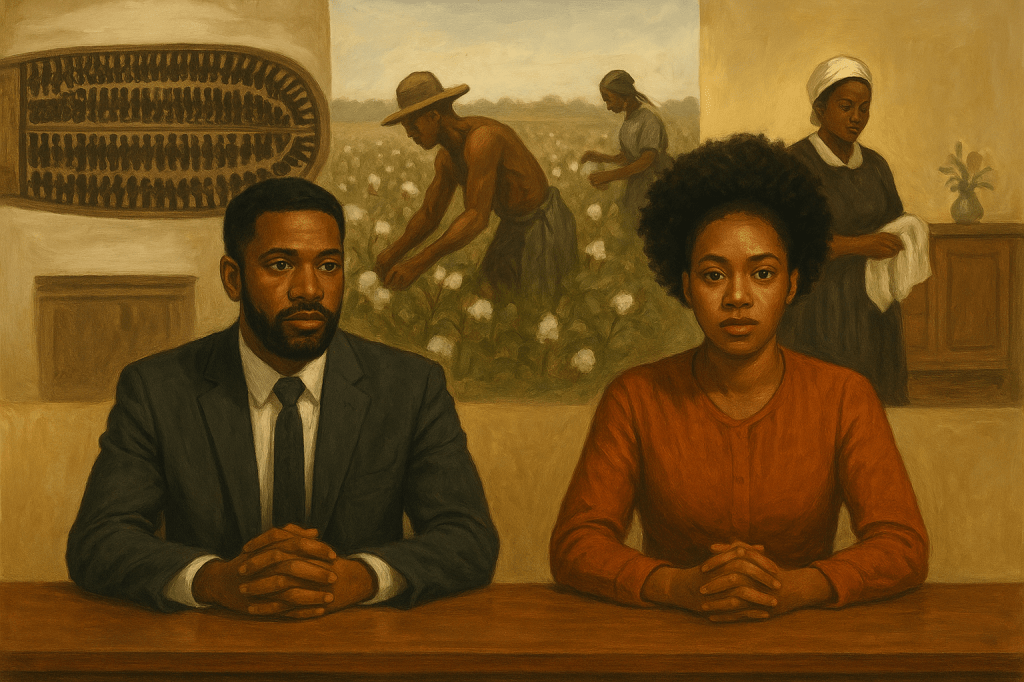
Reparations promised in 1865 through “40 acres and a mule” never materialized nationally, representing not only a breach of contract but a breach of justice. No federal reparative policy has been enacted despite centuries of documented theft, labor extraction, and structural disenfranchisement. The field and the counter today form an economic diptych — continuity rather than contrast: from unpaid cotton labor to underpaid service labor, from stolen land to inaccessible mortgages, from patrolled movement to policed existence, from literal chains to institutional ones.

The psychological captivity is often strongest. Media systems still export narratives that position Black identity as inferior, criminal, or disposable, reproducing a cognitive caste system that shapes public perception, opportunity distribution, and even self-esteem. Solomon teaches that perception becomes self-governing: “As he thinketh in his heart, so is he” (Proverbs 23:7, KJV). When a people lives under 400 years of negative mirrors, liberation must reconstruct the mind, not only the nation.

Understanding the Biblical “400-Year” Hardship Motif

In the Bible, long periods of suffering are often tied to exile, purification, oppression, and divine timing, not arbitrary catastrophe. The closest explicit reference to 400 years appears in Genesis 15:13–14 (KJV), where God tells Abram:

“Know of a surety that thy seed shall be a stranger in a land that is not theirs, and shall serve them; and they shall afflict them four hundred years; And also that nation, whom they shall serve, will I judge: and afterward shall they come out with great substance.”

This passage establishes three key principles:

  1. Suffering within foreign lands can be part of divine assignment — “a land that is not theirs.”
  2. The suffering serves a formative purpose for a chosen lineage — Abram’s seed is not destroyed, but shaped.
  3. The timeline ends with judgment of the oppressor and advancement of the oppressed — “I will judge” + “come out with great substance.”

Other biblical exiles follow similar structure, though without the number 400 attached. Israel’s bondage in Egypt, Judah’s exile into Babylon, and the scattering of tribes under imperial conquest all follow a recognizable pattern:

  • Identity is attacked
  • Oppression is used as endurance training
  • God times deliverance to align with spiritual readiness rather than political apology
  • Restoration is communal, covenantal, and spiritual before material

(Deuteronomy 30:3–5, Jeremiah 29:10–14, Psalm 126:1-3, KJV)

Thus, when people today speak of “400 years later,” they are usually drawing a parallel between African-descended suffering in America (beginning in 1619) and the Genesis 15 captivity framework, combining historical trauma with biblical typology. This is a symbolic theological claim, not a literal prophetic decree.

Du Bois (1903) noted that Black history in America has often been interpreted through a dual lens of diaspora and spiritual yearning, mirroring Hebraic exile themes. This interpretive tradition became especially strong in the African-American church and in later Afro-Hebraic movements. (Du Bois, 1903; Wilkerson, 2010)


Why 2025 Is Being Discussed as the “Cycle’s End”

The belief that “the 400-year test ends in 2025” is an example of contemporary sacred-historical reinterpretation, similar to how different generations calculated messianic or jubilee timelines in their own eras. The Bible shows that humans frequently attach chronology to hope:

  • Daniel expected restoration after 70 years because Jeremiah prophesied it (Daniel 9:2, KJV)
  • Israelites expected the Messiah based on timeline readings of prophets (Luke 3:15, KJV)
  • The Jubilee cycle (Leviticus 25) shaped conversations of liberation and return

Likewise, many Black thought movements today use 1619 → 2019/2025 as a rhetorical timeline to emphasize:

  • How long has injustice persisted
  • How delayed deliverance feels
  • How captivity keeps evolving
  • The moral debt owed to Black descendants has not been acknowledged or repaired

(Rothstein, 2017; Stevenson, 2014)

However, the Bible consistently teaches that God’s deliverance is not triggered by the clock alone, but by covenant remembrance and collective turning toward Him:

“Then ye shall call upon me, and ye shall go and pray unto me, and I will hearken unto you. And ye shall seek me, and find me, when ye shall search for me with all your heart.”
(Jeremiah 29:12-13, KJV)

This shows that spiritual awakening precedes systemic reversal in God’s economy.


What Has Changed vs. What Hasn’t

What has changed since 1619:

  • Black Americans are no longer enslaved as legal property
  • Literacy, land ownership, political office, scholarship, and cultural expression are possible
  • The Bible is now read by Black communities rather than read at them

(Woodson, 1933; Du Bois, 1903)

What has not changed at the root level :

  • Violence against Black bodies continues through hate-motivated crimes
  • Law enforcement injustice appears through disproportionate lethal force and brutality
  • No federal reparative restoration has been enacted for descendants of slavery
  • The wealth gap persists, restricting intergenerational mobility
  • Oppression remains structural, not individual alone
  • Bondage evolved from chains on bodies → chains on systems → chains on narratives → chains on economics → chains on mobility and life expectancy

(Muhammad, 2011; Rothstein, 2017; Stevenson, 2014)

Biblically, this mirrors a shift like captivity rather than the removal of it. Egypt began as physical bondage, but later exile became psychological, political, and spiritual scattering.


Yet transformation, though unfinished, remains possible. The biblical arc of exodus shows that freedom is not immediate but fought for, walked into, prayed into, and inherited by those who refuse to remain Egypt-minded. “Stand fast therefore in the liberty wherewith Christ hath made us free, and be not entangled again with the yoke of bondage” (Galatians 5:1, KJV). Black America has been made free in spirit — the labor left is to be made free in systems, policies, safety, economy, body, and legacy.

Bondage persists, but so does chosen resistance. The cotton field, the counter, the classroom, the courtroom, the wealth gap, the police district — these are the new Red Seas, new wildernesses, and new pleas for divine justice. Deliverance is still in motion. Liberation has begun, but emancipation is still the mission. And the question is no longer “Were we enslaved?” but “Why are the chains so adaptive, and where will exodus lead next?”

References

Bibb, H. (1849). Narrative of the Life and Adventures of Henry Bibb, an American Slave. Author.

Du Bois, W. E. B. (1903). The Souls of Black Folk. A. C. McClurg & Co.

Equal Justice Initiative. (2022). Lynching in America: Confronting the Legacy of Racial Terror (3rd ed.). Author.

Feagin, J. (2020). The racism: A short history (2nd ed.). Routledge.

Genovese, E. D. (1976). Roll, Jordan, Roll: The World the Slaves Made. Pantheon Books.

Higginbotham, A. L. (1978). In the Matter of Color: Race and the American Legal Process. Oxford University Press.

King James Bible. (1611). King James Version (KJV).

King, M. L., Jr. (1963). “I Have a Dream.” Speech presented at the March on Washington for Jobs and Freedom, Washington, D.C.

Muhammad, K. G. (2011). The Condemnation of Blackness: Race, Crime, and the Making of Modern Urban America. Harvard University Press.

National Archives. (2024). 13th Amendment to the U.S. Constitution: Abolition of Slavery (except as punishment for crime). U.S. Government.

Rothstein, R. (2017). The Color of Law: A Forgotten History of How Our Government Segregated America. Liveright Publishing.

Smith, S. (2016). Generations of captivity: A history of African-American slavery. Journal of Cultural History, 12(4), 45–67.

Stevenson, B. (2014). Just Mercy: A Story of Justice and Redemption. Spiegel & Grau.

Wilkerson, I. (2010). The Warmth of Other Suns: The Epic Story of America’s Great Migration. Random House.

Woodson, C. G. (1933). The Mis-Education of the Negro. Associated Publishers.

Exodus 21:16 – “He that stealeth a man, and selleth him… shall surely be put to death.”

Deuteronomy 28:37 – “Thou shalt become an astonishment, a proverb, and a byword, among all nations.”

Deuteronomy 28:43 – “The stranger that is within thee shall get up above thee very high; and thou shalt come down very low.”

Proverbs 22:7 – “The borrower is servant to the lender.”

Proverbs 23:7 – “As he thinketh in his heart, so is he.”

Psalm 12:8 – “The wicked walk on every side, when the vilest men are exalted.”

Psalm 83:4 – “Let us cut them off from being a nation.”Psalm 94:5 – “They break in pieces thy people, O Lord, and afflict thine heritage.”

Galatians 5:1 – “Stand fast therefore in the liberty wherewith Christ hath made us free, and be not entangled again with the yoke of bondage.”

Negroid Type: From Pseudoscience to Sacred Heritage

The term Negroid has long been one of the most controversial concepts in the study of human variation. Once used by anthropologists to categorize people of African descent, it has since become emblematic of the pseudo-scientific ideologies that underpinned racism, colonialism, and slavery. Yet, beyond its misuse, the study of African physical diversity, genetics, and spirituality reveals a deeper truth: the African phenotype represents the foundation of humanity itself.

Origins of the Term
The classification “Negroid” emerged in the late eighteenth and nineteenth centuries as part of the typological system developed by European naturalists such as Johann Friedrich Blumenbach. Blumenbach (1779) divided humankind into five “races”: Caucasoid, Mongoloid, Malayan, American, and Negroid. These categories, though influential, were based on superficial physical traits such as skin color, hair texture, and cranial measurements—not on actual biological lineage.

Scientific Racism and Colonial Expansion
Throughout the nineteenth century, the concept of the Negroid type became weaponized to justify slavery, imperialism, and racial hierarchy. Scientists like Samuel George Morton and Josiah C. Nott collected skulls and measured crania, falsely concluding that Africans had smaller brains and thus lesser intelligence. These ideas, later termed “scientific racism,” provided a veneer of legitimacy to the transatlantic slave trade and segregationist ideologies (Gould, 1996).

The Myth of Racial Purity
Racial typologies assumed that human groups were biologically distinct and hierarchically ordered. However, modern genetics has decisively refuted the notion of “pure races.” The Human Genome Project revealed that all humans share over 99.9% of their DNA, and that genetic variation within Africa is greater than that found between all other continents combined (Tishkoff et al., 2009). Thus, Africa is not a singular type, but the cradle of all human diversity.

Anthropological Evolution
Contemporary anthropology has moved away from fixed racial typologies toward an understanding of clinal variation—continuous, overlapping patterns of traits shaped by environment and adaptation. Features once associated with the so-called Negroid type—broad noses, full lips, dark skin, and tightly curled hair—are now recognized as adaptive responses to tropical climates, offering protection against ultraviolet radiation and dehydration (Jablonski, 2004).

Reclaiming the African Image
Despite its colonial misuse, many Afrocentric scholars have sought to reclaim the imagery associated with African phenotypes. The so-called Negroid features are not markers of inferiority but signatures of ancestral distinction and beauty. From the pyramids of Kemet to the kingdoms of Mali, Songhai, and Benin, these features have been celebrated in sculpture, iconography, and divine representation (Diop, 1974).

Theological Dimensions
In biblical interpretation, several theologians and Hebraic scholars suggest that many of the ancient Israelites and patriarchal figures were people of African or Afro-Asiatic descent (Hotep, 2012). Scriptures such as Jeremiah 8:21 and Song of Solomon 1:5 (“I am black but comely”) reflect an awareness of dark skin within sacred contexts. The “Negroid” image thus becomes not merely anthropological but theological—a reflection of divine creation in melanin.

The Melanin Doctrine
Melanin, the pigment responsible for skin color, has become central to Afrocentric spirituality and scientific theology. It is viewed not only as a biological substance but as a symbol of resilience, energy absorption, and divine intelligence. Modern science supports its importance as a natural protector against solar radiation and free radicals, granting both physiological and psychological strength (Barnes, 1998).

The Role of Genetics
Genetic anthropology has revealed that haplogroups such as E1B1A, prevalent among West and Central Africans, trace back tens of thousands of years and connect to ancient migrations across the Nile Valley and the Levant. This lineage further challenges Eurocentric narratives by demonstrating that African ancestry is central to the genesis of civilization, language, and spirituality (Keita & Boyce, 2005).

African Beauty and the Divine Aesthetic
Throughout art, history, and media, features once denigrated under “Negroid typology” have reemerged as powerful symbols of divine beauty. Full lips, coiled hair, and rich melanin have become icons of aesthetic authenticity. Artists, scholars, and theologians alike now celebrate these traits as reflections of the Imago Dei—the image of God expressed through African physiognomy.

The Psychological Aftermath of Typology
The lasting effects of racial classification systems manifest in colorism, internalized racism, and self-rejection among people of African descent. The colonial distortion of beauty and worth has caused generational trauma. However, through education, cultural pride, and spiritual renewal, many communities are redefining blackness as a state of sacred dignity rather than inherited shame (hooks, 1992).

Decolonizing Anthropology
To move forward, anthropology must continue to deconstruct Eurocentric frameworks and amplify African epistemologies. Decolonized scholarship acknowledges that Africa is not a peripheral contributor to human evolution—it is the epicenter. This perspective redefines the so-called Negroid type not as a scientific label but as an ancestral spectrum of human origin and identity.

The Biblical Lineage of Nations
Several biblical genealogies align with African migrations. Ham, the progenitor of Cush, Mizraim, and Canaan, is traditionally associated with African civilizations. Afro-Hebraic interpretations propose that the original Israelites shared ancestral links with these Afro-Asiatic peoples, connecting scriptural heritage to African identity (Ben-Yehuda, 2018).

Africa as Mother of Civilization
Civilizations such as ancient Nubia, Egypt, and Ethiopia challenge Western assumptions of white antiquity. These empires exhibited complex governance, literacy, architecture, and theology millennia before Europe’s Renaissance. Thus, the “Negroid” type, once portrayed as primitive, is historically proven to be the architect of civilization itself (Diop, 1974).

The Curse Narrative Debunked
The misuse of the biblical “curse of Ham” narrative historically justified slavery and segregation. However, critical exegesis reveals no divine condemnation of blackness; rather, this interpretation was fabricated to sustain white supremacy (Goldenberg, 2003). Modern theology restores the African presence in scripture as one of blessing, innovation, and covenantal purpose.

The Beauty of Diversity Within Africa
The African continent hosts immense phenotypic and cultural diversity—from the tall Nilotic peoples to the compact Bantu and the ancient Khoisan. Such variety proves the inadequacy of “Negroid” as a unifying label. Instead, Africa embodies a mosaic of adaptation, creativity, and divine design, representing the full expression of human potential.

The Modern Genetic Synthesis
Modern population genetics reinforces that all non-African peoples descend from small groups of Africans who migrated out of the continent roughly 60,000 years ago. Thus, every human phenotype, whether European or Asian, carries ancestral African DNA. Humanity, in essence, is a global expression of African origin (Stringer, 2016).

Cultural Redemption and Reeducation
To reclaim African identity, education must confront the falsehoods of racial hierarchy. Cultural and genetic literacy can restore self-worth among diasporic peoples. The truth that humanity originated in Africa dismantles the lie of inferiority and honors the spiritual narrative of creation found in Genesis: “And God formed man of the dust of the ground.”

Spiritual Anthropology
Beyond science, spiritual anthropology recognizes that the human form is a vessel of divine wisdom. The so-called Negroid type, with its radiant melanin and ancestral features, becomes a living testimony to divine craftsmanship. Through faith, knowledge, and cultural restoration, African descendants rediscover their sacred lineage as both biological and spiritual heirs of humanity.

Conclusion
The term Negroid type should no longer signify a scientific category but a journey—from misclassification to reclamation, from pseudoscience to sacred truth. Africa is not merely the continent of blackness; it is the womb of the world. By reinterpreting the narrative through historical critique, Afrocentric pride, and theological revelation, we affirm that to study the African face is to gaze upon the mirror of creation itself.


References (APA 7th Edition)

Barnes, J. (1998). Melanin: The key to freedom. Black Classic Press.
Ben-Yehuda, Y. (2018). Hebrew Israelites and the African connection: An Afrocentric biblical interpretation. Africana Studies Review, 12(3), 45–62.
Blumenbach, J. F. (1779). On the natural varieties of mankind. Göttingen.
Diop, C. A. (1974). The African origin of civilization: Myth or reality. Lawrence Hill Books.
Goldenberg, D. M. (2003). The curse of Ham: Race and slavery in early Judaism, Christianity, and Islam. Princeton University Press.
Gould, S. J. (1996). The mismeasure of man. W. W. Norton & Company.
hooks, b. (1992). Black looks: Race and representation. South End Press.
Hotep, U. (2012). The African origins of the Hebrew people. Kemet University Journal of African Spirituality, 8(2), 33–58.
Jablonski, N. G. (2004). The evolution of human skin and skin color. Annual Review of Anthropology, 33, 585–623.
Keita, S. O. Y., & Boyce, A. J. (2005). Genetics, history, and identity: The case of the African peoples. American Anthropologist, 107(1), 12–23.
Stringer, C. (2016). The origin of our species. Penguin Books.
Tishkoff, S. A., et al. (2009). The genetic structure and history of Africans and African Americans. Science, 324(5930), 1035–1044.

Islands of Men: Loneliness, Leadership, and the Digital Search for Brotherhood

Modern men are increasingly becoming islands—connected by technology yet disconnected emotionally, spiritually, and socially. The phrase “Islands of Men” captures a deep truth about masculine loneliness in the digital era, and how many men turn to online spaces in search of brotherhood, guidance, and identity. As society shifts and family structures fracture, these digital shores become places where men seek belonging, meaning, and leadership.

Loneliness among men has reached historic levels. Studies show that contemporary men report fewer friendships, fewer intimate bonds, and less emotional support than previous generations. The cultural expectation that men remain stoic and self-sufficient often prevents them from forming meaningful connections. As a result, many men drift through adulthood without a consistent community.

The digital world becomes a substitute for real-life brotherhood. Forums, livestreams, and manosphere communities provide men a place to voice their frustrations, their fears, and their longing for guidance. While some of these spaces can promote emotional honesty, many others reinforce isolation by encouraging competition, cynicism, or ideological extremism.

Leadership is central to the male search for belonging. Historically, men derived identity from mentorship, apprenticeship, and communal rites of passage. Today, these traditional forms have eroded. Without stable mentors, many men turn to online personalities for direction. This shift has profound implications, as influencers often prioritize entertainment and monetization over genuine leadership.

The loneliness men experience is not just social—it is also spiritual. Scripture teaches that “it is not good that the man should be alone” (Genesis 2:18), highlighting both relational and communal design. Yet modern men often carry silent burdens with no spiritual accountability. For many, the search for brotherhood becomes a search for identity in a world that offers conflicting messages about masculinity.

Digital brotherhood can mimic the structure of community but often lacks its substance. Men bond over shared frustrations—about relationships, society, or the economy—yet remain emotionally isolated. They find connection without intimacy, conversation without healing. This paradox deepens their loneliness rather than alleviating it.

Men seek guidance on how to lead, but leadership without character becomes dangerous. Many online spaces teach leadership as dominance rather than service. True leadership requires humility, accountability, and emotional awareness—traits that digital communities often undervalue.

The crisis of male loneliness is tied to the absence of father figures and mentors. Generational wounds perpetuate cycles of emotional detachment. Without strong relational models, many men learn to suppress vulnerability. Digital communities often reinforce this suppression instead of addressing it.

In real-life communities, men once learned leadership by observing fathers, uncles, pastors, and elders. Now, the most influential male voices come from screens instead of households. This shift disconnects leadership from lived experience and turns masculinity into performance rather than practice.

Economically, men face pressures that amplify their sense of isolation. Job instability, financial insecurity, and societal expectations can make men feel inadequate. Digital brotherhood often reinforces survivalist mindsets instead of nurturing hope and collaboration.

Emotionally, men carry unspoken trauma. Many have never been given permission to grieve, to fear, or to doubt openly. Without emotional outlets, these feelings turn into frustration or apathy. Digital spaces allow anonymity, but anonymity rarely fosters genuine healing.

Relationships intensify men’s loneliness. Romantic rejection, marital stress, or divorce can leave men more isolated than women due to weaker social support systems. Instead of seeking counsel, many retreat into digital echo chambers that validate bitterness rather than growth.

Men long for legacy, yet legacy requires community. A man cannot build generational impact alone. He needs brotherhood, elders, younger men to mentor, and a purpose greater than his own survival. Digital isolation undermines this pursuit by convincing men that independence is strength.

Spiritually, men need accountability that digital communities cannot provide. Growth requires people who know one’s struggles, habits, and flaws—not anonymous usernames. Biblical brotherhood involves correction, compassion, and shared purpose. This cannot be replicated through algorithms.

Men also seek belonging through achievements—career success, wealth, physical strength—but these do not replace brotherhood. Achievements impress others but do not heal loneliness. Brotherhood offers what success cannot: connection, validation, and shared mission.

The search for brotherhood online is ultimately a search for meaning. Men yearn for battles worth fighting, relationships worth maintaining, and identities grounded in more than external validation. The manosphere often promises quick answers, but meaning requires depth, discipline, and authentic community.

A healthier form of digital brotherhood is possible—one based on emotional literacy, mentorship, accountability, and spiritual grounding. Some communities encourage men to heal their trauma, develop resilience, and walk in integrity. These spaces model a better masculinity rooted not in dominance but in character.

Real brotherhood must eventually move beyond screens. Men need in-person connection—shared meals, honest conversations, activities, and spiritual support. Brotherhood flourishes when men stand shoulder-to-shoulder with those they trust, not when they scroll through curated identities.

Ultimately, the islands of men can become bridges if men rediscover what it means to build community. Leadership grows in connection, not isolation. Loneliness fades when men learn to be vulnerable, supportive, and accountable. And the digital search for brotherhood can become a pathway to real-life transformation when guided by truth, wisdom, and love.


References

Brooks, D. (2020). The crisis of male loneliness in modern society. Journal of Social Psychology, 162(4), 415–428.

Connell, R. W. (2005). Masculinities (2nd ed.). University of California Press.

Ging, D. (2019). Alphas, betas, and incels: The manosphere as a transnational online masculinity ecosystem. Men and Masculinities, 22(4), 638–657.

Mahalik, J. R., & Rochlen, A. (2019). Men, loneliness, and digital communities: A psychological exploration. American Journal of Men’s Health, 13(1), 1–12.

Way, N. (2011). Deep secrets: Boys’ friendships and the crisis of connection. Harvard University Press.

Wilcox, W. B., & Kline, K. (2021). Father absence, male identity, and digital belonging. Journal of Family Studies, 27(3), 345–361.

He Fell in Love with Brown

He saw her across the crowded room, and the world seemed to slow. The rich, earthy tones of her brown skin radiated warmth that no light fixture could replicate. Her presence was magnetic, a quiet gravity that drew him closer without a word. The psalmist once wrote, “The LORD is my light and my salvation; whom shall I fear?” (Psalm 27:1, KJV). In her, he found a light all his own, unyielding and holy.

Every gesture she made, every smile she offered, felt intentional yet effortless. He marveled at the subtle strength she carried, the kind often overlooked by the world. Scripture tells us that beauty is more than skin deep: “Favor is deceitful, and beauty is vain: but a woman that feareth the LORD, she shall be praised” (Proverbs 31:30, KJV). Her beauty was undeniable, yet her spirit captivated him even more.

He was drawn to the way her laughter filled the space around her, a melody of joy that felt like sacred music. Each note seemed to whisper truths that words could not contain. In her, he sensed a divinely crafted soul, reflecting the Creator’s intricate handiwork. “I praise thee; for I am fearfully and wonderfully made: marvelous are thy works” (Psalm 139:14, KJV). Her very being reminded him of God’s craftsmanship.

There was a quiet dignity in her posture, a confidence that needed no validation from anyone else. He admired the resilience in her eyes, the silent testament to battles fought and survived. As Ecclesiastes 3:11 says, “He hath made every thing beautiful in his time: also he hath set the world in their heart, so that no man can find out the work that God maketh from the beginning to the end” (KJV). She was beautiful, timeless, and perfectly placed.

He remembered the first time she spoke to him. Her voice, rich and warm, resonated with a sincerity that cut through superficial distractions. There was an authenticity in her tone that mirrored the wisdom of Proverbs: “She openeth her mouth with wisdom; and in her tongue is the law of kindness” (Proverbs 31:26, KJV). He felt as though he were listening to truth itself.

Every encounter with her revealed layers of complexity and depth, a world within her that he longed to explore. Her mind was sharp, her thoughts deliberate, yet she carried them with grace. Like Deborah of old, she seemed to be both judge and nurturer, embodying the duality of strength and tenderness (Judges 4:4-5, KJV).

He fell in love with the rhythm of her walk, the sway that spoke of quiet pride and unshakable self-respect. She moved through the world like a queen in exile returning to her throne. It reminded him of the proverb, “The king’s heart is in the hand of the LORD, as the rivers of water: he turneth it whithersoever he will” (Proverbs 21:1, KJV). Her presence had altered the course of his heart in ways beyond his comprehension.

Even her silence spoke volumes. In moments where words failed, he found himself drawn to the poetry of her quietude. “Be still, and know that I am God” (Psalm 46:10, KJV) became a mantra for him, as he discovered in her the beauty of patience and the art of reflection.

He admired her devotion, the way she lived with purpose and integrity. Her faith was evident not just in her words but in her actions. As James 2:17 reminds us, “Even so faith, if it hath not works, is dead, being alone” (KJV). She lived what she believed, and that authenticity stirred him profoundly.

He fell in love with the history she carried in her brown skin, the legacy of ancestors who had survived, thrived, and loved despite a world that sought to erase them. Her existence was a testament to endurance, echoing the promise, “I will bring the blind by a way that they knew not; I will lead them in paths that they have not known” (Isaiah 42:16, KJV). She was a living miracle.

He loved her laughter, her tears, her courage in the face of doubt. Her emotions were not weaknesses but expressions of a heart attuned to life’s depth. “A merry heart doeth good like a medicine: but a broken spirit drieth the bones” (Proverbs 17:22, KJV). He saw in her both medicine and balm, strength and vulnerability intertwined.

He fell in love with the subtle details others often overlooked: the curl of her hair, the glint in her eyes, the cadence of her speech. Each detail was a revelation, a reminder that beauty often resides in what the casual observer misses.

He admired her capacity to forgive, to love despite pain, to hold grace even when wronged. It reminded him of the teachings of Christ, “But I say unto you, Love your enemies, bless them that curse you, do good to them that hate you, and pray for them which despitefully use you, and persecute you” (Matthew 5:44, KJV). Her love was a reflection of divine love, patient and enduring.

In loving her, he found himself aspiring to become better, to rise to the level of integrity and strength she embodied. Her influence was transformative, a living testimony to the scripture, “Iron sharpeneth iron; so a man sharpeneth the countenance of his friend” (Proverbs 27:17, KJV). She refined him, piece by piece.

Finally, he understood that his love was not just for her outward beauty but for her essence—the spirit, the history, the joy, and the faith she carried. In loving her, he found God’s hand at work in his own heart, shaping him, teaching him, drawing him into a higher purpose. “And now abideth faith, hope, charity, these three; but the greatest of these is charity” (1 Corinthians 13:13, KJV). His love for Brown was rooted in something eternal.

He fell in love with Brown, not as one falls for mere appearances, but as one recognizes a sacred work of art, a soul set apart. Her brown skin was the vessel, her spirit the masterpiece, and in loving her, he glimpsed eternity itself.

The Weight He Carries: Masculinity in a World That Misunderstands Men

The modern man stands at a complex crossroads, expected to embody strength while simultaneously navigating an evolving cultural landscape that often misunderstands masculinity. What he carries is not merely personal—it is historical, emotional, and deeply shaped by societal expectations.

From childhood, boys are conditioned to suppress emotion, equating vulnerability with weakness. This early conditioning becomes a lifelong burden, limiting their ability to express pain, fear, or tenderness (Pollack, 1998).

As men grow older, they face contradictory messages about what masculinity should look like: be strong, but not too strong; be sensitive, but not emotional; be a leader, but not dominant. These conflicting expectations create confusion and internal conflict.

The pressure to provide financially is one of the heaviest weights men carry. In a society where worth is often measured by income, many men struggle with feelings of inadequacy when economic pressures rise or jobs are unstable (Mahalik et al., 2003).

Masculinity is frequently misunderstood as aggression or emotional detachment. In reality, these traits are often learned defenses developed to cope with environments that punish softness and reward stoicism (Connell, 2005).

Men also face isolation. While women are culturally encouraged to form supportive friendships, men are pushed toward independence, resulting in fewer emotional outlets and greater loneliness (Way, 2011).

Romantic relationships reveal another layer of struggle. Men are expected to protect and lead, yet are criticized when their leadership is perceived as controlling or outdated. The lack of clarity creates anxiety and self-doubt.

The media contributes to misunderstandings by portraying men as either hyper-masculine warriors or incompetent buffoons. These stereotypes leave little room for complexity or emotional nuance (Katz, 2011).

When men attempt to express their emotional needs, they are often dismissed as dramatic, weak, or incapable. This invalidation discourages emotional honesty and reinforces silence.

Mental health becomes a silent battlefield. Many men suffer from depression, anxiety, and trauma but avoid seeking help due to cultural stigma around therapy and vulnerability (Addis & Mahalik, 2003).

Fatherhood adds both joy and responsibility. Many men desire to be nurturing, present fathers, yet societal narratives often reduce them to mere providers rather than emotional anchors.

Black, brown, and marginalized men face additional challenges. Their masculinity is often criminalized, feared, or politicized, intensifying the misunderstanding and limiting their freedom to express their full humanity (hooks, 2004).

Economic shifts that devalue traditionally male occupations—like manufacturing—leave many men without clear roles, further complicating identity and purpose (Kimmel, 2017).

Spiritually, many men grapple with questions of worth, purpose, and identity. Faith—when embraced—offers grounding, reminding them that masculinity is not defined by culture but by divine intention and character.

Men often internalize the pain of failure more deeply than they admit. Whether they fail in relationships, careers, or personal goals, the shame they feel is compounded by the belief that men are supposed to be strong at all times.

Relationships improve when men feel safe to reveal their authentic selves. When partners, families, and communities embrace male vulnerability, healing becomes possible.

Healthy masculinity is not the absence of strength but the integration of strength with empathy, leadership with humility, and confidence with compassion. It is a balanced expression rather than a rigid mold.

The weight men carry becomes lighter when they are given language for their emotional experiences. Education around masculinity and mental health empowers men to navigate pain rather than suppress it.

Ultimately, masculinity is not broken—society’s understanding of it is. When men are allowed to be whole, emotional, spiritual, and complex beings, they rise into healthier expressions of manhood.

The man who learns to carry his weight with honesty, faith, and self-awareness discovers that he is stronger than he realized—not because he hides pain, but because he transforms it into purpose.


References

  • Addis, M. E., & Mahalik, J. R. (2003). Men, masculinity, and the contexts of help seeking. American Psychologist, 58(1), 5–14.
  • Connell, R. W. (2005). Masculinities (2nd ed.). University of California Press.
  • hooks, bell. (2004). We real cool: Black men and masculinity. Routledge.
  • Katz, J. (2011). The Macho Paradox: Why some men hurt women and how all men can help. Sourcebooks.
  • Kimmel, M. (2017). Angry white men: American masculinity at the end of an era. Nation Books.
  • Mahalik, J. R., Good, G. E., & Englar-Carlson, M. (2003). Masculinity scripts and men’s health. American Journal of Men’s Health, 2(2), 82–92.
  • Pollack, W. (1998). Real boys: Rescuing our sons from the myths of boyhood. Henry Holt.
  • Way, N. (2011). Deep secrets: Boys’ friendships and the crisis of connection. Harvard University Press.

Brown Horizons: A Confessional Journey for the Brown Boy and Girl.

To the brown boy and the brown girl — this is your confession, your hymn, your horizon. The world has too often told you that your color was a limitation when, in truth, it is your liberation. The richness of your skin is not a shadow; it is a sunrise — the dawn of a story that began long before the world learned to misname your beauty.

For too long, brown children have lived between two worlds — too light for one, too dark for another. You have been told to straighten your curls, soften your tone, and hide your brilliance to be accepted. Yet, in all of this shaping and shrinking, your soul has cried out for one simple truth: “Who am I when I am not trying to fit in?”

You are the hue of history, the color of continents, the reflection of God’s creativity. You were formed from the same soil that birthed civilizations — from the Nile rivers to the Nubian sands, from the valleys of India to the islands of the Caribbean. When the sun kisses your skin, it does not burn — it remembers. You are the living proof of God’s design, wrapped in melanin and memory.

The brown boy carries the weight of expectation — to be strong but not soft, bold but not broken. Yet inside him is a river of unspoken emotion, running deep with dreams and fears he rarely names. The world calls him “angry” when he is simply aching — aching to be seen, to be loved, to be enough. But God whispers, “You are my son, in whom I am well pleased” (Mark 1:11, KJV). His worth is not earned by achievements but inherited by grace.

The brown girl, too, has been burdened by mirrors that distort her reflection. Her curls are called “wild,” her skin “too dark,” her voice “too loud.” But in her laughter echoes the rhythm of creation, and in her eyes burns the light of resilience. She is the descendant of queens who wore gold not for vanity but for remembrance — symbols of divine favor and strength. “I am black, but comely,” she declares (Song of Solomon 1:5, KJV), not in apology, but in affirmation.

This confessional journey is not about shame but awakening. It is about remembering who you were before the world defined you — before colorism, colonization, and comparison blurred your vision. It is about reclaiming the joy of being brown — the joy of existing in a body that carries sunlight in its DNA.

To the brown boy: you are not invisible. You are brilliance waiting to be recognized. You are leadership in motion, not the sum of stereotypes. Learn to love your reflection without seeking permission. Let the Spirit of God be your mirror, for He will show you what the world refuses to see — a king in the making, a vessel of purpose, a protector born from promise.

To the brown girl: you are not too much; you are more than enough. The world may misunderstand your glow, but heaven celebrates it. Every freckle, curl, and curve is poetry in flesh. Your melanin is sacred art — kissed by creation, approved by eternity. Let your confidence be your crown and your humility its jewels.

And to both — learn that healing comes when you no longer measure your worth by their gaze. You are not competing with lighter or darker shades; you are completing the spectrum of beauty God designed. Your color is not an accident — it is an assignment.

This journey is confessional because healing requires honesty. It’s okay to admit you’ve felt unseen, unloved, or underestimated. But it’s also necessary to remember that your worth was written long before society formed its opinions. Your story began with “Let there be light,” and the light has never left you.

As you look toward the horizon — that endless meeting of heaven and earth — know that you are standing at the intersection of both. You are divine dust and eternal breath. The horizon does not choose one color; it holds them all in harmony. So, too, must you hold all parts of yourself — the pain, the pride, the promise.

Brown horizons are not boundaries; they are beginnings. They remind us that our color connects us to creation’s oldest truth — that from the soil came life, and from that life came light. To the brown boy and the brown girl: bloom boldly. Speak truth. Walk with dignity. Love without apology.

Your hue is holy. Your heritage is heaven’s art.
You are not becoming the light.
You are the light — kissed by the sun, kept by God, and destined for glory.


References

  • “I am black, but comely, O ye daughters of Jerusalem” — Song of Solomon 1:5
  • “Ye are the light of the world. A city that is set on an hill cannot be hid.” — Matthew 5:14
  • “And God said, Let there be light: and there was light.” — Genesis 1:3
  • “I will praise thee; for I am fearfully and wonderfully made.” — Psalm 139:14
  • “This is my beloved Son, in whom I am well pleased.” — Mark 1:11

The Cost of Strength: How Society Teaches Men to Suffer in Silence

From boyhood, society places a heavy expectation on males: be strong, be tough, be unshakeable. These early lessons become the foundation of a culture that praises male resilience while quietly punishing male vulnerability. The cost of this expectation is profound, shaping men’s emotional lives in ways that often go unseen.

Many boys are taught to “man up” before they even understand what emotions are. Crying, expressing fear, or asking for help are discouraged, replaced by messages that equate emotional expression with weakness (Pollack, 1998).

As these boys grow, they internalize the belief that silence is noble and vulnerability is shameful. Emotional restraint becomes a performance, and the world applauds them for pretending everything is fine.

Men often receive admiration for enduring pain without complaint. But beneath that admiration lies a dangerous expectation: strength is measured by how well a man hides his suffering. This perception leads to emotional suppression rather than emotional resilience (Addis & Mahalik, 2003).

The social script of masculinity teaches men to prioritize stoicism, turning emotional expression into a forbidden language. Over time, many lose the ability to articulate their inner world, leading to frustration, misunderstanding, and broken relationships.

Workplaces reinforce this silence. Men who admit stress or mental fatigue fear being seen as weak or incapable. Professional culture rewards those who suffer quietly and penalizes those who reveal human limitations (Mahalik et al., 2003).

Romantic relationships reveal another dimension of this silent burden. Many men desperately want emotional intimacy but fear rejection or ridicule if they open up. This creates a painful paradox: they crave connection but have been conditioned to avoid the vulnerability that makes connection possible.

Friendships among men are often limited by unspoken rules—jokes, competition, and surface conversation are acceptable, but deeper emotional sharing is discouraged. This results in profound isolation masked by casual companionship (Way, 2011).

Mental health is one of the greatest casualties of this silence. Men are statistically less likely to seek therapy, less likely to share their struggles, and more likely to suffer from untreated depression and anxiety (Addis & Mahalik, 2003).

Society encourages women to express emotion and discourages men from doing the same, creating an emotional double standard. The result is that men appear emotionally distant, not because they lack feeling, but because they have never been given permission to feel freely.

Cultural narratives often depict men as protectors and problem-solvers, roles that leave little room for emotional need. When men do express vulnerability, they may feel they are failing in their masculine responsibilities (Connell, 2005).

Media representations reinforce the expectation that “real men” absorb pain without complaint. Heroes in movies and television rarely cry, rarely seek help, and rarely acknowledge internal battles. These depictions shape how society views male strength.

Yet, beneath the surface, many men suffer from emotional numbness. The habit of suppressing feelings becomes so ingrained that some men struggle to identify their emotions at all, a phenomenon psychologists call “alexithymia.”

This emotional suppression affects men’s physical health as well. Research links chronic stress, unresolved trauma, and unexpressed emotion to heart disease, high blood pressure, and shorter life expectancy (Courtenay, 2000).

The pressure to remain strong at all times can lead some men to cope through harmful behaviors—substance abuse, aggression, or withdrawal. These behaviors are not signs of innate toxicity but of emotional exhaustion.

The cost of silence extends to fatherhood. Many fathers want to be emotionally present but were never taught how. When they attempt to bond or express softness, they may feel they are betraying the expectation of strength they were raised with.

Healing begins when men recognize that vulnerability is not the opposite of strength but a deeper expression of it. Admitting pain, fear, or uncertainty requires courage, not weakness.

Communities must also play a role by creating safe spaces for men to share, heal, and redefine masculinity in ways that honor emotional humanity. When men feel supported in vulnerability, they are more willing to step into wholeness.

Ultimately, society must reconsider its definition of strength. True strength is not silence. It is honesty. It is self-awareness. It is the willingness to confront pain rather than bury it.

When men are free to express their struggles without judgment, they reclaim parts of themselves that silence once stole. And in that reclamation, they discover that the strongest thing a man can be is fully human.


References

  • Addis, M. E., & Mahalik, J. R. (2003). Men, masculinity, and the contexts of help seeking. American Psychologist, 58(1), 5–14.
  • Connell, R. W. (2005). Masculinities (2nd ed.). University of California Press.
  • Courtenay, W. (2000). Constructions of masculinity and their influence on men’s well-being: A theory of gender and health. Social Science & Medicine, 50(10), 1385–1401.
  • Mahalik, J. R., Good, G. E., & Englar-Carlson, M. (2003). Masculinity scripts and men’s health. American Journal of Men’s Health, 2(2), 82–92.
  • Pollack, W. (1998). Real boys: Rescuing our sons from the myths of boyhood. Henry Holt.
  • Way, N. (2011). Deep secrets: Boys’ friendships and the crisis of connection. Harvard University Press.