Category Archives: slaves

Dilemma: The Modern & Slave Plantations

The legacy of slavery continues to shape the modern world in ways that are often overlooked. While chattel slavery in the United States officially ended in 1865, its economic, social, and psychological structures persist in subtle yet profound forms. Modern “plantations” manifest not only as historical sites but also as systemic systems of exploitation that disproportionately impact Black communities.

During the antebellum period, plantations were economic engines built on the labor of enslaved Africans. They relied on dehumanization, control, and violence to maintain productivity, wealth, and social hierarchy. The plantation system created lasting inequities in land ownership, education, and wealth accumulation.

Enslaved individuals were subjected to grueling labor from dawn to dusk, often under extreme conditions in the fields or as domestic workers. Families were torn apart, and basic human rights were denied. The psychological and cultural impact of this trauma has resonated across generations, creating long-lasting challenges in Black communities.

Plantations were also centers of cultural erasure. Enslaved Africans were forbidden from speaking their native languages, practicing their religions, or maintaining cultural traditions. This forced assimilation sought to strip individuals of identity while normalizing the supremacy of white culture.

The “modern plantation” can be understood metaphorically in terms of systemic oppression. Mass incarceration, exploitative labor practices, and economic marginalization of Black Americans are frequently described as contemporary forms of plantation-like control. While the methods differ, the underlying structures of surveillance, discipline, and economic extraction remain.

Historically, plantations relied on racialized hierarchies to maintain control. White supremacy dictated who could own property, access education, or participate in governance. These hierarchies have influenced social and institutional structures into the 21st century, contributing to persistent racial disparities in wealth, health, and political representation.

The psychological effects of plantation life continue to manifest in generational trauma. Studies on epigenetics suggest that stress and trauma experienced by enslaved ancestors may impact the mental and physical health of descendants, contributing to disparities in mental health, chronic illness, and resilience.

Education on plantation history often sanitizes the brutality experienced by enslaved individuals. Museums and historical sites sometimes focus on the architecture, wealth, or “heritage” of plantation owners while minimizing the suffering, resistance, and humanity of the enslaved population. This selective narrative reinforces systemic racism by erasing the lived experiences of Black Americans.

Labor exploitation continues in modern industries. Many low-wage sectors disproportionately employ Black workers under precarious conditions, echoing the economic dependency that existed on plantations. Farm labor, domestic work, and service industries reveal structural patterns reminiscent of historical exploitation.

Slavery and modern oppression are also interconnected through wealth disparities. The descendants of enslaved individuals were denied the ability to accumulate land, start businesses, or inherit wealth for generations. In contrast, many modern corporations and institutions trace their wealth back to slavery, creating intergenerational inequities that persist today.

Plantations were not only economic sites but also spaces of resistance and culture. Enslaved Africans preserved languages, songs, spiritual practices, and social networks, which formed the foundation of Black American culture. This resilience contrasts sharply with the narrative of passive subjugation often presented in history.

Modern parallels are visible in prison labor systems, where predominantly Black populations are employed for minimal wages. Scholars argue that this represents a continuation of the plantation logic: controlled labor extracted under constrained autonomy, producing profit for others while restricting freedom.

Cultural representations of plantations also shape perceptions. Films, literature, and tourism often romanticize plantation life, masking the violence and oppression that defined the institution. This misrepresentation perpetuates myths about the benevolence of slavery and undermines the acknowledgment of Black suffering and agency.

Plantations in the modern imagination can also refer to economic environments where Black workers are overexploited, surveilled, and restricted in mobility. Corporations, supply chains, and gig economies sometimes mirror the control mechanisms of historical plantations through low wages, lack of benefits, and limited upward mobility.

Land ownership remains a critical issue. After emancipation, Black farmers and landowners faced systemic barriers through discriminatory lending practices, violence, and legal maneuvers, preventing them from achieving economic independence. This mirrors the historical denial of land and wealth that characterized the plantation economy.

The plantation metaphor extends to education. Schools in under-resourced Black communities often suffer from overcrowding, poor facilities, and limited access to quality instruction. These conditions reflect structural neglect that echoes the constraints placed on enslaved individuals, shaping long-term outcomes.

Healthcare disparities also reflect plantation legacies. Limited access to medical services, environmental injustices, and systemic bias within healthcare institutions continue to disproportionately affect Black communities, echoing the neglect and exploitation of enslaved populations.

Understanding the link between historical plantations and modern inequalities is critical for policy and social justice. Recognizing systemic patterns enables more effective interventions, targeted support, and reparative measures that address the roots of inequity rather than treating symptoms superficially.

Resistance has always been part of the story. Enslaved Africans organized revolts, preserved cultural practices, and forged communities of resilience. Today, activism, scholarship, and advocacy continue this legacy, challenging modern forms of oppression and advocating for racial equity.

Ultimately, the dilemma of modern plantations reminds society that the end of slavery did not end its effects. The structures, ideologies, and systems established during slavery continue to shape economic, social, and cultural realities for Black Americans. Addressing this requires critical awareness, structural reform, and historical reckoning.


References

Berlin, I. (2003). Generations of Captivity: A History of African-American Slaves. Belknap Press.

Davis, A. Y. (2003). Are Prisons Obsolete? Seven Stories Press.

Kolchin, P. (2003). American Slavery, 1619–1877. Hill and Wang.

Wood, P. H. (1999). Black Majority: Negroes in Colonial South Carolina from 1670 through the Stono Rebellion. W. W. Norton & Company.

Alexander, M. (2010). The New Jim Crow: Mass Incarceration in the Age of Colorblindness. The New Press.

White, D. G. (1999). Ar’n’t I a Woman? Female Slaves in the Plantation South. W. W. Norton & Company.

Finkelman, P. (2009). Slavery and the Founders: Race and Liberty in the Age of Jefferson. M.E. Sharpe.

Gates, H. L., Jr., & Higginbotham, E. B. (2010). African American Lives. Oxford University Press.

Slave Master’s Name: What’s in a Name?

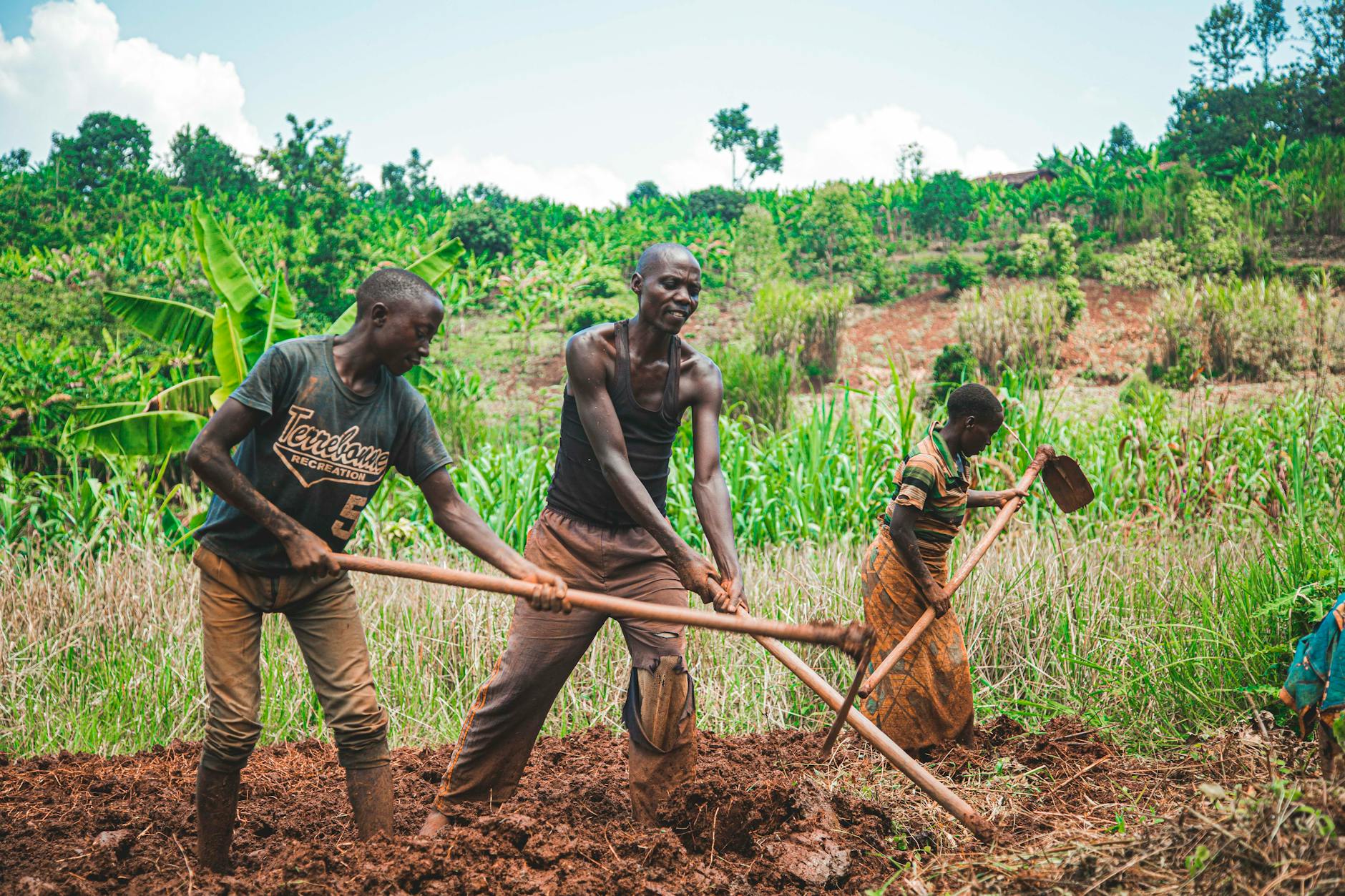
Photo by Heiner on Pexels.com

The question “What’s in a name?” takes on profound significance when examined through the lens of the African American experience. For enslaved Africans in America, a name was not merely a word of identity—it was a marker of power, ownership, and erasure. During slavery, the forced renaming of African people was a deliberate act of dehumanization designed to sever their connection to their heritage, ancestry, and language. A name once symbolized lineage, culture, and divine meaning; under slavery, it became a brand of bondage and submission to another man’s will.

When Africans were captured and sold into slavery, their original names—often rooted in powerful spiritual, ethnic, or familial significance—were stripped from them. Names like Kwame, Amina, Kofi, and Nia, each carrying meanings of time, birth order, and spiritual identity, were replaced by European Christian or Anglo-Saxon names such as John, Mary, William, and Sarah. This erasure of identity served the purpose of domination. The enslaved person’s name was a psychological reminder of who owned them. It was not merely about convenience; it was about control (Gates, 2014).

Slave masters often assigned their own surnames to enslaved individuals, creating an imposed lineage of ownership rather than kinship. For instance, an enslaved person on the Washington plantation might bear the last name Washington, while another under Thomas Jefferson might carry the name Jefferson. In this way, enslaved people’s identities were legally and socially tied to their oppressors. A name like “Samuel Washington” or “Mary Jefferson” became a haunting symbol of both enslavement and survival—marking one’s oppressor as the source of their new “identity.”

The changing of names also erased tribal and cultural continuity. Africans brought to the Americas came from diverse kingdoms and ethnic groups—Yoruba, Igbo, Akan, Mandinka, Wolof, and many others (Diop, 1974). Their names often reflected ancestral lineage, birth circumstances, or divine connection. When these names were replaced, a spiritual violence occurred. Names like Chukwuemeka (“God has done well”) or Adebayo (“He came in joy”) were replaced with names that carried no connection to ancestry or meaning.

During slavery, it was common for enslaved people to be renamed multiple times—once by slave traders, again by plantation owners, and sometimes even by overseers. For example, Olaudah Equiano, a captured Igbo man, was renamed “Gustavus Vassa” by his enslaver, after a Swedish king. He resisted the name but was beaten until he accepted it (Equiano, 1789). This forced renaming was a common practice meant to break resistance and reinforce subservience.

The act of naming also became a tool of Christianization. Slaveholders and missionaries imposed biblical names as a means of “civilizing” Africans and aligning them with Christian doctrine. Enslaved people were often baptized under names like Joseph, Ruth, David, or Elizabeth—names that symbolized European religious identity rather than African heritage (Raboteau, 1978). This symbolic rebirth under a slave master’s or biblical name was presented as salvation, though it truly represented cultural annihilation.

Following emancipation, many freed people grappled with the question of whether to keep their slave names or rename themselves. Some retained the surnames of their former masters as a way of tracing ancestry or simply because they had no other familial record to return to. Others, like Frederick Douglass—born Frederick Bailey—chose new names to reclaim agency. Douglass selected his surname after reading The Lady of the Lake, symbolizing his rebirth as a free man (Douglass, 1845).

The name “African American” itself is part of this evolving story of identity. Coined in the late 20th century, it was popularized by Jesse Jackson in 1988 as a way to connect Black Americans to their ancestral homeland and assert a dual identity—both African in origin and American in citizenship (Smith, 1992). Before this, the community had been labeled in various ways throughout history: Negro, Colored, Black, and earlier, slave. Each term carried social, political, and psychological weight, reflecting how America perceived its Black population.

In earlier centuries, names like Negro and Colored were formalized through laws and documents, yet they were terms of separation. The word Negro derived from the Spanish and Portuguese for “black,” but in America, it became synonymous with inferiority. Colored was adopted during the post-slavery era to denote distinction without open insult but still implied otherness. By the 1960s, Black became a term of pride, reclaimed during the Civil Rights and Black Power movements to symbolize strength, beauty, and unity (Tate, 2017).

Before these shifts, derogatory labels such as nigger, coon, boy, and mulatto were used to demean and dehumanize. These names were tools of oppression designed to maintain social hierarchy and racial subordination (Kennedy, 2002). Even the term mulatto—referring to mixed ancestry—was rooted in the Spanish word for mule, an animal hybrid, underscoring the contempt with which racial mixing was viewed.

The question of naming also extends to geography and identity formation. Enslaved Africans were taken from various parts of West and Central Africa, yet once in America, they were homogenized under the single racial label “Black.” This racialization eliminated ethnic distinctions that once existed among Akan, Yoruba, or Igbo peoples. Thus, the African diaspora’s names were rewritten by colonial power, creating what Frantz Fanon called a “zone of non-being,” where identity was reduced to servitude (Fanon, 1952).

Even after slavery, names continued to serve as markers of respectability or resistance. During the Reconstruction era and into Jim Crow, many African Americans adopted European names as a survival strategy—hoping to be treated with greater dignity. Later, during the 1960s and 1970s, a wave of cultural renaissance led many to reclaim African or Arabic names like Malcolm X, Assata Shakur, Imani, and Kwame as acts of self-determination and resistance to Eurocentric naming conventions (Karenga, 1967).

Names like Booker T. Washington, Sojourner Truth, and Harriet Tubman represent another powerful layer of renaming and self-definition. Sojourner Truth, born Isabella Baumfree, chose her name after receiving what she described as divine inspiration, reflecting her mission to “travel up and down the land” spreading truth. Tubman, born Araminta Ross, renamed herself after her mother and took her husband’s surname as an act of rebirth and liberation.

The persistence of slave masters’ names among African Americans today—such as Jefferson, Washington, Johnson, and Jackson—remains a haunting legacy of slavery’s reach. These surnames can be found throughout the Black community, yet they often obscure the true ethnic and familial histories that predate captivity. In this way, the very names many African Americans bear are silent monuments to centuries of oppression and survival.

The significance of names also intersects with identity politics and genealogical research. DNA testing and ancestral studies have reignited the search for lost African lineages, offering modern descendants the opportunity to reconnect with their ancestral names and origins. Many African Americans have begun adopting African surnames or reclaiming indigenous ones as acts of spiritual and cultural reclamation.

Thus, the question “What’s in a name?” becomes one of historical and existential weight. A name can be a chain or a key—a symbol of bondage or liberation. Enslaved Africans were stripped of their birthright through renaming, but through resilience, their descendants continue to redefine themselves in defiance of history’s imposed labels.

Today, movements like “Reclaiming Our Names” and cultural renaissances within the African diaspora underscore a truth that transcends centuries: identity cannot be fully erased, only buried and revived. Names like Kemet, Asante, Zulu, Nubia, and Ebo are once again spoken with pride, connecting generations to a pre-slavery legacy that colonialism sought to destroy.

In the end, to understand the story of the African American name is to understand the story of America itself—one of erasure, resistance, and rebirth. The names of slave masters still echo in many Black households, but so too does the unyielding spirit of those who survived. In reclaiming their names, African Americans are not just rewriting history; they are restoring the sacred link between identity and freedom.


References

Diop, C. A. (1974). The African Origin of Civilization: Myth or Reality. Lawrence Hill Books.
Douglass, F. (1845). Narrative of the Life of Frederick Douglass, an American Slave. Boston: Anti-Slavery Office.
Equiano, O. (1789). The Interesting Narrative of the Life of Olaudah Equiano. London.
Fanon, F. (1952). Black Skin, White Masks. Grove Press.
Gates, H. L. Jr. (2014). The African Americans: Many Rivers to Cross. PBS Books.
Karenga, M. (1967). Introduction to Black Studies. University of Sankore Press.
Kennedy, R. (2002). Nigger: The Strange Career of a Troublesome Word. Pantheon.
Raboteau, A. J. (1978). Slave Religion: The “Invisible Institution” in the Antebellum South. Oxford University Press.
Smith, R. C. (1992). Racism and the African American Experience. American Political Science Review, 86(2), 593–606.
Tate, S. A. (2017). Black Women’s Bodies and the Nation: Race, Gender, and Culture. Palgrave Macmillan.

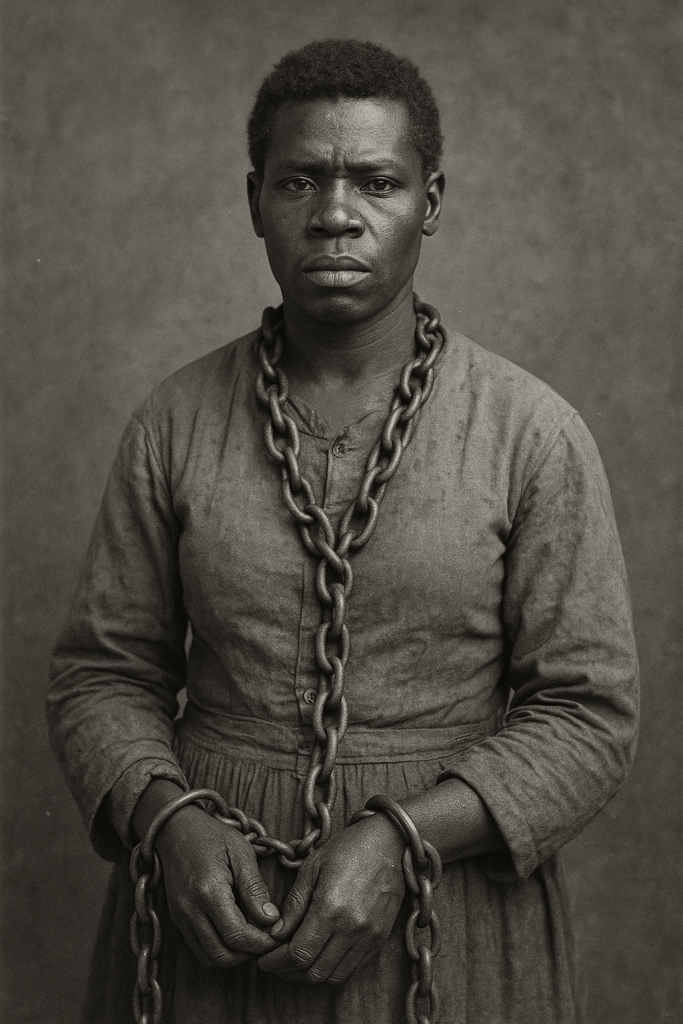
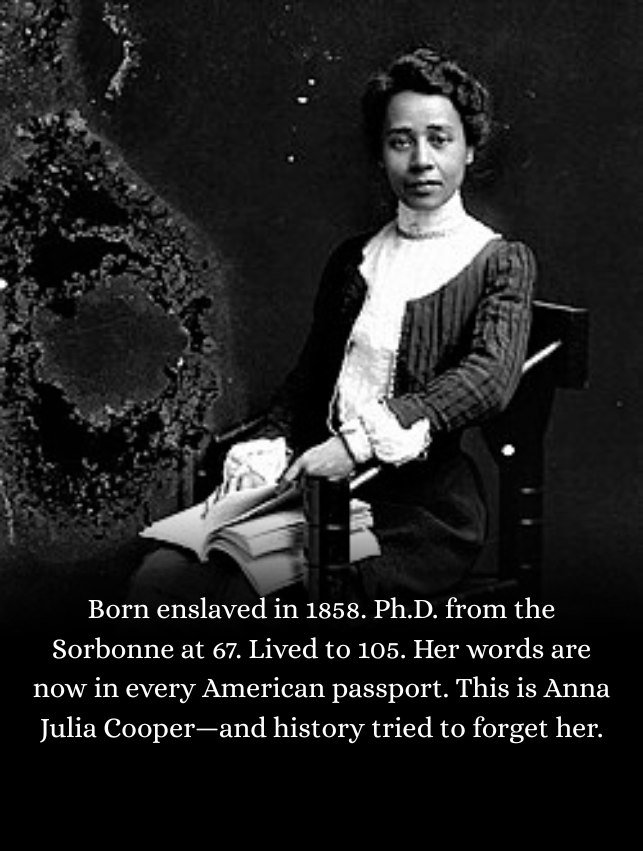
The Slave Files: Anna Julie Cooper

This photograph is the property of its respective owner. No copyright infringement intended.

Anna Julia Cooper was born on August 10, 1858 in Raleigh, North Carolina

Anna Julia Cooper was an influential African American educator, scholar, and author whose life and work left a profound impact on Black education and intellectual thought. Born in the late 19th century, she emerged during a period of systemic oppression and racial discrimination, when opportunities for African Americans—particularly women—were severely limited. Despite these obstacles, Cooper dedicated her life to uplifting her community through education, moral leadership, and scholarly contributions.

Cooper’s early life was marked by a determination to pursue learning despite societal barriers. She believed that education was a fundamental tool for liberation and empowerment. Her passion for teaching and scholarship became a central theme in her life, guiding her professional endeavors and public influence.

As an educator, Julia Cooper worked tirelessly to improve access to quality schooling for African Americans. She advocated for rigorous academic standards, the establishment of Black educational institutions, and curricula that fostered critical thinking and self-worth among students. Her efforts emphasized the transformative power of knowledge as a means to resist systemic oppression.

In addition to teaching, Cooper was a prolific writer and thinker. She authored essays and treatises on the moral, social, and intellectual development of African Americans, emphasizing the necessity of self-respect, cultural pride, and educational attainment. Her writings served as a blueprint for Black uplift during the early 20th century.

Cooper also engaged in public speaking and community organizing. She traveled widely, addressing audiences on the importance of education, civic responsibility, and moral development. Her speeches encouraged African Americans to embrace their intellectual potential and challenge societal narratives that sought to marginalize them.

Her impact extended to her mentorship of younger generations of Black scholars and educators. By providing guidance, encouragement, and access to educational resources, Cooper helped cultivate a new class of African American leaders committed to intellectual excellence and social progress.

Anna Julia Cooper’s work was informed by a deep moral and spiritual philosophy. She believed that personal character and ethical integrity were inseparable from educational and professional achievement. Her vision emphasized holistic development—intellectual, moral, and civic—as essential to individual and communal advancement.

Throughout her career, Cooper confronted racism, sexism, and social prejudice. Her ability to navigate these systemic challenges while achieving professional recognition serves as a testament to her resilience and strategic acumen. She became a symbol of Black female agency in a society structured to limit her potential.

Her legacy is visible in the educational institutions she influenced, the students she inspired, and the broader discourse on African American intellectual empowerment. Cooper’s life exemplifies the potential for knowledge and moral courage to transform communities and challenge entrenched inequalities.

Anna Julia Cooper remains a vital figure in African American history, her life and work illustrating the enduring power of education, scholarship, and leadership in advancing justice and equality. Her contributions continue to inspire educators, students, and leaders committed to intellectual rigor and moral responsibility.


References

  1. Gates, H. L., & Higginbotham, E. B. (2014). African American lives. Oxford University Press.
  2. Gutman, H. G. (1976). The black family in slavery and freedom, 1750-1925. Pantheon Books.
  3. Kelley, R. D. G. (1994). Race rebels: Culture, politics, and the Black working class. Free Press.
  4. Theoharis, J. (2018). A more beautiful and terrible history: The uses and misuses of civil rights history. Beacon Press.
  5. Wiggins, W. H. (2000). The intellectual tradition of African Americans: A historical overview. Greenwood Press.

The Unbroken: Chronicles of Enslaved Souls.

Photo by Safari Consoler on Pexels.com

The story of enslavement in the Americas is not solely a tale of brutality and dehumanization—it is also one of divine endurance, sacred strength, and the unyielding spirit of a people determined to survive. The enslaved African was stripped of name, language, and homeland, yet something eternal within remained unbroken. This resilience, forged in the furnace of oppression, became the cornerstone of Black identity and collective survival across generations.

In the belly of slave ships, chained in darkness and surrounded by death, the captives still prayed, sang, and remembered. The Middle Passage was intended to break their spirits, but it instead birthed a new kind of defiant endurance. These men and women carried not only physical strength but also the ancestral memory of kingdoms, kinship, and sacred traditions. Their songs—spirituals whispered between sobs and storms—were coded messages of hope and liberation (Gates & Curran, 2019).

On the plantations, survival was both a physical and spiritual act. Each day, enslaved people found ways to resist erasure—through language, through song, through secret gatherings where they worshipped a God who delivered Israel and would one day deliver them. The slave masters wielded whips, but they could not conquer faith. In fields where blood soaked the soil, the enslaved sowed seeds of freedom.

The resilience of enslaved women was particularly remarkable. They endured sexual violence, the theft of their children, and the weight of double oppression—both racial and gendered. Yet, they nurtured their families and passed down wisdom, oral history, and the will to survive. Their lullabies were both prayers and promises, ensuring that even in bondage, their children knew they were born from strength (Collins, 2000).

Resistance was not always open rebellion—it was often subtle, subversive, and strategic. Every moment of survival was an act of defiance. Running away, breaking tools, feigning ignorance, or refusing to reproduce were forms of rebellion that disrupted the machinery of slavery. Harriet Tubman, Nat Turner, and countless unnamed heroes transformed defiance into destiny, turning resistance into a moral revolution (Franklin & Schweninger, 1999).

Spiritual resilience emerged as a weapon of hope. The biblical story of Exodus became the foundation of the enslaved theology. The enslaved identified with the Israelites in Egypt, awaiting deliverance from their Pharaohs. Christianity, though distorted by oppressors, was reinterpreted as a promise of divine justice. Faith became the language of resistance, and hope became the instrument of liberation (Raboteau, 2004).

The communal bonds among the enslaved were vital for survival. Families, though often separated by sale, maintained spiritual connections across distances. Kinship was reimagined; any elder could be “Mama” or “Papa.” Community became the sanctuary when no physical refuge existed. Through shared grief, laughter, and labor, they built a sacred fellowship of the unbroken.

Music was both solace and strategy. The spirituals, field hollers, and ring shouts carried messages of escape, coded directions, and sacred affirmation. These songs bridged the gap between Africa and America, between despair and hope. The rhythms preserved memory; the harmonies echoed the soul’s refusal to be silenced. Each note was a heartbeat of survival.

The enslaved also resisted intellectually and artistically. Many secretly learned to read, defying laws that criminalized literacy. The ability to read the Bible became a spiritual victory. From these forbidden words grew the seeds of abolition, as literacy birthed leaders, preachers, and reformers who articulated the moral and human rights argument against slavery (Douglass, 1845).

In the quiet corners of their quarters, the enslaved crafted tools, quilts, and art that encoded messages of liberation. Every stitch, carving, or pattern was an assertion of agency. Creativity became both a cultural inheritance and a subtle rebellion, proving that beauty and meaning could be made even in the darkest captivity.

Resistance also took the form of flight. The Underground Railroad symbolized not just escape but the collective courage of those who risked their lives for others. It was an act of radical love—each conductor and traveler embodying the unbroken bond between freedom and faith. The northward journey was both a physical and spiritual pilgrimage (Hagedorn, 2010).

For those who could not flee, inner freedom became their sanctuary. Enslaved preachers proclaimed a higher law than that of man. They spoke of a kingdom not of this world, where the last would be first and the captors would answer to divine justice. Such preaching was a radical act, for it gave the enslaved people spiritual dignity in a world determined to deny it.

Children born in bondage inherited both trauma and triumph. They learned survival as a language, faith as a shield, and resilience as inheritance. Their elders’ stories became oral scripture—a record of human endurance written not on paper, but on hearts.

Even after emancipation, the unbroken spirit continued. Freedom brought new struggles—poverty, segregation, and systemic racism—but also renewed determination. The resilience that carried them through slavery now fueled education, enterprise, and the building of churches, schools, and communities that would shape the Black experience in America.

The artistry, faith, and family traditions that originated during slavery laid the foundation for African American culture. Jazz, blues, and gospel music carry echoes of the field songs and ring shouts. The resilience born in bondage became the creative force behind some of the world’s most profound cultural expressions.

The legacy of the unbroken lives in every generation that refuses to surrender to despair. From the Harlem Renaissance to the Civil Rights Movement, the descendants of the enslaved have transformed pain into purpose and memory into movement. Their very existence is testimony to divine perseverance and the unextinguished flame of dignity.

The chronicles of enslaved souls remind the world that oppression cannot conquer the human spirit. History records the suffering, but the descendants carry the victory. In every hymn sung, every march walked, and every child educated, the unbroken rise again.

The story of survival within slavery is not simply historical—it is theological, cultural, and psychological. It is the manifestation of a collective covenant with God, who preserves His people even in captivity. Their resilience was not accidental; it was providential. It was faith lived under fire, hope breathing through horror.

Ultimately, the unbroken spirit of the enslaved is a mirror reflecting humanity’s highest capacity for endurance and love. Their story calls the world to remember, to honor, and to emulate their strength. For though their bodies were chained, their souls remained forever free.


References

Collins, P. H. (2000). Black feminist thought: Knowledge, consciousness, and the politics of empowerment (2nd ed.). Routledge.

Douglass, F. (1845). Narrative of the life of Frederick Douglass, an American slave. Anti-Slavery Office.

Franklin, J. H., & Schweninger, L. (1999). Runaway slaves: Rebels on the plantation. Oxford University Press.

Gates, H. L., Jr., & Curran, A. S. (2019). Who’s Black and why? A hidden chapter from the eighteenth-century invention of race. Harvard University Press.

Hagedorn, K. J. (2010). Beyond the slave narrative: Politics, sex, and manuscripts in the Haitian Revolution. Duke University Press.

Raboteau, A. J. (2004). Slave religion: The “invisible institution” in the antebellum South. Oxford University Press.

Wheatley, P. (1773). Poems on various subjects, religious and moral. A. Bell.

Wilmore, G. S. (1983). Black religion and Black radicalism: An interpretation of the religious history of African Americans. Orbis Books.

Walker, D. (1829). David Walker’s appeal to the colored citizens of the world. Boston: David Walker.

Wood, P. H. (1974). Black majority: Negroes in colonial South Carolina from 1670 through the Stono Rebellion. W. W. Norton.

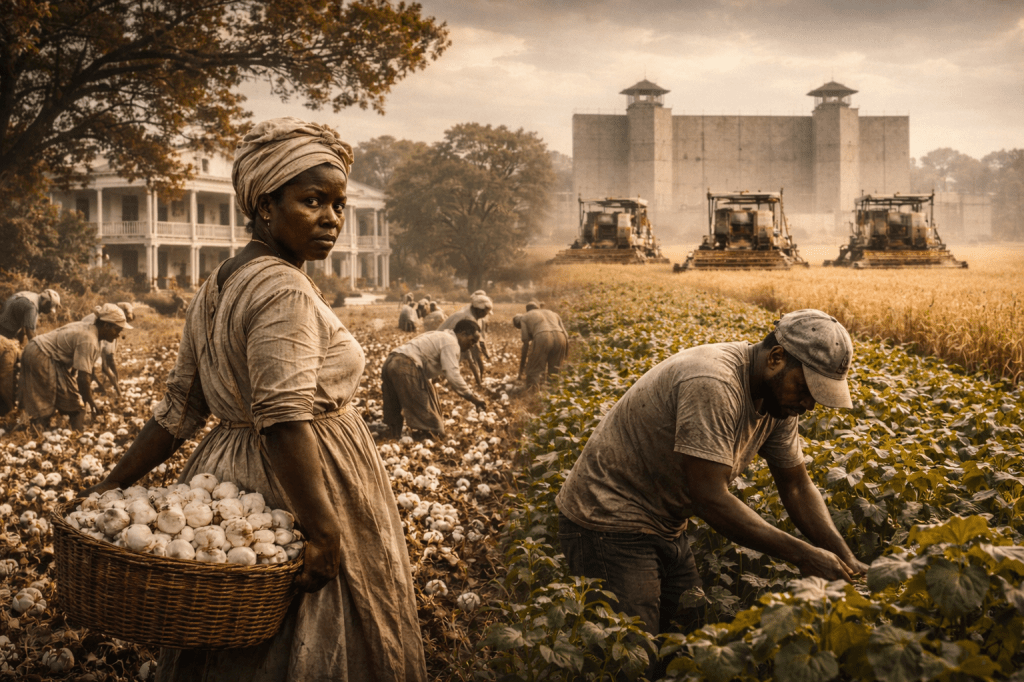
Behind the Cotton Fields: Hidden Lives of Slavery.

Photo by Karen Lau00e5rk Boshoff on Pexels.com

Behind the romanticized myths of southern plantations lay a hidden reality—a world of suffering, endurance, and humanity often obscured by the economic narrative of cotton. Slavery in the American South was not a static institution; it was a geographical and cultural system that shaped landscapes, identities, and lives. From the rich deltas of Mississippi to the rice swamps of South Carolina and the sugarcane fields of Louisiana, the geography of slavery dictated not only labor but the very rhythm of existence for millions of enslaved Africans.

Cotton was king, but it ruled through chains. The geography of the Deep South—its humid climate and fertile soil—made it ideal for cotton cultivation, turning human lives into instruments of production. Enslaved laborers worked from dawn to dusk, their hands blistered by the very fiber that fueled global capitalism. Every cotton boll carried both economic profit and human pain (Baptist, 2014).

In coastal regions, such as the Sea Islands of Georgia and South Carolina, the Gullah-Geechee people developed unique cultural patterns. Because of their isolation and African majority, they preserved much of their ancestral heritage—language, cuisine, and spirituality. This community represented a living bridge between Africa and America, maintaining traditions that defied cultural erasure (Joyner, 1984).

The plantation system was a complete world unto itself, governed by rigid hierarchies and surveillance. Overseers, driven by quotas and cruelty, maintained order through fear. The daily routine began before sunrise and often ended only when the last light faded. Enslaved people labored under the watchful eye of white dominance, yet within these confines, they built an internal world of faith, kinship, and quiet resistance.

Housing reflected the social order. While the master’s mansion stood as a symbol of wealth and power, the slave quarters told another story. Built of wood or mud, with dirt floors and minimal furnishing, these cabins were cramped but alive with community. Within their walls, families prayed, sang, and strategized survival. It was here, behind the cotton fields, that the enslaved recreated a sense of belonging in a world that sought to strip it away.

Foodways also reveal the ingenuity of enslaved Africans. Given meager rations—cornmeal, lard, and scraps—they transformed survival into art, creating culinary traditions that remain central to African American identity. Dishes such as gumbo, hoppin’ john, and rice stews were cultural testaments to memory and adaptation. Through food, they maintained ancestral ties and expressed creative resilience (Opie, 2008).

Religion was the spiritual heart of plantation life. The “invisible church” thrived in secrecy, where enslaved men and women gathered in hush harbors to worship under moonlight. These gatherings were both spiritual and political acts—spaces of liberation where they reinterpreted Christianity through an African lens. The God of the enslaved was not the master’s God of submission, but the deliverer who freed the oppressed (Raboteau, 2004).

Music was omnipresent. The fields echoed with spirituals and work songs that expressed pain, coded hope, and communal strength. The rhythm of hoe and song was a form of communication that transcended language barriers. “Steal Away,” “Go Down, Moses,” and “Swing Low, Sweet Chariot” were not merely songs but sacred messages of endurance and escape.

Gender dynamics shaped experiences differently. Enslaved women carried the dual burden of labor and sexual exploitation. Their bodies became sites of violence and survival. Yet, they also held the community together through care, storytelling, and midwifery. Enslaved mothers resisted psychological destruction by nurturing identity and strength in their children (White, 1999).

Children, born into bondage, learned early the rules of survival. Play was limited; innocence was fleeting. Many were separated from their parents, sold to other plantations before adolescence. Yet, even in these fragmented spaces, children were taught songs, proverbs, and prayers—spiritual inheritances that preserved humanity across generations.

The hidden economy of slavery extended beyond the fields. Skilled artisans—blacksmiths, carpenters, seamstresses—labored in silence, often earning small wages or privileges. Their expertise built the infrastructure of the South, though their names remain lost to history. Labor, in every form, was both a curse and a source of dignity for the enslaved (Berlin, 2003).

Cultural expression flourished in the margins. Folktales, particularly the Br’er Rabbit stories, functioned as allegories of resistance. The cunning trickster who outwitted stronger adversaries symbolized the enslaved spirit—resourceful, patient, and subversive. Oral tradition became a psychological refuge, turning oppression into wisdom (Levine, 1977).

Geography also shaped rebellion. In the swamps of Florida and Louisiana, maroon communities—runaway slaves who formed free settlements—thrived beyond the reach of slave catchers. These hidden enclaves were testaments to defiance, combining African survival skills with the American wilderness. The landscape itself became a partner in resistance (Weaver, 2006).

Daily life was marked by constant negotiation between subservience and selfhood. The enslaved learned to navigate the master’s world with coded behavior—outward compliance masking inner freedom. They practiced what scholar James C. Scott (1990) called “the hidden transcript,” a secret resistance carried in whispers, gestures, and double meanings.

Festivals and dances provided rare spaces of release. On Sundays and holidays, enslaved people gathered to dance the juba, stomp rhythms, and share stories. These cultural gatherings were acts of joy and identity reclamation, affirming their collective humanity despite systematic dehumanization.

The physical geography of slavery also dictated mortality. The rice plantations of the Carolinas were death traps, breeding malaria and disease. The Louisiana sugar fields were even harsher—workers were literally worked to death during harvest. Geography was not just landscape; it was a silent accomplice to suffering (Morgan, 1998).

Despite unimaginable conditions, enslaved people forged emotional worlds of love and loyalty. Marriages, though unrecognized by law, were sacred vows in the eyes of God. Couples risked punishment to see one another across plantations. Love itself became an act of rebellion—a declaration that they were still human, still capable of tenderness.

The hidden lives behind the cotton fields were not defined by despair but by determination. Within every prayer, song, and whispered story was a prophecy of freedom. The enslaved refused to be reduced to property; they were people of vision, artistry, and faith, whose daily resistance laid the foundation for future generations.

When emancipation finally came, it was not granted—it was earned through centuries of survival. The legacy of those hidden lives continues to shape the cultural, spiritual, and moral identity of African Americans today. Behind the cotton fields, there existed a civilization of strength—a people unbroken, unseen, yet unforgettable.


References

Baptist, E. E. (2014). The half has never been told: Slavery and the making of American capitalism. Basic Books.

Berlin, I. (2003). Generations of captivity: A history of African-American slaves. Harvard University Press.

Joyner, C. (1984). Down by the riverside: A South Carolina slave community. University of Illinois Press.

Levine, L. W. (1977). Black culture and Black consciousness: Afro-American folk thought from slavery to freedom. Oxford University Press.

Morgan, P. D. (1998). Slave counterpoint: Black culture in the eighteenth-century Chesapeake and Lowcountry. University of North Carolina Press.

Opie, F. D. (2008). Hog and hominy: Soul food from Africa to America. Columbia University Press.

Raboteau, A. J. (2004). Slave religion: The “invisible institution” in the antebellum South. Oxford University Press.

Scott, J. C. (1990). Domination and the arts of resistance: Hidden transcripts. Yale University Press.

Weaver, J. C. (2006). The red Atlantic: American indigenes and the making of the modern world, 1000–1927. Cambridge University Press.

White, D. G. (1999). Ar’n’t I a woman? Female slaves in the plantation South. W. W. Norton.

Bound by History: Stories of Enslavement and Resistance – emphasizes both the bondage and resilience of the enslaved.

The history of enslavement in the Americas is not solely a chronicle of oppression; it is also a story of profound endurance, cultural preservation, and resistance. Enslaved Africans and their descendants, bound in chains yet spiritually unbroken, forged new identities and forms of resistance that shaped the very foundations of modern society. This narrative of duality—bondage and resilience—reveals the complexity of human survival under the most dehumanizing conditions.

The transatlantic slave trade, which forcibly displaced over twelve million Africans between the sixteenth and nineteenth centuries, created one of the largest forced migrations in human history (Eltis & Richardson, 2008). Those captured were often torn from diverse kingdoms and ethnic groups, such as the Yoruba, Igbo, Mandinka, and Akan. Despite this fragmentation, enslaved Africans carried with them spiritual, linguistic, and cultural frameworks that would influence the Americas in lasting ways.

In the United States, slavery was institutionalized through laws that defined Africans and their descendants as property rather than people. The legal codes of the colonies and early republic—such as the Virginia Slave Codes of 1705—reinforced racial hierarchies and legitimized brutal systems of control (Morgan, 1975). Yet within this system, enslaved individuals constructed subtle and overt forms of resistance that defied their oppressors.

The plantation system depended on both physical labor and psychological domination. Slaveholders employed violence, religious manipulation, and family separation to maintain control (Douglass, 1845). However, enslaved people continually subverted these systems by forming kinship networks, maintaining oral traditions, and practicing spiritual resistance through African-derived religions such as Hoodoo and Yoruba-based worship (Raboteau, 2004).

Women bore the unique burden of both racial and gendered oppression. Enslaved women were subject to forced breeding, sexual assault, and domestic servitude. Yet they also played central roles in community preservation and acts of resistance. Harriet Tubman’s life exemplifies this defiance—her daring rescues through the Underground Railroad earned her the title “Moses” among her people (Clinton, 2004).

Resistance took many forms beyond escape. Work slowdowns, sabotage, secret education, and coded communication in spirituals all functioned as acts of rebellion. Songs like “Follow the Drinking Gourd” carried dual meanings, blending Christian faith with directions for liberation (Levine, 1977). Through these acts, enslaved Africans reclaimed a sense of power within an oppressive system.

Revolts were the most visible expressions of resistance. The Stono Rebellion of 1739 in South Carolina, led by a group of Angolan slaves, marked one of the earliest large-scale uprisings in the British colonies (Wood, 1974). Later, the Haitian Revolution (1791–1804) became the most successful slave revolt in world history, resulting in the first Black republic. It demonstrated that the enslaved were not passive victims but active agents of freedom (James, 1963).

In the antebellum United States, figures such as Nat Turner (1831) and Gabriel Prosser (1800) led insurrections that challenged the myth of slave docility. Though brutally suppressed, these rebellions instilled fear among slaveholders and inspired subsequent generations to envision liberation (Greenberg, 2003). The courage displayed in these movements reflected the enduring belief that freedom was a divine right, not a privilege granted by man.

Intellectual resistance also played a key role. Enslaved individuals who learned to read and write used literacy as a weapon. Frederick Douglass, once an enslaved man, used the written word to dismantle pro-slavery ideology, declaring that “knowledge makes a man unfit to be a slave” (Douglass, 1845). His narrative remains a seminal text in both American literature and abolitionist history.

The preservation of African traditions within slavery reflected a deeper form of psychological survival. Despite attempts by slaveholders to erase their identities, enslaved Africans maintained rituals, music, and kinship practices that evolved into African American culture. Spirituals, call-and-response singing, and ring shouts became not only acts of worship but of cultural resistance (Herskovits, 1941).

Religion provided both solace and subversion. While some enslaved people adopted the Christianity of their oppressors, they reinterpreted biblical stories through the lens of liberation. The story of Exodus, in which God delivers Israel from Egyptian bondage, became a cornerstone of enslaved spirituality and an enduring metaphor for freedom (Raboteau, 2004).

The abolitionist movement was fueled by both white and Black activists, but the testimony of formerly enslaved individuals proved especially powerful. Sojourner Truth, Harriet Jacobs, and Olaudah Equiano used personal narrative to humanize the enslaved and expose the cruelty of the institution (Jacobs, 1861; Equiano, 1789). Their voices reframed public morality and influenced global anti-slavery campaigns.

During the Civil War, the Emancipation Proclamation of 1863 symbolized a legal end to slavery in rebelling states, yet true freedom remained elusive. Many freedpeople continued to labor under exploitative sharecropping systems and faced racial terror through groups like the Ku Klux Klan (Foner, 1988). Resistance, however, persisted through education, political organization, and migration.

The Reconstruction era represented a moment of both hope and betrayal. Freedmen’s schools, Black churches, and civic organizations emerged as symbols of autonomy. Leaders such as Frederick Douglass and Hiram Revels advocated for equality and political participation. Yet the rise of Jim Crow laws soon reimposed racial subjugation, demonstrating the ongoing struggle for true emancipation (Du Bois, 1935).

Throughout the African diaspora, the legacy of slavery fostered movements for self-determination and cultural revival. In the Caribbean and South America, Afro-descendant populations maintained African spiritual systems such as Santería, Candomblé, and Vodou—each a testament to cultural survival against assimilation (Mintz & Price, 1992).

Archaeological and genealogical research continues to recover the names and stories of the enslaved. Sites such as the African Burial Ground in New York City reveal the humanity of those once reduced to property. Their skeletal remains bear witness to both the brutality of slavery and the resilience of African identity (LaRoche & Blakey, 1997).

Enslaved artisans, musicians, and healers also contributed to the cultural and economic life of the Americas. From the rice fields of South Carolina to the architecture of New Orleans, African labor and creativity shaped entire societies. These contributions challenge the narrative of enslaved passivity and highlight the intellectual and cultural agency of the oppressed (Gomez, 1998).

Education became both a symbol and instrument of resistance. Even under threat of death, enslaved people taught one another to read using the Bible, scraps of newspapers, or memory. Literacy symbolized mental emancipation, anticipating the later struggles for civil rights and access to education (Cornelius, 1991).

The trauma of enslavement did not end with abolition. Generations of African Americans have inherited both the scars and the strength of their ancestors. The collective memory of slavery informs ongoing struggles against systemic racism, economic inequality, and cultural erasure (Alexander, 2010).

Artistic expression continues to be a powerful medium of remembrance and resistance. From the sorrow songs of the nineteenth century to the blues, jazz, and hip-hop of today, African-descended people have turned pain into power, creating new languages of identity and protest (Ellison, 1952).

Modern descendants of enslaved people are reclaiming narratives through genealogy, art, and scholarship. Projects such as The 1619 Project and the Slave Voyages Database have reframed global understandings of how slavery shaped modern economies, politics, and social hierarchies (Hannah-Jones, 2019; Eltis et al., 2008).

Monuments and memorials increasingly honor those who resisted slavery rather than those who upheld it. Statues of Harriet Tubman and Nat Turner now stand where once only Confederate icons were displayed. These transformations reflect a shift from glorifying domination to celebrating endurance and justice (Savage, 1997).

The rediscovery of figures like Anarcha Westcott—an enslaved woman subjected to medical experimentation—reveals the hidden dimensions of slavery’s legacy in science and ethics. Her story, and those like hers, illuminate how enslaved bodies were exploited even in the pursuit of “progress” (Washington, 2006).

African spirituality, family structure, and oral history became weapons of survival. Even in bondage, enslaved people found ways to name their children with ancestral meanings, preserving identity in the face of dehumanization (Holloway, 1990). Their cultural endurance represents a quiet revolution that reshaped the spiritual landscape of the Americas.

Resistance was not limited to grand revolts or famous figures—it was embedded in everyday acts: a whispered prayer, a hidden song, or a stolen moment of rest. Each small act of defiance represented a declaration of humanity within a system designed to erase it (White, 1999).

Today, the legacies of bondage and resilience coexist in the collective consciousness of the African diaspora. To remember the enslaved is to remember both suffering and victory—to acknowledge the strength that transcended captivity. Their stories remind us that freedom was not given; it was wrestled from the grip of history.

In the final analysis, the history of enslavement is not simply a story of chains, but of transcendence. Enslaved Africans turned oppression into endurance, silence into song, and despair into defiance. Bound by history yet unbroken in spirit, they transformed the meaning of freedom itself, leaving a legacy that continues to shape the modern world.


References

Alexander, M. (2010). The new Jim Crow: Mass incarceration in the age of colorblindness. The New Press.
Clinton, C. (2004). Harriet Tubman: The road to freedom. Little, Brown.
Cornelius, J. D. (1991). “When I can read my title clear”: Literacy, slavery, and religion in the antebellum South. University of South Carolina Press.
Douglass, F. (1845). Narrative of the life of Frederick Douglass, an American slave. Anti-Slavery Office.
Du Bois, W. E. B. (1935). Black Reconstruction in America, 1860–1880. Harcourt, Brace.
Eltis, D., & Richardson, D. (2008). Atlas of the transatlantic slave trade. Yale University Press.
Equiano, O. (1789). The interesting narrative of the life of Olaudah Equiano. London.
Foner, E. (1988). Reconstruction: America’s unfinished revolution, 1863–1877. Harper & Row.
Gomez, M. A. (1998). Exchanging our country marks: The transformation of African identities in the colonial and antebellum South. University of North Carolina Press.
Greenberg, K. S. (2003). Nat Turner: A slave rebellion in history and memory. Oxford University Press.
Hannah-Jones, N. (2019). The 1619 Project. The New York Times Magazine.
Herskovits, M. J. (1941). The myth of the Negro past. Harper & Brothers.
Holloway, J. E. (1990). Africanisms in American culture. Indiana University Press.
Jacobs, H. (1861). Incidents in the life of a slave girl. Thayer & Eldridge.
James, C. L. R. (1963). The Black Jacobins: Toussaint L’Ouverture and the San Domingo Revolution. Vintage.
LaRoche, C. J., & Blakey, M. L. (1997). Seizing intellectual power: The dialogue at the New York African Burial Ground. Historical Archaeology, 31(3), 84–106.
Levine, L. (1977). Black culture and Black consciousness: Afro-American folk thought from slavery to freedom. Oxford University Press.
Mintz, S. W., & Price, R. (1992). The birth of African-American culture: An anthropological perspective. Beacon Press.
Morgan, E. S. (1975). American slavery, American freedom: The ordeal of colonial Virginia. W.W. Norton.
Raboteau, A. J. (2004). Slave religion: The “invisible institution” in the antebellum South. Oxford University Press.
Savage, K. (1997). Standing soldiers, kneeling slaves: Race, war, and monument in nineteenth-century America. Princeton University Press.
Washington, H. A. (2006). Medical apartheid: The dark history of medical experimentation on Black Americans from colonial times to the present. Doubleday.
White, D. G. (1999). Ar’n’t I a woman? Female slaves in the plantation South. W.W. Norton.
Wood, P. H. (1974). Black majority: Negroes in colonial South Carolina from 1670 through the Stono Rebellion. W.W. Norton.

The Slave Files: Whipped Peter (Gordon)

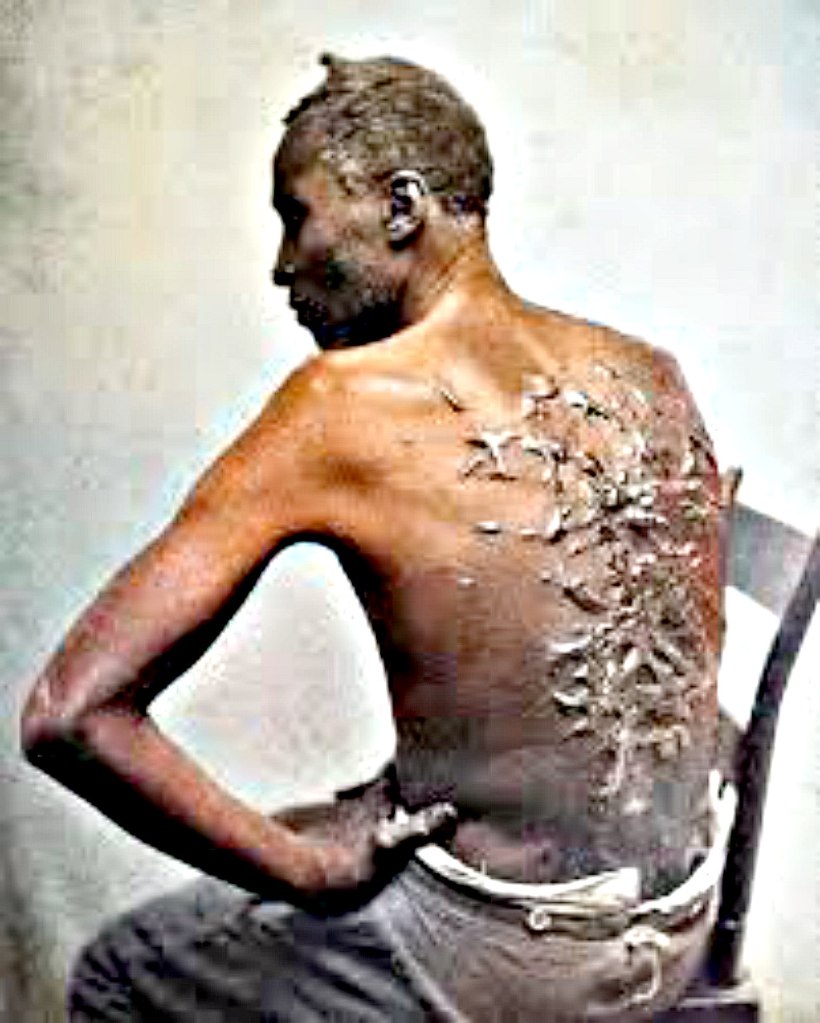
The Scourged Back

Chains that bound, yet could not break
A spirit strong, though flesh did ache.
Scarred and beaten, marked by pain,
He rose to freedom, hope his gain.

Whipped by cruelty, yet never bent,
A testament to courage, resilient.
From fields of sorrow to Union’s call,
Peter’s courage outshines it all.

Photo Credit: McPherson & Oliver. This photograph is the property of its respective owner.

Peter, also known as “Whipped Peter” or “Gordon,” was an enslaved African American man born around 1820–1825; some accounts report his birth around 1850 in Georgia. He was sold to a 3,000-acre plantation in Louisiana owned by Captain John Lyons. In late October 1862, after an altercation with his overseer, Peter was subjected to a brutal whipping that left deep, permanent scars across his back. The overseer reportedly applied salt to the wounds, a common and excruciating practice known as “salting,” intended to inflict maximum pain and humiliation.

Despite this horrific treatment, Peter survived and, in March 1863, escaped the plantation. Using onions to mask his scent from bloodhounds, he reached Union lines near Baton Rouge, Louisiana. There, photographers McPherson & Oliver captured his scarred back, producing the image known as “The Scourged Back.” This photograph circulated widely in abolitionist publications and became a poignant testament to the brutality of slavery, galvanizing public opinion against the institution.

In March 1863, Peter escaped from the plantation, covering his scent with onions to evade bloodhounds. After a perilous journey, he reached Union lines near Baton Rouge, Louisiana, where he was photographed by McPherson & Oliver, revealing the extent of his injuries. The resulting image, known as “The Scourged Back,” was widely circulated and became a poignant testament to the brutality of slavery . Following his escape, Peter enlisted in the Union Army and served in the U.S. Colored Troops, where he continued to contribute to the fight for freedom and justice. While his exact service details remain unclear, his story galvanized anti-slavery sentiments and highlighted the resilience and humanity of enslaved individuals. His story endures as a symbol of resilience, courage, and the unbreakable human spirit, reminding future generations of both the horrors of slavery and the strength required to survive and claim one’s freedom.


References for Further Reading