
Category Archives: reparations

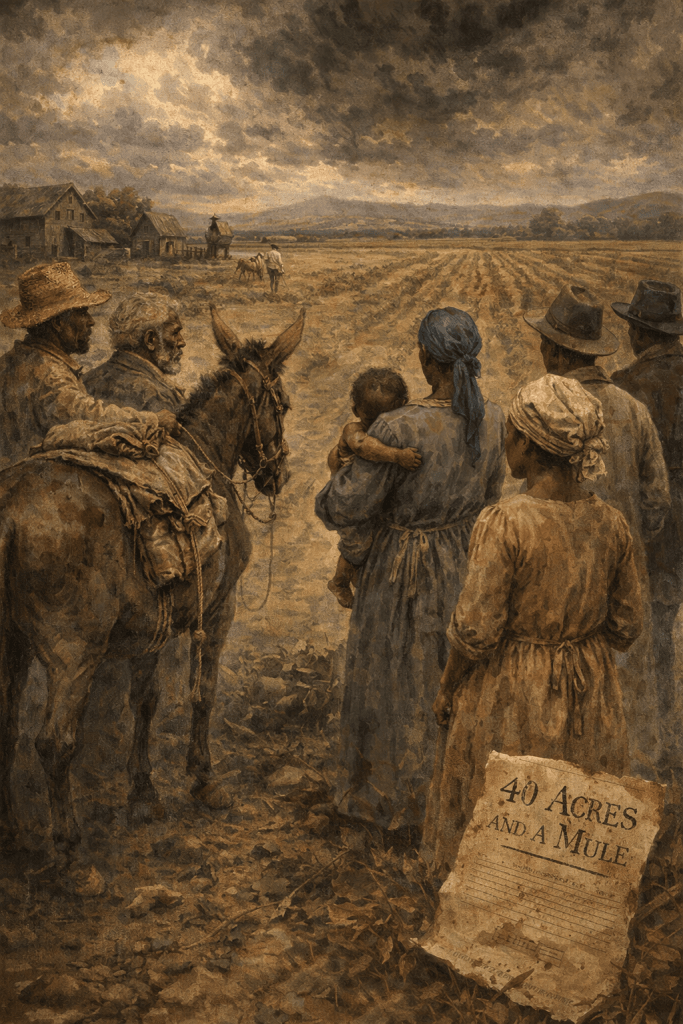
40 Acres and a Mule: The Promise That Was Never Kept.

The phrase “40 acres and a mule” has become one of the most powerful symbols of broken promises in American history, rooted in the aftermath of the American Civil War. It represents an unfulfilled commitment to provide formerly enslaved Black Americans with land and the means to sustain themselves economically.

The origin of this promise can be traced to January 1865, when Union General William Tecumseh Sherman issued Special Field Orders No. 15. This order set aside approximately 400,000 acres of confiscated Confederate land along the southeastern coast for settlement by freed Black families.

Under Sherman’s directive, each family was to receive up to 40 acres of land. Later, some were also given access to surplus army mules, leading to the enduring phrase “40 acres and a mule.” This initiative was seen as a foundational step toward economic independence.

The policy was implemented in areas of South Carolina, Georgia, and Florida, where thousands of formerly enslaved people began to establish communities. For many, this land represented not just property, but dignity, autonomy, and the fruit of generations of unpaid labor.

The idea of land redistribution was supported by leaders such as Thaddeus Stevens, who argued that true freedom required economic justice. Without land, formerly enslaved people would remain dependent on their former oppressors.

However, this promise was short-lived. Following the assassination of Abraham Lincoln in April 1865, his successor, Andrew Johnson, reversed many Reconstruction policies.

President Johnson issued proclamations that returned confiscated land to former Confederate landowners. As a result, thousands of Black families who had begun to build lives on this land were forcibly removed.

This reversal effectively nullified the promise of “40 acres and a mule.” Land that had been distributed to freedmen was taken back, often violently, leaving families dispossessed and vulnerable.

The failure to provide land had profound consequences. Without access to property, many Black Americans were pushed into sharecropping—a system that closely resembled slavery in its economic exploitation.

Sharecropping trapped families in cycles of debt and poverty. Landowners controlled the terms, often charging exorbitant fees for tools, seeds, and housing, ensuring that laborers remained financially dependent.

The denial of land ownership also prevented the accumulation of generational wealth. While white Americans were able to pass down land and assets, Black families were systematically excluded from these opportunities.

The concept of reparations is deeply tied to this history. Advocates argue that the promise of land was a form of restitution for centuries of slavery, and its revocation constitutes a debt still owed.

The economic disparity created by this broken promise is evident today. Scholars frequently link the racial wealth gap to the lack of land redistribution during Reconstruction.

The federal government’s failure to uphold its commitment undermined trust and reinforced systemic inequality. It demonstrated that legal freedom without economic support was insufficient.

In the 20th and 21st centuries, the call for reparations has gained renewed attention. Proposals include financial compensation, land grants, and institutional investments in Black communities.

Legislative efforts such as H.R. 40—named in reference to the original promise—seek to study and develop reparations proposals. The bill symbolizes a continued demand for accountability and justice.

Critics of reparations often argue against revisiting the past, but proponents emphasize that the effects of slavery and Reconstruction policies are still present in modern society.

The story of “40 acres and a mule” is not just historical—it is a living legacy that shapes economic realities today. It highlights the intersection of race, policy, and wealth in America.

Understanding this history is essential for addressing contemporary inequalities. It reveals how systemic decisions made over a century ago continue to impact generations.

The promise of land represented more than compensation—it was an opportunity for true independence. Its denial ensured that freedom would remain incomplete for millions.

Ultimately, “40 acres and a mule” stands as a reminder that justice delayed is justice denied. It calls for a reckoning with the past and a commitment to building a more equitable future.

References

Foner, E. (1988). Reconstruction: America’s Unfinished Revolution, 1863–1877. Harper & Row.

Gates, H. L. (2013). Life Upon These Shores: Looking at African American History, 1513–2008. Knopf.

Oubre, C. (1978). Forty Acres and a Mule: The Freedmen’s Bureau and Black Land Ownership. Louisiana State University Press.

Painter, N. I. (2007). Creating Black Americans: African-American History and Its Meanings, 1619 to the Present. Oxford University Press.

Williamson, J. (1995). After Slavery: The Negro in South Carolina During Reconstruction, 1861–1877. University of North Carolina Press.

Dilemma: Reparations

“Reparations are not about a handout—they are about restoring justice, repairing wounds, and reconciling with the truth of our shared history.” — Dr. Cornel West

Reparations have long stood at the center of Black America’s moral, historical, and spiritual struggle for justice. They represent not merely financial compensation but a public acknowledgment of the harm inflicted upon millions of African-descended people who endured chattel slavery, racial terrorism, legal segregation, and generational dispossession. Yet despite the magnitude of these injustices, the United States has continually resisted granting African Americans what has been afforded to other groups. This dilemma reflects the nation’s unresolved relationship with truth, accountability, and its own historical narrative.

Reparations remain a contentious issue because they force America to confront its past without euphemism. They require the nation to admit that slavery was not an accidental blemish but a deliberate economic system built on inhumanity. The refusal to offer reparations stems from the denial of responsibility—an unwillingness to accept that the wealth of the nation was constructed through Black suffering. While some argue that time has healed old wounds, generational inequality remains a living consequence that can be traced through the socioeconomic conditions of Black communities today.

Black people deserve reparations because the injustices committed against them were unique in scale, duration, and brutality. Enslaved Africans were legally defined as property, denied humanity, and subjected to violence, rape, forced family separations, and the destruction of cultural identity. Even after emancipation, racist laws such as Black Codes, Jim Crow legislation, redlining, and discriminatory policing reinforced the conditions of inequality. Reparations acknowledge that the effects of slavery did not end in 1865; they echo across generations.

America’s lies to Black people have been vast and intentional. The promise of “forty acres and a mule” never materialized. The idea that freedom would naturally lead to equality proved untrue as the nation constructed new systems of oppression. Meanwhile, myths were created to distort history: that slavery was benevolent, that Black people were inferior, and that racial disparities were due to cultural failings rather than structural inequities. These lies became embedded in school curricula, political rhetoric, and national identity.

Responsibility for this legacy lies not only with the enslavers but also with the federal government, religious institutions, financial corporations, and those who profited from Black labor. Each played a role in perpetuating harm. The U.S. Constitution protected slavery, banks insured enslavers’ “property,” and churches often misused Scripture to justify bondage. Collectively, these institutions built wealth by extracting the life force of an entire people, while simultaneously shaping a narrative that minimized their culpability.

One of the most insidious aspects of American slavery was its misuse of the Bible. Passages were selectively cited to suggest divine approval for slavery, while the liberating themes of the Exodus, justice, and human dignity were ignored. Enslavers weaponized religion to control enslaved people, teaching obedience while forbidding them from reading Scripture in full. Yet Black people found in the Bible—especially the King James Version—promises of deliverance, justice, and divine retribution against oppressors. They recognized that true biblical teaching contradicted the slaveholder’s theology.

The torture inflicted on Black people was systematic and state-sanctioned. Whippings, brandings, mutilation, forced breeding, sexual assault, medical experimentation, and psychological terror were common tools of control. Enslaved children were sold away from their parents; women were violated for profit; men were dehumanized to break their spirit. After slavery, brutality continued through lynching, convict leasing, and racial massacres such as Tulsa in 1921 and Rosewood in 1923. These acts were not isolated incidents but expressions of a national ideology that devalued Black life.

Native Americans also endured genocide, land theft, cultural destruction, and forced assimilation. In some cases, the U.S. government offered financial settlements, land returns, and federal recognition—imperfect but tangible forms of reparative justice. Their experience demonstrates that reparations are not unprecedented; America has the capacity to compensate groups it has harmed. The contrast raises the question: why were African Americans excluded?

The purpose of slavery was economic exploitation and racial domination. The outcome was the creation of a racial caste system where whiteness became associated with power and Blackness with subjugation. The legacy includes wealth disparities, underfunded schools, mass incarceration, health inequalities, and cultural erasure. Generations of Black families have been denied the opportunity to accumulate wealth, resulting in the deep socioeconomic chasm we observe today.

The answer to the dilemma lies in truth-telling, repair, and systemic transformation. Reparations are not merely about money but about addressing the structural conditions that slavery created. They involve formal apologies, financial restitution, educational investments, land returns, business grants, policy reforms, and national remembrance. They require acknowledging the ongoing nature of racial inequality.

Reparations are defined as compensation given to a group for past harms, typically by the government responsible for those harms. They may include monetary payments, community investments, or institutional reforms. Historically, reparations have been provided to Holocaust survivors, Japanese Americans interned during World War II, Native American tribes, and victims of certain state injustices. The absence of reparations for African Americans reveals a contradiction in American values.

Many ethnic groups have received reparations because their suffering was publicly acknowledged as unjust and undeserved. Yet Black suffering was normalized, rationalized, or erased. The failure to grant reparations to Black people is not due to logistical difficulty but to a societal unwillingness to confront racism’s foundational role in American identity. This reluctance is reinforced by political rhetoric that portrays reparations as divisive rather than healing.

Efforts to remove Black history from schools, libraries, and public discourse represent a modern continuation of historical erasure. By censoring slavery, Jim Crow, and systemic racism, America seeks to avoid accountability. This suppression not only distorts national memory but also undermines progress toward justice. When a nation refuses to teach its children the truth, it ensures that oppression will repeat itself in new forms.

The solution begins with acknowledging historical facts without dilution. Reparations commissions should gather documentation, hear testimonies, and formulate actionable plans. Churches and corporations should be required to confess their roles in slavery and contribute to repair. Educational institutions must restore truthful curricula. Policies should address wealth gaps through homeownership grants, student loan forgiveness, and investments in Black-owned businesses and schools.

Spiritually, the Bible affirms reparations. In Exodus, God commands Egypt to compensate the Israelites for their forced labor. In Luke 19:8 (KJV), Zacchaeus pledges to restore fourfold what he has taken unjustly. These passages demonstrate that repentance requires both confession and restitution. Justice is incomplete without repair.

A national program of reparations would not erase the past, but it would create a foundation for healing and reconciliation. It would honor the resilience of Black people whose ancestors endured the unthinkable. It would affirm that America is capable of truth, justice, and transformation.

Reparations are not charity—they are the moral debt owed to a people whose contributions built the nation while their humanity was denied. They represent not only compensation but also dignity restored. For Black America, reparations are not merely a request—they are a rightful claim grounded in history, faith, and justice.

Only through honesty, restitution, and a commitment to systemic change can America move beyond its broken legacy. Reparations are not the end of the story, but they are the beginning of a new chapter where truth prevails over denial and justice triumphs over inequality.

References
Alexander, M. (2012). The new Jim Crow: Mass incarceration in the age of colorblindness. The New Press.
Coates, T.-N. (2014). The case for reparations. The Atlantic.
Du Bois, W. E. B. (1903). The souls of Black folk. A.C. McClurg.
Horne, G. (2018). The apocalypse of settler colonialism. Monthly Review Press.
King James Bible. (1769/2021). King James Version.
West, C. (1993). Race matters. Beacon Press.
Zinn, H. (2005). A people’s history of the United States. Harper Perennial.