Category Archives: racism

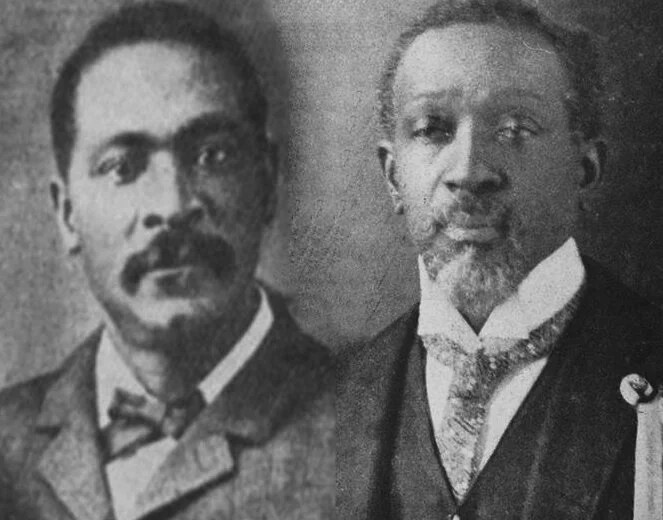
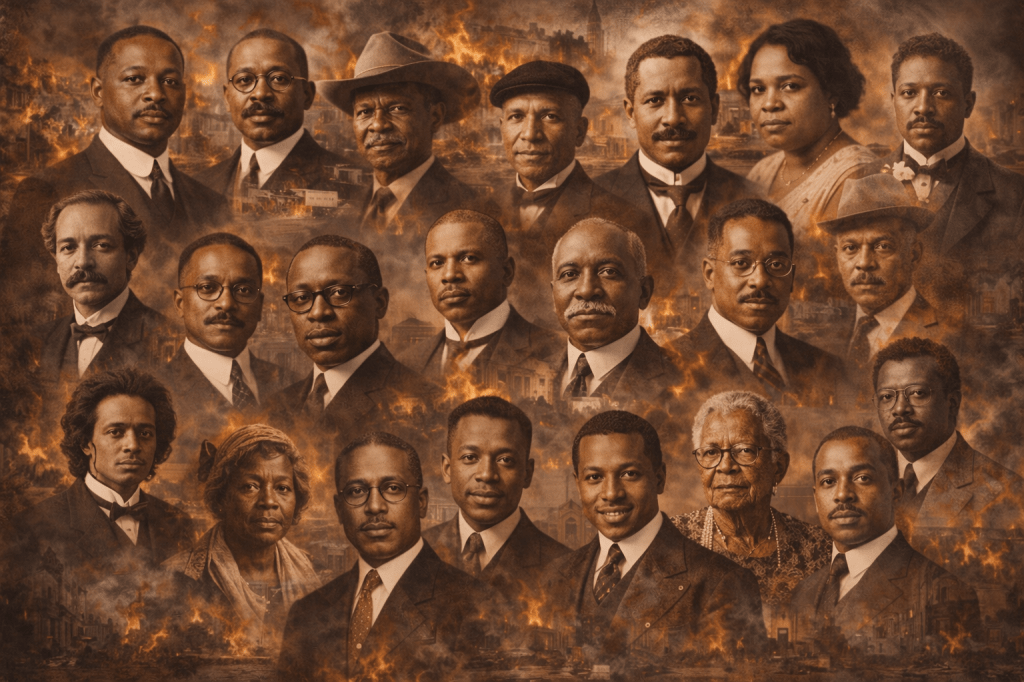
The Color Line Escape: The Black Students and Elites Who Passed Into White America.

The HBCU Students and Black Elites Who Passed as White.
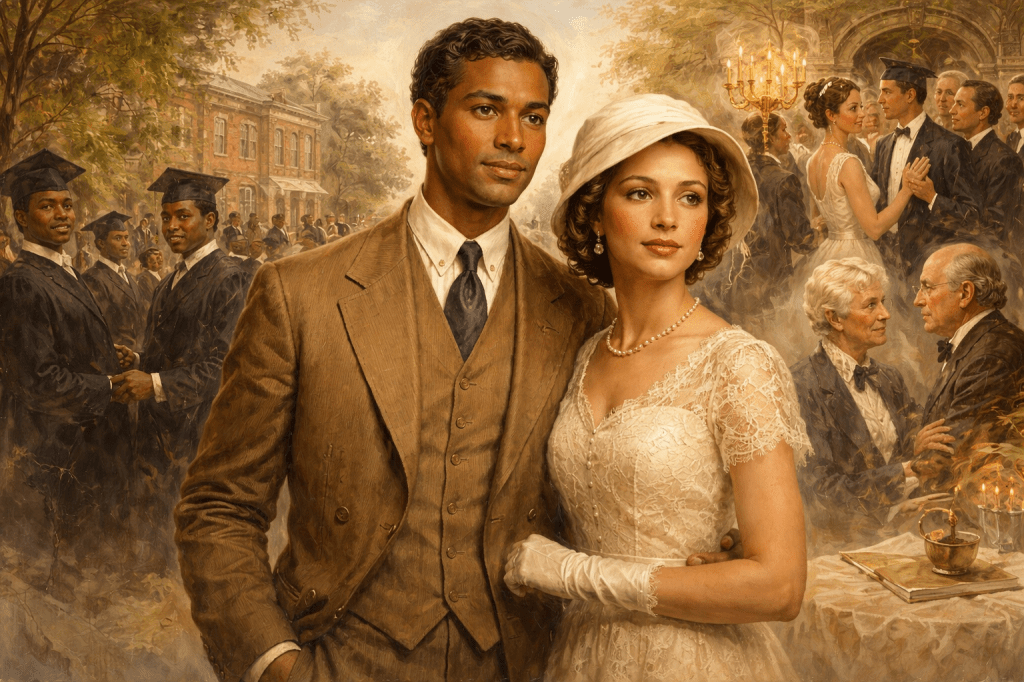
In the nineteenth and early twentieth centuries, the United States operated under a rigid racial system that determined nearly every aspect of a person’s life. Laws, customs, and social practices divided society into categories of “white” and “Black,” with whiteness granting access to education, wealth, safety, and political power. Within this oppressive system, some light-skinned African Americans made the difficult decision to “pass for white,” meaning they presented themselves as white to escape racial discrimination and gain opportunities otherwise denied to them.

Passing was not merely a social choice; it was a survival strategy shaped by systemic racism. During the era of slavery and the decades that followed Reconstruction, Black Americans faced constant threats to their livelihoods and safety. Segregation laws, violence, employment discrimination, and educational barriers created a society where whiteness often meant security and opportunity. For individuals whose physical appearance allowed them to cross the color line, passing became a pathway into a different social world.

Many of the individuals who passed came from educated Black families and elite communities. Some were graduates of historically Black colleges and universities, institutions that produced a generation of highly educated African Americans despite limited resources. Schools such as Howard University, Fisk University, and Atlanta University trained teachers, doctors, lawyers, and intellectuals who sought to uplift Black communities during the late nineteenth and early twentieth centuries.

Yet even with advanced education, racial barriers remained severe. Black professionals were often barred from practicing in white hospitals, law firms, and universities. Segregation limited their clientele and opportunities, making it difficult to fully utilize their education. In this environment, some light-skinned graduates chose to cross the racial boundary in order to practice their professions freely in white society.

One of the most famous examples of passing in American history is Anatole Broyard. Broyard was born into a Creole family of mixed ancestry in New Orleans but later lived as a white man in New York. As a literary critic for The New York Times, he built a successful career while concealing his Black heritage from most colleagues and friends.

Another example is Walter Francis White, whose appearance was so light that he could pass for white. Unlike many who crossed the color line permanently, White used his appearance strategically while working for the National Association for the Advancement of Colored People (NAACP). He traveled through the South investigating lynchings by posing as a white man to gather information.

The phenomenon of passing was deeply connected to America’s complex history of racial mixing. During slavery, many enslaved women were forced into relationships with white slave owners, resulting in generations of mixed-race descendants. By the late nineteenth century, some individuals of mixed ancestry had physical features that allowed them to be perceived as white.

For many who passed, the decision involved enormous personal sacrifice. Passing required cutting ties with family members, friends, and the Black community. Maintaining the illusion of whiteness meant living with constant fear that one’s racial background might be discovered. Exposure could result in job loss, social rejection, or even violence.

Some individuals passed temporarily to obtain employment or housing, while others permanently reinvented their identities. Those who crossed the color line often relocated to new cities where their past was unknown. Large urban centers such as New York City, Chicago, and Los Angeles provided anonymity that made it easier to construct new identities.

The pressures that encouraged passing intensified during the era of Jim Crow laws. Throughout the late nineteenth and early twentieth centuries, segregation laws enforced strict racial boundaries in schools, transportation, housing, and public life. These laws institutionalized racial inequality and reinforced the social advantages associated with whiteness.

Light-skinned members of the Black elite sometimes faced complicated choices within this racial hierarchy. On one hand, many felt a strong commitment to racial solidarity and community leadership. On the other hand, the opportunities available to whites could be dramatically different from those available to even the most educated Black citizens.

Passing was therefore not always motivated by rejection of Black identity. In many cases, it reflected the brutal realities of a society structured around racial discrimination. Economic advancement, personal safety, and professional success were powerful incentives for individuals seeking stability in an uncertain environment.

Literature and film have explored the psychological complexities of passing. Novels such as Passing depict the emotional tension experienced by individuals who cross the racial boundary. These stories reveal the internal conflict between personal ambition and loyalty to one’s heritage.

Historians estimate that thousands of African Americans passed for white during the late nineteenth and early twentieth centuries. However, the exact number is impossible to determine because many individuals successfully concealed their origins and left few records documenting their decisions.

Within Black communities, reactions to passing were mixed. Some viewed it as a betrayal or abandonment of the struggle for racial equality. Others understood it as a tragic consequence of systemic racism that forced people into impossible choices.

The existence of passing also exposed the arbitrary nature of racial categories. American society often defined race according to the “one-drop rule,” meaning that even a small amount of African ancestry classified a person as Black. Yet the fact that some individuals could move between racial identities demonstrated how socially constructed these categories truly were.

Passing gradually became less common after the civil rights movement of the 1950s and 1960s. As legal segregation was dismantled and new opportunities emerged for African Americans, the incentives to permanently abandon one’s racial identity diminished.

Nevertheless, the history of passing remains an important chapter in understanding race in the United States. It reveals the extreme pressures created by a society that rewarded whiteness while marginalizing Blackness.

For the students, professionals, and elites who crossed the color line, passing represented both opportunity and loss. While it sometimes brought economic stability and professional success, it often required the painful sacrifice of family ties, cultural heritage, and community belonging.

Ultimately, the phenomenon of passing highlights the human cost of racial inequality. It illustrates how deeply racism shaped personal identity, forcing individuals to navigate a world where the boundaries of race could determine the course of an entire life.


References

Ginsberg, E. K. (1996). Passing and the Fictions of Identity. Duke University Press.

Hobbs, A. (2014). A Chosen Exile: A History of Racial Passing in American Life. Harvard University Press.

Kennedy, R. (2001). Interracial Intimacies: Sex, Marriage, Identity, and Adoption. Pantheon Books.

Larsen, N. (1929). Passing. Alfred A. Knopf.

Smithsonian National Museum of African American History and Culture. History of racial passing in America.

Hine, D. C., Hine, W. C., & Harrold, S. (2014). The African American Odyssey. Pearson Education.

Library of Congress. Historical records on race and identity in the United States.
Black History: The Rivalry of Booker T. Washington and W.E.B. Du Bois.

Black Minds, Divergent Paths in the Battle for Black America’s Future.

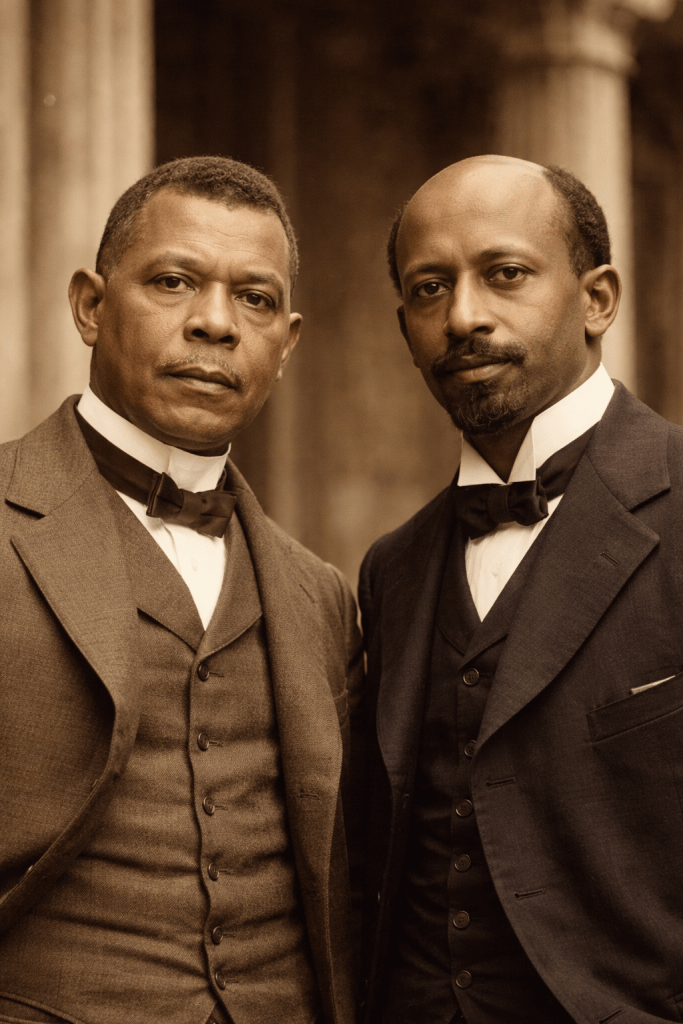
n the long and embattled arc of Black intellectual history, two towering figures emerged at the turn of the twentieth century whose visions would shape the destiny of African Americans for generations: Booker T. Washington and W. E. B. Du Bois. Though contemporaries, their philosophies diverged sharply, reflecting contrasting strategies for racial uplift during the nadir of American race relations. Together, they represent not merely disagreement but the dynamic intellectual tension that propelled Black progress forward.

Booker T. Washington was born into slavery in 1856 in Franklin County, Virginia. Emancipated as a child, he rose from bondage to become one of the most influential Black leaders of his era. His early life of poverty, labor, and illiteracy instilled in him a profound belief in discipline, industrial education, and economic self-sufficiency as the pathway to racial advancement. His autobiography, Up from Slavery, became a testament to perseverance and pragmatism.

Washington’s greatest institutional achievement was the founding of the Tuskegee Institute in Alabama in 1881. There, he emphasized vocational training—carpentry, agriculture, mechanics, domestic science—arguing that economic strength would earn Black Americans respect in a hostile white supremacist society. He believed that dignity could be constructed through labor and ownership, brick by brick.

His philosophy was crystallized in the 1895 Atlanta Exposition Address, often called the “Atlanta Compromise.” In that speech, Washington suggested that Black Americans should temporarily accept segregation and disenfranchisement while focusing on economic development. “Cast down your bucket where you are,” he urged, advocating cooperation with Southern whites in economic matters while avoiding direct agitation for civil rights.

In contrast stood W.E.B. Du Bois, born free in Great Barrington, Massachusetts, in 1868. Du Bois was the first African American to earn a Ph.D. from Harvard University. A scholar of extraordinary brilliance, he mastered history, sociology, economics, and classical studies. His intellect was widely regarded as unmatched among his contemporaries, earning him recognition as one of the greatest thinkers of the twentieth century.

Du Bois rejected Washington’s accommodationist stance. In his seminal work, The Souls of Black Folk, he critiqued what he perceived as Washington’s surrender of political rights. Du Bois introduced the concept of “double consciousness,” describing the psychological tension experienced by African Americans who must navigate a world that views them through the lens of prejudice.

Where Washington championed industrial education, Du Bois advocated for the “Talented Tenth”—the cultivation of a Black intellectual elite who would lead the race toward equality through higher education and political activism. He believed classical education, not merely vocational training, was essential for full citizenship and leadership.

Their disagreement was not simply personal but ideological. Washington emphasized economic gradualism; Du Bois demanded immediate civil rights. Washington sought alliances with white philanthropists and political leaders; Du Bois challenged the very structures of white supremacy. Washington operated behind the scenes, often wielding quiet influence; Du Bois engaged publicly and polemically.

In 1905, Du Bois helped found the Niagara Movement, a precursor to the NAACP, established in 1909. Through this organization, Du Bois became editor of The Crisis, a powerful publication that advocated for anti-lynching legislation, voting rights, and racial justice. His activism laid the groundwork for the modern Civil Rights Movement.

Washington’s influence, however, was equally formidable. He advised U.S. presidents and built networks of Black businesses, schools, and farmers throughout the South. Under his leadership, Tuskegee became a model of Black institutional autonomy. He believed that land ownership, craftsmanship, and financial literacy would fortify Black communities against economic exploitation.

Intellectually, both men were formidable, though in different ways. Washington possessed strategic intelligence and organizational genius. Du Bois embodied scholarly brilliance and philosophical depth. One was a master tactician of survival within oppression; the other a prophetic critic of injustice.

Their views on race also diverged. Washington, shaped by enslavement and Reconstruction’s violent collapse, viewed racial uplift as a long-term project requiring patience and economic stability. Du Bois, shaped by Northern education and exposure to global thought, viewed race as a social construct weaponized by power, demanding immediate dismantling.

Lineage and regional upbringing deeply influenced their perspectives. Washington’s Southern roots, born enslaved, forged a realism rooted in survival. Du Bois, of mixed African and European ancestry, raised in a relatively integrated Northern town, approached race with analytical detachment and global awareness. He later embraced Pan-Africanism, organizing international congresses that connected African diasporic struggles worldwide.

Both men were historically identified and socially classified as Black in the United States, but their ancestry backgrounds were different.

Booker T. Washington was born into slavery in Virginia in 1856. His mother, Jane, was an enslaved African woman. His father was a white man, widely believed to have been a neighboring plantation owner, though Washington never knew him. This means Washington was of mixed African and European ancestry biologically. However, under the racial caste system of the United States—particularly the “one-drop rule”—he was legally and socially defined as Black. Washington identified fully with the Black community and devoted his life to its advancement.

W. E. B. Du Bois was also of mixed ancestry. Born free in Massachusetts in 1868, Du Bois had African, French Huguenot, Dutch, and possibly Native American lineage. He openly acknowledged his multiracial heritage in his autobiographical writings. Despite his partial European ancestry and relatively lighter complexion, Du Bois was socially classified as Black and experienced racial discrimination. He strongly identified as a member of the African American community and became one of its foremost intellectual defenders.

It is important to understand that in 19th- and early 20th-century America, racial identity was not determined by ancestry percentages but by social classification and power structures. The legal doctrine of hypodescent—commonly known as the one-drop rule—assigned anyone with known African ancestry to the Black racial category regardless of admixture.

Genetically speaking, most African Americans descend from a mixture of West and Central African populations with varying degrees of European ancestry due to the history of slavery. Historically speaking, both Washington and Du Bois were Black men operating within and against a racially stratified society that did not recognize “mixed” as a protected or separate political identity.

Du Bois in particular wrestled intellectually with questions of race, ancestry, and identity. In The Souls of Black Folk, he emphasized the social construction of race and the psychological burden imposed upon Black Americans by white supremacy. His mixed heritage did not dilute his commitment to Pan-African solidarity; rather, it sharpened his critique of racial hierarchy.

In summary: biologically, both men had mixed ancestry. Socially, legally, culturally, and politically, they were Black men in America—and they embraced that identity in their scholarship and activism.

Despite their clashes, both men sought the elevation of Black people. Washington feared that agitation would provoke violent backlash. Du Bois feared that silence would entrench permanent subordination. Each perceived the dangers of his time differently, and each responded according to his convictions.

The early twentieth century proved that both strategies held merit. Economic institutions built under Washington provided material foundations for Black communities. Legal activism spearheaded by Du Bois and the NAACP led to landmark challenges to segregation, culminating in victories such as Brown v. Board of Education.

Washington died in 1915, while Du Bois lived until 1963, dying in Ghana on the eve of the March on Washington. Their lifespans bracketed the transformation from Reconstruction’s failure to the threshold of the Civil Rights Movement’s triumphs. History would vindicate aspects of both visions.

Du Bois eventually shifted toward socialism and Pan-African nationalism, critiquing capitalism as a global racial hierarchy. Washington remained committed to American industrial capitalism as a vehicle for Black prosperity. Their economic philosophies reveal deeper tensions about integration, autonomy, and systemic change.

The intellectual rivalry between Washington and Du Bois was not a weakness within Black leadership but a sign of intellectual vitality. Black America was not monolithic; it wrestled with strategy, ethics, and survival in real time. Their debates forced the nation to confront uncomfortable truths about democracy and citizenship.

Today, their legacies continue to shape discussions about education, economic empowerment, protest, and respectability politics. Contemporary debates over vocational training versus liberal arts education echo their arguments. The balance between institutional building and public protest remains central to social justice movements.

To ask who was “smarter” misses the deeper truth. Washington possessed practical genius; Du Bois embodied scholarly brilliance. Intelligence manifested differently in each man, yet both altered the trajectory of history. One built institutions; the other built consciousness.

In the final analysis, Booker T. Washington and W.E.B. Du Bois were not opposites so much as complementary forces within a larger struggle for Black liberation. One carved pathways within the system; the other challenged the system itself. Together, they expanded the intellectual and moral horizons of America, proving that Black thought in the early twentieth century was not only resilient but revolutionary.

References

Du Bois, W. E. B. (1903). The souls of Black folk. A. C. McClurg & Co.

Du Bois, W. E. B. (1968). The autobiography of W. E. B. Du Bois: A soliloquy on viewing my life from the last decade of its first century. International Publishers. (Original work published 1968)

Foner, E. (1988). Reconstruction: America’s unfinished revolution, 1863–1877. Harper & Row.

Harlan, L. R. (1972). Booker T. Washington: The making of a Black leader, 1856–1901. Oxford University Press.

Harlan, L. R. (1983). Booker T. Washington: The wizard of Tuskegee, 1901–1915. Oxford University Press.

Lewis, D. L. (1993). W. E. B. Du Bois: Biography of a race, 1868–1919. Henry Holt.

Lewis, D. L. (2000). W. E. B. Du Bois: The fight for equality and the American century, 1919–1963. Henry Holt.

Logan, R. W. (1954). The betrayal of the Negro: From Rutherford B. Hayes to Woodrow Wilson. Collier Books.

Meier, A. (1963). Negro thought in America, 1880–1915: Racial ideologies in the age of Booker T. Washington. University of Michigan Press.

Washington, B. T. (1901). Up from slavery. Doubleday, Page & Company.

Washington, B. T. (1895). The Atlanta Exposition Address. In L. R. Harlan (Ed.), The Booker T. Washington papers (Vol. 3). University of Illinois Press.

Woodward, C. V. (1955). The strange career of Jim Crow. Oxford University Press.

Black History: Mound Bayou – A Sovereign Dream in the Delta’s Shadow.

In the aftermath of Reconstruction, when the promise of Black citizenship was steadily being dismantled across the American South, a remarkable experiment in self-determination emerged in the Mississippi Delta. Mound Bayou was founded in 1887 as an all-Black town built on the principles of economic independence, political autonomy, and racial dignity. Conceived during the height of Jim Crow repression, it stood as a bold counter-narrative to white supremacy—an intentional “fortress” of Black sovereignty in hostile territory.

The founders of Mound Bayou were Isaiah T. Montgomery and his cousin Benjamin T. Green, both formerly enslaved men and sons of Benjamin Montgomery, who had been enslaved by Joseph E. Davis, brother of Jefferson Davis. Benjamin Montgomery had managed the Davis plantation and developed substantial administrative and agricultural expertise, which he passed on to his sons. After emancipation, Isaiah and Benjamin Green carried forward a vision of Black landownership and community governance rooted in self-reliance.

The Mississippi Delta in the late nineteenth century was fertile ground agriculturally but socially perilous for Black people. Sharecropping and debt peonage trapped many formerly enslaved families in cycles of economic dependency. Lynching and racial violence were pervasive. In this climate, Montgomery and Green sought to carve out a space where Black citizens could exercise full civic participation without white interference. They purchased land from the Louisville, New Orleans, and Texas Railway and began plotting a town.

Mound Bayou was deliberately located along the railroad line, which provided economic access while preserving geographic separation. The founders named the town after the nearby bayou and ancient Native American mounds in the region. From its inception, the town was self-governed by Black officials—mayors, police officers, merchants, and educators—forming one of the earliest fully autonomous Black municipalities in the United States.

Economic development was central to its survival. The town established cotton gins, general stores, and farms. Over time, it developed banks, insurance companies, and schools. Black professionals—doctors, lawyers, and teachers—found refuge and opportunity there. By the early twentieth century, Mound Bayou had become a symbol of Black enterprise, often cited alongside other independent Black communities such as Tulsa’s Greenwood District.

One of the most discussed early incidents illustrating the town’s social boundaries involved a white train conductor or traveler who reportedly stepped off a train in Mound Bayou, unaware that it was an all-Black town. According to local oral histories, he expected the usual racial deference accorded to whites in the South. Instead, he encountered a community that did not operate under Jim Crow norms of subservience. The shock was mutual: white intrusion was rare, and the town’s residents made clear that governance and authority there rested in Black hands. While versions of the story vary, the incident became emblematic of Mound Bayou’s guarded autonomy—a literal and symbolic “fortress” in the Delta.

Despite its ideals, the town’s leadership faced difficult political choices. In 1890, Isaiah T. Montgomery served as a delegate to the Mississippi Constitutional Convention. In a controversial move, he supported provisions that effectively disenfranchised many Black voters through poll taxes and literacy tests. Montgomery argued that political compromise was necessary to protect Mound Bayou from violent reprisal and to ensure its survival within a white-dominated state. His decision has remained a subject of scholarly debate, reflecting tensions between pragmatism and principle.

During the early 1900s, national Black leaders took notice. Booker T. Washington visited Mound Bayou and praised it as a model of Black self-help and industrial progress. Washington’s philosophy of economic advancement before political agitation aligned with Montgomery’s approach. The town was frequently cited in speeches and publications as proof that Black communities could thrive independently.

By 1907, Mound Bayou had a hospital, the Taborian Hospital, founded by the Knights and Daughters of Tabor, a Black fraternal organization. The hospital became one of the most important medical facilities for African Americans in Mississippi, providing care at a time when segregation barred them from white institutions. Health care, education, and business infrastructure reinforced the town’s status as a refuge.

The Great Migration altered the town’s trajectory. As millions of African Americans left the South for northern and western cities, Mound Bayou experienced population fluctuations. Mechanization in agriculture reduced labor needs, and economic challenges mounted. Yet the town endured, maintaining its identity as a symbol of Black resilience.

During the Civil Rights Movement, Mound Bayou again became significant. Activists and organizations such as the Student Nonviolent Coordinating Committee found support networks there. The town’s history of self-governance made it receptive to voter registration drives and community organizing efforts aimed at dismantling Jim Crow laws.

Federal anti-poverty programs in the 1960s, including initiatives under President Lyndon B. Johnson’s War on Poverty, brought new investments into the Mississippi Delta. Mound Bayou became a site for community health centers and economic development programs, linking its nineteenth-century origins to twentieth-century struggles for structural reform.

Throughout its existence, the town has embodied a paradox: it was both separatist in structure and integrative in aspiration. Its founders did not seek isolation for its own sake but protection from violence and degradation. In doing so, they created a civic experiment in Black nationalism long before that term gained popular currency.

The legacy of Isaiah T. Montgomery remains complex. To some, he was a visionary architect of Black autonomy; to others, his compromise at the 1890 convention symbolized accommodation to white supremacy. Yet without his political navigation, Mound Bayou may not have survived its vulnerable infancy.

Mound Bayou’s story also intersects with broader patterns of Black town formation across the South and West, including communities founded in response to racial terror and land exclusion. These towns were acts of resistance—physical manifestations of a people determined to claim space, cultivate land, and govern themselves.

Culturally, Mound Bayou fostered a sense of dignity that countered prevailing narratives of Black inferiority. Children grew up seeing Black authority normalized—Black teachers instructing, Black officers enforcing law, Black entrepreneurs building wealth. This psychological impact cannot be overstated in a region structured by racial hierarchy.

Though its population has declined from its early peak, the town remains incorporated and inhabited. Its very endurance is testimony to the durability of its founding vision. Streets laid in 1887 still carry the memory of aspiration etched into Delta soil.

Today, historians revisit Mound Bayou as part of a larger reconsideration of Reconstruction and its aftermath. Rather than viewing the post-Reconstruction era solely through the lens of Black disenfranchisement, scholars now emphasize Black institution-building and strategic survival. Mound Bayou stands at the center of that reinterpretation.

It was not merely a town but an argument—an embodied thesis that formerly enslaved people could master land, capital, and governance despite systemic obstruction. In the middle of the Delta, surrounded by plantations that once symbolized bondage, rose a community determined to rewrite destiny.

Mound Bayou endures as a sovereign dream carved from cotton fields and conviction. It reminds the nation that even under siege, Black Americans built fortresses of hope—self-fashioned citadels of dignity in the shadow of oppression.


References

Anderson, J. D. (1988). The education of Blacks in the South, 1860–1935. University of North Carolina Press.

Franklin, J. H., & Moss, A. A. (2000). From slavery to freedom: A history of African Americans (8th ed.). McGraw-Hill.

Green, A. (1999). Mound Bayou: An all-Black town in the Mississippi Delta. Mississippi Historical Society.

Montgomery, I. T. (1890). Speech at the Mississippi Constitutional Convention.

Washington, B. T. (1901). Up from slavery. Doubleday.

Woodruff, N. (2003). American Congo: The African American freedom struggle in the Delta. Harvard University Press.

Dilemma: Racist Jokes and Not Challenging Them

Racist jokes have long been disguised as “harmless humor,” but they are one of the most insidious tools used to maintain racial hierarchies and normalize prejudice. These jokes may seem trivial to those who tell them, yet they carry deep historical and psychological implications that wound the dignity of Black people and other marginalized groups. The failure to challenge such jokes allows racism to flourish in silence, turning laughter into complicity. Racist humor is not merely a matter of taste—it is a form of cultural violence that reinforces systemic oppression (Sue et al., 2019).

At the core of racist jokes lies the dehumanization of others. By reducing a person or group to a stereotype, humor becomes a weapon rather than a bridge. It permits white individuals to reaffirm superiority under the guise of comedy. When these jokes target Black people, they often draw on centuries-old caricatures born from slavery and Jim Crow imagery—depicting Black individuals as lazy, violent, hypersexual, or unintelligent (Pilgrim, 2012). Such portrayals have shaped how society perceives and mistreats Black lives.

Silence in the face of racist jokes is a form of passive racism. When bystanders laugh or remain quiet, they send a message that prejudice is acceptable or trivial. This silence validates the racist sentiment, giving it space to thrive in social and professional environments. The failure to challenge these remarks reflects what Martin Luther King Jr. described as the “appalling silence of the good people”—the moral inaction that sustains injustice (King, 1963).

Examples of racist jokes are numerous and often recycled across generations. Some of the most common include:

  1. “What do you call a Black pilot? A good example—because you didn’t expect that!”
  2. “Why don’t Black people like country music? Because every time they say ‘yee-haw,’ someone thinks they’re stealing horses.”
  3. “How do you starve a Black man? Hide his food stamps under his work boots.”
  4. “What’s faster than a Black man running with your TV? His mom cashing the check.”
  5. “Why are Black people afraid of chainsaws? Because they start with the sound ‘Run!’”
  6. “What’s the difference between Batman and a Black man? Batman can go to the store without Robin.”
  7. “Why did the Black guy buy a ladder? To get his credit score up.”
  8. “What do you call a Black man in college? A visitor.”
  9. “Why don’t Black people like swimming? They don’t want to wash off their color.”
  10. “What’s the national bird of Black America? The jailbird.”

These examples are painful to read but necessary to expose. Each joke perpetuates a stereotype rooted in anti-Blackness—whether about crime, poverty, education, or worth. They are not mere words; they echo the same ideologies that justified enslavement, segregation, and mass incarceration. Their humor is drawn from the suffering and systemic oppression of Black people.

When racist jokes go unchallenged, they teach observers—especially youth—that racial bias is acceptable. They create cultural permission for future discrimination. What begins as laughter at a “joke” can evolve into bias in hiring decisions, police interactions, or healthcare treatment. Racist humor trains society to see Black pain as entertainment and to dismiss calls for justice as overreactions (Ford & Ferguson, 2004).

Psychologically, racist jokes inflict harm on Black listeners. They reinforce feelings of alienation, shame, and anger. The experience of being mocked or reduced to a stereotype in public settings activates stress responses similar to trauma. Over time, these repeated microaggressions can lead to racial battle fatigue—a state of chronic emotional exhaustion experienced by many Black people navigating white-dominated environments (Smith, 2004).

Sociologically, racist jokes function as bonding rituals among white people. Laughter becomes a shared signal of racial belonging, reinforcing in-group solidarity at the expense of Black humanity. Those who laugh, even uncomfortably, affirm their membership in whiteness. This is why silence is never neutral—it sides with power, not justice. Every unchallenged joke strengthens the invisible architecture of racism in daily life (Billig, 2001).

To overcome this, people must learn to recognize and interrupt racism in real time. The first step is developing moral courage—the ability to speak up even when it feels socially uncomfortable. This can involve simple but firm responses such as: “That’s not funny,” “Why would you say that?”, or “I don’t tolerate racist jokes.” Silence is easy; resistance requires integrity. When someone disrupts the moment, they break the illusion that everyone agrees with the prejudice.

Education also plays a vital role. People must be taught to understand the historical roots of racist humor and how it connects to larger systems of oppression. Anti-racist training, media literacy, and open discussions about bias can dismantle the ignorance that fuels these “jokes.” Understanding that humor has been a tool of white supremacy helps individuals grasp why such comments are never innocent (Hughey & Byrd, 2013).

Accountability must replace passivity. In workplaces, schools, and families, institutions should create clear policies that address discriminatory remarks and jokes. Anti-racism should not be optional—it should be embedded in codes of conduct and enforced through restorative or disciplinary measures. This sends a message that humor is not exempt from ethics.

Healing from the effects of racist humor also requires community solidarity. Black people need spaces where their pain is validated and their identity celebrated. Laughter within Black spaces, however, serves a different function—it becomes an act of resistance and reclamation. When Black comedians address racism, they invert its power by transforming pain into truth-telling and empowerment. The difference lies in who holds the power to define the narrative.

Spiritual and emotional healing are also vital. Scriptures remind believers that “death and life are in the power of the tongue” (Proverbs 18:21, KJV). Racist jokes speak death—death to empathy, to equality, and to the image of God within Black lives. To overcome them, society must relearn the sacred weight of words and choose speech that uplifts rather than degrades.

For white allies, it is essential to examine why silence feels safer than confrontation. Fear of social rejection often outweighs moral responsibility. But true allyship demands discomfort. It means risking relationships to uphold justice and using privilege as a shield for the oppressed rather than a cloak for cowardice.

For Black people, resilience involves not internalizing the lies behind racist humor. These jokes are reflections of ignorance, not truth. Overcoming them means affirming self-worth, reclaiming identity, and surrounding oneself with affirming voices that speak life into Black existence. Education, faith, and cultural pride all serve as antidotes to the poison of ridicule.

On a societal level, challenging racist jokes is a step toward dismantling the normalization of anti-Blackness. When everyday racism becomes unacceptable in private conversations, society takes a measurable step toward equity. The goal is not to police humor but to purify it—to restore its power to unite rather than divide.

In the end, racist jokes are not about laughter but about control. They remind Black people of their supposed “place” in a racial hierarchy that should have been dismantled long ago. To laugh along is to agree; to stay silent is to consent. The only moral option is to challenge it. Every voice raised in truth breaks a link in the chain of systemic racism.

References
Billig, M. (2001). Humor and hatred: The racist jokes of the Ku Klux Klan. Discourse & Society, 12(3), 267–289.
Ford, T. E., & Ferguson, M. A. (2004). Social consequences of disparagement humor: A prejudiced norm theory. Personality and Social Psychology Review, 8(1), 79–94.
Hughey, M. W., & Byrd, W. C. (2013). The souls of white jokes: Whiteness and humor in social media. Ethnic and Racial Studies, 36(10), 1582–1598.
King, M. L. Jr. (1963). Letter from Birmingham Jail.
Pilgrim, D. (2012). The museum of racist memorabilia: The Jim Crow Museum of Racist Imagery. Ferris State University Press.
Smith, W. A. (2004). Black faculty coping with racial battle fatigue: The campus racial climate in a post–civil rights era. New Directions for Teaching and Learning, 2004(98), 27–37.
Sue, D. W., Alsaidi, S., Awad, M. N., Glaeser, E., Calle, C. Z., & Mendez, N. (2019). Disarming racial microaggressions: Microintervention strategies for targets, White allies, and bystanders. American Psychologist, 74(1), 128–142.

Black Stereotype Series: Mammy – The Origins and Legacy of a Controlling Image.

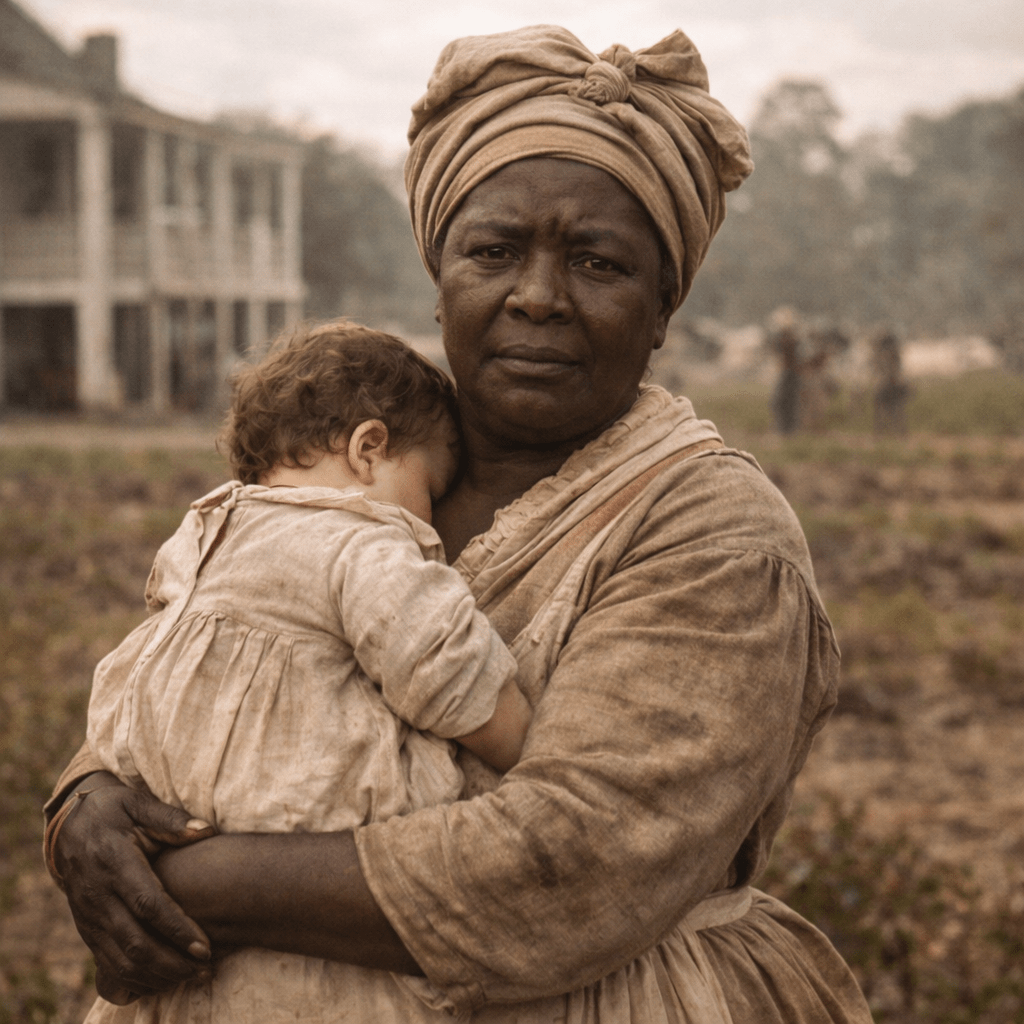
The “Mammy” stereotype is one of the most enduring and harmful caricatures in American culture, representing Black women as loyal, nurturing, and subservient caretakers of white families. This stereotype has its roots in the era of slavery, evolving into a pervasive image in popular media, advertising, and literature that distorted the realities of Black womanhood.

Historically, a mammy was a Black woman employed by a white household, often enslaved, responsible for raising white children, cooking, cleaning, and managing domestic labor. The role required complete obedience, selflessness, and emotional labor while denying the woman autonomy over her own life.

During slavery, the mammy’s existence was shaped by oppression and survival. While she was sometimes positioned as a maternal figure for white children, she was denied motherhood of her own children, who might be sold, abused, or neglected. This forced nurturing role was a form of psychological control that reinforced white supremacy.

Physical characteristics were often exaggerated in the Mammy stereotype. Popular culture depicted mammies as overweight, dark-skinned, elderly women with wide noses, large eyes, and hair tied in a scarf or kerchief. These features were contrasted against ideals of European beauty to emphasize their “otherness” and justify subservience.

The image of the mammy was not simply descriptive—it was prescriptive. It suggested that Black women were naturally suited for servitude, domestic labor, and caretaking, thereby legitimizing both slavery and racial hierarchies. The mammy became a comforting figure for white society, masking the brutality of slavery behind the illusion of loyalty and affection.

In the post-slavery era, the mammy stereotype persisted in media and advertising. The most famous example is Aunt Jemima, a brand that used a smiling, maternal Black woman as its mascot for pancake syrup and other products. The character reinforced notions that Black women existed to serve white households, normalizing racial subordination for generations.

The creation of the mammy stereotype had multiple causes. It served to ease white guilt over the horrors of slavery, rationalize the economic dependence on enslaved labor, and infantilize Black women as harmless, loyal, and nonthreatening. It also reinforced gendered expectations of women as domestic nurturers, but only within a racialized hierarchy.

Slavery itself created conditions for the mammy figure. Enslaved Black women were separated from their families, forced to work in domestic settings, and denied personal agency. These social realities became simplified and romanticized in cultural narratives, which erased the violence and coercion underlying their labor.

The mammy stereotype also had a visual codification in film and literature. Characters such as Hattie McDaniel in Gone with the Wind epitomized the trope, showing Black women as loyal, jolly, and devoted entirely to white families while remaining sexually desexualized. This image became a template for portrayals of Black women for decades.

Treatment of real-life mammies varied, but it was often harsh and exploitative. While some might have had close bonds with children they cared for, their labor was uncompensated or minimally compensated, and they were frequently subjected to physical punishment, verbal abuse, and systemic neglect.

The stereotype persists in subtle ways in modern culture. Contemporary media still sometimes portrays Black women in caregiving or service-oriented roles, emphasizing nurturing or subservient qualities while neglecting complexity, independence, and agency. These echoes of the mammy reinforce racialized expectations.

A defining aspect of the mammy figure is the emotional labor expected of her. She was imagined as endlessly patient, self-sacrificing, and cheerful regardless of mistreatment or abuse. In reality, enslaved and working Black women often carried immense emotional and physical burdens with no recognition or reward.

The mammy’s image was also carefully codified through dress and posture. Headscarves, aprons, and loose-fitting clothing became shorthand for subservience, domesticity, and age, creating a visual language that signaled loyalty to white households while denying Black women individuality or beauty.

Racist ideologies reinforced the stereotype. By presenting Black women as content in servitude, white society justified ongoing racial hierarchies and minimized the brutality of slavery. The mammy figure served as propaganda, comforting white audiences while erasing Black women’s struggles and resistance.

Advertising and branding further entrenched the mammy stereotype. From Aunt Jemima to various domestic product mascots, corporations leveraged the image of a smiling, motherly Black woman to sell products, perpetuating a reductive and exploitative representation for profit.

The mammy stereotype also intersects with gender oppression. By portraying Black women as caretakers first and individuals second, society denied them sexual, economic, and social autonomy. Their identity was flattened into a role that served white households, leaving little space for recognition of personal aspirations or desires.

Efforts to challenge and dismantle the mammy stereotype have increased in contemporary scholarship and activism. Scholars and cultural critics highlight the harm of these images and advocate for nuanced representations that honor the complexity, strength, and humanity of Black women.

In literature, cinema, and history, Black women’s voices reveal a different narrative than the mammy trope suggests. Enslaved and free women resisted domination in countless ways, asserting their dignity, creating cultural expressions, and protecting families despite systemic oppression.

The mammy stereotype exemplifies how race, gender, and labor intersected under slavery and beyond. It illustrates how visual and cultural symbols can enforce social hierarchies while shaping perceptions of entire communities. Understanding this history is critical to dismantling persistent racial stereotypes.

Ultimately, the mammy figure is not a reflection of reality but a tool of control and propaganda. Recognizing its origins, effects, and ongoing influence helps to contextualize contemporary struggles for representation, equity, and the reclamation of Black women’s narratives and beauty.


References

Giddings, P. (1984). When and Where I Enter: The Impact of Black Women on Race and Sex in America. HarperCollins.

Pilgrim, D. (2012). The Mammy Caricature. Jim Crow Museum of Racist Memorabilia, Ferris State University. Retrieved from https://www.ferris.edu/HTMLS/news/jimcrow/mammies/

Wallace-Sanders, K. (2008). Mammy: A Century of Race, Gender, and Southern Memory. University of Michigan Press.

Hine, D. C., Hine, W. C., & Harrold, S. (2009). The African American Odyssey. Pearson Higher Ed.

Pilgrim, D. (2000). Aunt Jemima and the Mammy Figure. Retrieved from https://www.ferris.edu/HTMLS/news/jimcrow/mammies/

West, C. M. (1995). Mammy, Jezebel, Sapphire, and Their Homegirls: Developing an “Oppositional Gaze” Toward the Images of Black Women. In Black Women in America (pp. 28–42). Indiana University Press.

Hall, K. (1992). Hair as Power: Cultural Identity and Resistance in African American History. Journal of American History, 79(3), 921–939.

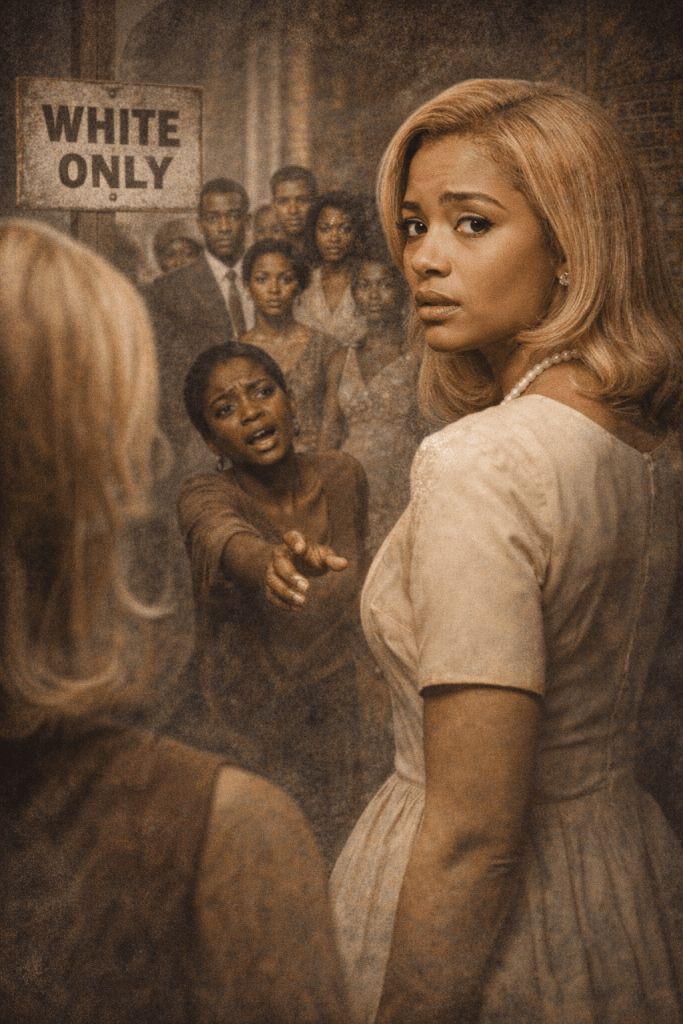
PASSING as White

Passing as White is one of the most psychologically complex survival strategies produced by racism in America. It refers to the act of a Black person presenting themselves as white to escape racial oppression, gain social mobility, or avoid discrimination. While often discussed as a historical phenomenon, passing is fundamentally a psychological condition rooted in fear, internalized racism, and the desire for safety in a white supremacist society.

Psychologically, passing is not merely about skin tone or physical appearance; it is about identity suppression. It requires the individual to constantly perform whiteness—altering speech, behavior, social circles, family history, and even emotional expression. The person must erase their Blackness not only from public view, but from their own self-concept to survive the performance.

Looking white becomes a form of social camouflage. Lighter skin, straighter hair, ambiguous features, and European phenotypes allow some Black people to “blend in” within white spaces. However, this blending comes at a profound cost: the continuous denial of one’s ancestry, culture, and lived reality.

Passing emerges from racial terror. In societies where Blackness is punished economically, socially, and physically, passing becomes a method of protection. It is an adaptation to violence. Instead of confronting racism directly, the individual attempts to escape it by exiting Blackness altogether.

This phenomenon was powerfully dramatized in the film Imitation of Life, which tells the story of a light-skinned Black woman who rejects her Black mother to live as white. The film exposes the emotional devastation of passing: the shame, the secrecy, the grief, and the permanent sense of unbelonging.

What happens psychologically when white people discover that someone who has been passing is actually Black is often catastrophic. The individual is typically met with betrayal, hostility, disgust, or expulsion. White acceptance is conditional, and once racial truth is revealed, the person is stripped of the social privileges they had gained.

This moment of “discovery” often triggers identity collapse. The passer is rejected by the white world they tried to assimilate into, while also feeling disconnected from the Black world they abandoned. They become socially homeless—belonging fully to neither group.

Self-hatred is at the core of passing. It is not simply strategic; it is an internalized ideology. The person has absorbed the belief that Blackness is inferior, dangerous, or shameful, and that proximity to whiteness equals safety, value, and humanity.

Passing also produces chronic psychological stress. The individual lives in constant fear of exposure. Every conversation, family detail, photograph, or social interaction becomes a potential threat. This creates a life of hypervigilance, anxiety, and emotional isolation.

One of the most famous real-life examples of passing is Anatole Broyard, a highly respected literary critic and writer who lived as a white man for most of his life. Broyard concealed his Black identity even from his own children and wife, believing that revealing his ancestry would destroy his career and social standing.

After his death, his children discovered the truth, leading to deep emotional consequences. Broyard’s life became a symbol of the tragic cost of passing—success built on erasure, achievement built on denial, and legacy built on silence.

Passing not only distorts how others see one; it also distorts how one experiences love, intimacy, and belonging. Romantic relationships become performances. Friendships become guarded. Family becomes a threat to exposure. The passer must constantly choose between truth and survival.

This creates what psychologists call identity fragmentation. The person splits themselves into parts: the public self and the hidden self. Over time, the hidden self becomes increasingly suppressed, producing depression, dissociation, and internal conflict.

Passing also reinforces white supremacy at a structural level. It validates the idea that whiteness is the ultimate form of social legitimacy, while Blackness is something to escape. Each individual act of passing becomes a silent confirmation of racial hierarchy.

Historically, passing was most common during Jim Crow, when Black people faced segregation, lynching, housing discrimination, and legal exclusion. For some, passing was the only way to access education, employment, or physical safety. It was not always about shame; sometimes it was about survival.

However, survival strategies can become psychological prisons. What begins as protection can evolve into permanent self-rejection. Over time, the person may forget how to exist authentically, even in private.

The modern version of passing still exists, but in more subtle forms. It appears in aesthetic assimilation, name changes, cultural distancing, anti-Black rhetoric, and identity ambiguity. Some people no longer pass racially, but culturally and ideologically.

At its deepest level, passing is a spiritual crisis. It represents a rupture between the self and its origins. The person disconnects from ancestral memory, collective identity, and historical truth in exchange for conditional acceptance.

Many who once passed later experience a psychological awakening. As they age, they begin to feel the emptiness of erasure. They realize that no amount of assimilation can replace the loss of authentic identity. What was gained socially is lost existentially.

Reclaiming Black identity after passing often involves grief. Grief for the years spent hiding, for the relationships built on falsehood, and for the self that was denied. It is not simply a return—it is a reconstruction.

The desire to now “be who you are” represents a form of psychological decolonization. It is the rejection of internalized racism and the re-embrace of ancestral truth. It is a recognition that safety without authenticity is not freedom.

True healing from passing requires confronting the ideology that made it necessary. It requires dismantling the belief that whiteness equals humanity and Blackness equals limitation. Until that belief is destroyed, passing will continue to exist.

Passing as White is not just a historical curiosity. It is a mirror held up to a society that made Black identity something people felt they had to escape in order to live.

The tragedy is not that some people passed.
The tragedy is that a world existed where passing felt necessary.


References

Fanon, F. (1967). Black skin, white masks. Grove Press.

Gates, H. L. Jr. (1996). Thirteen ways of looking at a Black man. Random House.

Hobbs, A. (2014). A chosen exile: A history of racial passing in American life. Harvard University Press.

Larsen, N. (1929). Passing. Alfred A. Knopf.

Rockquemore, K. A., & Brunsma, D. L. (2002). Beyond Black: Biracial identity in America. Rowman & Littlefield.

Smith, S. M. (2006). The performance of race: Passing and the aesthetics of identity. Cultural Critique, 63, 1–27.

Sollors, W. (1997). Neither Black nor white yet both: Thematic explorations of interracial literature. Oxford University Press.

Broyard, B. (2007). One drop: My father’s hidden life—A story of race and family secrets. Little, Brown and Company.

Wilkerson, I. (2020). Caste: The origins of our discontents. Random House.

Du Bois, W. E. B. (1903). The souls of Black folk. A.C. McClurg & Co.

Black History: Black Millionaires They Tried to Erase from History.

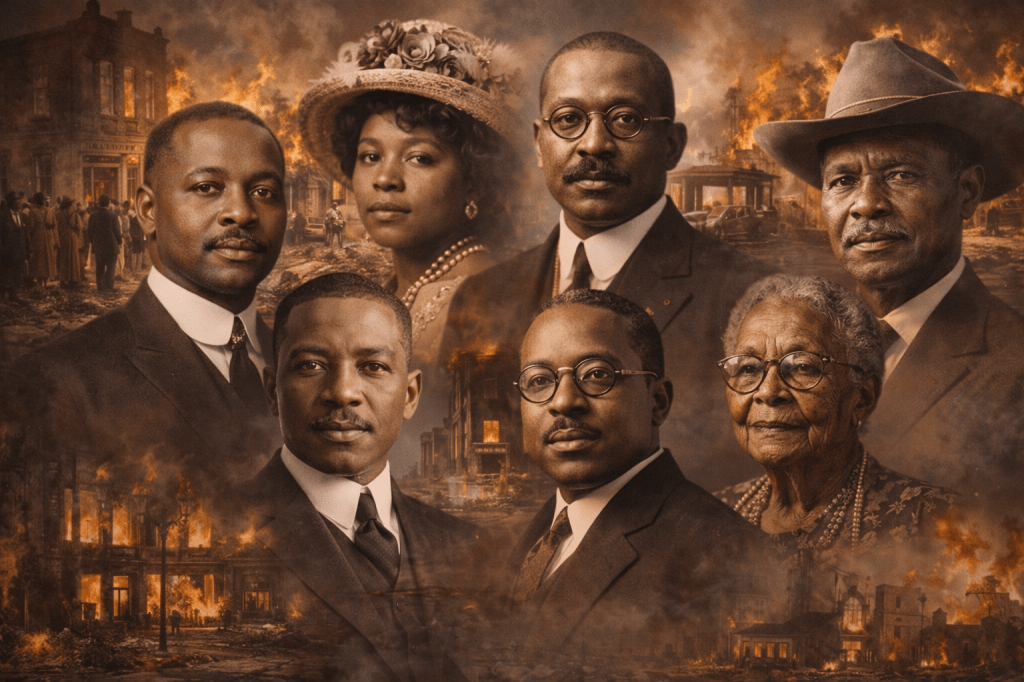
In early 20th‑century America, Black entrepreneurs in segregated communities defied racism by generating unprecedented wealth. These men and women built thriving businesses, owned property, and created entire economic ecosystems — only to have their legacies diminished, erased, or violently destroyed by systemic racism and white supremacist violence.

In Tulsa, Oklahoma, the Greenwood district — known as “Black Wall Street” — was one of the most remarkable examples of Black prosperity in American history. Founded by visionary Black businessmen and professionals, Greenwood became a symbol of independence, economic self‑sufficiency, and community resilience.

Among Greenwood’s earliest millionaires was O.W. Gurley, a real‑estate developer and entrepreneur. Born to formerly enslaved parents in Alabama, Gurley moved to Tulsa and purchased land designated for Black ownership. He built hotels, apartment buildings, a grocery store, and sponsored other local businesses, accumulating an estimated net worth that translated into the millions in today’s dollars.

Gurley’s success helped inspire others to invest in Greenwood. J.B. Stradford, another eminent figure, was the son of an emancipated slave who became a lawyer, real‑estate magnate, and hotelier. His crowning achievement was the Stradford Hotel, the largest Black‑owned hotel in the United States at the time. It offered luxury services equal to those in white Tulsa and hosted a thriving social life, attracting wealthy travelers and local elites.

John and Loula Williams were another Black power couple in Greenwood. They owned multiple businesses — including the Dreamland Theatre, a confectionary, and a rooming house — and became among the wealthiest Black residents. Loula was a partner in these ventures, showing how women also played central roles in building Black wealth.

Greenwood was far more than a collection of storefronts: it had its own bank, schools, hospital, newspaper, and even private transportation networks, all built and operated by Black entrepreneurs. The Tulsa Star, founded by A.J. Smitherman, became a prominent voice advocating civil rights, economic empowerment, and community solidarity.

Despite this economic miracle, Greenwood was targeted by white supremacists fearful of Black success. From May 31 to June 1, 1921, a white mob attacked the district in what is now known as the Tulsa Race Massacre, burning businesses, homes, and churches to the ground. Up to 300 Black residents were killed and roughly 1,200 homes destroyed. This coordinated assault erased generational wealth in a matter of hours.

The destruction of Greenwood exemplifies how racial violence was used to prevent Black Americans from maintaining wealth and influence. Millionaires like Gurley and Stradford lost everything; there was no restitution for survivors or descendants for decades. Their stories, once widely known locally, faded from mainstream historical memory.

Beyond Tulsa, there were other Black millionaires whose achievements were overshadowed or forgotten due to systemic racism. Jake Simmons Jr., an oilman from Oklahoma, became one of the most successful Black oil entrepreneurs in the mid‑20th century, partnering with major petroleum companies and opening opportunities in Africa’s energy sector. His rise showcased Black leadership in the global industry, yet his legacy remains underrecognized.

Black businesspeople in areas outside Tulsa also built considerable wealth during Jim Crow. In many segregated towns and cities, Black physicians, lawyers, educators, and merchants created thriving practices serving Black customers, generating stable incomes and propelling local economies. However, many were omitted from national business histories, minimized by the dominant narrative.

Black Millionaires Who Were Erased or Forgotten

  1. O.W. Gurley – Real estate developer and founder of Greenwood, Tulsa (“Black Wall Street”). Built hotels, grocery stores, and a thriving Black community before the Tulsa Race Massacre destroyed his fortune.
  2. J.B. Stradford – Lawyer and entrepreneur; owner of the Stradford Hotel, the largest Black-owned hotel in the U.S. before 1921. Lost property in the Tulsa Race Massacre.
  3. John and Loula Williams – Business power couple in Greenwood, owning multiple enterprises including theaters, confectionaries, and rooming houses.
  4. A.J. Smitherman – Publisher of the Tulsa Star, the influential newspaper in Greenwood that advocated Black economic empowerment and civil rights.
  5. Jake Simmons Jr. – Oklahoma oil tycoon and international businessman; instrumental in opening opportunities in Africa’s oil sector.
  6. Moses Austin – Early 19th-century businessman who invested in land and local enterprises; lesser-known due to records focusing on white counterparts.
  7. Paul Cuffe – African American entrepreneur and shipowner in the late 18th and early 19th centuries; financed Black migration to Sierra Leone and traded globally.
  8. Madam C.J. Walker – First female self-made millionaire in America through haircare and beauty products; her story was overshadowed for decades despite her philanthropy.
  9. Robert Reed Church – Memphis real estate mogul; accumulated wealth through investments and urban development in the post-Civil War South.
  10. Anthony Overton – Entrepreneur and publisher; owned the Overton Hygienic Company and the Chicago Bee newspaper.
  11. Alonzo Herndon – Founder of Atlanta Life Insurance Company; born enslaved and became one of the wealthiest Black men in the U.S.
  12. Norbert Rillieux – Inventor and businessman; revolutionized sugar refining and built wealth that was largely unrecognized in mainstream history.
  13. John H. Johnson – Founder of Johnson Publishing Company (Ebony, Jet); a 20th-century millionaire whose financial influence in media is often underappreciated.
  14. Viola Fletcher – Survivor and symbolic figure of Tulsa’s Greenwood, representing families who had generational wealth destroyed in the massacre.
  15. Samuel Coleridge-Taylor (U.S. connections) – Composer and businessman in music ventures; recognized in Europe but often omitted from U.S. economic history discussions.
  16. Mary Ellen Pleasant – Wealthy Black entrepreneur and philanthropist in San Francisco during the 19th century; aided civil rights causes but was historically obscured.
  17. Madison Jones – Oil and landowner in the early 20th century; wealth erased through discriminatory policies and lack of historical recognition.
  18. John Merrick – Founder of North Carolina Mutual Life Insurance Company; amassed wealth but is often only recognized regionally.
  19. Robert W. Johnson – Entrepreneur in early 1900s Chicago; built wealth in real estate and business before being written out of mainstream histories.
  20. Frederick McGhee – Lawyer and businessman; helped build economic infrastructure for Black communities in Minneapolis but largely forgotten in national narratives.

The erasure of these figures was not accidental. Throughout U.S. history, Black success has been met with legislative discrimination, economic exclusion, violence, and historical suppression. After the massacre, Greenwood’s rebuilt community prospered again for decades — only to be dismantled a second time in the mid‑20th century through “urban renewal” projects and highway construction that obliterated much of the neighborhood.

The consequences of this erasure persist. Without preservation and education about these Black millionaires, their contributions are excluded from textbooks, newspapers, and national consciousness. This has furthered false narratives that Black communities did not achieve economic success prior to the Civil Rights Movement.

Historians and activists today work to recover these stories, ensuring that Gurley, Stradford, the Williamses, Simmons, and many more are acknowledged as pioneers of Black wealth in America. Their legacy demonstrates profound resilience and innovation under adversity.

Black Wall Street’s destruction also disrupted generational wealth transfer; properties and businesses never regained their pre‑1921 value, and families were denied inheritance opportunities that could have sustained future prosperity.

In recent years, Tulsa has taken steps to confront its history. Reparations efforts, educational initiatives, and public memorialization aim to restore recognition for Greenwood’s lost entrepreneurs and honor survivors like Viola Fletcher, who testified about the massacre’s enduring impact.

The story of these Black millionaires is a reminder that racial oppression targeted not only individual lives but collective economic power. Their erasure from history reflects broader social resistance to acknowledging Black achievement.

Engaging with these histories allows for a more accurate understanding of American capitalism, one that includes both Black contributions and the violence used to undermine them.

Recognizing Black millionaires lost to history also challenges contemporary narratives about wealth, race, and opportunity, showing clearly that Black success was possible — and existed — long before today’s conversations about equity and inclusion.

These narratives also inspire modern generations of Black entrepreneurs, emphasizing the importance of legacy, community investment, and perseverance despite systemic barriers.

Understanding the erased histories of Black millionaires is vital not only for historical accuracy but for framing present discussions about wealth inequality, reparations, and racial justice in the United States.


References

National Geographic Society. (n.d.). Before the Tulsa Race Massacre, Black business was booming in Greenwood. National Geographic. https://www.nationalgeographic.com/history/history-magazine/article/before-tulsa-race-massacre-black-business-booming-greenwood

History.com Editors. (n.d.). 9 Entrepreneurs Who Helped Build Tulsa’s “Black Wall Street”. HISTORY. https://www.history.com/articles/black-wall-street-tulsa-visionaries

CNBC. (2020). What Is “Black Wall Street”? History of the community and its massacre. CNBC. https://www.cnbc.com/2020/07/04/what-is-black-wall-street-history-of-the-community-and-its-massacre.html

ABC7 New York. (n.d.). Tulsa Race Massacre: Story behind Black Wall Street destroyed by racist mob. https://abc7ny.com/tulsa-race-massacre-1921-black-wall-street-greenwood/10707747

Wikipedia contributors. (n.d.). Greenwood District, Tulsa. Wikipedia. https://en.wikipedia.org/wiki/Greenwood_District%2C_Tulsa

Wikipedia contributors. (n.d.). Jake Simmons. Wikipedia. https://en.wikipedia.org/wiki/Jake_Simmons

Wikipedia contributors. (n.d.). Viola Fletcher. Wikipedia. https://en.wikipedia.org/wiki/Viola_Fletcher

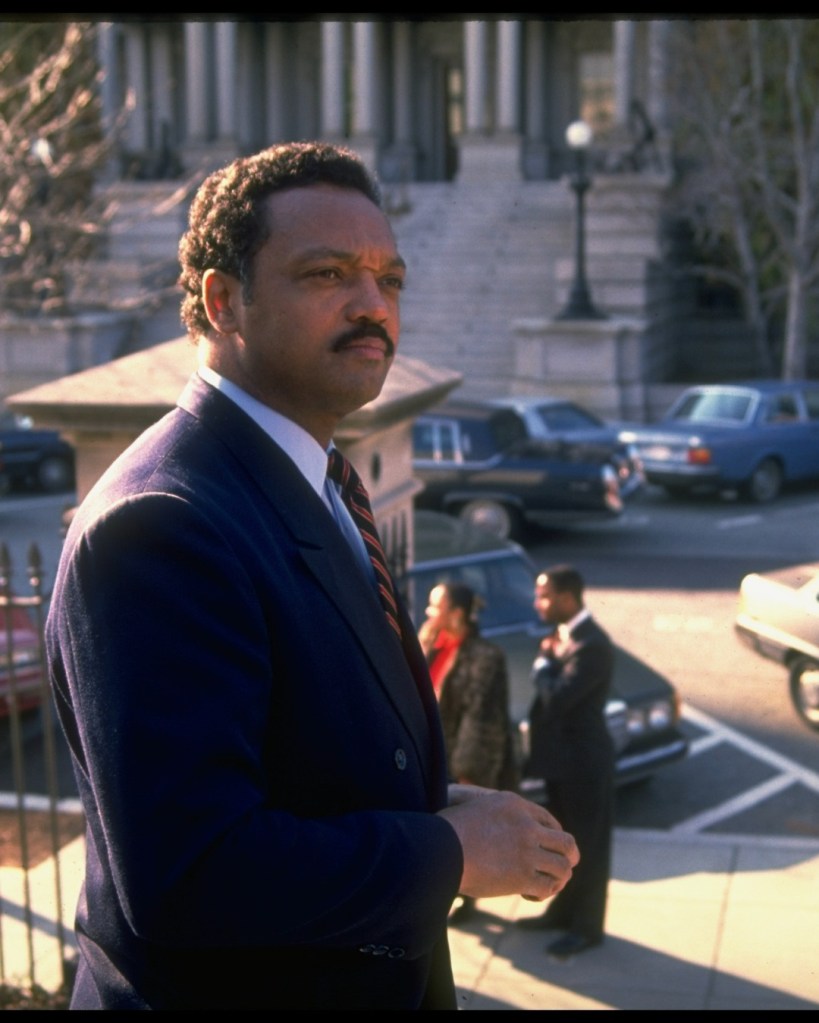
“Keep Hope Alive”: The Life, Legacy, and Impact of Jesse Jackson (1941–2026)

“I am somebody. I may be small, but I am somebody.” — Jesse Jackson

This photograph is the property of its respective owner. No copyright infringement is intended.

Jesse Louis Jackson, who passed away on February 17, 2026, at the age of 84, was a towering figure in American civil rights history. Born on October 8, 1941, in Greenville, South Carolina, Jackson grew up during the era of Jim Crow segregation. His early exposure to systemic racism deeply shaped his lifelong commitment to equality, justice, and empowerment for Black Americans.

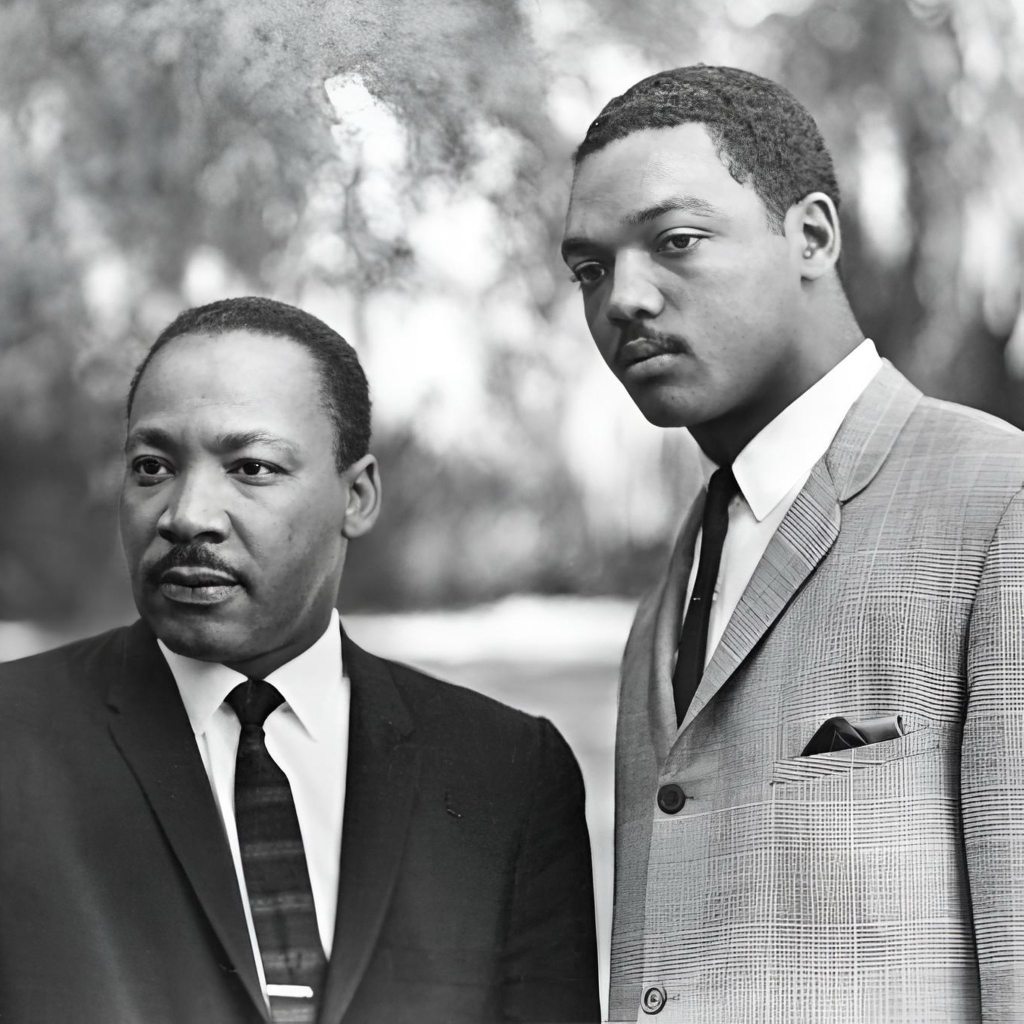
Jackson’s journey into activism began in the 1960s when he joined the Southern Christian Leadership Conference (SCLC), where he met Dr. Martin Luther King Jr. King recognized Jackson’s leadership potential, and Jackson later described those years as “a phenomenal four years of work” alongside King. Jackson was present in Memphis, Tennessee, when King was assassinated on April 4, 1968, and his close association with King further solidified his resolve to continue the civil rights movement.

This photograph is the property of its respective owner. No copyright infringement is intended.

Following King’s death, Jackson became a national leader, sustaining momentum in civil rights activism through voter registration drives, economic justice campaigns, and grassroots organizing. In 1971, he founded Operation PUSH (People United to Save Humanity) in Chicago to combat poverty, unemployment, and discrimination. PUSH later merged with the Rainbow Coalition to form Rainbow/PUSH, an organization dedicated to social justice, workplace diversity, and community empowerment.

Jackson’s advocacy was not limited to the United States. He engaged in international human rights work, negotiating the release of political prisoners and hostages, opposing apartheid in South Africa, and speaking on behalf of oppressed populations worldwide. His global activism reinforced his belief that the struggle for justice transcends borders.

Jackson also made a significant mark in politics. He ran for the Democratic presidential nomination in 1984 and 1988, energizing minority communities and introducing national discourse on civil rights, economic inequality, and foreign policy. His campaigns helped shape the political landscape for future generations of Black leaders.

A hallmark of Jackson’s activism was his ability to inspire with words and action. Phrases like “I am Somebody” and “Keep hope alive” became synonymous with his mission to uplift marginalized communities and foster dignity and self-worth among the oppressed.

Jackson’s faith played a central role in his work. As a Baptist minister, he linked spiritual responsibility with social action, framing activism as a moral imperative. His sermons, speeches, and writings consistently emphasized that justice and human rights were both ethical and spiritual obligations.

Education reform was another focus of Jackson’s advocacy. He fought for equitable funding, greater access to higher education, and programs supporting underprivileged youth. Jackson believed education was a key pathway to economic and social empowerment.

Throughout his career, Jackson also championed economic justice, challenging corporations to diversify workforces and increase opportunities for minority-owned businesses. He consistently used public advocacy and negotiation to create meaningful change.

Family was at the heart of Jackson’s life. He married Jacqueline Lavinia Brown Jackson, and together they raised six children, including Jesse Jackson Jr., who became a U.S. Congressman. Jackson emphasized the importance of instilling values of justice, community, and moral responsibility in his children.

Jackson’s contributions earned him numerous awards, including the Presidential Medal of Freedom in 2000, the highest civilian honor in the United States. He was also recognized by the NAACP, the National Urban League, and faith-based organizations for his lifelong dedication to civil rights, social justice, and humanitarian efforts.

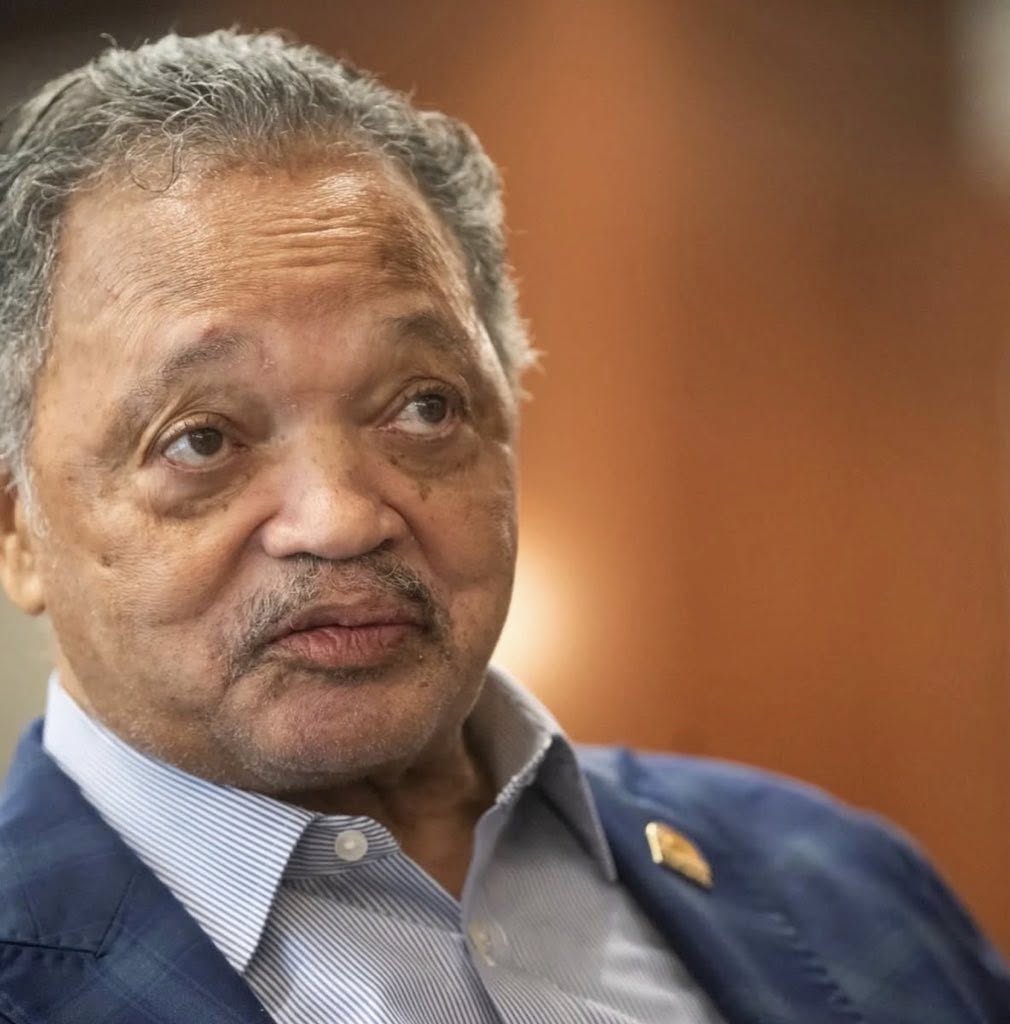
This photograph is the property of its respective owner. No copyright infringement is intended.

Despite facing criticism, political challenges, and health struggles, including progressive supranuclear palsy in his later years, Jackson remained active and engaged. He continued to mentor activists, inspire young leaders, and encourage civic participation until his final days.

Jesse Jackson’s life was a testament to resilience, faith-driven activism, and unwavering dedication to equality and human dignity. From his work alongside Martin Luther King Jr. to his global advocacy and political campaigns, Jackson left an indelible mark on history. His passing represents a profound loss, but his words, deeds, and legacy continue to inspire the fight for justice and the upliftment of marginalized communities worldwide.


References

Dilemma: Black Hair Discrimination

The Politics of Policing Black Identity

Angela Davis

“I had been looking at pictures of women who were free, and they were wearing their hair the way it grows out of their heads.”
(Davis, A. Y., Women, Race & Class, 1981)

Chimamanda Ngozi Adichie

“Hair is political. Hair is personal. Hair is identity.”
(Adichie, C. N., Americanah, 2013)

Bell Hooks

“Straightening our hair is one of the many ways we try to erase the reality of our Blackness.”
(Hooks, b., Black Looks: Race and Representation, 1992)

Lupita Nyong’o

“What I learned is that when the world tells you you’re not enough, you don’t have to believe it.”
(Nyong’o, L., Sulwe, 2019)

“Black hair is not a trend, a problem, or a phase—it is a living archive of survival, resistance, and ancestral memory.”

Black hair discrimination remains one of the most visible and normalized forms of racial bias in modern society. From classrooms to corporate offices, Black hair is disproportionately scrutinized, regulated, and punished under the guise of “professionalism,” “neatness,” or “dress code policies.” These standards are not neutral; they are rooted in Eurocentric ideals that define straight, loose, and non-textured hair as the default measure of beauty and respectability. As a result, Black people are often forced to alter their natural hair to gain acceptance, employment, or basic dignity.

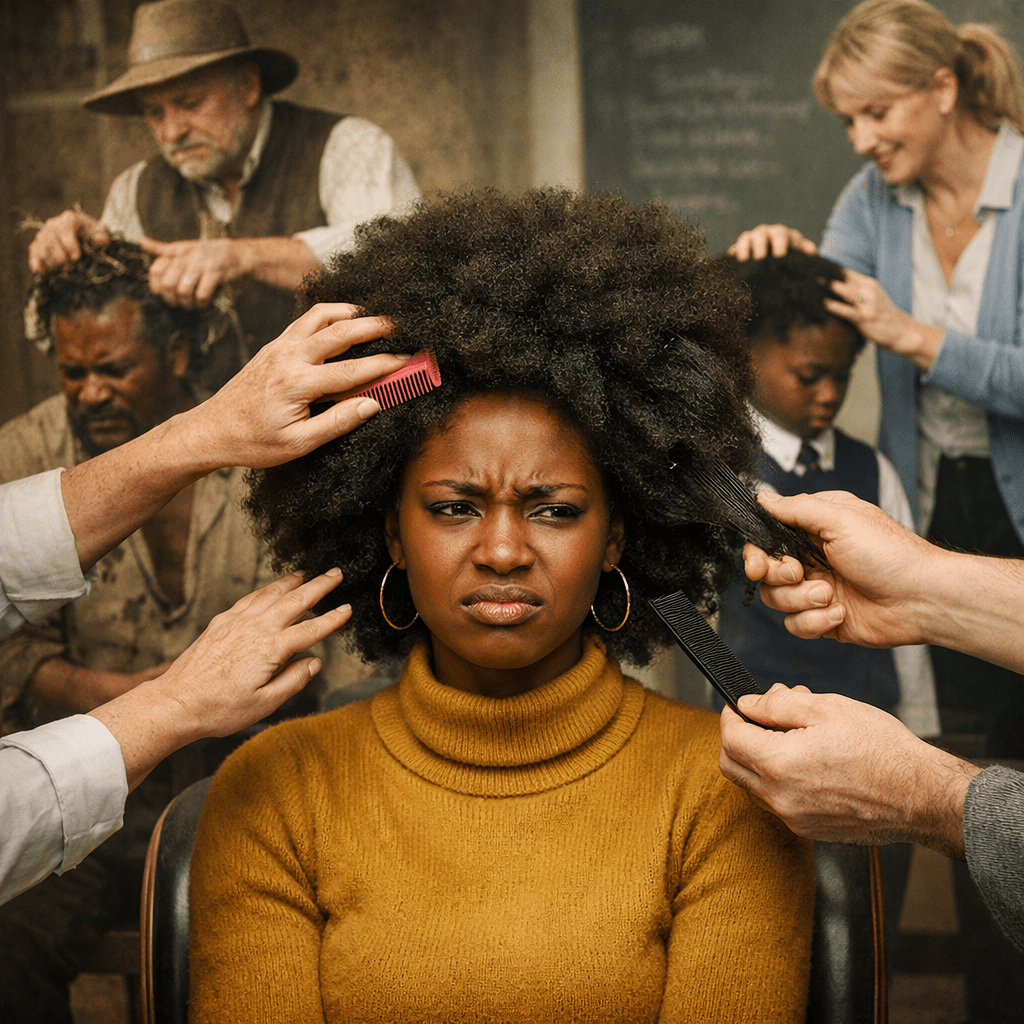
In schools, Black children are suspended, sent home, or humiliated for wearing braids, locs, Afros, twists, or even natural curls. These disciplinary practices communicate a dangerous message: that Black identity itself is disruptive and unacceptable. When a child’s natural hair becomes grounds for punishment, the educational system participates in psychological harm that can shape self-esteem and identity formation for life. The classroom becomes not a place of learning, but a site of racial conditioning.

In the workplace, similar patterns persist. Black professionals are routinely told their hair is “unprofessional,” “distracting,” or “unkept,” even when it is clean, styled, and culturally appropriate. This forces many to chemically straighten their hair, wear wigs, or suppress their natural texture in order to be perceived as competent. Such pressures reveal how deeply white norms are embedded in institutional culture, where assimilation is often required for survival.

The hatred toward Black hair did not originate in modern offices or schools—it was cultivated during slavery. Enslaved Africans were stripped of their cultural grooming practices and taught to associate straight hair with proximity to whiteness and social advantage. Field laborers, who often had tightly coiled hair, were deemed inferior, while those with looser textures were privileged within the plantation hierarchy. Hair became a racial marker used to rank human worth.

This legacy did not disappear after emancipation. It evolved into colorism and texture discrimination, where straighter hair is still associated with beauty, intelligence, and professionalism, while kinky or coiled hair is labeled “nappy,” “bad,” or “ugly.” These terms, passed down through generations, reflect internalized racism—a psychological inheritance from white supremacy that continues to shape how Black people see themselves.

One of the most painful aspects of Black hair discrimination is that it is often reinforced within Black families themselves. Many Black parents, conditioned by their own experiences of rejection and survival, teach their children that their natural hair is something to be fixed, relaxed, or hidden. Phrases like “your hair is too nappy” or “you need a perm” are not harmless—they transmit shame and self-rejection at the most formative stages of identity.

This internalization is not accidental; it is a direct result of systemic oppression. When society consistently rewards whiteness and penalizes Blackness, marginalized communities may adopt those standards as coping mechanisms. However, survival strategies should not become permanent ideologies. Black parents must wake up to the reality that teaching children to hate their natural features only perpetuates the same system that devalues them.

White supremacy plays a central role in Black hair discrimination because it establishes whiteness as the universal standard of normality. Under this system, anything outside of European phenotypes is constructed as deviant, exotic, or inferior. Hair texture becomes political, not because Black people made it so, but because racism made Black bodies sites of control.

The concept of “professionalism” itself is racially coded. There is no scientific or moral basis for associating straight hair with competence or intelligence. These associations are cultural myths that developed within colonial and capitalist systems that centered white identity as the model citizen. Black hair challenges these myths simply by existing in its natural state.

Black hair has also been criminalized. From police stops to courtroom bias, Afro-textured hair has been associated with deviance and threat. Studies show that Black people with natural hairstyles are more likely to be perceived as aggressive, untrustworthy, or less intelligent, even when all other factors are controlled. This demonstrates how aesthetic bias becomes a mechanism of social exclusion.

The rise of movements like the Natural Hair Movement and the passing of the CROWN Act represent resistance against these injustices. These efforts aim to legally protect individuals from discrimination based on hair texture and style. However, legal reform alone cannot dismantle deeply ingrained psychological and cultural beliefs. Laws can change policies, but they cannot instantly heal internalized self-hatred.

True liberation requires a cultural shift in how Black beauty is defined and taught. Black hair must be reframed not as a problem to manage, but as a sacred inheritance—genetically rich, biologically diverse, and historically powerful. The same coils once mocked were used to map escape routes during slavery, braid seeds for survival, and encode communal identity.

Education plays a crucial role in this transformation. Schools must incorporate Black history and African aesthetics into curricula, not as side notes, but as central narratives. When children learn that their features have historical meaning and cultural value, they are less likely to internalize racist hierarchies imposed by society.

Media representation is equally important. For decades, Black beauty was only celebrated when it approximated whiteness—light skin, straight hair, narrow features. Today, although representation has expanded, Eurocentric beauty standards still dominate advertising, film, and fashion industries. The normalization of natural Black hair must move beyond trends and become structural.

The policing of Black hair is ultimately about control. It is about who gets to define beauty, respectability, and humanity. When institutions regulate how Black people wear their hair, they are not managing aesthetics—they are managing identity. Hair becomes a battlefield where cultural memory confronts colonial ideology.

Psychologically, hair discrimination contributes to identity fragmentation. Black individuals are often forced to perform different versions of themselves depending on context—natural at home, altered at work, cautious in public. This constant self-monitoring produces emotional fatigue and reinforces the idea that authenticity is unsafe.

Black parents, educators, and leaders have a responsibility to disrupt this cycle. Teaching children that their hair is “good” exactly as it grows is not a trivial affirmation—it is a radical act of resistance. It challenges centuries of propaganda designed to disconnect Black people from their bodies and ancestry.

Healing from hair discrimination requires both structural and spiritual work. Structurally, institutions must dismantle biased policies. Spiritually and psychologically, Black communities must unlearn the lie that proximity to whiteness equals worth. The reclamation of Black hair is inseparable from the reclamation of Black identity.

Black hair is not unprofessional, unclean, or undesirable. It is African. It is genetic. It is historical. It is political because oppression made it so. And until society confronts the racial logic behind its beauty standards, Black hair will continue to be policed—not because it is wrong, but because it refuses to conform to a system built on white supremacy.

Ultimately, the hatred of Black hair reflects a deeper hatred of Black existence. To love Black hair fully is to reject the entire hierarchy that ranks human value by proximity to Europe. In that sense, every Afro worn freely, every loc grown proudly, and every child taught to love their coils is an act of cultural revolution.


References

Banks, I. (2000). Hair matters: Beauty, power, and Black women’s consciousness. New York, NY: New York University Press.

Byrd, A. D., & Tharps, L. L. (2014). Hair story: Untangling the roots of Black hair in America. New York, NY: St. Martin’s Press.

Collins, P. H. (2004). Black sexual politics: African Americans, gender, and the new racism. New York, NY: Routledge.

Crenshaw, K. (1991). Mapping the margins: Intersectionality, identity politics, and violence against women of color. Stanford Law Review, 43(6), 1241–1299.

Johnson, T. R., & Bankhead, T. (2014). Hair it is: Examining the experiences of Black women with natural hair. Open Journal of Social Sciences, 2(1), 86–100.

Rooks, N. (1996). Hair raising: Beauty, culture, and African American women. New Brunswick, NJ: Rutgers University Press.

Rosette, A. S., & Dumas, T. L. (2007). The hair dilemma: Conformity versus authenticity. Journal of Applied Psychology, 92(6), 1601–1616.

Tate, S. A. (2009). Black beauty: Aesthetics, stylization, politics. Farnham, UK: Ashgate.

The CROWN Act. (2019). Creating a Respectful and Open World for Natural Hair. U.S. legislation on hair discrimination.

Black History Month: Trayvon Martin – A Life Stolen, A Nation Awakened.

Trayvon Benjamin Martin was born on February 5, 1995, in Miami, Florida. He was a young African American teenager known by his family and friends as kind-hearted, playful, and full of potential. Trayvon enjoyed sports, especially football and basketball, and aspired to become an aviation mechanic. Like many young Black boys in America, his life reflected both ordinary youthful dreams and the inherited weight of navigating a society shaped by racial stereotypes and systemic inequality.


What Happened to Trayvon Martin

On the evening of February 26, 2012, Trayvon Martin was walking back to his father’s fiancée’s home in Sanford, Florida, after purchasing snacks from a convenience store. He was unarmed, wearing a hoodie, and talking on the phone with a friend. George Zimmerman, a neighborhood watch volunteer, reported Trayvon as “suspicious” to police, followed him despite being advised not to, and ultimately shot and killed him.

Zimmerman claimed self-defense and was later acquitted of all charges in 2013. The verdict sparked national and international outrage, as many saw the case as a reflection of how Black bodies are often criminalized, feared, and devalued within American society.


His Impact on the World

Though his life was tragically cut short at just 17 years old, Trayvon Martin’s death became a historical turning point. His name became a symbol of racial injustice and the dangerous consequences of racial profiling. The case helped ignite the modern civil rights movement known as Black Lives Matter, founded in 2013 by Alicia Garza, Patrisse Cullors, and Opal Tometi in response to Trayvon’s killing and Zimmerman’s acquittal.

Trayvon’s story forced America to confront uncomfortable truths about race, surveillance, fear, and the unequal application of justice. His hoodie became a global symbol of protest, representing how something as simple as clothing could become a perceived threat when worn by a Black male.


He Would Have Been 31 This Year

In 2026, Trayvon Martin would have been 31 years old. He could have been a husband, a father, a professional, or a leader in his community. Instead, his life exists in collective memory as a reminder of stolen futures and unrealized potential. His age now represents not just time passed, but the depth of loss — a life that never had the chance to fully begin.


Racism in America: A Broader Context

Trayvon Martin’s death cannot be understood in isolation. It exists within a long historical continuum of racial violence in America, from slavery and lynching to mass incarceration and police brutality. Sociologists describe this phenomenon as systemic racism — a structure in which laws, institutions, and cultural narratives disproportionately harm Black people.

The fear that led to Trayvon’s death reflects what scholars call implicit racial bias, where Black males are often subconsciously associated with danger, criminality, and threat. These biases influence everything from policing and surveillance to legal outcomes and media portrayals.

Trayvon’s case exposed how even in the absence of a crime, Black existence itself can be treated as suspicious. His death became a mirror held up to American society, forcing the nation to ask: Who is allowed to be innocent? Who is allowed to be safe? And whose life is presumed valuable?


Legacy

Trayvon Martin’s legacy is not defined by his death, but by the global movement that arose because of it. His name is spoken alongside others — Michael Brown, Tamir Rice, Sandra Bland, Breonna Taylor, George Floyd — as part of a growing historical archive of racial injustice.

Yet Trayvon remains unique: he was not arrested, not resisting, not committing a crime. He was simply walking home.

His life and death continue to educate, mobilize, and challenge the world to build a society where Black children can exist without fear, where justice is not selective, and where no family must bury a child for simply being seen as “out of place.”


References

Alexander, M. (2012). The new Jim Crow: Mass incarceration in the age of colorblindness. The New Press.

Bonilla-Silva, E. (2018). Racism without racists: Color-blind racism and the persistence of racial inequality in America (5th ed.). Rowman & Littlefield.

CBS News. (2013). George Zimmerman acquitted in Trayvon Martin case.

Garza, A. (2014). A herstory of the #BlackLivesMatter movement. The Feminist Wire.

Newman, K. S., & Cohen, A. (2014). Race, place, and building a youth movement: The case of Trayvon Martin. American Sociological Review, 79(3), 449–476.

Pew Research Center. (2016). On views of race and inequality, Blacks and Whites are worlds apart.

U.S. Department of Justice. (2013). Investigation of the Sanford Police Department’s handling of the Trayvon Martin shooting.