
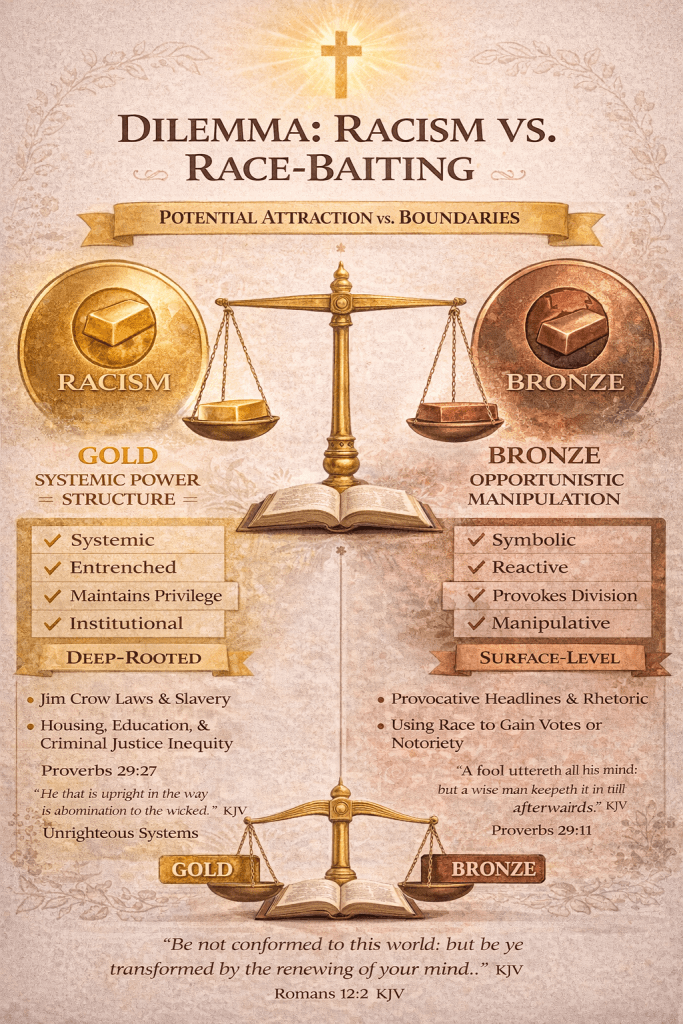
Racism remains one of the most persistent and destructive forces in society, functioning as a systemic power structure designed to maintain the dominance of one group over another (Feagin, 2006). Unlike individual prejudice, which reflects personal bias, racism involves institutional, cultural, and historical mechanisms that enforce inequality. Understanding racism as a power structure is critical to distinguishing it from race-baiting.
Race-baiting, in contrast, refers to tactics that manipulate racial tension for personal, political, or financial gain. It does not necessarily rely on structural dominance but rather exploits societal divisions, often inciting anger, fear, or resentment. While both racism and race-baiting are harmful, their mechanisms and intent differ.
Racism operates at multiple levels: individual, institutional, and systemic. Individual racism involves personal prejudice or discriminatory acts, whereas institutional racism manifests in policies, practices, and norms that advantage one racial group over others. Systemic racism describes the entrenched nature of these structures over generations.
Race-baiting exploits visible racial differences to provoke a reaction. Unlike racism, which is rooted in power dynamics and structural advantage, race-baiting may be opportunistic, focusing on rhetoric and emotional appeal rather than systemic control. Politicians, media personalities, and even social influencers often use race-baiting to advance agendas or gain attention.
In biblical terms, oppression and favoritism have long been condemned. James 2:1 warns, “My brethren, have not the faith of our Lord Jesus Christ, the Lord of glory, with respect of persons” (KJV). Partiality and systemic oppression violate God’s design for justice and equality. Racism is, therefore, fundamentally anti-biblical because it enforces inequality and diminishes the image of God in humanity (Genesis 1:27).
Understanding the difference between racism and race-baiting requires examining the intent behind actions. Racism seeks to preserve hierarchy, maintain privilege, and control resources. Race-baiting seeks to provoke emotional reaction and division, often for personal gain or notoriety. While a racist agenda benefits the oppressor materially or socially, race-baiting primarily manipulates perception.
The metaphor of bronze versus gold can help clarify the distinction. Bronze represents the superficial provocation, often symbolic and reactive—this is race-baiting. Gold represents the deep, entrenched systemic mechanisms—this is racism in its structural form. Observing whether an act addresses the root of inequality or merely agitates emotion can reveal its nature.
Racism and race-baiting intersect in public discourse. Some individuals and media sources may exaggerate or misrepresent incidents of racial tension for attention, funding, or political leverage. This blurs public understanding, making it difficult to address genuine structural injustice. As Proverbs 18:17 notes, “The first to plead his cause seemeth just; but his neighbor cometh and searcheth him” (KJV). Truth requires deeper investigation.
Racism thrives on normalization. When societal structures systematically advantage one group, discriminatory practices are often invisible or dismissed as “tradition” or “meritocracy.” Understanding this helps differentiate between acts that are opportunistic (race-baiting) and those that are embedded within the system (racism).
Race-baiting frequently misdirects anger away from systemic causes toward individual actors, scapegoating specific groups for broader structural problems. This manipulation can polarize communities and hinder meaningful solutions. Micah 6:8 reminds us of justice and humility: “He hath shewed thee, O man, what is good; and what doth the Lord require of thee, but to do justly, and to love mercy, and to walk humbly with thy God?” (KJV).
Media literacy is essential to recognize the distinction. Headlines and social media often amplify emotionally charged narratives without context. Racism is systemic, historically rooted, and persistent, while race-baiting relies on immediate reaction. Educated discernment enables individuals to see beyond sensationalism.
Racism is often intergenerational, perpetuated through education, housing, employment, criminal justice, and healthcare disparities. Race-baiting is usually episodic, emerging around specific incidents, speeches, or events. Understanding historical context is therefore critical to interpreting current racial discourse accurately.
Race-baiting can also occur within oppressed communities, where individuals or groups exploit internal divisions to gain influence. This demonstrates that race-baiting is less about power structures and more about manipulation, contrasting with racism’s reliance on systemic advantage.
The Bible condemns hypocrisy and manipulation. Proverbs 6:16–19 lists pride, false witness, and sowing discord among brethren as abominations to God. Race-baiting falls into the category of sowing discord, whereas racism violates divine law by enforcing inequality. Both are sin, but their mechanisms differ.
Recognizing racism requires assessing who benefits. True racism confers social, economic, and political advantage to a particular racial group. Race-baiting may inflame perceptions of injustice but does not create structural advantage. This distinction clarifies policy debates and moral accountability.
Racism also often hides behind ideology, meritocracy, or cultural norms. The systemic nature makes it less visible than race-baiting, which is loud, overt, and performative. Understanding the bronze versus gold distinction allows individuals to respond with strategic solutions rather than reactive emotion.
Education and awareness are key tools in dismantling both racism and race-baiting. Combatting racism requires structural reform, anti-discrimination policy, and societal accountability. Countering race-baiting requires critical thinking, media literacy, and spiritual discernment (Proverbs 14:15).
Christians are called to pursue justice and reconciliation. Isaiah 1:17 commands, “Learn to do well; seek judgment, relieve the oppressed, judge the fatherless, plead for the widow” (KJV). Responding to racism requires action and advocacy; responding to race-baiting requires wisdom, prayer, and discernment.
Racism is a deep societal disease, while race-baiting is a symptom that exploits and amplifies divisions. One targets systemic change; the other targets immediate perception. Addressing the root cause requires education, advocacy, and awareness of historical context, as well as spiritual discernment.
In conclusion, distinguishing between racism and race-baiting is essential for effective response. Bronze may flare in anger and reaction; gold endures in system and power. Both demand moral responsibility, but the solutions differ. Recognizing the systemic nature of racism while refusing to be manipulated by race-baiting is a critical skill for spiritual and social maturity (Romans 12:2).
References
Feagin, J. (2006). Systemic racism: A theory of oppression. Routledge.
Alexander, M. (2012). The New Jim Crow: Mass incarceration in the age of colorblindness. The New Press.
Kendi, I. X. (2019). How to be an antiracist. One World.
Proverbs 4:23; 14:15; 18:17; 6:16–19
Isaiah 1:17; Micah 6:8; James 2:1; Genesis 1:27
Romans 12:2; Hebrews 13:4
Matthew 10:16; Matthew 26:41
 THE BROWN GIRL DILEMMA