Category Archives: money

Birkins vs Bitcoin: Luxury vs Digital Wealth

Investing has always been a balancing act between risk and reward, but today, investors are increasingly confronted with unconventional options. Two seemingly disparate assets—Hermès Birkin bags and Bitcoin—have captured the attention of collectors, speculators, and wealth strategists alike. Each represents a different approach to wealth: one grounded in tangible luxury, the other in digital innovation. Understanding their value, risks, and potential returns is crucial for anyone seeking to diversify or preserve capital.

1. Birkin Bags (Luxury Collectibles)

Pros:

  • Scarcity & Exclusivity: Hermes Birkins are produced in extremely limited numbers. Certain colors, materials, and rare editions can appreciate significantly over time.
  • Tangible Asset: Physical item you can hold, store, and insure.
  • Cultural Status & Demand: Strong desirability among collectors; often considered a “blue-chip” luxury collectible.
  • Stable Value in Niche Market: Prices can outperform inflation, especially for rare or vintage pieces. For example, some Birkin bags have historically appreciated 500–600% over 10–15 years.

Cons:

  • High Entry Cost: Prices start around $12k–$15k and can go well above $500k for rare editions.
  • Liquidity Issues: Selling can be slow; you need the right buyer/market.
  • Storage & Maintenance: Requires careful storage and sometimes professional upkeep.
  • Market Risk: Tastes can change, and fashion trends fluctuate.

2. Bitcoin (Cryptocurrency)

Pros:

  • High Growth Potential: Has made millionaires in short periods; extremely high upside potential.
  • Liquidity: Can be bought/sold 24/7 on exchanges.
  • Decentralized: Not tied to any government or physical asset.
  • Ease of Transfer: Can be moved globally almost instantly.

Cons:

  • Extreme Volatility: Price swings can be 10–30% in a single day. Losses can be dramatic.
  • Regulatory Risk: Governments may regulate or ban crypto at any time.
  • No Tangible Value: Value is purely speculative; depends on adoption and market sentiment.
  • Security Risk: Hacking, forgotten keys, or scams can result in total loss.

3. Comparison Summary

FactorBirkin BagBitcoin
Initial CostHigh ($12k–$500k+)Low ($20+ per coin, fractional possible)
VolatilityLowHigh
LiquidityLowHigh
Historical ROI10–15% annually for rare piecesHighly variable; 100%+ in bull markets, huge losses in bear markets
Tangible vs DigitalTangibleDigital
Cultural/Status ValueVery highMostly speculative, social value varies

4. Strategic Approach

  • Birkin: Treat it as a luxury collectible with the bonus of potential appreciation. Best for wealth preservation and status.
  • Bitcoin: Treat as a high-risk/high-reward asset for potential growth. Suitable for risk-tolerant investors.

Bottom Line:

  • If you want status, tangibility, and slower, steady appreciation, go Birkins.
  • If you want high-risk, high-reward digital speculation, go Bitcoin.

Some savvy investors do both: Birkins as a hedge against volatility, Bitcoin for speculative upside.

Hermès Birkins, named after the actress and singer Jane Birkin, are the epitome of luxury fashion. Produced in limited quantities, these handbags are handcrafted in France and priced from approximately $12,000 to over $500,000, depending on size, material, and rarity. Their scarcity, combined with cultural desirability, has historically allowed Birkins to appreciate over time, sometimes outperforming traditional financial instruments.

Bitcoin, in contrast, is a decentralized cryptocurrency launched in 2009. It is purely digital, exists outside the traditional banking system, and relies on blockchain technology to maintain security and scarcity. Unlike tangible assets, Bitcoin’s value is speculative, dependent on adoption, market sentiment, and broader regulatory developments.

One of the key advantages of Birkins is their relative stability. While prices fluctuate based on market demand and fashion trends, the growth has historically been steady. Research has shown that rare Birkins have increased in value by an average of 10–15% annually over the past two decades. This makes them a reliable option for collectors and investors seeking to preserve wealth.

Bitcoin, on the other hand, is highly volatile. Its price has experienced dramatic swings, sometimes increasing by hundreds of percent within months or losing significant value just as quickly. This volatility offers opportunities for high returns but comes with equally high risks. Investors must be prepared for sudden price drops.

Liquidity is another important consideration. Bitcoin can be traded 24/7 on numerous exchanges worldwide, allowing investors to access cash relatively quickly. Birkins, however, require finding the right buyer, often through auctions or specialized resale markets. While the market for Birkins is robust, it is far less liquid than digital assets.

Cultural and status value further distinguishes Birkins. Owning a Birkin is a statement of wealth, taste, and social positioning. In some cases, this social capital can indirectly enhance the asset’s monetary value. Bitcoin, while increasingly mainstream, does not confer the same tangible prestige, though it signals financial acumen and early adoption of technology.

Storage and maintenance are practical factors that impact Birkins’ value. These handbags must be preserved carefully to maintain condition. Environmental factors, handling, and insurance all contribute to the overall cost of ownership. Bitcoin, conversely, requires secure digital storage, such as hardware wallets, but lacks the physical maintenance costs associated with luxury goods.

Risk profiles also differ. Birkins are exposed to fashion cycles and counterfeit markets but are largely insulated from regulatory intervention. Bitcoin faces regulatory scrutiny, cyber threats, and the potential for systemic market shocks. Investors must assess their tolerance for these different types of risk when deciding where to allocate capital.

Investment horizons further illustrate the distinction. Birkins are generally long-term assets; their appreciation occurs over years or decades. Bitcoin can generate substantial short-term gains, but timing and market conditions are critical. Each asset class therefore serves different investor objectives.

Accessibility is a practical consideration. While fractional ownership of Bitcoin allows almost anyone to invest with minimal capital, Birkins require substantial upfront investment. This high entry barrier limits Birkins to wealthy investors or dedicated collectors.

Diversification potential also differs. Birkins provide a hedge against inflation and traditional financial market volatility, while Bitcoin offers exposure to an emerging technological ecosystem with global reach. Combining both can create a complementary portfolio balance of tangible and digital assets.

Market data indicates that rare Birkins have outperformed gold and the S&P 500 in some periods. Bitcoin, while outperforming nearly every traditional asset class in its early years, exhibits much higher variability. Both require careful timing and market understanding to maximize returns.

Psychological factors influence investor behavior. Luxury goods like Birkins appeal to those seeking security and status, whereas Bitcoin attracts speculative traders and tech-savvy investors. These behavioral dynamics can impact market demand and price trajectories.

Global trends further influence both assets. Rising wealth in emerging markets has fueled Birkin demand, particularly in Asia and the Middle East. Bitcoin adoption, meanwhile, is expanding worldwide, with institutional investment and corporate acceptance driving legitimacy and price growth.

Inflation protection is another consideration. Birkins maintain value through scarcity and desirability, while Bitcoin’s fixed supply is designed to act as a hedge against currency devaluation. Both strategies offer ways to preserve purchasing power in uncertain economic environments.

Investment strategies vary accordingly. A conservative approach may favor Birkins for wealth preservation, while aggressive investors might allocate a portion of their portfolio to Bitcoin for speculative growth. Combining both can mitigate risk while capturing diverse opportunities.

Historical performance provides insight but not certainty. Past appreciation of Birkins suggests steady growth, yet fashion trends can change. Bitcoin’s history demonstrates massive gains alongside significant drawdowns, emphasizing the importance of risk management and timing.

Both assets challenge traditional notions of investment. Birkins blur the line between consumable luxury and financial instrument, while Bitcoin challenges conventional currency and banking systems. Investors must weigh personal goals, risk tolerance, and market understanding before committing capital.

Ultimately, Birkins and Bitcoin represent two very different investment philosophies: one rooted in tangible, culturally valued goods; the other in speculative, decentralized digital innovation. The “best” choice depends on individual priorities, financial goals, and appetite for risk.

For those seeking stability, status, and tangible luxury, Birkins are a compelling option. For those seeking high-risk, high-reward opportunities in a rapidly evolving digital landscape, Bitcoin offers unmatched potential. Combining both may provide the optimal balance between tradition and innovation, security and growth.


References

Aliko Dangote: The Richest Man in Africa

Aliko Mohammad Dangote is one of the most influential business figures on the African continent, known for his unmatched industrial footprint across multiple sectors. Born on April 10, 1957, in Kano, Nigeria, he emerged from a family whose legacy in commerce dates back generations. Growing up in a household connected to trade and entrepreneurship gave him early exposure to business fundamentals that would later inform his industrial empire.

His great-grandfather, Alhassan Dantata, was one of the wealthiest men in West Africa in the early 20th century, which placed Dangote within a lineage of economic leadership. Despite this background, Dangote’s ascent into modern global wealth was not inherited; instead, he built his conglomerate through strategic investments, reinvestment of profits, and a deep understanding of Africa’s economic needs.

Dangote’s business journey began in 1977 when he started a trading enterprise focused on importing sugar, rice, and other basic commodities. With a small loan from an uncle, he quickly found success by identifying gaps in Nigeria’s supply chain. This strength in commodity trading laid the foundation for more ambitious ventures in manufacturing and industrial production.

As Nigeria and other African nations faced growing demand for construction materials, Dangote shifted from trading to manufacturing. This move proved transformative. Cement production became the cornerstone of his wealth, with Dangote Cement rising to become the largest cement producer in Africa. The company expanded rapidly across borders and now operates in several African countries.

Sugar refining, flour milling, salt production, and logistics soon joined the portfolio, turning Dangote Group into a true continental powerhouse. Manufacturing enabled Dangote to reduce Nigeria’s reliance on imported goods, creating thousands of jobs and stimulating infrastructure growth across the region. This shift from trading to large-scale industrialisation is one of the defining aspects of his business success.

Dangote’s wealth surged as his companies grew, consistently placing him at the top of Africa’s wealth rankings. While fluctuations in currency and commodity prices occasionally shift positions, Dangote has held the title “richest man in Africa” for over a decade, according to major global wealth indexes. His dominance in multiple essential industries makes his economic influence both significant and stable.

A list of Africa’s wealthiest individuals often places Dangote first, followed by figures such as Johann Rupert, Nicky Oppenheimer, Nassef Sawiris, Naguib Sawiris, Abdul Samad Rabiu, and Mike Adenuga. These individuals represent diverse industries such as luxury goods, mining, telecommunications, and manufacturing, but Dangote stands out for building Africa’s largest home-grown industrial conglomerate.

His impact on Africa extends far beyond wealth. Dangote’s businesses have created millions of direct and indirect jobs, strengthened national economies, and brought vital infrastructure to regions that previously relied heavily on foreign imports. His companies have become symbols of African self-sufficiency and industrial capability, reshaping economic landscapes from West Africa to East Africa.

Dangote Cement alone revolutionized construction sectors across the continent, enabling more affordable housing, public works, and urban development. His entry into fertilizer production has had major implications for agricultural self-reliance, while his oil refinery—one of the largest privately owned refineries in the world—aims to significantly reduce Africa’s dependence on imported fuel.

For Nigeria specifically, Dangote is a monumental figure. His industries bolster the country’s GDP, expand its manufacturing sector, and contribute substantially to tax revenue. The refinery project is expected to change Nigeria’s fuel economy by transforming the nation from an importer to a potential exporter of refined petroleum products. This structural shift could reposition Nigeria’s economic identity globally.

Philanthropically, Dangote’s foundation supports healthcare, education, nutrition, and disaster relief across the continent. He has funded major campaigns against malnutrition, disease outbreaks, and pandemic emergencies. His charitable work reflects a commitment to human development alongside industrial progress.

His personal life is rooted in Northern Nigerian traditions. Dangote married early, divorced, remarried, and later divorced again. He has three daughters—Maria, Halima, and Fatima—and an adopted son, Abdulrahman. Despite his immense wealth, Dangote is known for his relatively private lifestyle, placing stronger emphasis on business growth than on public spectacle.

He was educated at schools in Kano before attending Al-Azhar University in Egypt, where he studied business. His education, combined with his family’s commercial influence, shaped his entrepreneurial outlook. From selling simple products as a child to controlling multibillion-dollar industries, his journey displays a consistent drive and business instinct.

Dangote’s rise was not without challenges. He maneuvered through Nigeria’s volatile economic environment, currency devaluations, changing government policies, and intense competition. Yet his strategic focus on essential goods—products people rely on daily—made his businesses recession-resistant and consistently profitable.

The history of his empire is also a history of African industrialisation. While many African billionaires derive wealth from inherited mining assets or globalized sectors, Dangote stands apart as a builder of factories, refineries, plants, and supply chains. His operations bring value directly to African soil, fostering development through manufacturing rather than raw-resource export.

Today, Dangote is not only a symbol of personal achievement but a symbol of African economic possibility. His success demonstrates the potential for African-led industrial transformation, inspiring entrepreneurs across the continent to invest locally and expand boldly.

In summary, Aliko Dangote is widely considered the richest man in Africa because of his vast industrial empire, dominant market position, and sustained economic influence. His contributions to Nigeria and the continent have been profound, reshaping industries, improving infrastructure, and setting a powerful example of African entrepreneurship. His life story—from a trading stall in Kano to global billionaire status—remains one of the most remarkable narratives in modern African history.


References

Britannica. (n.d.). Aliko Dangote.
Investopedia. (n.d.). How Aliko Dangote Became the Richest African.
Wikipedia. Aliko Dangote.
Wikipedia. Wealth of Aliko Dangote.
Wikipedia. List of Africans by Net Worth.
Dangote Group Official Website.
Bloomberg Billionaires Index.
Forbes Africa Billionaires List.

The Golden Cage

Materialism is the golden cage that glitters so beautifully it blinds the eyes of the beholder. It promises freedom, comfort, and power, yet silently imprisons the soul behind the bars of greed, vanity, and endless desire. The Bible warns in 1 Timothy 6:10 (KJV), “For the love of money is the root of all evil.” It is not money itself that destroys, but the affection and obsession with it—the worship of the gift rather than the Giver. In today’s society, where material success defines worth, the heart becomes chained to things that perish, forgetting the eternal riches of God.

The love of money distorts the soul’s priorities. Many trust wealth more than the One who provides it, seeking security in numbers rather than in divine providence. Proverbs 11:28 (KJV) declares, “He that trusteth in his riches shall fall: but the righteous shall flourish as a branch.” God calls us to depend on Him, not the fleeting comfort of possessions. When man begins to believe that wealth sustains him, pride replaces humility, and faith becomes conditional upon prosperity rather than purpose.

Christ Himself warned in Matthew 6:24 (KJV), “No man can serve two masters… Ye cannot serve God and mammon.” To serve mammon—the spirit of greed and material gain—is to surrender spiritual clarity for worldly satisfaction. This battle is not about currency but allegiance. When our hearts long more for luxury than for the presence of God, we have already built our own golden cage, adorned with success but devoid of peace.

Comparison is another bar of this golden prison. In constantly measuring ourselves against others, we become trapped in envy, chasing after illusions of happiness built on possessions. Galatians 6:4–5 (KJV) reminds us, “But let every man prove his own work… for every man shall bear his own burden.” The spirit of comparison leads to covetousness, the quiet killer of gratitude.

Gratitude, once replaced by greed, transforms blessings into burdens. The heart that once thanked God for daily bread begins to demand more, forgetting that “a man’s life consisteth not in the abundance of the things which he possesseth” (Luke 12:15, KJV). The desire for “more” becomes insatiable, and soon enough, contentment feels like poverty to the one addicted to acquisition.

The story of the rich young ruler (Matthew 19:16–22) serves as a solemn reminder. He desired eternal life but was unwilling to release his wealth. His possessions had possessed him. Christ’s invitation to “sell that thou hast, and give to the poor” was not merely about money—it was about surrender. God seeks hearts free from attachment to temporary treasures.

The lovers of money are never satisfied. Ecclesiastes 5:10 (KJV) warns, “He that loveth silver shall not be satisfied with silver.” Wealth multiplies desires instead of fulfilling them. It demands maintenance, protection, and worry. True peace cannot coexist with insatiable want. The wealthy without God are often the poorest in spirit.

Between the crown and the cross lies the choice of devotion. The crown represents self-glory, while the cross represents self-sacrifice. Christ chose the cross, teaching that eternal victory comes not through possession but through surrender. The golden cage tempts us with crowns, but freedom lies in carrying the cross of humility and service.

God wants your heart, not your hoarded treasures. In Matthew 6:21 (KJV), Jesus says, “For where your treasure is, there will your heart be also.” When our treasure lies in earthly wealth, our hearts remain earthbound. But when our treasure is in heaven, our spirit soars beyond material limits.

Materialism thrives on fear—fear of lack, fear of insignificance, fear of failure. This fear drives many to hoard and save beyond reason, believing that money can buy security. Yet Proverbs 23:5 (KJV) cautions, “Wilt thou set thine eyes upon that which is not? for riches certainly make themselves wings.” Wealth is fleeting; trust in it is fragile.

Jesus addressed this fear when He said, “Take no thought for your life, what ye shall eat, or what ye shall drink” (Matthew 6:25, KJV). The obsession with “what shall we eat or what shall we wear” reveals a heart that doubts divine provision. God, who feeds the birds and clothes the lilies, surely knows how to care for His children.

Seeking God’s kingdom first is the antidote to the golden cage. “But seek ye first the kingdom of God, and his righteousness; and all these things shall be added unto you” (Matthew 6:33, KJV). When we prioritize righteousness, material needs fall into place naturally. Faith transforms fear into freedom.

Money can serve as a ministry when used wisely. The more one gives, the lighter the heart feels. Acts 20:35 (KJV) says, “It is more blessed to give than to receive.” Generosity breaks the chains of materialism and transforms wealth into worship. Money becomes a tool of blessing rather than a symbol of bondage.

To spread wealth is to reflect the nature of God, who gives abundantly and freely. The golden cage is shattered when we learn to share. 2 Corinthians 9:7 (KJV) teaches, “God loveth a cheerful giver.” Giving aligns us with divine character and reminds us that we are stewards, not owners.

Hoarding wealth leads to heaviness of soul. The more one clings to possessions, the more burdened the heart becomes. True freedom is found in release. When we give, we participate in God’s economy—a system built not on scarcity, but on trust and generosity.

The golden cage promises power but delivers isolation. It feeds pride and starves compassion. Those consumed by wealth often lose touch with empathy, believing their riches are self-earned rather than divinely permitted. James 1:17 (KJV) reminds us, “Every good gift and every perfect gift is from above.”

Greed can disguise itself as ambition. The desire to achieve becomes corrupted when it seeks self-exaltation instead of service. Ambition rooted in God glorifies Him; ambition rooted in self glorifies man. The golden cage thrives on self-centered striving.

To escape this cage, one must learn contentment. Philippians 4:11 (KJV) says, “For I have learned, in whatsoever state I am, therewith to be content.” Contentment is not complacency—it is peace in provision. It recognizes that joy is not in having more, but in trusting the One who provides enough.

When gratitude replaces greed, the soul finds rest. The pursuit of wealth no longer defines success; obedience and faith do. The heart once enslaved by gold now glows with grace.

To escape the golden cage is to rediscover simplicity and sufficiency in God. It is to realize that true riches are spiritual, not material. When you stop chasing what glitters, you find the light of Christ shining within.

References

  • Holy Bible, King James Version (KJV): Matthew 6:24, Matthew 19:16–22, Matthew 6:25–33, 1 Timothy 6:10, Luke 12:15, Proverbs 11:28, Proverbs 23:5, Ecclesiastes 5:10, Acts 20:35, Philippians 4:11, James 1:17, Galatians 6:4–5, 2 Corinthians 9:7.

Media, Money, and Melanin: How Culture Shapes Perception.

Photo by Oladimeji Ajegbile on Pexels.com

Media is one of the most powerful forces in shaping societal perceptions of beauty, success, and desirability, and it often reinforces colorism, especially against Brown and Black women. Representation is tightly linked to economics, as visibility in advertising, television, film, and digital platforms directly correlates with financial opportunity. The intersection of media and money amplifies certain standards of beauty—typically lighter skin, Eurocentric features, and straight hair—while marginalizing darker-skinned individuals (Hunter, 2007).

The economic incentives of media shape perception by privileging images that attract attention, engagement, and revenue. Brands often market beauty products, clothing, and lifestyles that align with Eurocentric ideals, perpetuating narrow standards that exclude Brown-skinned and dark-skinned women. Television shows, films, and music videos frequently cast lighter-skinned actors and models, signaling societal value and desirability while creating a visual hierarchy rooted in complexion (Byrd & Tharps, 2014).

Digital media accelerates these patterns through algorithmic amplification. Platforms like Instagram, TikTok, and YouTube favor images that generate high engagement, often reinforcing Eurocentric aesthetics. Influencers with lighter skin tend to gain broader visibility, while darker-skinned users may receive less exposure. These algorithmic biases replicate historical colorist hierarchies, merging cultural perception with financial reward, and demonstrating how melanin becomes both a marker of identity and a determinant of social and economic value (Fardouly et al., 2015).

However, counter-narratives are emerging. Movements like #BlackGirlMagic, #UnapologeticallyBlack, and #MelaninPoppin celebrate darker complexions, natural hair textures, and culturally distinct features. These campaigns challenge traditional media standards while creating market demand for products, representation, and content that reflect authentic diversity. Brands are beginning to invest in campaigns featuring dark-skinned women, demonstrating that cultural affirmation and economic value can align.

Media also influences self-perception. Continuous exposure to lighter-skinned ideals fosters comparison and internalized bias, which can impact confidence, self-esteem, and career ambition. Psychological studies show that individuals who consume media lacking representation of their skin tone and features often experience diminished self-worth (Festinger, 1954). Providing positive, diverse portrayals allows Brown girls to see themselves in aspirational roles, countering centuries of exclusion.

Cultural context further shapes these dynamics. The historical legacy of colonialism and slavery has ingrained Eurocentric beauty standards within global media. Skin tone hierarchy, hair texture preference, and facial feature bias are all culturally mediated constructs that persist through advertising, film, and music. Recognizing the economic and cultural forces behind these standards equips communities to challenge bias and demand authentic representation (Hunter, 2007).

Faith and ethical perspective provide guidance in navigating these pressures. Proverbs 31:30 (KJV) reminds, “Favour is deceitful, and beauty is vain: but a woman that feareth the LORD, she shall be praised.” True value transcends media-driven metrics of desirability and economic reward. By rooting self-worth in character and faith, Brown girls can navigate the influence of media while preserving confidence and authenticity.

In conclusion, the interplay of media, money, and melanin shapes perception in profound ways, influencing societal beauty standards, financial opportunity, and self-esteem. While historical and algorithmic biases have favored lighter-skinned ideals, emerging cultural movements, diverse representation, and conscious media consumption provide avenues for empowerment. Recognizing the economics behind visibility enables Brown girls to understand both the influence of media and their power to redefine perception, asserting their worth in all spheres of life.


Exoticized and Erased: Brown Girls in Global Pop Culture

Brown girls occupy a complicated space in global pop culture, often simultaneously exoticized and erased. While their features, skin tone, and cultural markers are fetishized in music, fashion, and film, their full humanity, voices, and stories are frequently overlooked. This duality—being celebrated for appearance yet marginalized in representation—creates unique challenges for self-perception, identity formation, and societal inclusion (Hunter, 2007).

Exoticization occurs when Brown girls are portrayed as “other,” framed as alluring, mysterious, or hypersexualized, rather than as individuals with diverse talents, ambitions, and personalities. Fashion editorials, music videos, and film often employ tropes that commodify brownness for visual appeal, catering to a Eurocentric or Western gaze. While these portrayals provide visibility, they reduce complex identities to aesthetic consumption, reinforcing limited narratives about desirability and cultural value (Byrd & Tharps, 2014).

Erasure manifests when Brown girls are absent from leading roles, influential positions, and decision-making spaces in media and culture. Hollywood, global advertising, and international modeling frequently favor lighter-skinned actors and models, marginalizing darker-skinned or ethnically ambiguous performers. This absence diminishes representation, leaving Brown girls without aspirational figures in mainstream media while reinforcing colorist hierarchies and internalized bias (Hunter, 2007).

Celebrity culture both reflects and challenges these dynamics. Figures like Lupita Nyong’o, Issa Rae, and Priyanka Chopra have broken barriers, using visibility to showcase talent and authentic cultural identity. Lupita Nyong’o’s red carpet appearances celebrate her dark, radiant skin and African heritage, while Issa Rae’s work in media emphasizes narratives of Black life that are rarely centered globally. These successes demonstrate that Brown girls can redefine cultural perception when given opportunity, platform, and recognition.

Digital platforms provide new avenues to combat exoticization and erasure. Social media campaigns like #BrownSkinGirls and #UnapologeticallyBrown allow young women to claim narratives of beauty, talent, and intellect. User-generated content democratizes representation, enabling Brown girls to showcase their artistry, voice, and personal style beyond the limitations imposed by traditional media. This visibility challenges global audiences to recognize and value their full humanity.

The psychological impact of exoticization and erasure is significant. Internalizing limited portrayals can produce self-doubt, low self-esteem, and identity confusion. Conversely, positive representation strengthens resilience, cultural pride, and confidence. Exposure to authentic role models, media literacy education, and supportive community networks enables Brown girls to navigate cultural pressures while embracing their identity fully (Festinger, 1954).

Spiritual grounding also offers a corrective lens. As Proverbs 31:30 (KJV) states, “Favour is deceitful, and beauty is vain: but a woman that feareth the LORD, she shall be praised.” True recognition is not contingent on exoticization, social validation, or media presence. Anchoring identity in character, virtue, and faith equips Brown girls to value themselves beyond global narratives that often distort or minimize their significance.

In conclusion, Brown girls face the dual challenge of being exoticized yet erased in global pop culture. While these forces can distort self-perception, digital platforms, celebrity advocacy, and cultural affirmation provide tools to reclaim identity and celebrate authentic beauty. By resisting reductive narratives and embracing representation, Brown girls can assert agency, redefine cultural standards, and inspire a future in which their presence, talent, and beauty are fully recognized and celebrated.


References

Byrd, A. D., & Tharps, L. L. (2014). Hair Story: Untangling the Roots of Black Hair in America. St. Martin’s Press.

Fardouly, J., Diedrichs, P. C., Vartanian, L. R., & Halliwell, E. (2015). Social comparisons on social media: The impact of Facebook on young women’s body image concerns and mood. Body Image, 13, 38–45.

Festinger, L. (1954). A theory of social comparison processes. Human Relations, 7(2), 117–140.

Hunter, M. (2007). The persistent problem of colorism: Skin tone, status, and inequality. Sociology Compass, 1(1), 237–254.

Black Economics: The Legacy of Black Economics & Excellence.

This photograph is the property of its respective owners. No copyright infringement intended.

Black economics is deeply intertwined with the history, resilience, and ingenuity of Black communities worldwide. From the era of enslavement to the present, Black individuals have consistently demonstrated resourcefulness and entrepreneurial spirit, often in the face of systemic oppression (Wilson, 2012).

The legacy of Black excellence is rooted in survival. During slavery, enslaved Africans developed economic skills, such as agriculture, carpentry, and trade, which allowed them to generate personal wealth and support their communities under oppressive conditions (Berlin, 2003).

Following emancipation, Black communities sought economic autonomy through the establishment of businesses, banks, and cooperative enterprises. This era saw the rise of Black Wall Streets, with Tulsa’s Greenwood District being the most notable example, showcasing a thriving economy built entirely by Black hands (Harris, 2002).

Despite violent disruptions and discriminatory policies, Black entrepreneurs continued to innovate. Figures like Madam C.J. Walker, the first female self-made millionaire in America, demonstrated that economic success could serve as a platform for empowerment and societal change (Snyder, 1989).

Education has consistently been a cornerstone of Black economic advancement. Historically, Black communities prioritized schools, literacy, and vocational training as tools to break cycles of poverty and build generational wealth (Anderson, 1988).

Black excellence in economics is not confined to the United States. Across Africa and the Caribbean, Black-owned enterprises and cooperative movements have contributed significantly to regional economic growth, reinforcing the global nature of Black entrepreneurial achievement (Agyeman, 2015).

Modern Black businesses encompass a wide spectrum—from fashion and entertainment to technology and finance. These ventures demonstrate innovation and cultural influence while creating employment opportunities within and beyond Black communities (Brown & Dancy, 2018).

Black women have played a pivotal role in this economic legacy. Entrepreneurs like Oprah Winfrey and Rihanna have leveraged creativity and business acumen to build billion-dollar enterprises, inspiring future generations to pursue financial independence (Hooks, 2000).

The historical challenges Black entrepreneurs face are significant, including systemic racism, redlining, limited access to capital, and discriminatory banking practices. Yet, resilience and community solidarity have enabled many to thrive despite these barriers (Oliver, 2006).

Community-based economic strategies, such as mutual aid societies, credit unions, and co-ops, have historically fortified Black communities. These initiatives fostered financial literacy, collective wealth, and intergenerational support, laying the foundation for sustainable growth (Gills, 2009).

Black excellence is also reflected in professional achievement and leadership. Black economists, financiers, and business leaders have challenged stereotypes, influencing policy and demonstrating that economic mastery is not bound by race (Herring & Henderson, 2012).

Cultural entrepreneurship—where art, music, and media are monetized—has created pathways for wealth that simultaneously celebrate Black heritage. Hip-hop, for instance, became both a cultural and economic phenomenon, exemplifying the fusion of creativity and business (Chang, 2005).

Philanthropy remains a critical aspect of Black economic legacy. Historically, successful Black entrepreneurs have reinvested in their communities, funding education, healthcare, and social programs, thus reinforcing cycles of empowerment (Darity & Hamilton, 2012).

The Black economic experience highlights the importance of generational wealth. Building assets, investing in property, and developing financial literacy are critical strategies that sustain Black families and communities over time (Shapiro, 2004).

Modern initiatives, such as Black-owned banks and venture capital funds, aim to address historic inequities by providing capital and resources to underserved Black entrepreneurs, reflecting a continued commitment to economic excellence (Brown & Dancy, 2018).

Education, mentorship, and networking remain vital for sustaining Black economic growth. Programs that connect emerging entrepreneurs with experienced leaders cultivate both skills and confidence, ensuring the next generation carries forward the legacy of excellence (Agyeman, 2015).

Despite systemic barriers, Black communities continue to innovate. Technology startups, e-commerce platforms, and creative industries are areas where Black excellence is visible, challenging conventional economic paradigms and asserting influence in global markets (Harris, 2002).

Black economic thought also intersects with activism. Advocates for reparations, equitable lending practices, and fair labor policies aim to dismantle structures that inhibit Black wealth accumulation, reinforcing that economic empowerment is inseparable from social justice (Darity & Hamilton, 2012).

The legacy of Black excellence in economics is not solely measured in dollars. It is measured in resilience, knowledge, cultural influence, and the ability to transform adversity into opportunity. This holistic perspective underscores the enduring power of Black economic agency (Wilson, 2012).

Ultimately, celebrating Black economics is a recognition of a legacy forged through ingenuity, perseverance, and vision. It is a testament to the capacity of Black communities to create wealth, sustain culture, and inspire future generations toward both economic and personal excellence (Hooks, 2000).


References

Agyeman, J. (2015). Black entrepreneurship in Africa: Strategies for sustainable growth. Routledge.

Anderson, J. D. (1988). The education of Blacks in the South, 1860–1935. University of North Carolina Press.

Berlin, I. (2003). Generations of captivity: A history of African-American slaves. Harvard University Press.

Brown, D. L., & Dancy, T. E. (2018). Economic empowerment in Black communities. Journal of Black Studies, 49(2), 134–152.

Chang, J. (2005). Can’t stop won’t stop: A history of the hip-hop generation. St. Martin’s Press.

Darity, W., & Hamilton, D. (2012). African Americans and the wealth gap: Social justice and reparations. Palgrave Macmillan.

Gills, J. (2009). Cooperative economics and the Black community: Historical perspectives. Journal of Pan African Studies, 3(1), 55–73.

Harris, L. (2002). Black Wall Street: The rise and fall of Greenwood, Tulsa. University of Oklahoma Press.

Herring, C., & Henderson, L. (2012). Skin deep: How race and complexion matter in the workplace. Annual Review of Sociology, 38, 353–374.

Hooks, B. (2000). Where we stand: Class matters. Routledge.

Oliver, M. L. (2006). Black wealth/white wealth: A new perspective on racial inequality. Routledge.

Shapiro, T. (2004). The hidden cost of being African American: How wealth perpetuates inequality. Oxford University Press.

Wilson, W. J. (2012). The truly disadvantaged: The inner city, the underclass, and public policy. University of Chicago Press.

Financial Literacy for Black Women: Budgeting and Saving.

Photo by RDNE Stock project on Pexels.com

Financial literacy is a crucial skill for empowerment, independence, and long-term stability, particularly for Black women who face unique systemic and societal barriers to wealth accumulation. Understanding budgeting, saving, and money management equips Black women to build financial security, achieve personal goals, and pass on generational wealth.

The Importance of Budgeting

Budgeting is the foundation of financial literacy. A structured budget allows women to track income, expenses, and savings goals. According to the Consumer Financial Protection Bureau (CFPB, 2020), individuals who maintain a budget are more likely to avoid debt, meet savings goals, and reduce financial stress. For Black women, budgeting is also a tool for countering systemic financial inequities and ensuring economic independence.

Understanding Income and Expenses

The first step in budgeting is assessing total income, including salaries, side hustles, or passive income. Expenses should be categorized into fixed (rent, utilities) and variable (entertainment, groceries). Tracking these consistently provides insight into spending patterns and identifies areas where costs can be reduced.

10 Practical Financial Strategies for Black Women: Budgeting, Saving, and Investing

  1. Create a Realistic Budget
    Start by listing all sources of income and monthly expenses. Categorize spending into needs, wants, and savings. The 50/30/20 rule is an effective guide: 50% for needs, 30% for wants, and 20% for savings and debt repayment (Ramsey Solutions, 2021).
  2. Track Your Spending
    Use budgeting apps like Mint, YNAB (You Need A Budget), or Personal Capital to monitor where your money goes. Tracking spending increases awareness and helps identify areas to cut costs and increase savings.
  3. Build an Emergency Fund
    Set aside three to six months’ worth of living expenses in a separate, easily accessible account. This provides a financial cushion for unexpected events, reducing reliance on credit cards or loans.
  4. Eliminate High-Interest Debt
    Prioritize paying off credit cards and high-interest loans. Snowball or avalanche methods can help systematically reduce debt while minimizing interest payments.
  5. Automate Savings
    Set up automatic transfers to savings and investment accounts. Automating contributions ensures consistency, prevents overspending, and builds wealth over time.
  6. Invest for Long-Term Growth
    Explore stocks, bonds, mutual funds, and retirement accounts like 401(k)s or IRAs. Diversifying investments reduces risk and builds long-term wealth. Financial education and mentorship can guide Black women in navigating the investment landscape (Collins & Margo, 2009).
  7. Plan for Retirement Early
    Contributing early to retirement accounts allows compound interest to grow over time. Even small, consistent contributions can result in significant wealth accumulation.
  8. Educate Yourself Financially
    Read books, attend workshops, and follow financial literacy resources tailored to Black women. Understanding credit scores, interest rates, and investment principles empowers informed financial decisions.
  9. Teach and Share Financial Knowledge
    Encourage children, nieces, or younger family members to develop healthy money habits. Passing down financial knowledge builds generational wealth and fosters a culture of economic empowerment.
  10. Integrate Faith and Financial Stewardship
    Many Black women find strength in faith-based financial principles. Proverbs 21:20 (KJV) reminds us, “There is treasure to be desired and oil in the dwelling of the wise; but a foolish man spendeth it up.” Aligning spending and saving with values reinforces discipline and purpose.

By implementing these strategies, Black women can navigate financial challenges with confidence, achieve independence, and create generational wealth. Consistent practice, education, and planning are key to long-term financial success.

Saving Strategies

Black women should prioritize both short-term and long-term savings. Short-term savings cover emergencies and unexpected expenses, while long-term savings focus on wealth building, retirement, and investments. Financial advisors recommend the “50/30/20 rule,” allocating 50% of income to needs, 30% to wants, and 20% to savings and debt repayment (Ramsey Solutions, 2021).

Emergency Funds

Creating an emergency fund is essential for financial security. Experts suggest saving at least three to six months of living expenses. This provides a buffer against sudden income loss or unexpected costs, reducing reliance on high-interest debt.

Debt Management

Managing and reducing debt is critical for financial health. Credit card debt, loans, and other liabilities can hinder wealth accumulation. Prioritizing high-interest debt repayment and understanding credit scores empowers Black women to make informed financial decisions.

Investing for the Future

Beyond saving, investing allows for long-term wealth growth. Stocks, bonds, mutual funds, and retirement accounts provide opportunities to build assets over time. Black women historically face barriers to investment, including limited access to financial advice and systemic biases, making education and mentorship in investing crucial (Collins & Margo, 2009).

Financial Tools and Apps

Utilizing budgeting apps, spreadsheets, and financial management tools can streamline money tracking. Apps such as Mint, YNAB (You Need A Budget), and Personal Capital help monitor spending, track savings, and visualize financial goals.

Building Generational Wealth

Financial literacy also involves planning for the future and leaving a legacy. Educating children about money management, creating savings accounts for them, and investing in assets ensures wealth is preserved and expanded across generations. Proverbs 13:22 (KJV) states, “A good man leaveth an inheritance to his children’s children: and the wealth of the sinner is laid up for the just.”

Psychology of Money Management

Money behaviors are influenced by mindset and culture. For Black women, overcoming internalized scarcity thinking, societal pressure to spend, or historical mistrust of financial institutions is part of building financial confidence. Developing a healthy relationship with money is both psychological and practical.

Conclusion

Financial literacy empowers Black women to take control of their economic destiny. By mastering budgeting, saving, investing, and debt management, Black women can achieve independence, stability, and generational wealth. Knowledge, discipline, and strategic planning are keys to thriving financially in a system that has historically marginalized them.


References

  1. Consumer Financial Protection Bureau. (2020). Financial well-being in the U.S. CFPB.
  2. Ramsey Solutions. (2021). The 50/30/20 rule of budgeting. Ramsey Solutions.
  3. Collins, C., & Margo, R. (2009). The state of Black women’s financial literacy. National Women’s Law Center.
  4. Lusardi, A., & Mitchell, O. S. (2014). The economic importance of financial literacy: Theory and evidence. Journal of Economic Literature, 52(1), 5–44.
  5. American Psychological Association. (2017). Stress in America: Financial stress. APA.
  6. Oliver, M. L., & Shapiro, T. M. (2006). Black wealth/White wealth: A new perspective on racial inequality. Routledge.
  7. Scott, J. (2019). Smart money habits for Black women. HarperCollins.
  8. Holy Bible, King James Version (KJV).

Wealth as Empowerment: Building Generational Prosperity.

Photo by Pixabay on Pexels.com

Wealth is more than money; it is a tool of empowerment, influence, and legacy. For Black women, historically marginalized in economic structures, building wealth is both an act of self-determination and a vehicle for generational uplift. Wealth enables financial independence, access to education, and the ability to invest in community, creating a cycle of prosperity that can transcend systemic barriers.

Historically, Black women faced exclusion from financial institutions, employment opportunities, and property ownership. Despite these constraints, they developed strategies for survival and community wealth-building—establishing businesses, savings circles, and cooperative networks. These efforts demonstrate that financial empowerment has long been intertwined with resilience, resourcefulness, and leadership.

Modern financial empowerment involves strategic planning, investment, and education. Understanding assets, liabilities, budgeting, and wealth accumulation is essential. Psychological research emphasizes that financial literacy strengthens self-efficacy, reduces stress, and fosters long-term planning (Lusardi & Mitchell, 2014). Wealth-building is therefore not only practical but also psychological, reinforcing confidence and agency.

Entrepreneurship has been a key avenue for Black women to generate wealth and influence. From Madam C.J. Walker, America’s first self-made female millionaire, to contemporary business leaders like Rihanna with her Fenty brand, Black women have leveraged creativity, strategy, and branding to secure financial independence. These success stories demonstrate that entrepreneurship can create both personal prosperity and employment opportunities within the community.

Investment in real estate, stocks, and businesses also provides long-term security and intergenerational wealth. Proverbs 13:22 (KJV) states: “A good man leaveth an inheritance to his children’s children: and the wealth of the sinner is laid up for the just.” This verse underscores the biblical principle of building resources not only for oneself but for future generations. By adopting disciplined investment strategies, Black women can ensure that their wealth becomes a vehicle for generational prosperity.

Education is another cornerstone of wealth-building. By investing in knowledge, skills, and professional growth, Black women increase earning potential, career advancement, and financial independence. Community initiatives, scholarships, and mentorship programs further amplify these benefits, ensuring that economic empowerment is not an individual pursuit but a collective one.

Generational wealth also has profound societal implications. Families with accumulated resources can access better healthcare, housing, and education, breaking cycles of poverty and creating opportunities for upward mobility. Wealth enables philanthropy, community investment, and advocacy, extending the benefits of financial empowerment beyond the individual.

🌟 Generational Wealth Blueprint for Black Women

1. Build a Strong Financial Foundation

  • Budget Wisely: Track income and expenses; prioritize needs versus wants.
  • Emergency Fund: Save 3–6 months of living expenses to create financial security.
  • Debt Management: Pay down high-interest debt first and avoid unnecessary liabilities.

2. Invest Strategically

  • Stocks & Mutual Funds: Start early to leverage compounding interest.
  • Real Estate: Property ownership builds equity and long-term security.
  • Retirement Accounts: Contribute consistently to 401(k)s, IRAs, or other retirement plans.

Biblical Principle: Proverbs 13:22 (KJV) – “A good man leaveth an inheritance to his children’s children.” Investments today secure tomorrow’s legacy.


3. Entrepreneurship and Business Ownership

  • Leverage Skills & Talents: Turn passions into profitable ventures.
  • Mentorship & Networking: Connect with experienced businesswomen to learn strategies.
  • Scale & Reinvest: Grow the business and reinvest profits to expand impact.

Examples: Madam C.J. Walker’s haircare empire; Rihanna’s Fenty brand.


4. Education and Skill Development

  • Formal Education: Degrees and certifications increase earning potential.
  • Financial Literacy: Understand taxes, investments, and personal finance.
  • Continuous Learning: Stay updated on trends, technology, and market opportunities.

5. Build a Supportive Network

  • Community Circles: Join groups focused on financial empowerment.
  • Mentorship: Both give and receive guidance to create a generational cycle of learning.
  • Family Involvement: Teach children financial responsibility early to instill long-term habits.

6. Estate Planning and Legacy Building

  • Wills & Trusts: Protect assets and ensure smooth wealth transfer to future generations.
  • Life Insurance: Safeguard family in case of unexpected events.
  • Philanthropy: Invest in community initiatives to create societal impact.

7. Psychological and Spiritual Mindset

  • Abundance Mindset: Believe wealth is attainable and purposeful.
  • Resilience: View financial challenges as opportunities to learn and grow.
  • Faith-Driven Approach: Trust God as your guide in financial stewardship.

Scriptural Guidance: Deuteronomy 8:18 (KJV) – “But thou shalt remember the LORD thy God: for it is he that giveth thee power to get wealth.”


8. Key Takeaways

  • Wealth is a tool for empowerment, independence, and community uplift.
  • Combine financial literacy, investment, entrepreneurship, and mentorship to secure generational prosperity.
  • Faith, resilience, and community amplify the impact of wealth across generations.

Psychologically, wealth fosters self-determination and resilience. It provides a buffer against systemic stressors and allows for strategic life choices aligned with values rather than necessity. For Black women, who navigate intersectional challenges, financial empowerment reinforces autonomy, self-respect, and leadership.

Ultimately, wealth as empowerment is both practical and spiritual. It aligns with biblical teachings, supports community uplift, and ensures that success is sustainable across generations. By embracing financial literacy, entrepreneurship, investment, and education, Black women can transform wealth into a tool for personal growth, community development, and lasting legacy.


References

  • Lusardi, A., & Mitchell, O. S. (2014). The economic importance of financial literacy: Theory and evidence. Journal of Economic Literature, 52(1), 5–44.
  • Bible (KJV). Proverbs 13:22.
  • Boyd, R. L. (2003). The History of Black Women Entrepreneurs in America. Greenwood Press.
  • Walker, M. C. (2001). On Her Own Ground: The Life and Times of Madam C.J. Walker. Scribner.

💰 Money Traps: How People Fall Into Financial Snares.

Photo by Tima Miroshnichenko on Pexels.com

Money traps are financial pitfalls that lure people into unhealthy spending, debt, and poor stewardship habits. They often seem harmless or even appealing at first, but over time, they drain resources and prevent financial freedom. Many of these traps are rooted in human desires, impatience, and lack of discipline—issues that the Bible frequently warns against. Proverbs 21:20 (KJV) reminds us: “There is treasure to be desired and oil in the dwelling of the wise; but a foolish man spendeth it up.” This verse highlights that poor money habits can lead to waste and lack.

📋 List of Common Money Traps📋

Credit card debt and high-interest borrowing

Impulse spending and emotional purchases

Lifestyle inflation (keeping up with the Joneses)

Payday loans and predatory lending

Get-rich-quick schemes and gambling

Subscription fatigue and automatic renewals

Overspending during sales or holidays

Lack of budgeting and financial planning

One of the biggest money traps is credit card debt. Credit cards promise convenience but often come with high interest rates, leading to a cycle of borrowing that can take years to pay off. Many people only make the minimum payments, trapping them in perpetual debt. Proverbs 22:7 (KJV) warns, “The rich ruleth over the poor, and the borrower is servant to the lender.” Being enslaved to credit card companies robs people of peace and financial security.

Another common money trap is impulse spending. Emotional purchases, flash sales, and “buy now, pay later” offers encourage people to spend without thinking. This is often tied to deeper psychological needs—comfort, status, or instant gratification. Ecclesiastes 5:10 (KJV) says, “He that loveth silver shall not be satisfied with silver; nor he that loveth abundance with increase: this is also vanity.” The trap lies in believing that buying more will make us happy, when in fact it can lead to regret and clutter.

Lifestyle inflation is another snare. As income rises, many people upgrade their homes, cars, and daily spending rather than saving or investing. This can keep them living paycheck to paycheck despite earning more. Scripture encourages contentment: “And having food and raiment let us be therewith content” (1 Timothy 6:8, KJV). Without contentment, higher earnings simply lead to higher expenses, not greater wealth.

Payday loans and predatory lending are especially dangerous traps that target those in financial distress. These loans often have extremely high interest rates and fees, pulling people into a spiral of debt. The Bible calls for fair treatment and warns against usury: “Thou shalt not lend upon usury to thy brother” (Deuteronomy 23:19, KJV). Taking on predatory debt not only harms one’s finances but also exploits the poor.

Get-rich-quick schemes and risky investments are another category of money traps. From gambling to questionable online investments, people are often tempted by the promise of quick profit without hard work. Proverbs 28:20 (KJV) says, “A faithful man shall abound with blessings: but he that maketh haste to be rich shall not be innocent.” True wealth is built steadily through diligence, not through reckless risk-taking.

Subscription fatigue is a modern money trap that sneaks up on people. Monthly streaming services, apps, memberships, and automatic renewals can drain finances over time if left unchecked. This kind of slow leak is easy to ignore but adds up significantly. Luke 16:10 (KJV) teaches, “He that is faithful in that which is least is faithful also in much.” Managing small recurring expenses is an important act of stewardship.

Lastly, lack of financial planning is itself a trap. Without a budget, savings plan, or emergency fund, people live in constant crisis mode and are vulnerable to unexpected expenses. Proverbs 27:23 (KJV) advises, “Be thou diligent to know the state of thy flocks, and look well to thy herds.” In modern terms, this means knowing your financial condition, tracking income and expenses, and planning ahead.

Financial Stewardship Guide: Escaping Money Traps

Money traps are financial snares that prevent people from living in freedom and abundance. The Word of God teaches us that proper stewardship is part of righteous living. Luke 16:11 (KJV) reminds us: “If therefore ye have not been faithful in the unrighteous mammon, who will commit to your trust the true riches?” This guide outlines common money traps, their dangers, and how to overcome them with wisdom and discipline.


💳 1. Credit Card Debt & High-Interest Borrowing

The Trap: Using credit cards for everyday expenses or luxuries and only making minimum payments leads to a cycle of debt.
Scripture: “The borrower is servant to the lender.” (Proverbs 22:7, KJV)
Action Steps:

  • Stop using credit cards for non-essential spending.
  • Create a payoff plan (snowball or avalanche method).
  • Build an emergency fund so you don’t rely on credit in the future.

🛍️ 2. Impulse Spending & Emotional Purchases

The Trap: Buying things to relieve boredom, stress, or sadness — often leading to regret later.
Scripture: “He that loveth silver shall not be satisfied with silver.” (Ecclesiastes 5:10, KJV)
Action Steps:

  • Implement a 24-hour rule before big purchases.
  • Write down spending triggers and pray before making decisions.
  • Practice gratitude to fight the urge to buy for comfort.

🏡 3. Lifestyle Inflation (Keeping Up with the Joneses)

The Trap: Spending more as income grows instead of saving or investing.
Scripture: “And having food and raiment let us be therewith content.” (1 Timothy 6:8, KJV)
Action Steps:

  • Set lifestyle boundaries before raises or bonuses come.
  • Save or invest a portion of every increase.
  • Focus on purpose-driven spending, not status-driven spending.

💸 4. Payday Loans & Predatory Lending

The Trap: Quick cash with sky-high interest rates keeps borrowers trapped.
Scripture: “Thou shalt not lend upon usury to thy brother.” (Deuteronomy 23:19, KJV)
Action Steps:

  • Avoid payday loans completely — look for community resources or church benevolence funds.
  • Build a small savings buffer ($500-$1000) to cover emergencies.
  • Learn negotiation skills to set up payment plans for urgent bills instead of borrowing.

🎰 5. Get-Rich-Quick Schemes & Gambling

The Trap: Risky investments or gambling that promise fast wealth but often result in major loss.
Scripture: “He that maketh haste to be rich shall not be innocent.” (Proverbs 28:20, KJV)
Action Steps:

  • Research investments carefully; avoid anything that sounds too good to be true.
  • Choose steady, proven wealth-building tools (index funds, savings plans).
  • Develop patience and long-term thinking about money.

📺 6. Subscription Fatigue & Automatic Renewals

The Trap: Accumulating multiple monthly subscriptions that quietly drain finances.
Scripture: “He that is faithful in that which is least is faithful also in much.” (Luke 16:10, KJV)
Action Steps:

  • Review bank statements quarterly for forgotten subscriptions.
  • Cancel what you don’t use or downgrade to free versions.
  • Consolidate services or share family plans where possible.

🗓️ 7. Overspending During Sales or Holidays

The Trap: Getting lured by discounts and seasonal marketing hype.
Scripture: “Let your moderation be known unto all men.” (Philippians 4:5, KJV)
Action Steps:

  • Make a written budget for gifts and seasonal expenses.
  • Shop with a list and stick to it.
  • Remember that generosity is not measured by price tags but by love and intention.

📊 8. Lack of Budgeting & Financial Planning

The Trap: Living paycheck to paycheck with no plan, leading to stress and missed opportunities.
Scripture: “Be thou diligent to know the state of thy flocks.” (Proverbs 27:23, KJV)
Action Steps:

  • Create a simple monthly budget (income, giving, saving, spending).
  • Set financial goals (debt freedom, home ownership, retirement).
  • Review progress monthly and adjust as needed.

Key Takeaway

Financial freedom begins with wisdom, discipline, and spiritual stewardship. The Bible calls us to be faithful over what we have so God can trust us with more (Matthew 25:23, KJV). Avoiding money traps is not just about having more cash — it’s about living with peace, purpose, and the ability to bless others.

📚 References

Biblical References (KJV):

  • Proverbs 21:20 – “There is treasure to be desired and oil in the dwelling of the wise; but a foolish man spendeth it up.”
  • Proverbs 22:7 – “The rich ruleth over the poor, and the borrower is servant to the lender.”
  • Ecclesiastes 5:10 – “He that loveth silver shall not be satisfied with silver; nor he that loveth abundance with increase: this is also vanity.”
  • 1 Timothy 6:8 – “And having food and raiment let us be therewith content.”
  • Deuteronomy 23:19 – “Thou shalt not lend upon usury to thy brother.”
  • Proverbs 28:20 – “A faithful man shall abound with blessings: but he that maketh haste to be rich shall not be innocent.”
  • Luke 16:10 – “He that is faithful in that which is least is faithful also in much.”
  • Proverbs 27:23 – “Be thou diligent to know the state of thy flocks, and look well to thy herds.”
  • Philippians 4:5 – “Let your moderation be known unto all men. The Lord is at hand.”
  • Matthew 25:23 – “His lord said unto him, Well done, good and faithful servant… enter thou into the joy of thy lord.”

Financial & Scholarly Sources:

  • Lusardi, A., & Mitchell, O. S. (2014). The economic importance of financial literacy: Theory and evidence. Journal of Economic Literature, 52(1), 5–44. https://doi.org/10.1257/jel.52.1.5
  • Loibl, C., & Hira, T. K. (2009). Self-directed financial learning and financial satisfaction. Journal of Financial Counseling and Planning, 20(2), 48–60.
  • Federal Reserve Board. (2023). Report on the Economic Well-Being of U.S. Households. Retrieved from https://www.federalreserve.gov/consumerscommunities/shed.htm
  • Kahneman, D., & Tversky, A. (1979). Prospect theory: An analysis of decision under risk. Econometrica, 47(2), 263–291.
  • National Endowment for Financial Education (NEFE). (2022). Understanding financial behavior: Why we fall into money traps. Retrieved from https://www.nefe.org/
  • Ramsey, D. (2011). The Total Money Makeover: A Proven Plan for Financial Fitness. Nashville: Thomas Nelson.
  • Prawitz, A. D., Garman, E. T., Sorhaindo, B., O’Neill, B., Kim, J., & Drentea, P. (2006). InCharge financial distress/financial well-being scale: Development, administration, and score interpretation. Financial Counseling and Planning, 17(1), 34–50.

Affiliate Marketing 101: Strategies, Tips, and Tools to Earn Online.

Affiliate marketing is a performance-based marketing strategy where you promote someone else’s products or services and earn a commission for each sale or action generated through your unique referral link. Essentially, you act as a middleman connecting the product with the customer.

It benefits three parties:

  1. The Merchant: Gains more sales or leads without upfront marketing costs.
  2. The Affiliate (You): Earns a commission for driving traffic or sales.
  3. The Customer: Finds products through trusted recommendations.

In today’s digital world, affiliate marketing has emerged as one of the most popular ways to earn income online. At its core, affiliate marketing is a performance-based strategy where individuals, known as affiliates, promote products or services and earn a commission for every sale, click, or action generated through their unique referral links. It creates a win-win scenario: merchants increase their sales without upfront costs, affiliates earn money by promoting products, and customers gain access to trusted recommendations. For those looking to build a sustainable online income, understanding the fundamentals of affiliate marketing is essential.

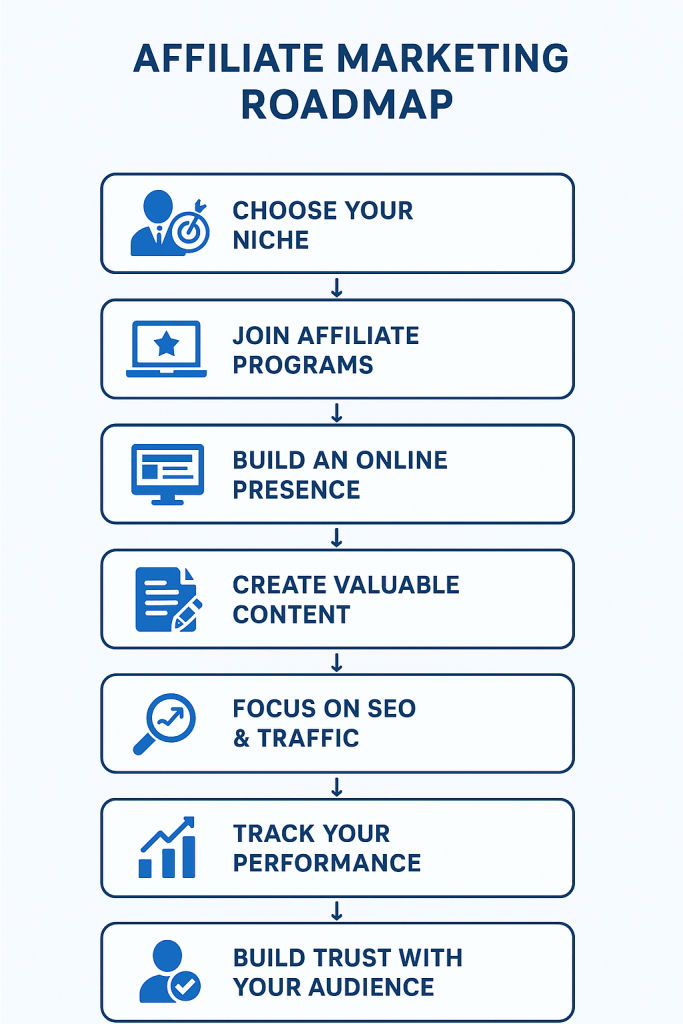
The first step to getting started in affiliate marketing is choosing a niche. A niche is a specific area of interest or industry, such as beauty, fitness, technology, travel, or personal finance. By focusing on a niche, affiliates can build authority and trust with their audience, ensuring that promotions resonate effectively. Once a niche is selected, the next step is to join reputable affiliate programs. Popular networks include Amazon Associates, ShareASale, CJ Affiliate, ClickBank, and Rakuten Marketing. Each platform offers unique benefits, from a wide variety of products to higher commission rates on digital goods, making it possible for affiliates to choose programs that align with their niche and audience.

Choose Your Niche:
Focus on a specific industry or topic you are passionate about, such as beauty, fitness, finance, tech, or travel. A clear niche builds trust and authority with your audience.

Select Affiliate Programs/Companies:
Start with reputable companies and networks. Popular options include:

  • Amazon Associates – Easy to join; wide range of products.
  • ShareASale – Thousands of merchants in various niches.
  • CJ Affiliate (Commission Junction) – High-quality brands and reliable tracking.
  • ClickBank – Digital products, often higher commissions.
  • Rakuten Marketing – Big brands and global reach.

Build an Online Presence:
You’ll need a platform to promote products:

  • Blog or Website: SEO content drives organic traffic.
  • Social Media: Instagram, TikTok, or Pinterest for visual promotions.
  • YouTube: Tutorials and reviews can be highly effective.
  • Email Marketing: Build a subscriber list for recurring promotions.

Affiliate Marketing Tips & Tricks: Quick-Start Guide

1. Choose Your Niche Wisely

  • Pick a topic you are passionate about.
  • Focus on a specific audience to build authority.

2. Join Reputable Affiliate Programs

  • Amazon Associates – Wide variety of products.
  • ClickBank – High commissions on digital products.
  • ShareASale / CJ Affiliate / Rakuten – Access to quality brands.

3. Build an Online Presence

  • Start a blog, YouTube channel, or social media profile.
  • Use email lists to reach your audience directly.

4. Create Valuable Content

  • Tutorials, reviews, comparison guides, and “how-to” articles.
  • Incorporate affiliate links naturally—don’t force them.

5. Focus on SEO & Traffic

  • Optimize your website for search engines to attract organic visitors.
  • Use paid ads strategically for faster results.

6. Track Your Performance

  • Use analytics to monitor clicks, conversions, and top-performing products.
  • Adjust strategies based on what works best.

7. Build Trust with Your Audience

  • Be honest about affiliate links.
  • Share genuine experiences and product recommendations.

8. Diversify & Scale

  • Join multiple affiliate programs to avoid relying on one source.
  • Reinvent and expand your content to reach more audiences.

9. Be Patient & Consistent

  • Earnings grow over time with effort, testing, and optimization.
  • Focus on quality and value rather than quick profits.

10. Learn from Successful Affiliates

  • Follow top affiliates in your niche.
  • Study strategies that consistently convert traffic into sales.

Building a strong online presence is crucial for affiliate marketing success. Affiliates can leverage blogs, websites, social media platforms, YouTube channels, and email marketing to reach potential customers. Content marketing, such as product reviews, tutorials, comparison guides, and “how-to” articles, allows affiliates to provide value while naturally integrating affiliate links. Search engine optimization (SEO) further amplifies reach by attracting organic traffic, while paid advertisements on Google, Facebook, or Instagram can target highly specific audiences to increase conversions. Trust is key; affiliates who provide genuine recommendations and showcase real experiences often see higher engagement and sales.

Content Marketing: Create valuable content like product reviews, “how-to” guides, and comparison articles.

SEO Optimization: Rank your content in search engines to attract free organic traffic.

Paid Ads: Facebook Ads, Google Ads, or influencer partnerships to drive targeted traffic.

Email Campaigns: Promote products to a dedicated audience with newsletters and promotions.

Social Proof & Trust: Use testimonials, case studies, and real experiences to boost credibility.

Successful affiliate marketers employ a combination of strategies to maximize earnings. Tracking performance through analytics enables affiliates to determine which products and promotional methods yield the best results. Diversifying income streams by joining multiple programs and promoting various products reduces risk and increases potential revenue. Email marketing campaigns to a loyal subscriber list can generate recurring income, and integrating social proof—such as testimonials, case studies, or user-generated content—helps establish credibility. Affiliates who prioritize quality over quantity and remain transparent about affiliate links build long-term relationships with their audience.

Pick products you personally trust and align with your audience.

Focus on quality over quantity; promote fewer, high-value products.

Track your performance with analytics to see what converts.

Diversify income streams with multiple affiliate programs.

Always disclose affiliate links; honesty builds trust with your audience.

The earning potential in affiliate marketing varies widely based on niche, traffic, and conversion rates. Beginners might earn between $50 and $500 per month, intermediate affiliates can generate $500–$5,000 monthly, and experienced marketers with multiple platforms and email lists can earn upwards of $50,000 per month. Physical products typically offer lower commissions (1%–10%), while digital products can provide higher rates (30%–75%). The key to success lies in patience, consistency, and reinvesting earnings to scale one’s efforts gradually.

  • Commissions vary by product and program:
    • Physical products: ~1%–10% per sale (Amazon).
    • Digital products: ~30%–75% per sale (ClickBank).
  • Income depends on traffic, conversion rates, and niche:
    • Beginners: $50–$500/month
    • Intermediate: $500–$5,000/month
    • Advanced: $5,000–$50,000+/month (top affiliates often scale with multiple websites and email lists)

Tip: Start small, reinvest earnings, and scale gradually for sustainable income.

In conclusion, affiliate marketing offers a flexible and potentially lucrative way to earn online, provided one approaches it with strategy, integrity, and dedication. By selecting the right niche, collaborating with reputable programs, establishing a robust online presence, and implementing targeted marketing strategies, aspiring affiliates can establish a sustainable source of income. With continuous learning, testing, and adaptation, affiliate marketing not only provides financial opportunities but also allows individuals to share valuable products and services with audiences around the world.

👉 These REFERENCES provide both academic depth and real-world industry insights.

Books & Academic Sources

  • Chaffey, D., & Ellis-Chadwick, F. (2019). Digital Marketing (7th ed.). Pearson.
  • Evans, D. S., & Schmalensee, R. (2016). Matchmakers: The New Economics of Multisided Platforms. Harvard Business Review Press.
  • Strauss, J., & Frost, R. (2016). E-Marketing (7th ed.). Routledge.

Industry & Professional Sources

Statistics & Earnings Potential

  • Statista. (2023). Affiliate Marketing – Statistics & Facts. Retrieved from https://www.statista.com
  • Business Insider Intelligence. (2021). The Affiliate Marketing Report.

👉 These references provide both academic depth and real-world industry insights.

Black Dollars, White Walls: The Fight for Economic Independence.

Photo by Tima Miroshnichenko on Pexels.com

The question of where Black dollars go has long troubled scholars, activists, and community leaders. Despite the vast buying power of African Americans, much of this wealth leaves Black communities almost as soon as it arrives. This leakage of economic resources reflects a cycle of dependency and disinvestment, where Black neighborhoods fail to benefit from the very money generated by their own residents. The fight for economic independence is, therefore, not merely financial but deeply tied to cultural survival, social justice, and community sustainability.

Black buying power in the United States has been steadily growing. According to Nielsen (2019), African Americans represent over $1.4 trillion in annual consumer spending—a figure that rivals the GDP of entire nations. Yet, this immense purchasing capacity has not translated into generational wealth or flourishing Black-owned economies. Instead, dollars are disproportionately spent in industries and corporations owned by non-Black entities, creating what scholars call an “economic drain.” Money circulates in Black neighborhoods for less than 6 hours, compared to 20 days in Jewish communities and nearly a month in Asian communities (Anderson, 2017).

The historical roots of this phenomenon lie in systemic exclusion. For decades, redlining, discriminatory lending, and racial zoning laws prevented Black entrepreneurs from establishing businesses in their own neighborhoods. Meanwhile, white-owned corporations and retailers infiltrated Black communities, extracting profits without reinvesting in local infrastructure. This pattern continues today: major grocery chains, clothing brands, and fast-food corporations dominate in urban areas, yet the profits return to suburban headquarters, leaving Black neighborhoods underdeveloped.

Spending patterns also reflect cultural and social dynamics. Studies indicate that African Americans allocate significant portions of their income to consumer goods such as apparel, footwear, entertainment, and fast food (Nielsen, 2019). For example, Black consumers spend $1.2 billion annually on soft drinks, $1.1 billion on beauty products, and billions more on luxury fashion brands that do little to support Black communities. These spending patterns often reflect aspirational consumption shaped by systemic deprivation and media representations of success, rather than long-term investment strategies.

Psychologically, this aligns with theories of conspicuous consumption and compensatory behavior. When systemic racism limits access to wealth and status, individuals may turn to visible markers of success—designer clothes, expensive cars, and branded goods—to assert dignity and identity (Veblen, 1899/2009). Amos Wilson (1998) argued that consumerism among Black people is not simply personal choice but the result of psychological conditioning designed to keep wealth flowing outward from Black neighborhoods. This cycle perpetuates dependence on external economies rather than fostering internal growth.

The Bible offers wisdom on this matter. Proverbs 21:20 (KJV) declares, “There is treasure to be desired and oil in the dwelling of the wise; but a foolish man spendeth it up.” Scripture warns against reckless consumption and advocates for stewardship, saving, and community provision. Black neighborhoods, continually drained of wealth, exemplify what occurs when consumption outpaces investment. The failure to build collective economic foundations has left generations vulnerable to exploitation and economic instability.

Solutions to this crisis must prioritize intentional economic strategies. First, supporting Black-owned businesses ensures that money circulates within the community, creating jobs and building local wealth. Initiatives such as cooperative economics, inspired by the Kwanzaa principle of Ujamaa, promote collective financial growth. Second, financial literacy education can equip individuals with tools for saving, investing, and building generational wealth. Finally, institutional reform in banking and lending must dismantle barriers that restrict Black entrepreneurs from accessing capital.

Examples of success illustrate what is possible. The Greenwood District of Tulsa, Oklahoma—famously known as “Black Wall Street”—demonstrated the power of circulating Black dollars locally. Before its destruction in 1921, dollars in Greenwood circulated for months, building banks, theaters, hospitals, and schools owned by African Americans (Franklin, 1997). Contemporary movements such as “Buy Black” campaigns and the development of digital Black-owned marketplaces signal a revival of these strategies for the 21st century.

Ultimately, the fight for economic independence requires more than individual choices; it demands collective discipline and structural transformation. Black dollars must be redirected from white walls—corporate headquarters and multinational brands—toward the rebuilding of Black neighborhoods. Economic sovereignty cannot be separated from political power, cultural preservation, and community uplift. Only when Black money circulates where it is most needed will the community break free from cycles of dependency and step fully into the vision of self-determination and prosperity.


References

Anderson, C. (2017). PowerNomics: The national plan to empower Black America. PowerNomics Corporation of America.

Franklin, J. H. (1997). From slavery to freedom: A history of African Americans (7th ed.). Knopf.

King James Bible. (1769/2017). The Holy Bible, King James Version. Cambridge University Press. (Original work published 1611).

Nielsen. (2019). It’s in the bag: Black consumers’ path to purchase. Nielsen Company.

Veblen, T. (2009). The theory of the leisure class. Oxford University Press. (Original work published 1899).

Wilson, A. (1998). Blueprint for Black power: A moral, political, and economic imperative for the twenty-first century. Afrikan World InfoSystems.