
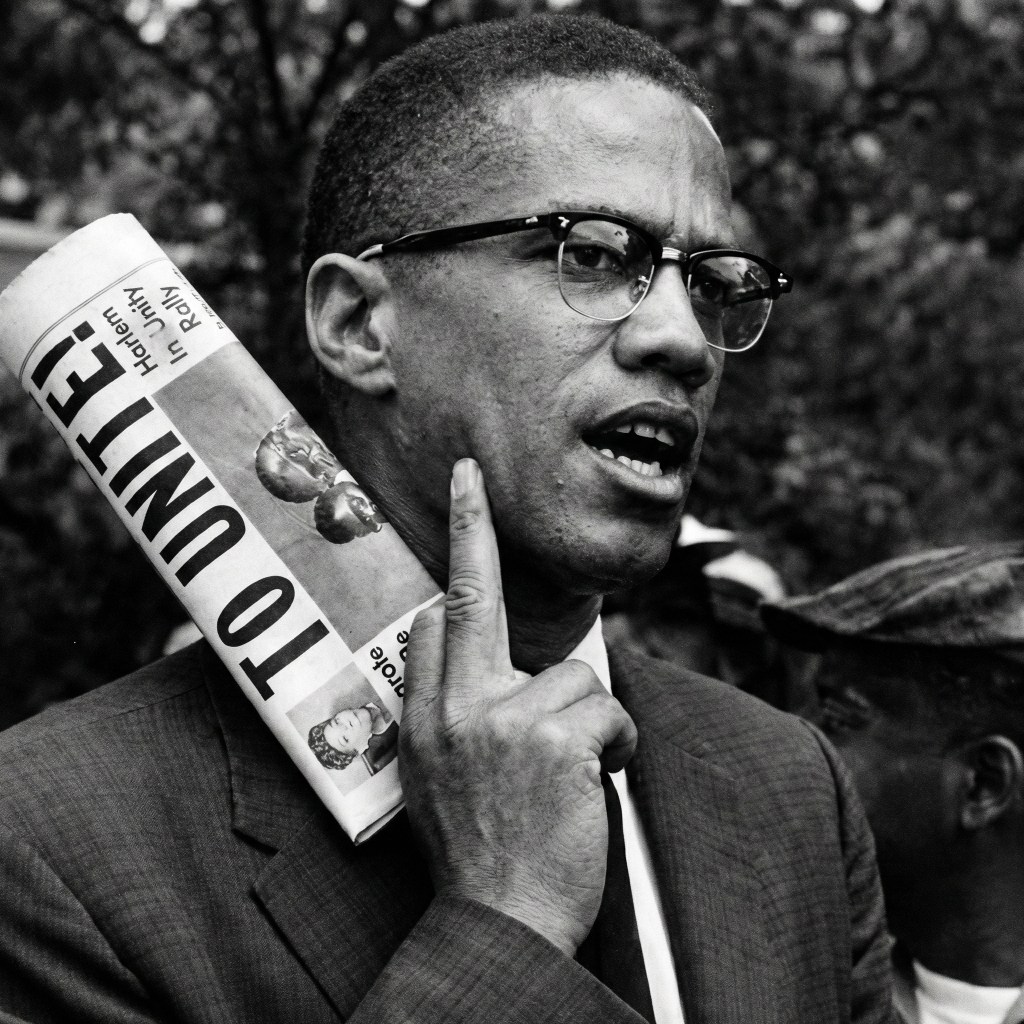
Malcolm X, born Malcolm Little on May 19, 1925, in Omaha, Nebraska, was one of the most influential African American leaders of the 20th century. His life journey—from a troubled youth to a prominent civil rights leader—reflects resilience, intellectual growth, and unwavering advocacy for Black empowerment. He died tragically on February 21, 1965, in New York City after being assassinated while preparing to address the Organization of Afro-American Unity.
Early Life: Malcolm was born to Earl Little, a Baptist minister and supporter of Black nationalist Marcus Garvey, and Louise Little, who was of Grenadian descent. Some sources suggest Malcolm may have had mixed ancestry, particularly through his mother’s Caribbean background, although he identified wholly with his African heritage (Marable, 2011). His early life was marked by hardship, including the death of his father under suspicious circumstances and his mother’s institutionalization, leaving Malcolm and his siblings in foster care.
Education and Youth: Malcolm was a bright student but faced systemic racism and personal challenges. Dropping out of school in eighth grade, he became involved in petty crime and was eventually imprisoned in 1946. His prison years became a turning point; he educated himself extensively, reading widely on history, philosophy, and religion, and converted to the Nation of Islam, adopting the surname “X” to symbolize the lost name of his African ancestry.
Nation of Islam and Activism: As a minister and national spokesperson for the Nation of Islam, Malcolm X advocated for Black self-determination, economic independence, and the rejection of racial integrationist strategies favored by other civil rights leaders like Martin Luther King Jr. He emphasized pride in Black identity and self-defense “by any means necessary” (Malcolm X, 1965).
Family Life: Malcolm married Betty Shabazz in 1958. Together they had six daughters: Attallah, Qubilah, Ilyasah, Gamilah, Malaak, and Kareema. His family played a critical role in preserving his legacy, with Betty Shabazz becoming a prominent educator and activist after his death.
Impact and Power: Malcolm X’s influence stemmed not from official awards or honors during his lifetime but from the power of his voice, intellect, and strategic activism. He inspired generations of African Americans to embrace self-respect, political engagement, and the pursuit of justice. His speeches, writings, and autobiography continue to serve as foundational texts for studies on civil rights, Black nationalism, and social justice (X & Haley, 1965).
Legacy: Malcolm X’s transformation after leaving the Nation of Islam in 1964 broadened his message to include global human rights and racial unity. His pilgrimage to Mecca, where he witnessed Muslims of all races praying together, influenced his belief in universal brotherhood while maintaining a focus on Black empowerment.
Awards and Recognition: While Malcolm X did not receive mainstream awards during his life, posthumously he has been honored extensively. He appears on lists of influential Americans, is commemorated through schools, streets, and cultural centers named in his honor, and his life story has been adapted in literature, documentaries, and films, notably the 1992 biographical film Malcolm X directed by Spike Lee and starring Denzel Washington.
Death: On February 21, 1965, Malcolm X was assassinated at the Audubon Ballroom in Manhattan. Three members of the Nation of Islam were convicted for his murder. His death marked a profound moment in the civil rights movement, and his ideas continued to shape Black empowerment movements, including the Black Power movement.
Nationality and Identity: Malcolm X identified as African American, fully embracing his Black heritage and ancestry. Although he may have had mixed ancestry through his mother, his philosophy and activism were rooted in reclaiming African identity and dignity in a racially oppressive society.
Power and Influence: Malcolm X’s power was intellectual, spiritual, and rhetorical. He wielded influence through his charisma, unflinching critique of systemic racism, and ability to mobilize people around principles of justice and self-determination. He challenged complacency, promoted self-education, and inspired activism that extended beyond the United States, connecting the struggle of African Americans to a global fight for human rights.
Conclusion: Malcolm X’s life is a testament to transformation, resilience, and the pursuit of justice. From troubled youth to revolutionary leader, he left an indelible mark on the civil rights movement and the consciousness of African Americans worldwide. His teachings on empowerment, pride, and self-determination remain deeply relevant in contemporary discussions of race, identity, and social justice.
References:
- Marable, M. (2011). Malcolm X: A life of reinvention. New York: Viking.
- X, M., & Haley, A. (1965). The autobiography of Malcolm X. New York: Grove Press.
- Carson, C. (Ed.). (1998). The autobiography of Martin Luther King, Jr. includes comparative studies on civil rights leadership. New York: Warner Books.
- Lincoln, C. E., & Mamiya, L. H. (1990). The Black church in the African American experience. Durham, NC: Duke University Press.






 THE BROWN GIRL DILEMMA