Chosen ones, seeking the will of the Most High is the highest calling of a believer’s life, for purpose is not discovered in ambition but in obedience. The world teaches us to chase success, status, and self-fulfillment, but Scripture teaches us to seek God’s will above all things, knowing that His plan is eternal, perfect, and aligned with our true destiny (Romans 12:2, KJV).
God’s will is not hidden in mystery to torment us, but revealed progressively to those who desire Him sincerely. The Most High does not guide the proud, the distracted, or the double-minded; He leads those who humble themselves and hunger for righteousness (Matthew 5:6, KJV).
The first way to seek God’s will is through prayer and communion. Prayer is not merely asking for blessings, but aligning your spirit with God’s mind. Through prayer, the believer learns to listen more than speak, and to submit rather than demand (Jeremiah 33:3, KJV).
The second way is through studying the Word of God. Scripture is the primary revelation of God’s will. If something contradicts the Word, it is not God’s will, no matter how appealing it seems (Psalm 119:105, KJV).
The third way is through fasting and spiritual discipline. Fasting weakens the flesh and strengthens spiritual sensitivity. Many cannot hear God clearly because their flesh is too loud and their spirit too weak (Matthew 17:21, KJV).
The fourth way is through obedience in small things. God does not reveal big assignments to people who ignore small instructions. Faithfulness qualifies you for clarity (Luke 16:10, KJV).
The fifth way is through godly counsel. The Most High often speaks through wise and spiritually grounded people. Isolation breeds deception, but wise counsel brings stability (Proverbs 11:14, KJV).
The sixth way is through patience and waiting. God’s will unfolds in seasons, not instantly. Many people rush into decisions and later pray for God to fix what they never asked Him about (Isaiah 40:31, KJV).
The seventh way is through surrender of personal desires. God’s will cannot be followed while clinging to ego, pride, or personal agendas. True guidance begins where self ends (Proverbs 3:5–6, KJV).
The eighth way is through inner peace and conviction. God’s will brings spiritual peace, even when the assignment is difficult. Confusion, chaos, and anxiety are not the voice of God (Colossians 3:15, KJV).
The ninth way is through observing spiritual fruit. God’s will produces righteousness, humility, growth, and love—not pride, greed, or destruction (Matthew 7:16, KJV).
The tenth way is through aligning your life with service. God’s will is always connected to serving others, not just enriching yourself. Purpose is found in impact, not comfort (Mark 10:45, KJV).
Seeking God’s will requires dying to the culture of self-worship and individualism. The modern world glorifies personal dreams, but Scripture calls believers to die daily and live for God’s glory (Luke 9:23, KJV).
Many people remain spiritually stuck because they want God to bless their plans instead of submitting to His. But God does not exist to serve human ambition; humans exist to serve divine purpose (Job 42:2, KJV).
The will of God often requires separation from people, environments, and habits that no longer align with your calling. Growth always involves pruning (John 15:2, KJV).
God’s will may not always be comfortable, but it will always be meaningful. It may involve sacrifice, rejection, or obscurity, but it will never be empty (2 Corinthians 4:17, KJV).
Those who seek God’s will develop spiritual discernment. They learn to recognize when opportunities are distractions and when closed doors are protection (1 Thessalonians 5:21, KJV).
When you seek God’s will, provision follows purpose. You do not chase resources; resources are assigned to your obedience (Matthew 6:33, KJV).
God’s will is not about becoming famous, wealthy, or admired, but about becoming aligned, obedient, and useful in His kingdom (Romans 8:28, KJV).
The chosen are not chosen for comfort but for calling. They are shaped by trials, refined by waiting, and strengthened by faith (James 1:2–4, KJV).
Those who truly walk in God’s will become spiritually anchored. They are not easily swayed by trends, pressure, or public opinion because their identity is rooted in divine instruction (Galatians 1:10, KJV).
Ultimately, seeking God’s will is seeking God Himself. Purpose is not found in destinations, careers, or titles, but in intimacy with the Creator who formed you before you were born (Jeremiah 1:5, KJV).
To seek the Most High’s will is to choose eternal alignment over temporary pleasure, divine purpose over human praise, and spiritual obedience over worldly success. This is the path of the chosen.
In the beginning of creation, humanity is introduced not as an accident of nature but as a deliberate act of divine intention. Scripture teaches that God formed man from the dust of the ground and breathed into his nostrils the breath of life, and man became a living soul (Genesis 2:7, KJV). This verse establishes a foundational theological truth: without the breath of God, humanity remains lifeless matter, no different from the soil beneath our feet.
The imagery of dust is deeply symbolic. Dust represents human fragility, limitation, and mortality. It reminds us that no matter how advanced civilization becomes, humanity remains dependent on divine power for existence. The breath of God transforms dust into life, meaning that human dignity does not originate from intellect, wealth, or status, but from divine impartation (Psalm 103:14).
The breath of life is not merely biological respiration; it is spiritual animation. In Hebrew, the word for breath, ruach, also means spirit or wind, indicating that life itself is sustained by the Spirit of God. This suggests that humanity is not self-sustaining but continuously upheld by divine presence (Ezekiel 37:5).
Without God’s breath, human existence loses its sacred meaning. Modern society often elevates human autonomy and self-sufficiency, yet scripture consistently reminds us that life is borrowed, not owned. Every heartbeat and breath testifies to divine mercy rather than human control (Acts 17:25).
The Most High God of Israel is portrayed throughout scripture as the giver and sustainer of life. He is not distant from creation but intimately involved in its continuation. Job acknowledges this truth when he declares that the Spirit of God has made him and the breath of the Almighty gives him life (Job 33:4).
To cherish the Creator is to recognize the source of one’s existence. Gratitude becomes a spiritual posture when one understands that life is a divine gift rather than a human achievement. Worship, therefore, is not ritualistic obligation but an acknowledgment of existential dependence (Psalm 150:6).
Human pride often blinds people to this reality. Scientific advancement has led many to believe that life can be explained without God, yet even science cannot produce consciousness from nothing. The mystery of life still points back to divine origin rather than mechanical causation (Collins, 2006).
In biblical theology, breath is also associated with renewal and restoration. In the valley of dry bones, God commands breath to enter lifeless bodies, and they rise again, symbolizing spiritual revival and national restoration (Ezekiel 37:9–10). This narrative reinforces that without divine breath, there is no resurrection, no hope, and no future.
The breath of God also signifies moral responsibility. If life comes from God, then life belongs to God. Humanity is therefore accountable to divine standards, not self-created ethics. This challenges modern individualism, which promotes self-definition without divine authority (Romans 14:7–8).
To say “we are dust without His breath” is to affirm human humility. It dismantles the illusion of self-made identity and replaces it with sacred dependency. Even kings and empires return to dust, but God’s breath remains eternal (Ecclesiastes 12:7).
The Most High is not merely a creator but a sustainer. He does not abandon what He forms. Scripture portrays God as continually involved in the world, sustaining all things by His word and power (Hebrews 1:3). Life is not a past miracle but an ongoing one.
Cherishing the Creator involves living in awareness of divine presence. It transforms daily life into a sacred experience. Eating, breathing, thinking, and loving become acts of worship when viewed through the lens of divine origin (Colossians 3:17).
The concept of breath also connects to divine communication. God’s breath produces His word, and His word produces life. The same God who breathed into Adam later breathed scripture into prophets and apostles, making His word living and powerful (2 Timothy 3:16).
From a theological perspective, denying God as the source of life leads to spiritual alienation. When humanity forgets its Creator, it begins to worship creation, self, and materialism. This reversal of order results in moral decay and existential emptiness (Romans 1:21–25).
The breath of God also represents divine intimacy. Unlike other creatures, humanity receives life through direct divine interaction. God does not speak humans into existence; He breathes into them, suggesting relational closeness rather than distant creation (Brueggemann, 2010).
Life therefore carries sacred responsibility. If God’s breath animates humanity, then every human life possesses inherent worth, regardless of race, class, or ability. This foundation supports biblical human dignity and justice (Genesis 1:27).
The Most High God of Israel reveals Himself not only as powerful but as compassionate. He breathes life into fragile dust and remains patient with human failure. His mercy sustains those who constantly fall short of divine perfection (Lamentations 3:22–23).
Even death in scripture does not represent divine abandonment. The return of breath to God signifies transition, not annihilation. The soul returns to its source, awaiting divine judgment and restoration (Ecclesiastes 12:7).
In this sense, breath becomes eschatological. It points beyond physical life to eternal reality. God’s breath does not merely create time-bound existence but prepares humanity for everlasting communion (John 20:22).
Ultimately, the statement “we are dust without His breath” is not a message of despair but of sacred truth. It reminds humanity that life is not meaningless, accidental, or random. Life is divine, purposeful, and sustained by the Most High God of Israel.
To cherish the Creator is to live in reverence, humility, and gratitude. Every breath becomes a testimony of divine mercy, and every moment becomes an opportunity to acknowledge the One who turns dust into living souls.
References
Brueggemann, W. (2010). Genesis: Interpretation: A Bible commentary for teaching and preaching. Westminster John Knox Press.
Collins, F. S. (2006). The language of God: A scientist presents evidence for belief. Free Press.
The Holy Bible, King James Version. (1611/2017). Cambridge University Press.
Wright, N. T. (2012). How God became king: The forgotten story of the Gospels. HarperOne.
Walton, J. H. (2009). The lost world of Genesis one: Ancient cosmology and the origins debate. InterVarsity Press.
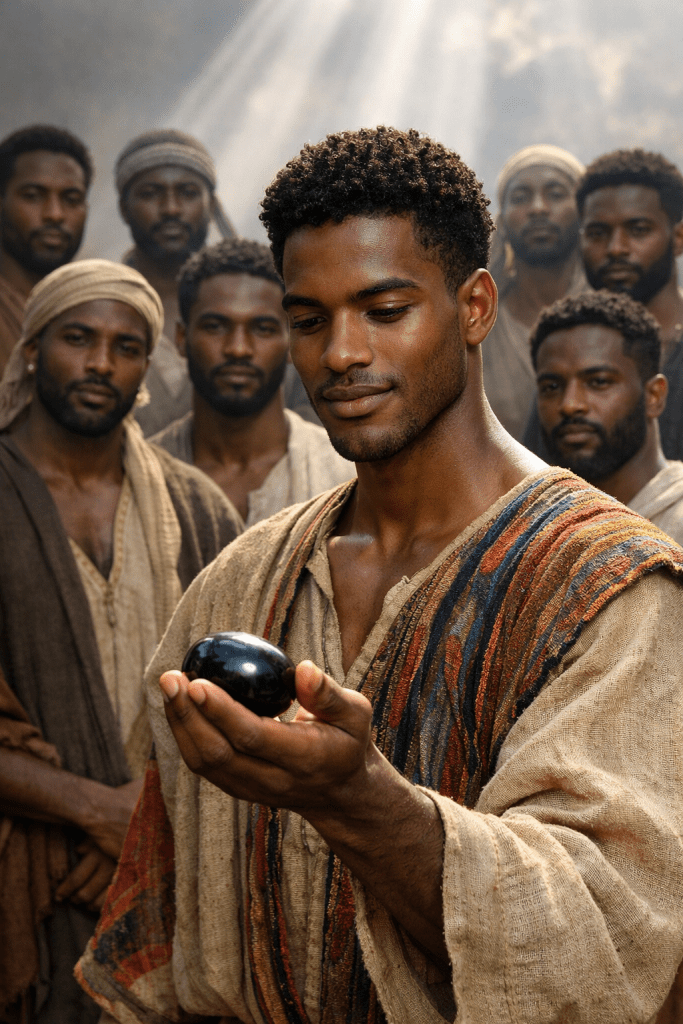
Onyx, dark as the midnight sky yet polished with hidden light, a stone of mystery shaped by time and pressure, a gem that carries both beauty and burden, whispering of destinies forged through suffering, and of souls refined in the fire of betrayal.
Onyx holds deep symbolic meaning in the biblical tradition, representing endurance, spiritual depth, and divine remembrance. In Scripture, onyx is one of the stones set in the high priest’s breastplate, engraved with the names of the tribes of Israel, signifying that each tribe was carried before God in sacred memory.
Joseph, the eleventh son of Jacob and the firstborn of Rachel, stands as one of the most compelling figures among the twelve tribes of Israel. His life narrative is not merely historical but theological, illustrating divine providence, generational conflict, and the mystery of chosenness within a fractured family system.
According to rabbinic and later symbolic traditions, Joseph is associated with the onyx stone, reflecting both his dark trials and radiant destiny. Onyx becomes a metaphor for Joseph’s life—polished through suffering, yet ultimately exalted through divine purpose.
Joseph’s story begins with favor, as he is given the coat of many colors by his father, a garment symbolizing distinction, authority, and emotional preference. This visible sign of love ignites jealousy among his brothers, sowing the seeds of betrayal long before the act itself unfolds.
The dreams Joseph receives intensify this conflict. In his visions, the sun, moon, and stars bow before him, along with sheaves of grain belonging to his brothers. These dreams are not merely youthful imagination but prophetic revelations that foreshadow his future role as a ruler and preserver of life.
Yet divine insight does not shield Joseph from human cruelty. His brothers, consumed by envy, conspire against him, stripping him of his garment and casting him into a pit before selling him to Midianite traders for silver, effectively turning family into traffickers and blood into profit.
This act of betrayal reflects one of the Bible’s deepest moral tensions: how God’s purpose often unfolds through human sin. Joseph is innocent, yet he becomes the vessel through which divine redemption will later flow, revealing the paradox of suffering as preparation.
Joseph’s descent into Egypt marks the beginning of his transformation. Though enslaved, he maintains integrity, resisting moral compromise even when falsely accused and imprisoned. His righteousness becomes a quiet rebellion against despair.
In prison, Joseph’s gift of dream interpretation resurfaces, proving that divine calling cannot be silenced by circumstance. His spiritual insight becomes the very instrument that elevates him from prisoner to prince.
Pharaoh’s dreams of famine and abundance position Joseph as a savior figure, entrusted with authority over Egypt’s economy. He rises not by lineage but by wisdom, embodying the principle that divine favor transcends social status.
Joseph’s beauty is also noted in Scripture, described as fair in form and appearance, making him both desired and tested. His physical attractiveness parallels his spiritual calling, showing how outward beauty can coexist with inner discipline.
When famine strikes, Joseph’s brothers unknowingly come before him in search of food, fulfilling the very dreams they once mocked. Their bowing becomes not an act of submission to a man, but to the divine orchestration behind his life.
Joseph’s emotional response reveals the complexity of forgiveness. He weeps privately, torn between memory and mercy, justice and compassion. His power is not in revenge, but in restraint.
The moment of reconciliation becomes one of the Bible’s most profound theological revelations. Joseph declares that what his brothers meant for evil, God intended for good, reframing trauma as testimony.
This declaration does not erase the pain of betrayal but redeems it. Joseph becomes the preserver of the family that once sought his destruction, turning the wound into a wellspring of survival.
Onyx, in this context, becomes more than a gemstone; it is a symbol of Joseph himself—darkened by suffering, refined by pressure, and set in divine memory as part of Israel’s eternal identity.
The family affair of Joseph is not merely about sibling rivalry but about generational inheritance, divine election, and moral responsibility. His story challenges the illusion of fairness and exposes the deeper logic of providence.
Joseph’s life reveals that destiny is not destroyed by betrayal, but often activated by it. The pit becomes the passageway, the prison becomes the platform, and the wound becomes the witness.
Through Joseph, the tribe associated with onyx emerges as a testament to spiritual endurance. He becomes a living stone in the architecture of Israel’s story, bearing both the scars of rejection and the seal of divine favor.
Onyx thus stands as a sacred metaphor for Joseph’s journey, reminding readers that God often engraves glory upon the darkest surfaces, and that what is polished by suffering may one day shine in sovereignty.
References The Holy Bible, King James Version. (2017). Hendrickson Publishers. (Original work published 1611). Exodus 28:9–12, 28:20 (KJV). Genesis 37–50 (KJV). Alter, R. (2018). The Hebrew Bible: A translation with commentary. W. W. Norton & Company. Sarna, N. M. (1989). Genesis: The traditional Hebrew text with the new JPS translation. Jewish Publication Society. Brown, F., Driver, S. R., & Briggs, C. A. (2001). The Brown-Driver-Briggs Hebrew and English lexicon. Hendrickson.
The story of a people is written not only in sacred texts and historical records, but also in the very code of their DNA. For descendants of the African diaspora, the intersection of Scripture and science reveals a profound truth: identity cannot be erased, no matter the depth of dispersion or oppression. Deuteronomy 28, one of the most sobering chapters of the Hebrew Scriptures, outlines blessings for obedience and curses for disobedience. Many have drawn parallels between its prophetic warnings and the lived experiences of Africans scattered through the transatlantic slave trade.
The Bible declares, “And the LORD shall scatter thee among all people, from the one end of the earth even unto the other” (Deuteronomy 28:64, KJV). Historically, this scattering is vividly mirrored in the forced displacement of millions of Africans from West and Central Africa to the Americas, Europe, and beyond. Genetic studies confirm these origins: Y-DNA haplogroup E1b1a (E-M2) and mtDNA lineages such as L2 and L3 are dominant among African Americans and Afro-Caribbean populations, directly tying them to regions historically involved in the slave trade (Salas et al., 2002; Tishkoff et al., 2009).
What is striking is how prophecy, history, and genetics intersect. Deuteronomy 28:68 warns of a return to Egypt “with ships,” a verse many connect with the Middle Passage. Ships became the vessels of bondage, scattering families and bloodlines across continents. Yet even in this rupture, the genetic markers remain unbroken—silent witnesses of survival. Each haplogroup is a testimony that no empire, chain, or auction block could erase God’s covenantal design.
The diaspora, then, is not simply a tragic result of history; it is a prophetic unfolding. Genetics confirms dispersion, but Scripture provides meaning. In the double helix of DNA, one sees both the curse of scattering and the promise of eventual regathering. As Isaiah declares, “He shall set up an ensign for the nations, and shall assemble the outcasts of Israel” (Isaiah 11:12, KJV). The science of ancestry maps the scattering; the Word of God points toward the gathering.
📖 References
Holy Bible, King James Version.
Salas, A., Richards, M., De la Fe, T., Lareu, M. V., Sobrino, B., Sánchez-Diz, P., … & Carracedo, Á. (2002). The making of the African mtDNA landscape. American Journal of Human Genetics, 71(5), 1082–1111.
Tishkoff, S. A., Reed, F. A., Friedlaender, F. R., Ehret, C., Ranciaro, A., Froment, A., … & Williams, S. M. (2009). The genetic structure and history of Africans and African Americans. Science, 324(5930), 1035–1044.
This artwork is the property of its respective owner. No copyright infringement intended.
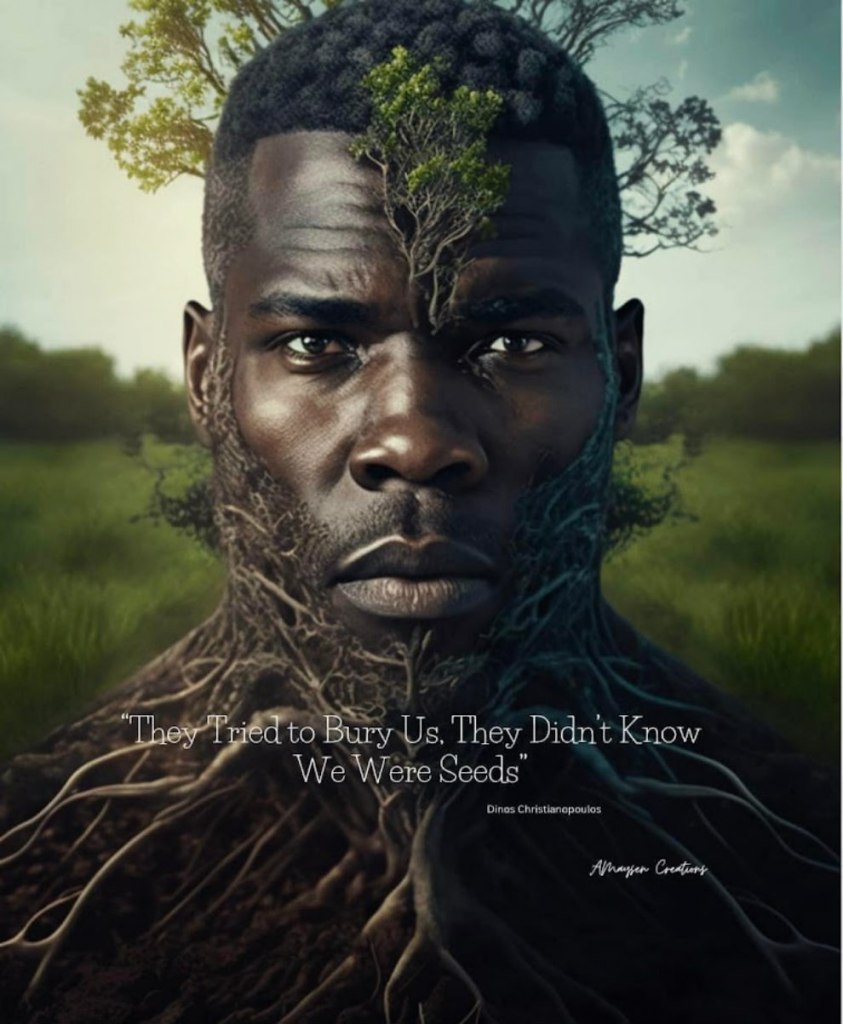
The story of God’s chosen people is deeply rooted in Scripture, prophecy, and history. Deuteronomy 28 (KJV) outlines blessings for obedience and curses for disobedience, serving as both a covenant promise and a prophetic warning. Many within the African diaspora identify their struggles and resilience with these verses, seeing themselves as the “seeds of the promise,” scattered across the earth yet preserved by God’s hand. Like trees planted by rivers of living water, they endure oppression, displacement, and hardship while continuing to grow, flourish, and bear fruit.
The Seeds and the Promise Seeds carry potential and continuity. Spiritually, the descendants of Israel are seeds of the covenant God made with Abraham (Genesis 17:7, KJV). Psychologically, seeds represent identity and generational transmission. Black people, despite systemic oppression, have carried cultural, spiritual, and intellectual seeds across continents, preserving language, rhythm, faith, and resilience. These seeds testify to survival against all odds.
Deuteronomy 28 and the Black Experience The curses in Deuteronomy 28:15–68 resonate profoundly with the history of Black people. Enslavement, scattering across nations, oppression by enemies, and loss of identity parallel the transatlantic slave trade and subsequent struggles of the African diaspora. Verse 68 speaks of returning to Egypt “again with ships,” a striking image that mirrors the ships that carried millions into bondage. Many interpret these prophecies as evidence that Black people are part of God’s chosen covenant people.
Trees Planted by Living Water Psalm 1:3 (KJV) describes the blessed man as being “like a tree planted by the rivers of water, that bringeth forth his fruit in his season.” This metaphor speaks to endurance and divine sustenance. Despite centuries of slavery, segregation, and systemic oppression, Black communities have remained rooted in faith, producing leaders, artists, scholars, and prophets who have blessed the world. The psychology of Black resilience reveals a deep wellspring of spiritual and cultural resources that mirror this biblical imagery.
Psychologically, Black people have carried generational trauma from enslavement, colonization, and racism. Yet, alongside trauma exists resilience—expressed through music, oral tradition, communal bonds, and faith in God. Na’im Akbar (1984) noted that African-descended people maintain strength by reclaiming identity, resisting oppression, and drawing on spirituality. This resilience is evidence of the “living water” that sustains God’s chosen, nourishing them in the face of systemic attempts to uproot them.
The history of Black people stretches far beyond the African continent. Evidence of African presence is found in ancient Israel, Mesopotamia, and early Christian communities. African contributions shaped global civilizations through science, mathematics, philosophy, and theology. From the Kingdom of Kush to the Moors in Spain, Black history reveals a legacy of leadership and brilliance that extends into the Americas, the Caribbean, and beyond. These contributions reveal a scattered yet resilient people, reflecting the biblical narrative of God’s chosen seed dispersed among nations.
Being chosen does not mean privilege without responsibility; it means bearing the covenant of obedience. Deuteronomy 7:6 (KJV) declares, “For thou art an holy people unto the LORD thy God: the LORD thy God hath chosen thee to be a special people unto himself, above all people that are upon the face of the earth.” This chosenness is marked not only by blessings but also by trials meant to refine and bring the people back to God. Black people’s journey through slavery, segregation, and systemic oppression mirrors this refining fire.
The transatlantic slave trade attempted to erase identity, yet language, song, and spirituality preserved the covenant consciousness of the people. Spirituals like “Go Down, Moses” encoded biblical identity, likening the plight of enslaved Africans to the Israelites in Egypt. This connection shows how deeply the promise of God was embedded in the psychology of Black communities, even in the darkest times.
Conclusion The seeds of the promise remain alive in God’s chosen. Though scattered, bruised, and oppressed, they continue to grow like trees planted by the rivers of water, sustained by the living Word of God. Black history—beyond Africa and into the Americas, Europe, and beyond—bears witness to the fulfillment of prophecy and the preservation of a covenant people. To live as God’s chosen is to embrace both identity and responsibility, walking in obedience, resilience, and faith. The story of the seeds of the promise is not only a history lesson—it is a living testimony of God’s hand upon His people.
References
Akbar, N. (1984). Africentric Social Sciences for Human Liberation. Journal of Black Studies.
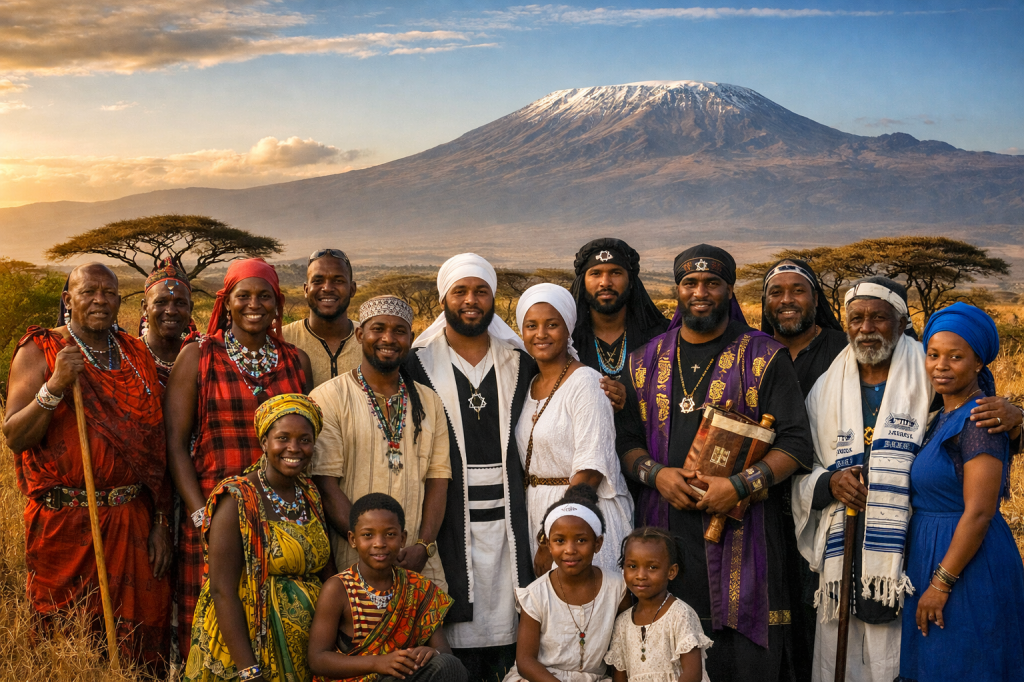
Africa holds a central and indispensable role in biblical prophecy, not as a peripheral landmass, but as a divinely positioned continent woven throughout Scripture from Genesis to Revelation. The Bible consistently presents Africa as a place of refuge, judgment, preservation, and future redemption. When read carefully through a prophetic lens, Africa emerges as a key stage upon which God’s purposes for humanity and Israel unfold.
From the earliest chapters of Genesis, Africa is present in sacred geography. The land associated with Cush, Mizraim, Put, and Ethiopia traces directly to the sons of Ham, whose descendants populated much of the African continent. Genesis records that one of the four rivers flowing from Eden, Gihon, compassed the whole land of Ethiopia, establishing Africa’s presence at the dawn of human history (Genesis 2:13, KJV). This placement signals Africa’s foundational role in God’s original creation narrative.
Africa also serves as a place of divine preservation. Egypt, located in northeast Africa, became the refuge for Joseph and later the entire family of Jacob during famine. God used Africa to sustain the covenant line through which Israel would emerge, demonstrating that African lands were instrumental in preserving the people of promise (Genesis 47:11–12, KJV).
The prophetic significance of Africa intensifies in the Exodus narrative. Egypt stands as both a place of refuge and bondage, illustrating how African territories function in God’s redemptive plan as spaces of testing, judgment, and eventual deliverance. The plagues upon Egypt were not random acts, but prophetic demonstrations of God’s supremacy over nations and false gods (Exodus 12:12, KJV).
Africa’s role extends beyond ancient Israel into messianic prophecy. The Gospel of Matthew records that Jesus Christ was taken into Egypt as a child to escape Herod’s massacre, fulfilling the prophecy, “Out of Egypt have I called my son” (Matthew 2:15, KJV). This moment affirms Africa as a protector of the Messiah and a fulfillment point of prophetic Scripture.
The prophets repeatedly reference African nations in end-time contexts. Isaiah speaks of Ethiopia as a land “shadowing with wings,” sending ambassadors by the sea, indicating geopolitical and prophetic relevance in global affairs (Isaiah 18:1–2, KJV). These passages suggest Africa’s involvement in international movements that precede divine intervention.
Psalm 68 explicitly foretells Africa’s future spiritual awakening, declaring, “Princes shall come out of Egypt; Ethiopia shall soon stretch out her hands unto God” (Psalm 68:31, KJV). This verse is widely understood as a prophetic declaration of Africa’s role in worship, restoration, and alignment with God’s kingdom purposes in the last days.
Africa also appears in prophetic judgments. Ezekiel prophesies against Egypt and its allies, including Cush and Put, demonstrating that African nations are not exempt from divine accountability (Ezekiel 30:4–5, KJV). These judgments align Africa with the broader prophetic pattern of nations being weighed according to righteousness and obedience to God.
The book of Daniel includes Africa in visions of global power shifts. The “king of the north” is said to have authority over “the precious things of Egypt,” along with the Libyans and Ethiopians following at his steps (Daniel 11:43, KJV). This prophecy places African nations within end-time geopolitical alignments.
Africa’s prophetic relevance is also seen in the spread of the gospel. Acts records the conversion of the Ethiopian eunuch, a high official who carried the message of Christ back to Africa, signaling the continent’s early and enduring connection to Christian faith (Acts 8:27–39, KJV). This event foreshadows Africa’s role in global evangelism.
The Bible repeatedly challenges Eurocentric interpretations that marginalize Africa. Scripture itself affirms Africa’s proximity to God’s redemptive acts, revealing that African lands and peoples were never spiritually distant or insignificant within biblical history or prophecy.
Africa’s suffering through colonization, enslavement, and exploitation mirrors biblical patterns of oppression followed by divine reckoning. Just as Egypt was judged for its cruelty toward Israel, Scripture warns that nations will be judged for injustice and bloodshed (Genesis 15:14, KJV). This principle reinforces Africa’s prophetic role as both witness and participant in God’s justice.
The prophetic scriptures also emphasize restoration. Isaiah foretells a time when scattered peoples will be brought back to worship the Lord from distant lands, including Africa (Isaiah 11:11, KJV). This regathering theme resonates strongly with African and diasporic histories.
Africa’s inclusion in prophecy demonstrates God’s global sovereignty. Biblical prophecy does not center exclusively on one region, but reveals a God who governs all nations, including those often overlooked or dismissed by human power structures (Acts 17:26, KJV).
The Book of Revelation depicts all nations and peoples standing before God’s throne, which necessarily includes Africa (Revelation 7:9, KJV). This vision affirms Africa’s presence in the culmination of prophetic history, not as a footnote, but as a redeemed participant in God’s eternal kingdom.
Africa’s prophetic significance also lies in its spiritual resilience. Despite centuries of trauma, African spirituality, worship, and biblical literacy remain deeply rooted, aligning with prophecies of endurance and faith under persecution (Matthew 24:13, KJV).
The repeated biblical mention of African lands underscores that prophecy is inseparable from geography. God acts in real places, among real people, and Africa consistently appears as one of those divinely appointed locations.
Understanding Africa’s role in biblical prophecy challenges distorted narratives that separate faith from Black history. Scripture affirms Africa as central to God’s plan, restoring dignity and biblical identity to African peoples worldwide.
Africa’s place in prophecy ultimately points to hope. The same God who used African lands for preservation, judgment, and refuge promises restoration, worship, and inclusion in His kingdom. This assures that Africa’s story is not marginal, but prophetic.
In the unfolding of biblical prophecy, Africa stands as a witness to God’s faithfulness across generations. From Eden to the Exodus, from the Messiah’s refuge to the final gathering of nations, Africa remains essential to the divine narrative, confirming that God’s promises encompass all lands and all peoples according to His sovereign will.
References
The Holy Bible, King James Version. (1769/2017). Cambridge University Press.
The Y-DNA haplogroup E1B1A is one of the most significant genetic markers in the study of human ancestry, particularly among African populations. Its prevalence in sub-Saharan Africa, especially among West and Central Africans, points to deep historical roots that connect modern descendants to ancient African civilizations. Understanding E1B1A provides insight into the lineage often associated with the biblical Seed of Israel.
Genetic studies indicate that E1B1A likely originated in East Africa and spread westward thousands of years ago. This haplogroup is notably dominant among people of the African diaspora, particularly those whose ancestors were forcibly brought to the Americas during the transatlantic slave trade (Henn et al., 2008). Its prevalence underscores the continuity of African ancestry across continents and centuries.
From a biblical perspective, the Seed of Israel carries promises of covenant, blessing, and nationhood. Scriptures emphasize that God’s covenantal blessings were passed down through the lineages of Abraham, Isaac, and Jacob (Genesis 17:7). Genetic markers like E1B1A offer a modern framework for tracing this lineage in historical and contemporary populations.
The dispersion of E1B1A aligns with historical accounts of migration and conquest. African kingdoms such as Ghana, Mali, and Songhai housed populations with high frequencies of this haplogroup. Their social, economic, and cultural achievements demonstrate a continuity of intelligence, leadership, and resilience—qualities associated biblically with the Israelites (Deuteronomy 28:1–14).
The biblical narrative situates the Israelites as a chosen people, set apart for divine purpose. The connection of E1B1A to African populations reinforces the argument that the original Israelites were of African descent. Psalm 105:6–11 recounts God’s covenant with Abraham and his seed, highlighting the enduring lineage that extends into modern African-descended populations (KJV).
Historically, the transatlantic slave trade severed cultural and genealogical continuity, obscuring the direct lineage of African descendants in the Americas. Despite this disruption, genetic markers like E1B1A provide scientific evidence of enduring heritage and ancestral connection, affirming the biblical promise of the preservation of Israel’s seed (Jeremiah 31:35–37).
Anthropological studies of E1B1A reveal patterns of societal structure, migration, and adaptation. Populations with this haplogroup historically established powerful kingdoms, engaged in sophisticated trade networks, and developed rich cultural traditions. These accomplishments reflect the divine favor and resilience described in Deuteronomy 28:12–13.
The association between E1B1A and leadership traits is notable. Historically, men with this lineage often held positions of authority, governance, and military command. This aligns with the biblical depiction of Israelite men as leaders, judges, and warriors chosen to uphold God’s law and protect their communities (Joshua 1:6–9).
E1B1A also connects to spiritual heritage. The Israelites were entrusted with God’s laws, ethical codes, and covenantal responsibilities. The resilience of African-descended populations, despite centuries of oppression, slavery, and displacement, mirrors the biblical narrative of enduring faith and divine preservation (Psalm 105:8).
Culturally, E1B1A populations have preserved elements of African identity, including language, music, and communal structures, even across diasporic contexts. These cultural continuities serve as living testimony to the endurance of the Seed of Israel, reflecting values emphasized in biblical instruction (Exodus 12:14).
Genetics and scripture intersect in demonstrating continuity and purpose. While DNA provides biological evidence, the Bible provides spiritual and moral context, framing the lineage as not only preserved but chosen and blessed by God (Genesis 28:13–15). Together, these perspectives illuminate the depth of African heritage.
The study of E1B1A challenges Eurocentric historical narratives that have often obscured African achievements. Recognizing the genetic, cultural, and spiritual legacies of E1B1A populations restores historical truth and affirms the presence of the Israelites in Africa (Deuteronomy 28:68).
The distribution of E1B1A among diasporic populations underscores the persistence of identity despite adversity. African-descended people in the Americas, Caribbean, and Europe carry markers of ancient lineage, testifying to the survival of Israel’s seed against historical forces of erasure (Isaiah 49:15–16).
Spiritual reflection on E1B1A emphasizes responsibility and calling. Those who carry this lineage are encouraged to embody principles of justice, wisdom, and leadership, reflecting the covenantal blessings promised to Israel (Proverbs 4:7). The DNA serves not merely as inheritance but as a blueprint for purpose.
Education and awareness of genetic heritage foster empowerment. Understanding the connection between E1B1A and biblical Israel allows African-descended populations to reclaim narratives of dignity, history, and destiny, reinforcing self-worth and communal pride (Jeremiah 33:3).
Modern research on E1B1A includes advanced genetic mapping and population studies. These studies reveal migration patterns, admixture, and historical continuity, providing scientific validation for long-held ancestral knowledge and oral traditions (Henn et al., 2012).
The resilience of E1B1A populations in the face of slavery, colonialism, and systemic oppression demonstrates a living manifestation of biblical promises. Their endurance exemplifies faithfulness and divine protection, echoing Deuteronomy 31:6.
Understanding E1B1A also highlights the intersection of biology, history, and theology. DNA does not exist in isolation—it interacts with culture, belief, and community. Recognizing this interplay enriches both scientific and spiritual understanding of human identity.
Mentorship and intergenerational transmission of knowledge are vital. Passing down awareness of lineage, cultural heritage, and spiritual responsibility ensures that the lessons embedded in E1B1A continue to guide descendants of Israel (Proverbs 22:6).
In conclusion, E1B1A is more than a genetic marker; it is a testament to endurance, heritage, and divine purpose. Tracing this lineage illuminates the biblical Seed of Israel, connecting modern African-descended populations to their ancestral covenant. Recognizing and embracing this inheritance empowers individuals and communities to embody the greatness, resilience, and responsibility embedded in their DNA.
References
Henn, B. M., Botigué, L. R., Gravel, S., Wang, W., Brisbin, A., Byrnes, J. K., … & Bustamante, C. D. (2012). Genomic ancestry of North Africans supports back-to-Africa migrations. PLOS Genetics, 8(1), e1002397. https://doi.org/10.1371/journal.pgen.1002397
Henn, B. M., Cavalli-Sforza, L. L., & Feldman, M. W. (2008). The great human expansion. Proceedings of the National Academy of Sciences, 105(36), 13471–13476. https://doi.org/10.1073/pnas.0805312105
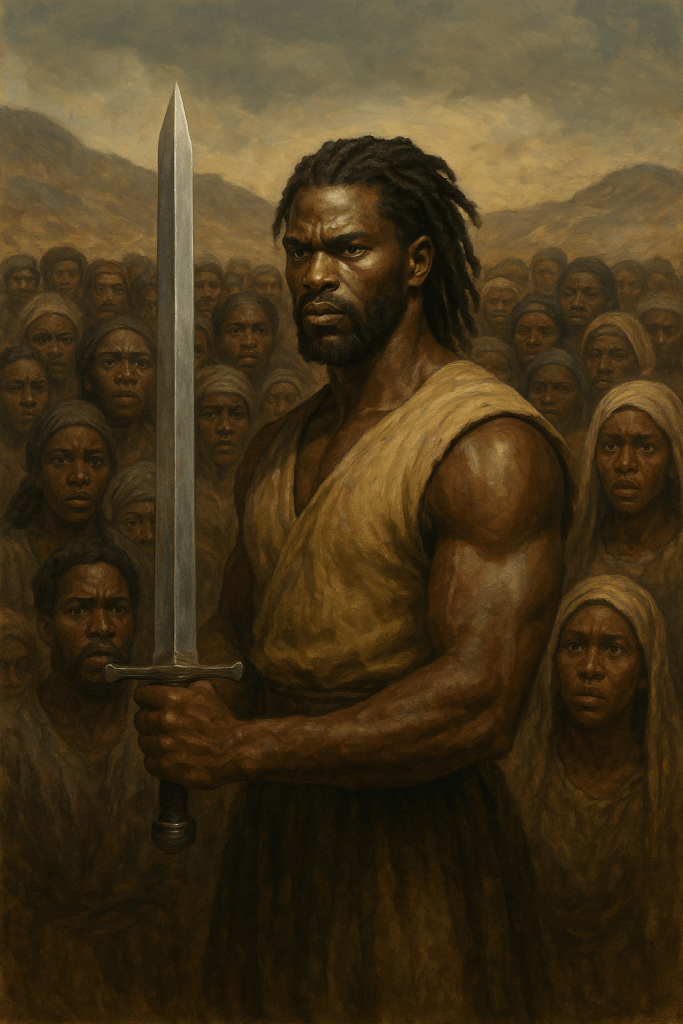
The account of Gideon and the Midianites unfolds during a dark period in Israel’s history, when the people repeatedly turned away from the covenant and suffered oppression as a consequence. The book of Judges situates this narrative in a cycle of sin, servitude, supplication, and salvation, revealing both human frailty and divine mercy according to the LORD’s enduring faithfulness.
Midian’s oppression of Israel was severe and systematic, stripping the land of its produce and driving the people into dens and caves. The Israelites cried unto the LORD, acknowledging that their distress was linked to disobedience, and the text emphasizes that economic devastation and fear had become daily realities in the promised land.
Before deliverance came, the LORD sent a prophet to remind Israel of His saving acts, declaring that He brought them out of Egypt and delivered them from the hand of all their oppressors. This rebuke framed the coming salvation as an act of grace rather than reward, exposing the spiritual root of Israel’s suffering.
Gideon is introduced not as a mighty warrior but as a fearful man threshing wheat by the winepress to hide it from Midian. This setting underscores the humility of Gideon’s beginnings and the contrast between human weakness and divine calling.
The Angel of the LORD greeted Gideon with words that seemed contradictory to his circumstances, calling him a “mighty man of valour.” This divine address reveals God’s perspective, which speaks identity and purpose into situations that appear barren and defeated.
Gideon questioned how deliverance could come through him, citing his clan’s insignificance and his own low status. The LORD’s response redirected Gideon’s focus from self-assessment to divine presence, promising, “Surely I will be with thee.”
A sign was given to Gideon through an offering consumed by fire, confirming the LORD’s commission. Gideon’s fear turned to reverence as he recognized the holiness of the encounter, building an altar and naming it “The LORD is peace.”
The call to deliver Israel began at home, as Gideon was instructed to tear down his father’s altar to Baal and cut down the grove beside it. This act demonstrated that spiritual reform must precede national victory and that idolatry could not coexist with covenant faithfulness.
Though Gideon acted by night out of fear, the LORD honored his obedience. When opposition arose from the men of the city, Gideon’s father defended him, declaring that Baal should plead for himself if he were truly a god.
As Midian gathered with Amalek and the children of the east, the Spirit of the LORD clothed Gideon, empowering him to call Israel to arms. Yet even in leadership, Gideon sought reassurance, revealing the patience of God with those who desire confirmation of His will.
The sign of the fleece demonstrated God’s condescension to Gideon’s weakness, granting clarity without rebuke. This moment highlights the balance between faith and divine compassion within the narrative.
When the army assembled, the LORD reduced Gideon’s forces to prevent Israel from boasting that victory came by human strength. The deliberate shrinking of the army underscored that salvation belongs to the LORD alone.
The final selection of three hundred men emphasized obedience and alertness rather than military might. Through this unlikely company, God prepared to display His power unmistakably.
On the eve of battle, the LORD strengthened Gideon by revealing a Midianite’s dream foretelling defeat by Gideon’s hand. Gideon’s worship in response illustrates faith matured through divine reassurance.
The strategy of trumpets, pitchers, and lamps defied conventional warfare, signaling that the victory would be miraculous. When the men cried, “The sword of the LORD, and of Gideon,” confusion seized the enemy camp.
The Midianites turned their swords upon one another and fled, fulfilling the LORD’s promise of deliverance. Israel pursued, and the oppressors were subdued, marking a decisive turning point.
Despite victory, Gideon refused kingship, declaring that the LORD alone would rule over Israel. This confession affirmed divine sovereignty, though later actions revealed lingering human weakness.
Gideon’s request for gold led to the creation of an ephod that became a snare to Israel, reminding readers that even faithful leaders can falter. The narrative remains honest about the complexity of righteousness and leadership.
The land had rest for forty years in the days of Gideon, reflecting the peace that follows obedience and divine intervention. Yet the cycle of Judges warns that peace is often temporary when remembrance fades.
The story of Gideon and Midian ultimately testifies to God’s power perfected in weakness, calling every generation to trust not in numbers or strength, but in the presence and promises of the LORD.
The story of Black people is a story of survival, resilience, and faith. It is a narrative that begins long before the transatlantic slave trade, rooted in the ancient civilizations of Africa. From the Nile Valley kingdoms to the bustling empires of West Africa, Black history is marked by contributions to science, governance, art, and spirituality. The chronicles of Black people must be told with both historical precision and spiritual reverence, for this is not merely a sociological story but a testament to God’s providence.
The Dispersion of the Israelites: From Jerusalem to Africa to the Americas
The destruction of Jerusalem in 70 AD marked a decisive turning point in the history of the descendants of Abraham, Isaac, and Jacob. The city’s fall under the Roman general Titus was catastrophic, shattering the center of Jewish religious and cultural life. The event is well documented by the first-century historian Flavius Josephus in The Wars of the Jews, where he recounts the siege, famine, and mass slaughter that befell the city. Over a million Jews perished, and tens of thousands were taken captive and sold into slavery across the Roman Empire.
Jesus had foretold this tragedy decades earlier. In Luke 21:20–24 (KJV), He warned: “And when ye shall see Jerusalem compassed with armies, then know that the desolation thereof is nigh… and they shall fall by the edge of the sword, and shall be led away captive into all nations.” This prophecy described both the violent fall of Jerusalem and the global scattering of the Hebrew people.
While some captives were sold into Roman markets and forced into gladiatorial games, others fled southward to escape the bloodshed. Historical and anthropological evidence suggests that many of these refugees crossed into Egypt and migrated further into the African interior, seeking refuge in areas beyond Roman control. This migration connected them to pre-existing Jewish communities in Africa, some of which dated back to the Babylonian exile (Ben-Jochannan, 1974).
Egypt became one of the first major destinations for fleeing Israelites. It was geographically close, and Egypt already had a significant Jewish population dating back to the time of Jeremiah (Jeremiah 43:7, KJV). From there, many continued their journey into regions like Nubia, Ethiopia, and eventually West Africa. This southward migration is critical to understanding the later presence of Hebrew communities in West and Central Africa by the time of European colonization.
Scholars of African history have traced the presence of Israelite-descended tribes among groups such as the Yoruba, Igbo, and Ashanti, noting parallels in circumcision practices, dietary laws, and names of God similar to Hebrew (Williams, 1930). Oral traditions among the Igbo, for instance, claim descent from “Eri,” a name associated with a son of Gad, one of the twelve tribes of Israel (1 Chronicles 7:7, KJV).
Deuteronomy 28:64 (KJV) foretold that disobedience to God’s covenant would result in scattering “from the one end of the earth even unto the other.” This scattering, or diaspora, became visible not only in the Middle East but across Africa. By the late medieval period, sizable populations of Israelite-descended people were living along the West African coast — precisely the regions where the transatlantic slave trade would later strike the hardest.
The transatlantic slave trade, beginning in the 15th century, represented the fulfillment of another sobering prophecy: Deuteronomy 28:68 (KJV): “And the LORD shall bring thee into Egypt again with ships… and there ye shall be sold unto your enemies for bondmen and bondwomen, and no man shall buy you.” The reference to ships is striking because the original enslavement in Egypt required no sea voyage. This indicated a new, future captivity involving maritime transport — which history now recognizes as the Middle Passage.
The Middle Passage was one of the most brutal chapters in human history. Africans — including descendants of those Israelite migrants — were shackled, crammed into ships, and subjected to horrific conditions. Mortality rates were staggering. Yet even in this, biblical prophecy was echoed: “Thy sons and thy daughters shall be given unto another people, and thine eyes shall look, and fail with longing for them all the day long” (Deuteronomy 28:32, KJV).
Once in the Americas, enslaved Africans were stripped of language, culture, and names. The erasure of identity fulfilled Psalm 83:4 (KJV): “They have said, Come, and let us cut them off from being a nation; that the name of Israel may be no more in remembrance.” The loss of cultural memory was intentional, designed to sever the people from their heritage and prevent rebellion.
Despite the oppression, faith survived. Many Africans retained fragments of Hebrew traditions, which fused with Christianity under enslavement. Spirituals like “Go Down, Moses” reflected the enslaved people’s identification with Israel in Egypt and their hope for divine deliverance.
Modern genetics has added another layer to this chronicle. Y-DNA haplogroup E1B1A, dominant among West and Central African men, has been linked by geneticists to lineages that originated in the Levant and Northeast Africa thousands of years ago (Chiaroni et al., 2009). This genetic marker supports the idea that many African-descended people in the Americas share ancestry with ancient Hebrew populations.
Psychologically, this historical trajectory inflicted deep trauma. Dr. Joy DeGruy (2005) describes this as Post-Traumatic Slave Syndrome, noting how the legacy of slavery has shaped family structures, identity, and mental health among descendants. Yet she also highlights resilience — the capacity to endure and rebuild despite generational wounds.
Biblically, the oppression of God’s people has never been the end of their story. Prophets foretold a regathering of Israel. Isaiah 11:11–12 (KJV) declares: “And it shall come to pass in that day, that the Lord shall set his hand again the second time to recover the remnant of his people… from Egypt, and from Pathros, and from Cush.” This points to a future restoration of those scattered into Africa.
Many scholars and theologians believe that the present-day awakening of African-descended people to their Hebraic identity is part of this prophetic fulfillment. This rediscovery is not merely academic — it is spiritual, calling descendants back to covenant faithfulness.
The cultural memory of Africa also remains important. Reconnecting to African languages, music, and traditions is a form of healing. It reclaims what colonization attempted to erase and reaffirms the dignity of a people made in God’s image (Genesis 1:27, KJV).
The Black church has historically been a space where this restoration work could take place. It has served as a vessel for memory, a hub for civil rights activism, and a platform for preaching hope. The church kept alive the dream of liberation when society denied it.
Economically, the descendants of these scattered Israelites continue to face systemic inequalities. Yet building generational wealth, pursuing education, and reclaiming land ownership align with biblical principles of restoration (Leviticus 25:10, KJV).
This chronicle also has a global dimension. Descendants of the transatlantic slave trade exist not only in the United States but in Brazil, the Caribbean, Central America, and beyond. Each community preserves pieces of the ancestral puzzle that, when put together, reveal a shared heritage.
Spiritually, there is a call to return to the God of Abraham, Isaac, and Jacob — to seek Him with all the heart. Deuteronomy 30:3–4 (KJV) promises that if Israel returns, “the LORD thy God will turn thy captivity, and have compassion upon thee… and will return and gather thee from all the nations.”
The story is therefore not one of perpetual despair but of divine restoration. God has preserved a remnant through centuries of scattering and oppression. Today’s rediscovery of identity is a signpost that the prophetic timeline is moving toward completion.
In conclusion, the journey of the descendants of Abraham, Isaac, and Jacob from Jerusalem to Africa to the Americas is one of tragedy, endurance, and hope. It fulfills both biblical prophecy and historical record. The same God who allowed the scattering also promises the gathering. The chronicles of this people are not finished — they continue to unfold as a testimony of divine faithfulness.
Africa is widely regarded as the cradle of civilization. Archaeological and genetic evidence point to early human development on the African continent (Stringer, 2016). The great kingdoms of Egypt, Kush, Mali, Ghana, and Songhai demonstrate that Africa was not a passive participant in history but a leader in early advancements. The Bible itself situates Africa within the redemptive story. Egypt (Mizraim), Ethiopia (Cush), and Libya (Put) are mentioned throughout Scripture, affirming that Africa was never on the periphery of God’s plan (Genesis 10:6-7, KJV).
The Hebrew Scriptures frequently reference Cush and its people with honor. The prophet Amos asks, “Are ye not as children of the Ethiopians unto me, O children of Israel?” (Amos 9:7, KJV). This verse reminds us that Blackness was never a mark of inferiority in the biblical narrative but part of God’s diverse creation. Moses married a Cushite woman (Numbers 12:1, KJV), and when Miriam spoke against her, God punished Miriam with leprosy — a divine rebuke against prejudice.
Despite this rich heritage, the colonization of Africa disrupted cultural memory. European imperial powers divided Africa’s resources and enslaved millions of its people, initiating one of the most devastating forced migrations in history. The transatlantic slave trade ripped families apart and subjected African men, women, and children to centuries of dehumanization (Thornton, 1998). Yet even in the holds of slave ships, faith survived. Spiritual songs and oral traditions became a way to encode hope and resistance.
The Middle Passage was one of the most horrific chapters in human history. Enslaved Africans endured overcrowded, disease-ridden ships where death was common. Yet many sang songs to God, cried out for deliverance, and clung to ancestral prayers. Psalm 137:1-4 (KJV) captures this sentiment: “By the rivers of Babylon, there we sat down, yea, we wept, when we remembered Zion.” For many, Africa became their Zion — a lost homeland.
On the plantations of the Americas, Black people forged a theology of survival. They identified with Israel in Egypt, believing that God would one day send a Moses to deliver them. The spiritual “Go Down, Moses” was not merely a song but a coded declaration of faith and hope. This is the birth of the Black church — the first autonomous institution for African Americans and a cornerstone of cultural preservation and liberation theology (Raboteau, 2004).
The Black church became a center of education, community organizing, and political mobilization. It taught enslaved and freed people to read, often beginning with the Bible. It was here that enslaved Africans learned that the God of Scripture heard the cry of the oppressed (Exodus 3:7, KJV). This knowledge empowered them to resist oppression and to fight for freedom.
The Emancipation Proclamation of 1863 did not end the struggle but opened a new chapter. Reconstruction was a period of rebuilding, yet white supremacist terror sought to erase Black progress through lynchings, Jim Crow laws, and systemic disenfranchisement (Litwack, 1998). Despite this, Black people built schools, businesses, and thriving communities such as Tulsa’s Greenwood District — known as “Black Wall Street.”
The destruction of Black Wall Street in the 1921 Tulsa Massacre illustrates the lengths to which white supremacy would go to crush Black economic independence. But even after this devastation, the spirit of Black entrepreneurship persisted. The chronicles of Black people show that each time they were pushed down, they rose again.
The Harlem Renaissance of the 1920s and 1930s represented a cultural reawakening. Writers like Langston Hughes, Zora Neale Hurston, and Claude McKay celebrated Black life, art, and identity. Jazz and blues became global art forms, showcasing the genius of Black creativity. This was a time of reclaiming dignity and rewriting the narrative of Black existence.
Psychologists argue that this reclaiming of cultural pride is vital for collective healing (Cross, 1991). Internalized racism and generational trauma can only be countered by affirming the value and beauty of Black identity. This is why movements such as “Black is Beautiful” in the 1960s were so revolutionary — they directly challenged centuries of psychological conditioning that taught Black people to despise themselves.
The Civil Rights Movement of the 1950s and 1960s was a modern-day Exodus. Leaders such as Dr. Martin Luther King Jr. drew explicitly from Scripture, declaring that justice would “roll down like waters” (Amos 5:24, KJV). Rosa Parks’ quiet defiance sparked a movement that changed the course of American history. Freedom was not handed over — it was fought for with blood, sweat, and prayer.
Globally, the chronicles of Black people include the fight against apartheid in South Africa, led by Nelson Mandela and Desmond Tutu. Their vision of reconciliation reminds us that liberation is not just about political freedom but about healing the soul of a nation. This mirrors Christ’s teaching on forgiveness and peacemaking (Matthew 5:9, KJV).
Today, Black people continue to face systemic racism, police brutality, and economic inequality. Movements like Black Lives Matter have emerged as a modern prophetic voice, declaring that Black life is sacred and must be protected. These movements echo the biblical cry for justice: “Learn to do well; seek judgment, relieve the oppressed” (Isaiah 1:17, KJV).
The chronicles of Black people also celebrate contributions to science, medicine, and technology. Figures like Dr. Charles Drew (blood banking pioneer), Katherine Johnson (NASA mathematician), and George Washington Carver (agricultural innovator) remind the world that Black brilliance is boundless.
The psychological toll of oppression cannot be ignored. Intergenerational trauma affects mental health, creating cycles of poverty and pain (DeGruy, 2005). Yet faith remains a powerful coping mechanism. Prayer, church fellowship, and cultural rituals provide a framework for resilience and post-traumatic growth.
One of the most beautiful elements of the Black chronicle is the music. Spirituals, gospel, blues, hip-hop, and Afrobeats all carry a spiritual and cultural memory. These art forms express lament, hope, joy, and resistance — much like the Psalms of David. They remind us that joy is an act of defiance in the face of suffering (Psalm 30:5, KJV).
Another vital thread is the restoration of African history and genealogy. DNA testing has allowed many to trace their roots back to specific tribes and regions in Africa, reestablishing a sense of belonging. This mirrors the biblical importance of genealogy in affirming identity (Matthew 1:1-17, KJV).
Education remains a battleground. Efforts to suppress Black history in schools are attempts to silence the chronicles of Black people. But God commands His people to remember and teach future generations (Deuteronomy 6:7, KJV). Preserving history is an act of obedience and survival.
Economically, supporting Black businesses and practicing financial literacy are modern forms of resistance. Proverbs 13:22 (KJV) declares, “A good man leaveth an inheritance to his children’s children.” Building generational wealth is a way to break the cycles of systemic poverty.
Spiritually, the chronicle calls for faithfulness. It is not enough to remember the past; there must be a commitment to living in righteousness and seeking God’s kingdom (Matthew 6:33, KJV). Black people have always been a deeply spiritual people, and this must remain central to the path forward.
Ultimately, the chronicles of Black people testify to a God who sustains His children. Through slavery, segregation, and suffering, He has preserved a remnant who continue to sing, create, build, and resist. The story is not over — it is still being written by a new generation determined to walk in freedom.
The final chapter will be one of restoration. Revelation 7:9 (KJV) envisions a great multitude “of all nations, and kindreds, and people, and tongues” standing before the throne. In that day, Blackness will no longer be despised but celebrated as part of the redeemed tapestry of humanity.
References
Cross, W. E. (1991). Shades of Black: Diversity in African-American Identity. Temple University Press.
DeGruy, J. (2005). Post Traumatic Slave Syndrome: America’s Legacy of Enduring Injury and Healing. Joy DeGruy Publications.
Litwack, L. F. (1998). Trouble in Mind: Black Southerners in the Age of Jim Crow. Vintage.
Raboteau, A. J. (2004). Slave Religion: The “Invisible Institution” in the Antebellum South. Oxford University Press.
Stringer, C. (2016). The origin and evolution of Homo sapiens. Philosophical Transactions of the Royal Society B, 371(1698).
Thornton, J. (1998). Africa and Africans in the Making of the Atlantic World, 1400-1800. Cambridge University Press.
Ben-Jochannan, Y. A. A. (1974). Africa: Mother of Western Civilization. Alkebu-Lan Books.
Chiaroni, J., Underhill, P. A., & Cavalli-Sforza, L. L. (2009). Y chromosome diversity, human expansion, drift, and cultural evolution. PNAS, 106(48), 20174–20179.
Josephus, Flavius. (75 AD). The Wars of the Jews.
Williams, J. (1930). Hebrewisms of West Africa. Lushena Books.
“Listen, ladies: first and foremost, the Word of God says, ‘Whoso findeth a wife findeth a good thing, and obtaineth favour of the Lord’ (Proverbs 18:22, KJV). That means a man is the one who finds you. Your responsibility is not to chase, but to choose wisely—with the guidance of the Most High.”
👑👑👑👑👑👑👑
Choosing a King (man) is one of the most important decisions you will ever make, because the man you join yourself to will not only shape your life but also your legacy. Too many women chase after men, ignoring the warning signs of their intuition, hoping that they can change him later. Yet the Word of God teaches us that it is better to wait on the Lord than to rush into the arms of the wrong man (Psalm 27:14, KJV). Purity, discernment, and patience are your strongest weapons. Never forget: you are the prize, and the right man will recognize your worth without you having to prove it.
👑 The Three Types of Men 👑
Type of Man
Traits
Psychology
Biblical Lens (KJV)
Result in a Relationship
Pimp / Misogynist
Lustful, controlling, manipulative, self-centered
Narcissistic, exploitative, uses women as objects
“For all that is in the world, the lust of the flesh… is not of the Father” (1 John 2:16)
“Husbands, love your wives, even as Christ also loved the church” (Ephesians 5:25)
Brings peace, growth, and godly love — a true partner and covering
✨ Takeaway: Only a King pursues with covenant, not conquest. Only a King provides covering that leads you closer to the Most High.
The Bible makes it clear that a woman should not chase a man but rather allow herself to be found. Proverbs 18:22 (KJV) declares, “Whoso findeth a wife findeth a good thing, and obtaineth favour of the Lord.” A godly man is the one who seeks, pursues, and wins you. He is not intimidated by the pursuit because he sees value in you. A woman lowering her standards to chase a man is settling for crumbs when the Lord desires to give her a banquet.
When considering what kind of man you should choose, remember that not all men are created equal in character. There are three types of men who will cross your path: the misogynist, the simp, and the king. Each reveals his nature through his actions, values, and treatment of women. Psychology teaches us that behavior speaks louder than words, and Scripture reminds us that “by their fruits ye shall know them” (Matthew 7:16, KJV).
The misogynist, or the pimp, is driven by lust, power, and control. He rules with his flesh, using women as objects for his pleasure rather than as partners to honor and cherish. This man thrives on conquest without covenant. He may charm you, but his heart is far from God. Psychology identifies such men as displaying narcissistic or exploitative tendencies—always taking, never giving. Choosing such a man will rob you of peace and dignity.
Then there is the simp, the weak man. This man may appear kind, but he lacks vision, leadership, and the ability to stand firm. He allows others to run over him, including women who use him, because he is desperate for acceptance. Though he is not abusive, he is not capable of being the covering God has called a husband to be (Ephesians 5:23, KJV). A woman yoked to a simp will end up carrying burdens that were meant for the man to shoulder.
Lastly, there is the king—the man after God’s own heart. This man is not perfect, but he seeks to please the Lord in his actions, words, and responsibilities. He is a provider, a protector, and a man who desires a wife, not a girlfriend. He does not want to be chased, because he understands that his role is to pursue. He values queens, not flings. Kings are not superficial; they look for substance, faith, and character. This is the man who will draw you closer to the Most High and love you as Christ loved the Church (Ephesians 5:25, KJV).
🌟 Top Qualities to Look for in a Man 🌟
Biblical Standards (KJV):
God-fearing – “The fear of the Lord is the beginning of wisdom” (Proverbs 9:10).
Provider – “If any provide not for his own… he hath denied the faith” (1 Timothy 5:8).
Protector – “Husbands, love your wives, even as Christ also loved the church” (Ephesians 5:25).
Faithful – “A faithful man shall abound with blessings” (Proverbs 28:20).
Self-controlled – “He that is slow to anger is better than the mighty” (Proverbs 16:32).
Truthful – “Lie not one to another, seeing that ye have put off the old man” (Colossians 3:9).
Leader – “For the husband is the head of the wife, even as Christ is the head of the church” (Ephesians 5:23).
Righteous in conduct – “By their fruits ye shall know them” (Matthew 7:16).
Consistency – reliable in words and actions; not hot and cold.
Integrity – honest and trustworthy; keeps commitments.
Discipline – able to delay gratification, make wise decisions.
Vision and purpose – has goals, direction, and plans for the future.
Respectful – honors boundaries, listens, and values your worth.
Secure masculinity – not intimidated by your strength, but confident in his role.
Supportive – encourages growth spiritually, emotionally, and mentally.
✨ In short: Choose a man after God’s own heart, who not only says he loves you, but proves it through protection, provision, and purpose.
Too often, women confuse attention with intention. Just because a man notices you does not mean he values you. Psychology calls this “confirmation bias”—when you only see what you hope to see, instead of the truth in front of you. Never confuse lust with love. Lust is temporary, but love is eternal, rooted in commitment and sacrifice.
Do not use sex as dating currency. The world teaches that intimacy can buy affection, but Scripture warns that fornication defiles both body and spirit (1 Corinthians 6:18-20, KJV). If a man’s interest depends on your willingness to give your body outside of covenant, he is not the one God has sent. A true king values purity and respects boundaries because he knows your worth.
Style should never outweigh substance. A man may look successful, handsome, and well-dressed, but appearances can deceive. Proverbs 31:30 (KJV) reminds us, “Favour is deceitful, and beauty is vain: but a woman that feareth the Lord, she shall be praised.” The same applies to men: what truly matters is not his style but his character, consistency, and his relationship with God.
The classical man—the faithful man who is husband material—does not want women to chase him. His masculinity is secure; he does not measure his worth by conquests but by covenant. Only pimps desire women to pursue them because they thrive on ego. A king, on the other hand, seeks to conquer not through seduction but through responsibility, love, and sacrifice.
When looking for a man, measure him by what Scripture and psychology affirm. A good man is disciplined, slow to anger, hardworking, and spiritually grounded (Proverbs 16:32; 1 Timothy 5:8, KJV). Psychologists highlight that good men demonstrate emotional intelligence, the ability to regulate emotions, communicate effectively, and show empathy. A man without these qualities may cause more harm than good.
Never ignore your intuition. The Holy Spirit gives discernment, and psychology confirms that gut feelings often stem from subconscious recognition of red flags. If something feels off, it probably is. Do not let loneliness silence the alarms within your spirit.
A godly man is also a provider. This does not mean you cannot work or contribute, but rather that he takes responsibility for the home. 1 Timothy 5:8 (KJV) says, “But if any provide not for his own… he hath denied the faith, and is worse than an infidel.” Provision is not only financial but emotional, spiritual, and physical.
Women must also guard against the temptation to compromise standards. Many women remain with men they know are pimps or simps because they fear being alone. But Scripture teaches that it is better to dwell alone with peace than in a house with strife (Proverbs 21:9, KJV). Waiting for a king requires patience and faith.
The top things you should look for in a man, both biblically and psychologically, include faith, consistency, integrity, discipline, leadership, empathy, and provision. A man with these traits will elevate you, not drain you. He will be your partner, not your project.
Choosing a man is ultimately choosing a covering. Who he is spiritually will directly affect your household, your children, and your destiny. You cannot afford to marry recklessly. Your choice should reflect your worth in God, not your fear of being overlooked.
A woman of God must remember that her value is not in her chase but in her presence. The right man will see your worth without you lowering yourself. He will pursue you with honor, not pressure you with lust. He will lead you closer to Christ, not further into sin.
Therefore, wait patiently for the king God has for you. Trust that the Lord is able to bring the right man in the right season. Until then, keep yourself pure, guard your heart, and never settle for less than God’s best.
Your destiny is too great, your calling too precious, and your soul too valuable to waste on a man who cannot cover, protect, and love you as Christ intended. You deserve a king, not a counterfeit. Let him win you, and never forget—you are the prize.
References
The Holy Bible, King James Version (KJV)
Gottman, J. M., & Silver, N. (2015). The Seven Principles for Making Marriage Work. Harmony Books.
Chapman, G. (2015). The Five Love Languages: The Secret to Love That Lasts. Northfield Publishing.
Cloud, H., & Townsend, J. (2017). Boundaries in Dating. Zondervan.
Goleman, D. (2006). Emotional Intelligence. Bantam.
Where faith, history, and truth illuminate the Black experience.






 THE BROWN GIRL DILEMMA