Category Archives: history

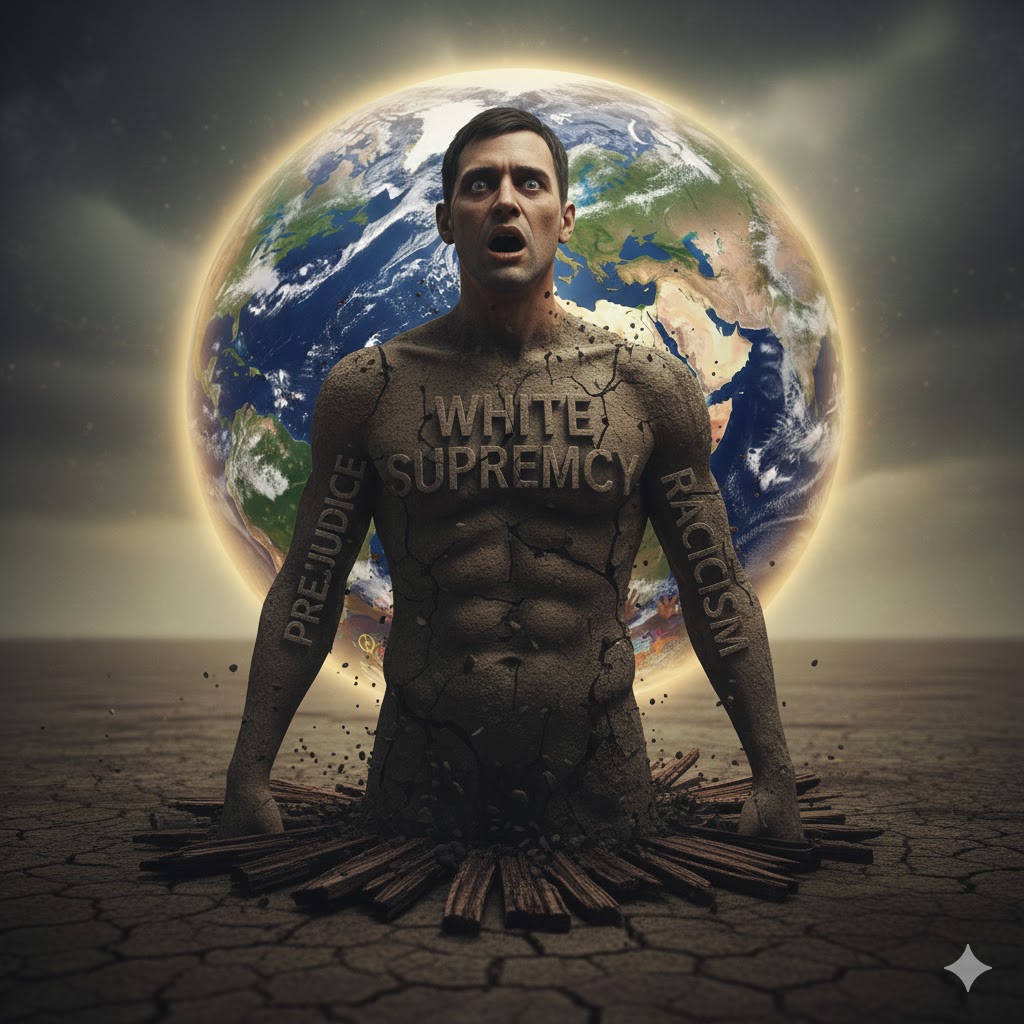
WHlTE Supremacy is crumbling across the globe.

White supremacy, long considered a dominant social and political force, is showing clear signs of decay across the globe. Once entrenched in colonial empires, economic systems, and cultural narratives, its structures are increasingly being challenged by movements for justice, equality, and truth. The ideology that once justified the subjugation of entire populations is now under scrutiny, as history, evidence, and activism expose the falsehoods it relied upon. Across nations, societies are awakening to the moral and ethical failures of racial hierarchy, revealing that supremacy built on fear and deception cannot endure indefinitely.

Historically, white supremacy was reinforced through law, religion, and education. Colonial powers justified slavery, land theft, and systemic oppression by promoting narratives of European superiority. Pseudo-science, distorted biblical interpretation, and manipulated history textbooks all served to normalize racial hierarchy. These systems were not natural; they were constructed to concentrate wealth, power, and control in the hands of a few while dehumanizing others. Today, this constructed system faces resistance at every level, from academic scholarship to grassroots activism.

The civil rights movements of the twentieth century marked an early wave of resistance. In the United States, South Africa, and other nations, oppressed populations began reclaiming their rights, asserting their humanity, and demanding systemic change. Leaders such as Martin Luther King Jr., Nelson Mandela, and countless others challenged both the laws and the ideologies that sustained racial oppression. These movements demonstrated that white supremacy relies on silence, ignorance, and fear, all of which are being steadily dismantled.

Globalization and access to information have accelerated the collapse of white supremacist narratives. The internet, social media, and independent media platforms allow oppressed and marginalized communities to share their truths widely. Historical injustices—slavery, colonialism, apartheid, and indigenous dispossession—can no longer be hidden or misrepresented. When truth spreads, the moral authority of supremacy erodes, revealing the system as an artificial construct maintained through propaganda and institutional control.

Education is another arena where white supremacy is being challenged. Curricula that once glorified European conquest and minimized the experiences of colonized peoples are being rewritten. African, Indigenous, Asian, and Latin American histories are increasingly taught with accuracy, highlighting the contributions, resilience, and humanity of non-European peoples. Knowledge empowers people to recognize that racial hierarchies are neither natural nor divinely ordained, challenging centuries of indoctrination.

Economic structures, too, are under scrutiny. Institutions that perpetuated systemic inequality are facing calls for reform and accountability. Wealth disparities rooted in centuries of exploitation are increasingly highlighted by scholars, journalists, and activists. Efforts to implement reparative justice, equitable access to resources, and anti-discrimination policies challenge the economic pillars that have historically sustained white dominance.

Cultural representation has also shifted. Media, film, literature, and art increasingly amplify the voices of historically marginalized communities. Stories of Black, Indigenous, and people of color challenge stereotypes, humanize lived experiences, and reclaim narratives previously controlled by dominant groups. Representation dismantles the psychological underpinnings of supremacy, proving that humanity cannot be defined by skin color.

Religious institutions are confronting the misuse of faith to justify racial oppression. Historically, distorted interpretations of Scripture and theology were used to validate slavery, colonialism, and apartheid. Modern theologians and faith leaders are rejecting these corrupt narratives, emphasizing equality, justice, and human dignity. Biblical truths, when correctly interpreted, expose the lies upon which white supremacy rests.

Political systems built to enforce racial hierarchy are also facing pressure. Voting rights movements, anti-discrimination legislation, and judicial scrutiny are challenging the legal mechanisms that preserved supremacy. Even in countries where inequality persists, public awareness and activism are creating conditions for reform. The principle that all humans are created in God’s image, as emphasized in Scripture, underpins many of these movements for justice.

Social consciousness is rising globally. Movements such as Black Lives Matter, Indigenous rights campaigns, and anti-apartheid organizations demonstrate collective resistance to systemic oppression. Awareness of historical injustices informs modern advocacy, fostering solidarity across racial and national lines. White supremacy thrives on isolation and ignorance; interconnected activism erodes its foundation.

White supremacy is also crumbling internally. The ideology depends on fear, competition, and the dehumanization of others. As societies evolve, its psychological and social control weakens. Younger generations, educated and globally connected, are less likely to accept racial hierarchies as truth. Moral and intellectual critique exposes its contradictions and immorality, accelerating its decline.

The arts and literature play a critical role in dismantling supremacy. Writers, musicians, filmmakers, and visual artists expose oppression, reclaim history, and celebrate the beauty and resilience of marginalized communities. Cultural production creates shared narratives that challenge the assumptions of supremacy, fostering empathy and social transformation.

Media exposure and investigative journalism have further undermined white supremacy. Exposing systemic racism, corruption, and oppression holds institutions accountable. Public awareness campaigns challenge normalized inequities, demanding transparency and reform. In an era where information is widely accessible, attempts to maintain supremacy through ignorance are failing.

Global collaboration is another factor. International human rights organizations, treaties, and advocacy groups challenge racial oppression worldwide. Nations are being held accountable for injustices through global scrutiny. The interconnected world makes isolationist supremacy impossible, as the truth of oppression spreads across borders.

Technology has also shifted power dynamics. Digital platforms allow communities to organize, educate, and resist in ways previously impossible. Supremacist ideologies, once reinforced locally and nationally, now face global critique. The democratization of information undermines traditional structures that perpetuated racial dominance.

Education, activism, and awareness are complemented by historical reckoning. Truth-telling about slavery, colonialism, and indigenous genocide creates accountability. Museums, documentaries, and scholarly research provide evidence that cannot be ignored. White supremacy’s historical foundations are exposed as morally corrupt and factually unsound.

The collapse of white supremacy is evident in demographic and political changes. Multicultural societies, increased immigration, and shifts in population dynamics challenge notions of racial hierarchy. As diversity becomes normalized, the old narratives of supremacy lose credibility and social relevance.

Legal challenges continue to dismantle systemic structures. Civil rights laws, anti-discrimination policies, and judicial interventions restrict the ability of supremacy to operate openly. Legal frameworks that were once complicit in oppression are now tools of accountability, signaling systemic transformation.

Psychologically, white supremacy loses influence as people internalize equality. Recognition of shared humanity diminishes fear, hate, and the belief in racial superiority. Education, social interaction, and media exposure cultivate empathy and understanding, directly opposing the ideology of supremacy.

White supremacy’s decline is also spiritual. Biblical principles affirm the equality of all humanity before God, emphasizing justice, mercy, and humility. James 2:1–4 warns against favoritism based on wealth or appearance, teaching that partiality is inconsistent with faith. Revelation 7:9 envisions a multitude from every nation worshiping God together, symbolizing the ultimate rejection of racial hierarchy.

The global dismantling of white supremacy is a reminder of God’s justice. While oppressive systems once seemed invincible, truth, righteousness, and divine order prevail. Societies are increasingly recognizing the immorality of supremacy, embracing equality, and restoring dignity to those who were dehumanized. The fall of white supremacy, though uneven, is already underway.

The assertion is bold, yet the evidence is mounting: the decaying structures of White Supremacy are crumbling across the globe. This is not merely a political or sociological observation, but a profound spiritual truth. For decades and centuries, this hateful ideology has operated as a destructive force, attempting to enforce a false hierarchy and deny the intrinsic dignity of countless millions. Today, however, the deep fissures and cracks are visible everywhere, indicating that a fundamental shift is underway—a shift driven by an immutable moral law that ultimately defeats oppression.

We hold fast to this central, unwavering thesis: The steady, irreversible decline of supremacist power is not an accident of history but the active manifestation of divine justice. Our God, the Creator of all humanity, the One who demands righteousness and equity, is engaged in this fight alongside those who seek liberation. The unraveling of this oppressive system is the inevitable consequence of a universe designed for truth and a divine will that is eternally committed to justice for the marginalized and the creation of a world where all bear the imago Dei.

To understand why this system is failing, we must first define the lie: White Supremacy is fundamentally an ideology of fear, exclusion, and power, rooted in historical oppression. It systematically denies the full personhood of those who do not fit its prescribed racial profile, seeking to justify theft, enslavement, and violence through corrupt theological and philosophical reasoning. This manufactured doctrine stands in direct opposition to the core tenets of faith—love of neighbor, humility, and the universal brotherhood of humankind.

Therefore, the struggle against this injustice is more than a socio-political contest; it is a spiritual warfare against the forces of division and hatred. When we observe activists marching, policymakers reforming, and communities unifying across racial lines, we are witnessing the hands of believers and people of conscience aligning with the divine purpose. We take courage, knowing that every act of resistance, every call for justice, and every tear shed for the oppressed is heard by a God who champions the cause of the poor and the prisoner, fighting for us in ways seen and unseen.


Historical Roots and Inevitable Cracks

The inevitability of this decline is rooted in the fact that supremacy is built upon a fundamental and unsustainable lie. No system of power that requires the constant degradation and dehumanization of others can ever truly endure. Historically, its maintenance has required continuous violence and denial of reality. But as education spreads, global connections deepen, and the voices of the oppressed grow louder, the fragility of the entire structure is exposed, leading to a steady erosion of its institutional power and moral authority.

The history of the fight for equality is, in essence, a chronicle of divine intervention against injustice. From the struggle of the Israelites against Pharaoh to the American Abolitionist Movement and the monumental Civil Rights era, every major victory against oppression serves as a testament to God’s alignment with the oppressed. These movements were not merely political skirmishes; they were spiritual earthquakes, cracking the foundations of institutionalized sin and demonstrating that no human system, however entrenched, can ultimately thwart the divine will for human freedom and dignity.

Today, the erosion of supremacy is being accelerated by global interconnectedness and demographic reality. The internet has dismantled the narrative control that once shielded oppressive systems, allowing stories of injustice to travel worldwide and galvanize international solidarity. Furthermore, the changing face of nations refutes the myth of a homogeneous racial ideal. As power shifts and diversity becomes the undeniable norm, the antiquated structure of White Supremacy finds itself increasingly isolated and irrelevant on the world stage.

This structural failure is accompanied by a profound shift in global consciousness. Younger generations, often raised with greater exposure to diverse cultures and histories, are showing a decreasing tolerance for bigotry. Social media movements and public discourse have accelerated accountability, making it far more difficult for racist attitudes and actions to hide in the shadows. This moral awakening signals that the human heart, guided by the innate sense of right and wrong instilled by the Creator, is actively rejecting the poison of hate.

The ideology of White Supremacy is further cursed by its internal fatal flaws: fear, division, and exclusion. It is a system built on perpetual anxiety—the fear of “the other” and the constant dread of losing perceived privilege. This internal poison denies its adherents true community, joy, and peace. By definition, a system that thrives on making enemies cannot build a sustainable future; it is inherently self-destructive and destined to crumble under the weight of its own paranoia and moral bankruptcy.

The Christian faith provides the clearest blueprint for this victory, because we worship a God of absolute Justice. When God declares, “Let justice roll down like waters, and righteousness like an ever-flowing stream,” He establishes the moral standard for all of creation. He is not neutral; He is eternally, unequivocally on the side of the marginalized. Our faith provides the foundational certainty that the fight against oppression is not just noble—it is guaranteed to succeed because the very character of the Almighty is fighting for us.


The Role of Faith and Divine Justice

Throughout history, the most effective movements against oppression have been led by prophets and activists who speak God’s truth to earthly power. Much like the ancient prophets who stood before kings to denounce injustice and idolatry, modern faith leaders and social justice advocates are fulfilling a divine mandate. They are the instruments through which the call for repentance and radical change is delivered, reminding society that systemic sin—like racism—must be dismantled from the ground up, not merely managed or contained.

This understanding places an urgent imperative on the faith community itself. The Church cannot be a passive observer; it must actively dismantle the vestiges of racism within its own walls and in the wider world. True discipleship demands seeing every human being as a full reflection of the imago Dei (the Image of God), rendering all forms of racial hierarchy utterly blasphemous. Our houses of worship must become training grounds for equity and reconciliation, living proof that unity in diversity is not a political aspiration but a spiritual reality.

From a spiritual perspective, divine judgment is the inevitable harvest of injustice. The biblical principle of “reaping what is sown” applies not just to individuals but to nations and systems. When power structures are built on the exploitation of the weak, the universe itself begins to correct the imbalance. The current crumbling of supremacist institutions—their loss of moral legitimacy, their internal fracturing, and their economic decline—is a manifestation of this profound, inescapable truth: systems rooted in lies cannot thrive indefinitely under the watchful eye of a just God.

Yet, the knowledge that God is fighting for us is the ultimate source of hope and endurance in the struggle. This commitment allows activists and advocates to press on, even when the work feels exhausting or the resistance seems overwhelming. Hope is not passive wishing; it is the active certainty that the arc of the moral universe bends toward justice, because a divine hand is guiding it. This sustained faith is the spiritual fuel that ensures the fight will continue until liberation is complete.

Today, the resurgence of extremist rhetoric and public hate groups should be understood as the final, desperate lashing out of a dying ideology. When a system loses its broad institutional power, it often retreats into noisy, violent extremism. These acts are not signs of renewed strength, but rather the frantic efforts of a minority unwilling to accept its imminent failure. This final, ugly phase is the death rattle of White Supremacy, confirming that the mainstream culture, informed by a growing moral consensus, has moved past its destructive logic.


The Path Forward and Conclusion

Our purpose now is not just to witness the decline of the old system, but to be the active architects of the new—building the beloved community, the new Kingdom of God on Earth. This involves intentionally crafting inclusive spaces, restructuring economic systems to ensure equitable access, and cultivating institutions that celebrate the worth of every person regardless of their heritage. We must move beyond simply reacting to hate and begin creating a positive, vibrant, multi-ethnic future that reflects the full, glorious diversity intended by the Creator.

The final phase of this spiritual war requires a call to personal action and profound self-examination. We must confront the subtle ways that systems of superiority may still reside within our own hearts and communities. This is the work of repentance and internal transformation, where we actively dismantle the unconscious biases and learned prejudices that are relics of the dying age. The most effective warriors for justice are those who have first found moral clarity and humility within themselves.

Furthermore, we are called to communal action through advocacy, policy, and unwavering solidarity. True faith demands that we lobby for laws that protect the vulnerable, support organizations that champion civil rights, and stand shoulder-to-shoulder with our neighbors who are targeted by hate. Our prayer is action, and our devotion is demonstrated by the fierce commitment to ensuring justice is done in the courts, on the streets, and in the halls of power.

Let this be our unshakeable affirmation of ultimate victory: The triumph of justice over oppression is not a utopian dream but a divine guarantee. The God who liberated slaves from bondage and raised the defeated from the dust is the same God who fights for us today. The ideology of White Supremacy is a spiritual corpse, sustained only by the breath of fear and inertia. Its end is certain, because its existence is incompatible with the character of the Almighty.

Therefore, we press on with unconquerable hope and boundless strength. Let the truth resonate in every corner of the world: The fight is hard, but the outcome is not in doubt. We are on the side of creation, love, and righteousness. Be encouraged, remain steadfast, and know that every step you take toward justice is a step taken with the Spirit of God marching right alongside you. Our God is fighting for us, and the victory is already assured.

📖 References

Cone, J. H. (2011). The cross and the lynching tree. Orbis Books.

Fredrickson, G. M. (2002). Racism: A short history. Princeton University Press.

Fanon, F. (1963). The wretched of the earth. Grove Press.

Finkelstein, N. G. (2003). Image and reality of the Israel–Palestine conflict (2nd ed.). Verso.

Khalidi, R. (2020). The hundred years’ war on Palestine: A history of settler colonialism and resistance, 1917–2017. Metropolitan Books.

Mamdani, M. (2001). When victims become killers: Colonialism, nativism, and the genocide in Rwanda. Princeton University Press.

Pappe, I. (2010). The ethnic cleansing of Palestine (2nd ed.). Oneworld Publications.

Said, E. W. (1979). The question of Palestine. Vintage Books.

Holy Bible, King James Version. (1611/2017). Cambridge University Press.

  • The Holy Bible. (2011). New International Version. Biblica. (Original work published 1978).
  • Branch, T. (1988). Parting the waters: America in the King years 1954-63. Simon & Schuster.
  • Cone, J. H. (1990). A black theology of liberation (2nd ed.). Orbis Books.
  • Kendi, I. X. (2016). Stamped from the beginning: The definitive history of racist ideas in America. Nation Books.
  • King, M. L., Jr. (1963). Letter from Birmingham jail.
  • King, M. L., Jr. (1968). Where do we go from here: Chaos or community? Harper & Row.
  • Pew Research Center. (n.d.). Demographics and population trends. [Various reports would be cited depending on the specific data used].
  • Southern Poverty Law Center. (n.d.). Hate map and extremism reports. [Specific reports would be cited depending on the data used].
  • Wallis, J. (2005). God’s politics: A new vision for faith and family in America. HarperOne.

The Fall of Babylon

Babylon in Scripture represents far more than an ancient empire; it symbolizes a spiritual system of rebellion, pride, idolatry, and oppression. In the Old Testament, Babylon rose to power as a wealthy, militarized nation that exalted itself above God, consuming weaker nations and enslaving peoples. Yet its physical fall, recorded in Daniel and Jeremiah, foreshadowed a much deeper truth: Babylon is ultimately a spirit, a mindset, and a world system that continues into the modern age. The modern-day Babylon is not a single city but the global structure of power that exalts wealth above righteousness, self above God, and corruption above truth. Revelation describes it as a great city “which reigneth over the kings of the earth” (Revelation 17:18 KJV), pointing to a worldwide system rooted in spiritual deception and the worship of materialism.

Modern Babylon appears in political empires, economic systems, media powers, and cultural forces that lead humanity away from obedience to God. Its influence blinds hearts, normalizes sin, and rewards wickedness. Revelation declares, “Babylon the great is fallen, is fallen” (Revelation 18:2 KJV), meaning that every proud nation built on exploitation, violence, and immorality will ultimately collapse. Modern Babylon thrives wherever people trust in militaries, governments, wealth, or human intelligence instead of the Most High God. It is the world’s obsession with dominance, luxury, status, and control. It disguises itself as success but leaves spiritual ruin in its wake.

Babylon is also the mindset that prioritizes self-worship. It is the inner rebellion that says, “I will ascend…I will be like the most High” (Isaiah 14:14 KJV). This mindset mirrors Lucifer’s fall, showing that Babylon is fundamentally the spirit of pride. Anyone who believes they can rule, control, or manipulate life without God has adopted Babylon’s mentality. It steals attention away from holiness and seduces people into believing that earthly achievements define worth.

The Bible shows that Babylon is rooted in confusion. The name itself comes from the Tower of Babel, where God confounded the languages of humanity because they tried to build a tower to heaven (Genesis 11:9 KJV). This confusion continues today in systems that preach lies as truth, promote ungodliness as freedom, and intentionally distort moral boundaries. Babylon’s confusion leads people to reject God’s commandments and embrace ideologies that destroy families, communities, and nations.

In the modern world, Babylon is visible in governments built on corruption, corporations that exploit labor, entertainment that glorifies sin, and economic structures that trap people in lifelong debt. It is present in political systems that wage war for profit and in religious institutions that claim God’s name but reject His laws. Revelation describes Babylon as a “habitation of devils” and a “hold of every foul spirit” (Revelation 18:2 KJV), showing that it is spiritually rotten at the core.

Babylon’s mindset also thrives in consumerism. The world encourages people to measure success by possessions, beauty, and social status. It convinces them that happiness comes from external achievements instead of spiritual transformation. This is why Revelation speaks of Babylon’s merchants as “the great men of the earth” who deceived nations through their sorceries (Revelation 18:23 KJV). The modern marketplace, driven by greed and manipulation, is a pillar of Babylon’s influence.

Another characteristic of Babylon is its injustice. Ancient Babylon enslaved Israel, oppressed the poor, and celebrated violence. Today’s Babylon does the same through mass incarceration, exploitation of the poor, racial inequality, and systems that profit from suffering. God warns, “Woe to him that buildeth a town with blood” (Habakkuk 2:12 KJV), showing that any society built on oppression is destined to fall.

Babylon also promotes false religion. It mixes truth with lies, spirituality with witchcraft, and holiness with corruption. It presents itself as righteous but denies the power of God. This is why Scripture calls it “Mystery, Babylon the Great” (Revelation 17:5 KJV). It thrives in religious hypocrisy—churches that preach prosperity instead of repentance, leaders who exploit believers, and doctrines that comfort sin rather than confront it.

The modern Babylon is also moral decay. It normalizes fornication, adultery, idolatry, and perversion. It glorifies rebellion against family structure and mocks righteousness. The Bible says Babylon made “all nations drink of the wine of the wrath of her fornication” (Revelation 14:8 KJV). In other words, the world has been intoxicated by sin, unable to see the danger of its choices.

Babylon trains people to chase pleasure rather than purpose. It distracts the mind with entertainment, lust, and vanity. It pushes people to worship celebrities, technology, and wealth. This constant distraction weakens spiritual discipline and separates people from God. It replaces prayer with pleasure and holiness with indulgence.

The mindset of Babylon is also rooted in rebellion against divine order. It rejects biblical family structures, mocks masculine and feminine roles ordained by God, and promotes chaos instead of stability. God established order to protect humanity, but Babylon seeks to dismantle everything sacred and replace it with confusion. It encourages people to redefine truth according to their emotions rather than God’s Word.

Babylon thrives by creating dependence on worldly systems. Instead of trusting God, people trust governments, corporations, pharmaceutical powers, and political leaders. Yet the Bible warns, “Cursed be the man that trusteth in man” (Jeremiah 17:5 KJV). Babylon’s foundation is misplaced trust—believing that human power can provide what only God can supply.

The fall of Babylon is both spiritual and physical. Revelation promises that its collapse will be sudden: “in one hour is thy judgment come” (Revelation 18:10 KJV). This shows that no matter how powerful an empire becomes, God can bring it down instantly. Babylon’s wealth, military might, and global influence cannot protect it from divine judgment.

God calls His people to separate themselves from Babylon’s system. “Come out of her, my people” (Revelation 18:4 KJV). This is not just a physical command but a spiritual one. Believers must reject Babylon’s mindset—pride, greed, lust, rebellion—and walk in holiness, humility, and obedience. To come out of Babylon is to break free from the world’s deception and submit fully to God’s authority.

Believers must also resist Babylon’s pressure to conform. Babylon rewards compromise, but God blesses righteousness. Daniel refused to eat Babylon’s food or bow to its idols, and God honored him. Likewise, those who stand against modern Babylon’s temptations will receive God’s protection and favor.

Babylon’s fall is also a warning. It teaches that every nation that exalts itself above God will be humbled. Every system that oppresses the innocent will be judged. Every mindset rooted in pride will collapse. God is patient, but judgment comes when wickedness reaches its fullness.

The fall of Babylon signifies the triumph of God’s kingdom. It represents the end of worldly corruption and the beginning of divine restoration. When Babylon falls, truth is restored, justice is lifted, and righteousness prevails. God removes everything that exalts itself against His authority.

Modern-day Babylon will fall just as ancient Babylon did. Its wealth, systems, and power will crumble, and those who placed their trust in it will be left empty. But those who trusted in God will stand strong. Babylon’s fall is not merely destruction—it is deliverance for God’s people.

In the end, the fall of Babylon points to the victory of Christ, who is King of kings and Lord of lords. All human pride, power, and rebellion will bow before Him. Babylon may rise with glory, but its end is certain. Only the kingdom of God will stand forever.

References:

Genesis 11:9 (KJV) – Origin of Babel, meaning confusion.
Isaiah 14:12–14 (KJV) – The prideful mindset connected to Babylon and Lucifer’s rebellion.
Habakkuk 2:12 (KJV) – Judgment on nations built on bloodshed and oppression.
Jeremiah 17:5 (KJV) – Warning against trusting in man rather than God.
Daniel 1:8 (KJV) – Daniel refusing Babylon’s food, symbolizing resisting corruption.
Revelation 14:8 (KJV) – “Babylon is fallen” because of her fornication and corruption.
Revelation 17:5 (KJV) – “Mystery, Babylon the Great,” symbolizing spiritual deception.
Revelation 17:18 (KJV) – Babylon as the city reigning over kings of the earth.
Revelation 18:2 (KJV) – Babylon as the habitation of devils and unclean spirits.
Revelation 18:4 (KJV) – God’s command: “Come out of her, my people.”
Revelation 18:10 (KJV) – Babylon’s sudden judgment “in one hour.”
Revelation 18:23 (KJV) – Merchants deceiving nations through sorceries.

The Dilemmas that Black People Face Today #blackpeopleproblems

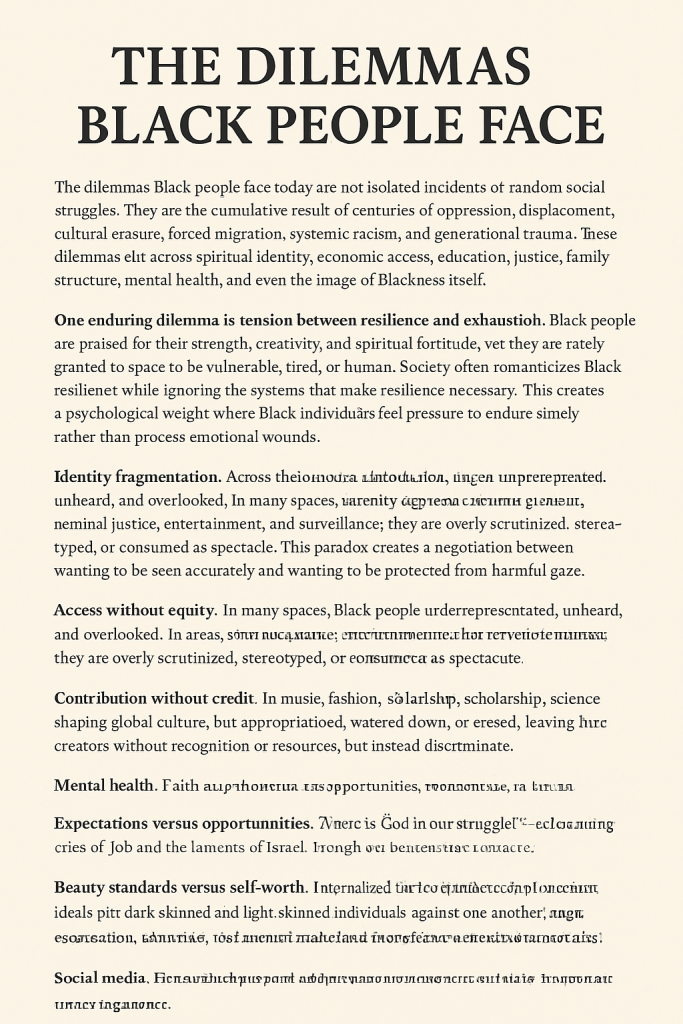
The dilemmas Black people face today are not isolated incidents or random social struggles. They are the cumulative result of centuries of oppression, displacement, cultural erasure, forced migration, systemic racism, and generational trauma. These dilemmas cut across spiritual identity, economic access, education, justice, family structure, mental health, and even the image of Blackness itself. They form a complex landscape that Black people must navigate daily while still fighting to build dignity, community, and hope.

One enduring dilemma is the tension between resilience and exhaustion. Black people are praised for their strength, creativity, and spiritual fortitude, yet they are rarely granted the space to be vulnerable, tired, or human. Society often romanticizes Black resilience while ignoring the systems that make resilience necessary. This creates a psychological weight where Black individuals feel pressure to endure silently rather than process emotional wounds.

Another dilemma lies in the legacy of identity fragmentation. Across the diaspora, Black people wrestle with questions of origin, belonging, and cultural continuity. The transatlantic slave trade severed language, history, names, and lineage—leaving many African Americans searching for spiritual and ancestral clarity. This leads to an internal conflict between who society has labeled them to be and who they truly are in God, history, and heritage.

Black people also face the dilemma of visibility versus hypervisibility. In many spaces, they are underrepresented, unheard, and overlooked. In other areas—such as criminal justice, entertainment, and surveillance—they are overly scrutinized, stereotyped, or consumed as spectacle. This paradox creates a constant negotiation between wanting to be seen accurately and wanting to be protected from harmful gaze.

Economically, the dilemma of access without equity remains a major barrier. While Black people may have access to schools, jobs, loans, and housing on paper, systemic practices—such as redlining, wage gaps, discriminatory hiring, and unequal school funding—undermine true equality. The presence of opportunity does not guarantee fairness, and this gap breeds frustration, fatigue, and generational stagnation.

Culturally, Black people face the dilemma of contribution without credit. From music to fashion, science scholarship, the Black world has shaped global culture. Yet those contributions are often appropriated, watered down, or erased, leaving Black creators without recognition or resources. Even in faith spaces, Black biblical history is minimized despite its foundational importance.

Within families, Black communities often face dilemmas created by historical disruption, including mass incarceration, economic instability, and systemic attacks on the Black home. These pressures can create strain in marriages, parenting, and generational continuity, forcing Black families to build structure while battling forces that aim to dismantle it.

Spiritually, there is a dilemma between faith and suffering. Black people often ask, “Where is God in our struggle?”—echoing the cries of Job and the laments of Israel. Yet faith has also been a source of resistance, identity, and liberation throughout Black history. The struggle lies in reconciling divine purpose with earthly injustice.

Colorism creates another dilemma: beauty standards versus self-worth. Internalized Eurocentric ideals can pit dark-skinned and light-skinned individuals against one another, producing wounds that trace back to slavery’s hierarchy. This dilemma shapes relationships, confidence, employment, desirability, and mental health.

In the area of justice, Black people face the dilemma of legal rights versus lived reality. Though laws promise equality, the outcomes—from traffic stops to sentencing—tell a different story. This dissonance reinforces a mistrust in systems meant to protect but instead discriminate.

Mental health remains a growing dilemma, as Black people contend with trauma, stress, discrimination, financial pressure, and societal expectations, all while lacking equitable access to culturally relevant care. Silence around therapy and emotional vulnerability can hinder healing.

Educationally, Black students face the dilemma of expectations versus opportunities. While excellence is often demanded, support is not always given. This leads to underfunded schools, biased assessments, and unequal advancement.

Social media has introduced new dilemmas—hyperexposure, comparison culture, cyberbullying, and the performative nature of modern identity. Though it allows Black voices to rise, it also magnifies criticism, competition, and unrealistic ideals.

And at the heart of all dilemmas lies a deeper spiritual one: the ongoing struggle for self-definition. Black people are constantly reclaiming a narrative that the world has tried to rewrite. This dilemma fuels movements, art, scholarship, and faith-based awakenings that reconnect Black people to origin, dignity, and divine purpose.

Despite these challenges, Black people continue to rise, resist, create, and believe. The dilemmas are real, but so is the power, brilliance, and spiritual calling placed upon the descendants of survival.


References

Alexander, M. (2010). The new Jim Crow: Mass incarceration in the age of colorblindness. The New Press.
Branch, T. (1988). Parting the waters: America in the King years, 1954–1963. Simon & Schuster.
Du Bois, W. E. B. (1903). The souls of Black folk. A. C. McClurg & Co.
hooks, b. (1995). Killing rage: Ending racism. Henry Holt.
Painter, N. I. (2006). Creating Black Americans: African-American history and its meanings. Oxford University Press.
Wilkerson, I. (2020). Caste: The origins of our discontents. Random House.
Woodson, C. G. (1933). The mis-education of the Negro. Associated Publishers.

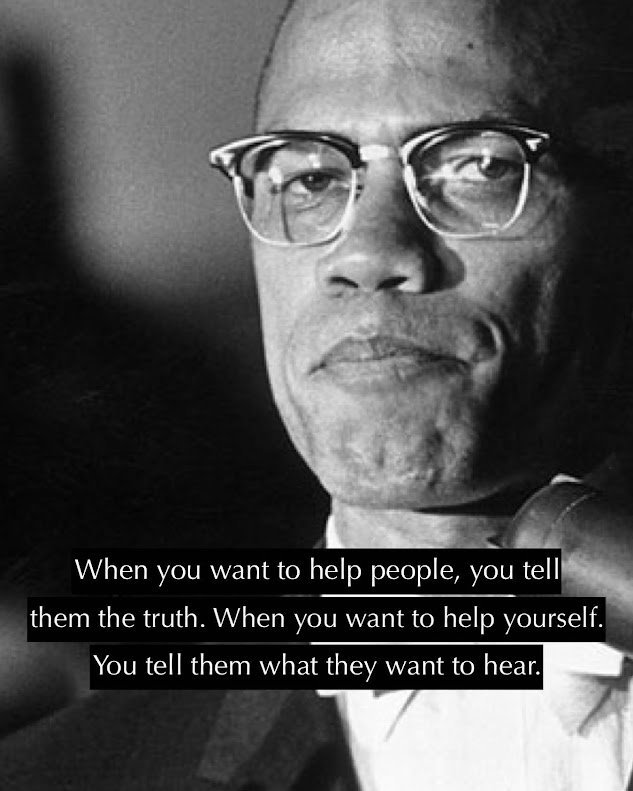
Malcolm says….

This photograph is the property of its respective owner. No copyright infringement intended.

Black Pride & Self-Respect

Malcolm X emphasized that Black people must love themselves first:

“We have been brainwashed, we have been hoodwinked, we have been bamboozled.”

“You can’t hate the roots of a tree and not hate the tree. You can’t hate Africa and not hate yourself.”

“We didn’t land on Plymouth Rock — the rock was landed on us.”

He fought against internalized inferiority and pushed for a mental and spiritual rebirth.


2. Self-Defense & Protection of Black Life

Malcolm rejected passive suffering:

“I am for violence if non-violence means we continue postponing a solution to the American Black man’s problem just to avoid violence.”

“You don’t have a revolution in which you love your enemy.”

His stance was not hatred — it was dignity, safety, and self-preservation.


3. Black Unity

Malcolm believed unity was a divine duty and the key to liberation:

“We need to stop begging the white man for what he cannot give us — freedom.”

“You can’t separate peace from freedom, because no one can be at peace unless he has his freedom.”

He urged Pan-African consciousness and global solidarity.


4. Independence & Self-Determination

He called Black people to build power for themselves:

“If you’re not ready to die for it, put the word ‘freedom’ out of your vocabulary.”

“The future belongs to those who prepare for it today.”


5. The Beauty & Majesty of Blackness

Malcolm preached Black excellence:

“The most disrespected person in America is the Black woman. The most unprotected person in America is the Black woman. The most neglected person in America is the Black woman.”

“You’re not supposed to be so blind with patriotism that you can’t face reality.”

He affirmed Black womanhood, identity, and moral authority.


6. Spiritual Destiny

As his worldview evolved, Malcolm spoke in biblical tones about Black suffering and redemption:

“One day may we all meet together in the light of understanding.”

Toward the end of his life, he emphasized global unity, African sovereignty, and spiritual truth.


Essence of Malcolm X’s Message

Malcolm X said Black people were:

  • A chosen and mighty people
  • Historically oppressed but destined to rise
  • Worthy of dignity, power, and love
  • Capable of creating their own future

His mission was to wake up his people.


In Summary

Malcolm X told Black people:
You are powerful. You are beautiful. Stop apologizing. Rise.

His message remains a prophetic call:

Honor yourself. Protect your people. Know your history. Walk in greatness.

The Wrath of Black Resilience

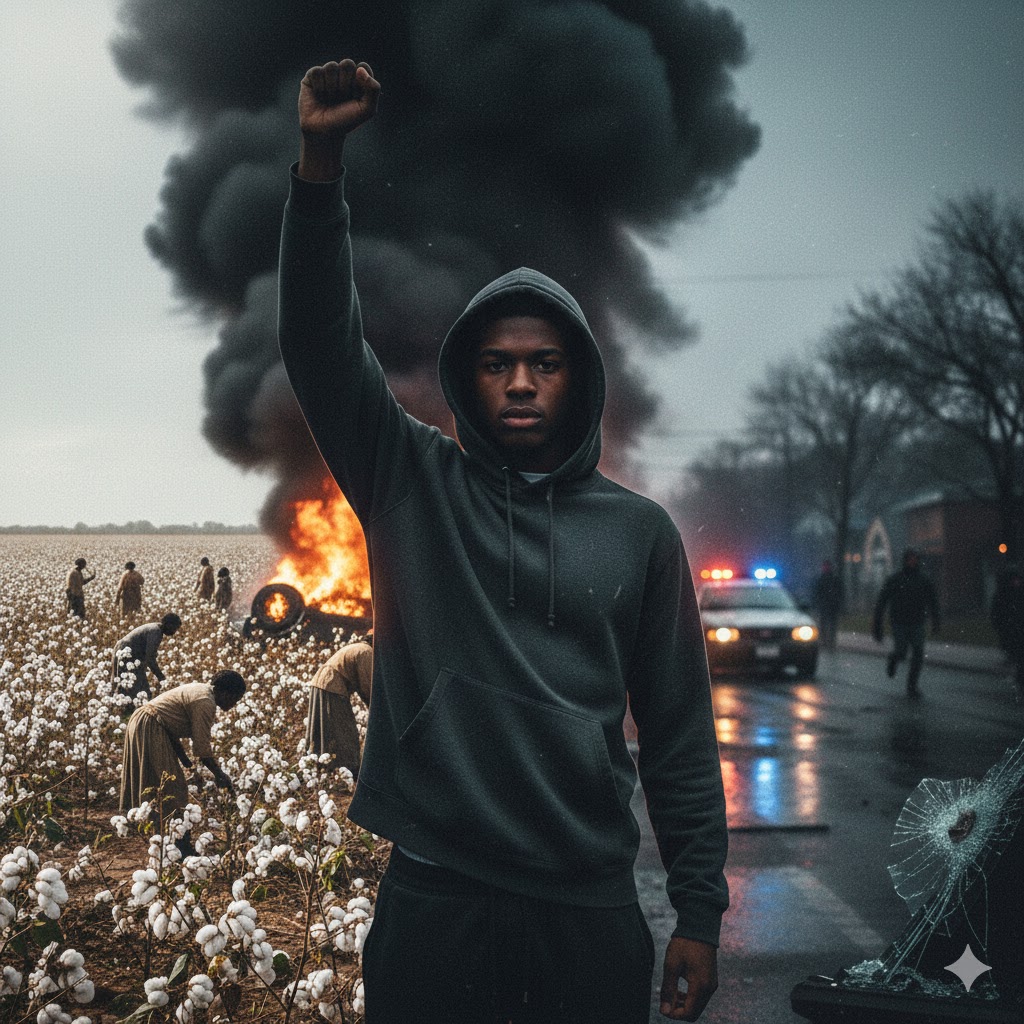
Black resilience is not a gentle force; it is a righteous wrath forged through centuries of pressure, pain, and perseverance. It is the fire that refuses to be extinguished, the power that rises from ashes with dignity still intact. This resilience is both a shield and a sword, shaped by generational survival and spiritual endurance.

The wrath of Black resilience is not destructive—it is transformative. It is the fierce determination to exist in a world that has tried, repeatedly, to erase, distort, or diminish Black life. This resilience emerges from the collision of suffering and hope, forming a strength unmatched in its depth and sacred in its origin.

This wrath carries memory. It remembers slave ships, plantations, whips, auctions, and chains. It remembers the cries of mothers whose children were torn from their arms and the prayers whispered in dark cabins to a God who seemed far yet remained present. Memory sharpens resilience into conviction.

It is a wrath tempered by wisdom. Black people have learned to survive without surrendering their humanity. The resilience that flows through the diaspora is a testimony to what happens when faith meets fire and refuses to break. It is refusal wrapped in courage—refusal to bow, to be silent, or to disappear.

The wrath of Black resilience is seen in the unyielding pursuit of justice. It is the righteous anger that propelled rebellions, marches, sit-ins, and court battles. It is the same spirit that fueled leaders like Malcolm X, Fannie Lou Hamer, Marcus Garvey, and Ida B. Wells—individuals who understood that survival alone was not enough; liberation was the goal.

It is a sacred wrath, aligned with the God of the oppressed. Scripture affirms that the Most High hears the cries of the afflicted. Black resilience draws strength from this divine truth, knowing that justice is not merely a human demand but a spiritual inheritance. This wrath becomes a holy resistance against systems of exploitation and dehumanization.

Yet, Black resilience also holds tenderness. Despite centuries of brutality, Black communities created art, music, family, culture, and spiritual practices that nourished life. This duality—wrath against injustice, tenderness toward each other—is the secret to its power.

This resilience is generational. From enslaved ancestors to modern activists, the flame of endurance has been passed down like a torch. Each generation fans it into something greater—revival, rebellion, restoration. The wrath of resilience ensures that the trauma of the past does not silence the future.

It also manifests in economic creativity. From sharecropping to Black Wall Street, from entrepreneurship to global influence, Black communities have repeatedly built and rebuilt despite sabotage and systemic barriers. This relentless reconstruction is a form of wrathful hope—hope that refuses to die.

The wrath of Black resilience is poetic. It sings through spirituals and hip-hop, dances through jazz and blues, and speaks through literature, sermons, and scholarship. Art becomes protest; creativity becomes survival; expression becomes liberation.

It is seen in Black love—the protective, enduring, healing love that withstands external assault. Black families have survived legal restrictions, targeted destabilization, and economic pressure. Yet the love still blossoms. That love is an act of defiance.

This resilience is intellectual as well. Black scholars have dismantled false histories, reconstructed truth, and reclaimed identity. The wrath here is quiet but profound—a refusal to let lies prevail. Knowledge becomes warfare, and scholarship becomes a pathway to cultural redemption.

The wrath of Black resilience also operates spiritually. Through Christianity, Islam, African traditional religions, and Hebrew Israelite faith practices, Black communities cultivated belief systems that affirmed their worth when the world denied it. Faith became resistance; prayer became strategy.

This resilience is communal. It is seen in mutual aid networks, church gatherings, neighborhood protection, and intergenerational mentorship. Black communities have learned that survival is collective work. Their wrath is unified; their resilience, intertwined.

Even in grief, Black resilience rises. Mourning becomes movement; sorrow becomes strategy. Whether after lynchings, massacres, police brutality, or generational trauma, the community finds a way to speak, march, organize, and heal without losing its soul.

The wrath of Black resilience is global. In Africa, the Caribbean, South America, and throughout the diaspora, colonization could not destroy the spirit of the people. Revolutions erupted; cultures survived; languages adapted; identities persisted. The global Black experience is one of endurance and rebirth.

This resilience is also prophetic. It does not simply react to injustice—it anticipates liberation. It sees beyond present oppression to future restoration. Black resilience believes in the possibility of a world made right, and it fights relentlessly until that vision becomes reality.

The wrath of resilience is not rage without direction—it is purpose wrapped in fire. It is the sharpened edge of survival and the disciplined determination to rise above systems built for destruction. It is righteousness standing firm against wickedness.

Ultimately, the wrath of Black resilience is a divine inheritance. It is the echo of ancestors, the strength of the present generation, and the promise of those yet to come. It is the collective heartbeat of a people who refuse to die, refuse to bend, and refuse to be forgotten.


References

Alexander, M. (2012). The new Jim Crow: Mass incarceration in the age of colorblindness. The New Press.

Cone, J. H. (1975). God of the oppressed. Orbis Books.

Davis, A. (2016). Freedom is a constant struggle: Ferguson, Palestine, and the foundations of a movement. Haymarket Books.

Gates, H. L. (2019). Stony the road: Reconstruction, white supremacy, and the rise of Jim Crow. Penguin Press.

Wells, I. B. (2020). Crusade for justice: The autobiography of Ida B. Wells. University of Chicago Press.

West, C. (2017). Race matters. Beacon Press.

Indigenous People of America

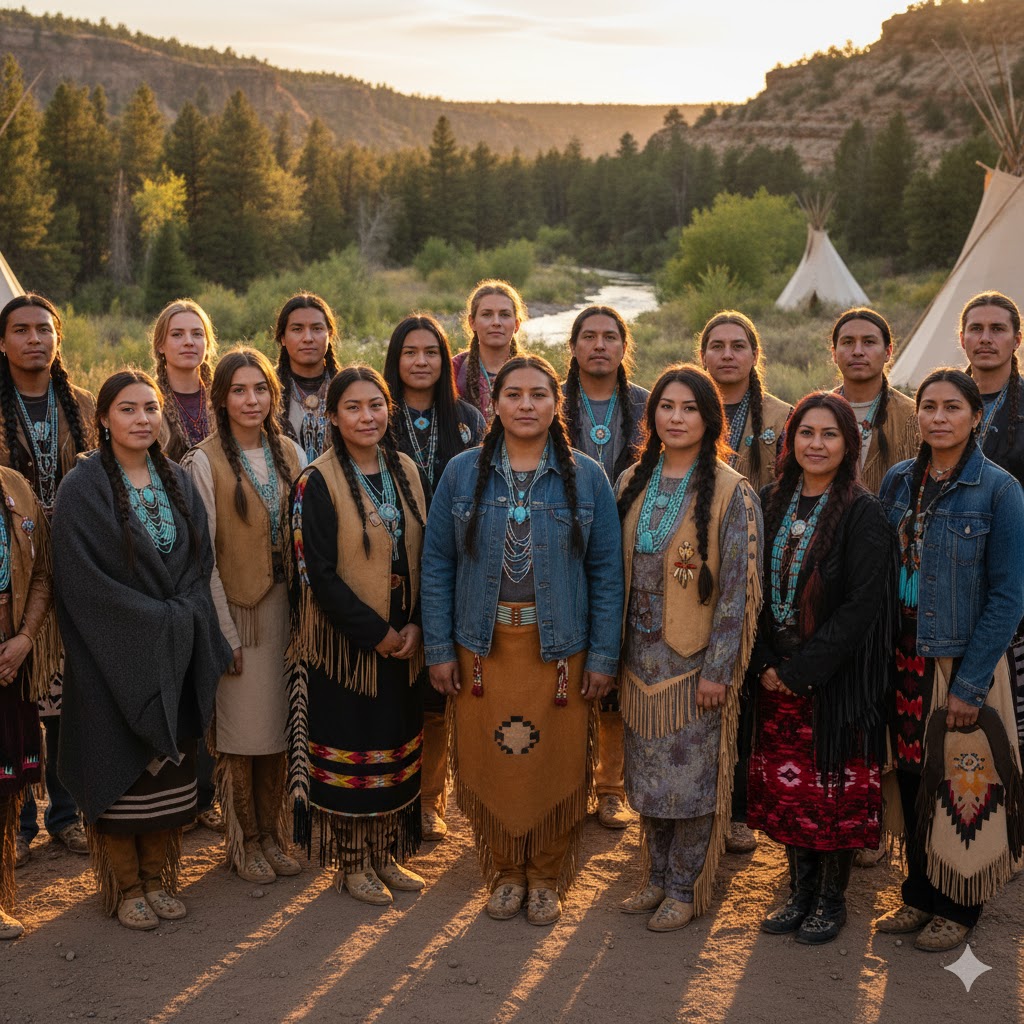
Native American people are the Indigenous peoples of the land now called the United States, and they are known by many names depending on the region and cultural group. The term “Native Americans” is commonly used today, but older names include “American Indians,” “Indigenous Americans,” “First Nations,” and “First Peoples.” Each tribe, however, has its own original name in its own language, often meaning “the people,” “the original ones,” or “human beings.” This diversity reflects the rich cultural and linguistic complexity of Indigenous civilizations long before European arrival.

Native Americans came in a wide range of skin tones, reflecting geographic diversity and ancient migrations. Historical accounts, genetic studies, and artwork created before European contact describe Indigenous peoples as brown-skinned, copper-toned, or deep reddish-brown. Some early explorers described them using terms like “tawny,” “brown,” or “dark.” A small group of historians and Afrocentric scholars argues that some Indigenous groups were Black or had African admixture prior to Columbus, but mainstream anthropology concludes that the first peoples of the Americas descended from ancient Asian populations.

Christopher Columbus’s arrival in 1492 dramatically altered the lives of Indigenous people. Columbus and his crew initially described the Indigenous people of the Caribbean as generous, peaceful, and welcoming. However, his treatment of them quickly turned violent. Columbus enslaved Native men, women, and children, forced them to mine gold, and imposed brutal punishments for failing to meet quotas. Many Indigenous people died from torture, forced labor, and diseases introduced by Europeans. These early actions set the stage for centuries of exploitation and colonization.

The history of Native Americans after Columbus is marked by war, displacement, forced assimilation, and systematic oppression. European settlers pushed Indigenous peoples off their ancestral lands through military force, broken treaties, and deliberate starvation campaigns. Entire communities were destroyed through massacres such as Wounded Knee, Sand Creek, and the Trail of Tears, which forced the Cherokee and other nations to relocate under deadly conditions. These events devastated populations, cultures, and social structures.

Many people ask what happened to the Native Americans, and the answer is complex. Disease brought by Europeans—smallpox, influenza, measles—caused massive population decline. Historians estimate that tens of millions of Indigenous people may have lived in the Americas before 1492, but up to 90% perished within the first century of contact. Survivors were pushed into reservations, stripped of cultural rights, and subjected to assimilation efforts, including boarding schools that prohibited Native languages and traditions.

Regarding reparations, the United States treated Native Americans differently from Black Americans. While Black Americans received no national reparations for slavery, Native Americans received limited forms of compensation in the form of treaties, land rights, and financial settlements—though these were often inadequate or unenforced. The Indian Claims Commission, established in 1946, offered monetary compensation for stolen land, but the payments were small compared to the value of what was taken. Many Indigenous activists note that no amount of money can compensate for genocide, cultural loss, and the destruction of entire nations.

Compared to Black people, Native Americans were treated through a system of removal and replacement, while Black people were subjected to chattel slavery and generational bondage. Both groups experienced racial violence, dehumanization, and systemic oppression, but the mechanisms differed. Enslaved Africans were forced into labor, while Indigenous people were pushed off their land or exterminated. Yet both suffered under white supremacy and colonial expansion.

The languages spoken by Native Americans before colonization were vast and varied. More than 300 Indigenous languages existed in North America, belonging to major language families such as Algonquian, Iroquoian, Siouan, Athabaskan, Uto-Aztecan, and Muskogean. Many tribes today work to preserve or revive these languages through immersion schools and cultural programs.

How Native Americans arrived in the Americas is a continuing subject of research. The most widely accepted theory holds that ancient peoples migrated from Siberia into Alaska across a land bridge called Beringia around 15,000–20,000 (not sure if this is true the amount of years)years ago. Alternative theories suggest coastal migration by boat or earlier arrivals, but these remain debated. Regardless of the exact method, Indigenous peoples developed sophisticated civilizations long before European contact.

The land now known as America had many Indigenous names before colonization. Different tribes had different names for regions, but the continent itself had no single unified name since there was no single unified nation. The English name “America” comes from Amerigo Vespucci, an Italian navigator whose writings incorrectly suggested he discovered a “New World.” European mapmakers later used his name to describe the continents.

Columbus Day has a complicated and painful history. First celebrated in the late 18th century, the holiday gained national recognition in 1937 as a celebration of Italian American heritage and Columbus’s voyages. However, for Native Americans, Columbus Day represents colonization, enslavement, massacres, and the beginning of genocide. This has led many states and cities to replace Columbus Day with Indigenous Peoples’ Day to honor Native resilience and history.

The treatment of Native Americans varied by region and time period, but their experiences consistently reflected displacement, violence, and cultural suppression. Treaties were broken, families were separated, and children were taken from their homes to be “Americanized.” Yet Indigenous peoples survived through resistance, resilience, and a commitment to preserving their identity.

The debate over whether some Indigenous peoples were Black adds another layer to the discussion. Some scholars point to early European reports describing “dark-skinned” or “Black” Native peoples, while others argue that these descriptions referred to natural variations in skin tone among Indigenous populations. Most anthropologists conclude that any similarity to African features developed independently.

Native Americans today continue to fight for sovereignty, land rights, cultural preservation, and justice. Their survival in spite of centuries of oppression is a testament to their strength. Across the United States, Indigenous nations maintain vibrant cultures, languages, and traditions, ensuring that the legacy of their ancestors endures.

The question of reparations remains ongoing. Many Indigenous communities seek not only financial compensation but also land restoration, legal recognition, and protection of sacred sites. Some progress has been made, but the historical wounds run deep.

Ultimately, Native American history is central to the story of America. Their experiences reveal the contradictions of a nation built on ideals of freedom while practicing colonization and racial hierarchy. By understanding this history, modern society can better honor Indigenous contributions and acknowledge the injustices committed against them.

The legacy of Columbus is deeply contested. While some view him as an explorer, others see him as the initiator of a brutal colonial system. His actions toward Indigenous peoples—including enslavement, torture, and exploitation—serve as a stark reminder of the destructive impact of European colonization.

Native American history is not just a story of suffering but also one of survival, identity, and endurance. Through cultural revival, language preservation, and political activism, Indigenous peoples continue to shape the future. Their presence and contributions remain foundational to the story of the Americas.


References

Calloway, C. G. (2012). First peoples: A documentary survey of American Indian history (4th ed.). Bedford/St. Martin’s.

Dunbar-Ortiz, R. (2014). An Indigenous peoples’ history of the United States. Beacon Press.

Loewen, J. W. (2007). Lies my teacher told me: Everything your American history textbook got wrong. The New Press.

Mann, C. C. (2005). 1491: New revelations of the Americas before Columbus. Vintage Books.

Stannard, D. E. (1992). American Holocaust: The conquest of the New World. Oxford University Press.

Thornton, R. (1987). American Indian Holocaust and survival. University of Oklahoma Press.

Slave Master’s Name: What’s in a Name?

Photo by Heiner on Pexels.com

The question “What’s in a name?” takes on profound significance when examined through the lens of the African American experience. For enslaved Africans in America, a name was not merely a word of identity—it was a marker of power, ownership, and erasure. During slavery, the forced renaming of African people was a deliberate act of dehumanization designed to sever their connection to their heritage, ancestry, and language. A name once symbolized lineage, culture, and divine meaning; under slavery, it became a brand of bondage and submission to another man’s will.

When Africans were captured and sold into slavery, their original names—often rooted in powerful spiritual, ethnic, or familial significance—were stripped from them. Names like Kwame, Amina, Kofi, and Nia, each carrying meanings of time, birth order, and spiritual identity, were replaced by European Christian or Anglo-Saxon names such as John, Mary, William, and Sarah. This erasure of identity served the purpose of domination. The enslaved person’s name was a psychological reminder of who owned them. It was not merely about convenience; it was about control (Gates, 2014).

Slave masters often assigned their own surnames to enslaved individuals, creating an imposed lineage of ownership rather than kinship. For instance, an enslaved person on the Washington plantation might bear the last name Washington, while another under Thomas Jefferson might carry the name Jefferson. In this way, enslaved people’s identities were legally and socially tied to their oppressors. A name like “Samuel Washington” or “Mary Jefferson” became a haunting symbol of both enslavement and survival—marking one’s oppressor as the source of their new “identity.”

The changing of names also erased tribal and cultural continuity. Africans brought to the Americas came from diverse kingdoms and ethnic groups—Yoruba, Igbo, Akan, Mandinka, Wolof, and many others (Diop, 1974). Their names often reflected ancestral lineage, birth circumstances, or divine connection. When these names were replaced, a spiritual violence occurred. Names like Chukwuemeka (“God has done well”) or Adebayo (“He came in joy”) were replaced with names that carried no connection to ancestry or meaning.

During slavery, it was common for enslaved people to be renamed multiple times—once by slave traders, again by plantation owners, and sometimes even by overseers. For example, Olaudah Equiano, a captured Igbo man, was renamed “Gustavus Vassa” by his enslaver, after a Swedish king. He resisted the name but was beaten until he accepted it (Equiano, 1789). This forced renaming was a common practice meant to break resistance and reinforce subservience.

The act of naming also became a tool of Christianization. Slaveholders and missionaries imposed biblical names as a means of “civilizing” Africans and aligning them with Christian doctrine. Enslaved people were often baptized under names like Joseph, Ruth, David, or Elizabeth—names that symbolized European religious identity rather than African heritage (Raboteau, 1978). This symbolic rebirth under a slave master’s or biblical name was presented as salvation, though it truly represented cultural annihilation.

Following emancipation, many freed people grappled with the question of whether to keep their slave names or rename themselves. Some retained the surnames of their former masters as a way of tracing ancestry or simply because they had no other familial record to return to. Others, like Frederick Douglass—born Frederick Bailey—chose new names to reclaim agency. Douglass selected his surname after reading The Lady of the Lake, symbolizing his rebirth as a free man (Douglass, 1845).

The name “African American” itself is part of this evolving story of identity. Coined in the late 20th century, it was popularized by Jesse Jackson in 1988 as a way to connect Black Americans to their ancestral homeland and assert a dual identity—both African in origin and American in citizenship (Smith, 1992). Before this, the community had been labeled in various ways throughout history: Negro, Colored, Black, and earlier, slave. Each term carried social, political, and psychological weight, reflecting how America perceived its Black population.

In earlier centuries, names like Negro and Colored were formalized through laws and documents, yet they were terms of separation. The word Negro derived from the Spanish and Portuguese for “black,” but in America, it became synonymous with inferiority. Colored was adopted during the post-slavery era to denote distinction without open insult but still implied otherness. By the 1960s, Black became a term of pride, reclaimed during the Civil Rights and Black Power movements to symbolize strength, beauty, and unity (Tate, 2017).

Before these shifts, derogatory labels such as nigger, coon, boy, and mulatto were used to demean and dehumanize. These names were tools of oppression designed to maintain social hierarchy and racial subordination (Kennedy, 2002). Even the term mulatto—referring to mixed ancestry—was rooted in the Spanish word for mule, an animal hybrid, underscoring the contempt with which racial mixing was viewed.

The question of naming also extends to geography and identity formation. Enslaved Africans were taken from various parts of West and Central Africa, yet once in America, they were homogenized under the single racial label “Black.” This racialization eliminated ethnic distinctions that once existed among Akan, Yoruba, or Igbo peoples. Thus, the African diaspora’s names were rewritten by colonial power, creating what Frantz Fanon called a “zone of non-being,” where identity was reduced to servitude (Fanon, 1952).

Even after slavery, names continued to serve as markers of respectability or resistance. During the Reconstruction era and into Jim Crow, many African Americans adopted European names as a survival strategy—hoping to be treated with greater dignity. Later, during the 1960s and 1970s, a wave of cultural renaissance led many to reclaim African or Arabic names like Malcolm X, Assata Shakur, Imani, and Kwame as acts of self-determination and resistance to Eurocentric naming conventions (Karenga, 1967).

Names like Booker T. Washington, Sojourner Truth, and Harriet Tubman represent another powerful layer of renaming and self-definition. Sojourner Truth, born Isabella Baumfree, chose her name after receiving what she described as divine inspiration, reflecting her mission to “travel up and down the land” spreading truth. Tubman, born Araminta Ross, renamed herself after her mother and took her husband’s surname as an act of rebirth and liberation.

The persistence of slave masters’ names among African Americans today—such as Jefferson, Washington, Johnson, and Jackson—remains a haunting legacy of slavery’s reach. These surnames can be found throughout the Black community, yet they often obscure the true ethnic and familial histories that predate captivity. In this way, the very names many African Americans bear are silent monuments to centuries of oppression and survival.

The significance of names also intersects with identity politics and genealogical research. DNA testing and ancestral studies have reignited the search for lost African lineages, offering modern descendants the opportunity to reconnect with their ancestral names and origins. Many African Americans have begun adopting African surnames or reclaiming indigenous ones as acts of spiritual and cultural reclamation.

Thus, the question “What’s in a name?” becomes one of historical and existential weight. A name can be a chain or a key—a symbol of bondage or liberation. Enslaved Africans were stripped of their birthright through renaming, but through resilience, their descendants continue to redefine themselves in defiance of history’s imposed labels.

Today, movements like “Reclaiming Our Names” and cultural renaissances within the African diaspora underscore a truth that transcends centuries: identity cannot be fully erased, only buried and revived. Names like Kemet, Asante, Zulu, Nubia, and Ebo are once again spoken with pride, connecting generations to a pre-slavery legacy that colonialism sought to destroy.

In the end, to understand the story of the African American name is to understand the story of America itself—one of erasure, resistance, and rebirth. The names of slave masters still echo in many Black households, but so too does the unyielding spirit of those who survived. In reclaiming their names, African Americans are not just rewriting history; they are restoring the sacred link between identity and freedom.


References

Diop, C. A. (1974). The African Origin of Civilization: Myth or Reality. Lawrence Hill Books.
Douglass, F. (1845). Narrative of the Life of Frederick Douglass, an American Slave. Boston: Anti-Slavery Office.
Equiano, O. (1789). The Interesting Narrative of the Life of Olaudah Equiano. London.
Fanon, F. (1952). Black Skin, White Masks. Grove Press.
Gates, H. L. Jr. (2014). The African Americans: Many Rivers to Cross. PBS Books.
Karenga, M. (1967). Introduction to Black Studies. University of Sankore Press.
Kennedy, R. (2002). Nigger: The Strange Career of a Troublesome Word. Pantheon.
Raboteau, A. J. (1978). Slave Religion: The “Invisible Institution” in the Antebellum South. Oxford University Press.
Smith, R. C. (1992). Racism and the African American Experience. American Political Science Review, 86(2), 593–606.
Tate, S. A. (2017). Black Women’s Bodies and the Nation: Race, Gender, and Culture. Palgrave Macmillan.

The Olmec Civilization: The Mother Culture of Mesoamerica

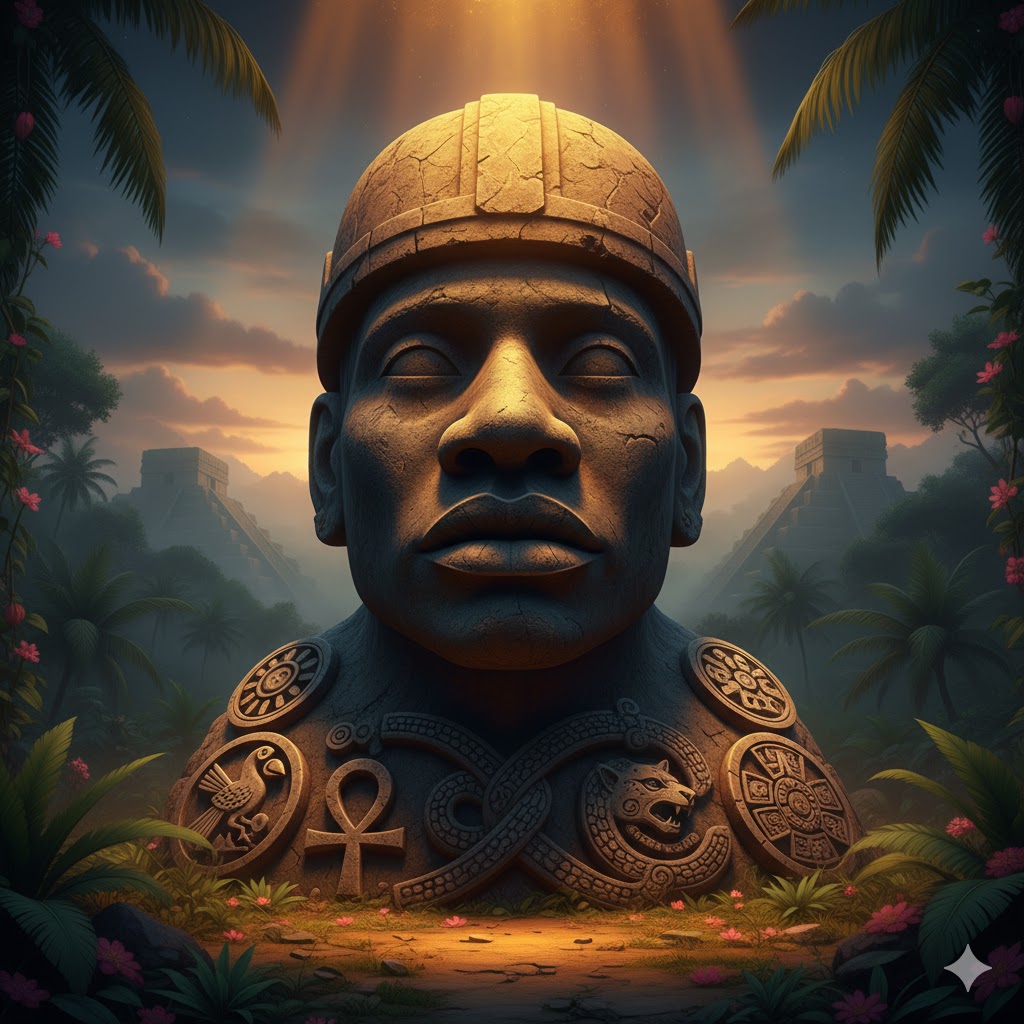
The Olmec civilization, often hailed as the “mother culture” of Mesoamerica, represents one of humanity’s earliest high cultures in the Americas. Flourishing between 1500 BCE and 400 BCE along the Gulf Coast of present-day Veracruz and Tabasco, Mexico, the Olmecs laid the foundation for later civilizations such as the Maya and Aztec. Renowned for their monumental artistry, religious symbolism, and complex social organization, the Olmecs embody the ingenuity, spirituality, and resilience of early American civilization (Diehl, 2004).

The term Olmec, derived from the Nahuatl word Olmeca meaning “rubber people,” refers to both the civilization and the region known for its rubber production (Coe, 2011). The Olmec heartland’s fertile river valleys and humid lowlands allowed for advanced agriculture and sustained population centers like San Lorenzo, La Venta, and Tres Zapotes. The Olmecs cultivated maize, cacao, beans, and squash—crops that later became staples of Mesoamerican culture.


Artistic and Architectural Achievements

The colossal stone heads—some weighing up to 50 tons—remain the most enduring symbols of Olmec artistry. These sculptures, carved from basalt transported over long distances, are believed to represent rulers or ballplayers. Each head bears unique facial features, suggesting individualized portrayals rather than idealized forms (Pool, 2007). The sheer craftsmanship demonstrates centralized governance, skilled artisans, and an aesthetic philosophy linking power to sacred representation.

In addition to colossal heads, the Olmecs mastered jade and greenstone carvings, producing figurines, masks, and ritual objects that reveal their refined sense of symmetry and spiritual symbolism. The preference for greenstone—associated with fertility and life—reflects a worldview in which art, agriculture, and divinity were inseparable.


Religion and Cosmology

Olmec religion revolved around deities representing natural forces—rain, maize, and fertility—and often took zoomorphic forms. The “Were-jaguar” figure, half-human and half-jaguar, is among the most pervasive motifs, symbolizing divine transformation or shamanic power (Reilly, 1995). Temples and pyramidal mounds were often aligned with celestial phenomena, emphasizing the Olmecs’ advanced understanding of astronomy.

Ritual bloodletting, offerings, and early forms of the Mesoamerican ballgame appear to have originated among the Olmecs. These rituals reflected the eternal cycles of life, death, and rebirth—core spiritual beliefs that later civilizations inherited.


Society and Governance

Archaeological and linguistic evidence suggests a hierarchical society led by priest-kings who fused political authority with religious power. Trade networks extended from Central America to the Valley of Mexico, spreading Olmec influence and artistic motifs across vast territories. Obsidian, jade, pottery, and feathers were among the traded materials, fostering economic and cultural exchange (Blomster, 2012).

Proto-writing and calendrical systems—evidenced in the Cascajal Block—suggest that the Olmecs developed one of the earliest written languages in the Americas (Rodríguez & Ortiz, 2006). This linguistic sophistication indicates a society of intellectual and ritual complexity rivaling early civilizations in Africa and Asia.


The African Connection: Theories and Debates

The colossal heads’ distinct features—broad noses, full lips, and strong jawlines—have long sparked debate among historians, archaeologists, and Afrocentric scholars. Proponents of the African connection argue that these sculptures bear striking resemblances to West African physiognomy, particularly to the features common among ancient Nubians and West Africans (Van Sertima, 1976). In his seminal work They Came Before Columbus, Ivan Van Sertima argued that African explorers may have reached the Americas centuries before Columbus, influencing early Mesoamerican culture. He pointed to the Olmec heads’ Negroid features, the presence of botanical similarities (such as the African cotton species Gossypium herbaceum), and shared pyramid-building traditions as potential evidence of pre-Columbian transatlantic contact.

Similarly, Black historian Clyde A. Winters (2013) has proposed that African migrants—possibly of the Mande or Nubian cultures—may have contributed to Olmec civilization’s rise through maritime exploration across Atlantic currents. These Afrocentric theories emphasize the historical agency of ancient African peoples and challenge Eurocentric narratives that minimize Africa’s global impact.

However, mainstream archaeologists interpret the facial features differently. Many argue that the Olmec heads reflect the indigenous physiognomy of the native populations of the Gulf Coast, whose features—broad noses and full lips—are naturally diverse and regionally adapted. Modern DNA studies and cranial analyses have not conclusively linked Olmec remains to African populations, instead situating them within the broader indigenous Mesoamerican genetic spectrum (Pool, 2007; Coe, 2011).

While definitive proof of transatlantic contact before Columbus remains elusive, the discussion itself highlights deeper questions of representation, racial bias, and the politics of archaeology. As Asante (2007) notes, Afrocentric inquiry seeks not to impose African origins on every civilization but to restore African humanity to the global historical narrative from which it has often been erased.


Legacy and Cultural Influence

Regardless of the debate, the Olmec legacy in Mesoamerican civilization is indisputable. Their iconography, ritual practices, and urban planning profoundly shaped later societies such as the Maya and Aztec. The concept of divine kingship, the calendar system, and pyramid architecture all bear traces of Olmec origin.

Culturally, the Olmecs symbolize the dawn of intellectual and spiritual consciousness in the Americas. Their art bridges heaven and earth, the visible and invisible worlds, offering timeless testimony to the human desire for divine connection and order.


Conclusion

The Olmec civilization stands as a foundational pillar in world history—a society of builders, artists, priests, and visionaries who defined Mesoamerican identity for millennia. Whether viewed through the lens of indigenous ingenuity or possible African contact, their story underscores the interconnectedness of human cultures. The colossal heads, staring silently through centuries, remind the world of a people whose beauty, intellect, and craftsmanship transcended their time.

As global discourse continues to evolve, revisiting the Olmec question through both scientific and Afrocentric frameworks enriches—not diminishes—our understanding of ancient history. For in every sculpted face of basalt lies not only a ruler of old but the universal face of humanity—diverse, divine, and eternally creative.


References

  • Asante, M. K. (2007). An Afrocentric Manifesto: Toward an African Renaissance. Polity Press.
  • Blomster, J. P. (2012). The Origins of Olmec Civilization: Theories of Formative Mesoamerican Development. Annual Review of Anthropology, 41(1), 223–239.
  • Coe, M. D. (2011). Mexico: From the Olmecs to the Aztecs (6th ed.). Thames & Hudson.
  • Diehl, R. A. (2004). The Olmecs: America’s First Civilization. Thames & Hudson.
  • Pool, C. A. (2007). Olmec Archaeology and Early Mesoamerica. Cambridge University Press.
  • Reilly, F. K. (1995). Art, Ritual, and Rulership in the Olmec World. Dumbarton Oaks.
  • Rodríguez, M. C., & Ortiz, P. (2006). New Evidence for Early Olmec Writing: The Cascajal Block. Science, 313(5793), 1610–1614.
  • Van Sertima, I. (1976). They Came Before Columbus: The African Presence in Ancient America. Random House.
  • Winters, C. A. (2013). African Empires in Ancient America: The Olmecs, the Mande, and the Transatlantic Legacy. African Diaspora Press.

The Slave Files: Anna Julie Cooper

This photograph is the property of its respective owner. No copyright infringement intended.

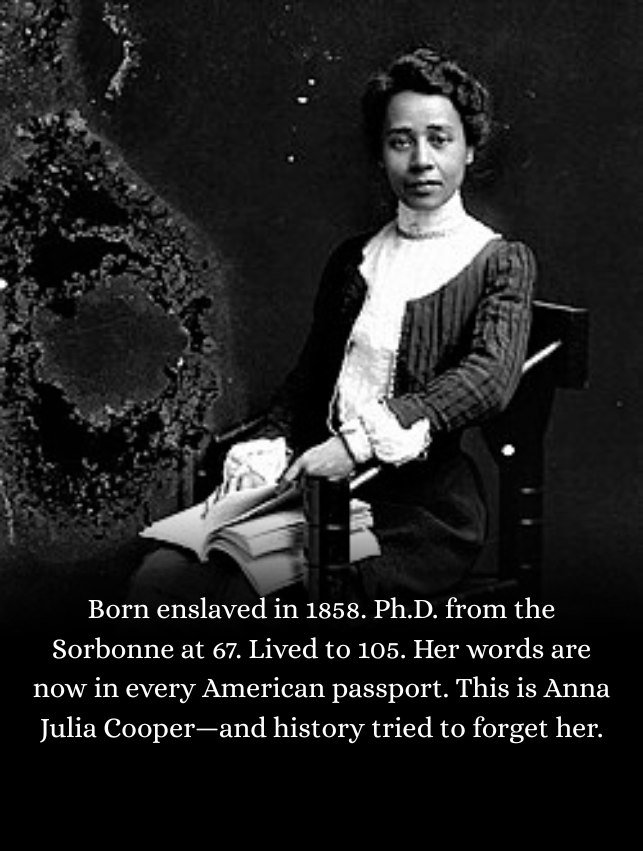
Anna Julia Cooper was born on August 10, 1858 in Raleigh, North Carolina

Anna Julia Cooper was an influential African American educator, scholar, and author whose life and work left a profound impact on Black education and intellectual thought. Born in the late 19th century, she emerged during a period of systemic oppression and racial discrimination, when opportunities for African Americans—particularly women—were severely limited. Despite these obstacles, Cooper dedicated her life to uplifting her community through education, moral leadership, and scholarly contributions.

Cooper’s early life was marked by a determination to pursue learning despite societal barriers. She believed that education was a fundamental tool for liberation and empowerment. Her passion for teaching and scholarship became a central theme in her life, guiding her professional endeavors and public influence.

As an educator, Julia Cooper worked tirelessly to improve access to quality schooling for African Americans. She advocated for rigorous academic standards, the establishment of Black educational institutions, and curricula that fostered critical thinking and self-worth among students. Her efforts emphasized the transformative power of knowledge as a means to resist systemic oppression.

In addition to teaching, Cooper was a prolific writer and thinker. She authored essays and treatises on the moral, social, and intellectual development of African Americans, emphasizing the necessity of self-respect, cultural pride, and educational attainment. Her writings served as a blueprint for Black uplift during the early 20th century.

Cooper also engaged in public speaking and community organizing. She traveled widely, addressing audiences on the importance of education, civic responsibility, and moral development. Her speeches encouraged African Americans to embrace their intellectual potential and challenge societal narratives that sought to marginalize them.

Her impact extended to her mentorship of younger generations of Black scholars and educators. By providing guidance, encouragement, and access to educational resources, Cooper helped cultivate a new class of African American leaders committed to intellectual excellence and social progress.

Anna Julia Cooper’s work was informed by a deep moral and spiritual philosophy. She believed that personal character and ethical integrity were inseparable from educational and professional achievement. Her vision emphasized holistic development—intellectual, moral, and civic—as essential to individual and communal advancement.

Throughout her career, Cooper confronted racism, sexism, and social prejudice. Her ability to navigate these systemic challenges while achieving professional recognition serves as a testament to her resilience and strategic acumen. She became a symbol of Black female agency in a society structured to limit her potential.

Her legacy is visible in the educational institutions she influenced, the students she inspired, and the broader discourse on African American intellectual empowerment. Cooper’s life exemplifies the potential for knowledge and moral courage to transform communities and challenge entrenched inequalities.

Anna Julia Cooper remains a vital figure in African American history, her life and work illustrating the enduring power of education, scholarship, and leadership in advancing justice and equality. Her contributions continue to inspire educators, students, and leaders committed to intellectual rigor and moral responsibility.


References

  1. Gates, H. L., & Higginbotham, E. B. (2014). African American lives. Oxford University Press.
  2. Gutman, H. G. (1976). The black family in slavery and freedom, 1750-1925. Pantheon Books.
  3. Kelley, R. D. G. (1994). Race rebels: Culture, politics, and the Black working class. Free Press.
  4. Theoharis, J. (2018). A more beautiful and terrible history: The uses and misuses of civil rights history. Beacon Press.
  5. Wiggins, W. H. (2000). The intellectual tradition of African Americans: A historical overview. Greenwood Press.

Dilemma: Lynching

Strange Fruit: The Lingering Shadow of Lynching.

Photo by Alexey Demidov on Pexels.com

Lynching, a brutal form of extrajudicial killing, has left an indelible mark on American history. While its most notorious period occurred during the late 19th and early 20th centuries, the echoes of this violence have persisted into more recent times. This narrative delves into the story of Trey Reed, a fictional character whose life and death mirror the tragic realities faced by Black individuals subjected to racial terror. Lynching refers to the act of a mob executing an individual without legal authority, often in a public setting, and typically motivated by racial hatred. Historically, these acts were used to enforce white supremacy and instill fear within Black communities.

The Case of Trey Reed

In the summer of 1975, Trey Reed, a 22-year-old Black man from Georgia, was found hanging from a tree in a rural area. Authorities quickly labeled his death a suicide, but inconsistencies in the investigation raised suspicions. Reed had been outspoken about racial injustices in his community, leading many to believe his death was a targeted act of violence.

Community Response

Reed’s death sparked outrage among local civil rights groups. Protests and vigils were held, demanding a thorough investigation and accountability. Despite the public outcry, the case remained officially closed, with no charges filed.

The Role of Media

National media coverage of Reed’s death brought attention to the ongoing issue of racial violence in America. Journalists uncovered patterns of similar incidents in the region, suggesting a broader, systemic problem.

Legal Challenges

In 1980, the Reed family filed a civil lawsuit against local law enforcement, alleging misconduct and negligence. The case drew attention to the lack of legal recourse available to families of lynching victims.

The Legacy of Trey Reed

Although no one was ever convicted in Reed’s death, his story became a symbol of the fight against racial injustice. Memorials and scholarships were established in his name, ensuring that his legacy would continue to inspire future generations.

Comparative Cases: The Lynching of Mack Charles Parker

In 1959, Mack Charles Parker, a Black man in Mississippi, was accused of raping a white woman. Before he could stand trial, a mob abducted him from jail, beat him, and shot him dead. Despite confessions from the perpetrators, no one was ever indicted, highlighting the impunity often afforded to those committing such acts.

The Murder of Mary Turner

In 1918, Mary Turner, a pregnant Black woman in Georgia, was lynched after protesting the killing of her husband. Her brutal death underscored the extreme lengths to which white supremacists would go to silence dissent and maintain control.

The Case of George Armwood

George Armwood was lynched in Maryland in 1933 after being accused of assaulting a white woman. His death marked the last recorded lynching in the state, reflecting the persistence of racial violence even in the mid-20th century.

The Impact of the Civil Rights Movement

The Civil Rights Movement of the 1950s and 1960s brought national attention to the issue of lynching. Activists like Rosa Parks and Martin Luther King Jr. highlighted these atrocities, pushing for legal reforms and greater societal awareness.

The Emmett Till Case

In 1955, 14-year-old Emmett Till was lynched in Mississippi after allegedly offending a white woman. His open-casket funeral and the subsequent trial brought international attention to the brutality of racial violence in America.

The Role of Photography

Photographs of lynching victims, such as the iconic image of Till’s disfigured body, played a crucial role in galvanizing public opinion and spurring the civil rights movement.

The Decline of Lynching

Following increased activism and legal challenges, the frequency of lynchings declined in the latter half of the 20th century. However, the legacy of these acts continues to affect communities today.

The Importance of Memorialization

Institutions like the Equal Justice Initiative have worked to document and memorialize the victims of lynching, ensuring that their stories are not forgotten.

The Role of Education

Educating the public about the history of lynching is essential for fostering understanding and reconciliation. Programs and curricula have been developed to teach about this dark chapter in American history.

Ongoing Racial Injustice

While lynching may no longer be as prevalent, racial violence and discrimination persist in various forms. Addressing these issues requires continued vigilance and activism.

The Need for Legal Reform

Advocates continue to push for legal reforms to address hate crimes and ensure justice for victims of racial violence. This includes efforts to strengthen laws and improve the accountability of law enforcement agencies.

The Role of Community Engagement

Community involvement is crucial in combating racial injustice. Local organizations and leaders play a vital role in advocating for change and supporting affected individuals and families.

Conclusion: Remembering the Past, Shaping the Future

The story of Trey Reed serves as a poignant reminder of the enduring impact of lynching and racial violence in America. By remembering these atrocities and honoring the victims, society can work towards healing and ensuring that such injustices are never repeated.

References