Category Archives: history

The Slave Files: Nat Turner

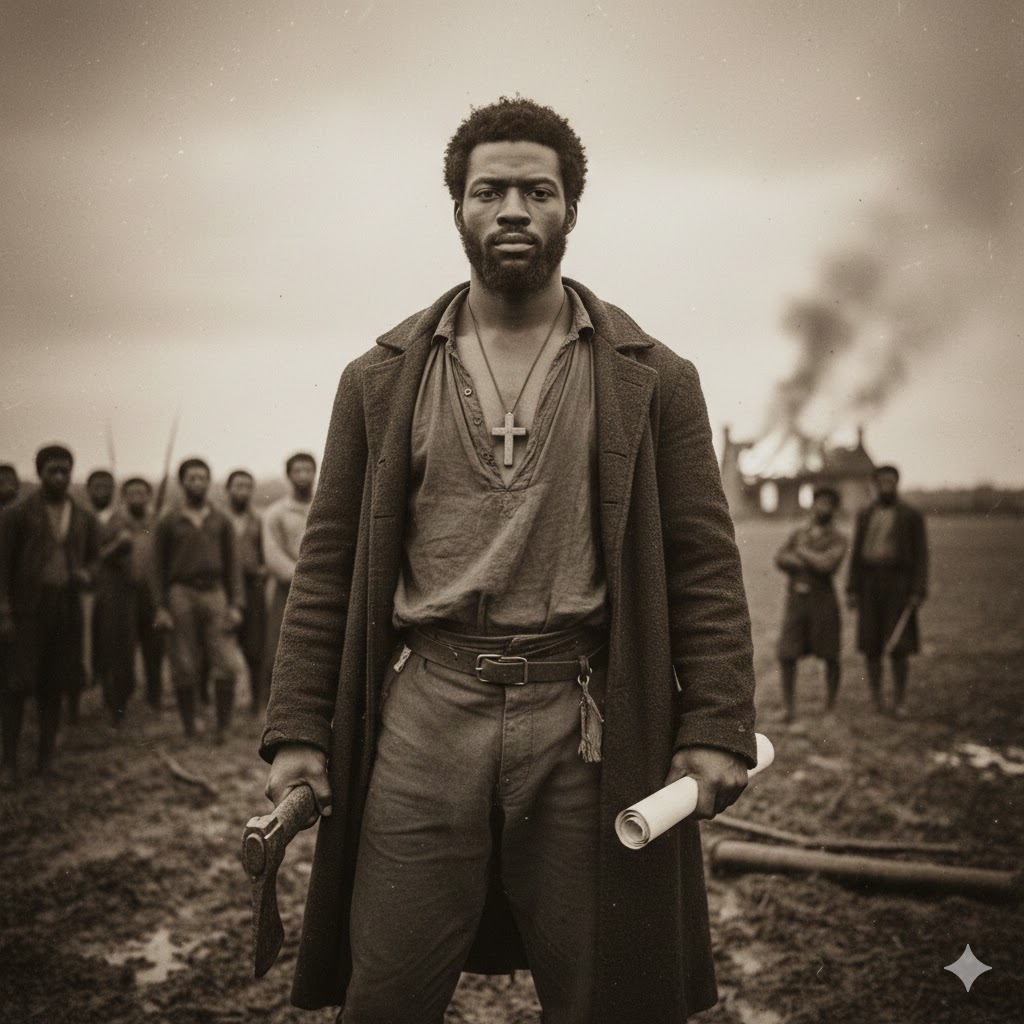
Nat Turner remains one of the most riveting, misunderstood, and fiercely debated figures in American history. His life, marked by enslavement, spiritual conviction, and violent rebellion, exposes the brutal underpinnings of slavery and the relentless pursuit of freedom among the enslaved. Born into bondage yet convinced that God spoke directly to him, Turner’s life becomes both a historical record and a moral indictment of an evil system built on racism, violence, and domination. His story is not merely an episode of revolt—it is a penetrating look into the psychology of oppression and the spiritual courage of a man who believed liberation was his divine mandate.

Nat Turner was born on October 2, 1800, in Southampton County, Virginia, on the Benjamin Turner plantation. Because he was enslaved, his last name “Turner” was not his by heritage but by ownership—a reminder of a system that erased African identities and imposed White surnames as marks of property. He was raised among enslaved people who maintained fragments of African culture while living under the constant threat of punishment, sale, and family separation. Early accounts describe him as highly intelligent, deeply introspective, and gifted with an unusual memory, demonstrating literary and spiritual aptitude uncommon among enslaved children, not because Black children were incapable, but because literacy was violently suppressed.

Turner’s early life was shaped by stories of Africa passed down through elders who remembered freedom. His mother and grandmother reportedly told him he was destined for greatness, strengthening his own belief that he was chosen by God. Because enslavers feared educated Black people, Turner’s intellectual and spiritual gifts were viewed as unsettling. Still, he was allowed to read and interpret scripture, which laid the foundation for his prophetic worldview. Turner believed the Holy Spirit communicated with him through visions and signs—an inner call that would later justify his resistance.

Throughout his enslavement, Turner worked on several plantations due to sale and transfer among enslavers. After Benjamin Turner’s death, Nat was passed to Samuel Turner, and later hired out to others in the region. Ultimately, he lived on the plantation of Joseph Travis—his final enslaver—where he labored in the fields, observed the conditions of fellow enslaved laborers, and cultivated a quiet but fiercely burning resentment toward the system of slavery. Though some enslavers described him as “meek” and “intelligent,” these words reveal more about the blindness of slaveholding ideology than Turner’s true convictions. Beneath the silence was clarity: he was not property but a man.

Nat Turner was married to an enslaved woman named Cherry (also recorded as “Cherie” in some sources), though records of their union are scarce due to the erasure and negligence inherent in slave documentation. They were separated by work arrangements and plantation boundaries, illustrating how marriage among enslaved people was vulnerable to sale, distance, and the will of slaveholders. Turner also had children, though their names and fates are not fully documented, a tragic reminder of how slavery destabilized Black family structures. Enslaved parenthood carried constant fear—a child could be sold, abused, or killed with no recourse.

The racism of Turner’s era was not subtle; it was law, culture, and religion weaponized. Enslavers justified their brutality through pseudo-Christian doctrine and racial myths that claimed African people were inferior. Turner, however, read the Bible for himself and saw deliverance where enslavers preached obedience. His spiritual interpretations defied the slaveholding church and pointed instead to liberation theology: God does not sanctify oppression. Turner began to see visions—blood on corn, heavenly signs, eclipses—as divine symbols that the time for judgment had come.

By 1828, Turner reported having a decisive vision in which “the Spirit spoke” and commanded him to lead a rebellion against slaveholders. He believed God chose him as a prophet, and that enslaved people would gain their freedom through an act of divine justice. This belief was not madness but a theological response to a world where law and society left no pathway to liberation. Slavery had destroyed every peaceful option—Turner saw rebellion as the only moral course.

On August 21, 1831, Nat Turner launched what would become the most significant slave rebellion in American history. Together with a group of enslaved men, he moved silently from plantation to plantation, killing approximately 55 White men, women, and children. While the violence was severe, it must be understood within the context of an institution that killed, raped, and brutalized enslaved people for centuries with complete impunity. Turner’s rebellion exposed the fear underlying slaveholding society—that enslaved people, given the chance, would fight for their freedom with the same intensity with which they had been oppressed.

The rebellion lasted nearly two days before being suppressed by militias and federal troops. What followed was even worse: White mobs and militias killed an estimated 100–200 Black people indiscriminately, many who had nothing to do with the uprising. This retaliatory slaughter revealed how deeply racism governed the South—Black life was disposable, whether rebellious or innocent.

Turner evaded capture for almost two months, hiding in woods and swamps familiar to enslaved laborers. His eventual capture on October 30, 1831, led to a swift trial. During his confinement, attorney Thomas R. Gray interviewed him, producing The Confessions of Nat Turner, a document that remains historically significant but must be read critically. While it gives insight into Turner’s thoughts, it was also shaped by White interpretation, editing, and sensationalism. Still, Turner remained confident in his divine mission, stating that he felt no regret for attempting to overthrow slavery.

On November 11, 1831, Nat Turner was hanged in Jerusalem, Virginia. His body was desecrated, and his remains scattered—a final attempt to erase him from history. But the rebellion had already shaken the South to its core. Slave laws intensified, restrictions on Black movement and literacy increased, and fear spread among White slaveholders. Yet among abolitionists and enslaved people, Turner became a symbol of courage, resistance, and the demand for freedom.

Turner’s life raises profound questions about morality, justice, and the lengths to which oppressed people must go to reclaim their humanity. His story is not merely about violence—it is about the conscience of a nation built on slavery. Whether viewed as a liberator, prophet, revolutionary, or extremist, the truth remains: Nat Turner forced America to confront the evil it tried to normalize. His biography is a testament to the enduring truth that freedom, once imagined, can never be contained.

His wife and children suffered the consequences of his rebellion in silence, surviving in a world that punished Black families for acts of resistance. Their story represents the generational trauma imposed on Black families, whose love existed under the constant threat of separation and sale. Turner’s rebellion was not just for himself—it was for them, and for millions whose cries went unrecorded.

Nat Turner’s legacy has evolved over time. To some, he is a martyr; to others, a warning. But to scholars, theologians, and descendants of the enslaved, he is a complex figure who embodies the deep wounds and righteous anger born of slavery. His rebellion is part of a larger narrative of Black resistance—from maroon communities to uprisings in the Caribbean to civil rights struggles centuries later.

Today, Turner stands as a reminder of how oppression will always birth resistance. His life forces us to examine how deeply racism shaped America’s foundations and how fiercely enslaved people fought for freedom in every generation. His story is not one of defeat but of defiance—an unbroken declaration that slavery could not crush the human spirit.

Turner’s biography invites us to grapple with the uncomfortable truth: righteousness and rebellion often walk hand in hand in the fight against injustice. His actions reflected a spiritual conviction grounded in the belief that God sides with the oppressed, not the oppressor. Whether read as prophecy or desperation, his rebellion demanded that the world acknowledge the humanity of the enslaved, whose blood built the nation.

The Slave Files on Nat Turner remind us that history is not clean, orderly, or polite. It is raw, painful, and shaped by people who refused to accept bondage as destiny. Turner’s story challenges modern readers not to sanitize the past but to confront it with honesty. The scars of slavery remain, but so does the legacy of those who fought against it with unwavering resolve.

Nat Turner was a slave, a husband, a father, a preacher, a visionary, and a revolutionary. His life cannot be reduced to a single moment of violence—it must be understood as the culmination of centuries of suffering and centuries of hope. The Slave Files preserve his memory not to glorify conflict but to honor the courage of a man who believed freedom was worth everything, even his life.

References
Aptheker, H. (1993). American Negro slave revolts. International Publishers.
Gray, T. R. (1831). The confessions of Nat Turner. Baltimore: T. R. Gray.
Greenberg, K. S. (2003). Nat Turner: A slave rebellion in history and memory. Oxford University Press.
Oates, S. B. (1975). The fires of jubilee: Nat Turner’s fierce rebellion. Harper & Row.
Tragle, H. L. (1971). The Southampton slave revolt of 1831: A compilation of source material. University of Massachusetts Press.

The Degradation of American Culture: The Good, the Bad, and the Ugly – The Niggerization of America!

Race, Media, Internalized Oppression, and the Crisis of Identity in Modern America

What the word is meant to imply (in sociological usage)

When people use the term “niggerization” (usually in polemical or extremist writing), they typically mean:

The perceived process by which a society or group is said to adopt negative stereotypes historically associated with Black people, such as:

  • poverty
  • disorder
  • criminality
  • vulgarity
  • hypersexuality
  • anti-intellectualism
  • cultural dysfunction

So in that usage, it is shorthand for:

“cultural degradation framed through racist stereotypes.”

Why the term itself is intellectually flawed

From a scholarly standpoint, the term is conceptually incoherent and racist, because:

  1. It assumes Blackness itself is synonymous with dysfunction.
  2. It collapses complex social problems into racial essence.
  3. It confuses structural conditions (poverty, trauma, policy, media) with biological or cultural identity.
  4. It reproduces the very colonial logic it claims to critique.

In other words, it racializes social pathology, instead of analyzing:

  • capitalism
  • media systems
  • historical trauma
  • political economy
  • psychological conditioning

The accurate academic concepts instead

In serious sociology and psychology, the phenomena people try to describe with that word are actually studied as:

  • Cultural degradation (Postman, 1985)
  • Internalized oppression (Fanon, 1967)
  • Collective trauma (Herman, 1992)
  • Symbolic violence (Bourdieu, 1991)
  • Cultural pathology under late capitalism
  • Media-induced behavioral normalization

These frameworks explain the same issues without racial essentialism.

Bottom line (the honest answer)

The term “niggerization” means:

“The claim that social or cultural decline is caused by or resembles racist stereotypes of Black people.”

But academically speaking, it is:

  • not a valid concept
  • not used in peer-reviewed scholarship
  • built on racist assumptions
  • and analytically useless for real understanding.

Serious analysis talks about systems, trauma, incentives, power, and psychology — not racialized caricatures.

American culture stands at a paradoxical crossroads. On one hand, it represents unprecedented technological advancement, economic power, and global influence; on the other, it reveals deep moral confusion, cultural fragmentation, and psychological instability. The same society that produced civil rights movements, scientific revolutions, and artistic brilliance now also exports nihilism, hypersexuality, intellectual decline, and cultural self-loathing. This contradiction demands serious analysis, not sentimental nostalgia or ideological denial.

The “good” of American culture lies in its foundational ideals: liberty, education, innovation, and the belief in human potential. The United States historically functioned as a space where marginalized groups—particularly Black Americans—transformed systemic adversity into cultural excellence. From spirituals and jazz to civil rights theology and Black intellectualism, oppressed communities generated some of the most profound moral and artistic contributions in human history.

Black culture, in particular, once operated as a counter-hegemonic force—rooted in church, family structure, discipline, and collective survival. The Black church served not merely as a religious institution but as a psychological refuge, political organizing center, and moral compass. It cultivated literacy, leadership, and resistance, producing figures like Martin Luther King Jr., W.E.B. Du Bois, Malcolm X, and countless unsung educators and theologians.

However, the “bad” emerges when culture shifts from liberation to commodification. Under late-stage capitalism, identity itself becomes a product. Blackness, once forged in collective struggle, is now marketed as aesthetic rebellion divorced from historical consciousness. Hip-hop, fashion, slang, and trauma are packaged for global consumption while structural realities remain unresolved.

This transformation reflects what Frantz Fanon described as internalized oppression—the psychological condition in which colonized or marginalized people unconsciously absorb the values and narratives of their oppressors. Rather than defining themselves through ancestral dignity or moral purpose, individuals increasingly mirror distorted media archetypes that reward dysfunction, hypervisibility, and performative identity.

The American media-industrial complex plays a decisive role in this pathology. Reality television, viral culture, and algorithmic platforms normalize ignorance, narcissism, and moral exhibitionism. Intelligence is no longer rewarded; attention is. Loudness replaces substance, controversy replaces coherence, and degradation becomes spectacle.

From a sociological standpoint, this represents what Pierre Bourdieu called symbolic violence—a system in which dominant structures impose meaning in ways that appear natural or entertaining. Cultural decline is not accidental; it is engineered through incentives that reward psychological regression over collective uplift.

The “ugly” phase emerges when dysfunction becomes identity. At this stage, cultural pathology is defended, not questioned. Self-destructive behavior is reframed as authenticity. Anti-intellectualism becomes empowerment. Victimhood becomes currency. Accountability becomes oppression. The very tools needed for liberation—language, art, sexuality, spirituality—are weaponized against self-development.

This phenomenon is not limited to Black America; it reflects a broader American collapse of values. Consumerism replaces character. Pleasure replaces purpose. Image replaces substance. The nation increasingly resembles what the sociologist Christopher Lasch termed a culture of narcissism, where self-expression replaces moral formation and therapy replaces ethics.

Theologically, this crisis reflects a deeper spiritual disorder. Scripture consistently frames cultural decay as the consequence of moral inversion. “Woe unto them that call evil good, and good evil” (Isaiah 5:20, KJV). When societies lose transcendent moral reference points, they descend into relativism, where no behavior can be judged and no standard upheld.

In biblical anthropology, human beings are not merely social animals but moral agents accountable to divine law. When culture severs itself from transcendent accountability, identity collapses into instinct, impulse, and ego. This is not freedom; it is regression.

Deuteronomy 28 presents a powerful framework for cultural analysis: obedience produces collective flourishing, while disobedience produces psychological confusion, social instability, and generational trauma. The text reads less like ancient theology and more like sociological prophecy.

From a psychological perspective, the current American condition aligns with collective trauma theory. Historical violence—slavery, segregation, economic exploitation—left deep neurological and cultural scars. However, unresolved trauma does not heal itself; it either transforms into wisdom or mutates into pathology.

Instead of healing through historical consciousness, education, and moral reconstruction, American culture increasingly chooses escapism: drugs, sex, entertainment, consumption, and digital addiction. These are not neutral pleasures; they function as anesthetics against existential emptiness.

The tragedy is that Black America once offered a powerful counter-model: communal identity, spiritual resilience, disciplined family structures, and moral seriousness forged under pressure. That legacy is now being diluted, caricatured, and commercially exploited.

What was once a culture of survival has become a culture of simulation. Pain is aestheticized. Trauma is monetized. Rebellion is marketed. Liberation is reduced to branding.

This is not merely cultural decline; it is psychological colonization in reverse—where the descendants of the oppressed internalize and perform the very stereotypes once imposed upon them, now for profit and validation.

Yet the story is not closed. Cultural cycles can be reversed. The same communities that produced intellectual giants, theologians, artists, and revolutionaries can do so again. Cultural resurrection is possible, but it requires ruthless honesty.

It requires rejecting media lies, reclaiming historical consciousness, restoring intellectual discipline, rebuilding family structures, and re-centering spiritual identity. Culture does not change through slogans; it changes through values, institutions, and collective memory.

The future of America will not be determined by technology or politics alone, but by psychological orientation: whether society chooses depth over spectacle, meaning over impulse, and truth over performance.

Ultimately, the crisis of American culture is not racial at its core—it is spiritual and psychological. Race merely reveals the fractures more vividly. What we are witnessing is not just cultural decay, but a civilizational test: whether identity will be grounded in transcendence or dissolved into algorithmic noise.

The good showed what America could be.
The bad reveals what it compromised.
The ugly exposes what it becomes when it forgets who it is.


References

Bourdieu, P. (1991). Language and symbolic power. Harvard University Press.

Fanon, F. (1967). Black skin, white masks. Grove Press.

Du Bois, W. E. B. (1903). The souls of Black folk. A.C. McClurg.

Lasch, C. (1979). The culture of narcissism: American life in an age of diminishing expectations. W. W. Norton.

Herman, J. L. (1992). Trauma and recovery. Basic Books.

bell hooks. (1992). Black looks: Race and representation. South End Press.

Postman, N. (1985). Amusing ourselves to death. Penguin.

The Holy Bible, King James Version. (1611/2017). Hendrickson Publishers.

Dei, G. J. S. (2012). Reframing Blackness and Black solidarities through anti-colonial and decolonial prisms. Springer.

Wilkerson, I. (2020). Caste: The origins of our discontents. Random House.

Dilemma: Racism and Race Baiting

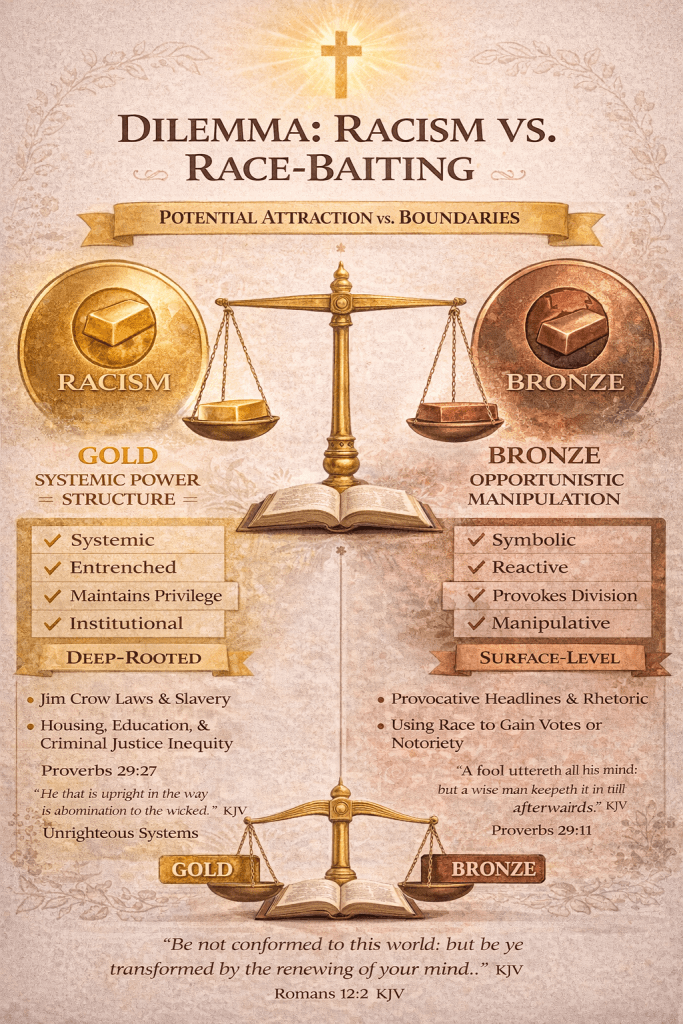
Racism remains one of the most persistent and destructive forces in society, functioning as a systemic power structure designed to maintain the dominance of one group over another (Feagin, 2006). Unlike individual prejudice, which reflects personal bias, racism involves institutional, cultural, and historical mechanisms that enforce inequality. Understanding racism as a power structure is critical to distinguishing it from race-baiting.

Race-baiting, in contrast, refers to tactics that manipulate racial tension for personal, political, or financial gain. It does not necessarily rely on structural dominance but rather exploits societal divisions, often inciting anger, fear, or resentment. While both racism and race-baiting are harmful, their mechanisms and intent differ.

Racism operates at multiple levels: individual, institutional, and systemic. Individual racism involves personal prejudice or discriminatory acts, whereas institutional racism manifests in policies, practices, and norms that advantage one racial group over others. Systemic racism describes the entrenched nature of these structures over generations.

Race-baiting exploits visible racial differences to provoke a reaction. Unlike racism, which is rooted in power dynamics and structural advantage, race-baiting may be opportunistic, focusing on rhetoric and emotional appeal rather than systemic control. Politicians, media personalities, and even social influencers often use race-baiting to advance agendas or gain attention.

In biblical terms, oppression and favoritism have long been condemned. James 2:1 warns, “My brethren, have not the faith of our Lord Jesus Christ, the Lord of glory, with respect of persons” (KJV). Partiality and systemic oppression violate God’s design for justice and equality. Racism is, therefore, fundamentally anti-biblical because it enforces inequality and diminishes the image of God in humanity (Genesis 1:27).

Understanding the difference between racism and race-baiting requires examining the intent behind actions. Racism seeks to preserve hierarchy, maintain privilege, and control resources. Race-baiting seeks to provoke emotional reaction and division, often for personal gain or notoriety. While a racist agenda benefits the oppressor materially or socially, race-baiting primarily manipulates perception.

The metaphor of bronze versus gold can help clarify the distinction. Bronze represents the superficial provocation, often symbolic and reactive—this is race-baiting. Gold represents the deep, entrenched systemic mechanisms—this is racism in its structural form. Observing whether an act addresses the root of inequality or merely agitates emotion can reveal its nature.

Racism and race-baiting intersect in public discourse. Some individuals and media sources may exaggerate or misrepresent incidents of racial tension for attention, funding, or political leverage. This blurs public understanding, making it difficult to address genuine structural injustice. As Proverbs 18:17 notes, “The first to plead his cause seemeth just; but his neighbor cometh and searcheth him” (KJV). Truth requires deeper investigation.

Racism thrives on normalization. When societal structures systematically advantage one group, discriminatory practices are often invisible or dismissed as “tradition” or “meritocracy.” Understanding this helps differentiate between acts that are opportunistic (race-baiting) and those that are embedded within the system (racism).

Race-baiting frequently misdirects anger away from systemic causes toward individual actors, scapegoating specific groups for broader structural problems. This manipulation can polarize communities and hinder meaningful solutions. Micah 6:8 reminds us of justice and humility: “He hath shewed thee, O man, what is good; and what doth the Lord require of thee, but to do justly, and to love mercy, and to walk humbly with thy God?” (KJV).

Media literacy is essential to recognize the distinction. Headlines and social media often amplify emotionally charged narratives without context. Racism is systemic, historically rooted, and persistent, while race-baiting relies on immediate reaction. Educated discernment enables individuals to see beyond sensationalism.

Racism is often intergenerational, perpetuated through education, housing, employment, criminal justice, and healthcare disparities. Race-baiting is usually episodic, emerging around specific incidents, speeches, or events. Understanding historical context is therefore critical to interpreting current racial discourse accurately.

Race-baiting can also occur within oppressed communities, where individuals or groups exploit internal divisions to gain influence. This demonstrates that race-baiting is less about power structures and more about manipulation, contrasting with racism’s reliance on systemic advantage.

The Bible condemns hypocrisy and manipulation. Proverbs 6:16–19 lists pride, false witness, and sowing discord among brethren as abominations to God. Race-baiting falls into the category of sowing discord, whereas racism violates divine law by enforcing inequality. Both are sin, but their mechanisms differ.

Recognizing racism requires assessing who benefits. True racism confers social, economic, and political advantage to a particular racial group. Race-baiting may inflame perceptions of injustice but does not create structural advantage. This distinction clarifies policy debates and moral accountability.

Racism also often hides behind ideology, meritocracy, or cultural norms. The systemic nature makes it less visible than race-baiting, which is loud, overt, and performative. Understanding the bronze versus gold distinction allows individuals to respond with strategic solutions rather than reactive emotion.

Education and awareness are key tools in dismantling both racism and race-baiting. Combatting racism requires structural reform, anti-discrimination policy, and societal accountability. Countering race-baiting requires critical thinking, media literacy, and spiritual discernment (Proverbs 14:15).

Christians are called to pursue justice and reconciliation. Isaiah 1:17 commands, “Learn to do well; seek judgment, relieve the oppressed, judge the fatherless, plead for the widow” (KJV). Responding to racism requires action and advocacy; responding to race-baiting requires wisdom, prayer, and discernment.

Racism is a deep societal disease, while race-baiting is a symptom that exploits and amplifies divisions. One targets systemic change; the other targets immediate perception. Addressing the root cause requires education, advocacy, and awareness of historical context, as well as spiritual discernment.

In conclusion, distinguishing between racism and race-baiting is essential for effective response. Bronze may flare in anger and reaction; gold endures in system and power. Both demand moral responsibility, but the solutions differ. Recognizing the systemic nature of racism while refusing to be manipulated by race-baiting is a critical skill for spiritual and social maturity (Romans 12:2).


References

Feagin, J. (2006). Systemic racism: A theory of oppression. Routledge.
Alexander, M. (2012). The New Jim Crow: Mass incarceration in the age of colorblindness. The New Press.
Kendi, I. X. (2019). How to be an antiracist. One World.
Proverbs 4:23; 14:15; 18:17; 6:16–19
Isaiah 1:17; Micah 6:8; James 2:1; Genesis 1:27
Romans 12:2; Hebrews 13:4
Matthew 10:16; Matthew 26:41

The Dark History of Being Light-Skinned and Dark-Skinned Black Person Around the World.

The history of light-skinned Black people in the Atlantic world is inseparable from the violence of slavery, colonialism, and racial domination. Lighter complexions did not emerge as a neutral genetic variation but, in many cases, as the direct result of coercion, sexual violence, and unequal power relations between enslaved African women and European men. To discuss light skin in Black history honestly requires confronting this brutal origin story and the enduring psychological and social consequences that followed.

During chattel slavery, rape was not an aberration but a systemic feature of the institution. Enslaved women had no legal right to consent, and white slaveholders exercised near-absolute power over their bodies. The children born from these assaults often inherited lighter skin, straighter hair textures, or other Eurocentric features, marking their very existence as living evidence of sexual violence and domination.

These mixed-ancestry children were frequently labeled “mulatto,” a term rooted in dehumanization and animalization. The classification was not simply descriptive; it functioned as a legal and social category that helped slave societies manage hierarchy within Blackness. Skin tone became a tool of division, reinforcing white supremacy while fracturing solidarity among the enslaved.

Light-skinned enslaved people were often assigned domestic labor rather than field work. This distinction produced the infamous dichotomy between the “house negro” and the field slave, a hierarchy that was imposed, not chosen. Domestic labor sometimes spared individuals from the harshest physical toil, but it exposed them to constant surveillance, sexual exploitation, and proximity to white power.

Being inside the slaveholder’s home did not equate to safety or privilege in any meaningful sense. House servants were more accessible targets for abuse, especially young girls and women. The home was often the site of repeated assaults, emotional manipulation, and forced compliance masquerading as favor.

Incest further complicates this history. Because slavery followed the legal principle of partus sequitur ventrem, children inherited the status of the enslaved mother regardless of the father’s identity. This meant white men could rape their own enslaved daughters and grandchildren without legal consequence, creating generational cycles of abuse that literally lightened the complexion of the enslaved population over time.

Light-skinned children were sometimes recognized as the biological offspring of white men, yet this recognition rarely translated into protection or freedom. More often, it produced resentment, secrecy, or further exploitation. These children occupied a liminal space—never white, yet treated differently within Black communities because of their appearance.

Colorism did not end with emancipation. After slavery, lighter skin continued to carry social currency within Black communities, a legacy of plantation hierarchies and white aesthetic standards. Access to education, employment, social clubs, and marriage prospects was often influenced by complexion, reinforcing divisions rooted in trauma rather than choice.

The psychological burden placed on light-skinned Black people is rarely discussed with nuance. Many carried the stigma of being perceived as products of rape or favoritism, while simultaneously being resented for “privileges” they neither requested nor controlled. This double bind created identity conflicts that reverberate across generations.

At the same time, darker-skinned Black people bore the brunt of systemic violence and exclusion, creating a false narrative that light skin equaled safety or advantage. This obscured the reality that all Black people, regardless of shade, remained subject to racial terror, disenfranchisement, and economic exploitation.

White supremacy strategically used color hierarchies to weaken collective resistance. By elevating lighter skin as closer to whiteness, slave societies encouraged internalized racism and competition. This divide-and-conquer strategy proved effective, leaving lasting scars in Black social relations long after formal slavery ended.

The myth of the “favored” light-skinned enslaved person ignores the constant precarity of their position. Favor could be revoked at any moment, and proximity to power often meant proximity to punishment. Psychological violence—humiliation, erasure, and forced loyalty—was as real as physical brutality.

In religious and moral discourse, enslaved women were blamed for their own assaults, reinforcing misogynoir and sexual shame. Light-skinned children became symbols onto which communities projected unresolved grief, anger, and confusion about sexual violence that was never acknowledged or healed.

Post-slavery societies institutionalized colorism through laws, media, and social norms. Paper bag tests, “blue vein” societies, and caste-like systems in the Caribbean and Americas continued to privilege lighter skin while stigmatizing darker tones. These practices reflected colonial logic rather than African worldviews.

Light skin thus became a paradoxical inheritance: a marker of survival through violence, yet also a source of alienation. Many light-skinned Black people struggled with belonging, questioned their legitimacy within Blackness, or felt compelled to overperform loyalty to counter suspicions of superiority.

Modern conversations about colorism often flatten this history, framing light skin solely as advantage without acknowledging its traumatic origins. This simplification risks reproducing harm by ignoring how sexual violence, incest, and coercion shaped Black bodies and identities.

Healing requires truth-telling. Acknowledging that many light-skinned Black people exist because of rape does not indict them; it indicts the system that produced them. It reframes colorism as a legacy of white supremacy rather than a natural preference within Black communities.

Reclaiming Black unity demands rejecting plantation hierarchies in all forms. Skin tone must be understood as a consequence of history, not a measure of worth, purity, or authenticity. Both light- and dark-skinned Black people inherit trauma from the same system, expressed differently but rooted in the same violence.

To confront the dark history of being light-skinned is to confront slavery honestly. It requires resisting romanticized narratives of privilege and instead centering the realities of rape, incest, coercion, and psychological harm. Only then can colorism be dismantled at its root.

True liberation lies in dismantling the myths that slavery created about skin, beauty, and value. When Black people collectively reject these imposed hierarchies, they reclaim the dignity that was denied to their ancestors—regardless of shade.

The history of dark-skinned Black people is inseparable from the foundations of global white supremacy and the transatlantic slave system. Darkness of skin was deliberately constructed as a marker of inferiority, danger, and disposability, used to justify enslavement, colonization, and dehumanization on a massive scale. From the earliest encounters between Africa and Europe, dark skin became a visual shorthand for domination.

During chattel slavery, darker skin was closely associated with field labor, brutality, and physical exhaustion. Enslaved Africans with the darkest complexions were often assigned the harshest work under the most violent conditions, reinforcing an imposed hierarchy where darkness equaled expendability. This association was not natural but engineered to align Blackness with suffering.

Slaveholders and overseers frequently treated darker-skinned enslaved people with heightened cruelty. Punishments were more public and severe, intended to terrorize others into submission. Darkness of skin was read as strength and resistance, which paradoxically made dark-skinned bodies targets for extreme violence meant to break both body and spirit.

European racial ideology framed dark skin as evidence of savagery, hypersexuality, and moral inferiority. Pseudoscientific racism used skin color to rank humanity, placing the darkest Africans at the bottom of fabricated racial hierarchies. These ideas were embedded in law, religion, and education, ensuring their persistence beyond slavery.

Dark-skinned women endured a unique intersection of racial and gendered violence. They were depicted as unfeminine, animalistic, and unrapeable, narratives that excused sexual assault while denying their victimhood. Their pain was minimized, and their bodies were exploited without acknowledgment or protection.

Unlike their lighter-skinned counterparts, dark-skinned enslaved women were less likely to be brought into the slaveholder’s home. Instead, they were forced into grueling labor while remaining vulnerable to sexual violence without the contradictory myths of “favor” or proximity to power. Their suffering was both hypervisible and ignored.

After emancipation, the devaluation of dark skin did not disappear. Reconstruction and Jim Crow regimes continued to associate darkness with criminality, poverty, and intellectual inferiority. Dark-skinned Black people were more likely to face harsher sentencing, economic exclusion, and social ostracism.

Within Black communities, colorism took root as an internalized inheritance of slavery. Dark-skinned individuals were often subjected to ridicule, diminished marriage prospects, and limited social mobility. These biases reflected plantation hierarchies rather than African cultural values, yet they became normalized through repetition.

Dark-skinned children frequently absorbed messages that their appearance was something to overcome rather than celebrate. Insults, teasing, and media representation taught them early that beauty, intelligence, and desirability were linked to lighter skin. This psychological conditioning produced long-term effects on self-worth and identity.

In education and employment, studies have shown that darker-skinned Black people often face greater discrimination than lighter-skinned peers. Teachers, employers, and institutions unconsciously reproduce racial hierarchies by associating darkness with incompetence or threat, reinforcing inequality under the guise of neutrality.

The criminal justice system has disproportionately punished dark-skinned Black people, who are more likely to be perceived as dangerous or aggressive. Skin tone bias affects policing, sentencing, and jury decisions, revealing how deeply colorism is embedded in modern systems of control.

Media representations have historically erased or caricatured dark-skinned people. When present, they were cast as villains, servants, or comic relief, rarely afforded complexity or humanity. This absence of dignified representation reinforced societal disdain for dark skin.

Dark-skinned men have often been portrayed as inherently violent or hypermasculine, narratives used to justify surveillance, incarceration, and extrajudicial violence. These stereotypes trace directly back to slavery-era fears of rebellion and resistance.

Despite these conditions, dark-skinned Black people have consistently embodied resilience and leadership. Many of the most vocal resisters, abolitionists, and freedom fighters bore the brunt of racial hatred precisely because their appearance symbolized unapologetic Blackness.

The global preference for lighter skin, seen in bleaching practices and beauty standards, reflects unresolved trauma rather than truth. Dark skin became a site of shame not because it lacked value, but because white supremacy taught the world to fear and reject it.

Healing requires confronting how darkness was weaponized against Black people. It demands rejecting the lie that proximity to whiteness equals humanity and acknowledging that the most violently oppressed bodies were often the darkest.

Reclaiming dark skin as beautiful and sacred is an act of resistance. It challenges centuries of conditioning that equated darkness with evil and lightness with virtue. This reclamation restores dignity stolen by slavery and colonialism.

True racial justice cannot exist without addressing colorism. Ignoring skin tone hierarchies allows slavery’s legacy to persist under new names. Justice requires naming how dark-skinned people have been uniquely targeted and harmed.

The dark history of being dark-skinned is not merely a story of suffering but of survival. Against overwhelming forces designed to erase them, dark-skinned Black people endured, resisted, and shaped the world.

Honoring this history means dismantling the systems that still punish darkness today. Only by confronting the truth of how dark skin was treated can society move toward genuine liberation, healing, and collective Black unity.

The histories of being light-skinned and dark-skinned are not opposing narratives, but parallel wounds carved by the same violent system. Color hierarchies were never born within Black communities; they were engineered by slavery and colonialism to rank, divide, and control. Whether through the sexual violence that produced lighter complexions or the intensified brutality directed at darker bodies, skin tone became a tool of domination rather than a reflection of worth.

Both histories reveal how white supremacy manipulated Black bodies into symbols—of proximity or distance, favor or punishment—while denying all Black people full humanity. These imposed distinctions fractured families, distorted identity, and seeded internalized bias that continues to echo across generations. The pain attached to skin tone is not accidental; it is historical, intentional, and unresolved.

True healing requires rejecting plantation logic in every form. It demands that Black communities confront colorism honestly, without competition or denial, and recognize it as inherited trauma rather than personal failure. Light skin and dark skin alike carry the memory of survival under oppression, not moral ranking or superiority.

Liberation begins when Black people refuse to measure themselves by standards forged in violence. When the false hierarchy of shade is dismantled, space is created for collective dignity, restoration, and unity. In reclaiming the fullness of Blackness—across every tone—we reject the lies of the past and affirm a future rooted in truth, justice, and wholeness.

References

Berlin, I. (1998). Many thousands gone: The first two centuries of slavery in North America. Harvard University Press.

Davis, A. Y. (1981). Women, race, & class. Random House.

Douglass, F. (1845). Narrative of the life of Frederick Douglass, an American slave. Anti-Slavery Office.

hooks, b. (1992). Black looks: Race and representation. South End Press.

Hunter, M. (2007). The persistent problem of colorism: Skin tone, status, and inequality. Sociology Compass, 1(1), 237–254. https://doi.org/10.1111/j.1751-9020.2007.00006.x

Morgan, J. L. (2004). Laboring women: Reproduction and gender in New World slavery. University of Pennsylvania Press.

Painter, N. I. (2010). The history of white people. W. W. Norton & Company.

Smallwood, S. (2007). Saltwater slavery: A middle passage from Africa to American diaspora. Harvard University Press.

Spillers, H. J. (1987). Mama’s baby, papa’s maybe: An American grammar book. Diacritics, 17(2), 65–81.

Wood, B. (2003). Women’s work, men’s work: The informal slave economies of lowcountry Georgia. University of Georgia Press.

Davis, A. Y. (1981). Women, race, & class. Random House.

Du Bois, W. E. B. (1903). The souls of Black folk. A. C. McClurg & Co.

Fanon, F. (1952). Black skin, white masks. Éditions du Seuil.

Hall, R. E. (1995). The bleaching syndrome: African Americans’ response to cultural domination vis-à-vis skin color. Journal of Black Studies, 26(2), 172–184.

Hunter, M. (2007). The persistent problem of colorism: Skin tone, status, and inequality. Sociology Compass, 1(1), 237–254. https://doi.org/10.1111/j.1751-9020.2007.00006.x

Jordan, W. D. (1968). White over Black: American attitudes toward the Negro, 1550–1812. University of North Carolina Press.

Spillers, H. J. (1987). Mama’s baby, papa’s maybe: An American grammar book. Diacritics, 17(2), 65–81.

Thompson, C. (2009). Black women, beauty, and hair as a matter of being. Women’s Studies, 38(8), 831–856.

Wilson, M., Hugenberg, K., & Rule, N. O. (2017). Racial bias in judgments of physical size and formidability. Psychological Science, 28(8), 1136–1144.

Wood, B. (2003). Women’s work, men’s work: The informal slave economies of lowcountry Georgia. University of Georgia Press.

Biblical Slavery Decoded

Biblical slavery is one of the most misunderstood and misused subjects in religious history, often weaponized to justify chattel slavery while stripping Scripture of its historical, linguistic, and moral context. A careful reading of the King James Version (KJV), alongside ancient Near Eastern customs, reveals that biblical servitude was fundamentally different from the race-based, perpetual, dehumanizing system imposed on Africans in the transatlantic slave trade.

In Scripture, the English word slave often translates from the Hebrew word ʿeḇeḏ, which broadly means servant, laborer, or bondman. This term encompassed a wide range of social arrangements, including hired workers, indentured servants, royal officials, and covenantal servants of God. Context, not modern assumptions, determines its meaning.

Biblical servitude was primarily economic, not racial. Israelites could enter servitude to repay debts, survive famine, or restore family stability. This system functioned as a form of social welfare in an agrarian society without modern banking or safety nets (Leviticus 25:35–39, KJV).

Unlike chattel slavery, biblical servants retained personhood and legal protections. Exodus 21 outlines clear limits on treatment, including punishment for abuse. If a servant was permanently injured, they were to be released free as compensation (Exodus 21:26–27, KJV).

Time limits are central to understanding biblical servitude. Hebrew servants could not be held indefinitely. They were released in the seventh year, known as the Sabbath year, without payment or penalty (Exodus 21:2, KJV; Deuteronomy 15:12).

The Jubilee year further reinforced freedom. Every fiftieth year, all Israelite servants were released, debts forgiven, and land restored to ancestral families. This system prevented generational poverty and perpetual bondage (Leviticus 25:10, KJV).

The Bible explicitly forbids manstealing, the very foundation of transatlantic slavery. Kidnapping a human being to sell or enslave them was a capital offense under biblical law (Exodus 21:16, KJV; Deuteronomy 24:7).

This prohibition directly condemns the capture, transport, sale, and hereditary enslavement of Africans. Any attempt to justify race-based slavery using the Bible ignores this clear and uncompromising command.

Foreign servants in Israel were also protected under divine law. While non-Israelites could enter long-term servitude, they were still bound by covenantal ethics, Sabbath rest, and humane treatment (Exodus 20:10, KJV).

The Bible commands empathy toward servants by reminding Israel of their own history of oppression in Egypt. God repeatedly anchors social justice in remembrance of slavery and divine deliverance (Deuteronomy 5:15, KJV).

Servants were entitled to rest on the Sabbath, placing them on equal footing with their masters before God. This alone dismantles the notion of absolute ownership (Exodus 23:12, KJV).

Biblical slavery also included voluntary lifelong service. If a servant chose to remain with a master out of love and security, it was a consensual covenant—not coercion (Exodus 21:5–6, KJV).

In the New Testament, the Greek word doulos is often translated servant or bondservant. It is used metaphorically to describe believers’ relationship to Christ, emphasizing devotion, not degradation (Romans 1:1, KJV).

Jesus never endorsed oppression. Instead, He confronted systems of exploitation and emphasized mercy, justice, and love of neighbor (Matthew 23:23, KJV).

Christ’s mission was liberation at every level—spiritual, social, and moral. He declared freedom for the captives and release for the oppressed (Luke 4:18, KJV).

Paul’s epistles address servants and masters within the Roman system, not as approval of slavery, but as guidance for ethical conduct within existing structures. He undermined slavery by affirming spiritual equality (Galatians 3:28, KJV).

Paul explicitly condemns enslavers in his list of lawless sinners, using language that echoes the Old Testament ban on manstealing (1 Timothy 1:9–10, KJV).

The letter to Philemon reveals the heart of biblical ethics. Paul urges Philemon to receive Onesimus not as a servant, but as a beloved brother—an appeal that dismantles hierarchical bondage (Philemon 1:15–16, KJV).

Biblical law consistently places God as the ultimate owner of all people. Humans are stewards, not masters of souls (Leviticus 25:55, KJV).

This divine ownership nullifies the idea that one human can permanently own another. All authority is subordinate to God’s righteousness.

The prophets fiercely rebuked oppression, exploitation, and abuse of the vulnerable. Slavery that crushed dignity was treated as a sin that provoked divine judgment (Isaiah 58:6, KJV).

Biblical justice demanded fair wages, humane conditions, and accountability. The exploitation of labor was never portrayed as righteous (Jeremiah 22:13, KJV).

The misuse of Scripture to justify American slavery represents a theological betrayal, not biblical fidelity. Selective reading severed verses from context to sanctify greed and racial domination.

Chattel slavery violated every biblical principle: it was racial, perpetual, violent, hereditary, and rooted in kidnapping. It mocked Sabbath rest, denied Jubilee, and erased personhood.

The curse of Ham narrative was never about Black people and was distorted centuries later to rationalize European colonialism. Scripture does not assign racial destiny through curses (Genesis 9:25–27, KJV).

Biblical slavery must be understood within covenantal law, not colonial ideology. God’s statutes consistently aimed at restoration, not destruction.

Freedom is central to God’s character. From the Exodus to the Cross, liberation defines His intervention in human history.

When Scripture is read honestly, it condemns systems that thrive on cruelty and profit from suffering. God sides with the oppressed, not the oppressor (Psalm 103:6, KJV).

The Bible does not sanitize suffering, but it never sanctifies it either. Justice, mercy, and humility remain the standard (Micah 6:8, KJV).

Understanding biblical slavery correctly dismantles false theology and restores truth. It exposes how Scripture was manipulated to uphold racism rather than righteousness.

Biblical slavery, decoded properly, reveals a God who regulates human brokenness while pointing relentlessly toward freedom. Any theology that excuses dehumanization stands in opposition to the God of the Bible.


References (KJV)

Exodus 20:10; Exodus 21:2, 16, 26–27; Exodus 23:12
Leviticus 25:10, 35–39, 55
Deuteronomy 5:15; Deuteronomy 15:12; Deuteronomy 24:7
Psalm 103:6
Isaiah 58:6
Jeremiah 22:13
Matthew 23:23
Luke 4:18
Romans 1:1
Galatians 3:28
1 Timothy 1:9–10
Philemon 1:15–16
Micah 6:8

Dilemma: Colonialism

Colonialism represents one of the most enduring and destructive systems in human history, shaping global inequalities that persist long after formal empires collapsed. At its core, colonialism involved the domination of one people by another through force, dispossession, and ideological control. The dilemma of colonialism lies not only in its historical brutality but in its long-term consequences, which continue to structure economic systems, cultural identities, and psychological realities across the modern world.

European colonial expansion was driven by the pursuit of land, labor, and resources, justified through doctrines of racial superiority and civilizational hierarchy. Indigenous societies were not encountered as equals but as obstacles to be conquered or “improved.” This worldview allowed colonial powers to rationalize enslavement, genocide, and cultural erasure as moral and economic necessities.

Economic exploitation was central to the colonial project. Colonized lands were reorganized to serve imperial markets, transforming self-sustaining economies into extractive systems dependent on the export of raw materials. Wealth flowed outward to imperial centers, while poverty was institutionalized in the colonies, laying the groundwork for global inequality.

The transatlantic slave trade functioned as a pillar of colonial capitalism. Millions of Africans were forcibly displaced, commodified, and exploited to fuel plantation economies in the Americas and the Caribbean. This system generated immense wealth for European powers while devastating African societies socially, demographically, and politically.

Colonialism also dismantled indigenous governance structures. Traditional political systems were replaced with colonial administrations designed to extract resources and suppress resistance. Artificial borders divided ethnic groups and forced rival communities into single political units, creating instability that continues to affect postcolonial states.

Cultural domination accompanied economic and political control. Colonial powers imposed their languages, religions, and value systems while denigrating indigenous cultures as primitive or inferior. This process stripped colonized peoples of historical continuity and disrupted intergenerational transmission of knowledge and identity.

Education under colonial rule was not designed to empower but to discipline. Schools trained a small elite to serve colonial administrations while teaching them to internalize European superiority. As Frantz Fanon observed, colonial education often produced alienation rather than enlightenment.

Religion was frequently weaponized to legitimize colonial expansion. Biblical narratives were selectively interpreted to justify conquest, enslavement, and submission. While Christianity offered spiritual comfort to many, it was also used as a tool of social control, obscuring the moral contradictions of colonial violence.

The psychological effects of colonialism were profound. Colonized peoples were subjected to constant messages of inferiority, leading to internalized racism and fractured self-perception. Fanon described this condition as a divided consciousness, where the oppressed come to see themselves through the eyes of the oppressor.

Racial hierarchies were meticulously constructed and enforced. Whiteness became synonymous with intelligence, beauty, and authority, while Blackness and indigeneity were associated with backwardness. These hierarchies did not disappear with independence; they were absorbed into global culture and continue to influence social relations.

Colonialism reshaped gender roles in destructive ways. Indigenous gender systems were often more fluid or complementary, but colonial rule imposed rigid patriarchal norms that marginalized women and erased their leadership roles. Colonial economies also relied heavily on the exploitation of women’s labor.

Environmental destruction was another hallmark of colonial rule. Land was treated as property rather than a sacred resource, leading to deforestation, soil depletion, and ecological imbalance. These practices prioritized short-term profit over sustainability, leaving lasting environmental scars.

Resistance to colonialism was constant, though often erased from dominant historical narratives. Enslaved Africans revolted, indigenous peoples fought invasions, and anti-colonial movements emerged across continents. Freedom was not granted by empires; it was wrested through struggle and sacrifice.

The transition from colonial rule to independence was frequently incomplete. Many nations inherited economies designed for extraction, not development, and political systems modeled on colonial governance. Independence without structural transformation left former colonies vulnerable to continued domination.

Colonial legacies remain visible in global wealth disparities. Former colonial powers continue to benefit from accumulated capital, while former colonies face debt, underdevelopment, and external interference. These inequalities are not accidental but historical outcomes of exploitation.

Colonialism also distorted historical memory. Textbooks and public narratives often minimize imperial violence while celebrating exploration and “progress.” This selective memory impedes reconciliation and allows injustice to persist without accountability.

From a moral and spiritual perspective, colonialism represents a profound violation of divine principles of justice and human dignity. Scripture condemns oppression, theft, and the exploitation of the vulnerable, warning that nations built on injustice cannot stand indefinitely.

The dilemma of colonialism is not simply whether it was harmful, but whether the world is willing to confront its consequences honestly. Apologies without reparative action risk becoming symbolic gestures rather than pathways to healing.

Decolonization requires more than political independence. It demands economic justice, cultural restoration, psychological healing, and historical truth-telling. Without these elements, colonialism merely changes form rather than ending.

Ultimately, colonialism challenges humanity to reckon with power, morality, and memory. Until its legacies are addressed with humility and justice, the wounds it created will continue to shape the present, reminding the world that history is never truly past.


References

Fanon, F. (1963). The wretched of the earth. Grove Press.

Fanon, F. (1967). Black skin, white masks. Grove Press.

Nkrumah, K. (1965). Neocolonialism: The last stage of imperialism. Thomas Nelson & Sons.

Rodney, W. (1972). How Europe underdeveloped Africa. Bogle-L’Ouverture Publications.

Said, E. W. (1978). Orientalism. Pantheon Books.

Smith, A. (1776/2007). An inquiry into the nature and causes of the wealth of nations. MetaLibri.

The Holy Bible, King James Version. (1611/1987). Cambridge University Press.

Who Benefits When the Curriculum is Sanitized, and the History is Whitewashed?

When education omits uncomfortable truths or sanitizes history, it does more than distort knowledge—it shapes identities and values in ways that serve the powerful. A whitewashed curriculum often conceals oppression, marginalization, and systemic injustice, leaving students with a skewed perception of reality.

Sanitizing history benefits those who wish to maintain societal dominance. By minimizing the moral failures of the powerful and glorifying selective narratives, the truth about injustice is obscured. Proverbs 18:13 warns, “He that answereth a matter before he heareth it, it is folly and shame unto him.” Without hearing the full account, society cannot respond with justice.

Whitewashing history perpetuates ignorance. Students grow up unaware of the struggles and resilience of oppressed peoples, creating a populace less likely to recognize injustice in the present. Knowledge of history is a form of power, and withholding it sustains inequity.

This sanitized narrative also undermines moral development. Encountering the realities of human sin is essential for cultivating discernment. Romans 1:18–20 states, “For the wrath of God is revealed from heaven against all ungodliness and unrighteousness of men, who hold the truth in unrighteousness.” Suppressing truth allows unrighteousness to flourish.

Those most harmed by whitewashing are communities whose histories are erased or distorted. Cultural and spiritual identity are shaped by knowledge of one’s past. Deuteronomy 32:7 teaches, “Remember the days of old, consider the years of many generations: ask thy father, and he will shew thee; thy elders, and they will tell thee.” History forms the backbone of identity, and its erasure impoverishes future generations.

Sanitized curricula also obscure the mechanisms of systemic oppression. Understanding slavery, colonization, segregation, and exploitation is essential to preventing their recurrence. Ignorance of these realities benefits the descendants of oppressors, who inherit both unexamined privilege and historical myths.

Economic and social power is often maintained through control of narratives. Ecclesiastes 8:11 reminds us, “Because sentence against an evil work is not executed speedily, therefore the heart of the sons of men is fully set in them to do evil.” Delay or denial of historical accountability allows injustices to continue unnoticed.

Whitewashing history also influences psychological and social development. When young people are taught incomplete or sanitized histories, they may internalize inferiority or fail to appreciate their heritage. Understanding one’s ancestry builds resilience and pride.

Sanitized education can manipulate national or cultural identity. By presenting selective histories, institutions foster loyalty to ideologies that serve dominant groups, rather than encouraging critical thinking or moral responsibility. Proverbs 23:23 states, “Buy the truth, and sell it not; also wisdom, and instruction, and understanding.” Truth must be sought and taught, even when uncomfortable.

In contrast, confronting history honestly fosters justice. Awareness of past wrongs equips society to correct present inequities and cultivate empathy. Psalm 82:3–4 exhorts, “Defend the poor and fatherless: do justice to the afflicted and needy. Deliver the poor and needy: rid them out of the hand of the wicked.” Education that recognizes oppression is a tool for justice.

Those in power benefit materially and socially from sanitized curricula. Wealth and influence are preserved, and social hierarchies remain unchallenged. Historical truths that might provoke moral or political reform are hidden.

Religious texts emphasize the importance of remembering and teaching truth. Proverbs 4:7 teaches, “Wisdom is the principal thing; therefore get wisdom: and with all thy getting get understanding.” Knowledge of history is part of this wisdom.

The erasure of marginalized histories also diminishes collective memory. When atrocities or injustices are minimized, lessons from the past are lost, and societies are more likely to repeat mistakes.

Furthermore, sanitized curricula often valorize the oppressor’s narrative, embedding it as a universal truth. This skews morality and erodes empathy, teaching young people to admire figures or institutions without critical evaluation.

A society that ignores historical suffering undermines the spiritual imperative to pursue justice. Isaiah 1:17 instructs, “Learn to do well; seek judgment, relieve the oppressed, judge the fatherless, plead for the widow.” Ignorance of oppression prevents action aligned with divine justice.

The consequences of whitewashed education are multi-generational. When children grow up unaware of historical realities, social inequalities persist, and systemic injustices are perpetuated silently.

Reclaiming historical truth empowers oppressed communities. Knowledge of ancestral struggles and victories fosters resilience, identity, and social cohesion. Deuteronomy 4:9 emphasizes the importance of remembering and teaching what one has learned: “Take ye therefore good heed unto yourselves; for ye saw no manner of similitude on the day that the LORD spake unto you in Horeb out of the midst of the fire.” Awareness preserves wisdom across generations.

In conclusion, sanitized curricula and whitewashed history benefit the powerful by preserving privilege and suppressing accountability. Yet, God commands the pursuit of truth, justice, and understanding, calling societies to confront their past and act rightly.

True education must confront reality fully. Only through honesty in teaching history can justice, empathy, and spiritual discernment flourish. Societies that conceal history cheat themselves of moral and spiritual growth, while those who face it with courage honor God and humanity alike.


References (KJV Bible):

  • Proverbs 18:13
  • Romans 1:18–20
  • Psalm 82:3–4
  • Deuteronomy 32:7
  • Ecclesiastes 8:11
  • Proverbs 23:23
  • Proverbs 4:7
  • Isaiah 1:17
  • Deuteronomy 4:9

The Altar of American Exceptionalism: Promise, Peril, and Consequence.

American exceptionalism is the belief that the United States occupies a unique moral, political, and historical position among nations. Rooted in Puritan theology, Enlightenment ideals, and revolutionary mythology, it has long framed the nation as chosen, exemplary, and destined for leadership. This belief has functioned as both a guiding philosophy and a civic religion, shaping national identity and public policy across generations.

At its best, American exceptionalism has inspired aspirational ideals. The language of liberty, equality, and self-governance provided a moral vocabulary that fueled abolitionism, civil rights movements, and democratic reforms. By holding itself to a proclaimed higher standard, the nation created a framework through which citizens could critique injustice and demand alignment between principle and practice.

The Declaration of Independence stands as a canonical text of exceptionalist thought, asserting universal rights while situating the American experiment as historically unprecedented. This rhetoric energized oppressed groups who invoked its promises to expose hypocrisy. Frederick Douglass’s famous question—what to the slave is the Fourth of July—demonstrates how exceptionalist ideals could be turned inward as a moral indictment rather than an excuse for complacency.

Yet American exceptionalism has also functioned as an altar upon which truth is sacrificed. When national myth hardens into unquestionable dogma, it suppresses historical accountability. Slavery, Indigenous dispossession, segregation, and imperial expansion were often justified or minimized under the assumption that America’s intentions were inherently benevolent, regardless of outcomes.

The doctrine has repeatedly blurred the line between patriotism and moral exemption. Foreign interventions, from Manifest Destiny to twentieth-century wars, were frequently framed as civilizing missions rather than power pursuits. Exceptionalism provided the moral cover for empire, allowing violence to be narrated as virtue and domination as destiny.

Domestically, exceptionalism has obscured structural inequality. The insistence that America is uniquely free and just has been used to delegitimize claims of systemic racism, economic exploitation, and gender inequality. If the nation is already exceptional, then disparities are framed as personal failures rather than institutional designs.

This mindset has been particularly damaging to Black Americans. The contradiction between exceptionalist rhetoric and lived reality produced what W.E.B. Du Bois called “double consciousness,” a constant negotiation between national belonging and exclusion. Black resistance movements have historically navigated the tension between appealing to American ideals and rejecting America’s false innocence.

American exceptionalism also reshaped capitalism into a moral narrative. Wealth accumulation became equated with virtue, and poverty with moral deficiency. The “American Dream” promised upward mobility while masking the racialized and class-based barriers that structured opportunity. Exceptionalism thus sanctified inequality under the guise of meritocracy.

In education, exceptionalist narratives often sanitize history. Textbooks emphasize triumph while minimizing atrocity, creating citizens who inherit pride without responsibility. This selective memory weakens democratic capacity, as honest self-critique is replaced with defensive nationalism.

Religiously, exceptionalism has fused with Christian nationalism, transforming the state into a quasi-divine instrument. Biblical language of chosenness has been selectively applied to America, displacing its original covenantal context. This theological distortion elevates the nation above moral law rather than subjecting it to prophetic judgment.

The psychological effects of exceptionalism are equally profound. It fosters cognitive dissonance when reality contradicts belief, leading to denial rather than reform. Citizens may experience identity threat when confronted with injustice, responding with hostility instead of empathy.

Globally, exceptionalism damages credibility. When the United States preaches democracy while tolerating human rights abuses at home and abroad, its moral authority erodes. Allies perceive hypocrisy, while adversaries exploit inconsistency, weakening international trust.

However, rejecting blind exceptionalism does not require abandoning national aspiration. A critical patriotism can preserve ethical commitment without mythological arrogance. Nations, like individuals, mature through accountability rather than denial.

Some scholars argue for a post-exceptionalist identity grounded in democratic humility. This approach views the United States not as above history but within it—capable of learning from other nations and from its own marginalized voices. Such humility strengthens rather than weakens democratic life.

The civil rights movement offers a model of reformed exceptionalism. Leaders like Martin Luther King Jr. appealed to America’s professed ideals while exposing its moral bankruptcy. Their vision did not worship the nation; it called it to repentance.

In this sense, American exceptionalism becomes most ethical when desacralized. When stripped of infallibility, it can function as an aspirational ethic rather than a shield against critique. The danger lies not in national ideals, but in their absolutization.

The future of American democracy depends on whether exceptionalism remains an altar or becomes a mirror. A mirror reflects both beauty and blemish, demanding growth. An altar demands worship and excuses failure.

Ultimately, the question is not whether America is exceptional, but how it understands exceptionality. If exceptionalism justifies power without justice, it corrodes the nation’s soul. If it compels responsibility proportional to power, it may yet serve a moral purpose.

The effects of American exceptionalism are therefore paradoxical. It has empowered liberation and legitimated oppression, inspired reform and excused violence. Its legacy demands discernment rather than devotion.

A transformed national consciousness would replace myth with memory, arrogance with accountability, and supremacy with service. Only then can the United States pursue greatness without sacrificing truth upon the altar of its own exceptionalism.


References

Appleby, J. (2018). The virtues of liberalism. Oxford University Press.

Bellah, R. N. (1967). Civil religion in America. Daedalus, 96(1), 1–21.

Du Bois, W. E. B. (1903). The souls of Black folk. A.C. McClurg & Co.

King, M. L., Jr. (1963). Why we can’t wait. Harper & Row.

Lipset, S. M. (1996). American exceptionalism: A double-edged sword. W.W. Norton.

Mills, C. W. (1997). The racial contract. Cornell University Press.

Zinn, H. (2003). A people’s history of the United States. HarperCollins.

The Mirror and the Myth: Somali Identity, Colorism, and the Question of Blackness

Somali identity sits at the crossroads of Africa, the Middle East, and the Indian Ocean world, shaped by centuries of migration, trade, and cultural blending. Because of this complex history, conversations about how some Somalis perceive Black people—and even how they perceive themselves—carry emotional, historical, and sociological weight. While it is inaccurate to claim that all Somalis dislike Black people, anti-Black attitudes indeed exist in parts of Somali society, much like in many cultures around the world influenced by colonialism and colorism.

The foundational issue is identity. Many Somalis see themselves not simply as “Black Africans,” but as Cushitic people, a linguistic and cultural group indigenous to the Horn of Africa. This Cushitic identity predates modern racial categories and often separates Somalis from other African ethnic groups in their own cultural memory. For some, this difference becomes a way to claim uniqueness rather than sameness.

Another layer is the historical Arabian connection. For over a thousand years, the Horn of Africa was tied to the Arabian Peninsula through trade, religion, and intermarriage. Somali clans trace parts of their lineage to Arab traders and Islamic scholars, especially after the spread of Islam in the 7th century. While genetic studies show that Somalis are overwhelmingly East African, the presence of some Arabian ancestry became culturally emphasized over time.

This emphasis contributed to a racial hierarchy that elevated proximity to Arab identity. Arab societies historically developed their own colorist and caste-like distinctions, and these ideas traveled back across the Red Sea. Within this framework, darker-skinned Africans were placed at the bottom, while “Arab-adjacent” identities were seen as more respectable. These beliefs influenced Somali beauty standards and self-perception.

Another contributing factor is colonialism. Italian and British powers reinforced racial categories that separated Somalis from other African groups. The more colonizers insisted Somalis were “not like other Africans,” the more some Somali elites embraced this distinction. Colonialism often amplifies preexisting anxieties, and racial hierarchy became a painful legacy that survived long after independence.

In many Somali communities, especially among diaspora youth, the tension around Black identity emerges from confusion rather than malice. Many grow up hearing conflicting narratives: that they are African, but not “Black”; that they are different, but not superior; that they should distance themselves from Blackness, yet they are racially profiled as Black everywhere they go outside Somalia. This creates an identity crisis.

Colorism further complicates the story. Lighter skin is often praised in Somali society, while darker skin may be stigmatized. These views are not unique to Somalis—they appear throughout Africa, the Middle East, and Asia due to global beauty standards shaped by colonialism, slavery, and media. In this system, “beauty” becomes racialized, and some people internalize the idea that proximity to Arab or Eurasian features is more desirable.

Because of these influences, some Somalis adopt an anti-Black worldview even while they themselves are viewed as Black in Western racial structures. This contradiction produces internalized tension and sometimes open prejudice. Yet, at the same time, there are many Somalis who identify proudly as Black, who celebrate African culture, and who reject colorism entirely. Somali societies are not monolithic.

Another significant factor is clan and ethnic hierarchy. Somali culture is deeply clan-oriented, and these hierarchies sometimes extend into attitudes toward neighboring African groups. Historically, pastoral communities often viewed agricultural or hunter-gatherer groups as socially inferior. Over time, these attitudes sometimes merged with racial ideas introduced through Arab societies and colonial rule.

The diaspora experience reshapes Somali identity in new ways. Young Somalis in the West often become more aware of race because they face the same racism as African Americans and other Black people. Many begin to question the old narratives and reject anti-Blackness, choosing instead to embrace broader Black solidarity. Others, however, cling to ideas of distinction as a coping mechanism for racism.

When people ask why some Somalis “think they are beautiful,” the deeper issue is that global beauty standards themselves are warped. Many societies have been conditioned to associate beauty with specific features—lighter skin, looser hair, narrow noses—because these were historically tied to social status and power. In Somali communities, beauty is often associated with a blend of Cushitic, Afro-Arab, and East African phenotypes. This has nothing to do with superiority and everything to do with cultural conditioning.

Moreover, Somali beauty is frequently celebrated within the global modeling and fashion world. This external validation reinforces cultural pride but can also unintentionally deepen colorist tendencies. When beauty becomes linked to specific features rather than the full spectrum of Somali diversity, it fuels exclusion and competition.

The question of “what is going on with them?” cannot be answered with a single explanation. Instead, Somali attitudes toward Blackness are shaped by layers of history—Arab influences, colonial classifications, clan structures, colorism, migration, and modern media. These forces shape self-perception, sometimes in harmful ways, but they are not fixed or universal.

There are many Somalis who actively challenge anti-Blackness, educate their communities, and advocate for unity with the broader African diaspora. Activists, scholars, and artists within Somali communities speak openly about dismantling these internalized biases. They argue that Black identity is not something to avoid, but something to honor and embrace.

At the same time, it is important to recognize that conversations about Somali identity must be nuanced. No ethnic group is uniformly prejudiced or uniformly enlightened. Just as some Somali individuals hold anti-Black beliefs, many others are deeply committed to solidarity, justice, and cross-cultural understanding.

It is also essential to avoid narratives that paint Somalis as uniquely problematic. Anti-Blackness is a global phenomenon—found in Arab countries, Asian countries, Latin America, Europe, and even among some Africans. Somali society reflects this global influence, not an inherent flaw.

Ultimately, the relationship between Somalis and Black identity is a story of internal conflict shaped by external forces. It reflects a broader truth: colonization, racial hierarchy, and colorism have left deep scars across the world. Healing requires honest dialogue, historical literacy, and intentional unlearning.

When Somalis embrace the fullness of their East African heritage, they challenge the myth of separation. When they reject colonial beauty hierarchies, they dismantle the internalized shame that feeds colorism. When they stand in solidarity with other Black communities, they reclaim a shared history of resilience, faith, and cultural pride.

In the end, identity is not just what one inherits—it is also what one chooses. And many Somalis today are choosing a narrative of unity rather than division, truth rather than myth, and empowerment rather than stigma.


References

Abdi, C. M. (2015). Elusive Jannah: The Somali Diaspora and Borderless Muslim Identity. University of Minnesota Press.
Lewis, I. M. (2002). A Modern History of the Somali. James Currey.
Samatar, A. I. (1994). The Somali Challenge: From Catastrophe to Renewal? Lynne Rienner.
Hassan, M. (2017). “Anti-Blackness in the Arab and Horn Regions.” Journal of African Studies, 44(2), 215–231.
Harper, K. (2019). Colorism and the Horn of Africa: Historical Roots and Modern Realities. Routledge.
Ali, N. (2021). “Somali Identity in the Diaspora: Negotiating Blackness, Islam, and Migration.” Diaspora Studies, 14(1), 55–73.

Table of Nations

The “Table of Nations,” found in Genesis 10, remains one of the most profound genealogical records in Scripture. It outlines the dispersion of Noah’s three sons—Shem, Ham, and Japheth—after the Flood and provides the earliest biblical framework for understanding the origins of ancient peoples. Far more than a list of names, this chapter functions as a historical, cultural, and spiritual map of humanity that echoes through prophecy, migration, and identity. Within the Hebraic tradition, the Table of Nations is essential because it roots modern peoples in an ancient covenant story that begins with Noah and extends through Abraham, Israel, and ultimately the Messiah.

Genesis 10 opens with an authoritative declaration: “Now these are the generations of the sons of Noah” (Genesis 10:1, KJV). This introduces the idea that all post-Flood civilizations trace back to one family. In a world often fractured by race and hierarchy, Scripture begins with unity—one origin, three sons, and seventy nations. This unity does not erase difference; instead, it explains the divine ordering of cultural and ethnic plurality.

The sons of Japheth are listed first—Gomer, Magog, Madai, Javan, Tubal, Meshech, and Tiras (Genesis 10:2). These names correspond to peoples historically associated with Europe, parts of Asia Minor, and regions north of Israel. The Scriptures later reference several of these groups in prophetic texts, particularly Magog and Meshech, demonstrating that the Table of Nations is foundational not only to ancient history but also to eschatology.

Javan, associated with the Greek-speaking world, becomes particularly important in biblical prophecy and later history. His descendants—Elishah, Tarshish, Kittim, and Dodanim (Genesis 10:4)—illustrate how the Mediterranean world emerged through Japheth’s lineage. When Paul preaches in Greece centuries later, he is indirectly standing in the territories outlined in Genesis 10, showing how interconnected the biblical timeline truly is.

Ham’s lineage, occupying verses 6–20, is the most extensive in the chapter. Ham’s sons—Cush, Mizraim, Phut, and Canaan (Genesis 10:6)—represent African and Near Eastern civilizations. Of particular interest is Cush, often associated with Ethiopia, Nubia, and the broader regions of East Africa. Mizraim is universally recognized in Scripture as Egypt. These associations form the basis for understanding African biblical presence, heritage, and advanced civilizations within Scripture.

The descendants of Cush include Seba, Havilah, Sabtah, Raamah, and Sabtechah, but the most notable among them is Nimrod (Genesis 10:8). Described as “a mighty one in the earth” and “a mighty hunter before the LORD” (Genesis 10:9), Nimrod is credited with founding major Mesopotamian cities such as Babel, Erech, and Akkad (Genesis 10:10). His legacy is tied to empire-building, demonstrating the influence of Hamitic peoples on early global civilization.

Mizraim’s offspring include notable groups such as the Ludim, Anamim, Lehabim, Naphtuhim, Pathrusim, Casluhim, and Caphtorim (Genesis 10:13–14). The Philistines arise from this branch, illustrating that major biblical adversaries came from Ham’s line—not as a mark of inferiority, but as a testament to Ham’s geographical and political significance in the biblical world.

Phut, associated with Libya and North Africa, appears frequently in prophetic texts (Ezekiel 27:10; Nahum 3:9). His descendants are known for their military strength, aligning with Scripture’s consistent recognition of African nations as powerful and influential in regional conflicts and alliances.

The most controversial portion of Ham’s lineage concerns Canaan. Often misused historically to justify oppression, the biblical text itself does not support such conclusions. The Canaanites—Hivites, Jebusites, Amorites, and others (Genesis 10:15–18)—occupied the land later promised to Abraham. Their presence sets the stage for Israel’s future covenantal journey, demonstrating how genealogy intersects with geography and destiny.

Shem’s descendants, listed in verses 21–31, form the Semitic families, including the Hebrews, Assyrians, and Arameans. Shem is called “the father of all the children of Eber” (Genesis 10:21), emphasizing his connection to Abraham and the lineage through which Israel would arise. From Shem comes Arphaxad, Shelah, and Eber—names that anchor the Messianic line.

Eber’s name becomes the root of the term “Hebrew,” underscoring Genesis 10 as the starting point for understanding Israel’s ethnic and spiritual identity. The genealogical path from Shem to Abraham in Genesis 11 continues the story, showing how divine promise unfolds through a family tree that begins in the Table of Nations.

The division of the earth in the days of Peleg—“for in his days was the earth divided” (Genesis 10:25)—is a mysterious and significant note. Many interpret this as referencing either linguistic division at Babel or geographic dispersion. Whatever the exact meaning, it emphasizes that God oversaw the ordering of nations according to His plan.

The Table of Nations concludes by reiterating the central theme: “These are the families of the sons of Noah… by these were the nations divided in the earth after the flood” (Genesis 10:32). This ending affirms divine sovereignty over human migration, culture, and ethnicity.

For Hebraic readers, this chapter serves as a spiritual compass. It roots identity not in modern racial constructs but in biblical origin. It reinforces that every nation has a place in the redemptive narrative, yet Israel occupies a unique covenantal role flowing from Shem.

The Table of Nations also shows that Africa, Asia, and the Near East played major roles in early civilization, contrary to narratives that minimize non-European contributions. Scripture positions African and Semitic peoples at the center, not the margins, of ancient history.

By tracing Nimrod, Mizraim, Canaan, Asshur, and Eber, the chapter provides a panoramic view of how empires and tribes arose. It reveals that humanity’s diversity reflects God’s design rather than human accident. Differences in culture, language, and geography trace back to Genesis 10, not to notions of superiority or inferiority.

In modern times, the Table of Nations challenges believers to see beyond surface distinctions. If all nations came from one family, then ethnic hostility contradicts Scripture. The chapter becomes a theological argument for unity grounded in divine creation.

Yet it also highlights spiritual distinction. Israel, emerging from Shem, carries a covenant responsibility unlike any other nation. This duality—unity in origin, distinction in calling—becomes a biblical pattern that continues throughout the Old and New Testaments.

Ultimately, the Table of Nations frames the biblical worldview of humanity: one creation, many nations, and one redemptive plan. From Genesis to Revelation, the nations appear repeatedly, culminating in the vision of “all nations, and kindreds, and people, and tongues” standing before the Lamb (Revelation 7:9).

In this way, Genesis 10 is not merely a genealogy; it is a prophetic map. It shows where humanity began, how it spread, and how God would later gather the nations again under His kingdom. The Table of Nations reminds every reader of their sacred origin, their place in the divine story, and the God who oversees the destiny of all peoples.

References (KJV):
Genesis 10; Genesis 11:10–26; Revelation 7:9; Ezekiel 27:10; Nahum 3:9.

📜 Table of Nations (Genesis 10)

Son of NoahDescendants/People Groups ListedCommon Historical Associations (Traditional/Scholarly)
JaphethGomer, Magog, Madai, Javan, Tubal, Meshech, Tiras. Grandsons: Ashkenaz, Riphath, Togarmah (from Gomer); Elishah, Tarshish, Kittim, Rodanim (from Javan).Indo-European peoples, often associated with the North, Asia Minor, and Mediterranean Coastlands (e.g., Greeks/Ionians, Medes, peoples of modern Turkey, Spain).
HamCush, Egypt (Mizraim), Put, Canaan. Grandsons: Seba, Havilah, Sabtah, Raamah, Sabteca (from Cush); Ludites, Anamites, Lehabites, Naphtuhites, Pathrusites, Kasluhites, Caphtorites (from Egypt); Sidon, Heth, Jebusites, Amorites, Girgashites, Hivites, Arkites, Sinites, Arvadites, Zemarites, Hamathites (from Canaan).Peoples of Africa, the Arabian Peninsula, Mesopotamia, and the Levant (e.g., Ethiopians, Egyptians, Libyans, Canaanites, Babylonians/Assyrians via Nimrod).
ShemElam, Ashur, Arphaxad, Lud, Aram. Grandsons: Uz, Hul, Gether, Mash (from Aram); Shelah (from Arphaxad). Great-grandson: Eber.Peoples of the Middle East, the Levant, and Persia (e.g., Elamites, Assyrians, Aramaeans, Hebrews/Israelites via Eber).