Category Archives: education

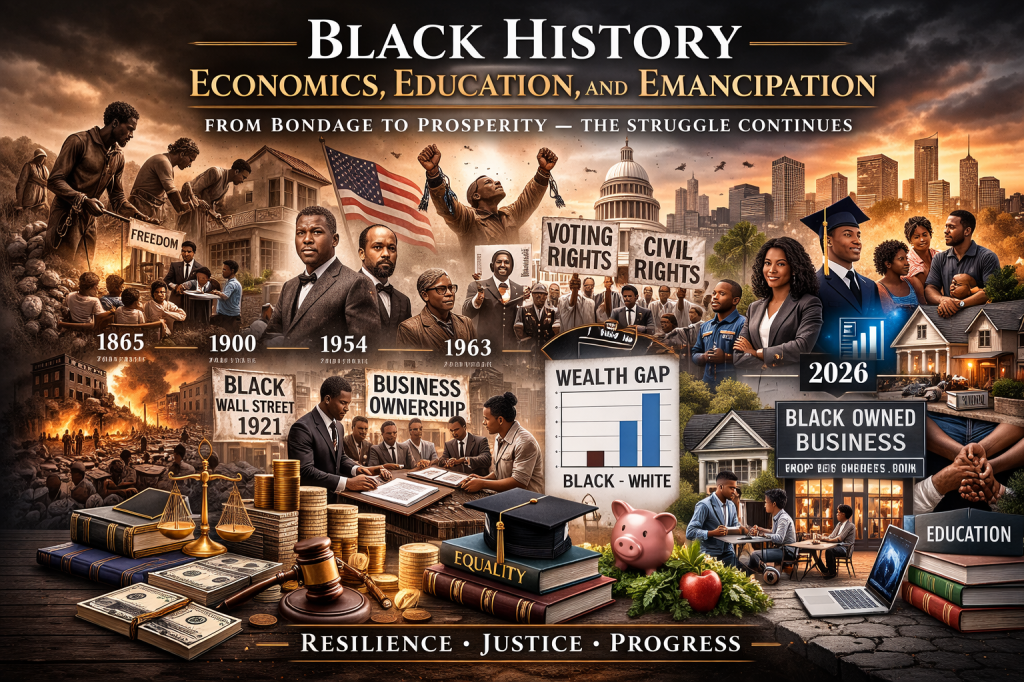
Black History: Economics, Education, and Emancipation.

Black history in the United States is not merely a litany of events; it is the story of a people’s persistent struggle for dignity, self-determination, and economic justice. From the systemic deprivations of slavery to the present day, the economic condition of Black Americans has been profoundly shaped by centuries of exclusion, exploitation, and resistance (McKinsey & Company, 2025). The interplay of economic opportunity, access to education, and emancipation has defined both individual lives and collective possibilities.

The legacy of slavery and Reconstruction laid the groundwork for persistent racial inequalities. Even at the formal end of slavery in 1865, Black Americans held virtually no wealth; over a century and a half later, that gap persists. Black households possess only a small fraction of national wealth compared with White households, illustrating how historical racial injustice still translates into economic precarity (LendingTree, 2026; Brookings Institution, 2024).

Structural discrimination continues to influence economic outcomes through labor markets that systematically disadvantage Black workers. Black Americans are overrepresented in lower-wage occupations and underrepresented in higher-paying managerial and professional roles, reinforcing income inequality (McKinsey & Company, 2019). This occupational segregation, rooted in historical discrimination, limits economic mobility and widens the wealth gap across generations.

Education has long been touted as a pathway to economic advancement, yet disparities in educational access and outcomes persist. Predominantly Black school districts receive significantly less funding than predominantly White districts, perpetuating cycles of unequal opportunity and limiting access to high-quality schooling (Black Wall Street Organization, 2025). In this context, education becomes not simply a means of individual uplift but a battleground for equity.

Higher education, while expanding enrollment for Black students over recent decades, also exposes students to disproportionate levels of debt. Black college graduates carry higher student loan burdens than their White counterparts, constraining their capacity to accumulate wealth through homeownership, savings, and investments (Black Wall Street Organization, 2025). Thus, the very institution that promises empowerment can become another vector of economic strain.

Despite the barriers, African Americans have demonstrated remarkable resilience. Historic models of Black economic self-help—mutual aid societies, Black-owned banks, business collectives, and cooperative enterprises—reflect a long tradition of economic self-determination. Yet these efforts have often faced hostile responses, from discriminatory lending practices to overt violence, as in the destruction of Black Wall Street in 1921 (Black Wall Street Organization, 2025).

Homeownership remains a key indicator of wealth building in America, yet the Black homeownership rate lags significantly behind that of White Americans, reflecting a century of housing discrimination and unequal access to mortgage capital (Washington Post, 2026). Even when Black families do own homes, properties often appraise for lower values due to enduring patterns of segregation and appraisal bias, further limiting generational wealth accumulation.

As of recent data, Black homeownership stands well below the rate for White families, and median wages for Black workers are substantially lower across industries. Black workers commonly earn about 70 percent of what White workers earn in comparable sectors, underscoring persistent wage disparities (LendingTree, 2026). These gaps are not accidental; they reflect longstanding structural inequities embedded in the economy.

Economic Data Tables: Black–White Disparities (2025–2026)

Median Household Income & Wealth

IndicatorBlack HouseholdsWhite HouseholdsSource
Median Household Income (2024)~$56,020~$88,010LendingTree (2026)
Median Household Wealth (% of U.S. total)~3.4%~83.5%LendingTree (2026)
Racial Wealth Ratio (White : Black)~8:1ZipDo (2026)
Median Wealth (Black vs White)~$24,100 vs $188,200ZipDo (2026)

Employment & Labor Market Disparities

IndicatorBlack WorkersWhite WorkersSource
Unemployment Rate (Q3, 2025)~7.8%~3.8%LendingTree (2026)
Black Unemployment (Nov 2025 spike)8.3%Reuters (2025)
Earnings Gap (Median wages)~70–75% of White wages100%WorldMetrics (2026)

Homeownership & Wealth Building

IndicatorBlack HouseholdsWhite HouseholdsSource
Homeownership Rate (2026)~43.6%~70.3%Washington Post (2026)
Homeownership Gap (Historical Persistence)Negligible improvement over decadesWashington Post (2026)
Access to Favorable Mortgage TermsHigher denial & biasLower denialLendingTree (2026)

These data illustrate several core structural truths:

  • Persistent Racial Wealth Gap: Black households hold a disproportionately small share of U.S. total wealth (about 3.4%), even though Black Americans represent ~13–14% of the population. Meanwhile, White households control over 80% of the national wealth. Economic inequality is thus not only about income but also about historical asset accumulation and generational transfer of wealth.
  • Income Inequality Across Sectors: Black workers earn approximately 70–75 cents for every dollar earned by White workers across major sectors, with the gap widening in higher‑paying occupations.
  • Employment Barriers: The unemployment rate for Black Americans in late 2025 and early 2026 was more than double the national rate, a persistent pattern indicating structural labor market discrimination and vulnerability during economic contractions.
  • Homeownership & Wealth Building: Black homeownership remains far below White rates, with only about 44% of Black households owning homes — a primary vehicle for middle‑class wealth — compared with around 70% of White households. Appraisal bias, mortgage denial disparities, and historical segregation play significant roles in this enduring gap

The wealth gap also manifests in broader national terms: White Americans hold the vast majority of U.S. wealth, while Black Americans hold only a small sliver despite representing a significant portion of the population (LendingTree, 2026). This imbalance illustrates how historical exclusion has compounded over time, making wealth accumulation a generational challenge.

In the labor market of 2025–2026, the unemployment rate for Black Americans has risen disproportionately higher than the national average, signaling troubling economic trends that scholars and civil rights analysts describe as a “Black recession.” Black unemployment climbed to levels nearly double those of White workers amid broader economic slowdown and policy reversals that eroded programs designed to address racial inequality (State of the Dream Report, 2026).

Economic policy and labor market shifts have gutted diversity and inclusion initiatives in federal agencies, removing support mechanisms that previously helped mitigate racial disparities in employment. As a result, Black workers have borne the brunt of federal job cuts, particularly Black women, who historically are overrepresented in public sector employment (State of the Dream Report, 2026).

The racial wealth gap is not simply an issue of income but of cumulative assets: investments, property equity, business ownership, and inheritance. White families disproportionately benefit from stock market gains and home equity appreciation, while Black families have historically had limited access to these primary vehicles of wealth growth (Investopedia, 2025). This structural imbalance inhibits intergenerational economic security.

The persistence of these disparities challenges the myth that formal emancipation was sufficient to equalize economic outcomes. Rather, emancipation began a long struggle against structural barriers that have constrained Black economic agency. This ongoing reality reveals that legal freedom without equitable economic opportunity remains incomplete.
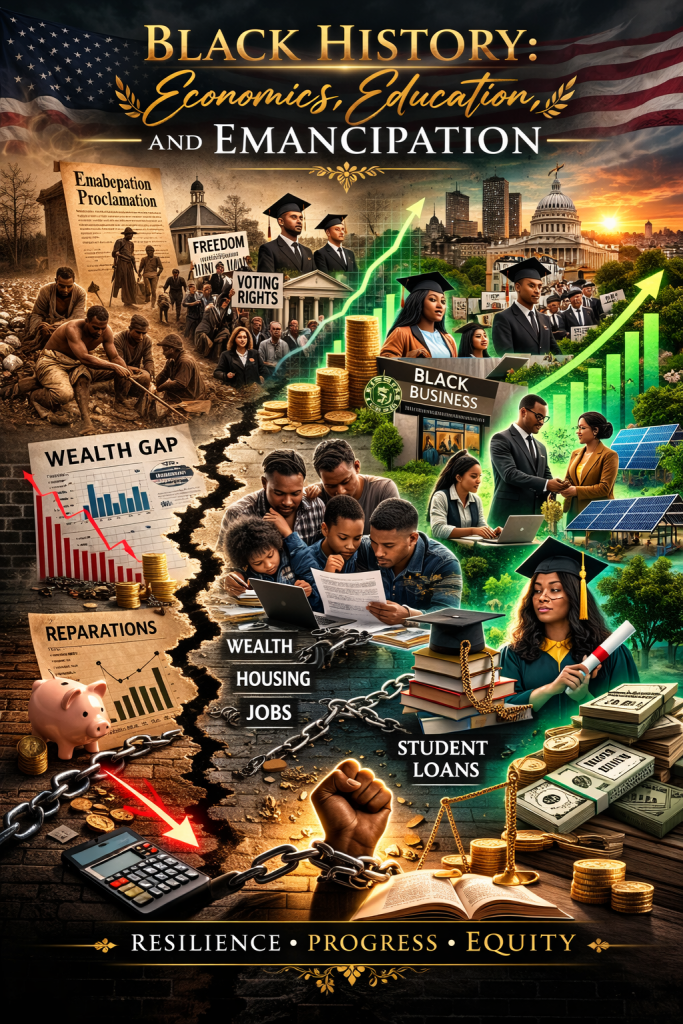
Economic suffering among Black Americans in 2026 highlights the continuing legacy of these structural inequalities. Rising unemployment, growing wealth concentration among white households, and barriers to capital for Black entrepreneurs all point to an economy in which racial disparities remain entrenched. Scholars argue that the effects of these disparities are so profound that closing the racial wealth gap could significantly benefit the U.S. economy as a whole (McKinsey & Company, 2019).

Educational disparities remain deeply intertwined with economic outcomes. Black students often attend schools with fewer resources, lower teacher salaries, and less access to advanced coursework, hindering academic achievement and future earnings potential. These inequities underscore how education and economic status are mutually reinforcing.

At the same time, economic inequality among Black communities intersects with health, housing, and social stability. The lack of access to quality healthcare increases medical expenses and economic vulnerability, and housing instability remains a persistent threat for families with limited economic resources (Black Wall Street Organization, 2025).

Yet, in spite of systemic barriers, Black economic empowerment initiatives continue to evolve. Black-owned businesses, though smaller and less capitalized than their White counterparts, represent a significant force for community development. Support for entrepreneurship and access to capital remain key strategies for building Black economic resilience (Black Wall Street Organization, 2025).

Historically and in the present day, education has served as both a means of empowerment and a site of struggle. The promise of education as a path to economic freedom remains contested, as disparities in funding, access, and outcomes continue to shape life chances for Black Americans.

To confront the entrenched economic disparities of 2026 and beyond, scholars and policy advocates emphasize the need for structural reforms that address labor market discrimination, broaden access to capital, and ensure equitable educational opportunity. Without such reforms, the legacy of racial economic inequality will persist, limiting the full realization of emancipation.

In sum, Black history—rooted in economics, education, and emancipation—is a testament to both the enduring injustice of systemic exclusion and the persistent struggle for full economic citizenship. The story of Black America’s economic journey reveals deep structural challenges but also the resilience and ingenuity that have propelled this nation toward a more inclusive future.


References

Brookings Institution. (2024). Black wealth is increasing, but so is the racial wealth gap. Retrieved from https://www.brookings.edu/articles/black-wealth-is-increasing-but-so-is-the-racial-wealth-gap/

LendingTree. (2026). Snapshots of Black and White disparities in income, wealth, and employment. Retrieved from https://www.lendingtree.com/debt-consolidation/black-and-white-disparities-study/

McKinsey & Company. (2019). The economic state of Black America: What is and what could be. Retrieved from https://www.mckinsey.com/featured-insights/diversity-and-inclusion/the-economic-state-of-black-america-what-is-and-what-could-be

State of the Dream Report. (2026). From regression to signs of a Black recession. The EDU Ledger. Retrieved from https://www.theeduledger.com/demographics/african-american/article/15815124/state-of-the-dream-2026-from-regression-to-signs-of-a-black-recession

The Washington Post. (2026). Why does Black homeownership lag White ownership in every major city? Retrieved from https://www.washingtonpost.com/business/2026/02/21/black-homeownership-singletary/

The Phenomenal Black Woman

The Black woman stands as one of the most powerful and resilient figures in modern society—an embodiment of endurance, brilliance, and sacred strength. Her story is not merely one of survival, but of transformation: turning adversity into innovation, pain into purpose, and marginalization into leadership. Across history and into the present, the Black woman continues to rise as a cultural architect, economic force, spiritual anchor, and intellectual pioneer.

Statistically and socially, Black women are among the most educated demographic groups in the United States. They consistently enroll in and complete higher education at rates surpassing many of their counterparts, often while balancing work, family, and community responsibilities. This pursuit of education is not simply for individual advancement but reflects a collective ethos—education as liberation, as legacy, as resistance against systems that once forbade their literacy.

Beyond education, Black women are also the most entrepreneurial group in America. They are starting businesses at unprecedented rates, creating brands, services, and institutions that respond directly to the needs of their communities. From beauty and wellness to finance, tech, education, and real estate, Black women are building economic ecosystems that circulate wealth and opportunity where it was historically denied.

This entrepreneurial spirit is deeply rooted in historical memory. Enslaved Black women were traders, healers, midwives, and market women long before modern capitalism recognized them as business owners. In the face of legal exclusion from wealth-building systems, they created informal economies, mutual aid societies, and cooperative networks that sustained entire communities through segregation and poverty.

The strength of the Black woman is not performative—it is structural. She is often the backbone of the family, holding emotional, financial, and spiritual labor simultaneously. She raises children, supports elders, nurtures partners, and still finds space to cultivate her own dreams. Her strength is not the absence of vulnerability, but the discipline of carrying love even while burdened.

Black women have long served as cultural carriers. Through language, food, music, fashion, and spirituality, they preserve ancestral knowledge and translate it into modern expression. From gospel hymns to hip-hop aesthetics, from soul food to wellness rituals, Black women shape culture while rarely being credited as its original architects.

Spiritually, the Black woman has been a priestess of survival. Whether through church leadership, ancestral traditions, or personal faith practices, she has held communities together through prayer, prophecy, and healing. She is often the intercessor—the one who believes when others lose faith, the one who remembers God when the world forgets her humanity.

Psychologically, Black women navigate a unique intersection of racial and gendered stress, yet they exhibit extraordinary emotional intelligence and adaptability. They master the art of code-switching, resilience, and strategic silence, often carrying invisible labor in professional and social spaces that demand excellence without offering protection.

Intellectually, Black women have been architects of major political, social, and academic movements. From abolition and civil rights to feminism, education reform, and digital activism, Black women have consistently led revolutions that they were later written out of. Their intellectual labor has reshaped law, sociology, literature, theology, and psychology.

The Black woman’s body itself has been a site of political struggle and cultural projection. Historically exoticized, commodified, hypersexualized, and criticized, her body has also been reclaimed as a symbol of beauty, fertility, creativity, and divine design. Today, Black women redefine beauty standards, celebrating melanin, natural hair, full features, and diverse body types as sacred rather than marginal.

In motherhood, Black women often mother not only their own children but entire communities. They become teachers, counselors, protectors, and advocates. Even in systems that criminalize their sons and overlook their daughters, Black women remain the primary architects of emotional and moral development.

In love and relationships, Black women are frequently expected to be endlessly loyal, patient, and forgiving, even when reciprocity is absent. Yet they continue to choose love, family, and connection, often while healing generational wounds of abandonment, instability, and emotional labor imbalance.

Economically, Black women stretch limited resources into abundance. They are financial strategists by necessity—managing households, building credit, launching side businesses, and creating generational pathways where none previously existed. They practice wealth-building not as luxury, but as survival and stewardship.

Politically, Black women are the most reliable voting bloc and one of the most influential forces in democratic movements. They organize, mobilize, educate, and protect civil rights, often without institutional power or public recognition. When social justice shifts, it is usually because Black women moved first.

Culturally, Black women shape global aesthetics. From hairstyles and slang to fashion, dance, and social media trends, Black women generate cultural capital that fuels entire industries. Yet their influence is frequently extracted, rebranded, and monetized without fair compensation or acknowledgment.

Emotionally, the Black woman is a healer. She holds space for grief, trauma, and transformation—not only her own, but others’. She listens, nurtures, advises, and absorbs emotional pain while rarely being given the same care in return.

Historically, the Black woman has been both invisible and indispensable. She built America’s domestic, agricultural, and caregiving infrastructure while being excluded from its rewards. Yet she continues to rise, not waiting for permission to thrive.

The modern Black woman is redefining femininity itself. She is soft and strong, spiritual and strategic, nurturing and ambitious. She refuses false binaries between vulnerability and power, choosing instead to embody both with grace.

An ode to the Black woman is an ode to life itself. She is the womb of culture, the memory of nations, the architect of futures not yet seen. Her existence is not an accident of history—it is a divine intervention in a world that tried to erase her.

The phenomenal Black woman is not exceptional because she overcame suffering—she is exceptional because she transformed suffering into legacy. She is the most educated, the most entrepreneurial, the most spiritually resilient, and one of the most culturally influential forces on earth. She is not just surviving history—she is writing it.

References

American Association of University Women. (2023). Fast facts: Women of color in higher education. https://www.aauw.org/resources/article/fast-facts-woc-higher-ed/

Anderson, M., & Perrin, A. (2018). Black women and technology adoption. Pew Research Center. https://www.pewresearch.org/internet/2018/01/25/blacks-and-technology-adoption/

Collins, P. H. (2000). Black feminist thought: Knowledge, consciousness, and the politics of empowerment (2nd ed.). Routledge.

Crenshaw, K. (1991). Mapping the margins: Intersectionality, identity politics, and violence against women of color. Stanford Law Review, 43(6), 1241–1299. https://doi.org/10.2307/1229039

Federal Reserve Bank of Kansas City. (2021). The state of women-owned businesses. https://www.kansascityfed.org/research/economic-review/women-owned-businesses/

Georgetown University Center on Education and the Workforce. (2020). A profile of Black women in the labor market. https://cew.georgetown.edu/cew-reports/black-women/

Giddings, P. (1984). When and where I enter: The impact of Black women on race and sex in America. HarperCollins.

McKinsey & Company. (2022). Black women are ambitious. But they’re held back at work. https://www.mckinsey.com/featured-insights/diversity-and-inclusion/black-women-are-ambitious-but-theyre-held-back-at-work

National Women’s Business Council. (2023). Black women entrepreneurs: Driving innovation and economic growth. https://nwbc.gov/

Pew Research Center. (2021). Black Americans are more likely than others to say family is central to their identity. https://www.pewresearch.org/social-trends/2021/03/25/

Smith, J. A., & Patton, L. D. (2016). Postracial rhetoric and the Black female student. Journal of College Student Development, 57(6), 645–661. https://doi.org/10.1353/csd.2016.0064

U.S. Census Bureau. (2022). Women-owned businesses by race and ethnicity. https://www.census.gov/programs-surveys/sbo.html

U.S. Department of Labor. (2023). Women in the labor force: A databook. https://www.dol.gov/agencies/wb/data

Walker, A. (1983). In search of our mothers’ gardens: Womanist prose. Harcourt Brace Jovanovich.

World Economic Forum. (2020). The power of Black women in the U.S. economy. https://www.weforum.org/reports/

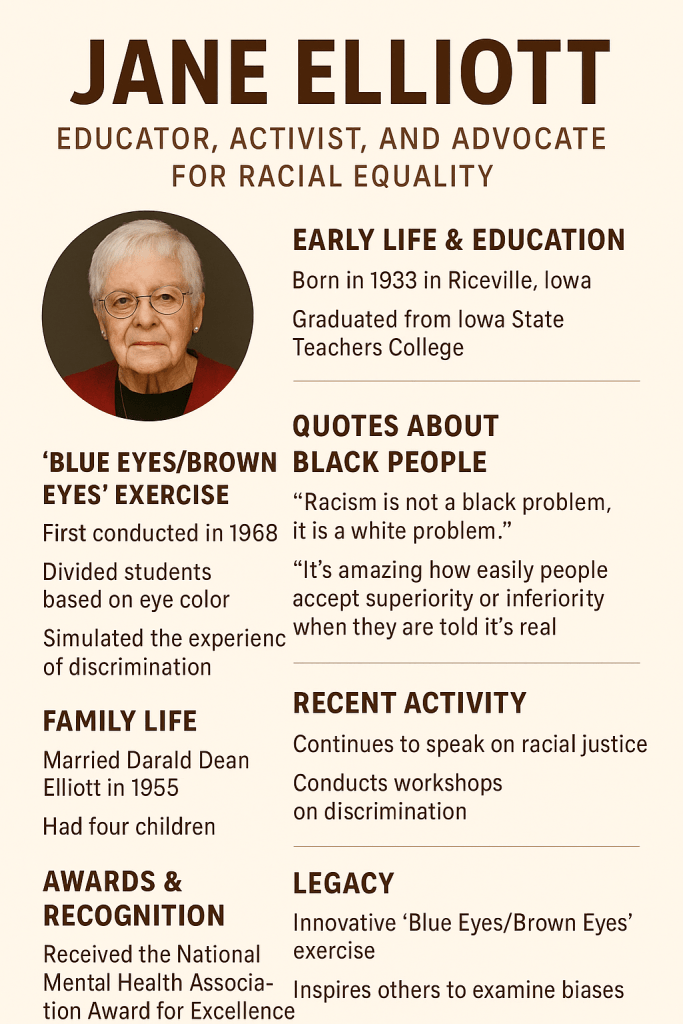
Jane Elliott: Educator, Activist, and Advocate for Racial Equality.

Elliott has spoken candidly about race and prejudice, emphasizing the importance of awareness and accountability. Two notable quotes include:

We don’t know anything about racism. We’ve never experienced it. If words can make a difference in your life for seven minutes, how would it affect you if you heard this every day of your life?”
— Jane Elliott BrainyQuote

“Racism is a learned affliction, and anything that is learned can be unlearned.”
— Jane Elliott A-Z Quotes

Jane Elliott is a prominent American educator and anti-racism activist, renowned for her innovative approach to teaching about prejudice and discrimination. Her most notable contribution is the “Blue Eyes/Brown Eyes” exercise, which she first conducted with her third-grade class in 1968, the day after the assassination of Dr. Martin Luther King Jr. This exercise aimed to simulate the experience of discrimination by dividing students based on eye color and assigning them arbitrary privileges and disadvantages accordingly. The profound impact of this exercise has led to its widespread adoption in various educational and corporate settings.


Early Life and Education

Born Jane Jennison on November 30, 1933, in Riceville, Iowa, she was the fourth of several children in her family. After graduating from high school in 1952, Elliott attended the Iowa State Teachers College (now the University of Northern Iowa), where she obtained an emergency elementary teaching certificate in five quarters. In 1953, she began teaching in a one-room school in Randall, Iowa, marking the start of her long career in education.


The “Blue Eyes/Brown Eyes” Exercise

In 1968, following Dr. King’s assassination, Elliott sought to teach her all-white, small-town students about the realities of discrimination. She divided the class into two groups based on eye color, assigning privileges to one group and disadvantages to the other. The exercise demonstrated how quickly individuals could internalize superiority or inferiority based on arbitrary characteristics, providing a powerful lesson on the mechanisms of prejudice. The exercise was documented in the 1970 film The Eye of the Storm and revisited in the 1985 PBS special A Class Divided.


Transition to Full-Time Activism

The success and impact of the “Blue Eyes/Brown Eyes” exercise led Elliott to leave her teaching position and pursue a career as a full-time speaker and educator on issues of race and discrimination. She has since conducted the exercise and lectured on its effects worldwide, including with college students, as seen in the 2001 documentary The Angry Eye.


Family Life

Elliott married Darald Dean Elliott in 1955. Together, they had four children. Darald Dean Elliott passed away in 2013. Elliott’s family life has been marked by her commitment to social justice and her role as a mother and educator.


Awards and Recognition

Throughout her career, Elliott has received numerous accolades for her work in education and anti-racism activism. She was honored with the National Mental Health Association Award for Excellence in Education. Her innovative approach to teaching about discrimination has been recognized globally, and she continues to be a sought-after speaker and trainer.


Advocacy for Racial Equality

Elliott’s work extends beyond the classroom. She has been an outspoken advocate for racial equality, challenging individuals and institutions to confront and address systemic racism. Her advocacy includes speaking engagements, workshops, and media appearances aimed at raising awareness and promoting change.


Public Speaking and Workshops

As a public speaker, Elliott has addressed a wide range of audiences, including educators, students, corporate leaders, and community groups. Her workshops often involve participatory exercises designed to help individuals experience and reflect on the impact of discrimination. These sessions are intended to foster empathy and inspire action toward greater inclusivity and equity.


Media Appearances

Elliott’s work has been featured in various media outlets, including documentaries, interviews, and news programs. Her appearances have helped to bring the conversation about race and discrimination into the public eye, reaching audiences beyond those who attend her workshops and lectures.


Philosophy on Race and Discrimination

Elliott’s philosophy centers on the idea that racism is a learned behavior that can be unlearned through education and awareness. She emphasizes the importance of confronting uncomfortable truths and encourages individuals to take responsibility for their actions and beliefs.


Critiques and Controversies

While Elliott’s methods have been widely praised, they have also faced criticism. Some argue that the “Blue Eyes/Brown Eyes” exercise can be emotionally distressing for participants. Elliott acknowledges these concerns but maintains that the discomfort experienced is necessary for individuals to understand the pain caused by discrimination.


Legacy and Impact

Elliott’s legacy is evident in the continued use of her “Blue Eyes/Brown Eyes” exercise in educational settings around the world. Her work has inspired countless individuals to examine their own biases and take action against racism. She remains a prominent figure in the fight for racial equality. In recent years, Elliott has continued her advocacy through speaking engagements and workshops. She remains active in promoting racial justice and educating others about the realities of discrimination. Reflecting on her career, Elliott expresses a deep commitment to her mission of combating racism. She views her work as a lifelong endeavor and remains dedicated to making a difference in the lives of others.


Conclusion

Jane Elliott’s contributions to the field of anti-racism education have had a lasting impact. Through her innovative exercises, public speaking, and unwavering commitment to social justice, she has challenged individuals and institutions to confront and address racism. Her work continues to inspire and educate, fostering a more inclusive and equitable society.


References

“Jane Elliott.” Wikipedia, https://en.wikipedia.org/wiki/Jane_Elliott

“The Eye of the Storm.” Wikipedia, https://en.wikipedia.org/wiki/The_Eye_of_the_Storm_(1970_film)

“A Class Divided.” Wikipedia, https://en.wikipedia.org/wiki/A_Class_Divided

“Jane Elliott.” IMDb, https://www.imdb.com/name/nm0254486/bio/

“From racism to one race: the Jane Elliott story.” Orato World Media, https://orato.world/2021/07/12/from-racism-to-one-race-the-jane-elliott-story/

“Jane Elliott’s Message To Black Women.” YouTube, https://www.youtube.com/watch?v=pAoLU9btfKU

Homeschooling: Train Up a Child

Photo by August de Richelieu on Pexels.com

“Train up a child in the way he should go: and when he is old, he will not depart from it” (Proverbs 22:6, KJV). These words remind parents of the vital responsibility to guide their children in righteousness, wisdom, and knowledge. In today’s society, with its moral decay and ideological pressures, homeschooling has become a powerful alternative to public schooling, offering parents the ability to shape not only the academic but also the spiritual and moral foundation of their children.

Homeschooling is the process by which parents educate their children at home rather than sending them to public or private schools. It allows for individualized instruction, a flexible schedule, and the ability to instill values aligned with biblical principles. Parents are able to directly influence what their children learn, how they learn, and what worldview is presented in their education.

One of the most significant benefits of homeschooling is the spiritual and moral oversight it provides. In public schools, children are often exposed to ideologies and behaviors contrary to biblical teachings. Lessons promoting moral relativism, secular humanism, and acceptance of behaviors like premarital sex, substance abuse, or gender confusion are increasingly present in curricula. Homeschooling allows parents to filter, guide, and correct these influences, teaching children God’s standards instead.

Another advantage is the opportunity for personalized learning. Every child has a unique pace, style, and set of strengths. Homeschooling allows parents to focus on areas where a child struggles while accelerating subjects in which they excel. This individualized attention can produce better academic outcomes and foster a love of learning.

In addition, homeschooling strengthens family bonds. Children spend more time with their parents and siblings, developing deeper relationships. This also allows parents to model biblical values daily, demonstrate servant leadership, and reinforce consistent discipline aligned with Scripture.

Public schools, in contrast, often promote behaviors and ideologies that can be spiritually harmful. The rise of programs teaching children that they can change genders or reject their God-given identity is one example. Children may be introduced to drag queen story hours, gender fluidity, and sexuality education that normalizes sinful behavior according to God’s Word (Genesis 1:27; Deuteronomy 22:5). Parents who oppose such teachings often find themselves in conflict with school boards or educators.

A practical example includes parents who have legally challenged school districts that introduce transgender ideology to elementary students. In some states, parents have filed lawsuits or withdrawn their children entirely from schools that support gender transition guidance for minors, citing parental rights and biblical convictions.

Getting started in homeschooling requires research, planning, and organization. The first step is understanding state laws, as homeschooling is regulated differently depending on location. Most states require parents to submit a notice of intent, keep attendance records, and maintain academic progress reports. Agencies such as the Home School Legal Defense Association (HSLDA) in the U.S. provide guidance, legal protection, and curriculum resources.

Parents must also choose a curriculum that aligns with their goals. There are Christian-based programs that integrate Scripture into every subject, classical education models, Charlotte Mason methods, and more. Choosing a curriculum depends on the child’s learning style, the parents’ teaching capacity, and the family’s educational objectives.

Homeschooling offers flexibility in daily schedules, allowing families to integrate real-life experiences, field trips, service projects, and mentorships into learning. This hands-on approach often increases engagement and retention, contrasting with the rigid structure of many public schools.

When comparing homeschooling and public schools, several advantages emerge. Homeschooled children often score higher on standardized tests, demonstrate higher literacy rates, and exhibit stronger moral reasoning. Socialization, a common critique of homeschooling, can be addressed through homeschool co-ops, sports teams, church activities, and community service, providing meaningful peer interaction.

However, homeschooling does come with challenges. Parents must dedicate significant time, effort, and resources. They must act as teacher, disciplinarian, and mentor, balancing these roles with work and household responsibilities. Academic gaps may occur if parents are not diligent, requiring supplemental courses or tutors in specialized subjects like advanced mathematics or foreign languages.

Critics of homeschooling often argue that homeschooled children lack social skills or exposure to diversity. However, many studies indicate that homeschooled children who participate in extracurricular activities, co-ops, and community programs develop excellent social skills, leadership qualities, and confidence.

The rise of gender ideology in schools is a key concern for many homeschooling parents. Children in public schools may encounter lessons teaching that it is acceptable to reject their biological sex or experiment with alternative lifestyles. Parents who wish to protect their children from this influence increasingly turn to homeschooling as a means of preserving moral and spiritual integrity.

Parents who oppose transgender and drag queen teachings often cite Deuteronomy 6:6–7, which instructs them to teach God’s Word diligently to their children, reinforcing parental responsibility over state-mandated curricula. By homeschooling, these parents ensure that children are raised with a biblical worldview rather than secular ideologies that contradict Scripture.

Homeschooling also allows parents to integrate biblical principles into every subject. History lessons can highlight God’s providence and moral lessons; science can include creationism and the wonder of God’s design; literature can focus on works that reflect virtue, courage, and faith. This integration fosters a holistic understanding of God’s truth.

A critical part of successful homeschooling is establishing a routine. Parents should create a daily schedule balancing core subjects like reading, writing, and mathematics with electives, physical education, arts, and spiritual study. Flexibility is important, but consistency ensures academic progress and discipline.

For curriculum guidance, homeschool families can follow these essentials:

  • Bible & Theology: Daily study of Scripture, memory verses, and character-building lessons.
  • Language Arts: Reading, writing, grammar, and spelling.
  • Mathematics: Arithmetic through advanced algebra, depending on grade level.
  • Science: Biology, chemistry, physics, and creation studies.
  • History & Social Studies: World and U.S. history, government, and cultural studies.
  • Arts & Music: Encouraging creativity through visual arts, music lessons, and performance.
  • Physical Education: Daily activity to build health and discipline.
  • Life Skills: Cooking, finances, time management, and community service.

Practical dos for homeschool families include:

  • Establish a clear educational and spiritual goal for your child.
  • Create a consistent routine and learning environment.
  • Integrate biblical principles into every subject.
  • Participate in homeschool co-ops, clubs, and community activities.
  • Keep records of attendance, grades, and progress for legal compliance.
  • Adapt curriculum to your child’s learning style and pace.
  • Encourage critical thinking, problem-solving, and creativity.
  • Pray regularly for guidance, wisdom, and protection over your children.

Families should contact their state or local education agency to understand homeschooling requirements. Many states have an online registration portal or department of education office that provides instructions, forms, and reporting guidelines. Organizations like HSLDA (http://www.hslda.org) offer legal support, curriculum recommendations, and advocacy resources.

Homeschooling is a biblically aligned approach to raising children in a world that increasingly rejects divine standards. By teaching children God’s Word, integrating faith into learning, and protecting them from harmful ideologies, parents fulfill the command to train up a child in the way he should go.

Homeschooling: Train Up a Child – Key Points

Definition:

  • Homeschooling is the education of children at home by parents instead of attending public or private schools.

Benefits of Homeschooling:

  • Spiritual and moral oversight; ability to teach biblical principles (Proverbs 22:6).
  • Individualized instruction tailored to each child’s learning pace.
  • Strengthened family bonds and consistent value teaching.
  • Flexibility in schedule and integration of real-life experiences.
  • Higher academic outcomes and literacy rates in many studies.

Challenges of Public Schools:

  • Exposure to secular ideologies contrary to Scripture.
  • Teaching of moral relativism, gender confusion, and sexual experimentation.
  • Influence of drag queen story hours, transgender lessons, and other controversial programs.

Getting Started in Homeschooling:

  • Research state homeschooling laws and regulations.
  • Notify local or state education agencies as required.
  • Keep attendance records and academic progress reports.
  • Seek guidance and legal protection from organizations like HSLDA.

Homeschooling vs Public School – Advantages:

  • Personalized education and pace adjustment.
  • Moral and spiritual instruction consistent with family values.
  • Opportunities for hands-on learning and practical skills.
  • Active parental involvement in curriculum and teaching.

Disadvantages/Challenges:

  • Requires significant parental time and commitment.
  • Need for supplemental instruction in specialized subjects.
  • Potential socialization concerns, mitigated by co-ops and community programs.

Opposition to Homeschooling:

  • Criticism from educators and society regarding socialization.
  • Legal and bureaucratic challenges in certain regions.
  • Resistance due to secular ideologies present in public schools.

Practical Considerations:

  • Parents can integrate biblical worldview into all subjects.
  • Curriculum should cover Bible, language arts, math, science, history, arts, PE, and life skills.
  • Establish a daily schedule balancing academics, spiritual study, and activities.
  • Utilize homeschool co-ops, clubs, and community events for social interaction.

Dos for Homeschool Families:

  • Set clear educational and spiritual goals.
  • Maintain consistency in routine and learning environment.
  • Keep accurate records of attendance, grades, and progress.
  • Pray for wisdom and guidance regularly.
  • Adapt curriculum to the child’s learning style.
  • Encourage critical thinking, creativity, and character development.

Curriculum Guidance:

  • Bible & Theology: Daily Scripture study and character lessons.
  • Language Arts: Reading, writing, grammar, and spelling.
  • Mathematics: Arithmetic to advanced levels.
  • Science: Biology, chemistry, physics, and creation studies.
  • History & Social Studies: World and U.S. history, government.
  • Arts & Music: Creativity and performance.
  • Physical Education: Daily exercise and health.
  • Life Skills: Cooking, finance, time management, and service.

Agencies & Legal Guidance:

  • Contact your state’s department of education or local school district for homeschooling requirements.
  • HSLDA (Home School Legal Defense Association) provides legal support, curriculum guidance, and advocacy.

Biblical Foundation:

  • Proverbs 22:6 – Train up a child in the way he should go.
  • Deuteronomy 6:6–7 – Teach God’s Word diligently to children.
  • Philippians 4:8 – Teach children to focus on what is true, honest, just, and pure.

Ultimately, homeschooling is not merely an academic decision—it is a spiritual commitment. Parents have the opportunity to shape not only intellect but character, morals, and faith, equipping their children to navigate the world with wisdom, integrity, and a firm foundation in the Most High Yah.


References

  • The Holy Bible, King James Version.
  • Home School Legal Defense Association (HSLDA). (n.d.). http://www.hslda.org
  • Ray, B. D. (2017). A Review of Research on Homeschooling and Academic Achievement. Peabody Journal of Education, 92(2), 201–217.
  • Green, C. L., & Hoover-Dempsey, K. V. (2007). Why Do Parents Homeschool? A Study of Parental Motivations in the United States. Educational Research, 49(6), 517–529.
  • Kunzman, R., & Gaither, M. (2013). Homeschooling: A Comprehensive Survey of the Research. Journal of School Choice, 7(4), 490–518.