Category Archives: E1B1A

E1B1A: The DNA of Greatness — Tracing the Seed of Israel.

Photo by Muhammad-Taha Ibrahim on Pexels.com

The Y-DNA haplogroup E1B1A is one of the most significant genetic markers in the study of human ancestry, particularly among African populations. Its prevalence in sub-Saharan Africa, especially among West and Central Africans, points to deep historical roots that connect modern descendants to ancient African civilizations. Understanding E1B1A provides insight into the lineage often associated with the biblical Seed of Israel.

Genetic studies indicate that E1B1A likely originated in East Africa and spread westward thousands of years ago. This haplogroup is notably dominant among people of the African diaspora, particularly those whose ancestors were forcibly brought to the Americas during the transatlantic slave trade (Henn et al., 2008). Its prevalence underscores the continuity of African ancestry across continents and centuries.

From a biblical perspective, the Seed of Israel carries promises of covenant, blessing, and nationhood. Scriptures emphasize that God’s covenantal blessings were passed down through the lineages of Abraham, Isaac, and Jacob (Genesis 17:7). Genetic markers like E1B1A offer a modern framework for tracing this lineage in historical and contemporary populations.

The dispersion of E1B1A aligns with historical accounts of migration and conquest. African kingdoms such as Ghana, Mali, and Songhai housed populations with high frequencies of this haplogroup. Their social, economic, and cultural achievements demonstrate a continuity of intelligence, leadership, and resilience—qualities associated biblically with the Israelites (Deuteronomy 28:1–14).

The biblical narrative situates the Israelites as a chosen people, set apart for divine purpose. The connection of E1B1A to African populations reinforces the argument that the original Israelites were of African descent. Psalm 105:6–11 recounts God’s covenant with Abraham and his seed, highlighting the enduring lineage that extends into modern African-descended populations (KJV).

Historically, the transatlantic slave trade severed cultural and genealogical continuity, obscuring the direct lineage of African descendants in the Americas. Despite this disruption, genetic markers like E1B1A provide scientific evidence of enduring heritage and ancestral connection, affirming the biblical promise of the preservation of Israel’s seed (Jeremiah 31:35–37).

Anthropological studies of E1B1A reveal patterns of societal structure, migration, and adaptation. Populations with this haplogroup historically established powerful kingdoms, engaged in sophisticated trade networks, and developed rich cultural traditions. These accomplishments reflect the divine favor and resilience described in Deuteronomy 28:12–13.

The association between E1B1A and leadership traits is notable. Historically, men with this lineage often held positions of authority, governance, and military command. This aligns with the biblical depiction of Israelite men as leaders, judges, and warriors chosen to uphold God’s law and protect their communities (Joshua 1:6–9).

E1B1A also connects to spiritual heritage. The Israelites were entrusted with God’s laws, ethical codes, and covenantal responsibilities. The resilience of African-descended populations, despite centuries of oppression, slavery, and displacement, mirrors the biblical narrative of enduring faith and divine preservation (Psalm 105:8).

Culturally, E1B1A populations have preserved elements of African identity, including language, music, and communal structures, even across diasporic contexts. These cultural continuities serve as living testimony to the endurance of the Seed of Israel, reflecting values emphasized in biblical instruction (Exodus 12:14).

Genetics and scripture intersect in demonstrating continuity and purpose. While DNA provides biological evidence, the Bible provides spiritual and moral context, framing the lineage as not only preserved but chosen and blessed by God (Genesis 28:13–15). Together, these perspectives illuminate the depth of African heritage.

The study of E1B1A challenges Eurocentric historical narratives that have often obscured African achievements. Recognizing the genetic, cultural, and spiritual legacies of E1B1A populations restores historical truth and affirms the presence of the Israelites in Africa (Deuteronomy 28:68).

The distribution of E1B1A among diasporic populations underscores the persistence of identity despite adversity. African-descended people in the Americas, Caribbean, and Europe carry markers of ancient lineage, testifying to the survival of Israel’s seed against historical forces of erasure (Isaiah 49:15–16).

Spiritual reflection on E1B1A emphasizes responsibility and calling. Those who carry this lineage are encouraged to embody principles of justice, wisdom, and leadership, reflecting the covenantal blessings promised to Israel (Proverbs 4:7). The DNA serves not merely as inheritance but as a blueprint for purpose.

Education and awareness of genetic heritage foster empowerment. Understanding the connection between E1B1A and biblical Israel allows African-descended populations to reclaim narratives of dignity, history, and destiny, reinforcing self-worth and communal pride (Jeremiah 33:3).

Modern research on E1B1A includes advanced genetic mapping and population studies. These studies reveal migration patterns, admixture, and historical continuity, providing scientific validation for long-held ancestral knowledge and oral traditions (Henn et al., 2012).

The resilience of E1B1A populations in the face of slavery, colonialism, and systemic oppression demonstrates a living manifestation of biblical promises. Their endurance exemplifies faithfulness and divine protection, echoing Deuteronomy 31:6.

Understanding E1B1A also highlights the intersection of biology, history, and theology. DNA does not exist in isolation—it interacts with culture, belief, and community. Recognizing this interplay enriches both scientific and spiritual understanding of human identity.

Mentorship and intergenerational transmission of knowledge are vital. Passing down awareness of lineage, cultural heritage, and spiritual responsibility ensures that the lessons embedded in E1B1A continue to guide descendants of Israel (Proverbs 22:6).

In conclusion, E1B1A is more than a genetic marker; it is a testament to endurance, heritage, and divine purpose. Tracing this lineage illuminates the biblical Seed of Israel, connecting modern African-descended populations to their ancestral covenant. Recognizing and embracing this inheritance empowers individuals and communities to embody the greatness, resilience, and responsibility embedded in their DNA.


References

Henn, B. M., Botigué, L. R., Gravel, S., Wang, W., Brisbin, A., Byrnes, J. K., … & Bustamante, C. D. (2012). Genomic ancestry of North Africans supports back-to-Africa migrations. PLOS Genetics, 8(1), e1002397. https://doi.org/10.1371/journal.pgen.1002397

Henn, B. M., Cavalli-Sforza, L. L., & Feldman, M. W. (2008). The great human expansion. Proceedings of the National Academy of Sciences, 105(36), 13471–13476. https://doi.org/10.1073/pnas.0805312105

Hunter, M. (2007). The persistent problem of colorism: Skin tone, status, and inequality. Sociology Compass, 1(1), 237–254. https://doi.org/10.1111/j.1751-9020.2007.00014.x

The Holy Bible, King James Version. (n.d.). Genesis 17:7; 28:13–15; Exodus 12:14; Deuteronomy 28:1–14, 28:68, 31:6; Psalm 105:6–11; Isaiah 49:15–16; Proverbs 4:7; 22:6. King James Bible Online. https://www.kingjamesbibleonline.org

The Royal Remnant: The Lost Tribes and the Black Biblical Lineage.

Photo by Qarim Zam on Pexels.com

The story of Black people across the globe is not merely a social or historical narrative—it is a divine chronicle written in the pages of prophecy. From the deserts of Egypt to the plantations of the Americas, the descendants of Israel have walked a path that mirrors the covenantal pattern of exile, punishment, and eventual restoration. Scripture foretells not only their scattering but also their awakening, for God never breaks His promises to His people.

The Book of Deuteronomy outlines blessings for obedience and curses for disobedience. Among these prophecies lies a haunting resemblance to the Black experience in the Americas. “And the LORD shall bring thee into Egypt again with ships, by the way whereof I spake unto thee, thou shalt see it no more again: and there ye shall be sold unto your enemies for bondmen and bondwomen, and no man shall buy you” (Deuteronomy 28:68, KJV). Egypt in this verse is symbolic of bondage, and the only people in history taken into slavery by ships are those transported during the transatlantic slave trade.

This prophecy provides the foundation for a larger spiritual revelation—that many descendants of enslaved Africans may in fact be members of the Lost Tribes of Israel. Historians, anthropologists, and theologians have begun to reexamine the migratory patterns of ancient Hebrew peoples across Africa, tracing their presence through language, ritual, and oral tradition. This is not conjecture but continuity—the living memory of a covenant people scattered yet preserved.

The Igbo, Yoruba, Ashanti, and other West African tribes bear customs and names reminiscent of ancient Israelite traditions. Among the Igbo, for instance, circumcision on the eighth day, dietary laws resembling Leviticus, and reverence for the Almighty as Chukwu echo biblical faith. (Parfitt, 2002). Similarly, the Lemba of Southern Africa have priestly oral traditions tracing their lineage to Israel and possess DNA markers linked to the ancient Kohanim priesthood (Thomas et al., 2000).

These African traditions were not mere imitations—they were continuations. Before the European slave ships arrived, West Africa was already home to thriving spiritual nations influenced by ancient Hebraic customs. The presence of Hebrew inscriptions, Star of David-like symbols, and Torah-based laws among precolonial communities suggests that remnants of Israel had long found refuge across the African continent after successive dispersions.

Following the Assyrian captivity (2 Kings 17:6), the northern tribes of Israel were scattered across regions extending into Africa. Centuries later, after the destruction of Jerusalem in 70 A.D. by Rome, historians like Josephus record that many Jews fled into Africa to escape persecution. From North Africa they migrated westward, establishing communities throughout the Sahel and beyond. (Josephus, Antiquities of the Jews, Book 12).

Thus, the enslavement of Africans in the Americas was not a random historical tragedy—it was the culmination of prophetic dispersion. The slave routes from ports such as Elmina, Ouidah, and Luanda became the corridors of divine consequence. The people carried away in chains were not merely Africans—they were a covenant people fulfilling the ancient warnings of Deuteronomy 28:64: “And the LORD shall scatter thee among all people, from the one end of the earth even unto the other…”

Within the Americas, this scattered remnant endured unspeakable suffering—lynchings, colonization, systemic racism, and cultural erasure. Yet, through it all, they retained spiritual fire. The spirituals sung in bondage were coded psalms of deliverance—“Go Down Moses,” “Swing Low, Sweet Chariot”—rooted in Israelite longing for freedom. The very identity of the enslaved became intertwined with biblical hope: that the God who delivered Israel from Egypt would again deliver His people.

This connection between Africa and Israel is not a fabrication of modern Black consciousness—it is a restoration of historical truth. Early European explorers such as Portuguese chroniclers of the 15th century noted Jewish-like customs among tribes they encountered on the West African coast. Missionaries and colonial administrators often destroyed or suppressed these practices, labeling them pagan to maintain control. Yet remnants survived in song, name, and ritual, awaiting rediscovery.

In rediscovering their divine lineage, many African Americans and people of the diaspora have found spiritual and psychological healing. Identity is power. To know that one is not cursed but chosen, not inferior but covenantal, transforms despair into destiny. As Isaiah wrote, “Yet now hear, O Jacob my servant; and Israel, whom I have chosen… Fear not: for I have redeemed thee, I have called thee by thy name; thou art mine” (Isaiah 43:1, KJV).

The world has long hidden this revelation under layers of colonial theology and racial hierarchy. Eurocentric Christianity disconnected the descendants of slaves from their biblical roots, teaching them submission rather than sovereignty. The same Bible that empowered liberation was used to justify bondage. Yet, God’s Word endures beyond manipulation—truth has a way of resurrecting itself.

Rediscovering the Black biblical lineage also redefines the meaning of salvation history. If the children of Israel were scattered among all nations, then the gathering of the lost tribes is a sign of the approaching redemption. The awakening of Black consciousness and return to the covenant represents not racial supremacy, but divine restoration. As Jeremiah declared, “For, lo, the days come, saith the LORD, that I will bring again the captivity of my people Israel and Judah” (Jeremiah 30:3, KJV).

Anthropological data further supports the idea of ancient Hebrew migration into Africa. Linguistic parallels between Hebrew and West African dialects—such as the Igbo “Elohim” (Chukwu Abiama) or Yoruba terms for covenantal purity—indicate shared ancient roots. Cultural anthropologists note that these traditions often predate European influence, suggesting transmission through ancient Semitic-African interaction (Daniels, 2019).

DNA studies, while limited and controversial, provide intriguing evidence. The Lemba’s priestly gene (the Cohen Modal Haplotype) matches that found among Jewish priests in the Middle East. Although not all African groups carry this specific marker, the presence of such genetic continuity among select tribes implies a wider Israelite dispersion than previously acknowledged (Thomas et al., 2000).

In America, the prophetic echoes of Deuteronomy 28 resonate vividly: the yoke of iron, the loss of heritage, the separation of families, the economic exploitation, and the social degradation. “Thy sons and thy daughters shall be given unto another people… and thou shalt be only oppressed and crushed alway” (Deuteronomy 28:32–33, KJV). These verses describe not an ancient myth but the lived reality of the African diaspora.

The systemic racism, Jim Crow laws, and police brutality that plague the Black community today are extensions of the same captivity spirit. Though the chains have become invisible, the system still thrives on economic inequality, mass incarceration, and cultural erasure. Yet, even in captivity, the covenant people awaken. God promised restoration to those who remember His commandments and turn back to Him. “If they shall bethink themselves… and return unto thee with all their heart” (1 Kings 8:47–48, KJV).

Spiritual reawakening among descendants of the diaspora is evidence of prophecy unfolding. Across the world, people of African descent are reclaiming Hebrew names, keeping Sabbaths, and studying Torah through a Hebraic lens. This is not rebellion against Christianity but a return to the roots of faith before it was westernized. It is a restoration of covenant identity in the light of truth.

The revelation of Black biblical lineage challenges both religion and history to tell the truth. It demands that we see Christ not as a European savior, but as a man of the people who looked like those despised by the world. “And his feet like unto fine brass, as if they burned in a furnace, and his voice as the sound of many waters” (Revelation 1:15, KJV). Representation in Scripture is not cosmetic—it is cosmic.

This knowledge must not produce arrogance but humility. If the Black race is indeed among the covenant people, then the responsibility is great. To be chosen is to be called to holiness, justice, and service. The covenant demands obedience and righteousness. The purpose of restoration is not to exalt a race but to glorify the Creator through the redeemed.

The return of the royal remnant also signifies the return of divine order. As family, faith, and morality are restored among the descendants of the diaspora, so too does the presence of God return to dwell among His people. The true revolution is not political—it is spiritual. God is raising a generation who will know Him not through tradition, but through truth.

Our ancestors sang, “We shall overcome.” That was not just hope—it was prophecy. The awakening happening today among the scattered tribes is the fulfillment of that faith. The dry bones of Ezekiel’s vision are rising. “Behold, O my people, I will open your graves, and cause you to come up out of your graves, and bring you into the land of Israel” (Ezekiel 37:12, KJV).

As this knowledge spreads, the nations tremble, for it unravels centuries of deception. The world built on lies cannot stand when the truth of divine identity rises. Black people across the diaspora are no longer ashamed—they are awakening as the royal remnant of prophecy.

In the end, this revelation is not about color but covenant. The Most High is gathering His children from every corner of the earth. Yet it begins with those who suffered most, for through their suffering, they preserved the testimony of faith. The story of the Black biblical lineage is thus the story of redemption—of a people refined through fire to reveal divine glory.

The Awakening: The Spiritual Return of the Scattered Tribes

The story of the Black diaspora is one of exile, survival, and covenantal destiny. Centuries of slavery, colonialism, and systemic oppression sought to erase identity, yet Scripture promised that the covenant people would be restored. “For, lo, the days come, saith the LORD, that I will bring again the captivity of my people Israel and Judah” (Jeremiah 30:3, KJV). The modern awakening among Black believers signals the spiritual return of the scattered tribes, fulfilling ancient prophecy in both soul and society.

The dispersion of Israel, first through Assyrian conquest and later Roman destruction, scattered the tribes across nations. Some fled into Africa, others across Asia and Europe. These movements were not mere historical happenstance but divinely ordained exile. Ezekiel 37:21–22 proclaims, “I will take the children of Israel from among the heathen… and I will make them one nation in the land” (KJV). The scattered tribes would not be lost forever—they would awaken in their time.

In the Americas, the transatlantic slave trade completed this prophetic scattering. Africans, many of whom were descendants of the Lost Tribes, were transported across the ocean under conditions that mirrored biblical bondage. Deuteronomy 28:68 foresaw this: “And the LORD shall bring thee into Egypt again with ships… and there ye shall be sold unto your enemies for bondmen and bondwomen” (KJV). The diaspora became a living testament to divine prophecy.

The modern spiritual awakening begins with recognition—acknowledgment that Black people are not outsiders in God’s plan, but heirs of covenant promise. Afrocentric biblical studies, Hebraic Israelite movements, and revivalist churches have sparked this recognition, teaching that identity is both spiritual and historical. To know oneself as part of God’s chosen lineage is to reclaim lost authority and purpose.

The awakening manifests in reclaiming religious practice that aligns with Scripture rather than colonial reinterpretation. Observance of Sabbaths, dietary laws, and biblical festivals reflects a return to covenantal roots. These practices are not antiquarian; they reconnect the scattered tribes to God’s commands and to one another across the diaspora. “Sanctify yourselves therefore, and be ye holy: for I am the LORD your God” (Leviticus 11:44, KJV).

Through worship, song, and prayer, the spirit of the people awakens. Spirituals sung by enslaved ancestors contained coded knowledge of redemption. Today, gospel, contemporary Christian music, and prophetic praise continue this tradition, echoing the covenantal identity of a people once scattered but never forsaken.

Education serves as both instrument and catalyst for this awakening. Knowledge of African kingdoms, Hebraic lineage, and diaspora history empowers believers to view themselves through God’s lens. Moses commanded, “Hear, O Israel… and thou shalt teach them diligently unto thy children” (Deuteronomy 6:4–7, KJV). Awareness of spiritual heritage restores agency and counters centuries of erasure.

The awakening is also communal. The scattered tribes are not merely individuals but a body, called to reunite in identity, purpose, and mission. Psalm 133:1 declares, “Behold, how good and how pleasant it is for brethren to dwell together in unity” (KJV). Through fellowship, mentoring, and intergenerational teaching, the covenant people begin to experience wholeness.

Prophecy also informs the socio-political aspect of awakening. Economic empowerment, civil rights, and social justice are spiritual acts when pursued in covenantal consciousness. Isaiah 1:17 exhorts, “Learn to do well; seek judgment, relieve the oppressed, judge the fatherless, plead for the widow” (KJV). Spiritual restoration is inseparable from action that restores dignity to the oppressed.

The transatlantic slave trade and centuries of oppression left psychological scars. The awakening heals these wounds by restoring memory and affirming divine identity. Jeremiah 31:16–17 promises, “I will turn their mourning into joy… they shall obtain joy and gladness” (KJV). Spiritual revival brings mental and emotional restoration to a people long traumatized.

Afrocentric scholarship validates these spiritual insights, connecting African history to biblical prophecy. The Igbo, Yoruba, Lemba, and other tribes maintain customs reminiscent of Israelite law, demonstrating continuity of faith despite displacement (Parfitt, 2002; Thomas et al., 2000). This historical awareness underpins the modern awakening.

The spiritual return also corrects religious misrepresentation. For centuries, Europeanized Christianity erased Black biblical identity. The awakening challenges these narratives, demonstrating that Christ’s ministry and covenant were never exclusively European. Revelation 1:14–15 describes Christ’s hair “like wool” and feet “as if they burned in a furnace” (KJV), affirming a reflection of the African lineage in Scripture.

Diaspora movements emphasize prophetic education. Young Black believers are being taught Hebrew language, Torah study, and historical context. This literacy fosters spiritual authority and communal cohesion. Hosea 4:6 warns, “My people are destroyed for lack of knowledge” (KJV). Knowledge of covenant identity is a shield against spiritual and social oppression.

Family and generational restoration are central to awakening. Broken families, a legacy of slavery and systemic oppression, are rebuilt when the covenant identity is embraced. Proverbs 22:6 instructs, “Train up a child in the way he should go: and when he is old, he will not depart from it” (KJV). Spiritual teaching preserves lineage not just biologically but covenantally.

The awakening embraces cultural heritage. Music, dance, and art reflecting African and Israelite traditions become vehicles for spiritual remembrance. Festivals, Sabbath gatherings, and communal meals recall biblical practices, linking the scattered tribes across continents. “And they shall teach no more every man his neighbour… but they shall all know me, from the least of them unto the greatest” (Jeremiah 31:34, KJV).

Spiritual gifts and prophetic revelation emerge in this context. Believers report visions, dreams, and callings reminiscent of biblical patterns, signaling divine confirmation of lineage. Joel 2:28–29 promises, “I will pour out my spirit upon all flesh… and your old men shall dream dreams” (KJV). The awakening is not symbolic alone; it is supernatural.

Economic and social empowerment accompany spiritual revival. As Deuteronomy 28 promises blessings for obedience, the re-engagement of Black communities in commerce, education, and governance becomes a fulfillment of divine covenant. Restoration is holistic, addressing body, mind, and spirit.

The awakening confronts systemic racism directly. Police brutality, mass incarceration, and educational inequities are challenged not only through social activism but through covenantal consciousness. Exodus 23:9 warns, “The stranger that dwelleth with you shall be unto you as one born among you, and thou shalt love him as thyself” (KJV). True restoration requires justice aligned with divine law.

Prophetic movements reconnect African Americans to continental Africa, fostering pan-African awareness. Pilgrimages, exchanges, and heritage tours cultivate identity, bridging the diaspora to ancestral lands. Acts 17:26 declares, “And hath made of one blood all nations of men” (KJV), emphasizing unity and restoration.

The awakening cultivates intergenerational leadership. Elders, pastors, and scholars mentor youth in covenant knowledge, spiritual discipline, and community responsibility. 1 Timothy 4:12 encourages, “Let no man despise thy youth; but be thou an example of the believers” (KJV). Leadership ensures the survival of covenant identity.

Healing of trauma is both spiritual and psychological. The acknowledgment of ancestral suffering, coupled with divine affirmation, restores dignity. Isaiah 61:3 promises “the garment of praise for the spirit of heaviness” (KJV). Spiritual awakening transforms grief into joy and sorrow into purpose.

Community reconciliation is central. Colorism, denominational divides, and social class fractures are addressed through covenantal teaching. Ephesians 4:3 exhorts, “Endeavouring to keep the unity of the Spirit in the bond of peace” (KJV). Restoration is collective, not merely individual.

The awakening also reclaims prophetic voice. Preachers, teachers, and leaders speak with authority rooted in covenant lineage. Their message challenges societal lies and reinforces divine destiny. Micah 6:8 instructs, “He hath shewed thee, O man, what is good; and what doth the LORD require of thee… to walk humbly with thy God” (KJV).

Faith-based activism emerges as a natural outgrowth. Communities engage in service, political advocacy, and social reform as acts of covenant obedience. Galatians 5:13 reminds, “Use not liberty for an occasion to the flesh, but by love serve one another” (KJV). Spiritual restoration and social action are inseparable.

Art, music, and literature reflect this awakening, bridging cultural memory with covenant identity. The preservation and celebration of African traditions alongside biblical practices reinforce continuity and destiny. Psalm 78:4 emphasizes, “We will not hide them from their children, shewing to the generation to come the praises of the LORD” (KJV).

The awakening is visible globally. African communities, Caribbean nations, and African American populations are engaging in spiritual revival simultaneously, demonstrating prophetic fulfillment. Isaiah 49:22 declares, “I will lift up mine hand to the nations, and set up my standard to the people” (KJV). The scattered tribes are returning.

Personal transformation accompanies communal revival. Individuals embrace covenant identity, moral responsibility, and spiritual discipline. Romans 12:2 exhorts, “Be ye transformed by the renewing of your mind” (KJV). Spiritual awakening begins internally before manifesting externally.

Prophetic fulfillment is ongoing. Modern recognition of Israelite lineage among African descendants aligns with biblical promises of restoration. Ezekiel 36:24–25 states, “I will take you from among the heathen… and sprinkle clean water upon you” (KJV). The spiritual return is literal and symbolic.

The awakening also emphasizes repentance. Spiritual restoration is contingent upon turning from falsehood and sin, embracing covenant obedience. 2 Chronicles 7:14 prescribes, *“If my people… shall humble themselves, and pray… then will I hear from heaven, and will forgive their sin, and embracing covenant obedience. 2 Chronicles 7:14 prescribes, “If my people… shall humble themselves, and pray… then will I hear from heaven, and will forgive their sin, and will heal their land” (KJV).

As the royal remnant rises, hope becomes tangible. Communities once demoralized are empowered, spiritually equipped, and historically informed. Deuteronomy 32:10 affirms, “He found him in a desert land, and in the waste howling wilderness; he led him about, he instructed him, he kept him as the apple of his eye” (KJV). God has never abandoned His people.

The awakening unites history, prophecy, and practice. African Americans and continental Africans reclaim cultural memory while embracing spiritual truth. Psalms 126:1–2 declares, “When the LORD turned again the captivity of Zion, we were like them that dream” (KJV). Dreams of restoration become reality.

The spiritual return empowers leadership, advocacy, and stewardship. Communities embrace covenant responsibility, ensuring that the royal remnant is both preserved and active. Proverbs 29:18 notes, “Where there is no vision, the people perish” (KJV). Covenant vision restores purpose.

Ultimately, the awakening is both prophetic and personal. Every believer who understands their lineage contributes to the restoration of the scattered tribes. Isaiah 11:12 declares, “He shall set up an ensign for the nations, and shall assemble the outcasts of Israel” (KJV). The scattered tribes are awakening, returning to the covenant, and fulfilling divine prophecy.

The royal remnant rises, not in vengeance but in victory. We remember who we are: a chosen generation, a royal priesthood, a holy nation. The chains of slavery have become the symbols of survival. The story is no longer about oppression but restoration. For the God of Israel has not forgotten His people.


References

  • The Holy Bible, King James Version (KJV).
  • Asante, M. K. (2003). Afrocentricity: The Theory of Social Change. African American Images.
  • Ben-Jochannan, Y. (1970). African Origins of Major Western Religions. Alkebu-Lan Books.
  • Daniels, B. (2019). Hebrew Identity in Africa: Cultural and Linguistic Evidence. Journal of Africana Studies.
  • Josephus, F. (75 CE). Antiquities of the Jews.
  • Parfitt, T. (2002). The Lost Tribes of Israel: The History of a Myth. Phoenix Press.
  • Thomas, M. G., Parfitt, T., et al. (2000). Y Chromosomes Traveling South: The Cohen Modal Haplotype and the Origins of the Lemba. American Journal of Human Genetics, 66(2), 674–686.
  • Williams, C. (1987). The Destruction of Black Civilization. Third World Press.
  • Wilkerson, I. (2020). Caste: The Origins of Our Discontents. Random House.

Genetics of a People: The Science of Ancestry and Haplogroups.

Photo by bareed_shotz on Pexels.com

In the search for identity, few tools have been as revolutionary as the study of genetics. Modern science allows us to trace human migrations, family lineages, and even ancient biblical connections through markers passed down in DNA. Among these markers, haplogroups—clusters of related genetic signatures inherited from a common ancestor—offer profound insights into the origins and journeys of entire peoples.

For those of African descent, haplogroup studies are especially significant. Y-DNA haplogroup E1b1a (E-M2), for instance, is one of the most common paternal lineages among West and Central Africans, regions heavily impacted by the transatlantic slave trade (Underhill et al., 2000). This same lineage is carried today by millions of African Americans, linking them genetically to ancestral homelands. Mitochondrial DNA (mtDNA), inherited maternally, likewise carries the story of women whose resilience sustained generations through migration, captivity, and survival.

What makes these findings powerful is not merely the science, but the resonance they have with Scripture. The Bible often speaks of “seed,” “bloodline,” and “generations” as carriers of both covenant and identity (Genesis 17:7; Deuteronomy 7:9, KJV). In this sense, haplogroups can be viewed as scientific confirmations of heritage and continuity, testifying to the endurance of a people across time and dispersion.

Understanding haplogroups does more than satisfy curiosity—it challenges the narratives of erasure imposed by colonialism and slavery. It allows descendants of the African diaspora to reclaim history not just through oral tradition or written record, but through the very code of their being. Genetics, then, becomes both a science and a witness, affirming that identity is neither lost nor forgotten, but inscribed in every cell.


📖 References

  • Underhill, P. A., Shen, P., Lin, A. A., Jin, L., Passarino, G., Yang, W. H., … & Oefner, P. J. (2000). Y chromosome sequence variation and the history of human populations. Nature Genetics, 26(3), 358–361.
  • Holy Bible, King James Version.

The Genetics of Black People #thescienceofblackbeauty

Photo by Merlin Lightpainting on Pexels.com

The genetics of Black people provides a profound window into human history, identity, and resilience. Through the lens of science, anthropology, and biblical reflection, one discovers that African-descended populations carry the richest genetic diversity on Earth. This diversity not only traces back to the earliest human origins but also tells the story of migration, adaptation, and survival. To understand Black genetics is to understand the foundations of humanity itself.

Africa as the Genetic Cradle

Modern genetics affirms what archaeology and anthropology have long suggested: Africa is the cradle of humanity. Studies of mitochondrial DNA (mtDNA) and Y-chromosome lineages confirm that all modern humans trace their ancestry to Africa approximately 200,000 years ago (Tishkoff et al., 2009). This means that the genetic diversity seen among Black people is not only vast but also foundational to the human story.

Haplogroups and Lineages

Among African and African diasporic populations, haplogroups such as E1b1a are highly prevalent. This Y-DNA lineage is especially common among West and Central Africans, as well as among African Americans and Afro-Caribbeans (Underhill et al., 2001). Such markers provide genetic evidence of ancestral ties that link dispersed Black populations back to Africa, particularly the regions most affected by the transatlantic slave trade.

Melanin as a Genetic Gift

One of the most visible genetic traits of Black people is melanin, the pigment responsible for skin color. Far from being a mere aesthetic trait, melanin serves as a protective adaptation against ultraviolet radiation. It reduces the risk of DNA damage while regulating vitamin D synthesis (Jablonski & Chaplin, 2000). In biblical reflection, one could argue that melanin symbolizes divine design: “I am black, but comely” (Song of Solomon 1:5, KJV).

Adaptation and Survival

Genetics reveals that traits common among African populations were shaped by evolutionary pressures. For example, the sickle cell trait—a genetic adaptation—provides resistance against malaria, a deadly disease endemic to parts of Africa. This illustrates how Black genetics embodies survival strategies written into DNA through centuries of environmental challenges.

The Transatlantic Slave Trade and Genetic Disruption

The forced displacement of millions of Africans through the transatlantic slave trade disrupted genetic continuity, yet it also created new diasporic lineages. African Americans, for example, typically show a mixture of West and Central African ancestry, with smaller proportions of European and Native American ancestry due to centuries of enslavement, coercion, and survival (Bryc et al., 2015). Genetics, therefore, serves as a testimony of trauma but also of resilience.

Diaspora Diversity

The African diaspora is far from monolithic. Afro-Caribbeans, Afro-Latinos, and African Americans all share African genetic roots but reflect distinct admixture histories. For instance, Afro-Brazilians often display higher proportions of African ancestry compared to African Americans, due to Brazil’s massive role in the slave trade (Telles, 2004). Yet across the diaspora, the shared thread is an undeniable African genetic legacy.

Health Implications in Genetics

The genetics of Black people also intersects with health in powerful ways. Certain conditions such as hypertension and diabetes are disproportionately prevalent among African-descended populations, influenced not only by genetics but also by systemic inequalities (Gravlee, 2009). Understanding genetic predispositions must go hand in hand with addressing structural racism in healthcare.

Misuse of Genetics in Racism

History has shown how genetics was misused to justify slavery, colonialism, and segregation. Pseudoscientific racism claimed that Black people were biologically inferior. Modern genetics refutes these falsehoods, affirming that race is a social construct, while genetic diversity within Africa surpasses that of all other continents combined (Lewontin, 1972).

Biblical Reflections on Ancestry

The Bible teaches that all humanity is made in the image of God (Genesis 1:27, KJV). Yet for Black people, genetics and scripture converge in unique ways. Deuteronomy 28 has been interpreted by some as prophetic, aligning the experiences of the African diaspora with the curses of Israel. While debated, this perspective connects genetics, history, and spiritual identity in profound ways.

Marriage of Science and Scripture

Rather than conflict, genetics and scripture can complement one another. Science reveals the pathways of migration and adaptation, while scripture reminds us of divine purpose. Acts 17:26 (KJV) declares: “And hath made of one blood all nations of men for to dwell on all the face of the earth.” This verse resonates deeply with the genetic truth that all humans share common African ancestry.

Genetics and Identity Formation

For many Black individuals, DNA testing has become a tool for reclaiming lost heritage. Commercial genetic tests allow descendants of the diaspora to trace their lineages back to specific African regions. This process provides not only scientific validation but also psychological healing from centuries of disconnection caused by slavery.

Psychology of Genetic Roots

Psychology suggests that knowing one’s ancestry strengthens self-esteem and identity formation (Phinney, 1990). For Black people, genetic awareness can counter narratives of erasure. By affirming African origins and resilience, genetics helps restore pride and a sense of belonging within the larger human family.

🧬 The Genetic Makeup of Black People

1. Genetic Diversity in Africa

Science shows that people of African descent carry the highest genetic diversity in the world. This is because Africa is the cradle of humankind, where modern Homo sapiens first evolved about 200,000 years ago (Tishkoff et al., 2009). Populations that migrated out of Africa carried only a subset of this genetic variation, which makes non-African groups less genetically diverse.


2. Haplogroups in African Populations

One of the most common paternal lineages in Sub-Saharan Africa is the Y-DNA haplogroup E1b1a. It is especially dominant among West and Central Africans and their descendants in the Americas due to the Transatlantic Slave Trade (Wood et al., 2005).

On the maternal side, African women often carry mtDNA haplogroups L0–L3, some of the oldest lineages in the world. These haplogroups trace directly back to the first mothers of humanity (Salas et al., 2002).


3. Skin Color and Melanin

The dark skin of Black people is due to high melanin production (specifically eumelanin). This adaptation evolved in Africa to protect against ultraviolet (UV) radiation, reducing risks of skin cancer and preserving folate, a vitamin essential for reproduction (Jablonski & Chaplin, 2010).


4. Health and Genetic Traits

Certain genetic traits in African populations arose as adaptations to local environments. For example:

  • The sickle-cell trait provides protection against severe malaria, which is widespread in Africa (Kwiatkowski, 2005).
  • Variants in the Duffy antigen receptor gene protect many West Africans from Plasmodium vivax malaria (Miller et al., 1976).

However, these adaptations can have trade-offs. For instance, carrying two sickle-cell alleles leads to sickle-cell disease.


5. Admixture and the Diaspora

Black populations outside Africa, especially in the Americas, often have mixed ancestry. African Americans, for example, typically have West and Central African ancestry but also varying degrees of European and Native American admixture due to historical slavery, colonization, and forced mixing (Bryc et al., 2015).


6. Genetics, Identity, and Misuse

Science has confirmed that while genetic diversity exists, race is not a strict biological category. Instead, it reflects clusters of ancestry shaped by migration and geography. Unfortunately, genetics has been historically misused to justify racism. Today, genetic studies highlight shared humanity and deep African origins of all people (Graves, 2005).


📖 Biblical Reflection (KJV)

  • “And hath made of one blood all nations of men for to dwell on all the face of the earth” (Acts 17:26).
  • “I will say to the north, Give up; and to the south, Keep not back: bring my sons from far, and my daughters from the ends of the earth” (Isaiah 43:6).

Genetic Continuity Across Generations

Despite centuries of oppression, African-descended people carry forward genetic continuity that cannot be erased. Each generation inherits not only biological traits but also stories of endurance. Psalm 139:14 (KJV) reminds us: “I will praise thee; for I am fearfully and wonderfully made.” Genetics affirms this biblical truth.

Cultural Implications of Genetics

Black culture—music, food, language, and spirituality—often reflects deep genetic memory. Anthropologists note that certain rhythms, agricultural practices, and even healing traditions among diasporic communities trace back to African roots. Genetics, therefore, is not only biological but also cultural.

The Ethics of Genetic Research

While genetic science holds promise, ethical considerations remain. Historically, Black communities have been exploited in medical and genetic research, such as the Tuskegee Syphilis Study. Thus, the pursuit of genetic knowledge must be grounded in justice, equity, and respect.

Future of Black Genetics

As technology advances, the genetics of Black people will play a central role in medicine, anthropology, and identity studies. Genetic research promises better healthcare outcomes when tailored to African ancestry. Moreover, it enriches global understanding of human origins and diversity.

Spiritual Continuity and Covenant

In scripture, covenant symbolizes continuity. Just as marriage is a covenant binding two into one flesh, so too does genetics bind generations into one continuous story (Genesis 2:24, KJV). For Black people, genetics reveals that despite historical fractures, divine continuity has preserved identity across centuries.

Walk Toward Eternal Truth

Genetics is not merely about physical lineage—it also points toward eternal truth. For believers, DNA testifies of God’s handiwork, inscribed into the very code of life. It calls humanity to unity rather than division, reminding us that science and scripture both declare the dignity of Black people.

Conclusion

The genetics of Black people is a narrative of origins, endurance, and divine purpose. From the haplogroups of Africa to the diasporic survival of slavery, from melanin’s protective gift to the misuse of science in racism, genetics tells a story of resilience. Scripture confirms this dignity, affirming that God’s covenant transcends race and history. To study Black genetics is not only to learn about biology but also to witness the unfolding of both science and spirit in one of humanity’s most profound stories. The genetics of Black people tells a story that stretches from the dawn of humanity in Africa to the present-day struggles for justice and identity. It encompasses haplogroups, slavery, melanin, health, psychology, and theology. More than science, genetics is a living testimony of survival, a record of God’s providence, and a foundation for future generations to reclaim both heritage and destiny.


📚 References

Bryc, K., Durand, E. Y., Macpherson, J. M., Reich, D., & Mountain, J. L. (2015). The genetic ancestry of African Americans, Latinos, and European Americans across the United States. The American Journal of Human Genetics, 96(1), 37–53. https://doi.org/10.1016/j.ajhg.2014.11.010

Gravlee, C. C. (2009). How race becomes biology: Embodiment of social inequality. American Journal of Physical Anthropology, 139(1), 47–57. https://doi.org/10.1002/ajpa.20983

Jablonski, N. G., & Chaplin, G. (2000). The evolution of human skin coloration. Journal of Human Evolution, 39(1), 57–106. https://doi.org/10.1006/jhev.2000.0403

Lewontin, R. C. (1972). The apportionment of human diversity. Evolutionary Biology, 6, 381–398. https://doi.org/10.1007/978-1-4684-9063-3_14

Phinney, J. S. (1990). Ethnic identity in adolescents and adults: Review of research. Psychological Bulletin, 108(3), 499–514. https://doi.org/10.1037/0033-2909.108.3.499

Telles, E. E. (2004). Race in another America: The significance of skin color in Brazil. Princeton University Press.

Tishkoff, S. A., et al. (2009). The genetic structure and history of Africans and African Americans. Science, 324(5930), 1035–1044. https://doi.org/10.1126/science.1172257

Underhill, P. A., et al. (2001). The phylogeography of Y chromosome binary haplotypes and the origins of modern human populations. Annals of Human Genetics, 65(1), 43–62. https://doi.org/10.1046/j.1469-1809.2001.6510043.x

Bryc, K., Durand, E. Y., Macpherson, J. M., Reich, D., & Mountain, J. L. (2015). The genetic ancestry of African Americans, Latinos, and European Americans across the United States. American Journal of Human Genetics, 96(1), 37–53. https://doi.org/10.1016/j.ajhg.2014.11.010

Graves, J. L. (2005). The race myth: Why we pretend race exists in America. Dutton.

Jablonski, N. G., & Chaplin, G. (2010). Human skin pigmentation as an adaptation to UV radiation. Proceedings of the National Academy of Sciences, 107(Supplement 2), 8962–8968. https://doi.org/10.1073/pnas.0914628107

Kwiatkowski, D. P. (2005). How malaria has affected the human genome and what human genetics can teach us about malaria. American Journal of Human Genetics, 77(2), 171–192. https://doi.org/10.1086/432519

Miller, L. H., Mason, S. J., Clyde, D. F., & McGinniss, M. H. (1976). The resistance factor to Plasmodium vivax in Blacks: The Duffy-blood-group genotype, FyFy. New England Journal of Medicine, 295(6), 302–304. https://doi.org/10.1056/NEJM197608052950602

Salas, A., Richards, M., De la Fe, T., Lareu, M. V., Sobrino, B., Sánchez-Diz, P., … & Carracedo, Á. (2002). The making of the African mtDNA landscape. American Journal of Human Genetics, 71(5), 1082–1111. https://doi.org/10.1086/344348

Tishkoff, S. A., Reed, F. A., Friedlaender, F. R., Ehret, C., Ranciaro, A., Froment, A., … & Williams, S. M. (2009). The genetic structure and history of Africans and African Americans. Science, 324(5930), 1035–1044. https://doi.org/10.1126/science.1172257

Wood, E. T., Stover, D. A., Ehret, C., Destro-Bisol, G., Spedini, G., McLeod, H., … & Hammer, M. F. (2005). Contrasting patterns of Y chromosome and mtDNA variation in Africa: Evidence for sex-biased demographic processes. European Journal of Human Genetics, 13(7), 867–876. https://doi.org/10.1038/sj.ejhg.5201370

E1B1A (Genetic Code of the Chosen)

E1B1A, also known as E-M2, is a Y-DNA (Y-chromosome) haplogroup—a genetic lineage passed exclusively from father to son. It is one of the most common paternal lineages among men of West and Central African descent, especially among the Yoruba, Igbo, Ewe, Fula, and other Bantu-speaking peoples. It is also prevalent among African Americans, Afro-Caribbeans, and Afro-Brazilians—largely because of the transatlantic slave trade.


🔬 Scientific Overview of E1B1A

  • Haplogroup Name: E1b1a (formerly known as E3a)
  • Current Label in Genetics: E-M2 (E1b1a1)
  • Region of Origin: Sub-Saharan Africa
  • Estimated Age: ~20,000 to 30,000 years ago
  • Genetic Trait: Passed only through the male line (father to son via the Y chromosome)

🌍 Where E1B1A is Found

  • High frequency in West Africa: Nigeria, Ghana, Benin, Cameroon
  • Caribbean & Americas: Especially among descendants of the transatlantic slave trade
  • African Americans: Around 60–70% of African-American men belong to E1B1A

🔁 Why It Matters

  1. Ancestral Tracking: E1B1A helps trace paternal ancestry directly to West Africa.
  2. Diaspora Connection: Found heavily among descendants of enslaved Africans, especially in the U.S., Caribbean, and Latin America.
  3. Tribal Links: Often linked with the Yoruba, Igbo, and Bantu tribes, who were among those captured during the slave trade.

📖 Biblical & Cultural Interpretations

Many researchers and Hebrew Israelite scholars believe E1B1A may correspond with the patrilineal line of the ancient Israelites, especially in light of:

  • Deuteronomy 28:68, which describes being taken into slavery by ships.
  • The historical pattern of curses and captivity matching the transatlantic slave trade.
  • Baruch 4:6 (KJV): “Ye were sold to the nations, not for your destruction: but because ye moved God to wrath, ye were delivered unto the enemies.”

This has led some to identify the E1B1A lineage as belonging to the descendants of Jacob (Israel) and believe it is the genetic marker of the lost tribes of Israel—specifically the tribe of Judah.


⚠️ Common Misconceptions

  • Not all Africans have E1B1A. Some have E1B1B, A, B, or other lineages.
  • E1B1B is often associated with North Africa, the Middle East, and sometimes Esau’s lineage (biblically speaking, the twin brother of Jacob).
  • Y-DNA only traces the male line, so a person’s complete ancestry includes many other lines not captured by Y-DNA.

🧬 Exploring Haplogroup E1b1a: Genetics, Identity & Heritage

Interview with interview with Dr. Yehoshua Ben Ephraim from my book “The Brown Girl Dilemma” 2017

1. Background & Identity

I am originally from Charleston, South Carolina. My intellectual formation is both traditional and autodidactic: I hold an Associate’s, Bachelor’s, and Master’s degree from accredited universities, complemented by an honorary doctorate for substantial contributions to theology and genetics. My expertise spans theology, philosophy, psychology, human behavior, and genetics, sustained by lifelong reading and interdisciplinary inquiry.


2. Origins of the Research

My investigation into lineage and identity was driven by the need to reclaim a lost heritage. Unlike other communities whose ancestral origins in Africa are preserved through tribal or national identity (e.g., Egyptian, Ethiopian), many Black Americans lack this clarity. Genetic research revealed that a significant number of African-descended individuals in the Americas carry Y‑DNA Haplogroup E1b1a, predominantly among the Yoruba and Igbo of Nigeria. This discovery prompted an exploration into how this genetic signature intersects with historical lineage, particularly the prophetic narratives in Deuteronomy 28.


3. The Y‑DNA Haplogroup of the Twelve Tribes of Israel

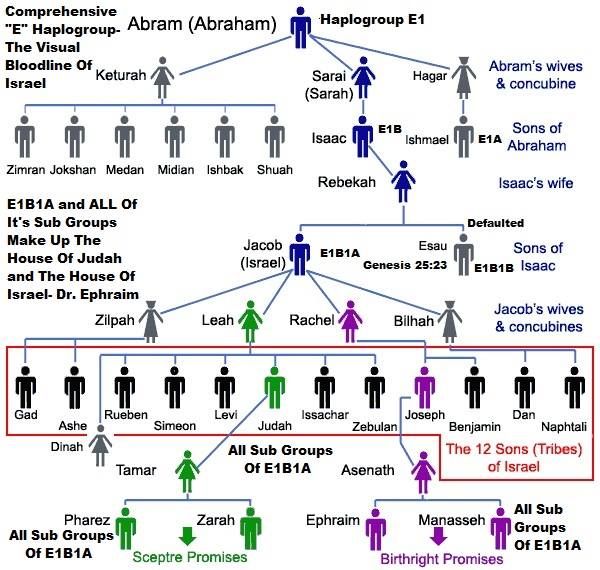
Through ancestral genetic and scriptural analysis, I concluded that the lineage of Jacob (the Patriarch of Israel) corresponds with Haplogroup E1b1a. The biblical reference in Deuteronomy 28:68, which mentions future enslavement “by ships,” appears prophetic when aligned with the transatlantic slave trade and the predominance of E1b1a among enslaved Africans. Y‑chromosome inheritance is paternally transmitted and unchanged, allowing us to trace a direct male line from Jacob to present-day descendants of the twelve tribes.


4. Genetic Comparison: Ashkenazi Jews & E1b1b

Genesis 25:23 declares that the nations of Jacob and Esau would diverge. Genetically, Esau’s descendants align with Haplogroup E1b1b, which is prevalent in certain Middle Eastern and North African populations. Many Ashkenazi Jews display E1b1b or haplogroup J—distinct from E1b1a, which supports a separate ancestral line. Misattributions linking E1b1b to Black Israelites are thus historically and scientifically flawed.


5. African Tribes & Mixed Lineage

Several African ethnic groups—such as the Lemba, Ashanti, and Igbo—carry both E1b1a and E1b1b haplogroups, reflecting historical admixture. Modern diaspora communities (e.g., in Brazil, the Caribbean, and the United States) also reflect this genetic diversity, consistent with historical migration and intermarriage patterns.


6. The Debate on Black Hebrew Israelites

DNA makes lineage claims far more objective. Since E1b1a is exclusive to the male line of Jacob, any claimant to Israelite identity must test positive for E1b1a. Others may have spiritual, cultural, or chosen affiliation but lack genetic continuity. This clarity undercuts ambiguous identity claims by non-E1b1a lineages.


7. Biracial Identity & Patriarchal Lineage

Y‑DNA is strictly paternal, affecting male descendants. However, cultural and genetic heritage in biracial individuals is influenced by both parents. Thus, while only biological fathers transmit Y‑DNA, biracial Israelite identity can be recognized through maternal collateral lines but requires genetic evidence for formal claim.


8. How DNA Defines National Lineage

Beyond identifying immediate relations, subgroups within E1b1a trace the fourteen branches of Jacob’s descendants (including Joseph’s sons, Ephraim and Manasseh). Genetic markers may eventually assist in mapping modern individuals to specific tribes.


9. Deuteronomy 28 in Context

Deuteronomy 28 outlines blessings and curses tied to Israel’s fidelity. Subsequent exile and dispersal—interpreted as the African diaspora—mirror the conditions described. This scriptural prophecy frames the historical and genetic narrative of descendants of Jacob (the Negroid lineage).


10. Present State & Path Forward

In 2017, many descendants remain disconnected from authentic identity, often identifying broadly as “African American.” This lack of specificity perpetuates cultural dislocation. Romans 9:27 suggests only a remnant attains covenantal alignment—highlighting the need for genealogical clarity and spiritual awakening. My role is to provide empirical—and scriptural—evidence. Change begins when we reconnect with identity and commit to obeying divine statutes.


🔍 Conclusion

  • E1b1a marks the paternal lineage of Jacob (Israel).
  • It is the definitive tool to distinguish genetic Israelites from others.
  • Recognizing this genetic truth is essential to rightful identity.
  • Following identity restoration comes moral and spiritual responsibility.

References:

Jobling, M. A., Hurles, M. E., & Tyler-Smith, C. (2013). Human Evolutionary Genetics. Garland Science.

Kittles, R. A., & Weiss, K. M. (2003). Race, ancestry, and genes: Implications for defining disease risk. Annual Review of Genomics and Human Genetics, 4(1), 33–67. https://doi.org/10.1146/annurev.genom.4.070802.110300

Underhill, P. A., et al. (2000). The phylogeography of Y chromosome binary haplotypes and the origins of modern human populations. Annals of Human Genetics, 64(Pt 3), 223–241. https://doi.org/10.1046/j.1529-8817.2000.00085.x

U.S. National Library of Medicine. (n.d.). Y chromosome haplogroups. Genetics Home Reference. https://ghr.nlm.nih.gov/primer/genomicresearch/ychromosome

Akbar, N. (1996). Breaking the Chains of Psychological Slavery. Mind Productions.

hooks, b. (1992). Black Looks: Race and Representation. South End Press.

Fanon, F. (1967). Black Skin, White Masks. Grove Press.

Russell-Cole, K., Wilson, M., & Hall, R. E. (2013). The Color Complex: The Politics of Skin Color in a New Millennium. Anchor Books.

American Psychological Association. (2019). Ethnic and Racial Disparities in Mental Health Care.