Category Archives: dilemmas

Dilemma: Racism and Race Baiting

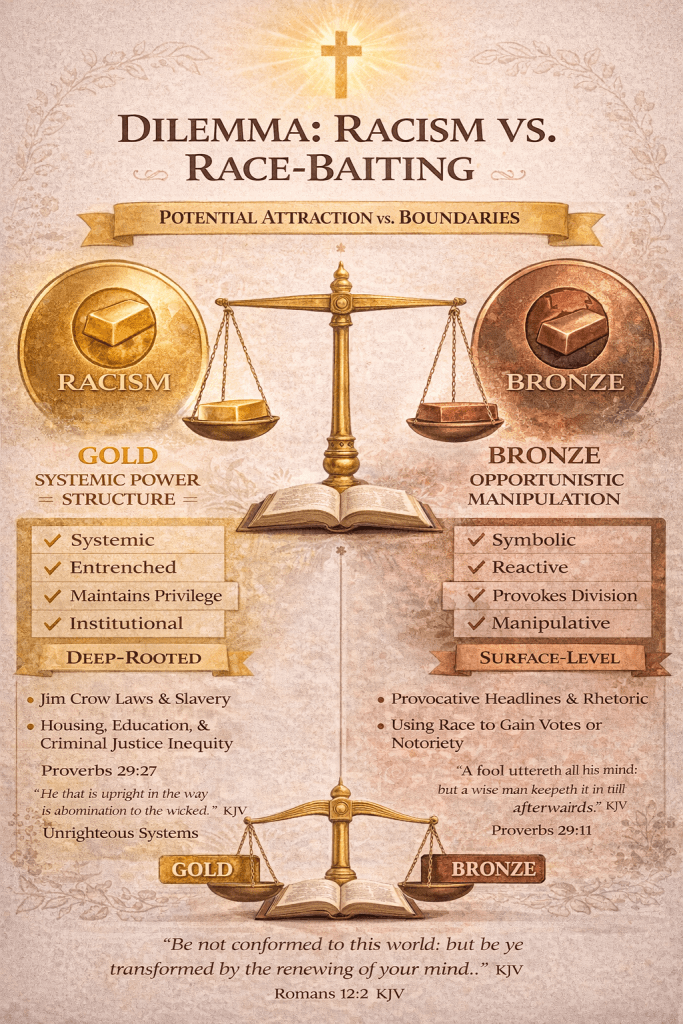
Racism remains one of the most persistent and destructive forces in society, functioning as a systemic power structure designed to maintain the dominance of one group over another (Feagin, 2006). Unlike individual prejudice, which reflects personal bias, racism involves institutional, cultural, and historical mechanisms that enforce inequality. Understanding racism as a power structure is critical to distinguishing it from race-baiting.

Race-baiting, in contrast, refers to tactics that manipulate racial tension for personal, political, or financial gain. It does not necessarily rely on structural dominance but rather exploits societal divisions, often inciting anger, fear, or resentment. While both racism and race-baiting are harmful, their mechanisms and intent differ.

Racism operates at multiple levels: individual, institutional, and systemic. Individual racism involves personal prejudice or discriminatory acts, whereas institutional racism manifests in policies, practices, and norms that advantage one racial group over others. Systemic racism describes the entrenched nature of these structures over generations.

Race-baiting exploits visible racial differences to provoke a reaction. Unlike racism, which is rooted in power dynamics and structural advantage, race-baiting may be opportunistic, focusing on rhetoric and emotional appeal rather than systemic control. Politicians, media personalities, and even social influencers often use race-baiting to advance agendas or gain attention.

In biblical terms, oppression and favoritism have long been condemned. James 2:1 warns, “My brethren, have not the faith of our Lord Jesus Christ, the Lord of glory, with respect of persons” (KJV). Partiality and systemic oppression violate God’s design for justice and equality. Racism is, therefore, fundamentally anti-biblical because it enforces inequality and diminishes the image of God in humanity (Genesis 1:27).

Understanding the difference between racism and race-baiting requires examining the intent behind actions. Racism seeks to preserve hierarchy, maintain privilege, and control resources. Race-baiting seeks to provoke emotional reaction and division, often for personal gain or notoriety. While a racist agenda benefits the oppressor materially or socially, race-baiting primarily manipulates perception.

The metaphor of bronze versus gold can help clarify the distinction. Bronze represents the superficial provocation, often symbolic and reactive—this is race-baiting. Gold represents the deep, entrenched systemic mechanisms—this is racism in its structural form. Observing whether an act addresses the root of inequality or merely agitates emotion can reveal its nature.

Racism and race-baiting intersect in public discourse. Some individuals and media sources may exaggerate or misrepresent incidents of racial tension for attention, funding, or political leverage. This blurs public understanding, making it difficult to address genuine structural injustice. As Proverbs 18:17 notes, “The first to plead his cause seemeth just; but his neighbor cometh and searcheth him” (KJV). Truth requires deeper investigation.

Racism thrives on normalization. When societal structures systematically advantage one group, discriminatory practices are often invisible or dismissed as “tradition” or “meritocracy.” Understanding this helps differentiate between acts that are opportunistic (race-baiting) and those that are embedded within the system (racism).

Race-baiting frequently misdirects anger away from systemic causes toward individual actors, scapegoating specific groups for broader structural problems. This manipulation can polarize communities and hinder meaningful solutions. Micah 6:8 reminds us of justice and humility: “He hath shewed thee, O man, what is good; and what doth the Lord require of thee, but to do justly, and to love mercy, and to walk humbly with thy God?” (KJV).

Media literacy is essential to recognize the distinction. Headlines and social media often amplify emotionally charged narratives without context. Racism is systemic, historically rooted, and persistent, while race-baiting relies on immediate reaction. Educated discernment enables individuals to see beyond sensationalism.

Racism is often intergenerational, perpetuated through education, housing, employment, criminal justice, and healthcare disparities. Race-baiting is usually episodic, emerging around specific incidents, speeches, or events. Understanding historical context is therefore critical to interpreting current racial discourse accurately.

Race-baiting can also occur within oppressed communities, where individuals or groups exploit internal divisions to gain influence. This demonstrates that race-baiting is less about power structures and more about manipulation, contrasting with racism’s reliance on systemic advantage.

The Bible condemns hypocrisy and manipulation. Proverbs 6:16–19 lists pride, false witness, and sowing discord among brethren as abominations to God. Race-baiting falls into the category of sowing discord, whereas racism violates divine law by enforcing inequality. Both are sin, but their mechanisms differ.

Recognizing racism requires assessing who benefits. True racism confers social, economic, and political advantage to a particular racial group. Race-baiting may inflame perceptions of injustice but does not create structural advantage. This distinction clarifies policy debates and moral accountability.

Racism also often hides behind ideology, meritocracy, or cultural norms. The systemic nature makes it less visible than race-baiting, which is loud, overt, and performative. Understanding the bronze versus gold distinction allows individuals to respond with strategic solutions rather than reactive emotion.

Education and awareness are key tools in dismantling both racism and race-baiting. Combatting racism requires structural reform, anti-discrimination policy, and societal accountability. Countering race-baiting requires critical thinking, media literacy, and spiritual discernment (Proverbs 14:15).

Christians are called to pursue justice and reconciliation. Isaiah 1:17 commands, “Learn to do well; seek judgment, relieve the oppressed, judge the fatherless, plead for the widow” (KJV). Responding to racism requires action and advocacy; responding to race-baiting requires wisdom, prayer, and discernment.

Racism is a deep societal disease, while race-baiting is a symptom that exploits and amplifies divisions. One targets systemic change; the other targets immediate perception. Addressing the root cause requires education, advocacy, and awareness of historical context, as well as spiritual discernment.

In conclusion, distinguishing between racism and race-baiting is essential for effective response. Bronze may flare in anger and reaction; gold endures in system and power. Both demand moral responsibility, but the solutions differ. Recognizing the systemic nature of racism while refusing to be manipulated by race-baiting is a critical skill for spiritual and social maturity (Romans 12:2).


References

Feagin, J. (2006). Systemic racism: A theory of oppression. Routledge.
Alexander, M. (2012). The New Jim Crow: Mass incarceration in the age of colorblindness. The New Press.
Kendi, I. X. (2019). How to be an antiracist. One World.
Proverbs 4:23; 14:15; 18:17; 6:16–19
Isaiah 1:17; Micah 6:8; James 2:1; Genesis 1:27
Romans 12:2; Hebrews 13:4
Matthew 10:16; Matthew 26:41


Dilemma: Renewing the Mind

Photo by Na Urchin on Pexels.com

The mind is a battlefield. Every day, thoughts vie for dominance, shaping emotions, decisions, and behaviors. For many, particularly in communities burdened by systemic oppression, trauma, and cultural pressures, renewing the mind is not optional—it is essential for spiritual, emotional, and psychological health. Romans 12:2 instructs, “And be not conformed to this world: but be ye transformed by the renewing of your mind, that ye may prove what is that good, and acceptable, and perfect, will of God.”

Renewing the mind begins with awareness. The first step is recognizing thought patterns that limit, harm, or deceive. Negative self-talk, internalized oppression, and unexamined assumptions often dictate behavior subconsciously. Awareness creates the possibility of intentional transformation.

Cultural conditioning heavily influences the mind. From media representation to educational bias, society transmits messages about worth, beauty, and possibility. For Black individuals, these messages can perpetuate internalized racism, colorism, and inferiority complexes (Hunter, 2007). Renewal requires discerning these external lies from divine truth.

Trauma complicates mental renewal. Historical oppression, family dysfunction, and personal experiences can create deeply embedded cognitive patterns. Therapy, journaling, and prayer are vital tools to unearth these patterns and replace them with healthier perspectives (Van der Kolk, 2014).

Scripture is central to the process. Biblical meditation on God’s Word reshapes thought. Philippians 4:8 exhorts believers to think on “whatsoever things are true, whatsoever things are honest, whatsoever things are just…pure, lovely, of good report.” Filling the mind with truth displaces toxic thinking.

Self-reflection is a spiritual discipline. Daily evaluation of thoughts, motivations, and reactions helps identify areas of conformity to worldly patterns versus alignment with God’s will. This practice cultivates discernment and intentional living.

Mind renewal is also psychological. Cognitive-behavioral strategies, such as challenging distorted thinking and reframing negative beliefs, complement spiritual practices. Science shows that thought patterns can physically reshape neural pathways over time (Siegel, 2012).

Community plays a role. Mentorship, accountability partners, and support groups reinforce positive thinking. Sharing struggles, insights, and victories prevents isolation and encourages consistency in mental transformation.

Renewal requires deliberate replacement. Thoughts rooted in fear, resentment, or envy must be replaced with gratitude, faith, and hope. Practicing affirmations grounded in Scripture empowers the mind to internalize divine perspectives.

Meditation and prayer are essential tools. Quiet reflection allows individuals to discern between worldly pressures and God’s voice. Listening attentively to the Spirit fosters clarity and wisdom, helping the mind align with divine purpose.

Education informs renewal. Understanding psychology, history, and personal ancestry contextualizes challenges and combats internalized lies. Knowledge about the self and the world strengthens resilience against external conditioning.

Forgiveness frees the mind. Holding grudges, shame, or resentment sustains toxic thinking. Colossians 3:13 instructs believers to forgive as God forgave, liberating the mind from bondage and opening space for renewal.

Creative expression aids transformation. Writing, art, music, and movement help externalize internal conflicts, providing perspective and emotional release. This process reinforces new, constructive thought patterns. 🎨🖋️

Consistency is key. Renewing the mind is ongoing, not a one-time act. Daily disciplines—prayer, Scripture, reflection, therapy, and community engagement—maintain the transformation and prevent regression into old patterns.

Ultimately, renewing the mind is liberation. It restores identity, cultivates wisdom, and aligns the believer with God’s design. By intentionally reshaping thought patterns, individuals rise above societal lies, generational trauma, and personal limitations, living fully in purpose and truth.


References

  • Hunter, M. (2007). The persistent problem of colorism: Skin tone, status, and inequality. Sociology Compass, 1(1), 237–254.
  • Siegel, D. J. (2012). The developing mind: How relationships and the brain interact to shape who we are. Guilford Press.
  • Van der Kolk, B. (2014). The body keeps the score: Brain, mind, and body in the healing of trauma. Penguin Books.
  • The Holy Bible, King James Version.

Dilemma: Slavery, Colonialism, and Racial Hierarchy

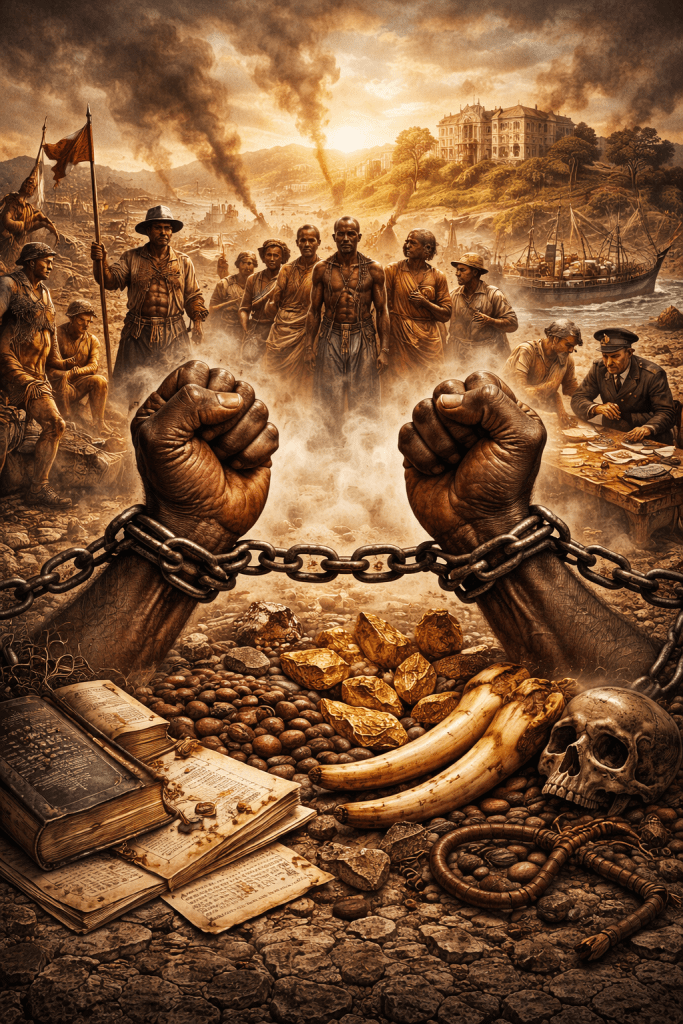
Slavery and colonialism did not emerge as isolated historical accidents but as deliberate systems engineered to extract labor, land, and life from subordinated peoples. At the center of these systems stood the construction of racial hierarchy, a framework that transformed domination into ideology and violence into normalcy.

The transatlantic slave trade marked a pivotal rupture in human history. Africans were captured, commodified, and transported across oceans under conditions designed to erase personhood. This was not merely economic exploitation; it was an ontological assault on humanity itself.

Colonialism expanded this logic globally. European empires occupied territories across Africa, the Americas, Asia, and the Caribbean, imposing foreign rule while dismantling indigenous governance, economies, and epistemologies. Control of land was accompanied by control of meaning.

Racial hierarchy emerged as the moral justification for these practices. Europeans increasingly defined themselves as fully human, rational, and civilized, while Africans and other colonized peoples were cast as primitive, inferior, or subhuman. This hierarchy was not natural; it was manufactured.

Theological distortion played a central role in legitimizing oppression. Biblical texts were selectively interpreted to sanctify slavery and empire, while passages emphasizing justice, liberation, and divine judgment against oppressors were muted or ignored.

One of the most egregious examples was the misuse of the so-called “Curse of Ham.” Though the Genesis narrative never mentions skin color or Africa as justification for enslavement, European theologians weaponized this passage to racialize bondage and claim divine approval for Black subjugation.

At the same time, enslaved Africans encountered the Bible through contradiction. The same text used to justify their chains also spoke of Exodus, covenant, judgment, and liberation. Enslaved readers discerned truths their oppressors refused to see.

The plantation economy reveals the intimate link between slavery and modern capitalism. Sugar, cotton, tobacco, and rice generated immense wealth for European nations and American colonies, laying the financial foundation of global modernity.

Colonial powers did not merely exploit labor; they extracted knowledge. African technologies, agricultural practices, metallurgy, and governance systems were appropriated, while African peoples were denied authorship of their own civilizations.

Colonial education systems reinforced inferiority by teaching colonized subjects to admire Europe and despise themselves. Language suppression, cultural erasure, and religious coercion produced psychological captivity alongside political domination.

Racial hierarchy was further codified through law. Slave codes, colonial ordinances, and later segregationist policies transformed racial inequality into legal structure, ensuring that injustice persisted beyond individual prejudice.

Even after formal abolition, slavery mutated rather than disappeared. Sharecropping, convict leasing, forced labor camps, and colonial labor systems continued extraction under new names, maintaining racial stratification.

The Bible’s prophetic tradition stands in direct opposition to such systems. Prophets repeatedly condemned societies that enriched themselves through exploitation, warning that injustice invites divine judgment regardless of national power.

Deuteronomy, Isaiah, Amos, and Jeremiah articulate a theology in which God sides with the oppressed and holds nations accountable for how they treat the vulnerable, the captive, and the poor.

Colonial Christianity often severed salvation from justice, emphasizing heaven while tolerating hell on earth. This theological bifurcation enabled believers to pray while profiting from suffering.

Black and African theology rejected this split. Faith became inseparable from survival, resistance, and hope. Worship functioned not as escapism but as protest against a world out of alignment with divine order.

Resistance to slavery and colonialism took multiple forms: revolts, maroon communities, abolitionist movements, pan-Africanism, and decolonization struggles. These movements testified that domination was never fully total.

The twentieth century witnessed formal decolonization, yet political independence did not erase economic dependency. Former colonies inherited borders, debts, and institutions designed for extraction, not flourishing.

Racial hierarchy adapted to new global arrangements. Development discourse replaced overt racism, yet inequality persisted through trade imbalances, resource exploitation, and global financial systems.

Within Western societies, the descendants of the enslaved continued to face exclusion through housing discrimination, educational inequity, mass incarceration, and economic marginalization—echoes of the original hierarchy.

Psychological consequences remain profound. Internalized inferiority, historical amnesia, and fractured identity are among the most enduring legacies of racial domination.

Scripture speaks to these realities not through denial but through remembrance. Biblical faith insists that history matters, that suffering is seen, and that injustice leaves a moral residue demanding response.

Divine justice in the biblical vision is neither rushed nor forgetful. It unfolds across generations, confronting systems rather than merely individuals.

The dilemma of slavery, colonialism, and racial hierarchy therefore confronts both history and theology. It demands honest reckoning rather than selective memory.

Healing requires truth, accountability, and restoration. Justice is not achieved through symbolic gestures alone but through material repair and transformed relationships.

The Bible ultimately refuses the permanence of oppression. Empires rise and fall, but divine justice endures beyond human power.

The continued struggle for racial justice is not a deviation from faith but a fulfillment of its ethical demand. To pursue justice is to align human action with divine intent.

Slavery and colonialism reveal the depths of human cruelty, but they also reveal the resilience of those who survived them. Survival itself stands as testimony against the lie of inferiority.

The racial hierarchy constructed to justify domination is historically contingent and morally bankrupt. It cannot withstand sustained truth.

This dilemma remains unresolved not because justice is absent, but because humanity continues to resist its demands.

Yet Scripture insists that injustice is unsustainable. The arc of history bends not by accident, but by moral weight.

The work of dismantling racial hierarchy is therefore sacred labor—historical, ethical, and spiritual—calling this generation to choose truth over comfort and justice over denial.


References

The Holy Bible, King James Version. (1611/1769).

Cone, J. H. (1997). God of the oppressed. Orbis Books.

Fanon, F. (1963). The wretched of the earth. Grove Press.

Rodney, W. (1972). How Europe underdeveloped Africa. Howard University Press.

Williams, E. (1944). Capitalism and slavery. University of North Carolina Press.

Du Bois, W. E. B. (1903). The souls of Black folk. A. C. McClurg & Co.

Heschel, A. J. (2001). The prophets. Harper Perennial.

Dilemma: Anxiety

Anxiety is one of the most common yet misunderstood human experiences, often existing at the intersection of biology, psychology, culture, and spirituality. It can appear as a quiet restlessness or as an overwhelming force that disrupts daily life. While anxiety has adaptive roots meant to protect humans from danger, in modern society it frequently becomes chronic, disproportionate, and debilitating. This dilemma raises profound questions about how fear, uncertainty, and meaning are navigated in a world marked by constant pressure.

At its core, anxiety is a response to perceived threat, whether real or imagined. The human nervous system is designed to detect danger and mobilize the body for survival. However, when this system remains activated without resolution, the body and mind pay a heavy price. Persistent anxiety alters sleep, concentration, and emotional regulation, gradually eroding a person’s sense of stability and control.

Modern life has intensified the conditions under which anxiety thrives. Economic insecurity, social comparison through digital media, political instability, and relentless productivity demands create an environment of continuous vigilance. The mind is rarely allowed to rest, and uncertainty becomes a permanent backdrop rather than a temporary condition. Anxiety, in this sense, is not merely an individual problem but a societal symptom.

Culturally, anxiety is often stigmatized or minimized. Individuals are encouraged to “push through,” “stay positive,” or “pray it away,” responses that may unintentionally deepen shame. When anxiety is treated as a moral failure or weakness, sufferers are less likely to seek help. This silence reinforces isolation, one of anxiety’s most destructive companions.

From a psychological perspective, anxiety disorders involve patterns of distorted thinking, heightened physiological arousal, and avoidance behaviors. Catastrophic thinking and hypervigilance train the brain to expect danger even in safe environments. Over time, the fear of anxiety itself becomes a trigger, creating a self-perpetuating cycle that feels impossible to escape.

Biologically, anxiety is associated with dysregulation in neurotransmitters such as serotonin, norepinephrine, and gamma-aminobutyric acid. Chronic stress also affects the hypothalamic-pituitary-adrenal axis, keeping cortisol levels elevated. These physiological changes demonstrate that anxiety is not imagined but embodied, rooted in measurable neurochemical processes.

Trauma plays a significant role in the development of anxiety. Early childhood adversity, abuse, neglect, and chronic exposure to stress can shape the nervous system toward hyperarousal. For many individuals, anxiety is the echo of unresolved pain rather than an irrational fear. Understanding this context fosters compassion and reframes anxiety as a survival adaptation rather than a flaw.

Social inequalities further complicate the anxiety dilemma. Marginalized communities often face compounded stressors, including discrimination, financial precarity, and limited access to mental health care. These structural pressures increase vulnerability to anxiety while simultaneously reducing pathways to healing. Anxiety, therefore, cannot be separated from broader questions of justice and equity.

Spiritually, anxiety raises questions about trust, control, and human limitation. Many faith traditions acknowledge fear as a universal human condition while calling believers toward surrender and hope. Anxiety often intensifies when individuals attempt to control outcomes beyond their capacity, revealing the tension between human agency and dependence on something greater than oneself.

Scriptural Encouragement for Anxiety (KJV)

Scripture consistently acknowledges human fear while directing the heart toward divine refuge rather than self-reliance. Anxiety is not condemned in the Bible; instead, believers are instructed on where to place their burdens.

“Cast thy burden upon the LORD, and he shall sustain thee: he shall never suffer the righteous to be moved” (Psalm 55:22, KJV). This verse reframes anxiety as a weight not meant to be carried alone, emphasizing divine support rather than human endurance.

“Be careful for nothing; but in every thing by prayer and supplication with thanksgiving let your requests be made known unto God” (Philippians 4:6, KJV). Here, anxiety is countered through intentional prayer, gratitude, and communication with God, offering a disciplined response to mental unrest.

“And the peace of God, which passeth all understanding, shall keep your hearts and minds through Christ Jesus” (Philippians 4:7, KJV). This peace is described as protective, guarding both emotion and thought when anxiety threatens stability.

“Fear thou not; for I am with thee: be not dismayed; for I am thy God: I will strengthen thee; yea, I will help thee” (Isaiah 41:10, KJV). This passage addresses fear directly, grounding reassurance in God’s presence rather than changing circumstances.

“When my heart is overwhelmed: lead me to the rock that is higher than I” (Psalm 61:2, KJV). Anxiety often emerges when internal resources are exhausted, and this verse acknowledges emotional overwhelm while pointing toward transcendence and refuge.

“Peace I leave with you, my peace I give unto you: not as the world giveth, give I unto you. Let not your heart be troubled, neither let it be afraid” (John 14:27, KJV). Christ distinguishes divine peace from worldly reassurance, highlighting a peace that is not dependent on external stability.

“Thou wilt keep him in perfect peace, whose mind is stayed on thee: because he trusteth in thee” (Isaiah 26:3, KJV). This verse emphasizes mental focus and trust as anchors against anxious thought patterns.

In biblical literature, anxiety is addressed not as a denial of fear but as an invitation to reorient the heart. Scriptures emphasize casting cares, seeking wisdom, and resting in divine provision. These teachings do not negate psychological reality but offer a framework for meaning, resilience, and inner peace amid uncertainty.

The mind-body connection is critical in understanding anxiety. Practices such as controlled breathing, physical movement, and mindfulness activate the parasympathetic nervous system, counteracting chronic stress responses. These embodied practices remind individuals that healing is not solely cognitive but somatic.

Therapeutic interventions provide evidence-based pathways toward recovery. Cognitive-behavioral therapy helps individuals identify and challenge maladaptive thought patterns. Acceptance and commitment therapy encourages individuals to coexist with anxious thoughts without being dominated by them. Medication, when appropriate, can stabilize neurochemical imbalances and support therapeutic progress.

Community support is another essential dimension of healing. Anxiety thrives in isolation but weakens in environments of empathy and understanding. Safe relationships provide reassurance, perspective, and accountability. Shared vulnerability transforms anxiety from a private burden into a collective concern.

Rest is a neglected yet powerful antidote to anxiety. In cultures that equate worth with productivity, rest is often viewed as indulgent rather than necessary. Chronic exhaustion amplifies anxiety by reducing emotional resilience and cognitive clarity. Reclaiming rest is both a psychological and ethical act.

Anxiety also carries a paradoxical message. It often signals that something in one’s life requires attention, change, or realignment. When listened to carefully, anxiety can reveal misaligned values, unresolved grief, or unrealistic expectations. The dilemma lies in discerning when anxiety is a warning to heed and when it is a distortion to challenge.

Faith-based coping strategies, when integrated responsibly, can complement clinical approaches. Prayer, meditation, scripture reading, and communal worship may reduce stress and foster hope. However, spiritual practices should not replace professional care when anxiety becomes overwhelming or disabling.

Children and adolescents face unique anxiety challenges in an increasingly digital and competitive world. Academic pressure, social media exposure, and global crises shape developing nervous systems. Early intervention, emotional education, and supportive environments are critical in preventing lifelong patterns of anxiety.

The language used to describe anxiety matters. When individuals are labeled as “anxious people” rather than people experiencing anxiety, identity becomes fused with the condition. Reframing anxiety as an experience rather than a defining trait opens space for growth and recovery.

Ultimately, the dilemma of anxiety reflects the fragility and resilience of the human condition. Anxiety reveals humanity’s deep desire for safety, certainty, and meaning. Addressing it requires humility, compassion, and a willingness to integrate science, community, and spirituality.

Healing from anxiety is rarely linear. It involves setbacks, insight, patience, and grace. By acknowledging anxiety as a complex and multifaceted experience, individuals and societies can move beyond stigma toward understanding. In doing so, anxiety becomes not a life sentence, but a passage toward deeper awareness and wholeness.


References

American Psychiatric Association. (2022). DSM-5-TR: Diagnostic and statistical manual of mental disorders (5th ed., text rev.). American Psychiatric Publishing.

Beck, J. S. (2020). Cognitive behavior therapy: Basics and beyond (3rd ed.). Guilford Press.

Bessel van der Kolk. (2014). The body keeps the score: Brain, mind, and body in the healing of trauma. Viking.

Hofmann, S. G., Asnaani, A., Vonk, I. J. J., Sawyer, A. T., & Fang, A. (2012). The efficacy of cognitive behavioral therapy: A review of meta-analyses. Cognitive Therapy and Research, 36(5), 427–440. https://doi.org/10.1007/s10608-012-9476-1

McEwen, B. S. (2017). Neurobiological and systemic effects of chronic stress. Chronic Stress, 1, 1–11. https://doi.org/10.1177/2470547017692328

Smith, J. C. (2019). Managing stress: Principles and strategies for health and well-being (5th ed.). Pearson.

The Holy Bible, King James Version. (1611/2017). Cambridge University Press.

Dilemma: Money

Money is one of the most powerful forces shaping human behavior, not because it has a life of its own, but because of what it does to the human heart. Scripture does not condemn money itself, yet it repeatedly warns that wealth has the capacity to distort humility, inflate ego, and quietly replace trust in God with trust in possessions. The dilemma of money lies in its ability to serve as both a tool and a temptation.

When wealth increases, humility is often the first virtue to be tested. Financial abundance can subtly convince a person that their success is self-generated, disconnecting prosperity from divine provision. The heart that once prayed earnestly can become casual, assuming tomorrow is guaranteed because resources appear secure. Proverbs warns, “Pride goeth before destruction, and a haughty spirit before a fall” (Proverbs 16:18, KJV).

Money also breeds arrogance by creating artificial hierarchies of worth. Those with more are often perceived as wiser, more capable, or more deserving, while the poor are unjustly viewed as failures. Scripture rebukes this thinking, reminding us that God is no respecter of persons (Acts 10:34, KJV). Wealth does not elevate righteousness, nor does poverty diminish dignity.

False security is one of money’s greatest deceptions. Bank accounts, investments, and assets promise safety, yet they cannot prevent illness, death, or divine judgment. Jesus warns against this illusion when He says, “Take heed, and beware of covetousness: for a man’s life consisteth not in the abundance of the things which he possesseth” (Luke 12:15, KJV).

Christ’s declaration that it is easier for a camel to go through the eye of a needle than for a rich man to enter the kingdom of God is not hyperbole meant to shock without meaning. It exposes how wealth entangles the soul, making surrender to God increasingly difficult (Matthew 19:23–24, KJV). Riches often compete with obedience, demanding loyalty that belongs to the Most High.

Money has the power to turn hearts away from dependence on God because it offers an alternative source of comfort. Instead of seeking daily bread through prayer, wealth allows people to stockpile security for years ahead. Yet Scripture teaches, “Trust in the LORD with all thine heart; and lean not unto thine own understanding” (Proverbs 3:5, KJV).

The Bible repeatedly commands those with abundance to distribute it quickly and generously. Wealth is not meant to stagnate in vaults while suffering surrounds us. “He that hath pity upon the poor lendeth unto the LORD; and that which he hath given will he pay him again” (Proverbs 19:17, KJV). Giving is not loss; it is obedience.

Hoarding wealth while others starve is portrayed in Scripture as moral failure, not financial wisdom. James speaks sharply to the wealthy who store riches while neglecting justice, declaring that their gold and silver will testify against them (James 5:1–3, KJV). Excess becomes evidence of indifference when compassion is absent.

The gospel ethic does not support the endless accumulation of luxury. One can only inhabit so many houses, drive so many cars, or carry so many handbags before excess becomes vanity. Ecclesiastes soberly observes that abundance does not satisfy the soul (Ecclesiastes 5:10, KJV). Desire expands with wealth, never contracting.

Death exposes the ultimate futility of hoarded riches. Scripture is clear that nothing material accompanies the soul beyond the grave. “For we brought nothing into this world, and it is certain we can carry nothing out” (1 Timothy 6:7, KJV). Every possession will eventually belong to someone else.

Jesus’ parable of the rich fool illustrates this truth vividly. The man builds bigger barns to store his goods, confident in his future, only to lose his life that very night. God asks, “Then whose shall those things be?” (Luke 12:20, KJV). Wealth without wisdom ends in loss.

True riches are measured by generosity, not accumulation. Christ teaches that treasures laid up in heaven cannot be corrupted, stolen, or destroyed (Matthew 6:19–21, KJV). Giving transforms wealth from a burden into a blessing.

Money becomes dangerous when it replaces God as the source of identity. Careers, titles, and net worth begin to define worth, while character and obedience fade into the background. Scripture reminds us that the love of money is the root of all kinds of evil, drawing many away from the faith (1 Timothy 6:9–10, KJV).

The poor are not an inconvenience to be avoided but a divine responsibility. Christ identifies Himself with the hungry, the naked, and the imprisoned, declaring that how we treat them is how we treat Him (Matthew 25:40, KJV). Wealth that ignores suffering dishonors God.

Generosity breaks the power money holds over the heart. Giving disciplines desire and realigns trust, reminding believers that provision comes from God, not from stored surplus. Paul teaches that God loves a cheerful giver, one who gives freely rather than fearfully (2 Corinthians 9:6–7, KJV).

Biblical stewardship does not forbid saving, but it condemns idolatry. Savings meant for wisdom differ from hoards driven by fear and pride. When money is guarded more fiercely than faith, it has become an idol.

The early church modeled radical generosity, selling possessions to ensure that no one lacked necessities (Acts 4:34–35, KJV). This was not coercion but compassion born from spiritual unity. Wealth was subordinated to love.

Money also tests obedience by revealing what we prioritize. Where resources flow, the heart follows. Jesus plainly states, “For where your treasure is, there will your heart be also” (Matthew 6:21, KJV).

Society celebrates excess, yet Scripture celebrates sufficiency. Paul declares that godliness with contentment is a great gain (1 Timothy 6:6, KJV). Contentment resists the endless hunger that wealth culture promotes.

Luxury without generosity hardens the heart. Over time, comfort dulls compassion, making suffering seem distant and abstract. Scripture calls believers to remember the poor always, not selectively (Galatians 2:10, KJV).

Money cannot purchase peace, wisdom, or eternal life. These are gifts of God, not commodities. Isaiah warns against laboring for what does not satisfy, urging people to seek what truly nourishes the soul (Isaiah 55:2, KJV).

The dilemma of money is ultimately a spiritual one. Wealth reveals who we trust, what we worship, and how deeply we believe God’s promises. It tests whether faith is genuine or conditional.

When money is surrendered to God, it becomes a servant rather than a master. Used rightly, it feeds the hungry, shelters the vulnerable, and advances righteousness. Used wrongly, it corrodes humility and fractures the soul.

Scripture does not ask whether we have money, but whether money has us. The call is not poverty for its own sake, but freedom from bondage to possessions. True wealth is found in obedience, generosity, and dependence on the Most High.

In the end, only what is done for God and others will endure. Riches fade, but righteousness remains. The dilemma of money forces every believer to choose between temporary comfort and eternal reward.


References

The Holy Bible, King James Version. (1769/2017). Cambridge University Press.

Blomberg, C. L. (2016). Neither poverty nor riches: A biblical theology of material possessions. IVP Academic.

Wright, C. J. H. (2010). Old Testament ethics for the people of God. IVP Academic.

Foster, R. J. (2018). Money, sex, and power: The challenge of the disciplined life. HarperOne.

Smith, J. K. A. (2016). You are what you love: The spiritual power of habit. Brazos Press.

Dilemma: Earthy Injustice

Earthly injustice is not an abstract concept but a lived reality etched into human history through conquest, enslavement, exploitation, and systemic inequality. It manifests wherever power divorces itself from morality and institutions prioritize profit, dominance, or comfort over human dignity.

From ancient empires to modern nation-states, injustice has been sustained by laws that favor the powerful and narratives that normalize suffering. These systems rarely collapse on their own; they persist until confronted by truth, resistance, and moral reckoning.

Scripture consistently identifies injustice as a violation of divine order. The Bible portrays God as attentive to imbalance, especially when the poor, the stranger, and the captive are crushed under unjust structures.

Earthly injustice thrives on dehumanization. When a group is stripped of identity, history, or worth, oppression becomes administratively easy and morally invisible to those who benefit from it.

Slavery represents one of the clearest examples of institutionalized injustice. Human beings were transformed into commodities, families into property, and labor into stolen wealth, all under legal and theological justification.

The transatlantic slave trade fused economic ambition with racial ideology, producing a hierarchy that outlived slavery itself. Its aftershocks remain embedded in wealth disparities, social stratification, and global inequality.

Colonialism extended injustice across continents, extracting resources while erasing cultures. Colonized peoples were taught to doubt their own humanity while serving the prosperity of distant empires.

Earthly injustice is often maintained through selective morality. Religious texts are quoted to demand obedience while passages condemning oppression are ignored or reinterpreted.

The Bible’s prophets repeatedly confronted this hypocrisy. They condemned societies that upheld ritual purity while neglecting justice, mercy, and compassion.

Injustice also operates psychologically. Generations exposed to domination may internalize inferiority, fulfilling the goals of oppression without the need for constant force.

Modern injustice frequently disguises itself as neutrality. Policies framed as fair or colorblind often perpetuate historical inequities by refusing to address unequal starting points.

Earthly courts can legalize injustice, but legality does not equate to righteousness. History records many laws that were lawful yet morally indefensible.

Scripture insists that injustice leaves a moral residue. Blood cries from the ground, wages withheld cry out, and suffering demands divine attention.

Those who endure injustice often develop alternative moral visions rooted in survival, faith, and communal care. These visions challenge dominant definitions of success and power.

Resistance to injustice takes many forms, from open rebellion to quiet endurance. Each asserts that oppression does not have the final word.

Earthly injustice is sustained by forgetting. When societies erase past crimes, they create conditions for repetition rather than repair.

Justice requires more than condemnation; it requires restoration. Repairing harm involves truth-telling, accountability, and material redress.

The Bible warns that unchecked injustice invites judgment. Nations that exalt themselves through exploitation eventually encounter collapse, whether through internal decay or external consequence.

Earthly injustice exposes the limits of human systems. It reveals the need for a higher moral authority beyond political power or economic interest.

The persistence of injustice does not negate justice’s existence. Rather, it testifies to the urgency of aligning human action with divine standards of righteousness.


References

The Holy Bible, King James Version. (1611/1769).

Cone, J. H. (1997). God of the oppressed. Orbis Books.

Du Bois, W. E. B. (1903). The souls of Black folk. A. C. McClurg & Co.

Heschel, A. J. (2001). The prophets. Harper Perennial.

Williams, E. (1944). Capitalism and slavery. University of North Carolina Press.

Dilemma: Colonialism

Colonialism represents one of the most enduring and destructive systems in human history, shaping global inequalities that persist long after formal empires collapsed. At its core, colonialism involved the domination of one people by another through force, dispossession, and ideological control. The dilemma of colonialism lies not only in its historical brutality but in its long-term consequences, which continue to structure economic systems, cultural identities, and psychological realities across the modern world.

European colonial expansion was driven by the pursuit of land, labor, and resources, justified through doctrines of racial superiority and civilizational hierarchy. Indigenous societies were not encountered as equals but as obstacles to be conquered or “improved.” This worldview allowed colonial powers to rationalize enslavement, genocide, and cultural erasure as moral and economic necessities.

Economic exploitation was central to the colonial project. Colonized lands were reorganized to serve imperial markets, transforming self-sustaining economies into extractive systems dependent on the export of raw materials. Wealth flowed outward to imperial centers, while poverty was institutionalized in the colonies, laying the groundwork for global inequality.

The transatlantic slave trade functioned as a pillar of colonial capitalism. Millions of Africans were forcibly displaced, commodified, and exploited to fuel plantation economies in the Americas and the Caribbean. This system generated immense wealth for European powers while devastating African societies socially, demographically, and politically.

Colonialism also dismantled indigenous governance structures. Traditional political systems were replaced with colonial administrations designed to extract resources and suppress resistance. Artificial borders divided ethnic groups and forced rival communities into single political units, creating instability that continues to affect postcolonial states.

Cultural domination accompanied economic and political control. Colonial powers imposed their languages, religions, and value systems while denigrating indigenous cultures as primitive or inferior. This process stripped colonized peoples of historical continuity and disrupted intergenerational transmission of knowledge and identity.

Education under colonial rule was not designed to empower but to discipline. Schools trained a small elite to serve colonial administrations while teaching them to internalize European superiority. As Frantz Fanon observed, colonial education often produced alienation rather than enlightenment.

Religion was frequently weaponized to legitimize colonial expansion. Biblical narratives were selectively interpreted to justify conquest, enslavement, and submission. While Christianity offered spiritual comfort to many, it was also used as a tool of social control, obscuring the moral contradictions of colonial violence.

The psychological effects of colonialism were profound. Colonized peoples were subjected to constant messages of inferiority, leading to internalized racism and fractured self-perception. Fanon described this condition as a divided consciousness, where the oppressed come to see themselves through the eyes of the oppressor.

Racial hierarchies were meticulously constructed and enforced. Whiteness became synonymous with intelligence, beauty, and authority, while Blackness and indigeneity were associated with backwardness. These hierarchies did not disappear with independence; they were absorbed into global culture and continue to influence social relations.

Colonialism reshaped gender roles in destructive ways. Indigenous gender systems were often more fluid or complementary, but colonial rule imposed rigid patriarchal norms that marginalized women and erased their leadership roles. Colonial economies also relied heavily on the exploitation of women’s labor.

Environmental destruction was another hallmark of colonial rule. Land was treated as property rather than a sacred resource, leading to deforestation, soil depletion, and ecological imbalance. These practices prioritized short-term profit over sustainability, leaving lasting environmental scars.

Resistance to colonialism was constant, though often erased from dominant historical narratives. Enslaved Africans revolted, indigenous peoples fought invasions, and anti-colonial movements emerged across continents. Freedom was not granted by empires; it was wrested through struggle and sacrifice.

The transition from colonial rule to independence was frequently incomplete. Many nations inherited economies designed for extraction, not development, and political systems modeled on colonial governance. Independence without structural transformation left former colonies vulnerable to continued domination.

Colonial legacies remain visible in global wealth disparities. Former colonial powers continue to benefit from accumulated capital, while former colonies face debt, underdevelopment, and external interference. These inequalities are not accidental but historical outcomes of exploitation.

Colonialism also distorted historical memory. Textbooks and public narratives often minimize imperial violence while celebrating exploration and “progress.” This selective memory impedes reconciliation and allows injustice to persist without accountability.

From a moral and spiritual perspective, colonialism represents a profound violation of divine principles of justice and human dignity. Scripture condemns oppression, theft, and the exploitation of the vulnerable, warning that nations built on injustice cannot stand indefinitely.

The dilemma of colonialism is not simply whether it was harmful, but whether the world is willing to confront its consequences honestly. Apologies without reparative action risk becoming symbolic gestures rather than pathways to healing.

Decolonization requires more than political independence. It demands economic justice, cultural restoration, psychological healing, and historical truth-telling. Without these elements, colonialism merely changes form rather than ending.

Ultimately, colonialism challenges humanity to reckon with power, morality, and memory. Until its legacies are addressed with humility and justice, the wounds it created will continue to shape the present, reminding the world that history is never truly past.


References

Fanon, F. (1963). The wretched of the earth. Grove Press.

Fanon, F. (1967). Black skin, white masks. Grove Press.

Nkrumah, K. (1965). Neocolonialism: The last stage of imperialism. Thomas Nelson & Sons.

Rodney, W. (1972). How Europe underdeveloped Africa. Bogle-L’Ouverture Publications.

Said, E. W. (1978). Orientalism. Pantheon Books.

Smith, A. (1776/2007). An inquiry into the nature and causes of the wealth of nations. MetaLibri.

The Holy Bible, King James Version. (1611/1987). Cambridge University Press.

The Dilemma of Neocolonialism

Neocolonialism describes a modern system of domination in which former colonial powers and global institutions maintain control over formerly colonized nations through economic, political, cultural, and psychological means rather than direct rule. Though flags have changed and independence has been declared, power has not been equally redistributed. The dilemma of neocolonialism lies in its invisibility; it operates quietly through contracts, currencies, media, and ideology, making exploitation appear voluntary and progress appear neutral.

Unlike classical colonialism, which relied on overt violence and occupation, neocolonialism thrives on dependency. Developing nations are encouraged to integrate into a global system that is structurally unequal, where the terms of trade, access to capital, and control of resources overwhelmingly favor the Global North. Independence, in this context, becomes symbolic rather than substantive.

Economic neocolonialism is perhaps its most visible manifestation. International financial institutions often impose austerity measures, privatization, and deregulation as conditions for loans, stripping nations of sovereignty over their own economies. These policies frequently benefit multinational corporations while deepening poverty and limiting state capacity to provide education, healthcare, and infrastructure.

Resource extraction remains central to neocolonial control. Many African, Caribbean, and Latin American nations possess vast natural wealth, yet remain impoverished due to exploitative mining contracts, oil concessions, and agricultural monopolies. Raw materials are exported cheaply, processed elsewhere, and sold back at inflated prices, perpetuating unequal exchange.

Currency dependence is another powerful tool of neocolonialism. Systems such as the CFA franc tie African economies to former colonial powers, restricting monetary autonomy and reinforcing external oversight. Control over currency is control over policy, development, and ultimately national destiny.

Political neocolonialism operates through proxy leadership and external influence. Leaders who comply with foreign interests are often supported diplomatically or militarily, while those who resist face sanctions, destabilization, or regime change. Sovereignty becomes conditional upon obedience rather than legitimacy.

Cultural neocolonialism shapes how people see themselves. Western norms of beauty, success, governance, and intelligence are exported globally through media, education, and advertising. Indigenous knowledge systems are marginalized, while Eurocentric frameworks are presented as universal standards.

Language itself becomes a colonial residue. Former colonies often conduct governance, law, and higher education in colonial languages, creating barriers to participation and reinforcing elite dominance. Linguistic hierarchy mirrors power hierarchy, privileging those closest to colonial culture.

Education systems frequently reproduce colonial narratives. Textbooks may minimize imperial violence while glorifying Western “development.” Students are trained to admire foreign models and distrust local solutions, producing generations alienated from their own history and capacity.

Psychologically, neocolonialism cultivates internalized inferiority. Frantz Fanon described this condition as the colonization of the mind, where the oppressed adopt the worldview of the oppressor. This mental dependency sustains material dependency.

Technological neocolonialism has emerged as a new frontier. Data extraction, digital surveillance, and platform monopolies allow corporations to profit from the Global South while controlling information flows. Technology promises liberation but often deepens asymmetry.

Media representation reinforces global hierarchy. Western news outlets frame crises in the Global South as perpetual dysfunction, rarely acknowledging historical causes rooted in imperial exploitation. This narrative justifies continued intervention and control.

Neocolonialism also shapes migration patterns. Economic instability caused by extraction and austerity forces people to migrate, while host nations criminalize them for seeking survival. The system creates displacement and then punishes its victims.

Gender dynamics are not exempt. Neocolonial economies disproportionately exploit women’s labor, particularly in manufacturing, domestic work, and informal markets. At the same time, Western feminism is often exported without regard for local cultural and economic realities.

Environmental degradation is another consequence. Extractive industries devastate land and water, leaving communities with pollution while profits flow outward. Climate vulnerability in formerly colonized regions is inseparable from histories of imperial extraction.

Resistance to neocolonialism takes many forms. Grassroots movements, pan-Africanism, decolonial scholarship, and economic nationalism challenge the status quo. These efforts seek not isolation but equitable participation and self-determination.

True development requires epistemic justice. Valuing indigenous knowledge, local governance models, and culturally grounded solutions disrupts the assumption that progress must mirror Western paths. Decolonization is as much intellectual as it is economic.

Spiritual traditions have long recognized the moral dimensions of exploitation. Biblical teachings condemn unjust weights, usury, and oppression of the poor, affirming that systems built on inequality invite judgment rather than blessing.

The dilemma of neocolonialism persists because it benefits powerful actors while diffusing responsibility. Exploitation is hidden behind contracts, development rhetoric, and globalization. Accountability becomes difficult when domination lacks a single visible ruler.

Breaking free from neocolonialism requires structural change, not symbolic reform. Economic sovereignty, cultural affirmation, political autonomy, and ethical global cooperation must replace dependency and extraction.

Ultimately, neocolonialism challenges humanity to choose between domination and justice. Until power is redistributed and dignity restored, independence will remain incomplete, and freedom will remain conditional rather than lived.


References

Amin, S. (1976). Unequal development: An essay on the social formations of peripheral capitalism. Monthly Review Press.

Fanon, F. (1963). The wretched of the earth. Grove Press.

Fanon, F. (1967). Black skin, white masks. Grove Press.

Nkrumah, K. (1965). Neocolonialism: The last stage of imperialism. Thomas Nelson & Sons.

Rodney, W. (1972). How Europe underdeveloped Africa. Bogle-L’Ouverture Publications.

Said, E. W. (1978). Orientalism. Pantheon Books.

World Bank. (2020). Global economic prospects. World Bank Publications.

The Holy Bible, King James Version. (1611/1987). Cambridge University Press.

Dilemma: Transformation from Sin to Godliness

Transformation from sin to godliness is one of the most universal dilemmas of the human soul. Scripture frames this not as self-improvement, but as spiritual rebirth, renewing the inner man before altering outward behavior. “Except a man be born again, he cannot see the kingdom of God” (John 3:3, KJV).

Many struggle because they want transformation without surrender. Humanity seeks to edit habits while God calls for a full spiritual transition. “Lean not unto thine own understanding” (Prov. 3:5, KJV) dismantles the belief that change originates in human reasoning alone.

Sin is more than wrongdoing—it is nature. The dilemma is not simply escaping sinful behavior but escaping a sinful heart. “For the imagination of man’s heart is evil from his youth” (Gen. 8:21, KJV).

Conviction, not shame, initiates transition. When sin meets the light of truth, it exposes rather than merely condemns. “All things that are reproved are made manifest by the light” (Eph. 5:13, KJV).

Acknowledgment precedes deliverance. People cannot repent from what they refuse to name. “He that covereth his sins shall not prosper” (Prov. 28:13, KJV) emphasizes confession as a theological prerequisite for moral conversion.

Repentance is often romanticized, yet it is warfare. Transformation is resisted because sin is familiar even when it is destructive. Paul echoes this struggle: “For the good that I would I do not: but the evil which I would not, that I do” (Rom. 7:19, KJV).

The dilemma intensifies when sin masquerades as identity, pleasure, or coping. Many hold onto sin because it once served as emotional anesthesia. Yet scripture asserts that obedience to God replaces bondage with liberty: “Ye shall know the truth, and the truth shall make you free” (John 8:32, KJV).

Transformation requires the dismantling of self-delusion. Spiritual becoming demands that illusions of self-righteousness die first. “There is a way which seemeth right unto a man, but the end thereof are the ways of death” (Prov. 14:12, KJV).

True godliness cannot be inherited culturally, mimicked publicly, or worn cosmetically. It is internal legislation. God promised a new covenant of inward law: “I will put my law in their inward parts, and write it in their hearts” (Jer. 31:33, KJV).

Many face the dilemma of wanting God but not wanting to lose autonomy. Submission feels like erasure until one realizes it is the pathway to sanctification. “Submit yourselves therefore to God. Resist the devil, and he will flee from you” (James 4:7, KJV) merges surrender and resistance in the same breath.

Godliness demands separation from former attachments. Sin nurtures alliances; holiness cuts them. “Come out from among them, and be ye separate” (2 Cor. 6:17, KJV) signals that transformation sometimes means exile from environments that once normalized sin.

Renewal is gradual in expression but instantaneous in source. People assume transformation is self-generated progress, yet the Bible reveals it as divine activation. “A new heart also will I give you, and a new spirit will I put within you” (Ezek. 36:26, KJV).

This new heart rejects sin by new appetite, not old restraint. Holiness emerges when desire changes before discipline does. “Delight thyself also in the Lord; and he shall give thee the desires of thine heart” (Psa. 37:4, KJV).

Sin is addictive because it promises control, escape, or relief. Godliness challenges addiction not by negation but by superior spiritual fulfillment. “The Lord is my shepherd; I shall not want” (Psa. 23:1, KJV) reframes scarcity, longing, and dependence.

Transformation makes the inner life visible before the outer life becomes accountable. Behavior eventually bows to new spiritual authority. “Be not conformed to this world: but be ye transformed by the renewing of your mind” (Rom. 12:2, KJV).

The mind must be rewired because sin is first a belief system before it is a lifestyle. The battleground begins in thought patterns. “Casting down imaginations… and bringing into captivity every thought to the obedience of Christ” (2 Cor. 10:5, KJV).

Obedience becomes evidence of inner transformation, not the cause. Works reveal salvation, not produce it. “Faith without works is dead” (James 2:20, KJV).

Transformation carries suffering because growth wounds pride, pleasure, and human comfort. But scripture teaches suffering is part of purification, not proof of abandonment. “We must through much tribulation enter into the kingdom of God” (Acts 14:22, KJV).

Godliness does not coexist with arrogance. Meekness is the posture of spiritual transformation. “God resisteth the proud, but giveth grace unto the humble” (James 4:6, KJV).

Deliverance does not mean desire never returns. It means desire no longer owns the believer. The struggle may whisper, but it cannot command. “Sin shall not have dominion over you” (Rom. 6:14, KJV).

The dilemma of transformation is that humanity wants arrival without process, strength without vulnerability, and holiness without crucifixion of the flesh. Yet scripture confirms spiritual death to sin is prerequisite. “They that are Christ’s have crucified the flesh with the affections and lusts” (Gal. 5:24, KJV).

Godliness is not mere abstinence from evil but alignment with divine nature. It is embodiment of God’s character through righteousness, truth, mercy, and obedience. “Herein is my Father glorified, that ye bear much fruit” (John 15:8, KJV).

The transition from sin to God reflects God’s patience with His people, His correction as love, and His rewriting of human nature through spirit infusion, not external law performance alone. “Whom the Lord loveth he correcteth” (Prov. 3:12, KJV).

The final dilemma is not whether change is possible, but whether submission will be chosen over self-management. Scripture assures the believer that transformation is not accidental but divine destiny once surrendered. “Being confident of this very thing, that he which hath begun a good work in you will perform it” (Phil. 1:6, KJV).


References

The Holy Bible, King James Version. (1611). Cambridge University Press.
American Bible Society. (1816). KJV Standard Text.

Dilemma: Exalted by Heaven, Dismissed by Earth.

To be chosen by Heaven yet questioned by humanity is a paradox the righteous have known since ancient days. There is a sacred ache carried by those whose souls are stamped with divine appointment, yet whose footsteps walk through a world that refuses to recognize their worth. It is the internal tug-of-war between divine identity and earthly invisibility—where God calls you “beloved,” but society calls you “less.”

This dilemma is not imagined; it is lived in the marrow of Black existence. From prophets overlooked by their own brethren to kings treated as commoners in foreign lands, history echoes with the cry: How does one carry majesty in a world that denies your crown?

It is a spiritual condition wrapped in sociological reality. Blackness—rich in heritage, woven with divine pigment and ancestral royalty—has been treated as a burden instead of a blessing. The ones Heaven elevated have been made to crawl through earthly systems built to shrink them. Yet their essence refuses diminishment; greatness leaks through every attempt to confine it.

This world will often pretend not to see the brilliance it fears. When melanin glows like bronze tempered by sacred fire, when identity is rooted not in ego but calling, the earth responds with discomfort. To be divinely marked means to be misunderstood by those who measure worth through carnal lenses.

Scripture shows this pattern repeatedly. Joseph was favored by Heaven but thrown into pits by men. David was anointed yet ignored in his father’s house. Christ Himself—Sinless, Sovereign, Salvation incarnate—was despised and rejected before exaltation. Their identity was never defined by human acceptance; Heaven had already spoken.

So too with the Black soul molded in dignity yet raised in a world programmed to pretend it sees nothing worthy. It is not a flaw of the divine—it is the blindness of a fallen age. A world corrupted by hierarchy sees threat in what God sees as treasure.

This dismissal is both systemic and spiritual. Colonial theology, media manipulation, and economic suppression attempted to erase divinely appointed glory. But Heaven’s decree cannot be undone by human distortion. The oppressed do not lose their anointing simply because oppressors fail to recognize it.

The heartache arises not from pride but purpose. Deep inside is the yearning to be known as God intended—to be seen not for flesh alone, but for spirit, mind, lineage, and destiny. When the earth rejects what God has ordained, it carves silent wounds in the soul.

Yet rejection often functions as refinement. The dismissed learn stillness, depth, and resilience. Their prayer life sharpens. Their vision deepens. They walk through fire and emerge as vessels that do not crumble under praise nor break under pressure. Heaven hides what Hell would try to kill.

To be unseen is sometimes preparation. Hiddenness is not punishment—it is consecration. When God sets you apart, the world may mistake you for forgotten, but Heaven is shaping something sacred out of sight. The overlooked learn to stand without applause, believe without validation, and rise without permission.

And there is a particular weight for Black men and women whose bodies carry the language of divinity—skin kissed by creation’s first dawn, features carved from ancient kings, hair spiraling like galaxies. The world’s refusal to honor what God honored only confirms spiritual inversion: light is feared when it is not pale.

But destiny does not negotiate with human insecurity. The same ones dismissed by earth will one day stand in positions prepared for them before time. Those once ignored become the standard. The rejected stone becomes the cornerstone. The first shall be last and the last first.

This tension—exalted above yet reduced below—produces a depth of character unrivaled by ease. To endure rejection while wearing unseen royalty requires humility, steadfastness, and a spirit anchored in truth rather than opinion.

In the quiet of prayer, the overlooked hear their true name. In the scriptures, they find reflection. In ancestry, they find proof. In oppression, they find prophecy. And in endurance, they discover their crown was never given by the world, so it can never be taken by it.

For when Heaven exalts you, earth’s dismissal becomes irrelevant. The world does not validate calling—it merely reacts to it. And reaction is evidence of reality. God’s chosen often walk through seasons where applause is muted, doors are slow to open, and honor feels distant. But what is delayed by man is never denied by God.

To be dismissed is not to be devalued. To be unseen is not to be ordinary. To be rejected is not to be unworthy. When God has spoken, human silence cannot negate divine proclamation.

How White Supremacy Affected Black People — and the Theology of Being “Chosen”

White supremacy was not merely an attitude; it was a global power system constructed to elevate whiteness as superior and to suppress African and Afro-diasporic people socially, spiritually, psychologically, and economically. It operated through:

  • Colonization
  • Enslavement and racial caste systems
  • Cultural erasure and forced assimilation
  • Colorism and beauty hierarchy
  • Misinterpretation of scripture to justify oppression
  • Educational, legal, and religious denial of African dignity and history

Its purpose was to break identity so the oppressed would forget who they were.

Psychological and Spiritual Strategy

White supremacy was not only physical — it was mental and spiritual. It sought to:

  • Strip African people of language, lineage, and legacy
  • Replace self-knowledge with inferiority narratives
  • Destroy family and masculine leadership structure
  • Shame dark skin, African features, and indigenous faith practice
  • Remove memory of royalty, priesthood, and ancient civilizations
  • Disconnect Black people from scripture and covenant identity

To dominate a people, you first must make them forget themselves.


Biblical Framework: The Chosen Motif

The idea of Black people being “chosen” is not about supremacy—but identity, survival, and covenant continuity through suffering.

In scripture, the chosen:

  • Suffered captivity (Deut. 28)
  • Were scattered among nations
  • Were despised and rejected
  • Lost language and heritage
  • Were restored and remembered by God in due time

This echoes the journey of African descendants, especially in the Americas.

Scriptural Parallels (KJV)

“And ye shall be plucked from off the land… and the LORD shall scatter thee among all people.”
— Deuteronomy 28:63–64

“They shall be for a reproach and a proverb and a byword.”
— Deuteronomy 28:37

“Princes shall come out of Egypt; Ethiopia shall soon stretch out her hands unto God.”
— Psalm 68:31

“Ye are a chosen generation, a royal priesthood.”
— 1 Peter 2:9

The suffering of African people aligns historically and spiritually with the pattern of God’s chosen in scripture — not because they sought dominance, but because they carried a divine assignment.


Being Chosen Does Not Mean Superior — It Means Set Apart

To be chosen in scripture means:

  • Chosen for responsibility
  • Chosen for the covenant
  • Chosen to endure trial and exile
  • Chosen to return to truth and faith
  • Chosen to shine God’s glory in humility, not pride

It is a burden before it is a blessing.

Just as Israel suffered before restoration, Black struggle reflects refining, not rejection.


Reclamation After Oppression

White supremacy attempted to erase identity.

But the very survival, resilience, creativity, spiritual power, and rising global awakening of Black people proves a divine seal that oppression could not break.

Reclaiming identity means:

  • Loving one’s God-given skin and features
  • Re-educating after historical distortion
  • Reconnecting to scripture with open eyes
  • Honoring African legacy and dignity
  • Walking in humility, faith, and purpose

Chosen identity produces service, not arrogance; spiritual authority, not domination.


The Pain and the Crown

White supremacy tried to bury the truth:

  • That dark skin is not curse but divine design
  • That African civilizations birthed mathematics, science, philosophy, and monarchy
  • That African presence in scripture is undeniable
  • That God uses the oppressed as vessels of His glory

The world rejected what Heaven sealed.

Like Joseph, like David, like Christ — dismissal precedes elevation.


Conclusion

Black suffering was not proof of inferiority —
it was the mark of a people whose identity threatened the world’s illusions.

Oppression did not erase destiny;
it revealed it.

Not chosen to rule over others —
but chosen to remind humanity who God is.

Chosen for endurance, for faith, for testimony,
and for the rising that the world cannot stop.


“The stone which the builders refused is become the head stone of the corner.”

— Psalm 118:22 (KJV)

So walk upright, bronze soul. Heaven sees you. Heaven backs you. Heaven named you before the world tried to rename you. And one day, what was whispered in spiritual realms will be undeniable in earthly ones.

Earth may overlook you, but Heaven never will.
And Heaven’s validation is the only crown that endures.


Scriptural References (KJV)
Psalm 118:22
Isaiah 53:3
1 Samuel 16:7
Romans 8:30
Matthew 20:16
Genesis 37–50 (Joseph narrative)