
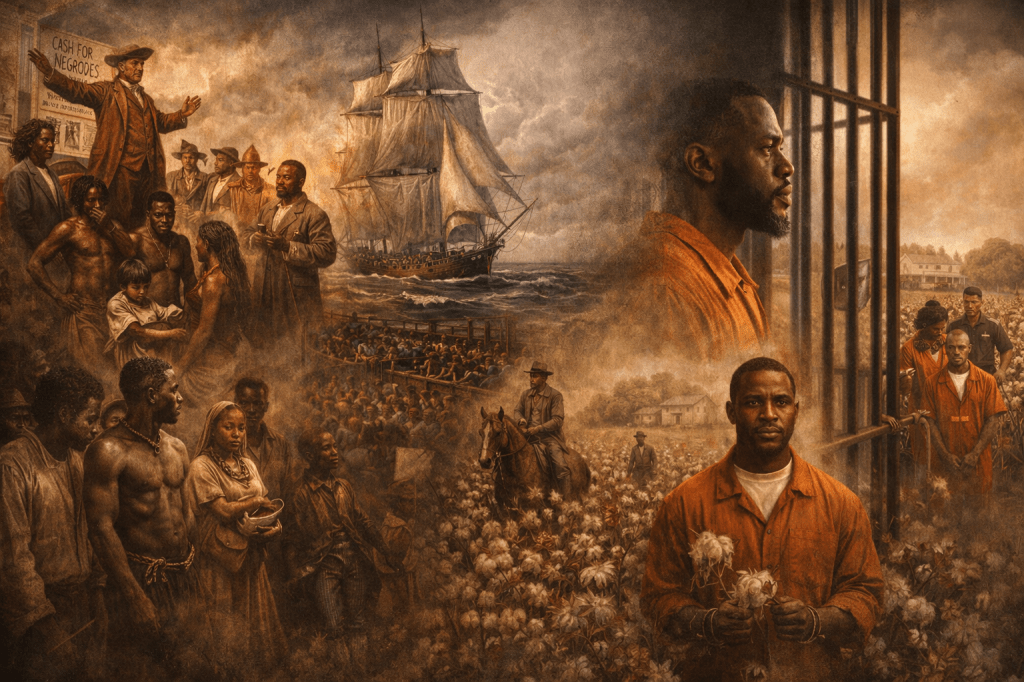
The history of the transatlantic slave trade is one of the most defining and devastating chapters in Black history, shaping the modern world through violence, exploitation, and racial hierarchy. It represents not merely a period of forced labor, but the systematic dehumanization of African peoples and the construction of a global economy built on Black suffering. Slavery was not accidental or natural; it was a deliberate system engineered for profit, power, and domination.
The slave trade began in the late 15th century with European expansion into Africa and the Americas. Portuguese and Spanish traders were among the first to establish routes, followed by the British, French, Dutch, and later Americans. Africa became a central source of labor for European colonies in the so-called “New World,” especially in plantations producing sugar, cotton, tobacco, and coffee.
The primary reason behind the slave trade was economic. European empires needed a massive labor force to exploit land stolen from Indigenous peoples. Africans were targeted because they were already skilled agricultural workers, could survive tropical climates, and were geographically accessible through coastal trading ports. Race was later used to morally justify what was, at its core, an economic crime.
African people were captured through warfare, raids, kidnappings, and betrayal by local intermediaries pressured or coerced into participating. Millions were marched to coastal forts, imprisoned in dungeons, and branded as property. Families were torn apart permanently, with no regard for kinship, language, or humanity.
The Middle Passage was one of the most horrific experiences in human history. Enslaved Africans were packed into ships like cargo, chained, starved, raped, beaten, and thrown overboard. Many died from disease, suicide, or suffocation before ever reaching land. Those who survived arrived psychologically traumatized and physically broken.
Upon arrival in the Americas, Black people were sold at auction and legally reduced to chattel. They were stripped of names, cultures, religions, and identities. Enslaved Africans were treated not as human beings, but as livestock—bred, whipped, mutilated, and worked to death.
Slavery was enforced through extreme violence. Enslaved people were beaten, lynched, raped, and tortured for disobedience. Laws known as slave codes made it illegal for Black people to read, write, gather, or defend themselves. Resistance was punished with death.
Yet, despite unimaginable brutality, enslaved Africans resisted constantly. They escaped, revolted, preserved culture, practiced spiritual traditions, and passed down ancestral knowledge. Revolts such as the Haitian Revolution proved that enslaved people never accepted their condition as legitimate.
In the United States, slavery became the foundation of the national economy. Cotton was king, and enslaved labor made America one of the richest nations on earth. Banks, insurance companies, universities, and governments were directly funded by slave profits.
The Civil War (1861–1865) led to the formal abolition of slavery in the U.S. through the 13th Amendment. However, freedom was largely symbolic. Formerly enslaved people were released into poverty with no land, no resources, and no protection.
Immediately after slavery, Black Americans faced Black Codes, sharecropping, and convict leasing—systems that recreated slavery under new names. Prisons replaced plantations. Chain gangs replaced whips. Black labor remained controlled.
The Jim Crow era legalized racial segregation and terror. Lynchings, racial pogroms, and voter suppression were used to maintain white supremacy. Black people were excluded from housing, education, healthcare, and political power.
The Civil Rights Movement of the 1950s and 60s challenged legal segregation. Figures like Martin Luther King Jr., Malcolm X, and Fannie Lou Hamer fought for basic human rights. Laws changed, but systems did not.
Mass incarceration emerged as the new form of social control. The “War on Drugs” targeted Black communities, filling prisons with nonviolent offenders. Black men became statistically more likely to be incarcerated than to attend college.
Police violence replaced slave patrols. The same logic of control persisted: Black bodies were still viewed as dangerous, disposable, and criminal. Surveillance, brutality, and profiling became modern tools of oppression.
Economic inequality remains rooted in slavery. The racial wealth gap, housing discrimination, school segregation, and healthcare disparities all trace back to stolen labor and denied opportunity.
Globally, the legacy of slavery continues through neocolonialism, resource extraction, and economic dependency across Africa and the Caribbean. Western wealth still rests on historical exploitation.
Culturally, Black identity has been shaped by trauma and resilience. Music, religion, language, and art emerged as tools of survival. Black culture became both a source of global influence and commodification.
Psychologically, slavery created intergenerational trauma. Internalized racism, colorism, and identity fragmentation are modern expressions of historical violence. The mind became another site of colonization.
Legally, slavery was never repaired. There were no reparations, no land restitution, no national healing process. Former enslavers were compensated—former slaves were not.
From slavery to Jim Crow, from segregation to mass incarceration, the system changed in form but not in function. Black people remain disproportionately policed, imprisoned, impoverished, and surveilled.
History in Black reveals a painful truth: slavery did not end—it evolved. The chains became invisible, the plantations became prisons, and the auction blocks became algorithms. What changed were the laws. What did not change was the structure of power.
References
Alexander, M. (2012). The New Jim Crow: Mass incarceration in the age of colorblindness. The New Press.
Baptist, E. E. (2014). The half has never been told: Slavery and the making of American capitalism. Basic Books.
Berlin, I. (2003). Generations of captivity: A history of African-American slaves. Harvard University Press.
Du Bois, W. E. B. (1935). Black reconstruction in America. Free Press.
Equiano, O. (1789). The interesting narrative of the life of Olaudah Equiano. Author.
Equal Justice Initiative. (2017). Lynching in America: Confronting the legacy of racial terror. https://eji.org
Gates, H. L. (2014). The African Americans: Many rivers to cross. PBS.
Hochschild, A. (1998). King Leopold’s ghost. Houghton Mifflin.
Kendi, I. X. (2016). Stamped from the beginning: The definitive history of racist ideas in America. Nation Books.
UNESCO. (2010). The transatlantic slave trade database. https://www.slavevoyages.org
U.S. National Archives. (n.d.). 13th Amendment to the U.S. Constitution. https://www.archives.gov
Washington Post. (2020). Fatal Force: Police shootings database. https://www.washingtonpost.com/graphics/investigations/police-shootings-database/
Williams, E. (1944). Capitalism and slavery. University of North Carolina Press.
 THE BROWN GIRL DILEMMA