Category Archives: Beauty

Beauty, Bias, and the Brown Girl Battle. #thebrowngirldilemma

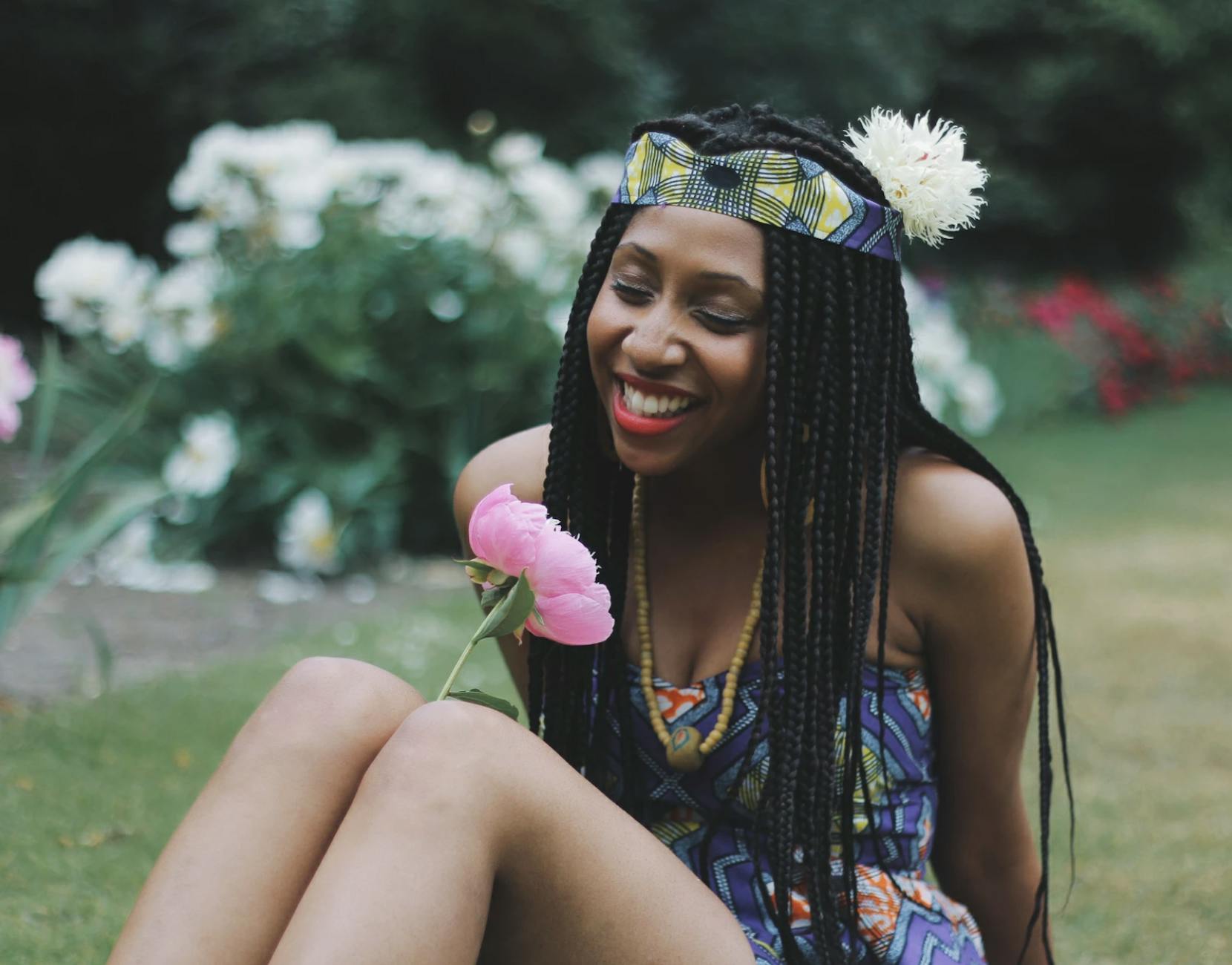
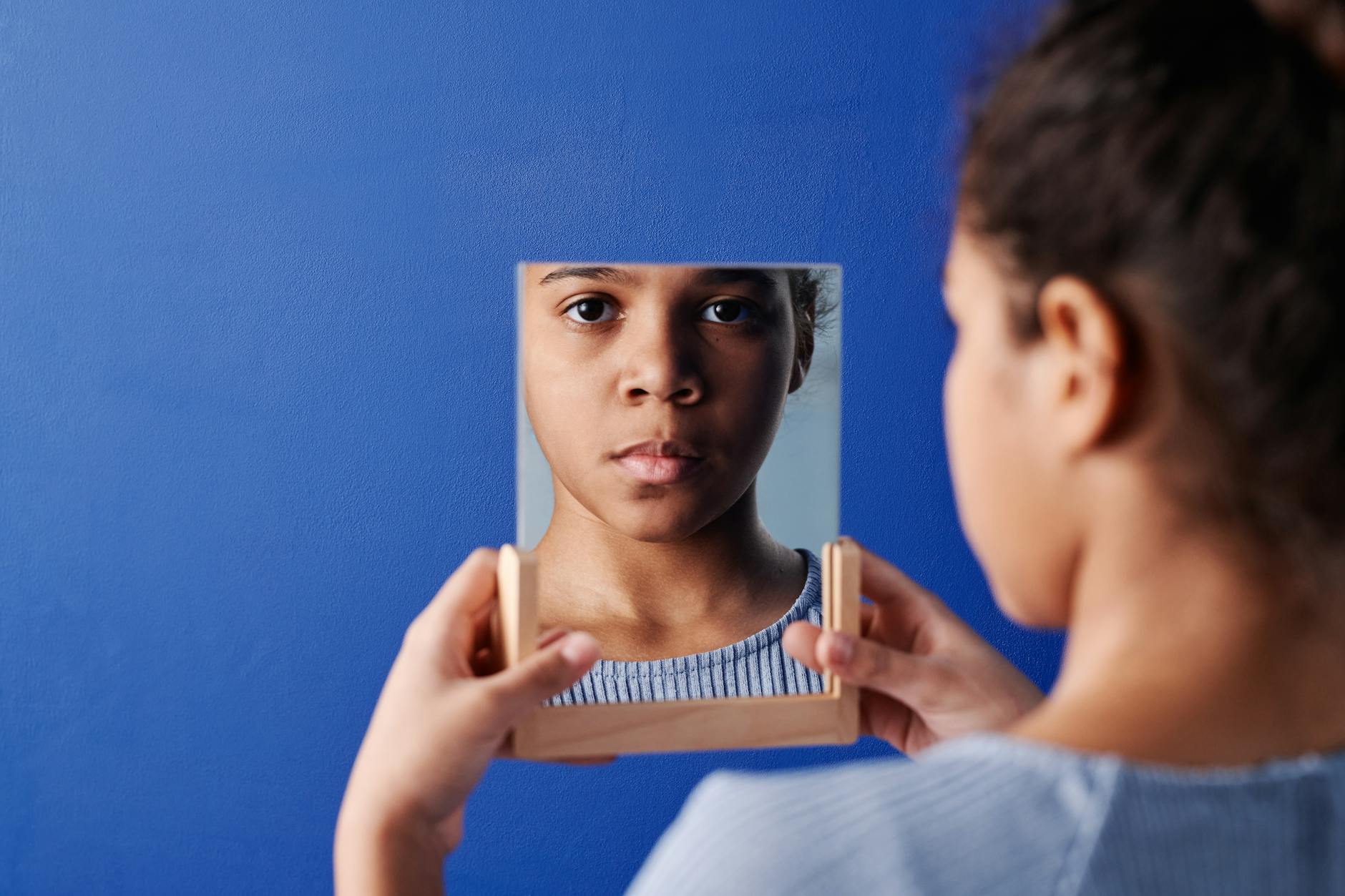
Photo by Norma Mortenson on Pexels.com

The battle for beauty is one of the most enduring struggles for brown-skinned women. It is not simply about cosmetics or fashion, but about history, identity, and survival in a society that has long privileged Eurocentric standards. The phrase “brown girl battle” encapsulates this conflict—where beauty and bias intersect, shaping not only how women are seen but also how they see themselves. To understand this battle is to understand the interplay of race, gender, and culture across centuries.

Beauty as a Social Construction

Beauty is not universal; it is constructed through cultural norms and political power. The idea that lighter skin, straighter hair, or thinner noses are inherently more attractive was not born naturally but manufactured through colonialism, slavery, and racial ideology (Painter, 2010). These constructions continue to influence who is deemed beautiful, desirable, and worthy of opportunities. For brown girls, beauty is not simply about preference but about systems of validation and exclusion.

The Colonial Legacy of Bias

The roots of this bias reach into the colonial era, when European conquerors imposed hierarchies that equated whiteness with superiority and Blackness with degradation. Colonized peoples were taught to despise their own features and strive toward European ideals. The scars of this indoctrination remain visible in societies where light skin continues to be prized in marriage markets, media, and labor economies. The brown girl battle is thus not a personal insecurity but a historical inheritance.

Slavery and the Politics of Shade

During slavery in the Americas, skin tone often determined one’s labor and treatment. Lighter-skinned enslaved women, often the result of sexual violence, were more likely to be placed in domestic roles, while darker-skinned women were forced into backbreaking fieldwork (Hunter, 2007). These practices entrenched colorism within communities of African descent, reinforcing the association of lighter skin with privilege. This historical stratification still shapes perceptions of beauty today.

Colorism Within Communities

One of the most painful aspects of the brown girl battle is that it exists not only between races but within racial groups. Families, schools, and social spaces often reinforce the preference for lighter skin, creating divisions among women who share the same heritage. This intra-community bias can be more wounding than external prejudice, as it corrodes solidarity and deepens insecurities.

Media Representation and Erasure

The media has long been complicit in the brown girl battle. For decades, television and film rarely showcased brown-skinned women as romantic leads or beauty icons. Instead, roles often relegated them to the margins—maids, aggressors, or comic relief. When women of color were celebrated for their beauty, they were frequently of lighter complexion or racially ambiguous. This “brown girl gap” in representation reinforced the bias that brownness was less desirable.

The Rare Visibility of Brown Beauty

When figures like Viola Davis, Lupita Nyong’o, and Gabrielle Union gained visibility, they disrupted these narratives. Lupita’s 2014 Oscar win, paired with her grace and elegance, represented a cultural breakthrough. She openly acknowledged the pain of growing up unseen and the healing power of representation for younger girls who looked like her. Their visibility did not erase the bias, but it began to shift the cultural imagination of beauty.

The Psychological Toll of Bias

Psychological research has shown that repeated exposure to biased standards of beauty can harm self-esteem, body image, and mental health (Thompson, 1996). For brown women, the battle is internal as much as external. The mirror becomes a contested space, reflecting not only their features but also the societal rejection attached to those features. Many grow up questioning their worth, wondering if they will ever be deemed beautiful without modification.

Hair as a Battleground

Hair has become one of the most politicized aspects of the brown girl battle. Eurocentric norms often pressure women to straighten or chemically alter their natural hair to be seen as professional or attractive. Natural hair movements resist this bias, affirming that curls, kinks, and coils are not defects but crowns. Yet, the need for legislation such as the CROWN Act in the United States shows that the policing of Black hair remains a structural problem.

Features Under Scrutiny

Beyond hair and skin, facial features are often judged against Eurocentric standards. Broader noses, fuller lips, and darker eyes were historically devalued, even as cosmetic industries later profited from imitating these same features. The irony of brown women being shamed for their natural features while those features are celebrated when surgically acquired by white women reflects the depth of bias in beauty culture.

Faith as Liberation from Bias

Spiritual traditions provide a counter-narrative to beauty bias. The Bible affirms the worth of women regardless of skin tone or appearance. Song of Solomon 1:5 proclaims, “I am black, but comely” (KJV), boldly affirming beauty in blackness. 1 Peter 3:3–4 reminds women that true beauty lies not in adornment but in “the hidden man of the heart.” Faith, therefore, provides brown women with a spiritual foundation to resist external lies and embrace divine affirmation.

Ancestral Pride and Heritage

For centuries, African societies celebrated brown and dark skin as symbols of strength, wisdom, and fertility. Sculptures, rituals, and traditions affirmed melanin-rich bodies as divine gifts. Reclaiming this ancestral pride allows modern brown women to combat internalized inferiority. By embracing the beauty once honored by their ancestors, they resist colonial erasure and affirm their sacred heritage.

Intersections of Gender and Race

The brown girl battle is intensified by the intersection of gender and race. While all women face pressures from beauty standards, brown women contend with racialized expectations layered on top of gender roles. They are often expected to embody strength without softness, competence without femininity, and beauty without visibility. These contradictions make their battle uniquely complex.

Global Dimensions of the Battle

Around the world, brown women confront the same biases in different forms. In India, the skin-lightening industry thrives on the message that lighter is better. In the Caribbean and Latin America, color hierarchies determine social mobility. In Africa itself, colonial legacies persist in beauty marketing and media representation. The brown girl battle is thus not confined to one geography but is global in scope.

Social Media and Reclamation

Social media has become both a battlefield and a tool of liberation. On one hand, filters and algorithms often reinforce Eurocentric beauty ideals. On the other, movements like #BlackGirlMagic and #MelaninPoppin create digital spaces where brown women affirm their beauty on their own terms. Online, they build communities that counter mainstream bias and celebrate diversity of shade, hair, and features.

Representation as Revolution

Representation is not cosmetic; it is political. When brown women are centered in media, politics, and fashion, it challenges centuries of bias. Michelle Obama’s visibility as First Lady, for instance, offered an unprecedented redefinition of elegance and grace in brown skin. Each act of representation is a strike against erasure, proving that beauty cannot be monopolized by one standard.

Intergenerational Cycles of Bias

The battle is also fought across generations. Mothers who were told they were “too dark” may unintentionally pass insecurities to their daughters. Breaking these cycles requires intentional affirmation, teaching brown girls to see themselves as beautiful and worthy from a young age. This intergenerational healing is vital to dismantling the deep roots of bias.

Collective Resistance and Healing

Healing requires more than individual self-love; it requires collective resistance. Communities must challenge colorism, expand representations, and dismantle systems that perpetuate inequality. Schools, media, and workplaces must normalize beauty in every shade. Collective affirmation ensures that no girl grows up questioning her worth because of her skin.

Beyond Beauty: Full Humanity

Ultimately, the brown girl battle is not only about being recognized as beautiful. It is about being seen as fully human. Beauty bias is a symptom of deeper racial inequality. When society affirms the beauty of brown women, it is also affirming their dignity, intelligence, and value. The battle for beauty is therefore inseparable from the broader struggle for justice.

Conclusion: Winning the Battle

The battle is ongoing, but it is not unwinnable. Brown women continue to resist bias through faith, heritage, representation, and community. By naming and confronting the structures that create the bias, they reclaim power over the narrative of beauty. To declare that brown is beautiful is not vanity—it is an act of survival, defiance, and liberation. The brown girl battle, though forged in oppression, is ultimately a story of victory, where beauty becomes not just reflection but revolution.


References

  • Hunter, M. (2007). The persistent problem of colorism: Skin tone, status, and inequality. Sociology Compass, 1(1), 237–254.
  • Monk, E. P. (2014). Skin tone stratification among Black Americans, 2001–2003. Social Forces, 92(4), 1313–1337.
  • Painter, N. I. (2010). The history of White people. W.W. Norton & Company.
  • Thompson, C. (1996). Black women, beauty, and hair as a matter of being. Women’s Studies, 25(6), 667–678.
  • The Holy Bible, King James Version.
The Burden of Beauty: Brown Skin in a Colorist World. #thebrowngirldilemma

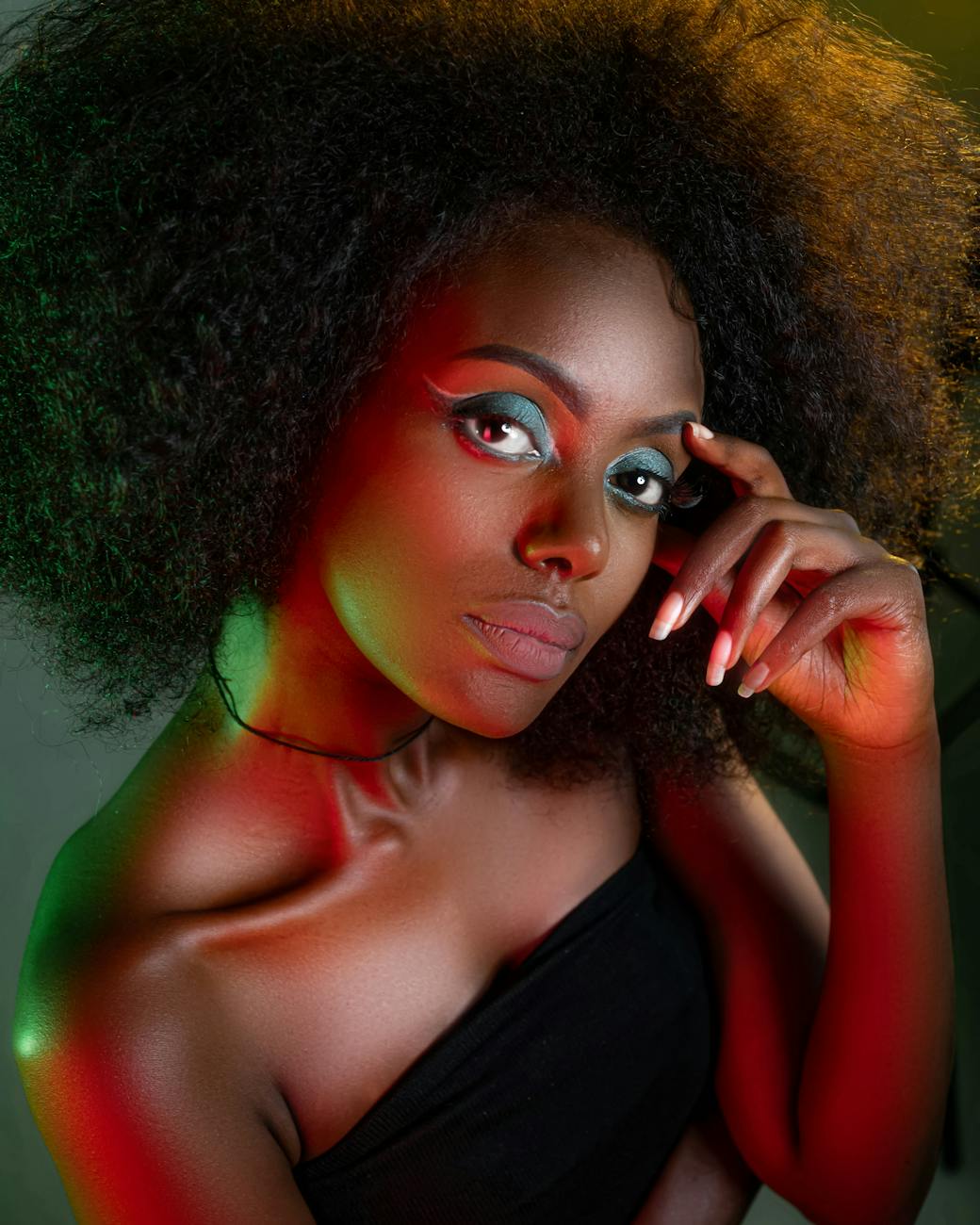
Photo by EZEKIXL AKINNEWU on Pexels.com

Beauty has always been both a blessing and a burden, especially for brown-skinned women navigating societies structured by colorism and white supremacy. The burden of beauty for the brown girl lies not only in external perceptions of her skin but also in the internalized struggles she must confront in affirming her own worth. In a world where lighter skin is often equated with superiority, desirability, and privilege, brown skin becomes a site of both fascination and rejection—desired for its exotic appeal yet devalued in the hierarchy of social status.

Historically, this burden is rooted in colonialism and slavery, where skin tone was weaponized as a measure of proximity to whiteness. Lighter-skinned women were often afforded marginal privileges, while darker-skinned women were relegated to harsher labor and harsher stereotypes (Hunter, 2007). This historical legacy continues in modern media, where Eurocentric beauty standards dominate, casting brown women as either hypersexualized or invisible. Such distortions create psychological weight, forcing many brown women to wrestle with feelings of inadequacy, envy, or invisibility.

Yet, paradoxically, the brown girl’s beauty is undeniable. Her skin is rich in melanin, biologically designed to protect and preserve, defying aging in a way the world calls “Black don’t crack.” Her hair grows in crowns of coiled resilience, testifying to strength and uniqueness. Still, the blessing of this natural beauty becomes a burden when society simultaneously covets and condemns it. For example, fashion and beauty industries often imitate brown features—full lips, curves, tanned skin—while marginalizing the very women who embody them naturally (Tate, 2016).

From a theological perspective, this burden of beauty is not merely social but spiritual. Scripture reminds us that beauty is not defined by outward appearance but by the inward spirit: “Whose adorning let it not be that outward adorning of plaiting the hair, and of wearing of gold… But let it be the hidden man of the heart, in that which is not corruptible, even the ornament of a meek and quiet spirit” (1 Peter 3:3–4, KJV). The brown girl’s true beauty rests not in meeting a colonial standard but in embracing her God-given design. Her worth is eternal, sealed by divine purpose, and not diminished by earthly bias.

Psychologically, carrying this burden often leads to both trauma and transformation. Studies on colorism reveal that women of darker complexions face greater discrimination in employment, relationships, and media representation (Keith & Herring, 1991). Yet, those who reclaim their identities often experience heightened resilience and self-definition. The process of unlearning colorist ideologies is itself an act of resistance—a reprogramming of the mind to embrace authenticity over assimilation.

Culturally, movements such as #MelaninMagic, #BlackGirlMagic, and natural hair revolutions signify collective rejection of imposed beauty hierarchies. They are testimonies that brown girls are no longer passive recipients of definition but active authors of their beauty narrative. Representation of dark-skinned actresses like Viola Davis, Danai Gurira, and Lupita Nyong’o has further chipped away at barriers, providing mirrors for young girls who previously saw none.

The burden of beauty, therefore, becomes an opportunity for liberation. Brown skin is not a curse but a crown; its richness tells the story of survival, endurance, and divine creativity. The true challenge lies not in the brown girl’s skin but in the world’s distorted lens. To confront colorism is to confront an entire system that profits from insecurity. When brown girls embrace their reflection, they transform the burden of beauty into a banner of pride, healing not only themselves but generations to come.

The brown girl dilemma, in this context, is not about being beautiful—it is about surviving the weight of being beautiful in a world that struggles to accept her as she is. Her power rests in remembering that her worth predates colonial hierarchies and transcends human judgment. Her beauty is eternal, rooted in divine creation, and no longer a burden when she learns to see it through God’s eyes.


References

  • Hunter, M. (2007). The Persistent Problem of Colorism: Skin Tone, Status, and Inequality. Sociology Compass, 1(1), 237–254.
  • Keith, V. M., & Herring, C. (1991). Skin tone and stratification in the Black community. American Journal of Sociology, 97(3), 760–778.
  • Tate, S. (2016). Skin Bleaching in Black and Brown Communities: Connected to Colorism and Colonialism. Palgrave Macmillan.
  • The Holy Bible, King James Version.
Plastic Surgery: The Artifical Beauty Standard

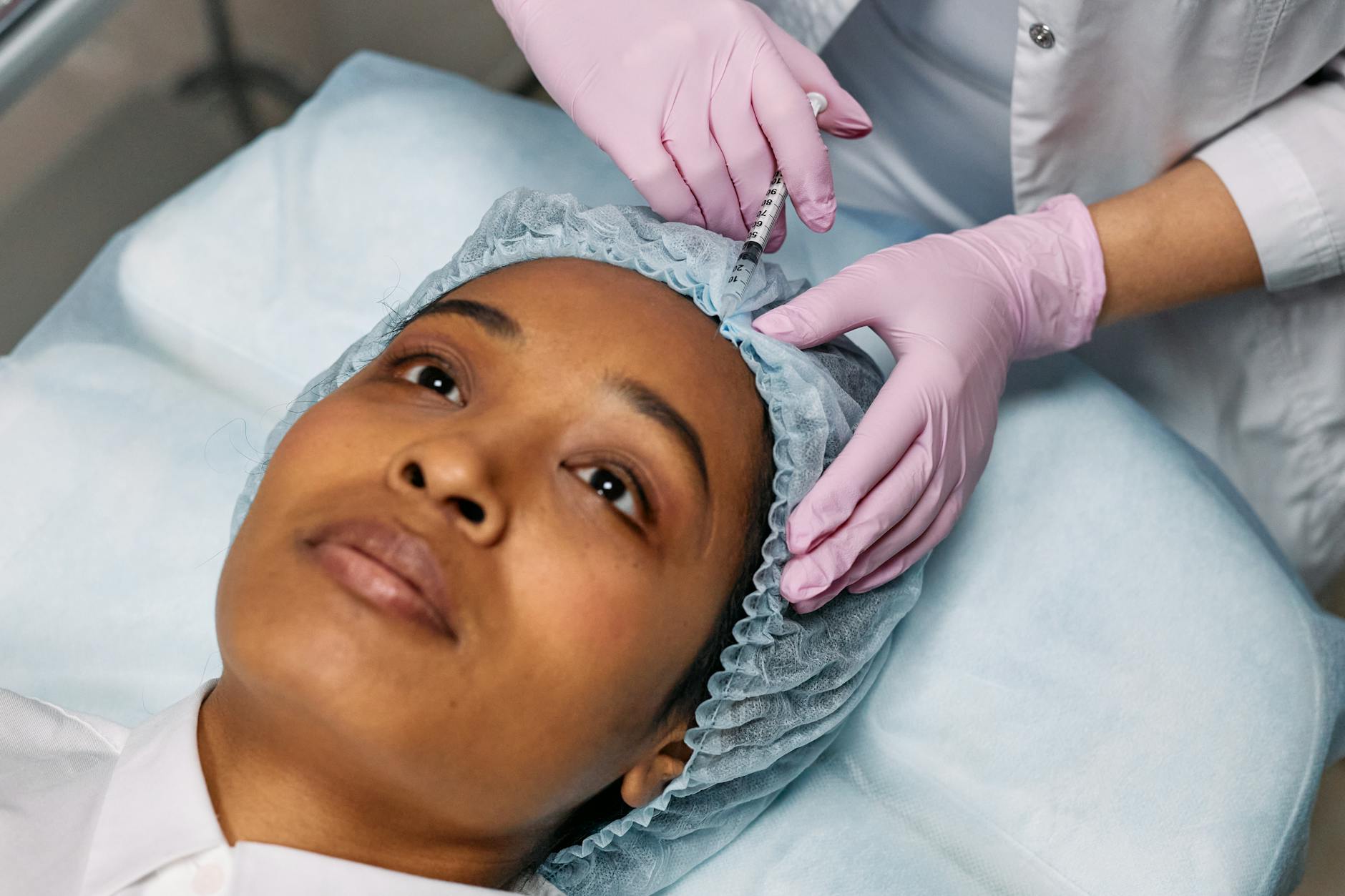
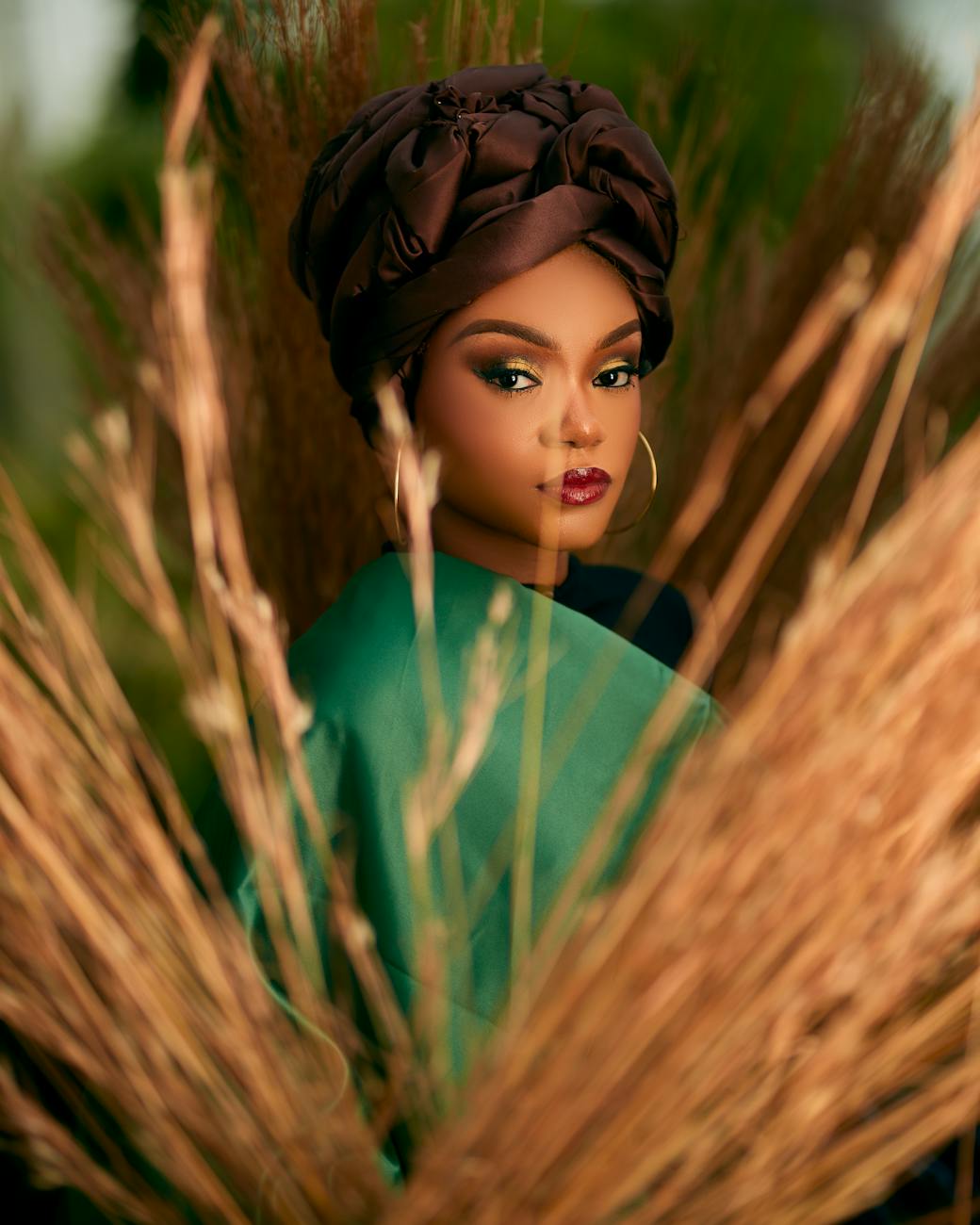
Photo by cottonbro studio on Pexels.com

The pursuit of beauty has existed for centuries, but in modern society, it has taken on new dimensions with the widespread use of plastic surgery. Increasingly, men and women are willing to undergo painful, expensive, and sometimes dangerous procedures to alter their natural appearance. This fixation on artificial beauty reflects deeper issues of self-esteem, cultural pressure, and misplaced value on outward appearance rather than inner character. The Bible warns against such vanity, urging believers to focus on the “hidden man of the heart” (1 Peter 3:3 -4, KJV), where true beauty lies.

The Psychology of Plastic Surgery

From a psychological standpoint, many people who seek plastic surgery struggle with body image dissatisfaction, social comparison, and the pressures of perfectionism. Studies have linked high usage of cosmetic surgery to body dysmorphic disorder (BDD)—a condition where individuals obsess over perceived flaws in their appearance (Sarwer et al., 2007). Social media platforms further intensify this by promoting “filter culture” and unrealistic beauty ideals, leading many to feel inadequate in their natural state. While some individuals pursue cosmetic enhancements for reconstructive purposes after accidents or illness, the majority seek it for vanity-driven reasons tied to self-worth and societal approval.

Popular Procedures and Cultural Influence

The most popular plastic surgery procedures include rhinoplasty (nose reshaping), liposuction, breast augmentation, buttock enhancement (such as the Brazilian Butt Lift), eyelid surgery, and facelifts. In non-surgical categories, Botox and dermal fillers dominate. Celebrities have both normalized and accelerated these trends. Figures such as the Kardashians are often cited by plastic surgeons as the most requested “look” (Devgan, 2021). Other celebrities like Michael Jackson, Lil’ Kim, and Jocelyn Wildenstein became famous for their extensive facial surgeries. Surgeons report that patients often bring photos of celebrities or even AI-generated images of themselves to consultations, asking to be transformed into “idealized” versions of beauty.

Most Popular Plastic Surgery Procedures

According to the 2024 ASPS (American Society of Plastic Surgeons) report:

These trends reflect both enduring body contouring demands and the growing popularity of quick, minimally invasive procedures.


2. Which Celebrity Faces Are Most Requested?

Plastic surgeons report strong demand to emulate the appearance of celebrities, particularly members of the Kardashian-Jenner family, renowned for contoured bodies, full lips, and balanced facial features. However, now, many clients bring filtered selfies, seeking to replicate surgically what filters achieve—a phenomenon referred to as “Snapchat Dysmorphia.” Wikipedia


3. Psychology: Why Do People Get Plastic Surgery?

  • Self-Image & Identity: Many seek boosted confidence or wish to look refreshed rather than drastically altered. Surgeons like Dr. Banek integrate psychological evaluations to understand client motivations. The Times
  • Social Media Influence: The rise of social media and filter culture increases facial and body dissatisfaction. A study from Boston University found a jump in people considering cosmetic surgery—from 64% to 86%—and increased surgeon consultations. New York Post
  • Psychological Traits: Research shows that high levels of perfectionism and external appearance pressure predict increased interest in cosmetic procedures. Allure

Summary Table

TopicInsight
Top Procedures (2024)Liposuction, breast augmentation, abdominoplasty, breast lift, eyelid surgery
Celebrity TrendsKardashian-inspired looks and “filtered selfie” aesthetic requests
Why People Opt InTo improve confidence, influenced by social media, driven by body image issues

The Cost of Artificial Beauty

Plastic surgery is also a multi-billion-dollar industry. In the United States, procedures can range from $5,000 to $15,000 for breast or body operations, and $7,500 or more for facial surgeries (American Society of Plastic Surgeons, 2022). Non-surgical procedures, though less invasive, still cost hundreds to thousands annually due to repeat maintenance. Beyond financial cost, patients often face physical risks such as infection, scarring, nerve damage, or even death from procedures like the Brazilian Butt Lift, which has one of the highest mortality rates among elective surgeries.

Biblical Teachings on Beauty

The Bible warns against excessive focus on outward appearance. Proverbs 31:30 (KJV) reminds us, “Favour is deceitful, and beauty is vain: but a woman that feareth the Lord, she shall be praised.” Similarly, 1 Timothy 2:9 encourages modesty and inner godliness over outward adornment. God created each person “fearfully and wonderfully made” (Psalm 139:14, KJV), and altering His vanity design can reflect ingratitude and misplaced priorities. While the Bible does not specifically mention plastic surgery, it consistently elevates inner character, spiritual fruit, and holiness above physical alterations.

Why People Do It

The reasons people undergo plastic surgery are deeply tied to insecurity, cultural standards, and societal glorification of celebrity beauty. Many believe it will bring happiness, confidence, or romantic fulfillment, but psychological studies reveal that satisfaction often fades, leading to repeated procedures (Honigman et al., 2004). In essence, it becomes a cycle of chasing perfection that never delivers lasting peace. The Bible teaches that true contentment cannot be bought or surgically implanted but is rooted in faith, identity in God, and the love of Christ (Philippians 4:11).

Conclusion

Plastic surgery reflects a culture that idolizes artificial beauty and neglects the spiritual truth that worth is found in God. While reconstructive procedures have legitimate purposes, the obsession with vanity-driven alterations reveals a deeper spiritual and psychological struggle. For believers, the call is clear: resist the false promises of worldly beauty standards and embrace the eternal beauty of a heart aligned with God.


References

  • American Society of Plastic Surgeons. (2022). Plastic Surgery Statistics Report. Retrieved from https://www.plasticsurgery.org
  • Devgan, L. (2021). The Kardashian Effect: How Celebrity Culture Influences Plastic Surgery. Journal of Cosmetic Surgery, 38(5), 112–120.
  • Honigman, R., Phillips, K. A., & Castle, D. J. (2004). A review of psychosocial outcomes for patients seeking cosmetic surgery. Plastic and Reconstructive Surgery, 113(4), 1229–1237.
  • Sarwer, D. B., Cash, T. F., Magee, L., Williams, E. F., Thompson, J. K., Roehrig, M., … & Anderson, D. A. (2007). Female college students and cosmetic surgery: An investigation of experiences, attitudes, and body image. Plastic and Reconstructive Surgery, 120(3), 845–856.
  • The Holy Bible, King James Version.
What makes a Woman truly beautiful?

Photo by cottonbro studio on Pexels.com

Beauty is one of the most debated concepts in human history, yet its truest form transcends mere physical appearance. While society often emphasizes youth, skin tone, or body shape, biblical scripture and psychology reveal that true beauty lies in a woman’s inner essence, her spiritual alignment, and her impact on others.


Beauty Rooted in Character

The Bible consistently reminds us that outward attractiveness is fleeting, but inner character endures. Proverbs 31:30 (KJV) declares: “Favour is deceitful, and beauty is vain: but a woman that feareth the Lord, she shall be praised.” Here, beauty is redefined as reverence for God, moral integrity, and righteous living. A woman’s character — her honesty, patience, and humility — shines brighter than any adornment. Psychologically, researchers confirm that individuals are perceived as more attractive when they display warmth and kindness (Kniffin & Wilson, 2004).


Confidence and Self-Worth

True beauty cannot exist without confidence. A woman who understands her worth is not easily swayed by Eurocentric beauty ideals, media filters, or societal comparisons. Confidence radiates through posture, voice, and presence, shaping how others perceive her. According to Cash and Smolak (2011), self-esteem and body image significantly influence perceptions of beauty. When a woman accepts and loves her natural skin tone, hair texture, and unique features, she communicates a power that no external validation can diminish.


Compassion as a Radiant Force

Compassion is another dimension of beauty that goes beyond aesthetics. A woman’s ability to nurture, empathize, and uplift others embodies inner radiance. 1 Peter 3:3–4 (KJV) emphasizes this, stating: “Whose adorning let it not be that outward adorning of plaiting the hair, and of wearing of gold… but let it be the hidden man of the heart, in that which is not corruptible, even the ornament of a meek and quiet spirit, which is in the sight of God of great price.” Meekness and compassion beautify a woman’s spirit, making her presence restorative.


Wisdom and Purpose as Elegance

Wisdom transforms beauty into legacy. A woman of understanding and purpose carries a timeless elegance that surpasses physical allure. Ecclesiastes 3:11 reminds us that God “hath made every thing beautiful in his time.” When women walk in purpose — whether in leadership, motherhood, scholarship, or service — their beauty expands beyond themselves and impacts generations. Psychologically, meaning and purpose increase not only personal well-being but also how others perceive attractiveness (King et al., 2006).


The Harmony of Body, Mind, and Spirit

Lastly, true beauty emerges from balance. A woman who honors her body as the temple of God (1 Corinthians 6:19), renews her mind through positive thought (Romans 12:2), and nurtures her spirit through prayer reflects a glow that cannot be replicated by cosmetics. This harmony creates wholeness, and wholeness itself is beauty.


Conclusion

A truly beautiful woman is not defined solely by her physical features but by her depth of spirit, confidence, compassion, wisdom, and divine alignment. While outward beauty may draw attention, it is her inner radiance that captures hearts and endures through time. In essence, beauty is not just what she looks like, but what she lives like.


📖 References

  • Cash, T. F., & Smolak, L. (2011). Body Image: A Handbook of Science, Practice, and Prevention. Guilford Press.
  • Kniffin, K. M., & Wilson, D. S. (2004). The effect of nonphysical traits on the perception of physical attractiveness. Evolution and Human Behavior, 25(2), 88–101.
  • King, L. A., Hicks, J. A., Krull, J. L., & Gaiso, A. K. (2006). Positive affect and the experience of meaning in life. Journal of Personality and Social Psychology, 90(1), 179–196.
  • The Holy Bible, King James Version.
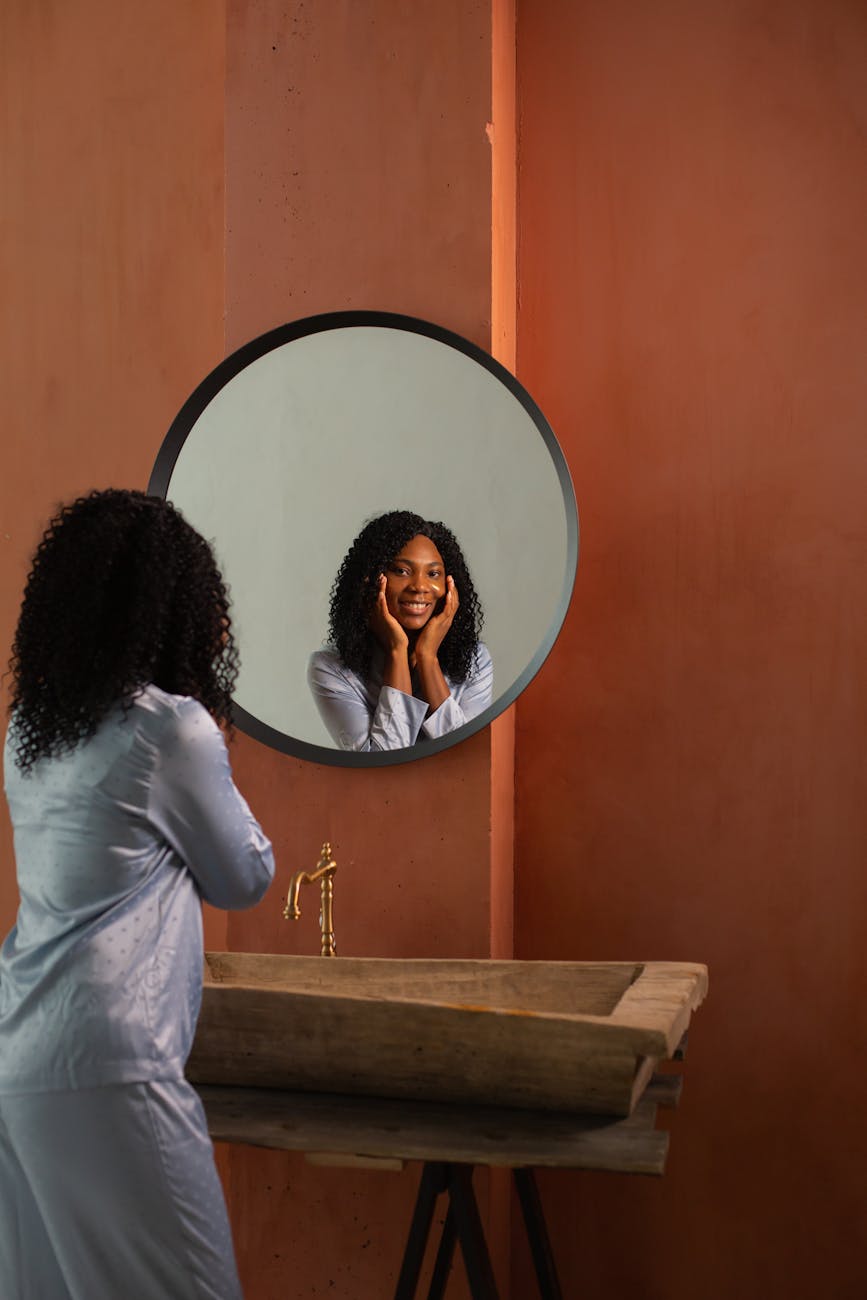
Slavery’s Legacy on Modern Beauty Standards.

Photo by Abenezer Shewaga on Pexels.com

Beauty is never neutral. It is tied to power, culture, and history. For people of African descent, the idea of what is considered beautiful has been shaped profoundly by the transatlantic slave trade and its enduring consequences. The standards of beauty that dominate in Western culture today continue to reflect the racial hierarchies constructed during slavery. These standards privilege Eurocentric features—light skin, straight hair, narrow noses—while devaluing the natural attributes of African people. To understand modern beauty culture, one must trace its roots back to slavery and its systems of oppression.

Beauty, often perceived as natural or universal, is in reality a social construct deeply shaped by history, culture, and systems of power. For people of African descent, modern beauty standards are inseparably tied to the legacy of slavery and colonialism. The racial hierarchies established during the transatlantic slave trade not only dehumanized Africans but also codified Eurocentric ideals of attractiveness. These legacies persist in the privileging of lighter skin, straighter hair, and Eurocentric facial features while stigmatizing natural Black aesthetics. Understanding slavery’s role in shaping these standards reveals how oppression continues to infiltrate the psychology of self-image and the global beauty industry.

Eurocentric Beauty and Slavery’s Foundations

Slavery created a racialized hierarchy of features. Dark skin, broad noses, and tightly coiled hair were falsely associated with ugliness, savagery, and lack of civilization, while white features were elevated as the pinnacle of beauty and refinement (Fanon, 2008). This was not simply aesthetic preference; it was a political weapon used to justify enslavement and subjugation. By dehumanizing African features, slaveholders reinforced racial superiority while stripping enslaved people of pride in their appearance.

Light Skin Privilege Under Slavery

Within the plantation system, lighter-skinned enslaved people often received preferential treatment, working inside homes rather than in the fields. This was largely due to their proximity to whiteness, often the result of sexual violence committed by slaveholders against enslaved women (Hunter, 2005). This color hierarchy planted deep divisions that still affect Black communities today, with lighter skin frequently associated with higher status, desirability, and opportunity.

Colorism as Slavery’s Heir

The preference for lighter skin, known as colorism, is one of slavery’s most enduring legacies. Research shows that lighter-skinned African Americans are more likely to be perceived as attractive, more employable, and more educated compared to darker-skinned peers (Hill, 2002). These biases echo the privileges extended to mixed-race enslaved people, showing how slavery’s beauty hierarchy remains embedded in society’s subconscious.

The Psychological Wounds of Beauty Hierarchies

Psychologists such as Frantz Fanon (2008) described how colonized and enslaved people internalized white superiority, leading to a desire to approximate whiteness. This internalized racism manifests in practices like skin bleaching, hair straightening, and altering facial features through surgery. The pain of these practices is not in individual choice alone, but in the fact that centuries of conditioning taught Black people to see themselves as less beautiful unless they conformed to Eurocentric ideals.

Women, Hypersexualization, and Beauty

For Black women, the legacy of slavery extends into gendered stereotypes. Enslaved women were simultaneously hypersexualized and devalued. They were depicted as exotic, animalistic, and lustful, justifying both sexual exploitation and the denial of their femininity (Collins, 2000). These stereotypes live on in media portrayals of Black women as either hypersexual “video vixens” or undesirable compared to white counterparts. The slavery-era denial of Black femininity still lingers in modern representations.

Black Men and Bodily Commodification

Black men, too, inherited distorted beauty standards. During slavery, their bodies were commodified for labor and reproduction, leading to the creation of stereotypes associating Black masculinity with strength, hyper-athleticism, and physical dominance (Yancy, 2008). While some of these associations are admired in modern sports and media, they also reduce Black men to bodies rather than whole persons, a dehumanization that echoes slavery’s exploitation.

Naomi Campbell and Breaking Barriers

The fashion world historically resisted darker-skinned models, favoring light-skinned or racially ambiguous women. Naomi Campbell, one of the first Black supermodels to achieve international recognition, broke barriers by forcing the industry to confront its Eurocentric preferences. Yet even she has spoken about being excluded from magazine covers and fashion campaigns because of her skin tone. Her success represents both resistance and the persistence of slavery’s beauty legacy in high fashion.

Alek Wek and the Reclamation of African Aesthetics

Alek Wek, a South Sudanese model, transformed the global perception of beauty by challenging Eurocentric norms. With her dark skin and distinct African features, she faced initial backlash, but her rise to prominence forced the fashion industry to confront its biases. Lupita Nyong’o has publicly acknowledged that seeing Alek Wek made her believe that her own dark skin could be beautiful. Wek’s career is a testament to reclaiming Black aesthetics denied during slavery.

Lupita Nyong’o and the Affirmation of Dark Skin

Lupita Nyong’o has become a symbol of unapologetic Black beauty. In her speeches, she has reflected on childhood experiences of praying for lighter skin because of the societal pressures she faced. Her visibility and accolades, including her Academy Award, symbolize a corrective to the centuries-long denigration of dark-skinned women. Yet her story also reveals the ongoing weight of slavery’s legacy, as generations of children have been taught to equate lighter skin with worth.

Beyoncé and the Complexity of Representation

Beyoncé, celebrated worldwide, embodies the complexities of modern Black beauty representation. While she embraces her identity as a Black woman, her lighter skin and long, often straightened hair align more closely with Eurocentric ideals. This duality sparks debate: does her image empower or reinforce old hierarchies? The discussion itself reveals the depth of slavery’s impact, where even empowerment is entangled with questions of proximity to whiteness.

Adut Akech and Global Black Beauty

Adut Akech, a South Sudanese-Australian model, represents a new wave of global Black beauty. With her natural hair and rich complexion, she challenges the lingering belief that Eurocentric features are required for international success. Her prominence on runways worldwide demonstrates progress, yet her experiences with racism in the industry reveal how the wounds of slavery remain.

Media and Capitalism’s Exploitation of Insecurities

Slavery’s legacy lives not only in representation but in commerce. The beauty industry profits billions from insecurities tied to Eurocentric standards. Skin-lightening products dominate markets in Africa, Asia, and the Caribbean, showing how globalized the colonial beauty hierarchy has become. Hair relaxers and cosmetic surgeries targeting nose shapes and lips similarly reflect capitalism’s exploitation of slavery’s psychological scars.

Resistance Through the Natural Hair Movement

The natural hair movement directly challenges slavery’s legacy by rejecting the idea that straight hair is more professional or beautiful. Laws such as the CROWN Act, which bans hair discrimination in workplaces and schools, reflect the fight for freedom to embrace Black aesthetics. This movement is not just about style but about reclaiming dignity denied during slavery.

Social Media as a Space of Liberation

Unlike traditional media, social platforms have allowed Black creators to redefine beauty standards for themselves. Movements such as #MelaninPoppin and #BlackGirlMagic affirm the beauty of dark skin and natural features. These grassroots affirmations of identity are acts of resistance against centuries of imposed inferiority, echoing the Civil Rights era’s declaration that “Black is Beautiful.”

Theological Reflections on Black Beauty

Scripture challenges slavery’s lies about beauty. Song of Solomon 1:5 (KJV) affirms: “I am black, but comely, O ye daughters of Jerusalem.” This verse rejects the notion that darkness diminishes beauty. Isaiah 61:3 reminds us that God grants “beauty for ashes,” showing that even the ashes of slavery’s dehumanization can give rise to dignity and self-affirmation.

Beauty, Liberation, and Self-Worth

Reclaiming beauty is more than cosmetic; it is spiritual and psychological liberation. Romans 12:2 (KJV) calls for transformation through renewed minds, not conformity to the world’s ideals. Liberation from Eurocentric beauty standards is part of a broader freedom struggle—asserting that Blackness itself is sacred and inherently beautiful.

The Continuing Struggle Against Slavery’s Shadow

Even as progress is made, slavery’s shadow lingers in subtle forms—casting lighter-skinned actresses more often, privileging Eurocentric features in media, and pressuring Black people to alter their appearance for acceptance. Recognizing these patterns is essential for dismantling the chains of slavery that persist invisibly in beauty culture.

Conclusion

Slavery’s legacy on modern beauty standards is undeniable. From the plantation to the fashion runway, from media screens to beauty aisles, Eurocentric ideals continue to haunt definitions of attractiveness. Yet resistance has been powerful—from Naomi Campbell and Alek Wek to Lupita Nyong’o, Beyoncé, and Adut Akech, Black beauty continues to rise as a force of liberation. The struggle for self-acceptance and dignity is not just aesthetic; it is a moral, cultural, and spiritual battle against slavery’s enduring legacy. In affirming that “Black is Beautiful,” we affirm life, freedom, and the sacred worth of all who bear the mark of melanin.


References

Collins, P. H. (2000). Black feminist thought: Knowledge, consciousness, and the politics of empowerment. Routledge.

Fanon, F. (2008). Black skin, white masks. Grove Press. (Original work published 1952)

Hill, M. E. (2002). Skin color and the perception of attractiveness among African Americans: Does gender make a difference? Social Psychology Quarterly, 65(1), 77–91.

Hunter, M. (2005). Race, gender, and the politics of skin tone. Routledge.

Yancy, G. (2008). Black bodies, white gazes: The continuing significance of race in America. Rowman & Littlefield.

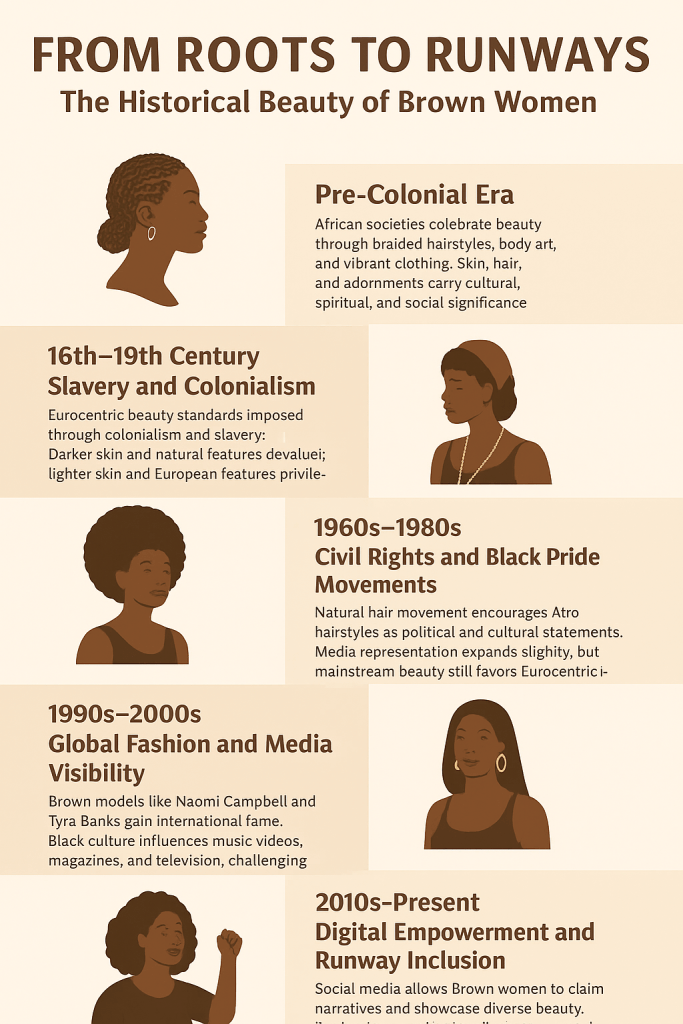
From Roots to Runways: The Historical Beauty of Brown Women

Photo by Al Ameen Saddiq on Pexels.com

The beauty of Brown women is deeply intertwined with culture, history, and resilience. From ancestral traditions to modern fashion runways, Brown women have navigated societies that often imposed Eurocentric standards while cultivating unique forms of self-expression, artistry, and elegance. Exploring this trajectory—from historical roots to contemporary visibility—reveals not only aesthetic contributions but also the resilience and empowerment embedded in the legacy of Brown women.

Ancestral Traditions and Cultural Significance

Throughout African, Caribbean, and Latin American societies, beauty has historically been expressed through hairstyles, skin care, adornments, and textiles. Braided and twisted hairstyles, body art, and vibrant clothing often carried social, spiritual, or cultural meaning, signaling status, heritage, or community affiliation (Byrd & Tharps, 2014). These traditions celebrated melanin-rich skin, facial features, and natural hair textures long before the imposition of colonial beauty standards. Beauty, in these contexts, was both personal and collective—a reflection of identity and heritage.

Colonialism, Slavery, and the Imposition of Eurocentric Standards

The transatlantic slave trade and colonial regimes brought systemic oppression that devalued darker skin and natural features. European ideals of beauty—fair skin, straight hair, and Eurocentric facial features—became markers of social privilege and desirability (Hunter, 2007). Despite these pressures, Brown women preserved cultural beauty practices, maintaining pride in their appearance and transmitting ancestral knowledge through generations. This resistance demonstrates that beauty has always been inseparable from resilience and identity affirmation.

African American Beauty Culture and the Harlem Renaissance

In the United States, the Harlem Renaissance (1920s–1930s) provided a platform for Black artistic expression, including beauty and fashion. Women like Josephine Baker, with her daring style and signature elegance, challenged mainstream perceptions while celebrating African aesthetics. Beauty salons became cultural hubs where women exchanged styling techniques, supported one another, and fostered community identity (Perry, 2009). These spaces cultivated confidence, creativity, and empowerment, demonstrating that beauty is not merely aesthetic but also sociocultural.

Modern Visibility and Runway Influence

In contemporary fashion, Brown women increasingly claim visibility and redefine industry standards. Models like Adut Akech, Duckie Thot, and Naomi Campbell have dominated international runways, demonstrating that melanin-rich beauty is not niche but universal. Designers are incorporating diverse features and complexions into campaigns, acknowledging the historical exclusion and striving toward inclusion. Social media further amplifies these voices, allowing Brown women to influence global perceptions directly.

Timeline: The Historical Beauty of Brown Women

Pre-Colonial Era

  • African societies celebrate beauty through braided hairstyles, body art, and vibrant clothing.
  • Skin, hair, and adornments carry cultural, spiritual, and social significance.

16th–19th Century: Slavery and Colonialism

  • Eurocentric beauty standards imposed through colonialism and slavery.
  • Darker skin and natural features devalued; lighter skin and European features privileged.
  • Brown women preserve cultural beauty practices covertly or in safe community spaces.

1920s–1930s: Harlem Renaissance

  • Black artistic expression flourishes; women like Josephine Baker challenge mainstream norms.
  • Beauty salons become cultural hubs for skill-sharing, empowerment, and community.

1960s–1980s: Civil Rights and Black Pride Movements

  • Natural hair movement encourages Afro hairstyles as political and cultural statements.
  • Media representation expands slightly, but mainstream beauty still favors Eurocentric ideals.

1990s–2000s: Global Fashion and Media Visibility

  • Brown models like Naomi Campbell and Tyra Banks gain international fame.
  • Black culture influences music videos, magazines, and television, challenging stereotypes.

2010s–Present: Digital Empowerment and Runway Inclusion

  • Social media allows Brown women to claim narratives and showcase diverse beauty.
  • Models like Adut Akech, Duckie Thot, and public figures like Lupita Nyong’o redefine global standards.
  • Colorism awareness movements (#MelaninMagic, #BrownSkinPoppin) increase representation and self-love advocacy.

Present & Future

  • Celebration of melanin-rich skin, natural hair, and diverse features continues to grow globally.
  • Beauty becomes a tool of empowerment, cultural pride, and resistance against systemic bias.

Media Representation and Colorism

While progress has been made, media representation continues to favor lighter-skinned women. Colorism—preference for lighter shades within communities of color—persists, reinforcing hierarchical beauty standards (Hunter, 2007). Visibility of darker-skinned models, actresses, and influencers challenges these norms, offering representation that affirms a broader spectrum of beauty. Public figures like Lupita Nyong’o and Tracee Ellis Ross exemplify this shift, inspiring younger generations to embrace their natural features proudly.

Beauty as Resistance and Empowerment

The historical beauty of Brown women reflects both aesthetic expression and resistance. Maintaining traditional hairstyles, advocating for natural skin care, and claiming space in fashion and media are acts of empowerment. Each choice affirms identity, challenges dominant beauty paradigms, and honors ancestral legacy. Brown women’s beauty has always been inseparable from cultural pride, resilience, and agency.

Conclusion

From roots to runways, the beauty of Brown women is a testament to heritage, resilience, and self-expression. Historical traditions, artistic contributions, and contemporary visibility reveal that beauty is not merely physical; it is cultural, social, and political. Celebrating this legacy affirms the value of melanin-rich skin, natural hair, and diverse features, ensuring that the beauty of Brown women continues to inspire confidence, empowerment, and cultural pride for generations to come.


References

  • Byrd, A. D., & Tharps, L. L. (2014). Hair story: Untangling the roots of Black hair in America. St. Martin’s Press.
  • Hunter, M. (2007). The persistent problem of colorism: Skin tone, status, and inequality. Sociology Compass, 1(1), 237–254.
  • Perry, I. (2009). Prophets of the hood: Politics and poetics in Hip Hop. Duke University Press.

“Black Don’t Crack”: The Science Behind Melanated Skin.

Photo by KATRIN BOLOVTSOVA on Pexels.com

The popular phrase “Black Don’t Crack” is more than just a cultural expression; it is a reflection of biological science, genetics, and lived experience. The phrase highlights how people of African descent, with higher levels of melanin, often appear younger than their chronological age. While the statement is rooted in cultural pride, dermatological research confirms that melanated skin is more resistant to the visible effects of aging due to its structural composition and protective properties.

Melanin, the pigment that determines skin color, is a powerful natural protector. Darker skin tones contain higher amounts of eumelanin, which shields the skin against ultraviolet (UV) radiation, reducing the likelihood of premature wrinkles, sunspots, and photoaging (Palmer & Oppenheimer, 2019). Studies have shown that darker skin tones have a natural sun protection factor (SPF) estimated between 13 and 15, compared to lighter skin which has an SPF of 3 or less (Taylor, 2002). This biological advantage helps delay visible signs of aging, keeping skin firm and radiant for longer periods.

In addition to UV protection, melanated skin has structural benefits. Research indicates that Black skin tends to have a denser dermis, with more compact collagen fibers and greater elasticity (Halder & Bridgeman-Shah, 1995). Collagen breakdown is one of the primary causes of wrinkles and sagging, yet in darker skin, this process occurs at a slower rate. Combined with natural oil production that maintains skin hydration, these factors contribute to the smooth and youthful appearance often seen in Black individuals.

Cultural narratives about beauty are reinforced by celebrities whose appearances defy time. Angela Bassett, at nearly 65, is celebrated for her glowing, youthful complexion, often appearing decades younger. Similarly, actors like Morris Chestnut and Halle Berry continue to embody ageless elegance, their skin reflecting both genetics and disciplined skincare routines. Pharrell Williams, often cited as a celebrity who appears almost untouched by time, demonstrates the profound impact of melanin’s protective qualities, paired with healthy lifestyle choices. Even supermodel Naomi Campbell, in her fifties, continues to maintain the same radiance and elasticity as she did at the height of her modeling career.

Psychologically, the phrase “Black Don’t Crack” also acts as an affirmation, countering centuries of Eurocentric beauty standards that often marginalized Black features. By celebrating the resilience and beauty of melanated skin, the phrase empowers communities to embrace their natural attributes while acknowledging the unique biological advantages they hold. It not only speaks to science but also to the cultural pride and resistance embedded in Black identity.

Yet, it is important to recognize that “Black Don’t Crack” is not a guarantee. Lifestyle choices, diet, hydration, stress management, and skincare practices all play a crucial role in preserving youthfulness. While melanin provides natural protection, it does not eliminate the risks of sun damage or skin cancer, making sunscreen and self-care important across all skin tones (Kundu & Patterson, 2013).

In conclusion, the phrase “Black Don’t Crack” embodies both cultural truth and scientific fact. Melanated skin, with its higher levels of melanin, stronger collagen structures, and natural oil balance, is biologically designed to age more gracefully. Celebrities such as Angela Bassett, Naomi Campbell, and Pharrell Williams exemplify the synergy between genetics and lifestyle in sustaining youthful appearances. What began as a cultural saying has now been validated by dermatological science: the richness of Black skin is both a gift of nature and a source of cultural pride.


References

  • Halder, R. M., & Bridgeman-Shah, S. (1995). Skin cancer in African Americans. Cancer, 75(S2), 667-673.
  • Kundu, R. V., & Patterson, S. (2013). Dermatologic conditions in skin of color: Part I. Special considerations for common skin disorders. American Family Physician, 87(12), 850–856.
  • Palmer, J. S., & Oppenheimer, S. B. (2019). The biology of melanin. Journal of Dermatological Science, 96(2), 75-83.
  • Taylor, S. C. (2002). Skin of color: Biology, structure, function, and implications for dermatologic disease. Journal of the American Academy of Dermatology, 46(2 Suppl Understanding), S41–S62.

Dark Skin, Light Skin: Understanding Shades of Brown.

Skin color is more than a biological trait; it is a social, cultural, and historical marker. Among people of African descent, the spectrum of brown skin encompasses a wide array of shades, each carrying unique significance in terms of identity, beauty, and social perception. The differences between dark skin and light skin are often perceived not only visually but also psychologically and socially, shaping how individuals are treated, how they see themselves, and how society values them. To understand shades of brown, one must consider genetics, history, psychology, and cultural representation.

Genetic and Biological Foundations

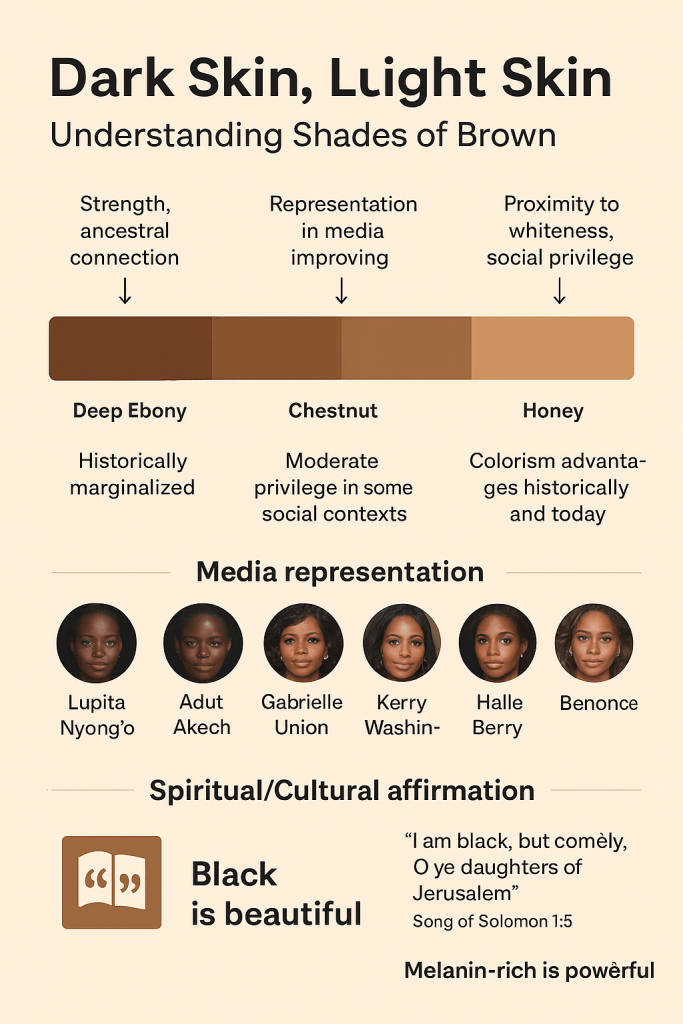
Human skin color is determined primarily by melanin, the pigment produced by melanocytes. Darker skin contains higher levels of eumelanin, which provides more protection against ultraviolet (UV) radiation. Lighter brown skin contains less eumelanin, resulting in greater sensitivity to UV exposure (Jablonski & Chaplin, 2000). These variations occur naturally across populations due to evolutionary adaptation to geographic and environmental conditions. In African and African-descended populations, this genetic diversity produces a rich spectrum of brown skin—from deep ebony to caramel and honey tones.

Cultural Significance of Skin Tone

Shades of brown have been imbued with cultural meaning throughout history. In many African societies, dark skin is celebrated as a sign of strength, vitality, and connection to ancestry. Conversely, during and after slavery in the Americas, lighter skin was often associated with proximity to whiteness, privilege, and social mobility (Hunter, 2005). This historical privileging of light skin laid the foundation for colorism—the practice of favoring lighter-skinned individuals over darker-skinned ones within communities of color.

Examples of celebrities/models for each tone:

  • Dark Brown: Lupita Nyong’o, Adut Akech, Viola Davis.
  • Medium Brown: Gabrielle Union, Kerry Washington.
  • Light Brown: Halle Berry, Zendaya, Beyoncé.

Colorism and Social Hierarchy

Colorism is a direct legacy of slavery and colonialism. Enslaved light-skinned Africans often received preferential treatment, while darker-skinned individuals were relegated to harsher labor. These social hierarchies persisted into the 20th century, influencing marriage, employment, and media representation. Research shows that lighter-skinned African Americans often enjoy advantages in education, income, and perceptions of attractiveness, demonstrating the lingering psychological and structural effects of colorism (Hill, 2002).

Psychological Impacts

Skin tone can affect self-esteem, social interactions, and identity formation. Dark-skinned individuals may experience negative stereotypes, including assumptions about aggression, laziness, or undesirability, while light-skinned individuals may face internal and external pressure to conform to Eurocentric beauty standards (Fanon, 2008). These dynamics contribute to a spectrum of internalized perceptions of beauty and self-worth, influencing choices about hair, clothing, and cosmetic practices.

Shades of Brown in Media Representation

Media representation continues to reflect and shape perceptions of brown skin. Historically, lighter-skinned actors and models were prioritized in film, television, and advertising, reinforcing the desirability of proximity to whiteness. Dark-skinned individuals were underrepresented or cast in secondary roles, perpetuating stereotypes (Hunter, 2005). Today, movements such as #MelaninPoppin and #BlackGirlMagic seek to celebrate all shades of brown, providing positive visibility for darker-skinned individuals and challenging entrenched biases.

Celebrities as Icons of Melanin Diversity

Public figures have played a key role in redefining beauty standards across the spectrum of brown skin. Adut Akech, Lupita Nyong’o, and Viola Davis celebrate deep ebony skin, while actresses like Halle Berry and Zendaya represent lighter shades of brown. By showcasing a range of skin tones, these women challenge narrow conceptions of beauty and affirm that Blackness is not monolithic but diverse and vibrant.

The Bible and Affirmation of Dark Skin

Scripture affirms the beauty and worth of dark-skinned individuals. Song of Solomon 1:5 (KJV) states, “I am black, but comely, O ye daughters of Jerusalem,” validating the inherent beauty of darker tones. Such affirmations counteract centuries of imposed inferiority and colorist ideologies, offering spiritual grounding for self-acceptance and pride in one’s natural skin.

The Global Perspective

Shades of brown carry significance beyond African-descended populations in the Americas. Across Latin America, the Caribbean, and Africa, skin tone influences social hierarchy, marriage prospects, and economic opportunities. In India and Southeast Asia, similar dynamics exist, with lighter skin often preferred in media and marriage markets. These global patterns reveal that the social value assigned to skin tone is historically contingent and culturally transmitted rather than biologically inherent.

Skin Tone and Hair Texture

Skin tone often intersects with hair texture in shaping beauty standards. Darker-skinned individuals with tightly coiled hair historically faced compounded biases in professional and social settings. Lighter-skinned individuals with looser curls or straighter hair were more likely to align with Eurocentric aesthetics, reinforcing hierarchies within African-descended communities. Movements celebrating natural hair, such as the CROWN Act in the U.S., have challenged these biases and promoted acceptance of diverse expressions of Black beauty.

Colorism in Family and Relationships

Colorism also manifests in interpersonal relationships. Studies indicate that lighter-skinned individuals may experience preferential treatment in dating, marriage, and family dynamics. In some cases, families internalize societal biases, encouraging lighter-skinned children to pursue social advantages associated with proximity to whiteness. This perpetuates generational cycles of color-based prejudice, highlighting the social power of skin tone beyond personal preference.

Psychological Resilience

Despite systemic pressures, many dark-skinned individuals cultivate resilience and pride. Awareness of historical oppression, cultural affirmation, and spiritual grounding contribute to self-confidence and community solidarity. Social campaigns and media representation increasingly highlight the value and beauty of darker tones, fostering empowerment and collective affirmation.

Intersectionality: Race, Gender, and Skin Tone

Shades of brown are experienced differently depending on gender. Dark-skinned women often face compounded bias, with stereotypes intersecting with sexism, while men encounter expectations tied to hypermasculinity and athleticism. Intersectional analysis shows that skin tone cannot be separated from broader structures of racial and gendered inequality, emphasizing the need for nuanced understanding.

Beauty Standards and Economic Implications

Skin tone affects economic outcomes. Studies reveal that lighter-skinned individuals are often favored in hiring, promotions, and media representation. Cosmetic industries exploit these perceptions, marketing skin-lightening products and hair-straightening treatments as pathways to social and professional success. Understanding shades of brown therefore requires attention to both cultural meaning and material consequences.

Spiritual and Cultural Affirmation

Faith and cultural traditions offer avenues for affirming the beauty of all shades of brown. African proverbs, folklore, and religious texts celebrate melanin-rich skin as a symbol of vitality, heritage, and divine design. These affirmations provide psychological and spiritual reinforcement against societal biases.

Conclusion

Shades of brown are not merely aesthetic; they are markers of identity, history, and social dynamics. Dark skin and light skin among African-descended populations carry complex cultural meanings shaped by slavery, colonization, and media representation. Understanding these shades requires attention to biology, psychology, culture, and spirituality. By affirming the beauty of all tones—from deep ebony to caramel and honey—society can challenge colorism, celebrate diversity, and restore dignity to what has long been marginalized. As Song of Solomon 1:5 reminds us, “I am black, but comely,” all shades of brown are inherently worthy of recognition and celebration.


References

Fanon, F. (2008). Black skin, white masks. Grove Press. (Original work published 1952)

Hill, M. E. (2002). Skin color and the perception of attractiveness among African Americans: Does gender make a difference? Social Psychology Quarterly, 65(1), 77–91.

Hunter, M. (2005). Race, gender, and the politics of skin tone. Routledge.

Jablonski, N. G., & Chaplin, G. (2000). The evolution of human skin coloration. Journal of Human Evolution, 39(1), 57–106.

Influencers Who Redefine Black Beauty

In an era dominated by social media, influencers have emerged as powerful agents shaping beauty standards, representation, and cultural narratives. For Black women, who have historically faced underrepresentation and colorist biases in mainstream media, influencers play a critical role in redefining beauty by celebrating diversity, melanin-rich skin tones, natural hair textures, and authentic self-expression. These digital leaders challenge Eurocentric ideals and cultivate a sense of pride, confidence, and empowerment among their audiences.

Historically, beauty standards in Western media have marginalized Black women, often equating light skin, straight hair, and European features with desirability and success. Dark-skinned women with natural hair textures were frequently excluded from modeling, advertising, and entertainment opportunities (Hunter, 2007). The rise of social media has provided platforms for influencers to bypass traditional gatekeepers and present authentic representations of Black beauty to a global audience.

Influencers such as Jackie Aina, Nyma Tang, and Patrice Williams have leveraged platforms like Instagram, YouTube, and TikTok to advocate for inclusive beauty. Jackie Aina, for instance, highlights the lack of foundation shades for dark-skinned women and collaborates with brands to ensure products serve diverse skin tones. Nyma Tang’s #TheDarkestShadeChallenge brought attention to the exclusion of deep shades in cosmetic lines, fostering industry-wide change and highlighting the power of social media activism.

These influencers do more than promote products; they challenge entrenched narratives. They share personal stories, address colorism, and provide tutorials that celebrate natural hair, protective styling, and makeup techniques tailored to darker skin. Their platforms serve as educational spaces where followers learn self-care, self-expression, and confidence-building strategies grounded in authenticity rather than conformity.

Top Influencers Redefining Black Beauty

1. Jackie Aina

  • Platform: YouTube, Instagram
  • Contribution: Advocates for inclusive makeup shades; collaborates with brands to expand dark-skinned options.
  • Impact: Increased industry awareness; millions of followers inspired to embrace their melanin.

2. Nyma Tang

  • Platform: YouTube, Instagram
  • Contribution: #TheDarkestShadeChallenge highlighting exclusion of deep foundation shades.
  • Impact: Prompted brands to expand shade ranges; educated audiences on colorism in beauty.

3. Patrice Williams

  • Platform: Instagram, Twitter
  • Contribution: Celebrates natural hair textures and dark-skinned beauty; creates content affirming self-confidence.
  • Impact: Reinforces pride in authentic Black beauty; provides tutorials and inspiration.

4. Nabela Noor

  • Platform: TikTok, Instagram
  • Contribution: Promotes self-love and inclusivity in makeup and fashion.
  • Impact: Encourages body positivity and cultural pride for women of all skin tones.

5. Nyomi Smart

  • Platform: Instagram, YouTube
  • Contribution: Beauty influencer focusing on skincare and makeup for deeper skin tones.
  • Impact: Challenges beauty stereotypes; advocates for representation in media and brands.

Key Themes Highlighted by Influencers

  • Celebration of melanin-rich skin and natural hair.
  • Awareness of colorism and media biases.
  • Advocacy for inclusive beauty products.
  • Promotion of self-love, confidence, and authenticity.
  • Education about historical and cultural context of Black beauty.

Visual Design Notes

  • Color Palette: Rich browns, golds, and warm tones to reflect melanin-rich skin.
  • Icons: Hair, lipstick, makeup brushes, and Instagram/YouTube logos.
  • Layout: 5 influencer profiles with photos or icons, brief description, and impact summary.
  • Header Quote: “Fearfully and wonderfully made” – Psalm 139:14 (KJV).

The psychology behind influencer impact is significant. Seeing relatable role models who reflect one’s own skin tone and features can enhance self-esteem, reduce internalized colorism, and foster positive body image (Tiggemann & Slater, 2014). For Black women, representation matters; influencers who embrace their natural features provide validation that has long been denied by mainstream media.

In addition to individual influencers, movements like #MelaninMagic and #BlackGirlMagic celebrate dark-skinned beauty collectively, encouraging followers to embrace their melanin and reject societal pressures to conform to Eurocentric standards. These campaigns also emphasize community support, cultural pride, and resilience, reinforcing positive identity formation.

Social media influencers also engage with brands to promote inclusivity in product development. Their advocacy ensures that makeup, skincare, and haircare products cater to diverse skin tones and hair textures, fostering systemic change in industries that have historically marginalized Black consumers. This intersection of activism and entrepreneurship demonstrates that redefining beauty is both cultural and commercial.

Biblically, embracing one’s natural beauty aligns with principles of self-respect and honoring the body God has given. “I will praise thee; for I am fearfully and wonderfully made: marvellous are thy works; and that my soul knoweth right well” (Psalm 139:14, KJV). Recognizing and celebrating one’s God-given features counters societal pressure to conform to externally imposed beauty standards.

Furthermore, influencers encourage critical thinking about media consumption. By highlighting Photoshop, filters, and unrealistic standards, they teach followers to question idealized images and focus on holistic self-worth rather than superficial perfection. This advocacy combines digital literacy, cultural pride, and personal empowerment, demonstrating the multifaceted role of Black beauty influencers in contemporary society.

In conclusion, influencers who redefine Black beauty are transforming how society perceives melanin-rich skin, natural hair, and diverse facial features. Through representation, activism, and education, they challenge Eurocentric norms, promote self-confidence, and create inclusive spaces for Black women to celebrate their authentic selves. By leveraging social media platforms, these influencers empower audiences to embrace their uniqueness, reject harmful stereotypes, and redefine beauty on their own terms.


References

  • Hunter, M. (2007). The persistent problem of colorism: Skin tone, status, and inequality. Sociology Compass, 1(1), 237–254.
  • Tiggemann, M., & Slater, A. (2014). NetGirls: The Internet, Facebook, and body image concern in adolescent girls. International Journal of Eating Disorders, 47(6), 630–643.
  • The Holy Bible, King James Version.
  • Thompson, C. (2019). Black Hair: Art, Style, and Culture. Bloomsbury Academic.

Beyond the Surface: Beauty, Desire, and the Male Mind.

Photo by Samad Ismayilov on Pexels.com

In human relationships, the question of what draws a man to a woman has long been the subject of debate. While beauty may initially capture attention, many women have experienced the frustration of being chosen primarily for physical appearance rather than character, intellect, or shared values. Understanding why this happens requires exploring psychological research, cultural conditioning, and biblical wisdom.


Psychologically, physical attractiveness triggers a primal response linked to reproductive instincts. Evolutionary psychology suggests that men often equate beauty with youth, health, and fertility (Buss, 2019). This does not mean all men are shallow; rather, their initial attraction is often guided by visual cues. In modern society, media saturation has amplified this bias, with beauty being elevated as a key marker of desirability. This explains why many women feel reduced to their appearance, especially in the dating phase, before deeper qualities are recognized.


Beauty is subjective, but across cultures, men tend to respond to traits such as facial symmetry, clear skin, and certain body proportions (Grammer & Thornhill, 1994). However, beauty is not purely physical—it can also encompass feminine charm, grace, and the way a woman carries herself. Still, the initial spark for many men is visual. This emphasis is reinforced by societal conditioning, where advertisements, films, and social media repeatedly pair male desire with physical perfection.


Do Men Lust After a Woman’s Beauty?

Yes, lust is often a factor. Lust is a desire focused primarily on physical gratification, whereas love is sacrificial and enduring. Biblically, lust is warned against because it distorts God’s purpose for relationships. Jesus taught, “Whosoever looketh on a woman to lust after her hath committed adultery with her already in his heart” (Matthew 5:28, KJV). Lust objectifies, reducing a woman to her body, whereas biblical love values her as a whole person.


Social psychology indicates that physical attractiveness can overshadow personality in first impressions, a phenomenon known as the “halo effect” (Dion et al., 1972). Men may assume that beauty correlates with other positive traits, even without evidence. Additionally, peer influence and societal status play roles—being with a beautiful woman can be perceived as a social achievement. Unfortunately, this sometimes leads men to overlook women with exceptional character, kindness, and intellect.


Statistics on Beauty vs. Intelligence Preferences

Research from the University of California (Li et al., 2002) found that when men were given hypothetical dating profiles, physical attractiveness was ranked higher than intelligence in short-term mate selection. However, for long-term relationships, intelligence and kindness began to rank higher. A 2018 YouGov poll found that 64% of men initially notice appearance first, while 27% notice personality first—suggesting beauty dominates first impressions, but is not the sole determinant for lasting bonds.

10 Celebrities Men Admire:

Highest ranking of all time: Halle Berry and Angelina Jolie among men of different nationalities.

  1. Margot Robbie
    • Widely recognized for her classic beauty and radiant presence, Margot consistently ranks high in Golden Ratio-based beauty lists NFL Jerseys Free Shipping Store.
  2. Zendaya
    • Celebrated for her flawless features and charisma, she scores prominently in symmetry rankings and visual appeal polls The SunBeauty Mirror.
  3. Ana de Armas
    • Known for her sultry allure and expressive eyes, she ranks high in beauty app scores and is a consistent fan favorite iRocketBeauty Mirror.
  4. Gal Gadot
  5. Scarlett Johansson
    • A long-standing sex symbol, she’s continues to score highly for timeless appeal and sensuality iFashion StylesReddit.
  6. Taylor Swift
  7. Lupita Nyong’o
    • Admired for her radiant beauty and elegance, often celebrated in rankings that include both aesthetic and inspirational qualities NFL Jerseys Free Shipping Store.
  8. Jisoo (BLACKPINK)
    • A global icon of 21st-century elegance, she ranks extremely high for symmetry and beauty in Asian and global beauty app rankings Beauty Mirror.
  9. Bella Hadid
    • Frequently cited as one of the top beauties of 2025 due to her striking features and modeling accomplishments Brain Quiz Time.
  10. Deepika Padukone
    • Globally celebrated for her grace and timeless beauty, especially in Indian and international media Brain Quiz TimeWikipedia.

Context & Insights

  • Scientific Perspective: Many of these celebrities feature in beauty studies using the Greek Golden Ratio, which quantifies facial symmetry and proportions as markers of perceived beauty New York PostThe Sun.
  • Fan & Survey Data: Surveys—such as those on Reddit—highlight how men and others rate attractiveness, with Gal Gadot, Ana de Armas, Scarlett Johansson, and others at the top Reddit.
  • Cultural Influence: Pop culture, media exposure, and personal branding elevate these women not just for beauty, but for confidence, authenticity, and achievements—factors that resonate deeply across audiences.

Beauty is inherently subjective, yet these celebrities stand out by consistently captivating the perceptions of both males and the general public with a mix of symmetry, charisma, cultural impact, and grace. If you’re curious about their ranking dynamics or want comparisons across beauty studies, polls, or cultural contexts, just let me know!


The Bible warns against choosing a wife based solely on outward beauty: “Favour is deceitful, and beauty is vain: but a woman that feareth the LORD, she shall be praised” (Proverbs 31:30, KJV). Samson’s downfall began when he chose women based on appearance without discerning their hearts (Judges 14:3). 1 Samuel 16:7 reminds us, “The LORD seeth not as man seeth; for man looketh on the outward appearance, but the LORD looketh on the heart.”


Biblically and practically, a man should value godly character, kindness, emotional maturity, and shared vision for life. Proverbs 31 describes the ideal woman as industrious, wise, and compassionate, with her fear of the Lord as her crowning virtue. A man should look beyond beauty to find a partner who will be a source of encouragement, wisdom, and spiritual strength—a woman who can walk alongside him in both trials and triumphs.


Conclusion

Beauty may open the door, but it is character that keeps the relationship strong. While men may be biologically inclined to notice beauty first, spiritual discernment calls them to see deeper. Choosing a partner is one of life’s most profound decisions, and a man who values a woman’s faith, heart, and wisdom will build a foundation that physical attraction alone can never sustain.


References

Buss, D. M. (2019). Evolutionary psychology: The new science of the mind. Routledge.

Dion, K., Berscheid, E., & Walster, E. (1972). What is beautiful is good. Journal of Personality and Social Psychology, 24(3), 285–290.

Grammer, K., & Thornhill, R. (1994). Human (Homo sapiens) facial attractiveness and sexual selection. Ethology, 100(3), 283–294.

Li, N. P., Bailey, J. M., Kenrick, D. T., & Linsenmeier, J. A. (2002). The necessities and luxuries of mate preferences. Journal of Personality and Social Psychology, 82(6), 947–955.

Beauty Mirror. (2025). Top 10 most beautiful celebrities according to Beauty Mirror app – women. Retrieved from https://blog.beauty-mirror.com/posts/top-10-most-beautiful-celebrities-according-to-beauty-mirror-app-women

Brain Quiz Time. (2025). World’s top 10 most beautiful women in 2025. Retrieved from https://brainquiztime.com/worlds-top-10-most-beautiful-women-in-2025-quiz

National Football League Jerseys Free Shipping Store. (2025). Top 10 most beautiful women in the world 2025 ranked according to science. Retrieved from https://nfljerseysfreeshippingstore.com/article/top-10-most-beautiful-women-in-the-world-2025-ranked-according-to-science

New York Post. (2025, January 23). Scientific formula reveals 10 most beautiful supermodels in the world. Retrieved from https://nypost.com/2025/01/23/lifestyle/scientific-formula-reveals-10-most-beautiful-supermodels-in-the-world

Reddit. (2025). Which female celebrities do men find most attractive? Retrieved from https://www.reddit.com/r/SampleSize/comments/rr8u5e

The Sun. (2025). World’s most beautiful women revealed according to Golden Ratio – and there’s a shock winner. Retrieved from https://www.thesun.co.uk/fabulous/31021386/worlds-most-beautiful-women-golden-ratio