
Category Archives: appearance

Biblical Exegesis and Racialized Aesthetics: Deuteronomy 28, the Apocrypha, and the Theology of Appearance

Biblical exegesis demands disciplined attention to text, context, and theology. Yet interpretation is never neutral. Throughout history, Scripture has been filtered through cultural assumptions about the body, beauty, and belonging. One of the most persistent distortions is racialized aesthetics—the assignment of moral, spiritual, and intellectual value to physical appearance along racial lines. When this aesthetic hierarchy enters biblical interpretation, it produces theological error, ethical harm, and spiritual injustice.

Racialized aesthetics did not originate in Scripture; they were imposed upon it. The biblical text consistently resists appearance-based judgment, yet Christian interpretation—especially within Western traditions—has often elevated visual traits aligned with power while diminishing those associated with the oppressed. This article argues that faithful exegesis requires dismantling aesthetic hierarchies and recovering Scripture’s rejection of visual virtue.

The Hebrew Bible establishes early that appearance is an unreliable indicator of divine favor. In 1 Samuel 16:7, God explicitly rejects physical stature as a criterion for leadership, declaring that divine judgment penetrates beyond what the eye can see. This moment is not incidental; it is theological. It exposes the human tendency to confuse visibility with worth and confronts it directly.

Deuteronomy 28 further complicates the relationship between embodiment and judgment. The chapter details blessings for covenant obedience and curses for disobedience, many of which are experienced visibly—on bodies, families, and communities. These curses include displacement, enslavement, public humiliation, and generational suffering. Importantly, the text does not frame these visible afflictions as evidence of moral inferiority, but as the result of covenantal violation within a specific historical framework.

However, later interpreters racialized these visible conditions, detaching them from covenant theology and reassigning them to biological destiny. Enslaved African peoples, whose suffering mirrored Deuteronomy 28’s curses, were not read as participants in biblical history but as objects of divine rejection. This inversion transformed Scripture from a witness against oppression into a weapon of justification.

The Apocrypha reinforces Scripture’s critique of appearance-based judgment. Sirach warns against pride rooted in external beauty and cautions that honor does not arise from outward display but from wisdom and righteousness. Wisdom of Solomon condemns rulers who mistake power and splendor for moral authority, reminding readers that God judges motives rather than monuments.

These texts reveal a consistent biblical anthropology: the body is meaningful but not determinative of virtue. Beauty is acknowledged but relativized. Power is visible but accountable. Racialized aesthetics violates this framework by treating physical traits as theological evidence.

The New Testament intensifies this critique. Jesus repeatedly confronts religious leaders who rely on external markers of holiness. His condemnation of “whited sepulchres” exposes aesthetic righteousness as a form of deception—clean surfaces concealing ethical decay. The warning is unmistakable: visual holiness can coexist with moral corruption.

Paul’s epistles further dismantle embodied hierarchy. In Galatians, Paul rejects ethnic, social, and gender distinctions as determinants of spiritual status. This declaration is not abstract theology; it is a direct challenge to systems that rank bodies according to worth. Any theology that reintroduces visual hierarchy contradicts apostolic teaching.

Despite these textual correctives, Christian theology absorbed racialized aesthetics through colonial expansion, Enlightenment racial theory, and artistic representation. Christ was rendered through Eurocentric imagery, saints were depicted as pale and symmetrical, and holiness became visually coded. Over time, whiteness was unconsciously equated with godliness, while Blackness was associated with curse, carnality, or distance from God.

This aesthetic theology shaped ecclesial life. Leadership, credibility, and spiritual authority were disproportionately granted to those whose appearance aligned with dominant norms. Even today, churches often reward visual respectability while overlooking ethical substance.

Psychologically, this mirrors the halo effect—the cognitive bias in which attractiveness produces assumed virtue. When baptized into theology, the halo effect becomes a doctrinal error. It replaces discernment with impression and confuses presentation with obedience.

Biblical wisdom literature directly challenges this confusion. Proverbs warns that beauty without discretion is dangerous, while Ecclesiastes insists that external advantage is fleeting. These texts call believers to value fear of God over visual appeal and righteousness over reputation.

A faithful exegetical method must therefore interrogate not only Scripture but the interpreter. What bodies do we trust instinctively? Whose suffering do we spiritualize or dismiss? Without confronting these questions, interpretation risks perpetuating injustice under the guise of orthodoxy.

Theologically, racialized aesthetics constitutes idolatry. It elevates created form over divine command and assigns salvific meaning to appearance. Scripture consistently condemns such distortions, not because beauty is evil, but because it is insufficient as a moral measure.

Recovering biblical exegesis requires hermeneutical repentance—a willingness to unlearn aesthetic hierarchies and re-center Scripture’s ethical vision. This includes recognizing that divine election does not follow visual logic and that suffering bodies are not theological failures.

In a digital age dominated by image curation and performative holiness, this recovery is urgent. Faith is increasingly evaluated through visibility rather than fruit, branding rather than obedience. Scripture stands in opposition to this trend, insisting that righteousness is revealed through action, justice, and covenantal faithfulness.

Ultimately, biblical exegesis and racialized aesthetics are incompatible. One seeks truth through disciplined reading; the other imposes hierarchy through visual bias. To read Scripture faithfully is to reject the lie that appearance reveals virtue and to affirm that God’s judgment rests beyond the reach of the eye.


References

Banks, P. (2021). Black aesthetics and the Bible: Reading scripture through embodied experience. Fortress Press.

Cone, J. H. (1997). God of the oppressed (Rev. ed.). Orbis Books.

Felder, C. H. (Ed.). (1991). Stony the road we trod: African American biblical interpretation. Fortress Press.

Gafney, W. (2017). Womanist midrash: A reintroduction to the women of the Torah and the Throne. Westminster John Knox Press.

Jennings, W. J. (2010). The Christian imagination: Theology and the origins of race. Yale University Press.

Kidd, T. S. (2006). The forging of races: Race and scripture in the Protestant Atlantic world. Cambridge University Press.

Sugirtharajah, R. S. (2012). Exploring postcolonial biblical criticism: History, method, practice. Wiley-Blackwell.

Taylor, P. C. (2016). Black is beautiful: A philosophy of Black aesthetics. Wiley-Blackwell.

Wimbush, V. L. (2014). White men wrote the Bible: Theological racism and the politics of interpretation. Continuum.

The Holy Bible, King James Version. (1611/2017).

The Apocrypha. (Sirach; Wisdom of Solomon).
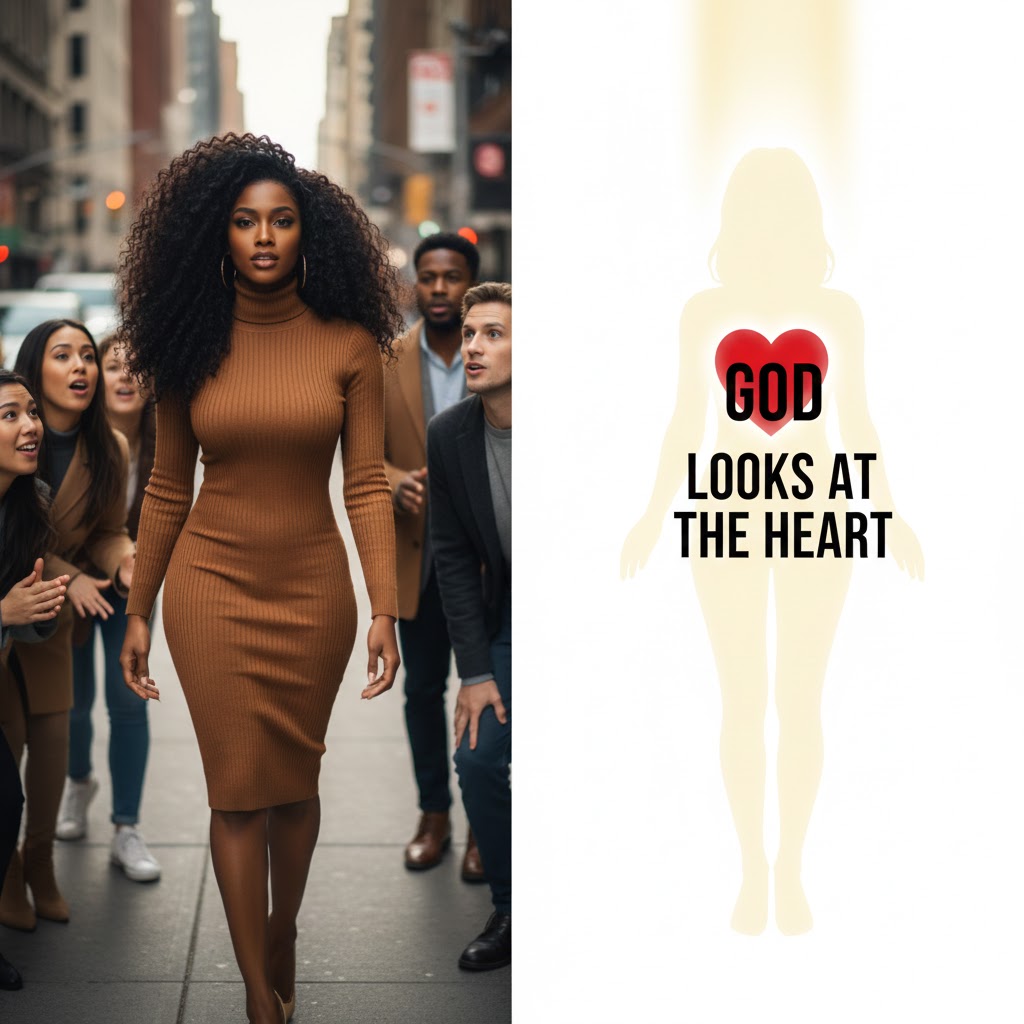
The Gospel of Beauty: For man looketh on the outward appearance, but the Lord looketh on the heart.

In a society increasingly obsessed with physical appearance, the tension between outward beauty and inner virtue has never been more pressing. Scripture repeatedly underscores that while humans are prone to judge based on external features, God evaluates the character and intentions of the heart. The Apostle Samuel’s words in 1 Samuel 16:7 (KJV) illustrate this: “But the Lord said unto Samuel, Look not on his countenance, or on the height of his stature; because I have refused him: for the Lord seeth not as man seeth; for man looketh on the outward appearance, but the Lord looketh on the heart.”

Physical beauty, while celebrated culturally, is transient. Societal standards continually shift, creating pressure to conform to ideals that are both fleeting and often unattainable. This emphasis on outward appearance fosters vanity, envy, and superficial judgment, diverting attention from moral, spiritual, and relational substance.

The Bible consistently contrasts external allure with internal virtue. Proverbs 31:30 (KJV) asserts: “Favor is deceitful, and beauty is vain: but a woman that feareth the Lord, she shall be praised.” Here, the text emphasizes reverence, wisdom, and moral integrity as enduring qualities far surpassing aesthetic appeal.

Men, too, are subject to this cultural fixation. In 1 Peter 3:3-4 (KJV), spiritual instruction guides believers: “Whose adorning let it not be that outward adorning of plaiting the hair, and of wearing of gold, or of putting on of apparel; But let it be the hidden man of the heart, in that which is not corruptible, even the ornament of a meek and quiet spirit, which is in the sight of God of great price.” True beauty emanates from humility, meekness, and spiritual devotion rather than fashion or cosmetics.

Social psychology mirrors this biblical principle. Studies on the “halo effect” show that attractive individuals are often assumed to possess positive traits; however, research also suggests that outward beauty does not predict ethical behavior, compassion, or integrity (Eagly et al., 1991). The wisdom of Scripture anticipates this insight, teaching discernment beyond superficial appearances.

Vanity and obsession with outward appearance can disrupt relationships and spiritual growth. When individuals prioritize beauty over character, they risk fostering pride, insecurity, and shallow social connections. Conversely, cultivating inner virtue promotes resilience, meaningful relationships, and spiritual fulfillment.

The Psalms reinforce the primacy of the heart over appearance. Psalm 51:10 (KJV) pleads: “Create in me a clean heart, O God; and renew a right spirit within me.” God’s concern is not outward perfection but purity of intent, ethical integrity, and contrition, qualities invisible to human eyes yet central to divine evaluation.

Biblical narratives illustrate that God often chooses those overlooked by society. Moses, a reluctant leader with apparent deficiencies in confidence; David, the youngest son of Jesse, overlooked for physical stature; and Esther, a woman of quiet virtue elevated to influence, exemplify God’s attention to character over appearance (Exodus 3, 1 Samuel 16, Esther 2).

Beauty, therefore, is not condemned but reframed. 1 Timothy 2:9-10 (KJV) instructs: “In like manner also, that women adorn themselves in modest apparel, with shamefacedness and sobriety; not with broided hair, or gold, or pearls, or costly array; But (which becometh women professing godliness) with good works.” True adornment lies in righteous actions and godly conduct.

Cultural and technological influences exacerbate the human tendency to equate beauty with value. Social media, advertising, and entertainment industries often perpetuate narrow ideals, while Scripture provides an enduring corrective: God measures worth by moral, relational, and spiritual integrity.

The New Testament further emphasizes the enduring nature of inner qualities. Galatians 5:22-23 (KJV) describes the fruit of the Spirit—love, joy, peace, longsuffering, gentleness, goodness, faith, meekness, temperance—which constitute lasting beauty far beyond physical allure.

Discerning God’s perspective requires intentional cultivation of the heart. Prayer, study of Scripture, and acts of service shift focus from external validation to divine affirmation, reinforcing humility, integrity, and spiritual maturity.

Parents and mentors have a responsibility to teach this principle. Encouraging children to value kindness, diligence, and godly character over appearance fosters resilience against societal pressures and nurtures lifelong spiritual and relational flourishing.

The dangers of valuing appearance above character are also illustrated in narrative warnings. Proverbs 31:25-26 (KJV) praises the virtuous woman: “Strength and honour are her clothing; and she shall rejoice in time to come. She openeth her mouth with wisdom; and in her tongue is the law of kindness.” Strength, honor, wisdom, and kindness surpass transient beauty in both societal and divine evaluation.

In communal life, the prioritization of inner virtue cultivates trust, empathy, and ethical behavior. A society that mirrors God’s evaluation—honoring the heart over the outward appearance—promotes justice, relational depth, and enduring value.

Christian leaders and teachers can model this principle, valuing and affirming individuals for character, service, and spiritual devotion rather than attractiveness or charm, thereby reinforcing a culture that reflects divine priorities.

Ultimately, the Gospel of Beauty calls for a reversal of conventional judgment. Human eyes may favor external traits, but God’s perspective emphasizes eternal qualities. Aligning personal and communal evaluation with this principle fosters moral clarity and spiritual depth.

Believers are reminded to cultivate discernment and humility. 1 Samuel 16:7 (KJV) serves as a perpetual guide: resist superficial judgment, prioritize inner virtue, and honor God’s assessment over societal perception.

In conclusion, while the world celebrates outward beauty, Scripture consistently teaches that God looks at the heart. True beauty is measured in character, integrity, service, and devotion. Aligning life with these principles ensures enduring worth, divine favor, and relational richness beyond the fleeting admiration of human eyes.

References

Eagly, A. H., Ashmore, R. D., Makhijani, M. G., & Longo, L. C. (1991). What is beautiful is good, but…: A meta-analytic review of research on the physical attractiveness stereotype. Psychological Bulletin, 110(1), 109–128.

Holy Bible, King James Version (KJV). 1 Samuel 16:7; Proverbs 31:30; 1 Peter 3:3-4; Psalm 51:10; 1 Timothy 2:9-10; Galatians 5:22-23; Proverbs 31:25-26.

Wolf, N. (1991). The beauty myth: How images of beauty are used against women. HarperCollins.

Langlois, J. H., Kalakanis, L., Rubenstein, A. J., Larson, A., Hallam, M., & Smoot, M. (2000). Maxims or myths of beauty? A meta-analytic and theoretical review. Psychological Bulletin, 126(3), 390–423.

The Sexual Economy of Appearance

Appearance operates as a form of currency within modern social life, shaping access to desire, power, and protection. The sexual economy of appearance refers to the system in which physical attractiveness is exchanged for attention, validation, opportunity, and status. This economy is not neutral; it is governed by racialized, gendered, and class-based hierarchies that determine whose bodies are most valued.

Within this economy, beauty functions as capital. Individuals who align with dominant beauty standards are rewarded with romantic abundance, social visibility, and sexual leverage. Those who do not are often rendered invisible or forced to compensate through emotional labor, compliance, or self-sacrifice. Attraction becomes less about mutual connection and more about market positioning.

Gender plays a defining role in how appearance is monetized. Women are socialized to understand their bodies as primary assets, evaluated continuously and publicly. Men, by contrast, are more often judged on status and resources, yet still benefit from partnering with women whose appearance enhances their own social standing.

Race profoundly structures this sexual marketplace. Eurocentric beauty ideals elevate lighter skin, narrower features, and looser hair textures, while darker skin and Afrocentric features are systematically devalued. This hierarchy mirrors colonial and slave-based systems that assigned worth based on proximity to whiteness.

Desire within this system is frequently mistaken for personal preference. In reality, attraction is shaped by repeated cultural messaging that teaches who is “beautiful,” “feminine,” and “worthy.” These lessons are absorbed long before conscious choice, making desire feel natural even when it reproduces inequality.

The sexual economy also governs behavior. Attractive individuals are granted more grace, patience, and forgiveness in romantic interactions. They are pursued rather than required to prove themselves. Less attractive individuals are expected to accept lower standards, tolerate disrespect, or feel grateful for attention.

Social media has intensified this economy by quantifying desirability through likes, followers, and visibility. Appearance now translates directly into economic and sexual capital, rewarding those who conform and punishing those who resist. Algorithms act as gatekeepers, reinforcing existing beauty hierarchies.

Colorism amplifies sexual stratification within marginalized communities. Lighter-skinned women are often perceived as more feminine, approachable, and “wife-worthy,” while darker-skinned women are sexualized, ignored, or cast as less desirable partners. These dynamics fracture intimacy and erode collective self-worth.

Men also navigate this economy, though differently. Physical attractiveness can elevate masculine desirability, yet men are more frequently evaluated on their ability to provide status, protection, or resources. Still, beauty influences whose masculinity is affirmed and whose is questioned.

The moral implications of this economy are significant. When beauty is treated as merit, inequality appears deserved. Sexual success is framed as virtue, while rejection is interpreted as personal failure rather than structural bias.

Resistance begins with naming the system. The sexual economy of appearance thrives on silence and denial. Honest examination disrupts the illusion that attraction exists outside culture, power, and history.

Liberation requires redefining value beyond appearance. Intimacy grounded in mutual respect, shared values, and emotional safety challenges the market logic that reduces people to visual commodities.

Ultimately, dismantling the sexual economy of appearance is not about rejecting beauty but about refusing to let it determine human worth. Desire becomes ethical when it is conscious, reflective, and free from inherited hierarchies.

References

Bourdieu, P. (1986). The forms of capital. In J. Richardson (Ed.), Handbook of theory and research for the sociology of education (pp. 241–258). Greenwood Press.

Collins, P. H. (2004). Black sexual politics: African Americans, gender, and the new racism. Routledge.

Eagly, A. H., Ashmore, R. D., Makhijani, M. G., & Longo, L. C. (1991). What is beautiful is good, but… A meta-analytic review of research on the physical attractiveness stereotype. Psychological Bulletin, 110(1), 109–128.

Hamermesh, D. S. (2011). Beauty pays: Why attractive people are more successful. Princeton University Press.

Hunter, M. (2007). The persistent problem of colorism: Skin tone, status, and inequality. Sociology Compass, 1(1), 237–254.

Illouz, E. (2007). Consuming the romantic utopia: Love and the cultural contradictions of capitalism. University of California Press.

Zelizer, V. A. (2005). The purchase of intimacy. Princeton University Press.