Category Archives: african American Trauma

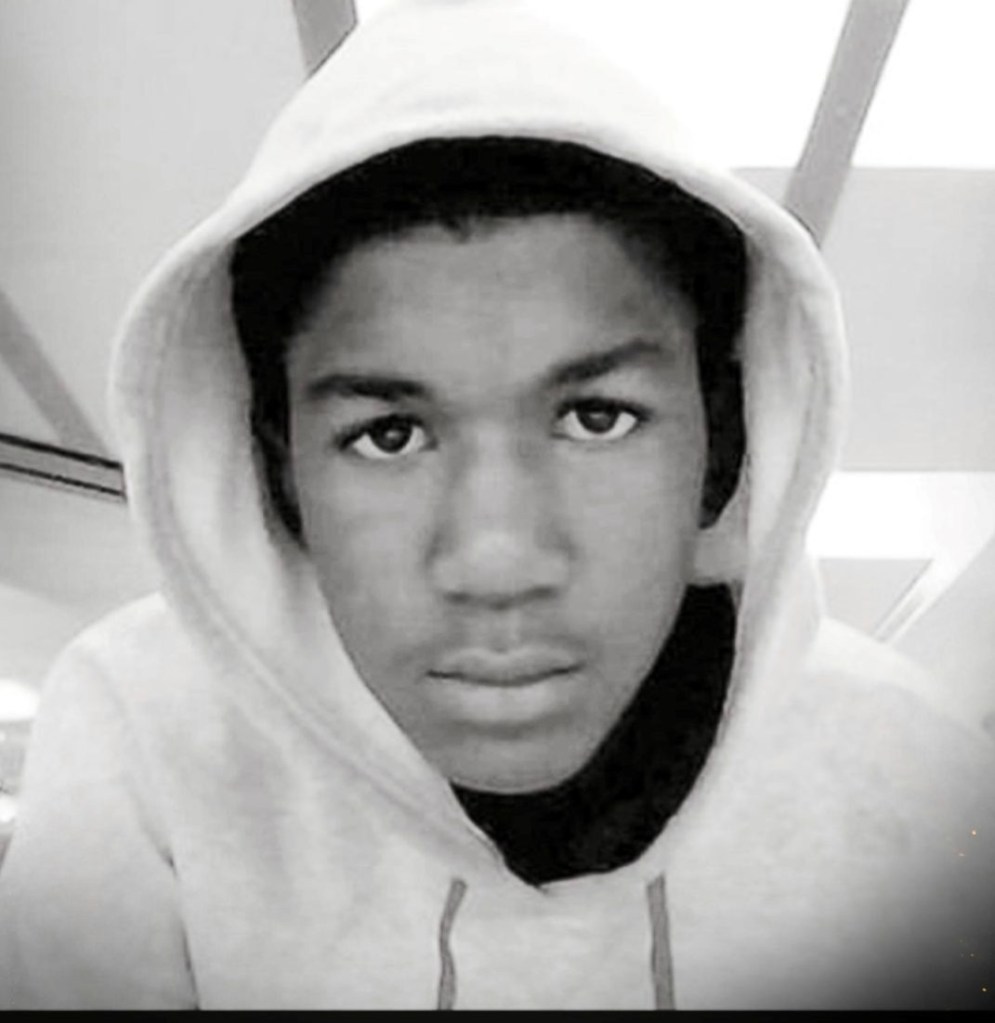
Black History Month: Trayvon Martin – A Life Stolen, A Nation Awakened.

Trayvon Benjamin Martin was born on February 5, 1995, in Miami, Florida. He was a young African American teenager known by his family and friends as kind-hearted, playful, and full of potential. Trayvon enjoyed sports, especially football and basketball, and aspired to become an aviation mechanic. Like many young Black boys in America, his life reflected both ordinary youthful dreams and the inherited weight of navigating a society shaped by racial stereotypes and systemic inequality.


What Happened to Trayvon Martin

On the evening of February 26, 2012, Trayvon Martin was walking back to his father’s fiancée’s home in Sanford, Florida, after purchasing snacks from a convenience store. He was unarmed, wearing a hoodie, and talking on the phone with a friend. George Zimmerman, a neighborhood watch volunteer, reported Trayvon as “suspicious” to police, followed him despite being advised not to, and ultimately shot and killed him.

Zimmerman claimed self-defense and was later acquitted of all charges in 2013. The verdict sparked national and international outrage, as many saw the case as a reflection of how Black bodies are often criminalized, feared, and devalued within American society.


His Impact on the World

Though his life was tragically cut short at just 17 years old, Trayvon Martin’s death became a historical turning point. His name became a symbol of racial injustice and the dangerous consequences of racial profiling. The case helped ignite the modern civil rights movement known as Black Lives Matter, founded in 2013 by Alicia Garza, Patrisse Cullors, and Opal Tometi in response to Trayvon’s killing and Zimmerman’s acquittal.

Trayvon’s story forced America to confront uncomfortable truths about race, surveillance, fear, and the unequal application of justice. His hoodie became a global symbol of protest, representing how something as simple as clothing could become a perceived threat when worn by a Black male.


He Would Have Been 31 This Year

In 2026, Trayvon Martin would have been 31 years old. He could have been a husband, a father, a professional, or a leader in his community. Instead, his life exists in collective memory as a reminder of stolen futures and unrealized potential. His age now represents not just time passed, but the depth of loss — a life that never had the chance to fully begin.


Racism in America: A Broader Context

Trayvon Martin’s death cannot be understood in isolation. It exists within a long historical continuum of racial violence in America, from slavery and lynching to mass incarceration and police brutality. Sociologists describe this phenomenon as systemic racism — a structure in which laws, institutions, and cultural narratives disproportionately harm Black people.

The fear that led to Trayvon’s death reflects what scholars call implicit racial bias, where Black males are often subconsciously associated with danger, criminality, and threat. These biases influence everything from policing and surveillance to legal outcomes and media portrayals.

Trayvon’s case exposed how even in the absence of a crime, Black existence itself can be treated as suspicious. His death became a mirror held up to American society, forcing the nation to ask: Who is allowed to be innocent? Who is allowed to be safe? And whose life is presumed valuable?


Legacy

Trayvon Martin’s legacy is not defined by his death, but by the global movement that arose because of it. His name is spoken alongside others — Michael Brown, Tamir Rice, Sandra Bland, Breonna Taylor, George Floyd — as part of a growing historical archive of racial injustice.

Yet Trayvon remains unique: he was not arrested, not resisting, not committing a crime. He was simply walking home.

His life and death continue to educate, mobilize, and challenge the world to build a society where Black children can exist without fear, where justice is not selective, and where no family must bury a child for simply being seen as “out of place.”


References

Alexander, M. (2012). The new Jim Crow: Mass incarceration in the age of colorblindness. The New Press.

Bonilla-Silva, E. (2018). Racism without racists: Color-blind racism and the persistence of racial inequality in America (5th ed.). Rowman & Littlefield.

CBS News. (2013). George Zimmerman acquitted in Trayvon Martin case.

Garza, A. (2014). A herstory of the #BlackLivesMatter movement. The Feminist Wire.

Newman, K. S., & Cohen, A. (2014). Race, place, and building a youth movement: The case of Trayvon Martin. American Sociological Review, 79(3), 449–476.

Pew Research Center. (2016). On views of race and inequality, Blacks and Whites are worlds apart.

U.S. Department of Justice. (2013). Investigation of the Sanford Police Department’s handling of the Trayvon Martin shooting.

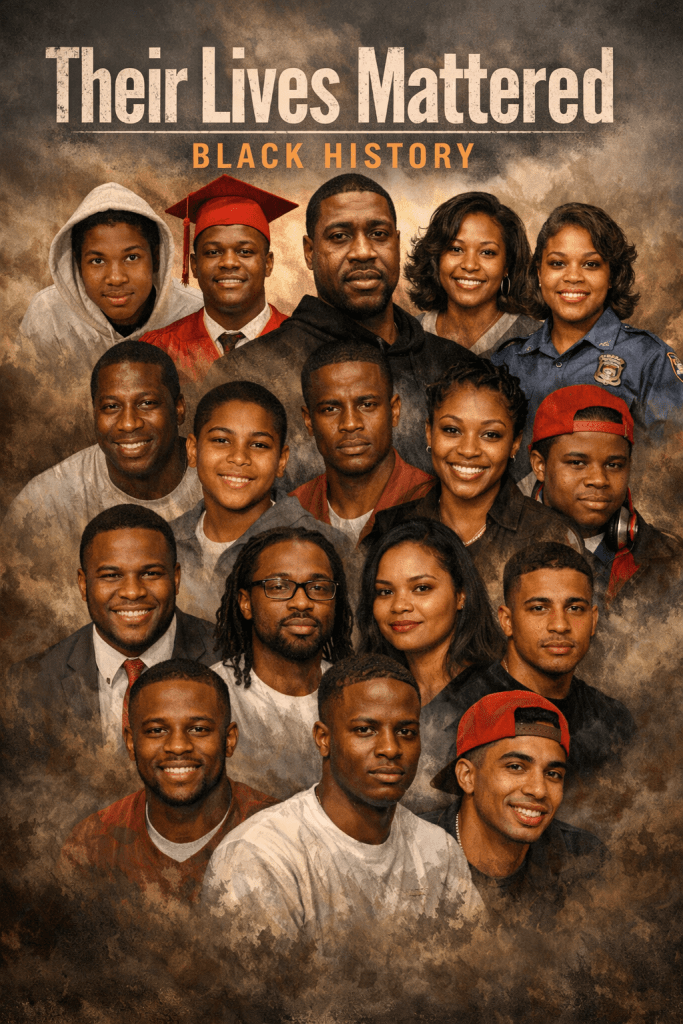
Their Lives Mattered: A Black History Lament.

Their lives mattered not as statistics, not as hashtags, not as passing headlines, but as human beings whose existence was violently interrupted by systems meant to protect. The stories of Trayvon Martin, La’Quan McDonald, Sonya Massey, George Floyd, Breonna Taylor, Eric Garner, Tamir Rice, Freddie Gray, Sandra Bland, Michael Brown, Botham Jean, Philando Castile, Atatiana Jefferson, Stephon Clark, Daunte Wright, and countless others reveal a recurring pattern of racialized state violence, criminalization of Black bodies, and the persistent failure of American justice.

Trayvon Martin was a 17-year-old unarmed Black teenager who was fatally shot in 2012 by George Zimmerman in Sanford, Florida, while walking home from a convenience store. Despite being unarmed and posing no threat, Trayvon was followed, confronted, and killed under the logic of “suspicion.” Zimmerman was acquitted under Florida’s “Stand Your Ground” law, igniting national outrage and becoming a catalyst for the Black Lives Matter movement.

La’Quan McDonald was a 17-year-old Black teenager who was shot 16 times by Chicago police officer Jason Van Dyke in 2014. Dashcam footage later revealed that La’Quan was walking away from police when he was killed, contradicting official police reports. The city suppressed the video for over a year. Van Dyke was eventually convicted of second-degree murder, a rare outcome in police killings.

Sonya Massey, a 36-year-old Black woman, was killed in 2024 by an Illinois sheriff’s deputy after calling 911 for help. While experiencing a mental health crisis, she was shot in her own home. Her death raised renewed concerns about how Black women, especially those in psychological distress, are treated as threats rather than victims in need of care.

George Floyd was a 46-year-old Black man killed in 2020 after Minneapolis police officer Derek Chauvin knelt on his neck for over nine minutes while Floyd was handcuffed and pleading for his life. His death was captured on video and sparked the largest global protests against racial injustice in modern history. Chauvin was later convicted of murder, marking a rare moment of legal accountability.

Breonna Taylor was a 26-year-old Black emergency medical technician who was shot and killed in her Louisville apartment in 2020 when police executed a no-knock warrant while she was asleep. Officers fired over 30 bullets, killing her in her own home. No officer was charged directly for her death, reinforcing public outrage over the lack of accountability.

Eric Garner was a 43-year-old Black man who died in 2014 after being placed in a chokehold by NYPD officer Daniel Pantaleo for allegedly selling loose cigarettes. Garner’s final words, “I can’t breathe,” became a global symbol of police brutality. A grand jury declined to indict the officer, and Pantaleo was only fired years later.

Tamir Rice was a 12-year-old Black child who was shot and killed by Cleveland police in 2014 while playing with a toy gun in a park. Officers arrived and shot him within seconds, without attempting de-escalation. No criminal charges were filed, despite Tamir being a minor posing no imminent threat.

Freddie Gray was a 25-year-old Black man who died in 2015 from a spinal injury sustained while in police custody in Baltimore. He had been arrested and transported in a police van without being properly restrained. His death led to mass protests, but none of the officers involved were ultimately convicted.

Sandra Bland was a 28-year-old Black woman found dead in a Texas jail cell in 2015 after being arrested during a traffic stop. Her death was ruled a suicide, but her treatment, arrest, and the circumstances of her death raised serious questions about racial profiling, police aggression, and custodial negligence.

Michael Brown was an 18-year-old Black teenager shot and killed by police officer Darren Wilson in Ferguson, Missouri, in 2014. Brown was unarmed at the time. His body was left in the street for hours, igniting national protests. A grand jury declined to indict Wilson, fueling global outrage.

Botham Jean was a 26-year-old Black accountant who was shot and killed in his own apartment in 2018 by off-duty Dallas police officer Amber Guyger, who claimed she mistook his home for hers. Guyger was convicted of murder, but her sentence was widely criticized as lenient.

Philando Castile was a 32-year-old Black school cafeteria worker who was shot and killed by police during a traffic stop in Minnesota in 2016. He had calmly informed the officer that he was legally carrying a firearm. His girlfriend livestreamed the aftermath. The officer was acquitted.

Atatiana Jefferson was a 28-year-old Black woman shot and killed by police in 2019 while inside her home in Fort Worth, Texas, after a neighbor requested a wellness check. She was playing video games with her nephew when she was killed. The officer was later convicted of manslaughter.

Stephon Clark was a 22-year-old Black man shot and killed by Sacramento police in 2018 while standing in his grandmother’s backyard. Officers claimed he had a gun; he was holding a cellphone. He was shot 20 times. No officers were charged.

Daunte Wright was a 20-year-old Black man killed in 2021 during a traffic stop in Minnesota when an officer claimed she mistakenly drew her gun instead of her taser. Wright’s death occurred during the trial of Derek Chauvin and reignited national protests. The officer was convicted of manslaughter.

These deaths are not isolated incidents but part of a historical continuum rooted in slavery, Jim Crow, mass incarceration, and racialized policing. The criminal justice system has repeatedly failed to protect Black lives while excusing or minimizing state violence through qualified immunity, grand jury non-indictments, and legal doctrines that prioritize police narratives over Black testimony.

Their lives mattered because they were sons, daughters, parents, workers, students, and dreamers. They mattered because their deaths exposed the moral contradictions of a nation that proclaims liberty while systematically devaluing Black existence. To remember them is not simply an act of mourning, but a political demand for truth, accountability, and structural transformation.

Their names and many others live on not only in memory but in resistance. They have become ancestral witnesses to injustice and sacred symbols in a global struggle for Black dignity. Their blood cries out from the ground, demanding not silence, but justice.


References

Alexander, M. (2012). The New Jim Crow: Mass incarceration in the age of colorblindness. The New Press.

Black Lives Matter. (n.d.). Say Their Names. https://blacklivesmatter.com

Equal Justice Initiative. (2020). Lynching in America: Confronting the legacy of racial terror. https://eji.org

Garner, E. (2014). NYPD case files and DOJ Civil Rights Investigation. U.S. Department of Justice.

Mapping Police Violence. (2023). Police killings database. https://mappingpoliceviolence.org

New York Times. (2014–2024). Police brutality and racial justice reporting.

U.S. Department of Justice. (2020). Investigation into the Minneapolis Police Department.

Washington Post. (2015–2024). Fatal force: Police shootings database. https://www.washingtonpost.com/graphics/investigations/police-shootings-database/

Williams, P. J. (1991). The Alchemy of Race and Rights. Harvard University Press.

Dilemma: Incest

Photo by Mu00e1rcio Filho on Pexels.com

The Hidden Wounds of Incest: A Biblical, Psychological, and Cultural Examination

Incest—an act of sexual relations between close family members—has existed since ancient times, often cloaked in silence, shame, and generational trauma. The Bible itself does not shy away from exposing such sins, not to glorify them, but to warn against their devastating consequences. From the story of Tamar’s violation by her half-brother Amnon (2 Samuel 13), to the manipulation of Lot by his daughters (Genesis 19:30–38), Scripture records these acts as moral cautionary tales. Incest represents a corruption of familial love and trust, turning what should be protection into predation.

In 2 Samuel 13, Tamar, the daughter of King David, was raped by her half-brother Amnon under the guise of feigned illness. This act of incest shattered Tamar’s dignity and brought a spirit of division into David’s household. Afterward, Amnon’s “love” turned into hatred, illustrating how lust masquerading as affection quickly turns destructive (2 Samuel 13:15). The psychological trauma Tamar endured is reflective of what modern survivors face—shame, identity confusion, and lifelong emotional scars.

Similarly, in Genesis 19, after the destruction of Sodom and Gomorrah, Lot’s daughters, believing all men were gone, intoxicated their father and lay with him to preserve his lineage. Though their motives were rooted in fear and survival, the result was a lineage of conflict through the Moabites and Ammonites. The Bible shows that even when sin seems “rationalized,” its impact ripples through generations.

The law of Moses clearly forbids incest: “None of you shall approach to any that is near of kin to him, to uncover their nakedness: I am the Lord” (Leviticus 18:6, KJV). These laws served both moral and biological purposes, protecting families from genetic deformities and emotional destruction. Violating this boundary is a form of spiritual defilement that corrupts the divine structure of family and intimacy.

Psychologically, incest is one of the most damaging forms of sexual abuse. It creates what clinicians call trauma bonding, where the victim feels both affection and fear toward their abuser. According to the American Psychological Association (APA, 2020), survivors often experience post-traumatic stress disorder (PTSD), dissociation, sexual dysfunction, and self-blame. The confusion between love and abuse distorts their future relationships and trust in authority figures.

The case of R. Kelly, the R&B singer who revealed he was molested by his older sister, demonstrates how cycles of incestuous abuse can manifest in adulthood. Studies suggest that many perpetrators of sexual exploitation were once victims themselves (Lisak & Miller, 2002). Kelly’s later predatory behavior toward young girls can be seen as a tragic example of unhealed trauma turning into a weapon.

Likewise, Mackenzie Phillips, daughter of musician John Phillips of The Mamas & the Papas, publicly disclosed her ten-year incestuous relationship with her father. Her confession shocked the entertainment world but illuminated a dark truth about power, addiction, and denial in families of fame. Phillips described feeling both “trapped and brainwashed,” a psychological state akin to Stockholm Syndrome, where victims internalize the abuser’s control.

Such confessions highlight the need for trauma-informed intervention. According to Judith Herman (1992) in Trauma and Recovery, healing from incest requires breaking secrecy, reclaiming autonomy, and re-establishing safe connections. Silence protects the perpetrator; truth frees the survivor. Tamar’s cry, “And whither shall I cause my shame to go?” (2 Samuel 13:13, KJV), still echoes in the hearts of countless survivors seeking justice and restoration.

Incest destroys the foundation of trust within families. The parent, sibling, or relative—meant to shield the vulnerable—becomes the violator. The victim learns to associate intimacy with pain, affection with danger. Over time, this leads to emotional numbness or hypersexuality as coping mechanisms. Researchers Finkelhor and Browne (1985) identified four key dynamics of child sexual abuse—traumatic sexualization, betrayal, powerlessness, and stigmatization—all of which are intensified in incestuous situations.

Biblically, incest carries spiritual consequences beyond the physical act. When David’s son Amnon raped Tamar, it triggered a chain of revenge, hatred, and death in the royal household. Absalom, Tamar’s full brother, killed Amnon in retaliation, fulfilling the prophetic word that “the sword shall never depart from thy house” (2 Samuel 12:10). Sexual sin within the family invites generational turmoil and emotional dysfunction.

Even in modern times, incest remains a hidden epidemic. The World Health Organization (WHO, 2022) reports that one in five women and one in thirteen men worldwide experience sexual abuse during childhood—often by relatives. Shame, manipulation, and threats silence many victims, making it one of the least reported crimes. Religious and cultural pressures can compound the trauma when communities protect the abuser to avoid scandal.

From a spiritual warfare perspective, incest is a manifestation of demonic influence that targets the sanctity of the family. In the KJV Bible, sexual immorality is often linked to uncleanness and idolatry (1 Corinthians 6:18–20). When sexual sin enters a household, it opens spiritual doors to confusion, depression, and generational bondage. Deliverance requires repentance, confession, and God’s restoring power.

Celebrities and public figures who come forward about incest break the veil of secrecy that enables predators. Their transparency helps dismantle the cultural myth that wealth, beauty, or fame can shield one from abuse. When Mackenzie Phillips spoke, countless survivors found courage to share their own stories, echoing Revelation 12:11: “And they overcame him by the blood of the Lamb, and by the word of their testimony.”

Healing from incest involves rebuilding identity. Survivors must learn that their worth is not defined by what was done to them but by who they are in God. Psalm 147:3 promises, “He healeth the broken in heart, and bindeth up their wounds.” Therapy, prayer, and community support play vital roles in restoring emotional and spiritual wholeness.

The psychological impact extends into adulthood, often manifesting as depression, addiction, and difficulty in forming healthy sexual boundaries. Survivors may fear intimacy, struggle with guilt, or reenact trauma in their relationships. Psychologist Bessel van der Kolk (2014) notes in The Body Keeps the Score that trauma literally reshapes the brain, altering the way individuals process safety, love, and touch.

In the church and community, education and accountability are essential. Clergy and counselors must recognize signs of abuse and respond with compassion, not condemnation. Misinterpreting forgiveness as silence enables continued harm. Jesus said, “It must needs be that offences come; but woe to that man by whom the offence cometh!” (Matthew 18:7, KJV). Justice and mercy are not opposites—they are partners in healing.

The effects of incest are both personal and generational. Just as Lot’s descendants through Moab and Ammon became nations at odds with Israel, unresolved sexual trauma can produce cycles of dysfunction within families. Breaking the cycle requires truth-telling, therapy, spiritual deliverance, and community restoration.

In popular culture, we see a shift toward awareness and advocacy. Documentaries, survivor memoirs, and therapeutic ministries now give voice to the voiceless. What was once hidden in shame is now being confronted under the light of truth. As Ephesians 5:11 instructs, “And have no fellowship with the unfruitful works of darkness, but rather reprove them.”

Ultimately, incest is not merely a physical act but a spiritual and psychological wound that distorts God’s original design for family. It replaces love with control, safety with fear, and holiness with perversion. But healing is possible. Through repentance, therapy, and faith, survivors can rise from the ashes of their pain and reclaim their God-given identity.

Generational Trauma and Incest in the Black Community: Breaking the Cycle

Incest is not only a personal violation but also a social and generational wound, particularly within African American communities where historical trauma, systemic oppression, and cultural silence intersect. The legacy of slavery disrupted family structures, separating children from parents, and normalizing environments where abuse could flourish unnoticed. These historical ruptures set the stage for patterns of sexual abuse, including incest, that can persist across generations.

African American families often contend with the compounded effects of racism, poverty, and mass incarceration, which can exacerbate vulnerabilities to abuse. Research by Hill (2006) suggests that stressors such as parental absence, economic strain, and neighborhood instability increase the risk of intergenerational trauma, including sexual exploitation within families. When combined with cultural taboos around discussing sexuality and abuse, survivors are left isolated and silenced.

In the Bible, generational trauma is a recurring theme. The curse on Canaan after Ham’s transgression (Genesis 9:25) illustrates how the actions of one generation can shape the lives of descendants. Similarly, incestuous acts, like those of Lot’s daughters (Genesis 19), produced long-lasting consequences for their descendants. In African American communities, generational trauma often manifests in cycles of abuse, distrust, and distorted sexual norms.

Historically, the forced separation of enslaved families created environments where sexual abuse, often by those in power, became normalized. Enslaved children were vulnerable to predation by overseers, and familial bonds could be legally and violently disrupted. This normalization of sexual violation has parallels in modern incest cases, as survivors often struggle with internalized shame and confusion about boundaries.

Psychological research emphasizes the concept of intergenerational trauma, where the emotional scars of one generation influence parenting styles, attachment, and family dynamics in the next. According to Danieli (1998), unresolved trauma can be transmitted through behaviors, neglect, and emotional dysregulation, creating environments where incest or sexual abuse can recur.

Incest survivors within Black communities face unique barriers to disclosure. Fear of family shame, distrust of law enforcement, and cultural emphasis on protecting the family’s reputation often prevent victims from seeking help. This silence mirrors Tamar’s plight in 2 Samuel 13, where fear of dishonor constrained her ability to find justice. The shame imposed by community perception can compound the trauma.

Celebrity testimonies, like Mackenzie Phillips or R. Kelly, highlight how abuse can transcend social strata. Within the Black entertainment industry, the pattern is mirrored in cases where family or authority figures exploit young women under the guise of mentorship or protection. These examples underscore that incest is not limited by class, fame, or intellect—it is a societal and familial disease.

The psychological impact on African American incest survivors often includes PTSD, depression, anxiety, and difficulties with trust and intimacy. Bryant-Davis and Ocampo (2005) found that Black women survivors frequently report compounded trauma due to racialized oppression, systemic injustice, and community minimization of abuse. This intersectionality intensifies the effects of incest.

Sexual abuse within families can distort the perception of love and authority. Children learn to associate attachment with violation, leading to hypervigilance or emotional withdrawal. In the Black community, where extended family networks are often relied upon for support, betrayal by a trusted relative can have profound consequences for identity formation and emotional security.

Tamar’s story provides a biblical archetype for understanding these dynamics. Amnon’s abuse was both sexual and emotional, violating familial trust and creating a household torn by vengeance. Similarly, incest in African American families can destabilize relationships, erode trust, and create cycles of retaliation, neglect, or emotional estrangement.

Education and awareness are critical tools in prevention. Programs that teach children about boundaries, consent, and body autonomy are essential. The National Sexual Violence Resource Center (NSVRC, 2021) emphasizes culturally competent education, acknowledging historical trauma and the unique pressures faced by marginalized communities, including Black families.

Therapeutic intervention for survivors is multifaceted. Cognitive-behavioral therapy (CBT), trauma-focused therapy, and spiritually integrated counseling have proven effective in addressing both psychological and spiritual wounds. Psalm 34:18 reminds survivors, “The Lord is nigh unto them that are of a broken heart; and saveth such as be of a contrite spirit.” Healing requires a holistic approach addressing mind, body, and spirit.

Faith-based communities play a crucial role in either perpetuating silence or promoting healing. Clergy must be trained to respond appropriately to disclosures of incest, balancing spiritual guidance with trauma-informed care. Failure to act can reinforce cycles of secrecy and shame, while responsible pastoral intervention can model justice and restoration.

Breaking generational cycles also involves confronting the systemic factors that enable abuse. Poverty, lack of access to mental health care, and community neglect often exacerbate familial dysfunction. Advocates argue for increased funding for mental health services, child protection programs, and survivor-centered initiatives in historically marginalized communities.

Psychologically, survivors must reconstruct boundaries and redefine intimacy. Judith Herman (1992) emphasizes that recovery involves creating safe relational environments, processing trauma narratives, and reclaiming agency. For Black survivors, this may also involve addressing racialized trauma and intergenerational family expectations.

Family systems therapy is often effective in addressing incest, especially when generational patterns exist. By identifying roles, boundaries, and communication patterns, families can disrupt cycles of abuse and model healthier interactions. The goal is not only individual healing but systemic restoration.

Scripturally, God calls for protection of the vulnerable and accountability for transgressors. Ezekiel 22:12–13 condemns the oppression of the helpless and abuse of trust. African American faith communities can draw from these passages to affirm the rights of survivors and reject cultural norms that perpetuate silence.

Cultural acknowledgment of the problem is a first step. Public discourse, survivor advocacy, and media representation help dismantle stigma and normalize reporting. The openness of celebrities, combined with grassroots activism, provides a platform for generational healing and community education.

In conclusion, incest in the Black community is a multifaceted issue rooted in historical, psychological, and familial trauma. Breaking the cycle requires acknowledgment, education, faith-based and therapeutic intervention, and systemic reform. Tamar’s story, alongside modern survivors’ testimonies, serves as both a warning and a guidepost for healing.

Ultimately, restoration is possible. Through therapy, prayer, community support, and spiritual reflection, survivors can reclaim identity, trust, and relational health. Proverbs 22:6 reminds us, “Train up a child in the way he should go: and when he is old, he will not depart from it.” By addressing incest and generational trauma head-on, African American communities can protect future generations and honor God’s design for family.

In closing, the story of Tamar, and countless others like her, calls us to confront incest with both compassion and conviction. Silence is complicity. To protect the next generation, families and faith communities must dismantle secrecy and shame, allowing truth, justice, and divine healing to prevail.


References

  • American Psychological Association. (2020). APA Dictionary of Psychology. APA Publishing.
  • Finkelhor, D., & Browne, A. (1985). The traumatic impact of child sexual abuse: A conceptualization. American Journal of Orthopsychiatry, 55(4), 530–541.
  • Herman, J. L. (1992). Trauma and recovery. Basic Books.
  • Lisak, D., & Miller, P. M. (2002). Repeat rape and multiple offending among undetected rapists. Violence and Victims, 17(1), 73–84.
  • van der Kolk, B. A. (2014). The body keeps the score: Brain, mind, and body in the healing of trauma. Viking.
  • World Health Organization. (2022). Global status report on violence prevention. WHO.
  • The Holy Bible, King James Version (KJV).Bryant-Davis, T., & Ocampo, C. (2005). Racist-incident–based trauma. The Counseling Psychologist, 33(4), 479–500.
  • Danieli, Y. (1998). International handbook of multigenerational legacies of trauma. Springer.
  • Finkelhor, D., & Browne, A. (1985). The traumatic impact of child sexual abuse: A conceptualization. American Journal of Orthopsychiatry, 55(4), 530–541.
  • Hill, R. B. (2006). The strengths of African American families: Twenty-five years later. University Press of America.
  • Judith Herman, 1992. Trauma and Recovery: The Aftermath of Violence—From Domestic Abuse to Political Terror.
  • National Sexual Violence Resource Center (NSVRC). (2021). Child sexual abuse prevention: Cultural considerations.

Dilemma: Spiritually Shell-Shocked.

Spiritual Prisoners of War.

Photo by Nicola Barts on Pexels.com

In the landscape of American history, the Black experience remains a story marked by both divine endurance and deep trauma. The spiritual and psychological wounds inflicted by systemic racism, economic disenfranchisement, police brutality, and the remnants of Jim Crow laws have created generations that are spiritually shell-shocked—alive yet aching, breathing yet broken. The dilemma lies in navigating faith amid oppression, maintaining hope in a society designed to erode it, and remembering God’s promises when the world appears to forget justice.

From slavery to segregation, the Black soul has endured centuries of assault. The spiritual shell-shock of oppression echoes through time, a collective PTSD that manifests in our communities, churches, and identities. Just as soldiers return from war carrying invisible wounds, so too do descendants of the enslaved carry inherited pain. The difference is that this war was not fought overseas—it was fought on American soil, in cotton fields, courtrooms, and city streets.

Systemic racism operates not merely as prejudice, but as a structured power that undermines entire communities. It infiltrates schools, healthcare, housing, and employment, creating barriers that cripple progress. This machinery of inequity causes spiritual fatigue—a despair that whispers, “You are less than.” Yet Scripture declares otherwise: “I will praise thee; for I am fearfully and wonderfully made” (Psalm 139:14, KJV). This biblical truth must combat societal lies.

The economics of racial inequality further deepen the wound. The wealth gap between Black and white families is not accidental but a continuation of the theft of labor, land, and opportunity. During Reconstruction, promises like “forty acres and a mule” dissolved into betrayal, leaving many freedmen impoverished and powerless. The spiritual result was disillusionment—a people free in name but bound by poverty.

This cycle of economic despair is a modern plantation, disguised as urban poverty and wage disparity. Financial oppression strips dignity and fosters hopelessness. Yet the Bible reminds us that “The borrower is servant to the lender” (Proverbs 22:7, KJV). The struggle for economic liberation, therefore, is not only political but deeply spiritual—a fight for self-determination and divine restoration.

Police brutality represents the contemporary form of public terror once embodied by lynching. The televised deaths of unarmed Black men and women mirror the postcards of hangings sent during Jim Crow. The uniform replaced the hood, but the system remains. When another Black life is unjustly taken, the community collectively grieves—not just the person, but the persistence of evil.

This trauma accumulates. Every hashtag and protest becomes another reminder of a system that sees our skin as a weapon. For many, faith becomes both refuge and rebellion. It is the cry of Psalm 13:1—“How long wilt thou forget me, O Lord? forever? how long wilt thou hide thy face from me?” This ancient lament still echoes in our streets.

Jim Crow’s ghost still walks among us, haunting courtrooms, schools, and neighborhoods. Though its laws were repealed, its logic endures—in redlining, mass incarceration, and inequitable education. The spiritual dilemma emerges when those once oppressed by the whip now face oppression by the pen and policy.

Violence—both physical and structural—has long been a tool of control. From slave patrols to modern policing, from bombed Black churches to mass shootings, violence serves as a reminder that progress is fragile. This constant threat instills a collective fear, a hypervigilance that mirrors soldiers in combat. Spiritually, it breeds exhaustion and distrust, even toward divine promises.

The community’s resilience, however, is nothing short of miraculous. The same Bible that slaveholders misused to justify bondage became the source of liberation for the enslaved. The Exodus story, with Moses leading the Israelites from Egypt, became the heartbeat of the Black spiritual imagination. “Let my people go” (Exodus 5:1, KJV) was not only a biblical command but a declaration of human dignity.

Churches became sanctuaries for both the soul and the movement. Spiritual shell-shock was met with sacred song, protest, and prayer. The Negro spirituals—“Go Down, Moses,” “Swing Low, Sweet Chariot”—carried coded messages of freedom and theological hope. These songs were both therapy and theology, merging lament with resistance.

Yet in today’s world, the faith of our ancestors collides with a modern crisis of belief. Many young Black men and women question God’s justice in the face of persistent inequality. The dilemma deepens: How does one trust a God who allows suffering? But Scripture reminds us that “The sufferings of this present time are not worthy to be compared with the glory which shall be revealed in us” (Romans 8:18, KJV).

This verse reframes pain as purpose. What we endure is not meaningless, but molding. Oppression has refined our faith, producing resilience that outlasts empires. Every attempt to destroy us has revealed God’s sustaining hand. The survival of Black faith is a miracle greater than any political reform.

Education, too, has been weaponized and redeemed. During segregation, Black excellence flourished in spite of systemic neglect. Teachers and parents instilled divine worth in children the world rejected. Today, the erosion of that moral foundation contributes to spiritual shell-shock. The mind cannot heal if it is constantly fed inferiority.

Media and pop culture compound this by distorting Black identity. The glorification of violence, hypersexuality, and materialism numbs spiritual awareness. It’s a different kind of warfare—psychological colonization. Romans 12:2 urges, “Be not conformed to this world: but be ye transformed by the renewing of your mind.” This transformation is critical for our collective healing.

The Black home once stood as a fortress of love and resilience. However, systemic pressures—from mass incarceration to economic hardship—have fractured family structures. Absentee fathers, struggling mothers, and disillusioned youth form the triad of generational pain. This fragmentation contributes to our spiritual disorientation.

Healing, therefore, must be both individual and communal. It begins with acknowledgment—confessing that we are wounded yet worthy, broken yet beloved. Psalm 34:18 assures us, “The Lord is nigh unto them that are of a broken heart; and saveth such as be of a contrite spirit.”

True liberation requires spiritual reawakening. Policy changes may improve conditions, but only divine renewal can restore identity. When people recognize that their worth is not defined by systems but by God, they reclaim the power once stripped away.

The dilemma of being spiritually shell-shocked also exposes the hypocrisy of America’s Christian conscience. The same nation that quotes Scripture to justify its actions often ignores the Bible’s call for justice: “Learn to do well; seek judgment, relieve the oppressed, judge the fatherless, plead for the widow” (Isaiah 1:17, KJV).

Economic justice is a biblical command, not a political suggestion. The prophets denounced exploitation and greed. Amos cried, “Let judgment run down as waters, and righteousness as a mighty stream” (Amos 5:24, KJV). Martin Luther King Jr. echoed this cry, linking faith with civil rights, spirituality with social action.

Racial reconciliation cannot occur without repentance. America must confront its original sins of slavery and genocide with humility, not denial. Forgiveness without truth is false peace. Healing requires both justice and grace, both accountability and compassion.

Mental health, often stigmatized in the Black community, is another battlefield. The trauma of racism manifests as depression, anxiety, and despair. Churches must evolve into spaces of both prayer and therapy, merging spiritual and psychological care. For faith without healing is fragile.

As generational trauma lingers, hope becomes revolutionary. The very act of believing in God’s goodness amid injustice defies despair. Hebrews 11:1 declares, “Now faith is the substance of things hoped for, the evidence of things not seen.” Black faith, in this sense, is radical—it believes when the world gives no reason to.

The modern civil rights struggle continues through education, protest, and policy, but it must also continue through prayer. Spiritual warfare demands spiritual weapons: truth, righteousness, and perseverance. Ephesians 6:12 reminds us that “we wrestle not against flesh and blood, but against principalities, against powers, against the rulers of the darkness of this world.”

To be spiritually shell-shocked is not to be defeated—it is to be aware of the cost of survival. It is the weariness of a people who have prayed, marched, and bled for centuries, yet still believe. That belief is the bridge between trauma and triumph.

Every generation must decide whether to remain wounded or to walk toward wholeness. Healing demands confrontation—with history, with injustice, and with ourselves. But as 2 Chronicles 7:14 promises, “If my people, which are called by my name, shall humble themselves, and pray… then will I hear from heaven, and will forgive their sin, and will heal their land.”

The Healing of the Shell: Faith After the Fire

After centuries of endurance, the Black spirit stands at a crossroads—scarred but not destroyed, wounded but still whispering songs of survival. “We are troubled on every side, yet not distressed; we are perplexed, but not in despair” (2 Corinthians 4:8, KJV). These words encapsulate the paradox of our condition: to have walked through fire and yet to still reach toward heaven. Healing the spiritual shell-shock of oppression requires not only remembrance of the pain but the reclaiming of divine purpose that outlasts it.

The shell, once a defense mechanism, is also a symbol of transformation. It represents the hardened exterior formed by centuries of struggle, the thick skin we developed to survive injustice. Yet true healing calls for the courage to shed that shell—to allow vulnerability, forgiveness, and faith to reemerge. For too long, survival has been mistaken for healing. Now, the time has come for restoration.

The first step toward healing is truth. Healing cannot occur where denial persists. The nation must confront its sins, and individuals must acknowledge their pain. As Christ said, “Ye shall know the truth, and the truth shall make you free” (John 8:32, KJV). The truth liberates both the oppressed and the oppressor, for only through confession can grace begin its work.

Healing also requires remembrance without reliving. To remember is to honor our ancestors who carried crosses not of their choosing. To relive, however, is to remain bound by yesterday’s trauma. Faith becomes the bridge between memory and freedom. It transforms lament into legacy.

Forgiveness remains one of the hardest lessons. How can a people forgive centuries of cruelty? The answer is not found in excusing evil but in freeing the heart from its grip. Christ’s command to forgive seventy times seven (Matthew 18:22, KJV) was not meant to minimize injustice, but to preserve the soul from bitterness. To forgive is to reclaim control over one’s spirit.

Economic and psychological restoration must accompany spiritual healing. Poverty is not only material but mental—a conditioned belief in lack. The renewed Black mind must recognize that abundance begins in purpose, not possessions. Deuteronomy 8:18 reminds us, “But thou shalt remember the Lord thy God: for it is he that giveth thee power to get wealth.” True wealth is wisdom, faith, and community.

Education becomes both the sword and the salve. Where ignorance once enslaved, knowledge now emancipates. Every degree earned, every book read, every child taught is an act of spiritual warfare. Hosea 4:6 warns, “My people are destroyed for lack of knowledge.” Education is not merely academic—it is divine awakening.

The Black Church, though wounded, remains a pillar of healing. It must evolve beyond emotional worship to holistic restoration—addressing mental health, family stability, and financial literacy alongside prayer. A healed church produces healed people, and healed people transform nations.

Prayer, too, takes on new meaning after the fire. No longer the desperate cry of the oppressed, it becomes the steady declaration of the redeemed. Prayer changes posture—it lifts bowed heads and strengthens weary hearts. Philippians 4:6–7 teaches, “Be careful for nothing; but in every thing by prayer and supplication with thanksgiving let your requests be made known unto God.” Gratitude after grief is evidence of divine maturity.

Generational trauma must meet generational transformation. The pain inherited from slavery, segregation, and systemic racism must end where revelation begins. When we teach our children who they are—royalty, not remnants—we disrupt the cycle. Psalm 127:3 reminds us, “Lo, children are an heritage of the Lord.” Healing, therefore, is not just for us, but for those who come after.

Black love is also a revolutionary form of healing. To love oneself in a world that taught you to hate your reflection is an act of holy defiance. To love one another, beyond pain and prejudice, restores the image of God in humanity. 1 John 4:7 declares, “Beloved, let us love one another: for love is of God.” Love becomes our new language of deliverance.

Art, music, and storytelling continue to serve as instruments of spiritual recovery. Every poem, painting, and melody created from the ashes of struggle is testimony that beauty still lives in us. The creative spirit is sacred—it mirrors the Creator’s power to bring light out of darkness.

Faith must also be paired with works. James 2:17 reminds us, “Faith, if it hath not works, is dead.” The healing of our communities requires action—voting, mentoring, organizing, and building. Spirituality must step out of the sanctuary and into the streets. Healing is faith in motion.

Black women, as the backbone of resilience, deserve rest as part of healing. Too long have they carried the dual burdens of race and gender, faith and fatigue. Their healing is essential for the restoration of families and nations. Proverbs 31 describes a virtuous woman, but she must also be valued beyond her labor—honored for her soul.

Black men, too, must rediscover their divine identity beyond trauma. They are not statistics or stereotypes, but kings in covenant with God. The healing of their minds and spirits restores balance to homes and communities. Psalm 82:6 declares, “Ye are gods; and all of you are children of the most High.” The rediscovery of this truth breaks the curse of inferiority.

Community healing requires unity. Division—by class, colorism, or creed—only prolongs our pain. Christ’s prayer in John 17:21 was for oneness: “That they all may be one; as thou, Father, art in me, and I in thee.” Healing begins when we see each other not as rivals, but as reflections.

Healing after the fire also means redefining justice. Justice is not revenge but restoration—repairing what was broken and returning what was stolen. The call for reparations is not greed but biblical righteousness. Exodus 22:1 shows that restitution follows wrongdoing. A healed people must also be a just people.

Our relationship with God deepens through suffering. Pain teaches empathy, dependence, and humility. The scars of our history become testimonies of grace. As Joseph told his brothers, “Ye thought evil against me; but God meant it unto good” (Genesis 50:20, KJV). Our collective suffering has birthed divine wisdom.

Faith after the fire demands hope beyond sight. Hebrews 10:23 declares, “Let us hold fast the profession of our faith without wavering; (for he is faithful that promised).” The promise is not that the fire will not come, but that it will refine, not consume.

Healing also requires joy. After centuries of lament, we must learn to laugh again, to celebrate victories both great and small. Psalm 30:5 promises, “Weeping may endure for a night, but joy cometh in the morning.” That morning has not yet fully come, but dawn is near.

Cultural healing emerges when we reclaim the narratives once stolen from us. The story of the African diaspora is not solely one of suffering, but of strength, innovation, and divine purpose. We are not victims of history—we are vessels of prophecy.

The healing journey is incomplete without gratitude. Gratitude acknowledges that despite everything—chains, whips, and systemic cruelty—we are still here. Gratitude is a weapon of faith. It transforms trauma into triumph, sorrow into song.

In the ashes of oppression, new seeds of purpose take root. Out of the pain of racism grows the fruit of resilience; out of exile comes excellence. The fire was never meant to destroy us—it was meant to purify us for destiny.

Each generation must decide whether to inherit pain or pursue peace. Healing is a choice, one made daily in the face of adversity. Joshua 24:15 declares, “Choose you this day whom ye will serve.” To choose healing is to choose God’s will over generational wounds.

Ultimately, the healing of the shell represents resurrection. The same God who raised Christ from the dead can revive a people once buried under oppression. Romans 8:11 promises, “He that raised up Christ from the dead shall also quicken your mortal bodies by his Spirit.” Our spirits, too, are being quickened.

The fire has passed. The smoke still lingers, but so does the song. We rise not as victims, but as visionaries. Our shells may be cracked, but light now shines through them. The healing has begun—not just for a people, but for the soul of a nation.

And when the world asks how we survived, our answer will be simple: because grace never left us. “But they that wait upon the Lord shall renew their strength; they shall mount up with wings as eagles” (Isaiah 40:31, KJV). The spiritually shell-shocked have become spiritually restored—healed after the fire, whole by faith.

That healing is the hope of the spiritually shell-shocked. Despite every injustice, we endure. Despite every wound, we rise. The dilemma of our suffering becomes the testimony of our faith: that though the world may bruise the body, it cannot break the spirit.


References

  • The Holy Bible, King James Version (KJV).
  • Alexander, M. (2010). The New Jim Crow: Mass Incarceration in the Age of Colorblindness. The New Press.
  • Du Bois, W. E. B. (1903). The Souls of Black Folk. A. C. McClurg & Co.
  • Cone, J. H. (1970). A Black Theology of Liberation. Orbis Books.
  • King Jr., M. L. (1963). Letter from Birmingham Jail.
  • Wilkerson, I. (2020). Caste: The Origins of Our Discontents. Random House.
  • West, C. (1993). Race Matters. Beacon Press.
  • Thurman, H. (1949). Jesus and the Disinherited. Abingdon Press.