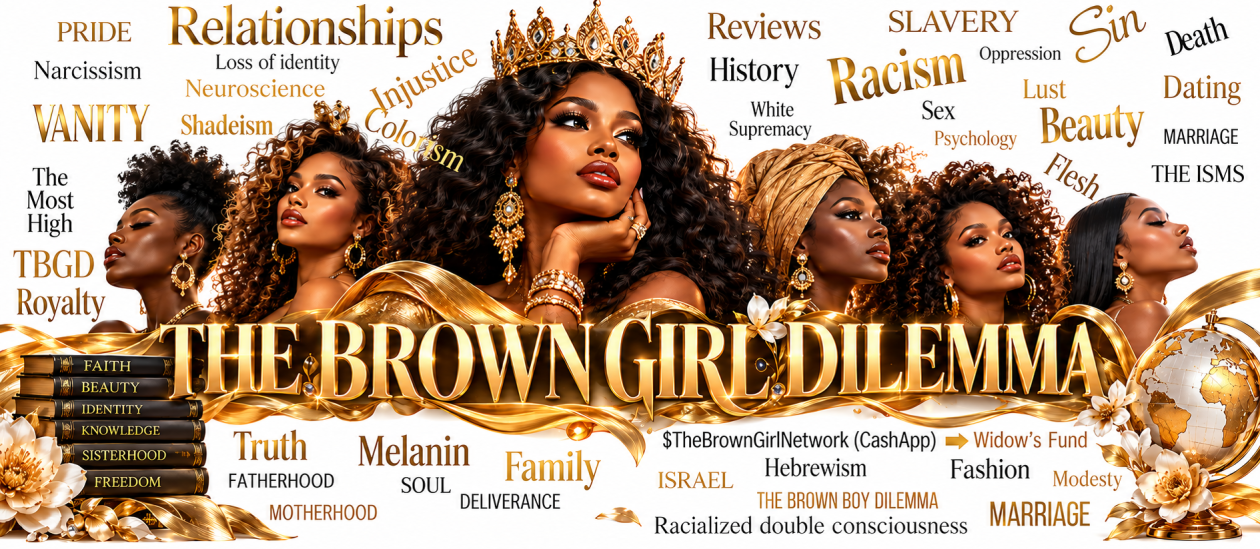

The persistent marginalization of dark-skinned women in the dating landscape is not a superficial issue rooted merely in personal preference; rather, it is a deeply embedded sociocultural and psychological phenomenon shaped by centuries of historical conditioning, media representation, and internalized bias. This dilemma intersects with identity, desirability politics, and spiritual perception, revealing a layered crisis that warrants both cultural critique and biblical examination.
Historically, the roots of colorism can be traced to systems of colonialism and slavery, where proximity to whiteness was equated with value, beauty, and social mobility. Darker skin, by contrast, became associated with labor, subjugation, and inferiority. These early hierarchies did not dissipate with emancipation but instead evolved into internalized standards that continue to influence interpersonal attraction and societal norms (Hunter, 2007).
Within the Black community, colorism operates as a silent hierarchy, often privileging lighter skin tones in media, relationships, and social validation. Studies have shown that lighter-skinned women are more likely to be perceived as desirable partners, reinforcing a cycle where dark-skinned women are overlooked despite possessing equal or greater qualities (Keith & Herring, 1991).
Modern media further exacerbates this imbalance by disproportionately showcasing lighter-skinned or racially ambiguous women as the standard of beauty. Music videos, films, and advertising campaigns subtly communicate that femininity and desirability are aligned with Eurocentric features, leaving darker-skinned women underrepresented or misrepresented (Collins, 2000).
Social media has intensified this issue through filters, editing tools, and algorithmic biases that often favor lighter complexions. The digital age, while offering a platform for visibility, simultaneously reinforces unrealistic and exclusionary beauty ideals that marginalize darker skin tones.
Psychologically, repeated exposure to these standards can lead to internalized colorism, where individuals unconsciously adopt societal biases. This manifests in dating preferences that mirror colonial hierarchies rather than authentic attraction, perpetuating exclusion under the guise of “personal choice” (Fanon, 1967).
From a relational standpoint, dark-skinned women often report feeling invisible or undervalued in dating spaces. This invisibility is not merely anecdotal but supported by research indicating disparities in messaging, matching rates, and perceived attractiveness across skin tones on dating platforms.
Biblically, however, such hierarchies are fundamentally flawed. Scripture consistently emphasizes the inward nature of true beauty and worth. In 1 Samuel 16:7 (KJV), it is written, “for man looketh on the outward appearance, but the Lord looketh on the heart,” challenging superficial standards that dominate modern dating culture.
The Song of Solomon offers a powerful counter-narrative. In Song of Solomon 1:5 (KJV), the Shulamite woman boldly declares, “I am black, but comely,” affirming both her complexion and her beauty without apology. This verse stands as a direct rebuke to colorist ideologies, positioning dark skin as inherently beautiful within a biblical framework.
Furthermore, the biblical concept of love is rooted in covenant, character, and spiritual alignment rather than physical preference alone. Proverbs 31:30 (KJV) states, “Favour is deceitful, and beauty is vain: but a woman that feareth the Lord, she shall be praised,” redirecting the standard of attraction toward reverence for God.
Culturally, the undervaluing of dark-skinned women is also tied to stereotypes that portray them as less feminine, more aggressive, or less desirable. These harmful tropes, often perpetuated through media and societal narratives, distort perception and influence dating behavior.
The intersection of race and gender further complicates this issue. Dark-skinned women face a unique form of discrimination that combines both racism and sexism, often referred to as misogynoir (Bailey, 2013). This dual bias amplifies their marginalization in romantic contexts.
Despite these challenges, there has been a growing movement of affirmation and empowerment among dark-skinned women. Through literature, social media, and community-building, narratives are being reclaimed, and beauty standards are being redefined on their own terms.
Men’s preferences, often cited as justification, must also be critically examined. Preferences do not exist in a vacuum; they are shaped by exposure, conditioning, and societal messaging. Therefore, accountability is necessary in deconstructing biases that contribute to exclusion.
The role of faith communities is equally important. Churches and spiritual spaces have the potential to either reinforce harmful standards or dismantle them through teaching and representation that aligns with biblical truth rather than cultural distortion.
Healing from the impact of colorism requires both individual and collective effort. For dark-skinned women, this may involve reclaiming identity, rejecting societal narratives, and embracing a God-centered understanding of worth and beauty.
For men, particularly within the Black community, it involves introspection and a willingness to challenge internalized biases. True spiritual maturity demands alignment with divine principles rather than cultural conditioning.
Representation also plays a critical role in shifting perceptions. When dark-skinned women are consistently portrayed as beautiful, desirable, and multifaceted, it disrupts entrenched narratives and expands the scope of attraction.
Ultimately, the issue is not a lack of beauty or worth among dark-skinned women but a distortion of perception shaped by historical and cultural forces. Correcting this requires a return to truth—both culturally and biblically.
In conclusion, the overlooking of dark-skinned women in dating is a reflection of deeper societal dysfunction rather than individual deficiency. Through cultural awareness, spiritual alignment, and intentional change, these patterns can be dismantled, paving the way for a more just and truthful understanding of beauty and love.
References
Bailey, M. (2013). Misogynoir transformed: Black women’s digital resistance. New York University Press.
Collins, P. H. (2000). Black feminist thought: Knowledge, consciousness, and the politics of empowerment. Routledge.
Fanon, F. (1967). Black skin, white masks. Grove Press.
Hunter, M. (2007). The persistent problem of colorism: Skin tone, status, and inequality. Sociology Compass, 1(1), 237–254.
Keith, V. M., & Herring, C. (1991). Skin tone and stratification in the Black community. American Journal of Sociology, 97(3), 760–778.
The Holy Bible, King James Version.
Discover more from THE BROWN GIRL DILEMMA
Subscribe to get the latest posts sent to your email.