
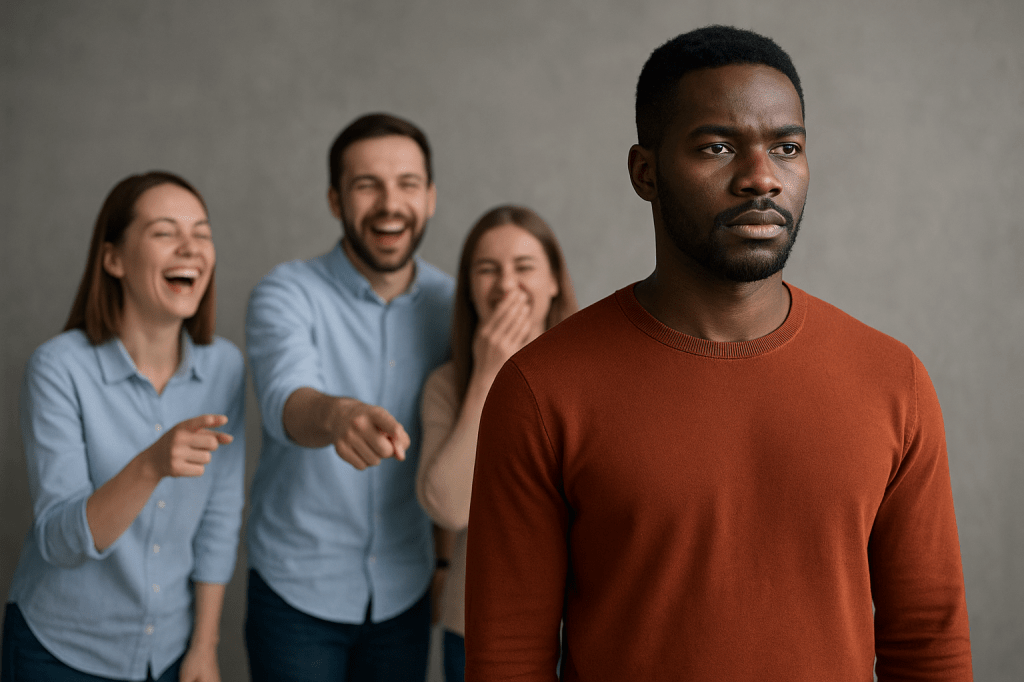
Racist jokes have long been disguised as “harmless humor,” but they are one of the most insidious tools used to maintain racial hierarchies and normalize prejudice. These jokes may seem trivial to those who tell them, yet they carry deep historical and psychological implications that wound the dignity of Black people and other marginalized groups. The failure to challenge such jokes allows racism to flourish in silence, turning laughter into complicity. Racist humor is not merely a matter of taste—it is a form of cultural violence that reinforces systemic oppression (Sue et al., 2019).
At the core of racist jokes lies the dehumanization of others. By reducing a person or group to a stereotype, humor becomes a weapon rather than a bridge. It permits white individuals to reaffirm superiority under the guise of comedy. When these jokes target Black people, they often draw on centuries-old caricatures born from slavery and Jim Crow imagery—depicting Black individuals as lazy, violent, hypersexual, or unintelligent (Pilgrim, 2012). Such portrayals have shaped how society perceives and mistreats Black lives.
Silence in the face of racist jokes is a form of passive racism. When bystanders laugh or remain quiet, they send a message that prejudice is acceptable or trivial. This silence validates the racist sentiment, giving it space to thrive in social and professional environments. The failure to challenge these remarks reflects what Martin Luther King Jr. described as the “appalling silence of the good people”—the moral inaction that sustains injustice (King, 1963).
Examples of racist jokes are numerous and often recycled across generations. Some of the most common include:
- “What do you call a Black pilot? A good example—because you didn’t expect that!”
- “Why don’t Black people like country music? Because every time they say ‘yee-haw,’ someone thinks they’re stealing horses.”
- “How do you starve a Black man? Hide his food stamps under his work boots.”
- “What’s faster than a Black man running with your TV? His mom cashing the check.”
- “Why are Black people afraid of chainsaws? Because they start with the sound ‘Run!’”
- “What’s the difference between Batman and a Black man? Batman can go to the store without Robin.”
- “Why did the Black guy buy a ladder? To get his credit score up.”
- “What do you call a Black man in college? A visitor.”
- “Why don’t Black people like swimming? They don’t want to wash off their color.”
- “What’s the national bird of Black America? The jailbird.”
These examples are painful to read but necessary to expose. Each joke perpetuates a stereotype rooted in anti-Blackness—whether about crime, poverty, education, or worth. They are not mere words; they echo the same ideologies that justified enslavement, segregation, and mass incarceration. Their humor is drawn from the suffering and systemic oppression of Black people.
When racist jokes go unchallenged, they teach observers—especially youth—that racial bias is acceptable. They create cultural permission for future discrimination. What begins as laughter at a “joke” can evolve into bias in hiring decisions, police interactions, or healthcare treatment. Racist humor trains society to see Black pain as entertainment and to dismiss calls for justice as overreactions (Ford & Ferguson, 2004).
Psychologically, racist jokes inflict harm on Black listeners. They reinforce feelings of alienation, shame, and anger. The experience of being mocked or reduced to a stereotype in public settings activates stress responses similar to trauma. Over time, these repeated microaggressions can lead to racial battle fatigue—a state of chronic emotional exhaustion experienced by many Black people navigating white-dominated environments (Smith, 2004).
Sociologically, racist jokes function as bonding rituals among white people. Laughter becomes a shared signal of racial belonging, reinforcing in-group solidarity at the expense of Black humanity. Those who laugh, even uncomfortably, affirm their membership in whiteness. This is why silence is never neutral—it sides with power, not justice. Every unchallenged joke strengthens the invisible architecture of racism in daily life (Billig, 2001).
To overcome this, people must learn to recognize and interrupt racism in real time. The first step is developing moral courage—the ability to speak up even when it feels socially uncomfortable. This can involve simple but firm responses such as: “That’s not funny,” “Why would you say that?”, or “I don’t tolerate racist jokes.” Silence is easy; resistance requires integrity. When someone disrupts the moment, they break the illusion that everyone agrees with the prejudice.
Education also plays a vital role. People must be taught to understand the historical roots of racist humor and how it connects to larger systems of oppression. Anti-racist training, media literacy, and open discussions about bias can dismantle the ignorance that fuels these “jokes.” Understanding that humor has been a tool of white supremacy helps individuals grasp why such comments are never innocent (Hughey & Byrd, 2013).
Accountability must replace passivity. In workplaces, schools, and families, institutions should create clear policies that address discriminatory remarks and jokes. Anti-racism should not be optional—it should be embedded in codes of conduct and enforced through restorative or disciplinary measures. This sends a message that humor is not exempt from ethics.
Healing from the effects of racist humor also requires community solidarity. Black people need spaces where their pain is validated and their identity celebrated. Laughter within Black spaces, however, serves a different function—it becomes an act of resistance and reclamation. When Black comedians address racism, they invert its power by transforming pain into truth-telling and empowerment. The difference lies in who holds the power to define the narrative.
Spiritual and emotional healing are also vital. Scriptures remind believers that “death and life are in the power of the tongue” (Proverbs 18:21, KJV). Racist jokes speak death—death to empathy, to equality, and to the image of God within Black lives. To overcome them, society must relearn the sacred weight of words and choose speech that uplifts rather than degrades.
For white allies, it is essential to examine why silence feels safer than confrontation. Fear of social rejection often outweighs moral responsibility. But true allyship demands discomfort. It means risking relationships to uphold justice and using privilege as a shield for the oppressed rather than a cloak for cowardice.
For Black people, resilience involves not internalizing the lies behind racist humor. These jokes are reflections of ignorance, not truth. Overcoming them means affirming self-worth, reclaiming identity, and surrounding oneself with affirming voices that speak life into Black existence. Education, faith, and cultural pride all serve as antidotes to the poison of ridicule.
On a societal level, challenging racist jokes is a step toward dismantling the normalization of anti-Blackness. When everyday racism becomes unacceptable in private conversations, society takes a measurable step toward equity. The goal is not to police humor but to purify it—to restore its power to unite rather than divide.
In the end, racist jokes are not about laughter but about control. They remind Black people of their supposed “place” in a racial hierarchy that should have been dismantled long ago. To laugh along is to agree; to stay silent is to consent. The only moral option is to challenge it. Every voice raised in truth breaks a link in the chain of systemic racism.
References
Billig, M. (2001). Humor and hatred: The racist jokes of the Ku Klux Klan. Discourse & Society, 12(3), 267–289.
Ford, T. E., & Ferguson, M. A. (2004). Social consequences of disparagement humor: A prejudiced norm theory. Personality and Social Psychology Review, 8(1), 79–94.
Hughey, M. W., & Byrd, W. C. (2013). The souls of white jokes: Whiteness and humor in social media. Ethnic and Racial Studies, 36(10), 1582–1598.
King, M. L. Jr. (1963). Letter from Birmingham Jail.
Pilgrim, D. (2012). The museum of racist memorabilia: The Jim Crow Museum of Racist Imagery. Ferris State University Press.
Smith, W. A. (2004). Black faculty coping with racial battle fatigue: The campus racial climate in a post–civil rights era. New Directions for Teaching and Learning, 2004(98), 27–37.
Sue, D. W., Alsaidi, S., Awad, M. N., Glaeser, E., Calle, C. Z., & Mendez, N. (2019). Disarming racial microaggressions: Microintervention strategies for targets, White allies, and bystanders. American Psychologist, 74(1), 128–142.
Discover more from THE BROWN GIRL DILEMMA
Subscribe to get the latest posts sent to your email.
 THE BROWN GIRL DILEMMA