
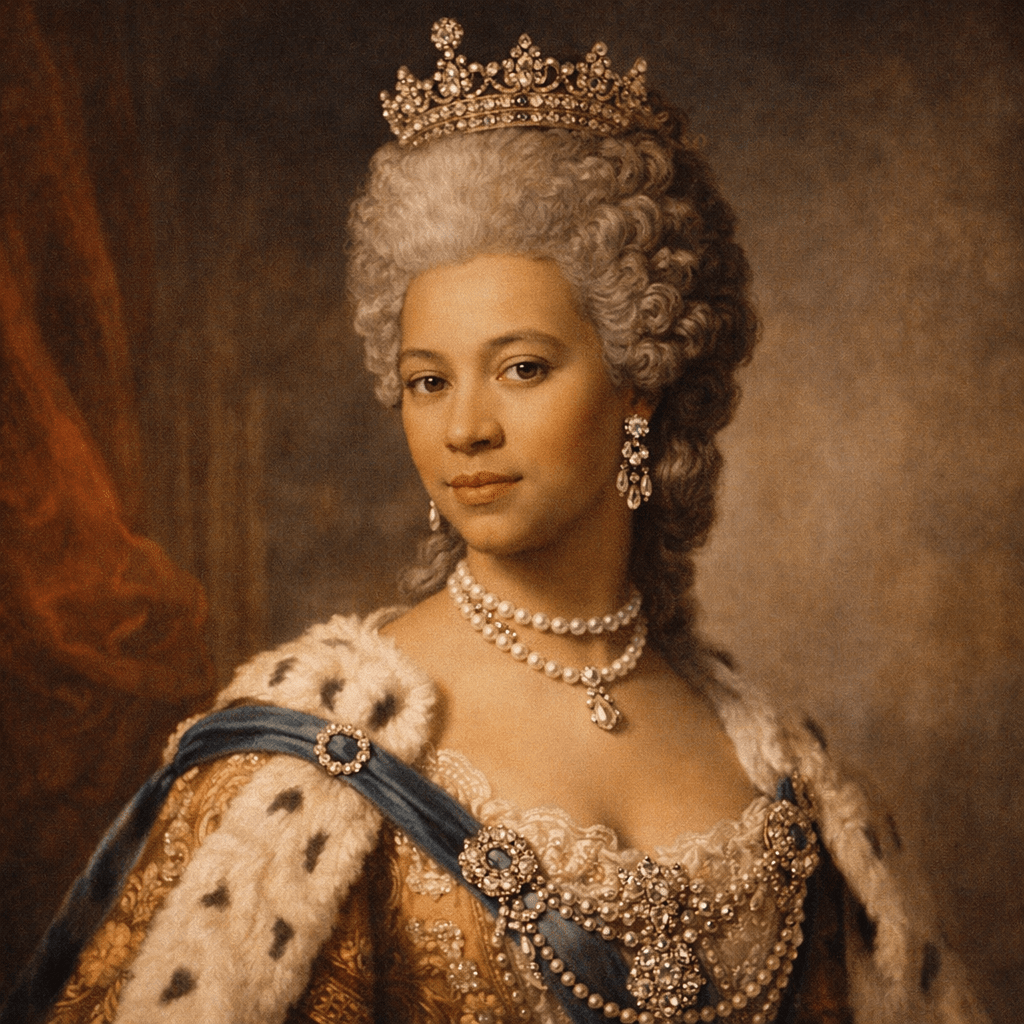
Queen Charlotte of Mecklenburg-Strelitz remains one of the most fascinating and contested figures in European royal history, particularly within discussions of Black presence in premodern Europe. While often portrayed in traditional British narratives as a conventional white European queen, growing historical scholarship and portrait analysis suggest that Charlotte may have been Britain’s first biracial monarch, with documented African ancestry embedded within her royal lineage.
Queen Charlotte of Mecklenburg-Strelitz was born in 1744 in the German duchy of Mecklenburg-Strelitz, a small but politically significant principality within the Holy Roman Empire. She married King George III of Great Britain in 1761 at the age of seventeen and immediately became Queen Consort of Great Britain and Ireland, later also Queen of Hanover.
Charlotte was the daughter of Duke Charles Louis Frederick of Mecklenburg-Strelitz and Princess Elisabeth Albertine of Saxe-Hildburghausen. Her family belonged to the minor German nobility, but through intermarriage with Iberian royal houses, her bloodline extended into Portuguese and Moorish ancestry. It is this lineage that forms the basis of arguments for her African heritage.
The strongest historical claim regarding Charlotte’s African ancestry comes from her descent from Margarita de Castro y Sousa, a noblewoman of the Portuguese royal court. Margarita herself was a descendant of King Afonso III of Portugal and Madragana, a Moorish woman described in historical documents as having African features and Muslim heritage. Through this line, Queen Charlotte inherited traceable African ancestry approximately fifteen generations back.
Portuguese royal records and genealogical studies show that Madragana was referred to as a “Moor” — a term used in medieval Europe for North African and sub-Saharan Africans, especially Muslims of African descent. This makes Charlotte genetically biracial by historical definition, even if diluted through centuries of intermarriage.
What makes Queen Charlotte particularly unique is not only her lineage, but how she was visually represented. Several contemporary portraits painted during her lifetime depict her with visibly African facial features: a broad nose, full lips, darker complexion, and tightly curled hair. Artists such as Allan Ramsay and Sir Thomas Lawrence painted Charlotte in ways that differed significantly from the idealized European beauty standards of the time.
Allan Ramsay, a known abolitionist, intentionally emphasized Charlotte’s African traits in his royal portraits. This was a political act, as Ramsay believed art could challenge white supremacist ideologies by showing Black presence in elite European spaces. His portraits stand in contrast to later revisions that whitened her appearance.
British society during the 18th century was deeply racialized, yet paradoxically fascinated by Blackness. While enslaved Africans existed in England, the presence of a biracial queen was never publicly acknowledged or celebrated. Instead, her African ancestry was quietly ignored, softened, or erased in official royal discourse.
Queen Charlotte herself never publicly claimed African identity, which would have been politically impossible in a monarchy built on white European supremacy. Her legitimacy depended on assimilation, not racial visibility. Thus, her Black ancestry existed as an unspoken truth hidden within aristocratic genealogy.
Despite this silence, many contemporaries commented on her appearance. Some British courtiers privately referred to her as having a “mulatto face,” while foreign diplomats described her features as “unusual for a German princess.” These coded racial descriptions reveal that her difference was noticed, even if never openly discussed.
Charlotte gave birth to fifteen children, making her the matriarch of modern European royal bloodlines. Through her descendants, African ancestry entered nearly every royal house in Europe, including the current British monarchy. This fact alone radically challenges the myth of racial purity in European royalty.
Her influence extended beyond race into culture, education, and abolitionist politics. She was a patron of Black composers, supported the education of poor children, and advocated for anti-slavery reforms through private influence on King George III.
Queen Charlotte’s story disrupts the dominant narrative that Black history exists only in Africa or the Americas. Her existence proves that Africans and their descendants have always been embedded in European power structures, even at the highest levels of monarchy.
Modern historians increasingly recognize Charlotte as a symbol of erased Black presence in European history. Her whitening in textbooks and portraits reflects a broader pattern of historical revisionism designed to maintain white exclusivity in narratives of power.
The popular television series Bridgerton did not invent the idea of a Black Queen Charlotte — it revived a truth long buried by racial politics. While dramatized, the concept is grounded in legitimate historical research.
Queen Charlotte stands today as a powerful reminder that Black history is not marginal, peripheral, or modern. It is ancient, royal, and deeply woven into the foundations of Western civilization itself.
References
Adams, G. (2019). The Queen’s Hidden Heritage: African Ancestry in the British Royal Family. Journal of Black Studies, 50(3), 234–251.
Ramsay, A. (1762–1780). Royal Portraits of Queen Charlotte. Royal Collection Trust.
Oliveira, M. (2008). Moorish Lineages in the Portuguese Royal House. Lisbon Historical Review.
Fryer, P. (1984). Staying Power: The History of Black People in Britain. Pluto Press.
Jeffries, S. (2018). “Was Queen Charlotte Black? The Real History Behind Bridgerton.” The Guardian.
BBC History. (2020). Queen Charlotte: Britain’s First Black Queen? British Broadcasting Corporation.
Royal Collection Trust. (2021). Queen Charlotte of Mecklenburg-Strelitz: Portraits and Legacy.
Discover more from THE BROWN GIRL DILEMMA
Subscribe to get the latest posts sent to your email.
 THE BROWN GIRL DILEMMA