
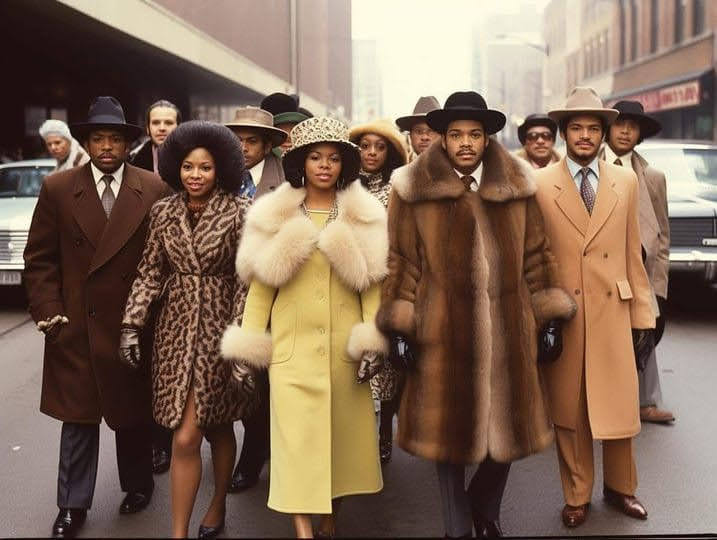
During the late 19th and early 20th centuries, a shadow of division quietly crept into the African American community. While the chains of slavery had been legally broken, psychological and social hierarchies still persisted. One of the most insidious manifestations of this post-slavery prejudice was the emergence of the “Blue Vein Society”—a secretive social circle that privileged lighter-skinned African Americans whose veins were visible through their pale complexion (Williamson, 1980). This phenomenon mirrored the racial stratification of white America and revealed the deep scars of internalized racism within Black society.
The Blue Vein Societies were born during the Gilded Age—a period characterized by industrial growth, wealth disparity, and rampant racial segregation (Painter, 2010). African Americans who had achieved education and modest prosperity sought to establish social institutions mirroring those of the white elite. Yet, these institutions often excluded darker-skinned Blacks, reinforcing a caste system based not on merit or morality, but on melanin. The societies became symbols of self-preservation and self-hatred, embodying the psychological damage of colonial color hierarchies.
Membership in the Blue Vein Society was said to require that one’s veins be visible through the skin—a euphemism for having very light or near-white skin (Gatewood, 1990). In an era when proximity to whiteness determined access to privilege, these societies became a means for some African Americans to distance themselves from the stigma of “blackness.” This reflected how deeply colonial standards of beauty and worth had been internalized, even among the descendants of the enslaved.
The root of such divisions can be traced back to plantation hierarchies. During slavery, lighter-skinned individuals—often the mixed-race children of white masters and enslaved women—were given preferential treatment, often working indoors or receiving limited education (Hunter, 2005). This created a generational mindset that associated lightness with refinement and darkness with inferiority. After Emancipation, this mentality did not vanish; it evolved into social clubs, fraternities, sororities, and churches that subtly practiced “paper bag tests.”
The Blue Vein Societies were not unique but were part of a broader pattern of colorist exclusion. These groups, primarily found in northern cities like Philadelphia, Boston, and Chicago, sought to maintain a certain “respectability” that aligned with white middle-class norms (Higginbotham, 1993). Members prided themselves on “proper” speech, education, and decorum, but often at the expense of racial solidarity.
This internalized hierarchy represented what Frantz Fanon (1952) later described as “epidermalization”—the process by which colonized people internalize the oppressor’s value system, judging themselves and others through the lens of white supremacy. The Blue Vein Society was, in essence, a tragic manifestation of Fanon’s theory—a social structure that perpetuated colonial poison under the guise of Black advancement.
The Gilded Age, with its illusions of progress, masked deep racial inequities. While white elites flaunted wealth and luxury, Black Americans continued to battle economic and social exclusion. Within this struggle, colorism became both a weapon and a wound. For lighter-skinned African Americans, aligning with whiteness offered a semblance of protection, while for darker-skinned individuals, it deepened a sense of marginalization.
The existence of such societies also reveals how European standards of beauty became entrenched across the African diaspora. Straight hair, narrow noses, and fair skin were viewed as desirable attributes. These features were valorized not because they had intrinsic worth, but because they signified proximity to whiteness (Russell, Wilson, & Hall, 1992).
As a result, these beauty ideals infiltrated every sphere of life—from marriage prospects to employment opportunities. The Blue Vein Society not only dictated social status but also influenced the reproduction of colorism across generations. Parents encouraged their children to “marry light,” believing that each union could “improve the race.”
Such ideologies were devastating to racial unity. They fractured communities, creating an invisible caste system among a people already suffering under white supremacy. The irony was cruel: African Americans, who should have been bound by shared struggle and history, found themselves divided by shades of brown.
The Black elite of the Gilded Age—doctors, teachers, preachers, and business owners—often viewed lighter skin as a sign of civilization and intelligence. This belief was not simply vanity; it was a survival mechanism in a society that systematically devalued Blackness (Du Bois, 1903). However, this “double consciousness” produced a spiritual conflict—a yearning for white acceptance while simultaneously grappling with Black identity.
The Blue Vein Society became a metaphor for the fractured soul of post-slavery America. It represented the desperate attempt of a traumatized people to navigate a racist society while unknowingly perpetuating its ideologies. In this sense, colorism was both a symptom and a strategy—a misguided attempt to survive within a system designed to dehumanize.
By the early 20th century, these societies began to wane as new waves of Black consciousness arose. The Harlem Renaissance (1920s) celebrated Black beauty, art, and intellect in all shades. Writers like Langston Hughes and Zora Neale Hurston rejected colorist standards and affirmed the richness of dark skin as a symbol of resilience and creativity.
However, the legacy of the Blue Vein Society lingers. Even today, lighter-skinned privilege continues to shape opportunities in media, beauty, and relationships (Hall, 2010). The colonial poison that once divided plantation slaves now manifests in modern colorist bias within global Black communities.
Understanding the Blue Vein Society requires confronting the painful reality that oppression often breeds mimicry. In the words of Paulo Freire (1970), “The oppressed, instead of striving for liberation, tend to become oppressors of the oppressed.” Within this tragic paradox, we see how systemic racism reproduces itself internally.
It also reveals the long-term psychological toll of slavery and colonization. Generations of African Americans inherited a fractured sense of self—torn between pride in their Blackness and shame imposed by Eurocentric norms.
The Gilded Age’s obsession with refinement and class offered no true liberation. It merely repackaged racism within a Black context. The Blue Vein Society, with all its exclusivity, was not progress—it was assimilation.
Today, scholars and activists call for a reclaiming of identity that honors all shades of African heritage. True empowerment lies not in conforming to colonial aesthetics, but in dismantling them.
In reclaiming “Mama Africa’s legacy,” we must reject the toxic residues of colorism and remember that the measure of worth is not skin tone but spirit, integrity, and faith. The disturbing truth of the Blue Vein Society serves as both a warning and a lesson: healing begins when we confront the mirror of our history without denial.
Ultimately, the story of the Blue Vein Society is a cautionary tale—a reminder that colonialism’s greatest victory was not physical enslavement, but mental division. Only through truth, unity, and cultural reclamation can that legacy finally be undone.
References
Du Bois, W. E. B. (1903). The Souls of Black Folk. Chicago: A.C. McClurg.
Fanon, F. (1952). Black Skin, White Masks. Grove Press.
Freire, P. (1970). Pedagogy of the Oppressed. Herder and Herder.
Gatewood, W. B. (1990). Aristocrats of Color: The Black Elite, 1880–1920. University of Arkansas Press.
Hall, R. E. (2010). The Melanin Millennium: Skin Color as 21st Century International Discourse. Springer.
Higginbotham, E. B. (1993). Righteous Discontent: The Women’s Movement in the Black Baptist Church, 1880–1920. Harvard University Press.
Hunter, M. (2005). Race, Gender, and the Politics of Skin Tone. Routledge.
Painter, N. I. (2010). The History of White People. W. W. Norton.
Russell, K., Wilson, M., & Hall, R. (1992). The Color Complex: The Politics of Skin Color among African Americans. Harcourt Brace.
Williamson, J. (1980). New People: Miscegenation and Mulattoes in the United States. Louisiana State University Press.
Discover more from THE BROWN GIRL DILEMMA
Subscribe to get the latest posts sent to your email.
 THE BROWN GIRL DILEMMA