
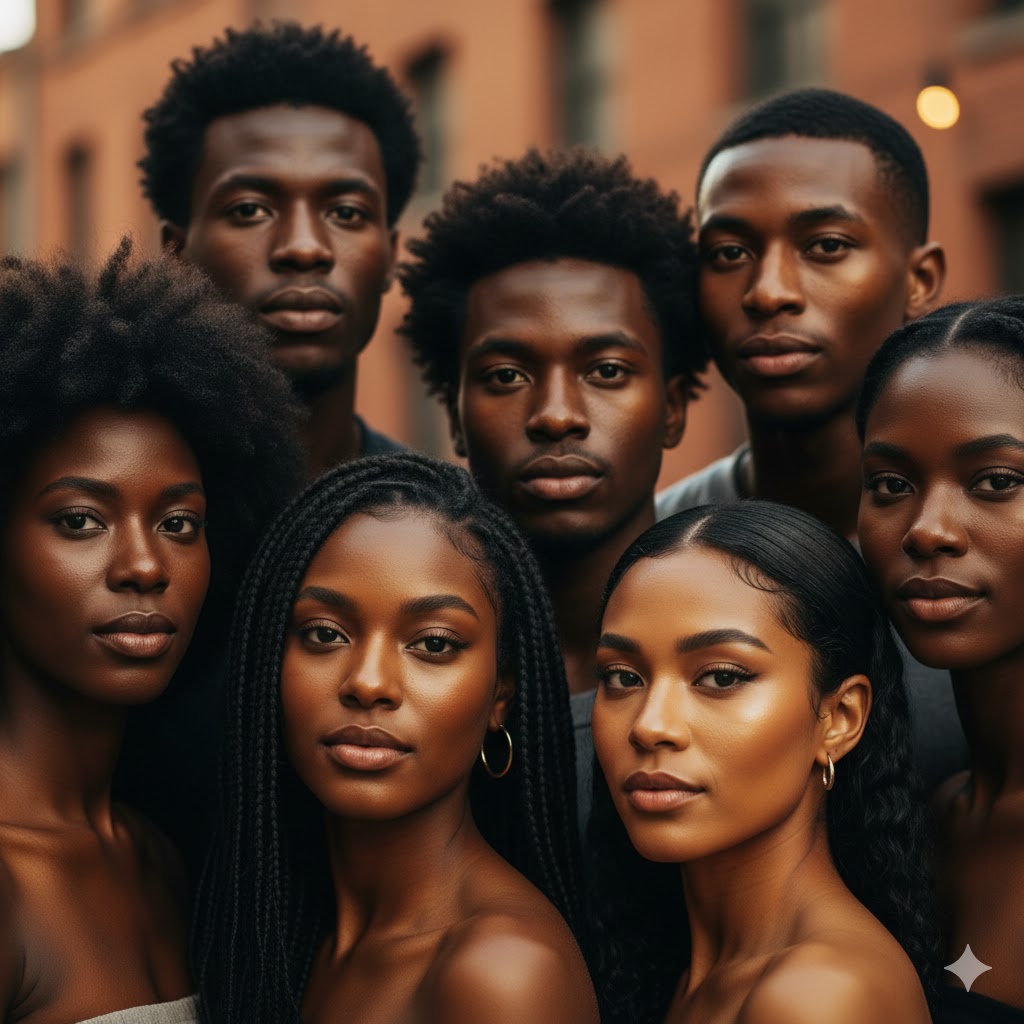
The Brown Standard of beauty is a celebration of melanin-rich aesthetics, cultural heritage, and racial pride. It challenges Eurocentric beauty ideals by centering features historically marginalized yet deeply valued within Black and brown communities. From the warmth of light sun-kissed skin to the richness of deep chocolate tones, from big expressive eyes to small delicate ones, from broad noses to narrow bridges, and from full lips to more subtle contours, the Brown Standard honors the diversity of features shaped by ancestry, environment, and lineage. Hair textures—curly, coily, wooly, and naturally sun-kissed fros—are celebrated as both aesthetic markers and cultural symbols. This standard recognizes beauty not merely as symmetry or proportion but as an embodiment of heritage, identity, and lived experience.
Historically, African civilizations revered features now central to the Brown Standard. Sculptures, carvings, and paintings depict broad noses, full lips, and textured hair as signs of dignity, strength, and nobility. Beauty was intertwined with status, spirituality, and communal values rather than arbitrary or externally imposed standards. As Asante (2003) emphasizes, African societies understood aesthetics as a reflection of balance, harmony, and moral character.
Colorism, however, complicates the Brown Standard. Hunter (2007) observes that lighter skin tones have historically received greater social recognition and privilege, even within communities of color. The Brown Standard emerges as both a reclamation and a counter-narrative: it affirms that beauty exists across the spectrum of melanin-rich skin and that features long devalued by colonial and Eurocentric influence are inherently beautiful.
Socially, the Brown Standard functions as a form of aesthetic capital (Bourdieu, 1986). Individuals embodying these traits often gain visibility, credibility, and social deference within their communities. Big eyes, full lips, and textured hair can signal health, vitality, and cultural alignment. Yet, the standard is not prescriptive; it celebrates diversity and the individuality of melanin-rich features rather than enforcing conformity to a single template.
Psychologically, embracing the Brown Standard enhances self-esteem and cultural pride. Dion, Berscheid, and Walster (1972) demonstrate that perceptions of attractiveness influence assumptions about intelligence, kindness, and capability. In communities honoring the Brown Standard, individuals experience affirmation of their worth, resisting the internalized bias imposed by Eurocentric ideals.
Hair remains one of the most visible markers of the Brown Standard. Natural curls, coils, and fros are celebrated as symbols of authenticity, heritage, and resistance to assimilation. The reclamation of natural hair in recent decades represents both a personal and collective assertion of identity, challenging discriminatory practices in professional, educational, and social contexts (Rhode, 2010).
Facial features such as big eyes and full lips carry expressive power, conveying emotion, vitality, and presence. Broad noses and high cheekbones reflect ancestral lineage and are markers of cultural pride. Each feature contributes to a holistic aesthetic that communicates identity, resilience, and historical continuity.
The Brown Standard also acknowledges the interplay of skin tone and environmental influence. Sun-kissed tones, freckles, and variations in melanin distribution are celebrated as markers of natural beauty rather than flaws. This inclusivity fosters recognition of the wide range of expressions within melanin-rich populations.
Colorism continues to influence access to social and economic opportunities. Hamermesh (2011) notes that lighter-skinned individuals often receive favorable treatment, higher wages, and greater social mobility. The Brown Standard, by affirming the beauty of darker tones, challenges systemic bias and encourages broader societal recognition of diverse aesthetics.
Media representation plays a pivotal role in shaping the Brown Standard. For decades, Eurocentric models dominated television, film, and advertising. However, contemporary Black and brown media increasingly feature melanin-rich beauty in its varied forms, highlighting curly hair, full lips, and diverse skin tones. Representation affirms identity, validates aesthetic preference, and reshapes cultural perceptions.
The spiritual dimension of beauty within the Brown Standard cannot be overlooked. Biblical teachings emphasize that true worth lies in character, integrity, and divine favor rather than external appearance (1 Samuel 16:7). Yet, celebrating the beauty inherent in melanin-rich features aligns with a recognition of God’s creativity and the sacredness of His diverse creation.
Education and cultural discourse are essential to sustaining the Brown Standard. Schools, media, and community institutions can teach the history of Black aesthetics, the social consequences of colorism, and the value of melanin-rich features. Knowledge of ancestral beauty practices reinforces cultural pride and counters internalized bias.
The Brown Standard also intersects with gender. Women, in particular, face societal pressure to conform to Eurocentric ideals, yet embracing features aligned with the Brown Standard fosters empowerment and self-affirmation. Men similarly navigate expectations around masculinity and attractiveness, and recognition of ancestral features enhances confidence and social authority.
Psychologically, the affirmation of the Brown Standard combats feelings of invisibility or inadequacy. When communities celebrate features like sun-kissed fros, curly hair, and full lips, individuals internalize a sense of worth that resists systemic prejudice. This recognition contributes to mental health, social cohesion, and identity formation.
Culturally, the Brown Standard affirms continuity with African and diasporic heritage. Hairstyles, skin tones, and facial features function as living markers of lineage, connecting contemporary individuals to historical identity and ancestral pride. It celebrates the multiplicity of Black and brown beauty without imposing rigid conformity.
Colorism and the fetishization of lighter skin within global contexts reveal the ongoing struggle for equitable recognition. The Brown Standard challenges these hierarchies by emphasizing the legitimacy, attractiveness, and dignity of darker tones. It asserts that all expressions of melanin-rich beauty are valid, desirable, and worthy of visibility.
The Brown Standard also engages with intersectional identity. Skin tone, hair texture, facial features, and body shape intersect with culture, socioeconomic status, and historical context to influence how individuals are perceived. Recognition of this complexity ensures that the Brown Standard honors diversity rather than enforcing a narrow ideal.
Media, fashion, and beauty industries are beginning to reflect the Brown Standard more faithfully. Campaigns featuring a wide spectrum of skin tones, natural hair textures, and facial features expand societal understanding of beauty, affirming that aesthetics rooted in ancestry and melanin are compelling and desirable.
Ultimately, the Brown Standard is not merely a set of physical prerequisites but a holistic framework of cultural pride, identity, and self-affirmation. It celebrates the wide spectrum of melanin-rich skin, curly and wooly hair, big and small eyes, broad and narrow noses, and full or subtle lips. It is a standard grounded in ancestry, history, and lived experience, challenging Eurocentric hierarchies while elevating the dignity and visibility of Black and brown bodies.
In conclusion, the Brown Standard represents the intersection of history, culture, and aesthetics. It affirms the beauty inherent in diversity, the power of melanin-rich features, and the importance of honoring ancestral lineage. By embracing this standard, individuals and communities reclaim identity, resist colorism, and celebrate the unique and radiant expressions of Black and brown beauty.
References
Anderson, T. L., Grunert, C., Katz, A., & Lovascio, S. (2010). Aesthetic capital: A research review on beauty perks and penalties. Sociology Compass, 4(8), 564–575. https://doi.org/10.1111/j.1751-9020.2010.00312.x
Asante, M. K. (2003). The history of Africa: The quest for eternal harmony. Routledge.
Bourdieu, P. (1986). The forms of capital. In J. Richardson (Ed.), Handbook of theory and research for the sociology of education (pp. 241–258). Greenwood Press.
Dion, K., Berscheid, E., & Walster, E. (1972). What is beautiful is good. Journal of Personality and Social Psychology, 24(3), 285–290.
Eagly, A. H., Ashmore, R. D., Makhijani, M. G., & Longo, L. C. (1991). What is beautiful is good, but… A meta-analytic review. Psychological Bulletin, 110(1), 109–128.
Feingold, A. (1992). Good-looking people are not what we think. Psychological Bulletin, 111(2), 304–341.
Hunter, M. (2007). The persistent problem of colorism: Skin tone, status, and inequality. Sociology Compass, 1(1), 237–254. https://doi.org/10.1111/j.1751-9020.2007.00006.x
Langlois, J. H., et al. (2000). Maxims or myths of beauty? Psychological Bulletin, 126(3), 390–423.
Rhode, D. L. (2010). The beauty bias: The injustice of appearance in life and law. Oxford University Press.
Wilson, T. D. (2002). Strangers to ourselves: Discovering the adaptive unconscious. Harvard University Press.
Gafney, W. (2017). Womanist midrash: A reintroduction to the women of the Torah and the Throne. Westminster John Knox Press.
Discover more from THE BROWN GIRL DILEMMA
Subscribe to get the latest posts sent to your email.
 THE BROWN GIRL DILEMMA