
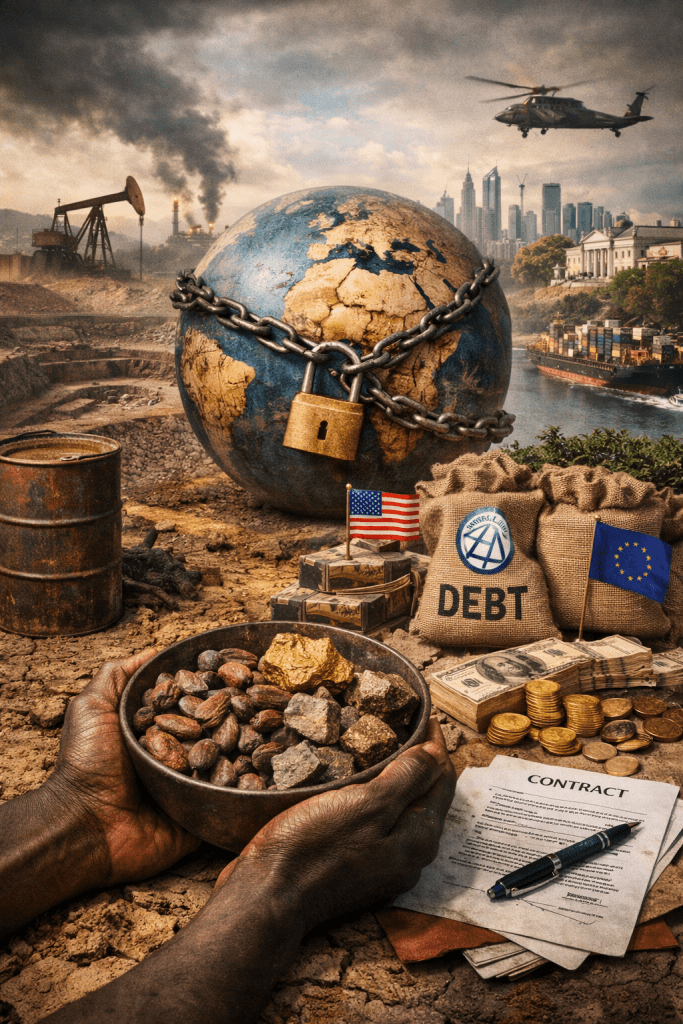
Neocolonialism describes a modern system of domination in which former colonial powers and global institutions maintain control over formerly colonized nations through economic, political, cultural, and psychological means rather than direct rule. Though flags have changed and independence has been declared, power has not been equally redistributed. The dilemma of neocolonialism lies in its invisibility; it operates quietly through contracts, currencies, media, and ideology, making exploitation appear voluntary and progress appear neutral.
Unlike classical colonialism, which relied on overt violence and occupation, neocolonialism thrives on dependency. Developing nations are encouraged to integrate into a global system that is structurally unequal, where the terms of trade, access to capital, and control of resources overwhelmingly favor the Global North. Independence, in this context, becomes symbolic rather than substantive.
Economic neocolonialism is perhaps its most visible manifestation. International financial institutions often impose austerity measures, privatization, and deregulation as conditions for loans, stripping nations of sovereignty over their own economies. These policies frequently benefit multinational corporations while deepening poverty and limiting state capacity to provide education, healthcare, and infrastructure.
Resource extraction remains central to neocolonial control. Many African, Caribbean, and Latin American nations possess vast natural wealth, yet remain impoverished due to exploitative mining contracts, oil concessions, and agricultural monopolies. Raw materials are exported cheaply, processed elsewhere, and sold back at inflated prices, perpetuating unequal exchange.
Currency dependence is another powerful tool of neocolonialism. Systems such as the CFA franc tie African economies to former colonial powers, restricting monetary autonomy and reinforcing external oversight. Control over currency is control over policy, development, and ultimately national destiny.
Political neocolonialism operates through proxy leadership and external influence. Leaders who comply with foreign interests are often supported diplomatically or militarily, while those who resist face sanctions, destabilization, or regime change. Sovereignty becomes conditional upon obedience rather than legitimacy.
Cultural neocolonialism shapes how people see themselves. Western norms of beauty, success, governance, and intelligence are exported globally through media, education, and advertising. Indigenous knowledge systems are marginalized, while Eurocentric frameworks are presented as universal standards.
Language itself becomes a colonial residue. Former colonies often conduct governance, law, and higher education in colonial languages, creating barriers to participation and reinforcing elite dominance. Linguistic hierarchy mirrors power hierarchy, privileging those closest to colonial culture.
Education systems frequently reproduce colonial narratives. Textbooks may minimize imperial violence while glorifying Western “development.” Students are trained to admire foreign models and distrust local solutions, producing generations alienated from their own history and capacity.
Psychologically, neocolonialism cultivates internalized inferiority. Frantz Fanon described this condition as the colonization of the mind, where the oppressed adopt the worldview of the oppressor. This mental dependency sustains material dependency.
Technological neocolonialism has emerged as a new frontier. Data extraction, digital surveillance, and platform monopolies allow corporations to profit from the Global South while controlling information flows. Technology promises liberation but often deepens asymmetry.
Media representation reinforces global hierarchy. Western news outlets frame crises in the Global South as perpetual dysfunction, rarely acknowledging historical causes rooted in imperial exploitation. This narrative justifies continued intervention and control.
Neocolonialism also shapes migration patterns. Economic instability caused by extraction and austerity forces people to migrate, while host nations criminalize them for seeking survival. The system creates displacement and then punishes its victims.
Gender dynamics are not exempt. Neocolonial economies disproportionately exploit women’s labor, particularly in manufacturing, domestic work, and informal markets. At the same time, Western feminism is often exported without regard for local cultural and economic realities.
Environmental degradation is another consequence. Extractive industries devastate land and water, leaving communities with pollution while profits flow outward. Climate vulnerability in formerly colonized regions is inseparable from histories of imperial extraction.
Resistance to neocolonialism takes many forms. Grassroots movements, pan-Africanism, decolonial scholarship, and economic nationalism challenge the status quo. These efforts seek not isolation but equitable participation and self-determination.
True development requires epistemic justice. Valuing indigenous knowledge, local governance models, and culturally grounded solutions disrupts the assumption that progress must mirror Western paths. Decolonization is as much intellectual as it is economic.
Spiritual traditions have long recognized the moral dimensions of exploitation. Biblical teachings condemn unjust weights, usury, and oppression of the poor, affirming that systems built on inequality invite judgment rather than blessing.
The dilemma of neocolonialism persists because it benefits powerful actors while diffusing responsibility. Exploitation is hidden behind contracts, development rhetoric, and globalization. Accountability becomes difficult when domination lacks a single visible ruler.
Breaking free from neocolonialism requires structural change, not symbolic reform. Economic sovereignty, cultural affirmation, political autonomy, and ethical global cooperation must replace dependency and extraction.
Ultimately, neocolonialism challenges humanity to choose between domination and justice. Until power is redistributed and dignity restored, independence will remain incomplete, and freedom will remain conditional rather than lived.
References
Amin, S. (1976). Unequal development: An essay on the social formations of peripheral capitalism. Monthly Review Press.
Fanon, F. (1963). The wretched of the earth. Grove Press.
Fanon, F. (1967). Black skin, white masks. Grove Press.
Nkrumah, K. (1965). Neocolonialism: The last stage of imperialism. Thomas Nelson & Sons.
Rodney, W. (1972). How Europe underdeveloped Africa. Bogle-L’Ouverture Publications.
Said, E. W. (1978). Orientalism. Pantheon Books.
World Bank. (2020). Global economic prospects. World Bank Publications.
The Holy Bible, King James Version. (1611/1987). Cambridge University Press.
Discover more from THE BROWN GIRL DILEMMA
Subscribe to get the latest posts sent to your email.
 THE BROWN GIRL DILEMMA