
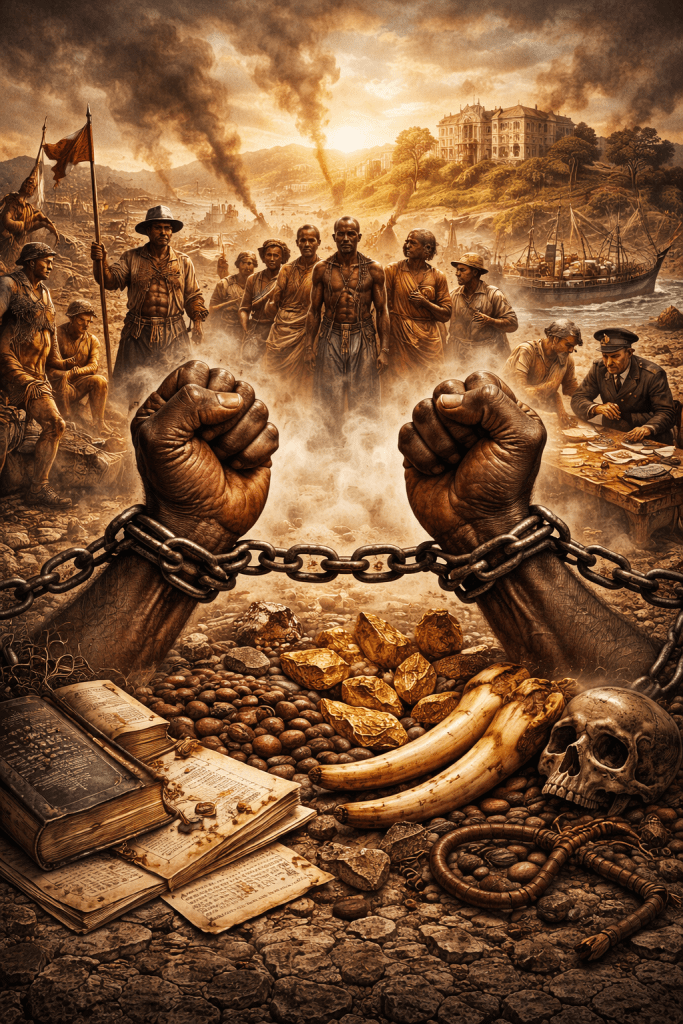
Colonialism represents one of the most enduring and destructive systems in human history, shaping global inequalities that persist long after formal empires collapsed. At its core, colonialism involved the domination of one people by another through force, dispossession, and ideological control. The dilemma of colonialism lies not only in its historical brutality but in its long-term consequences, which continue to structure economic systems, cultural identities, and psychological realities across the modern world.
European colonial expansion was driven by the pursuit of land, labor, and resources, justified through doctrines of racial superiority and civilizational hierarchy. Indigenous societies were not encountered as equals but as obstacles to be conquered or “improved.” This worldview allowed colonial powers to rationalize enslavement, genocide, and cultural erasure as moral and economic necessities.
Economic exploitation was central to the colonial project. Colonized lands were reorganized to serve imperial markets, transforming self-sustaining economies into extractive systems dependent on the export of raw materials. Wealth flowed outward to imperial centers, while poverty was institutionalized in the colonies, laying the groundwork for global inequality.
The transatlantic slave trade functioned as a pillar of colonial capitalism. Millions of Africans were forcibly displaced, commodified, and exploited to fuel plantation economies in the Americas and the Caribbean. This system generated immense wealth for European powers while devastating African societies socially, demographically, and politically.
Colonialism also dismantled indigenous governance structures. Traditional political systems were replaced with colonial administrations designed to extract resources and suppress resistance. Artificial borders divided ethnic groups and forced rival communities into single political units, creating instability that continues to affect postcolonial states.
Cultural domination accompanied economic and political control. Colonial powers imposed their languages, religions, and value systems while denigrating indigenous cultures as primitive or inferior. This process stripped colonized peoples of historical continuity and disrupted intergenerational transmission of knowledge and identity.
Education under colonial rule was not designed to empower but to discipline. Schools trained a small elite to serve colonial administrations while teaching them to internalize European superiority. As Frantz Fanon observed, colonial education often produced alienation rather than enlightenment.
Religion was frequently weaponized to legitimize colonial expansion. Biblical narratives were selectively interpreted to justify conquest, enslavement, and submission. While Christianity offered spiritual comfort to many, it was also used as a tool of social control, obscuring the moral contradictions of colonial violence.
The psychological effects of colonialism were profound. Colonized peoples were subjected to constant messages of inferiority, leading to internalized racism and fractured self-perception. Fanon described this condition as a divided consciousness, where the oppressed come to see themselves through the eyes of the oppressor.
Racial hierarchies were meticulously constructed and enforced. Whiteness became synonymous with intelligence, beauty, and authority, while Blackness and indigeneity were associated with backwardness. These hierarchies did not disappear with independence; they were absorbed into global culture and continue to influence social relations.
Colonialism reshaped gender roles in destructive ways. Indigenous gender systems were often more fluid or complementary, but colonial rule imposed rigid patriarchal norms that marginalized women and erased their leadership roles. Colonial economies also relied heavily on the exploitation of women’s labor.
Environmental destruction was another hallmark of colonial rule. Land was treated as property rather than a sacred resource, leading to deforestation, soil depletion, and ecological imbalance. These practices prioritized short-term profit over sustainability, leaving lasting environmental scars.
Resistance to colonialism was constant, though often erased from dominant historical narratives. Enslaved Africans revolted, indigenous peoples fought invasions, and anti-colonial movements emerged across continents. Freedom was not granted by empires; it was wrested through struggle and sacrifice.
The transition from colonial rule to independence was frequently incomplete. Many nations inherited economies designed for extraction, not development, and political systems modeled on colonial governance. Independence without structural transformation left former colonies vulnerable to continued domination.
Colonial legacies remain visible in global wealth disparities. Former colonial powers continue to benefit from accumulated capital, while former colonies face debt, underdevelopment, and external interference. These inequalities are not accidental but historical outcomes of exploitation.
Colonialism also distorted historical memory. Textbooks and public narratives often minimize imperial violence while celebrating exploration and “progress.” This selective memory impedes reconciliation and allows injustice to persist without accountability.
From a moral and spiritual perspective, colonialism represents a profound violation of divine principles of justice and human dignity. Scripture condemns oppression, theft, and the exploitation of the vulnerable, warning that nations built on injustice cannot stand indefinitely.
The dilemma of colonialism is not simply whether it was harmful, but whether the world is willing to confront its consequences honestly. Apologies without reparative action risk becoming symbolic gestures rather than pathways to healing.
Decolonization requires more than political independence. It demands economic justice, cultural restoration, psychological healing, and historical truth-telling. Without these elements, colonialism merely changes form rather than ending.
Ultimately, colonialism challenges humanity to reckon with power, morality, and memory. Until its legacies are addressed with humility and justice, the wounds it created will continue to shape the present, reminding the world that history is never truly past.
References
Fanon, F. (1963). The wretched of the earth. Grove Press.
Fanon, F. (1967). Black skin, white masks. Grove Press.
Nkrumah, K. (1965). Neocolonialism: The last stage of imperialism. Thomas Nelson & Sons.
Rodney, W. (1972). How Europe underdeveloped Africa. Bogle-L’Ouverture Publications.
Said, E. W. (1978). Orientalism. Pantheon Books.
Smith, A. (1776/2007). An inquiry into the nature and causes of the wealth of nations. MetaLibri.
The Holy Bible, King James Version. (1611/1987). Cambridge University Press.
Discover more from THE BROWN GIRL DILEMMA
Subscribe to get the latest posts sent to your email.
 THE BROWN GIRL DILEMMA