
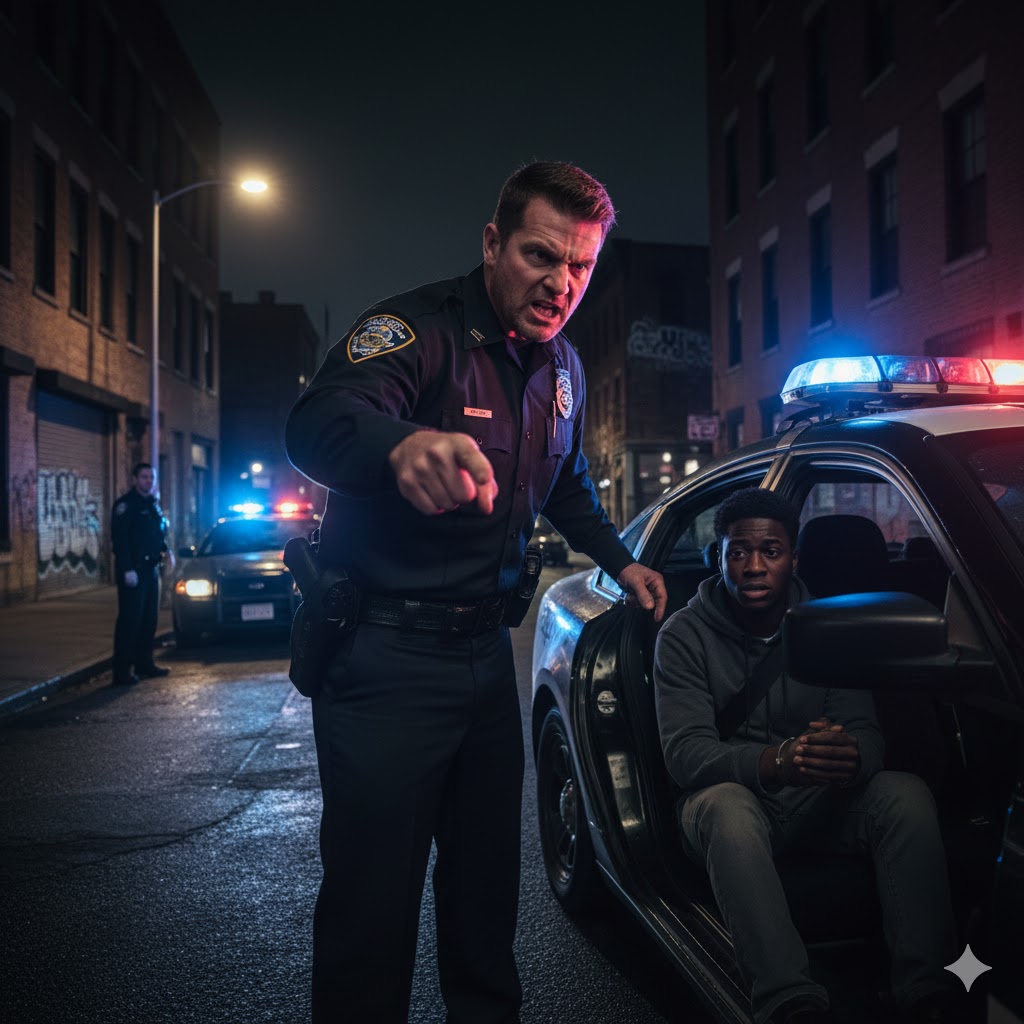
Police harassment of Black Americans remains a pressing moral, social, and structural crisis in the United States. It is not limited to isolated incidents, but reflects recurring patterns of enforcement, disrespect, and disproportionate force, tied intimately to racialised histories and institutional practices. Understanding why this occurs demands engagement with racism, power, training, neighbourhood conditions, and the embedded culture of policing.
One reason police harassment happens with such frequency and racial skew is the legacy of racialised policing practices—rooted in slave patrols, segregation era policing, and the enforcement of racial hierarchy. These historical antecedents help explain why Black people are often treated as suspects, targets, or threats rather than equal citizens. The institutional memory of policing still carries layers of the “othering” of Black bodies.
Data show the disparity clearly. According to the Prison Policy Initiative, in 2022, Black people were over three times as likely as white people to experience the threat or use of force in their most recent police encounter. Prison Policy Initiative. The same dataset found that Black people reported higher rates of being handcuffed, searched, or having weapons used against them, even when controlling for initiation.
Another survey revealed that 42 % of African Americans said they personally experienced unfair treatment by police—being stopped, searched, questioned, physically threatened, or abused. Among those, 22 % reported such mistreatment in the past year. Equity in America. A separate poll found that 24 % of young Black adults reported being harassed by police, compared to significantly lower rates among whites. PBS
More dramatically, research from the Harvard T.H. Chan School of Public Health shows that Black Americans are approximately 3.23 times more likely than white Americans to be killed during a police encounter. Harvard Public Health. Meanwhile, a database from Statista indicates that in 2024 to November, there were 277 Black people killed by police in the U.S., at a rate of 6.2 per million, compared to 2.4 per million for white Americans. Statista
Why do so many officers harass Black people or treat them more harshly? There are several interacting factors: implicit and explicit racial bias, discretionary power in stops/searches/enforcement, law enforcement cultures that valorise control and suspicion, and the spatial realities of policing in predominantly Black communities. Research using smartphone data showed police presence is higher in Black neighbourhoods after controlling for density and crime—thus exposure alone increases the chance of harassment. arXiv
Police discretion plays a major role: when an officer stops an individual, the decision to search, question, or use force is shaped by perceptions of threat, compliance, demeanour—and research suggests that for Black individuals, this threshold is lower. A large‑scale study of state patrol stops found that Black drivers were stopped, searched, and arrested at higher rates than white drivers, controlling for many variables. arXiv
The institutional placement of many police forces in neighbourhoods with concentrated disadvantage and racial segregation exacerbates the dynamic. Black communities have historically been over‑policed, under‑resourced, and subject to environmental stressors—thus law enforcement becomes a vector of control rather than a partner of community safety. The deployment patterns, stop frequencies and local enforcement priorities all contribute to disparate harassment outcomes.
The role of racism is foundational. Racism doesn’t mean every officer consciously hates Black people, but it means the system of policing—and the broader criminal‐legal system—is structured in ways that devalue Black lives, normalise suspicion of Black persons, and grant officers broad latitude to treat Black bodies as less deserving of dignity. The repeated pattern of harassment, stops, searches, and use of force underscores this structural dimension.
Harassment is not just about physical force—it includes psychological stress, demeaning interaction, being treated like a criminal before any crime is committed, being over‐policed for minor infractions, and being more likely to have force used or threatened. The cumulative effect of multiple daily exposures to disrespect and coercion produces what some scholars call “racialised trauma”.
Consider the case of George Floyd. On May 25, 2020, George Floyd, a 46‑year‑old Black man, was arrested by the Minneapolis Police Department after being accused of using a counterfeit $20 bill. Officer Derek Chauvin, who is white, pressed his knee into Floyd’s neck for over nine minutes while Floyd was handcuffed and lying face down. Floyd repeatedly said he could not breathe. Al Jazeera+2PBS+2
Chauvin was found guilty on all charges—second‑degree unintentional murder, third‐degree murder, and second‐degree manslaughter—on April 20, 2021. PBS+1 He was later sentenced to 22.5 years in prison. Al Jazeera The case became a global symbol of police violence against Black people and sparked huge protests through the Black Lives Matter movement and beyond.
The Floyd case illustrates many of the themes of harassment: an officer treating a Black man as a threat, using excessive force, ignoring pleas of distress, and being held accountable only after overwhelming public outrage and video evidence. It reminds us that even when overt hatred may not be the driver, the system allows and legitimates harassment.
In analysing harassment, one must note that harassment in policing doesn’t just occur in fatal encounters. The bulk of harassment consists of non‑fatal stops, handcuffing, searches, threats of force, shouting and demeaning conduct. The 2022 Survey by the Bureau of Justice Statistics (via Prison Policy Initiative summary) found that Black people experienced enforcement actions in 18 % of street stops (versus 15 % for whites) and 8 % were searched or arrested (versus 6 % for whites). Prison Policy Initiative
Educationally and economically, the toll of police harassment is severe. Black individuals facing repeated policing are more likely to experience stress, distrust of legal institutions, disruption in job search or mobility, and negative health outcomes—including heightened risk of hypertension, mental‑health disorders and premature mortality. The linkage from harassment to broader life outcomes is increasingly recognised in social science.
From a theological perspective, the dignity of Black persons is undermined when harassment becomes routine. The imago Dei (Genesis 1:27) is ignored when state agents treat Black bodies as disposable or suspect. The prophetic tradition calling for justice (Isaiah 1, Amos 5) demands that the church and polity recognise and resist the systemic dehumanisation of Black people through police harassment.
In practical terms, addressing police harassment requires multi‑layered reform: changing officer training and culture; limiting discretionary stops, searches and use of force; increasing accountability and transparency; reducing over‑policing of Black neighbourhoods; empowering community oversight; and de‑racialising perceptions of threat. Structural changes must accompany individual reform.
The dilemma remains deeply stubborn because the system of policing is woven into larger economic, social, and racial structures: poverty, residential segregation, educational inequality and criminal‐legal system entanglement. Reform of policing alone, without addressing these root conditions will not fully dismantle the pattern of harassment.
In sum, police harassment of Black Americans is not an occasional anomaly but a predictable outcome of racialised policing, discretion, structural inequality, and institutional culture. The data confirm what lived experience tells us: Black people are more likely to be stopped, searched, threatened, handcuffed, and killed by police than white people—simply because they are Black. The case of George Floyd underscores the severity of the consequences when the system fails utterly. Recognition, repentance, systemic reform, and reparative action are necessary if we are to move toward justice.
References
- Phillips, C., Goel, S., et al. (2017). A large‑scale analysis of racial disparities in police stops across the United States. arXiv. Retrieved from https://arxiv.org/abs/1706.05678 arXiv
- Chen, M. K., Christensen, K. L., John, E., Owens, E., & Zhuo, Y. (2021). Smartphone data reveal neighborhood‑level racial disparities in police presence. arXiv. Retrieved from https://arxiv.org/abs/2109.12491 arXiv
- Poll: 7 in 10 Black Americans say they have experienced incidents of discrimination or police mistreatment in their lifetime, including nearly half who felt their lives were in danger. (2020, June 18). Kaiser Family Foundation. Retrieved from https://www.kff.org/racial-equity-and-health-policy/press-release/poll‑7‑in‑10‑black‑americans‑say‑they‑have‑experienced‑incidents‑of‑discrimination‑or‑police‑mistreatment‑in‑their‑lifetime‑including‑nearly‑half‑who‑felt‑their‑lives‑were‑in‑danger/ KFF
- Two‑thirds of African Americans know someone mistreated by police, and 22 % report mistreatment in the past year. (n.d.). Equity in America. Retrieved from https://equityresearch.tufts.edu/two‑thirds‑of‑african‑americans‑know‑someone‑mistreated‑by‑police‑and‑22‑report‑mistreatment‑in‑past‑year/ Equity in America
- What the data shows about police use of force by race. (2023, May 8). USAFacts. Retrieved from https://usafacts.org/articles/what-the-data-shows-about-police-use-of-force-by-race/ USAFacts
- Nearly a quarter of young Black people say they’ve been harassed by police, poll finds. (2016, August 31). PBS NewsHour. Retrieved from https://www.pbs.org/newshour/nation/young-black-adults-less-trusting-police-poll-finds/ PBS
- What to know about the charges in the Derek Chauvin trial. (2021). CBS News. Retrieved from https://www.cbsnews.com/news/derek-chauvin-trial-george-floyd-death-jurors-charges/ CBS News
- “Two Black Americans comprise 13 % of the U.S. population, yet data suggests they represent 23 % of those fatally shot by police officers.” (2022). Police Interactions and the Mental Health of Black Americans: A Systematic Review. PubMed. Retrieved from https://pubmed.ncbi.nlm.nih.gov/31482464/ PubMed
Discover more from THE BROWN GIRL DILEMMA
Subscribe to get the latest posts sent to your email.
 THE BROWN GIRL DILEMMA