
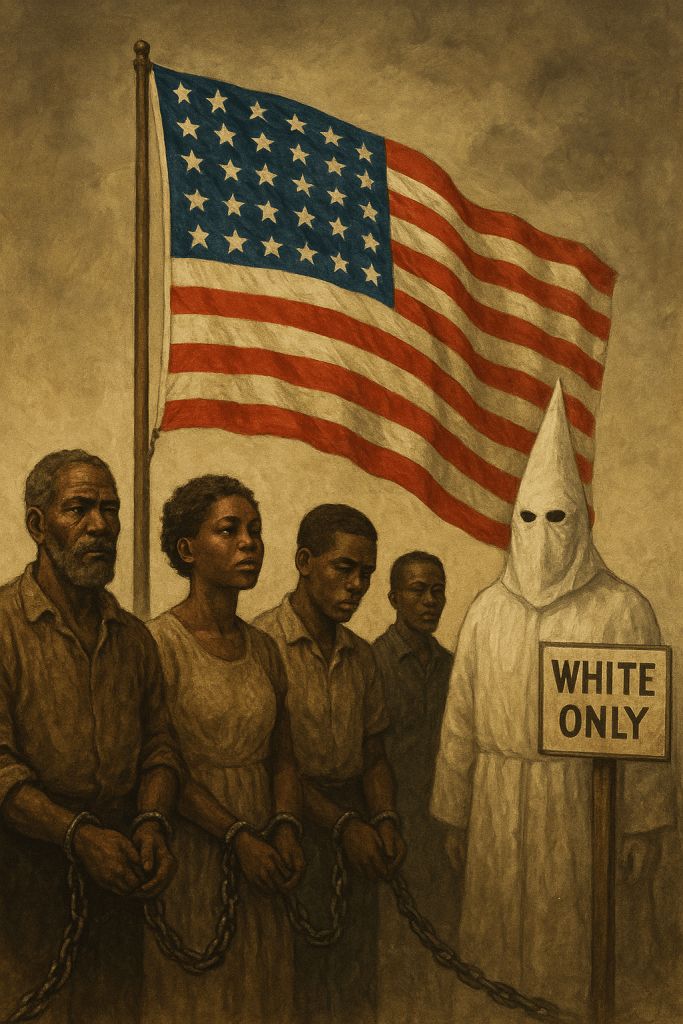
American exceptionalism is the belief that the United States occupies a unique moral, political, and historical position among nations. Rooted in Puritan theology, Enlightenment ideals, and revolutionary mythology, it has long framed the nation as chosen, exemplary, and destined for leadership. This belief has functioned as both a guiding philosophy and a civic religion, shaping national identity and public policy across generations.
At its best, American exceptionalism has inspired aspirational ideals. The language of liberty, equality, and self-governance provided a moral vocabulary that fueled abolitionism, civil rights movements, and democratic reforms. By holding itself to a proclaimed higher standard, the nation created a framework through which citizens could critique injustice and demand alignment between principle and practice.
The Declaration of Independence stands as a canonical text of exceptionalist thought, asserting universal rights while situating the American experiment as historically unprecedented. This rhetoric energized oppressed groups who invoked its promises to expose hypocrisy. Frederick Douglass’s famous question—what to the slave is the Fourth of July—demonstrates how exceptionalist ideals could be turned inward as a moral indictment rather than an excuse for complacency.
Yet American exceptionalism has also functioned as an altar upon which truth is sacrificed. When national myth hardens into unquestionable dogma, it suppresses historical accountability. Slavery, Indigenous dispossession, segregation, and imperial expansion were often justified or minimized under the assumption that America’s intentions were inherently benevolent, regardless of outcomes.
The doctrine has repeatedly blurred the line between patriotism and moral exemption. Foreign interventions, from Manifest Destiny to twentieth-century wars, were frequently framed as civilizing missions rather than power pursuits. Exceptionalism provided the moral cover for empire, allowing violence to be narrated as virtue and domination as destiny.
Domestically, exceptionalism has obscured structural inequality. The insistence that America is uniquely free and just has been used to delegitimize claims of systemic racism, economic exploitation, and gender inequality. If the nation is already exceptional, then disparities are framed as personal failures rather than institutional designs.
This mindset has been particularly damaging to Black Americans. The contradiction between exceptionalist rhetoric and lived reality produced what W.E.B. Du Bois called “double consciousness,” a constant negotiation between national belonging and exclusion. Black resistance movements have historically navigated the tension between appealing to American ideals and rejecting America’s false innocence.
American exceptionalism also reshaped capitalism into a moral narrative. Wealth accumulation became equated with virtue, and poverty with moral deficiency. The “American Dream” promised upward mobility while masking the racialized and class-based barriers that structured opportunity. Exceptionalism thus sanctified inequality under the guise of meritocracy.
In education, exceptionalist narratives often sanitize history. Textbooks emphasize triumph while minimizing atrocity, creating citizens who inherit pride without responsibility. This selective memory weakens democratic capacity, as honest self-critique is replaced with defensive nationalism.
Religiously, exceptionalism has fused with Christian nationalism, transforming the state into a quasi-divine instrument. Biblical language of chosenness has been selectively applied to America, displacing its original covenantal context. This theological distortion elevates the nation above moral law rather than subjecting it to prophetic judgment.
The psychological effects of exceptionalism are equally profound. It fosters cognitive dissonance when reality contradicts belief, leading to denial rather than reform. Citizens may experience identity threat when confronted with injustice, responding with hostility instead of empathy.
Globally, exceptionalism damages credibility. When the United States preaches democracy while tolerating human rights abuses at home and abroad, its moral authority erodes. Allies perceive hypocrisy, while adversaries exploit inconsistency, weakening international trust.
However, rejecting blind exceptionalism does not require abandoning national aspiration. A critical patriotism can preserve ethical commitment without mythological arrogance. Nations, like individuals, mature through accountability rather than denial.
Some scholars argue for a post-exceptionalist identity grounded in democratic humility. This approach views the United States not as above history but within it—capable of learning from other nations and from its own marginalized voices. Such humility strengthens rather than weakens democratic life.
The civil rights movement offers a model of reformed exceptionalism. Leaders like Martin Luther King Jr. appealed to America’s professed ideals while exposing its moral bankruptcy. Their vision did not worship the nation; it called it to repentance.
In this sense, American exceptionalism becomes most ethical when desacralized. When stripped of infallibility, it can function as an aspirational ethic rather than a shield against critique. The danger lies not in national ideals, but in their absolutization.
The future of American democracy depends on whether exceptionalism remains an altar or becomes a mirror. A mirror reflects both beauty and blemish, demanding growth. An altar demands worship and excuses failure.
Ultimately, the question is not whether America is exceptional, but how it understands exceptionality. If exceptionalism justifies power without justice, it corrodes the nation’s soul. If it compels responsibility proportional to power, it may yet serve a moral purpose.
The effects of American exceptionalism are therefore paradoxical. It has empowered liberation and legitimated oppression, inspired reform and excused violence. Its legacy demands discernment rather than devotion.
A transformed national consciousness would replace myth with memory, arrogance with accountability, and supremacy with service. Only then can the United States pursue greatness without sacrificing truth upon the altar of its own exceptionalism.
References
Appleby, J. (2018). The virtues of liberalism. Oxford University Press.
Bellah, R. N. (1967). Civil religion in America. Daedalus, 96(1), 1–21.
Du Bois, W. E. B. (1903). The souls of Black folk. A.C. McClurg & Co.
King, M. L., Jr. (1963). Why we can’t wait. Harper & Row.
Lipset, S. M. (1996). American exceptionalism: A double-edged sword. W.W. Norton.
Mills, C. W. (1997). The racial contract. Cornell University Press.
Zinn, H. (2003). A people’s history of the United States. HarperCollins.
Discover more from THE BROWN GIRL DILEMMA
Subscribe to get the latest posts sent to your email.
 THE BROWN GIRL DILEMMA