
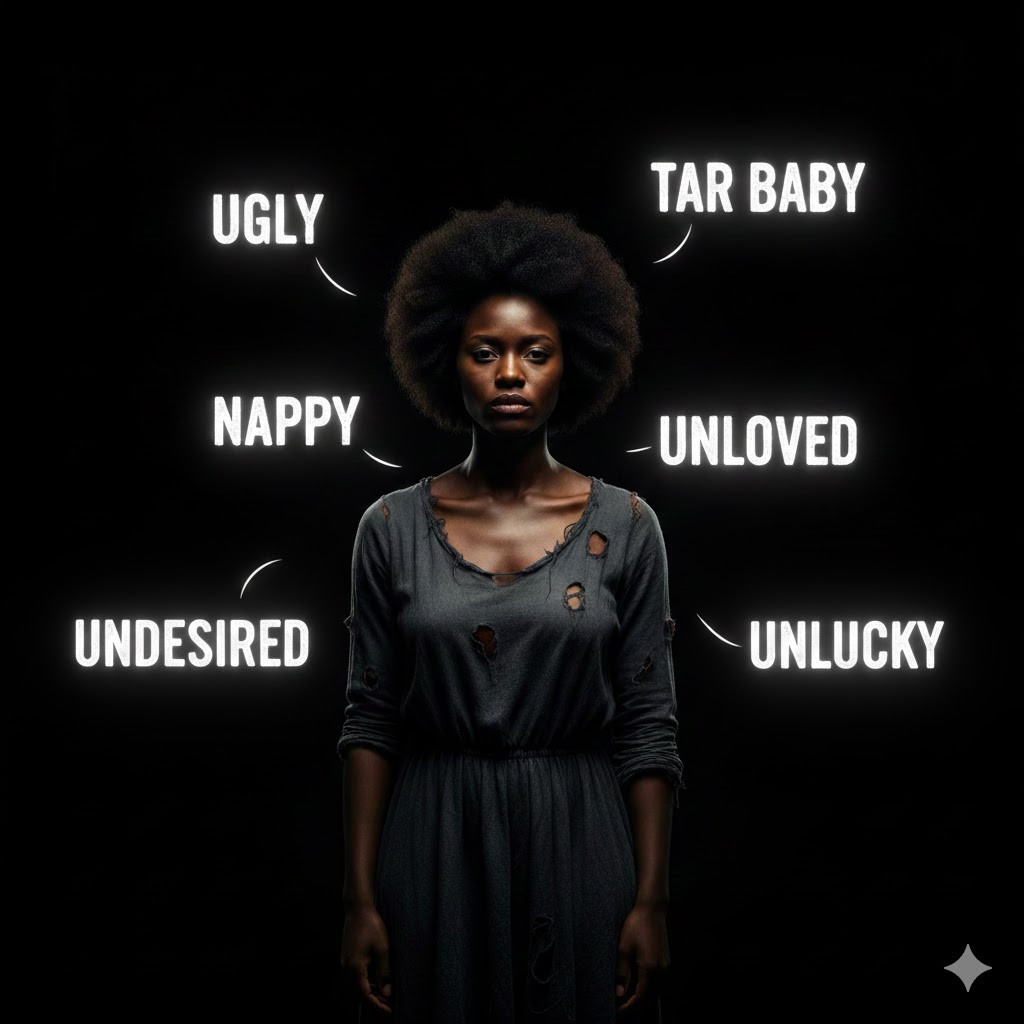
The dark skin penalty refers to the systematic disadvantages imposed on individuals with darker complexions within societies shaped by white supremacy and colonial hierarchy. Unlike overt racism, this penalty operates subtly, often normalized as preference or coincidence, yet its consequences are profound and measurable. It represents the inverse of light skin privilege and functions as a social tax placed on visible Blackness.
Historically, the dark skin penalty was engineered during slavery and colonialism, where darkness was equated with inferiority, savagery, and danger. European racial ideology constructed Blackness as a problem to be controlled, while lighter skin was positioned as closer to civility and trustworthiness. These ideas were enforced through law, theology, and violence.
Within slavery, darker-skinned enslaved people were disproportionately assigned to the most brutal labor, exposed to harsher punishment, and denied even marginal privileges afforded to lighter-skinned individuals. Darkness became associated with disposability, while lighter skin functioned as a buffer within the racial caste system.
After emancipation, these hierarchies did not dissolve. They were absorbed into Black communities as internalized beliefs. Dark skin came to symbolize struggle, unattractiveness, and threat, while lightness symbolized opportunity. This psychological inheritance transformed external oppression into internal policing.
Beauty standards remain one of the most visible expressions of the dark skin penalty. Darker-skinned women are frequently excluded from dominant beauty narratives, described as less feminine, less soft, or less desirable. Empirical research confirms that darker skin is rated as less attractive due to entrenched Eurocentric aesthetics (Hunter, 2007).
In romantic and marital contexts, darker-skinned women experience higher rates of rejection and lower likelihood of marriage offers. They are often sexualized without being valued for long-term partnership, reflecting a dehumanizing pattern rooted in colonial hypersexualization (Russell et al., 1992).
Darker-skinned men also bear a severe penalty. They are more likely to be perceived as aggressive, criminal, or intellectually inferior. These stereotypes follow them into schools, workplaces, and public spaces, shaping expectations and treatment regardless of behavior.
The criminal justice system magnifies this penalty. Studies demonstrate that darker-skinned Black men receive longer sentences and harsher punishment than lighter-skinned Black men for similar crimes, revealing that skin tone itself influences legal outcomes (Monk, 2019).
In the job market, darker skin correlates with lower wages, fewer promotions, and higher unemployment rates. Employers often unconsciously associate darker skin with incompetence or danger, despite identical credentials (Monk, 2014). Professionalism becomes racially coded.
Educational environments also reflect this bias. Darker-skinned children are disciplined more harshly, perceived as less capable, and tracked into lower academic pathways. Early exposure to penalty shapes confidence and long-term achievement.
Within families, the dark skin penalty is often reinforced through differential treatment. Darker-skinned children may receive less praise, harsher discipline, or fewer resources, while lighter-skinned siblings are protected and celebrated. These dynamics communicate worth long before language can articulate it.
The psychological consequences are severe. Dark-skinned individuals face higher risks of depression, anxiety, and diminished self-esteem due to chronic devaluation. Fanon described this as epidermalization of inferiority, where the body itself becomes a site of shame (Fanon, 1952).
Media representation compounds the penalty. Darker-skinned people are underrepresented or typecast as villains, aggressors, or side characters, while lighter-skinned individuals dominate narratives of love, success, and heroism. Repetition normalizes hierarchy.
Spiritually, the dark skin penalty contradicts biblical truth. Scripture affirms that God is no respecter of persons and judges by the heart rather than appearance (1 Samuel 16:7; Acts 10:34, KJV). Color-based judgment is therefore a moral failure.
The Bible explicitly condemns partiality. James warns that favoring one person over another based on external markers makes one guilty of sin (James 2:1–9, KJV). Colorism violates divine law as surely as overt injustice.
The dark skin penalty fractures communal solidarity. It redirects pain inward, encouraging comparison and resentment rather than collective resistance. This fragmentation benefits oppressive systems by weakening unity.
Healing requires intentional confrontation of these biases. Naming the penalty dismantles denial. Silence allows harm to masquerade as normalcy. Scripture teaches that truth precedes freedom (John 8:32, KJV).
Cultural restoration demands redefining beauty, intelligence, and worth outside colonial frameworks. African history and theology affirm darkness as original, powerful, and divine in its own right (Diop, 1974).
Psychological healing must accompany social reform. Therapeutic approaches that address racial trauma align with Scripture’s call for renewal of the mind (Romans 12:2, KJV). Without healing, internalized penalty persists even in success.
The abolition of the dark skin penalty requires both structural change and spiritual repentance. Institutions must address bias, and individuals must unlearn inherited hierarchies. Liberation is incomplete without both.
Ultimately, the dark skin penalty is not a reflection of deficiency but of distortion. It reveals the depth of colonial damage, not the worth of those who bear it. Divine justice demands its dismantling.
Until dark skin is affirmed as fully human, fully beautiful, and fully worthy, inequality will continue to reproduce itself within oppressed communities. God’s standard remains unchanged: all flesh stands equal before Him.
References
The Holy Bible, King James Version. (1611). Various passages.
Russell, K., Wilson, M., & Hall, R. (1992). The color complex: The politics of skin color among African Americans. Anchor Books.
Hunter, M. (2007). “The persistent problem of colorism.” Sociology Compass, 1(1), 237–254.
Monk, E. P. (2014). “Skin tone stratification among Black Americans.” Social Forces, 92(4), 1317–1337.
Monk, E. P. (2019). “The color of punishment.” Ethnic and Racial Studies, 42(10), 1593–1612.
Fanon, F. (1952). Black skin, white masks. Grove Press.
Cross, W. E. (1991). Shades of Black: Diversity in African-American identity. Temple University Press.
Diop, C. A. (1974). The African origin of civilization: Myth or reality. Lawrence Hill Books.
Wilkerson, I. (2020). Caste: The origins of our discontents. Random House.
Discover more from THE BROWN GIRL DILEMMA
Subscribe to get the latest posts sent to your email.
 THE BROWN GIRL DILEMMA