
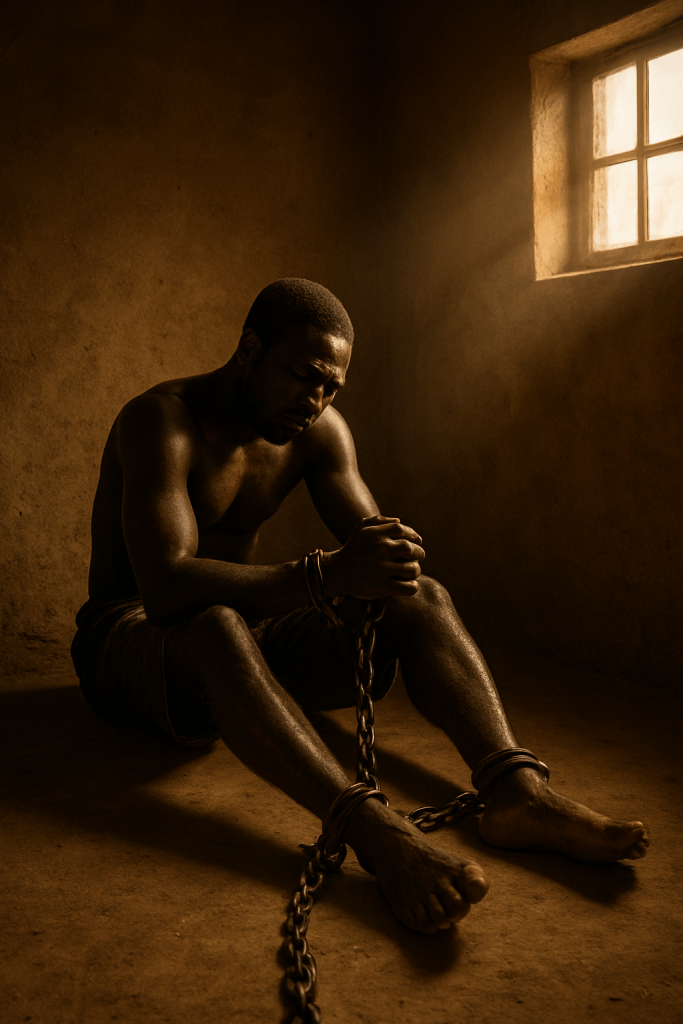
The dilemma of forced diaspora stands as one of the most defining and devastating realities in human history, particularly for African-descended peoples whose displacement reshaped the modern world. This rupture was not merely geographic but spiritual, psychological, and generational, severing people from land, language, kinship systems, and sacred memory.
Diaspora, in its truest sense, implies scattering. Forced diaspora, however, denotes violent expulsion—movement without consent, carried out through domination, coercion, and terror. The transatlantic slave trade exemplifies this condition, transforming human beings into cargo and redefining captivity as commerce.
Within the Hebrew Bible, displacement functions as both a consequence and a warning. Deuteronomy 28 in the King James Version presents blessings for obedience and curses for disobedience, culminating in exile, captivity, and foreign domination. The chapter is not abstract theology; it is historically grounded prophecy rooted in covenantal law.
Deuteronomy 28 begins with prosperity and national elevation, but the latter portion details systematic collapse. Hunger, poverty, loss of sovereignty, and enslavement emerge as consequences when a people fall under divine judgment. These themes recur throughout biblical history, particularly in the experiences of Israel.
Verse 48 declares that the people would serve enemies “in hunger, and in thirst, and in nakedness, and in want of all things,” while verse 68 foretells transportation into bondage by ships. This specific imagery has drawn sustained attention in diasporic biblical interpretation.
The reference to ships in Deuteronomy 28:68 is striking, as captivity in the ancient Near East was typically overland. The verse’s maritime language suggests a future mode of enslavement distinct from earlier Assyrian or Babylonian exiles, intensifying its interpretive gravity.
The Middle Passage, spanning the fifteenth through nineteenth centuries, involved the forced shipment of millions of Africans across the Atlantic Ocean. Conditions aboard slave ships included extreme overcrowding, disease, starvation, and death, reflecting the dehumanization described in Deuteronomy’s curses.
Men, women, and children were chained in holds, stripped of identity, and reduced to inventory. The loss of names, languages, and familial ties parallels the biblical language of becoming “a byword and a proverb” among nations, as stated in Deuteronomy 28:37.
The Middle Passage was not an isolated event but the center of a global economic system dependent upon forced labor. European empires extracted wealth through plantations, mines, and infrastructure built upon the backs of enslaved Africans.
Forced labor in the Americas mirrored the biblical description of unrelenting servitude. Enslaved people labored without rest, legal protection, or compensation, echoing Deuteronomy 28:65, which describes no ease, trembling hearts, and failing eyes.
The plantation system institutionalized violence, sexual exploitation, and family separation. Children were sold away from parents, marriages were unrecognized, and kinship networks were deliberately destroyed to prevent resistance.
This systematic breaking of family structures resonates with Deuteronomy 28:32, which warns that sons and daughters would be given to another people, with no power to rescue them. The verse reflects a loss of agency that defined chattel slavery.
Forced diaspora also produced cultural amnesia. African cosmologies, languages, and governance systems were suppressed, replaced by imposed identities rooted in racial hierarchy. Yet fragments survived through music, oral tradition, and spiritual practice.
The introduction of Christianity to enslaved Africans occurred within contradiction. While Scripture was used to justify bondage, enslaved people discerned liberation themes within the text, identifying with Israel’s suffering and hope for deliverance.
Biblical narratives of exile—from Egypt to Babylon—offered frameworks for understanding suffering without surrendering dignity. The God who judged also promised restoration, a tension deeply embedded in Deuteronomy 30’s assurance of return.
Forced diaspora produced a transnational Black identity forged through shared trauma. Though stripped of homeland, African-descended peoples formed new cultures across the Caribbean, South America, and North America.
Resistance took many forms, including revolts, maroon societies, work slowdowns, and spiritual endurance. These acts challenged the totalizing power of forced labor systems and affirmed retained humanity.
Economic exploitation under slavery laid the foundation for modern global capitalism. Wealth extracted from forced labor financed industrialization, universities, banks, and nation-states, while the enslaved inherited poverty.
The end of legal slavery did not end the conditions described in Deuteronomy 28. Sharecropping, convict leasing, segregation, and mass incarceration functioned as continuations of forced labor under new legal frameworks.
Psychological captivity followed physical captivity. Generations internalized narratives of inferiority imposed to rationalize enslavement, fulfilling Deuteronomy 28:34, which speaks of madness for the sight of one’s eyes.
The forced diaspora fractured identity, producing questions of origin, belonging, and purpose. Many descendants of the enslaved continue to search archives, DNA, and Scripture for an ancestral connection.
Theological interpretations linking Deuteronomy 28 to the African diaspora remain contested, yet their persistence reflects an attempt to reconcile history with sacred text. For many, Scripture becomes a map through trauma.
The curse language of Deuteronomy is inseparable from covenant responsibility. In biblical theology, judgment is never arbitrary; it functions as correction rather than annihilation.
Importantly, Deuteronomy 28 does not conclude Israel’s story. Later prophets promise regathering, healing, and restoration, emphasizing divine faithfulness beyond punishment.
Forced diaspora, while devastating, did not erase African-descended peoples. Survival itself stands as testimony to resilience under conditions designed to destroy.
Cultural contributions born from displacement—music, language, theology, and political thought—have reshaped global civilization, often without acknowledgment of their origins.
Memory remains central to healing. To remember the Middle Passage is to resist erasure and affirm the humanity of those who endured it.
Scripture, when read with historical awareness, becomes a site of reckoning rather than oppression. Deuteronomy 28 challenges readers to confront how power, obedience, and justice intersect.
The dilemma of forced diaspora persists in contemporary inequalities, reminding the world that history is not past. The echoes of ships, chains, and fields remain embedded in modern systems.
Yet the biblical narrative insists that captivity is not the final word. Justice, restoration, and truth remain integral to divine order.
Forced diaspora stands as both a warning and a witness—a warning against unchecked power and a witness to the enduring strength of a people who survived the unthinkable.
References
The Holy Bible, King James Version. (1611/1769). Deuteronomy 28–30.
Curtin, P. D. (1969). The Atlantic slave trade: A census. University of Wisconsin Press.
Gomez, M. A. (2005). Reversing sail: A history of the African diaspora. Cambridge University Press.
Smallwood, S. E. (2007). Saltwater slavery: A middle passage from Africa to American diaspora. Harvard University Press.
Williams, E. (1944). Capitalism and slavery. University of North Carolina Press.
Discover more from THE BROWN GIRL DILEMMA
Subscribe to get the latest posts sent to your email.
 THE BROWN GIRL DILEMMA