
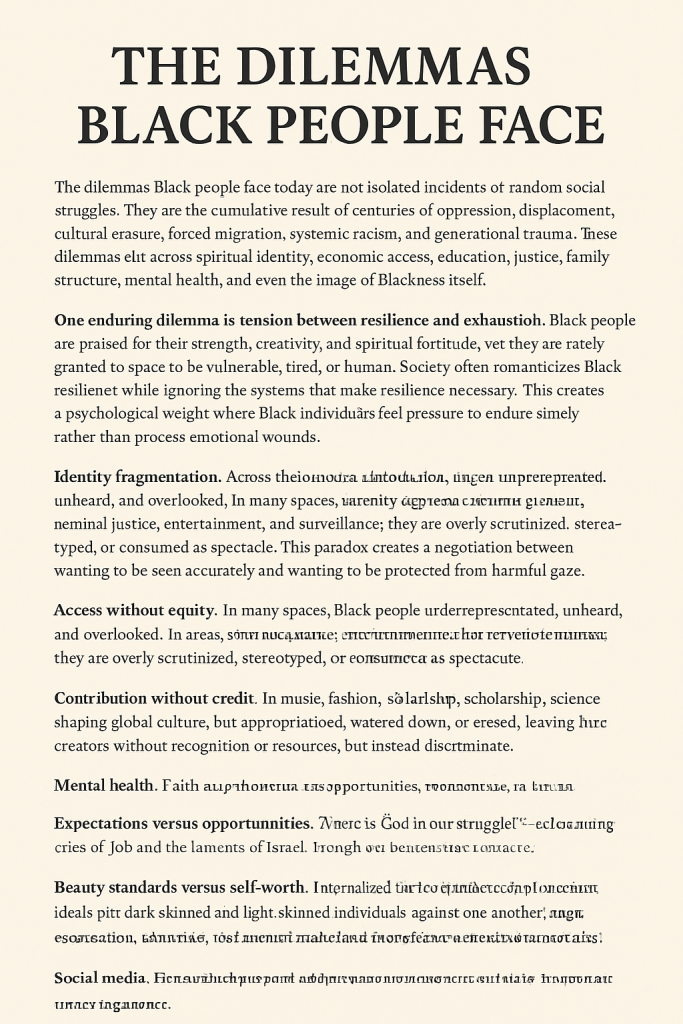
The dilemmas Black people face today are not isolated incidents or random social struggles. They are the cumulative result of centuries of oppression, displacement, cultural erasure, forced migration, systemic racism, and generational trauma. These dilemmas cut across spiritual identity, economic access, education, justice, family structure, mental health, and even the image of Blackness itself. They form a complex landscape that Black people must navigate daily while still fighting to build dignity, community, and hope.
One enduring dilemma is the tension between resilience and exhaustion. Black people are praised for their strength, creativity, and spiritual fortitude, yet they are rarely granted the space to be vulnerable, tired, or human. Society often romanticizes Black resilience while ignoring the systems that make resilience necessary. This creates a psychological weight where Black individuals feel pressure to endure silently rather than process emotional wounds.
Another dilemma lies in the legacy of identity fragmentation. Across the diaspora, Black people wrestle with questions of origin, belonging, and cultural continuity. The transatlantic slave trade severed language, history, names, and lineage—leaving many African Americans searching for spiritual and ancestral clarity. This leads to an internal conflict between who society has labeled them to be and who they truly are in God, history, and heritage.
Black people also face the dilemma of visibility versus hypervisibility. In many spaces, they are underrepresented, unheard, and overlooked. In other areas—such as criminal justice, entertainment, and surveillance—they are overly scrutinized, stereotyped, or consumed as spectacle. This paradox creates a constant negotiation between wanting to be seen accurately and wanting to be protected from harmful gaze.
Economically, the dilemma of access without equity remains a major barrier. While Black people may have access to schools, jobs, loans, and housing on paper, systemic practices—such as redlining, wage gaps, discriminatory hiring, and unequal school funding—undermine true equality. The presence of opportunity does not guarantee fairness, and this gap breeds frustration, fatigue, and generational stagnation.
Culturally, Black people face the dilemma of contribution without credit. From music to fashion, science scholarship, the Black world has shaped global culture. Yet those contributions are often appropriated, watered down, or erased, leaving Black creators without recognition or resources. Even in faith spaces, Black biblical history is minimized despite its foundational importance.
Within families, Black communities often face dilemmas created by historical disruption, including mass incarceration, economic instability, and systemic attacks on the Black home. These pressures can create strain in marriages, parenting, and generational continuity, forcing Black families to build structure while battling forces that aim to dismantle it.
Spiritually, there is a dilemma between faith and suffering. Black people often ask, “Where is God in our struggle?”—echoing the cries of Job and the laments of Israel. Yet faith has also been a source of resistance, identity, and liberation throughout Black history. The struggle lies in reconciling divine purpose with earthly injustice.
Colorism creates another dilemma: beauty standards versus self-worth. Internalized Eurocentric ideals can pit dark-skinned and light-skinned individuals against one another, producing wounds that trace back to slavery’s hierarchy. This dilemma shapes relationships, confidence, employment, desirability, and mental health.
In the area of justice, Black people face the dilemma of legal rights versus lived reality. Though laws promise equality, the outcomes—from traffic stops to sentencing—tell a different story. This dissonance reinforces a mistrust in systems meant to protect but instead discriminate.
Mental health remains a growing dilemma, as Black people contend with trauma, stress, discrimination, financial pressure, and societal expectations, all while lacking equitable access to culturally relevant care. Silence around therapy and emotional vulnerability can hinder healing.
Educationally, Black students face the dilemma of expectations versus opportunities. While excellence is often demanded, support is not always given. This leads to underfunded schools, biased assessments, and unequal advancement.
Social media has introduced new dilemmas—hyperexposure, comparison culture, cyberbullying, and the performative nature of modern identity. Though it allows Black voices to rise, it also magnifies criticism, competition, and unrealistic ideals.
And at the heart of all dilemmas lies a deeper spiritual one: the ongoing struggle for self-definition. Black people are constantly reclaiming a narrative that the world has tried to rewrite. This dilemma fuels movements, art, scholarship, and faith-based awakenings that reconnect Black people to origin, dignity, and divine purpose.
Despite these challenges, Black people continue to rise, resist, create, and believe. The dilemmas are real, but so is the power, brilliance, and spiritual calling placed upon the descendants of survival.
References
Alexander, M. (2010). The new Jim Crow: Mass incarceration in the age of colorblindness. The New Press.
Branch, T. (1988). Parting the waters: America in the King years, 1954–1963. Simon & Schuster.
Du Bois, W. E. B. (1903). The souls of Black folk. A. C. McClurg & Co.
hooks, b. (1995). Killing rage: Ending racism. Henry Holt.
Painter, N. I. (2006). Creating Black Americans: African-American history and its meanings. Oxford University Press.
Wilkerson, I. (2020). Caste: The origins of our discontents. Random House.
Woodson, C. G. (1933). The mis-education of the Negro. Associated Publishers.
Discover more from THE BROWN GIRL DILEMMA
Subscribe to get the latest posts sent to your email.
 THE BROWN GIRL DILEMMA