
The white gaze is a historical and sociological concept that refers to the way white society observes, defines, and judges Black identity. From the transatlantic slave trade to modern mass media, the white gaze has consistently imposed labels and expectations on Black people that serve to uphold systems of power and control. In this view, Black identity is not self-determined, but rather constructed as “the other,” existing in opposition to whiteness.
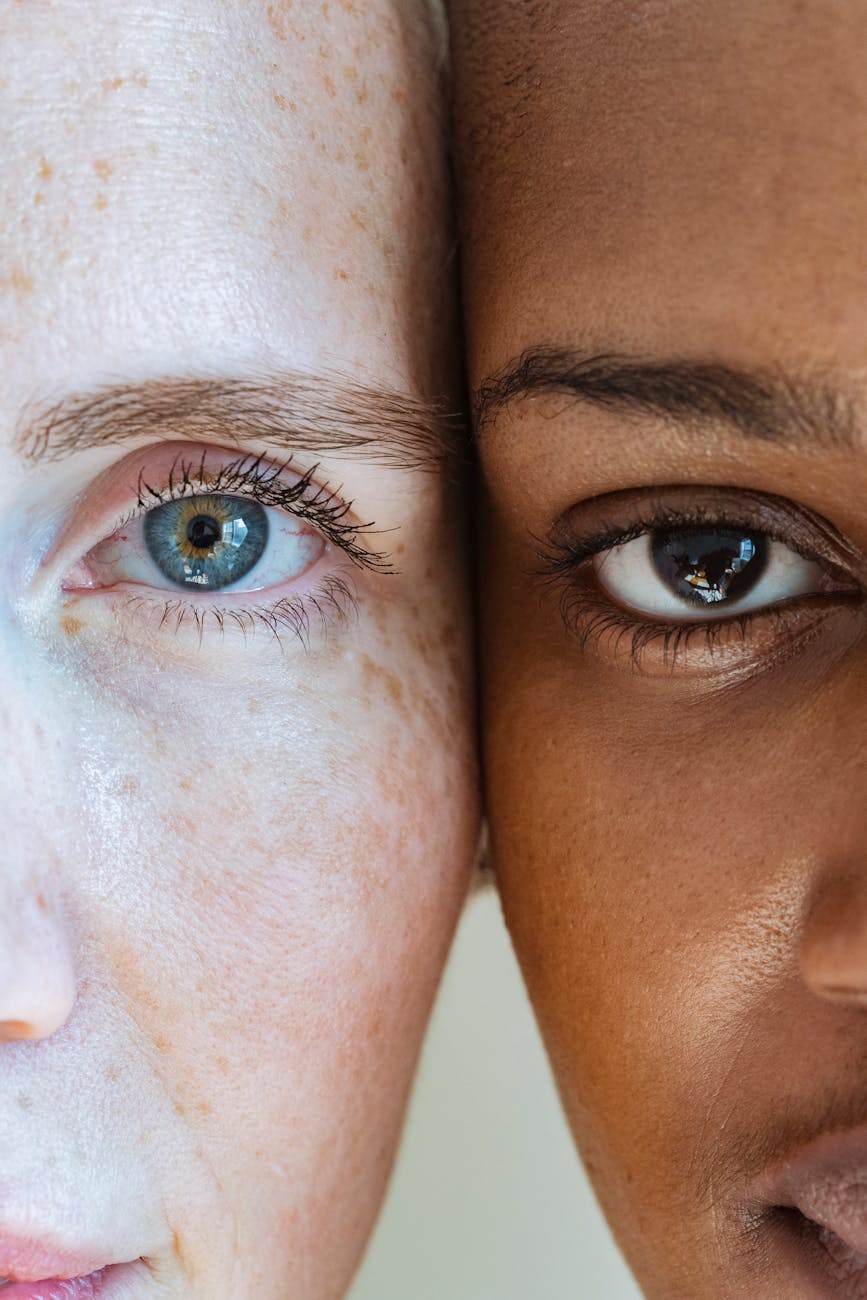
The Black gaze, however, is a complicated internalization of both pride and pain. On one hand, it represents the self-awareness and affirmation of Blackness in defiance of systemic oppression. On the other, it can mirror internalized racism and colorism, as members of the Black community sometimes measure one another by proximity to white standards. The tension between the white gaze and the Black gaze creates an ongoing struggle for authenticity and wholeness.
Under the white gaze, all Black people are lumped into one category regardless of complexion, culture, or background. From slavery’s “one-drop rule” to Jim Crow’s “separate but equal,” whiteness has historically reduced Black identity to an object of suspicion, inferiority, or exoticism. This dehumanization was designed to rationalize inequality and maintain white dominance.
The Black gaze developed in resistance but also in fragmentation. Within Black communities, hierarchies of skin tone, hair texture, and cultural expression have often reproduced divisions. While these divisions are rooted in historical oppression, they nevertheless create cycles of mistrust and judgment. The “brown skin paradox” of being not light enough and not dark enough reflects this painful reality.
To understand the white gaze, one must acknowledge its function as surveillance and control. The white gaze is not neutral—it polices how Black people dress, speak, and behave. Even today, racial profiling, biased policing, and workplace discrimination reflect the persistence of the white gaze in shaping opportunities and consequences.
In contrast, the Black gaze, when rooted in empowerment, serves as a mirror of resilience. Black communities have created beauty, culture, and art that redefine standards outside of whiteness. Music, literature, and fashion have all been tools of resistance, reclaiming dignity from the distortions of the white gaze. Yet, the challenge remains: how to cultivate a gaze that unifies rather than divides.
Colorism complicates the Black gaze. Preference for lighter skin or “good hair” reflects the lingering influence of slavery, when proximity to whiteness often meant access to privilege. These divisions persist in families, dating preferences, and media representation. Such internal hierarchies weaken collective strength and hinder healing.
The Bible speaks directly to division and partiality. James 2:9 (KJV) declares, “But if ye have respect to persons, ye commit sin, and are convinced of the law as transgressors.” Favoritism based on appearance, whether by white supremacy or internal colorism, stands against God’s standard of justice. In Christ, identity is not measured by skin but by spirit.
Healing begins when the lies of both gazes are rejected. For Black people, this means no longer seeking validation through whiteness or competing for approval based on complexion. It requires embracing the truth of Psalm 139:14 (KJV): “I will praise thee; for I am fearfully and wonderfully made: marvellous are thy works; and that my soul knoweth right well.” Every shade is a reflection of divine craftsmanship.
Unity cannot come without truth. John 8:32 (KJV) proclaims, “And ye shall know the truth, and the truth shall make you free.” The truth is that white supremacy has always sought to divide and weaken, and that internalized division only strengthens the oppressor. Recognizing this truth is the first step to dismantling false gazes.
Healing also requires forgiveness, though not in the sense of forgetting history or ignoring injustice. Forgiveness, in this context, means refusing to allow bitterness to define identity. As Ephesians 4:31-32 (KJV) teaches, believers are called to “put away all bitterness, and wrath, and anger” and to “forgive one another, even as God for Christ’s sake hath forgiven you.” Unity comes when past wounds do not dictate future relationships.
Education is a tool for liberation. By learning the history of the white gaze and its impact, Black communities can understand the roots of division and resist repeating them. Teaching children the beauty of all shades and the worth of all features is a radical act of healing. Representation matters, but affirmation within families and communities matters even more.
Economics and justice are also part of healing. Unity requires advocating for equity in schools, workplaces, and the justice system. To confront the white gaze is to challenge systemic racism. To reform the Black gaze is to dismantle intra-community prejudices. Both are necessary for collective progress.
The role of the church is critical. Too often, churches have ignored or even perpetuated colorism and division. Yet the church is uniquely positioned to proclaim Galatians 3:28 (KJV): “There is neither Jew nor Greek, there is neither bond nor free, there is neither male nor female: for ye are all one in Christ Jesus.” The gospel calls for a unity that transcends race and shade without denying the realities of oppression.
Art, music, and storytelling play a role in reshaping the gaze. From gospel music to hip hop, Black creativity has always been a means of healing and protest. These cultural expressions disrupt the white gaze and provide spaces where Black identity is celebrated authentically. They remind the world that Blackness is not a monolith but a mosaic.
Unity requires humility. Healing cannot come if individuals cling to pride or superiority based on shade or proximity to whiteness. Philippians 2:3 (KJV) instructs, “Let nothing be done through strife or vainglory; but in lowliness of mind let each esteem other better than themselves.” This humility is the foundation of reconciliation within the community.
Healing also requires love. 1 Peter 4:8 (KJV) declares, “And above all things have fervent charity among yourselves: for charity shall cover the multitude of sins.” Love must be the lens through which the Black gaze is redefined—not as a competition of shades, but as a celebration of shared struggle, heritage, and destiny.
When the white gaze is dismantled and the Black gaze is purified, unity becomes possible. This unity is not uniformity but strength in diversity. It acknowledges pain but refuses to be imprisoned by it. It reclaims agency and affirms that every shade is essential to the collective story.
Ultimately, healing and unity require centering identity in God rather than in human gazes. To be seen by God, rather than to live under the gaze of man, is true freedom. 2 Corinthians 5:17 (KJV) reminds us: “Therefore if any man be in Christ, he is a new creature: old things are passed away; behold, all things are become new.” A new gaze emerges—God’s gaze—where worth is immeasurable, and unity is divine.
References
- Hunter, M. (2007). The persistent problem of colorism: Skin tone, status, and inequality. Sociology Compass, 1(1), 237–254.
- hooks, b. (1992). Black looks: Race and representation. South End Press.
- Fanon, F. (1967). Black skin, white masks. Grove Press.
- The Holy Bible, King James Version (KJV).
Discover more from THE BROWN GIRL DILEMMA
Subscribe to get the latest posts sent to your email.
 THE BROWN GIRL DILEMMA