
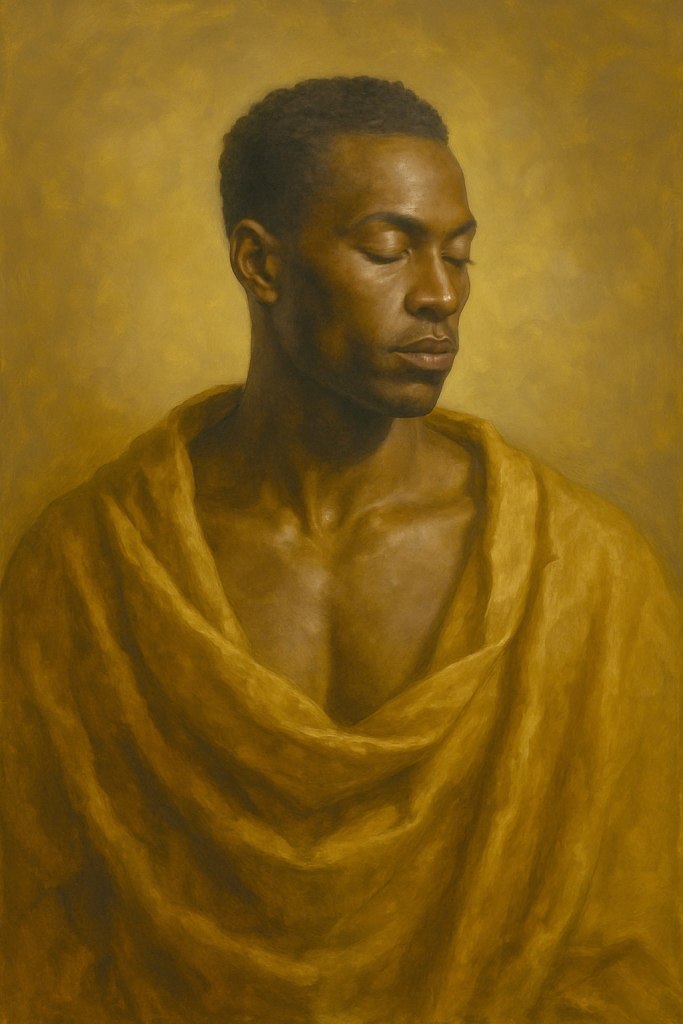
The legacy of Black men throughout history is a chronicle of courage, intellect, and moral strength. Too often, mainstream narratives reduce their contributions to fragments—overlooking the deep values that guided their endurance and brilliance. From the kingdoms of Africa to the modern struggles of identity in America, the Black man has been a central figure in the construction of civilization and the preservation of humanity’s conscience. His story is not just one of survival but of purpose, rooted in ancestral wisdom and spiritual discipline.
The image of the Black man before colonialism was one of leadership and sacred duty. In empires such as Mali, Songhai, and Kemet (Egypt), men were not only warriors and rulers but also philosophers, astronomers, and spiritual guides. Their sense of manhood was inseparable from service to community and reverence for the divine. Mansa Musa of Mali, for instance, exemplified how wealth and faith could coexist under moral responsibility, making him one of history’s most revered kings (Gomez, 1998).
Colonialism, however, disrupted this equilibrium. European imperialists imposed false hierarchies that redefined the African man as primitive, stripping him of dignity and rewriting his identity through the lens of conquest. The transatlantic slave trade transformed men once viewed as protectors and visionaries into property. Yet, even in bondage, the enslaved man retained an inner compass of values—courage, faith, and brotherhood—that sustained his humanity against systematic dehumanization (Franklin & Moss, 2000).
Black men of the antebellum era carried an unspoken theology of resistance. Their faith was both shield and sword, as seen in the spirituals sung under the stars and the coded messages of liberation woven into song. The story of men like Denmark Vesey and Nat Turner reflects the moral paradox of faith and rebellion—where violence was not a lust for power but a cry for freedom born from divine conviction (Aptheker, 1943).
With emancipation came new challenges. The Reconstruction period presented opportunities for leadership and literacy, yet the rise of Jim Crow laws swiftly sought to crush these gains. Black men responded not by despair but by constructing values-based institutions—churches, schools, and fraternal orders—that instilled discipline and dignity. Leaders like Booker T. Washington and W. E. B. Du Bois embodied contrasting yet complementary visions of manhood: one rooted in practical labor and self-reliance, the other in intellectual excellence and cultural pride (Harlan, 1983).
Throughout the 20th century, the Black man became both the conscience and catalyst of social change. The Civil Rights era revealed men whose moral fortitude transcended fear. Martin Luther King Jr. wielded nonviolence as a weapon of divine justice, while Malcolm X called for self-defense and cultural awakening. Despite their differences, both shared the same masculine integrity—the conviction that manhood is not about dominance but discipline, not ego but service (Marable, 2011).
The strength of these men was not limited to their activism; it extended to their private lives as fathers, mentors, and builders. The Black father figure, though often attacked by policy and stereotype, has remained a vital symbol of stability and love. The presence of a guiding father or mentor—whether biological or spiritual—represents a foundational value in the Black male experience: accountability through legacy.
Black artistry has also served as a mirror of male evolution. Jazz, blues, and hip-hop became outlets for emotional expression in a world that often silenced the Black man’s voice. From Louis Armstrong’s trumpet to Kendrick Lamar’s lyrical introspection, these men have embodied vulnerability as strength, challenging toxic models of masculinity. Their art carries ethical messages of perseverance, faith, and cultural self-knowledge (Dyson, 2001).
The value system of the Black man has always been rooted in communal consciousness. In African and diasporic traditions, the concept of “Ubuntu”—I am because we are—captures the essence of his worldview. Manhood is measured not by isolation but by contribution. Even in the face of racism, this communal ethos has survived, inspiring social movements and mentorship programs that uphold integrity, responsibility, and respect as cornerstones of Black male identity.
In academia and philosophy, the Black man has reclaimed intellectual space once denied to him. Thinkers like Cornel West and Molefi Kete Asante have redefined masculinity through Afrocentric and moral frameworks, asserting that to be a man is to be morally awake. This intellectual tradition resists Western individualism by grounding value in collective elevation rather than competition (Asante, 2007).
Spiritually, the Black man’s faith remains one of his most defining values. The pulpit has long been his platform of leadership, where preachers like Richard Allen and T. D. Jakes have spoken truth to power. Even outside the church, his spiritual strength manifests in prayer, meditation, and ancestral reverence. The KJV Bible’s portrayal of righteous men—David, Joseph, Moses—resonates deeply within his cultural narrative, reinforcing the belief that godly character is the highest expression of manhood (Proverbs 20:7, KJV).
The challenges of modernity have not erased these values but tested them. Systemic racism, mass incarceration, and economic disenfranchisement continue to threaten the moral fabric of Black manhood. Yet, new generations of men are reclaiming purpose through mentorship, entrepreneurship, and fatherhood. The rebirth of the “modern griot”—the storyteller who teaches through wisdom—is proof that the value of knowledge endures.
Masculine values within the Black community emphasize balance—strength tempered with humility, courage coupled with compassion. The ideal man is both protector and nurturer, reflecting divine duality. His power is not to control but to sustain, his authority not to dominate but to serve. This ethical framework echoes the ancient African principle of Ma’at, representing truth, justice, and harmony (Karenga, 2004).
In examining historical figures like Frederick Douglass, we see a prototype of moral masculinity—an intellect sharpened by suffering, a leader shaped by conviction. His life embodies a recurring theme: that the Black man’s greatness lies not in what he possesses, but in what he perseveres through. The same can be said for countless unnamed men who labored, prayed, and built legacies under the weight of oppression.
Values such as loyalty, integrity, and faith are not abstract ideals for the Black man—they are survival mechanisms. To navigate a world that questions his humanity, he must cultivate inner peace and moral consistency. In every era, from slavery to the digital age, these values have anchored him, ensuring that his reflection in history’s mirror is not defined by pain alone, but by principle.
The psychological and emotional wellness of the Black man has become a vital modern conversation. Healing from generational trauma requires returning to ancestral values—brotherhood, spiritual grounding, and emotional intelligence. These are not signs of weakness but pathways to restoration. As Proverbs 27:17 teaches, “Iron sharpeneth iron; so a man sharpeneth the countenance of his friend.” Brotherhood remains a sacred practice of renewal.
Education has always been both shield and sword for the Black man. The pursuit of knowledge represents not assimilation but liberation—a means to reclaim narrative and redefine identity. The value of education, both formal and spiritual, transforms oppression into opportunity and silence into strategy.
As history continues to unfold, the story of Black men remains unfinished but unbroken. From ancient kings to modern visionaries, they are the living embodiment of endurance shaped by ethics. The “Male Files” of history reveal not just a pattern of survival, but a symphony of values—faith, resilience, honor, and love—that continue to define their collective soul.
In the mirror of time, the Black man sees more than scars—he sees structure. His reflection is not one of victimhood but vision, not despair but determination. The values that were carried his ancestors now sustain his sons. The beauty of his story is not only in his strength, but in the moral code that gives that strength purpose.
References
Aptheker, H. (1943). American Negro slave revolts. Columbia University Press.
Asante, M. K. (2007). Afrocentricity: The theory of social change. African American Images.
Dyson, M. E. (2001). Holler if you hear me: Searching for Tupac Shakur. Basic Civitas Books.
Franklin, J. H., & Moss, A. A. (2000). From slavery to freedom: A history of African Americans. McGraw-Hill.
Gomez, M. A. (1998). Exchanging our country marks: The transformation of African identities in the colonial and antebellum South. University of North Carolina Press.
Harlan, L. R. (1983). Booker T. Washington: The wizard of Tuskegee, 1901–1915. Oxford University Press.
Karenga, M. (2004). Maat, the moral ideal in ancient Egypt: A study in classical African ethics. Routledge.
Marable, M. (2011). Malcolm X: A life of reinvention. Viking.
The Holy Bible, King James Version. (1611/2017). King James Bible Online. https://www.kingjamesbibleonline.org/
 THE BROWN GIRL DILEMMA