
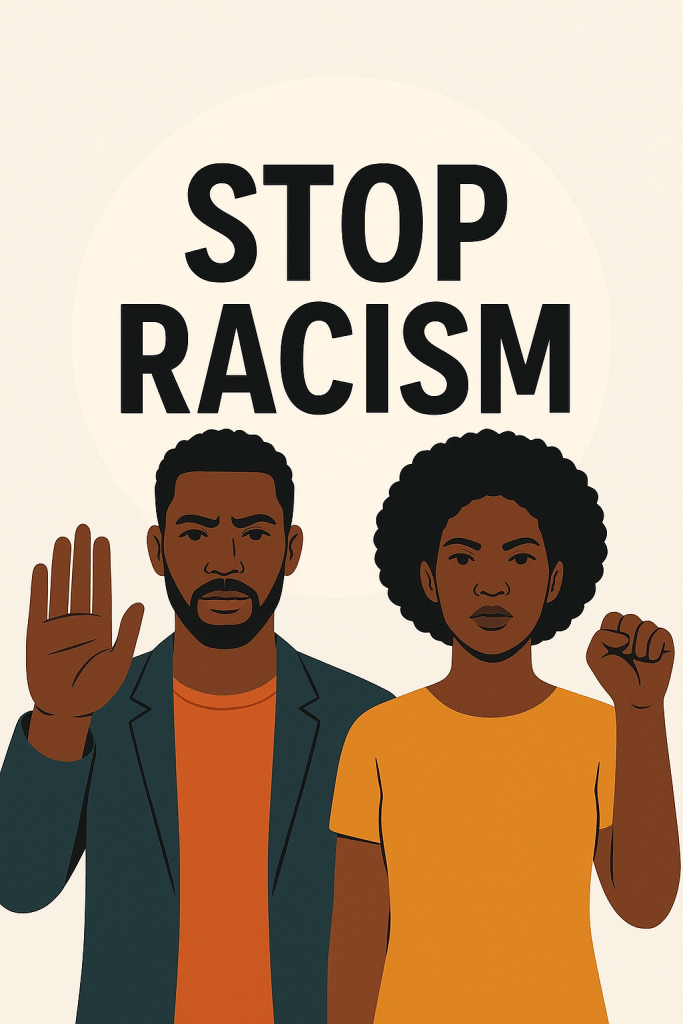
Racism is not a singular phenomenon but a complex system of beliefs, policies, and practices that establish and maintain racial hierarchies. It operates on individual, institutional, and structural levels, shaping everything from identity formation to social mobility. Understanding the types of racism is critical for dismantling the deeply embedded inequities that continue to define societies around the world (Bonilla-Silva, 2014).
Individual racism occurs when a person’s beliefs, attitudes, or actions consciously or unconsciously perpetuate racial prejudice or discrimination. It is expressed through personal bias, stereotyping, and direct acts of hostility toward people of another race. Though often the most visible form of racism, it is only one layer of a much larger system (Tatum, 2017).
Interpersonal racism happens in day-to-day interactions, often disguised as microaggressions. These subtle acts—such as questioning a person’s intelligence or making assumptions about their background—communicate inferiority and reinforce racial hierarchies. The cumulative impact of such encounters can result in significant psychological harm (Sue et al., 2007).
Internalized racism occurs when individuals from marginalized racial groups adopt the negative beliefs or stereotypes perpetuated by dominant groups. This internal oppression manifests through self-doubt, assimilation, and the devaluation of one’s cultural heritage. It often results from centuries of colonization, media misrepresentation, and social exclusion (Pyke, 2010).
Institutional racism refers to policies and practices embedded within organizations—such as schools, corporations, or law enforcement—that produce unequal outcomes along racial lines. Even when not explicitly racist, these structures perpetuate disparities in employment, housing, education, and criminal justice (Carmichael & Hamilton, 1967).
Structural racism extends beyond individual institutions and reflects the historical accumulation of inequality across systems. It is the totality of social, economic, and political mechanisms that normalize racial disadvantage and privilege. Structural racism is both pervasive and self-reinforcing, making it one of the most difficult forms to dismantle (Gee & Ford, 2011).
Systemic racism operates as a comprehensive framework that upholds racial inequality in virtually every sphere of life. It is the “normalization and legitimization” of various dynamics—historical, cultural, and institutional—that routinely advantage white people while disadvantaging people of color (Feagin, 2013).
Cultural racism manifests through the promotion of one group’s norms, values, and aesthetics as the universal standard. This form of racism is deeply embedded in media, beauty ideals, education, and religion. It often leads to the marginalization of cultural expressions that do not align with dominant ideals (hooks, 1992).
Colorism—a byproduct of cultural and systemic racism—favors lighter skin tones over darker ones, even within the same racial group. This phenomenon originates from colonial hierarchies that equated proximity to whiteness with superiority and privilege. Colorism affects access to opportunities, social status, and self-worth (Hunter, 2007).
Environmental racism refers to the disproportionate exposure of marginalized racial communities to environmental hazards. Examples include toxic waste sites, polluted neighborhoods, and limited access to clean water and green spaces. This form of racism connects race directly to public health outcomes (Bullard, 2000).
Economic racism operates through inequitable labor systems, wage disparities, and barriers to financial mobility. The racial wealth gap in the United States, for instance, is not accidental but the result of centuries of discriminatory practices—from slavery and sharecropping to redlining and employment discrimination (Oliver & Shapiro, 2019).
Educational racism is evident in underfunded schools, biased curricula, and tracking systems that disadvantage students of color. These inequities reinforce generational poverty and limit access to higher education, perpetuating systemic disparities (Ladson-Billings, 2006).
Political racism manifests when laws, policies, or voting systems suppress the political power of racial minorities. Gerrymandering, voter ID laws, and disenfranchisement are tools historically used to limit Black and brown representation in governance (Anderson, 2016).
Medical racism exposes racial disparities in health care access, treatment, and outcomes. From the exploitation of enslaved Black bodies in early medical research to the ongoing neglect of pain reports by Black patients, racism remains a critical determinant of health inequality (Washington, 2006).
Linguistic racism operates through language hierarchies that stigmatize certain dialects or accents as “less educated” or “unprofessional.” This form of bias privileges white, Western speech norms and penalizes linguistic diversity within communities of color (Flores & Rosa, 2015).
Religious racism merges ethnocentrism with theological bias, often using religion to justify racial domination. Historically, Christianity was weaponized to validate slavery and colonization, presenting whiteness as divine and Blackness as cursed (Cone, 1969). The aftershocks of this manipulation still influence racialized theology today.
Spatial racism refers to the deliberate segregation of communities through housing policies and urban planning. Practices like redlining, restrictive covenants, and gentrification maintain racial boundaries, limiting access to resources and generational wealth (Rothstein, 2017).
Media racism perpetuates stereotypes that frame people of color as dangerous, inferior, or hypersexualized. Such portrayals shape public perception, influence policy, and justify violence. The absence of nuanced representation contributes to cultural erasure (Entman & Rojecki, 2001).
Colorblind racism is a contemporary form that denies the existence of racial inequality by asserting that race “no longer matters.” This ideology ignores systemic inequities and discourages meaningful discussions about race, ultimately maintaining the status quo (Bonilla-Silva, 2014).
Ultimately, racism manifests in diverse but interconnected ways—individual prejudice feeding institutional policy, cultural bias informing structural design. These interlocking forms ensure that racial inequality is both normalized and invisible to those who benefit from it. Understanding the many faces of racism is not an intellectual exercise but a moral imperative toward dismantling its hold on humanity.
References (APA 7th Edition)
Anderson, C. (2016). White rage: The unspoken truth of our racial divide. Bloomsbury.
Bonilla-Silva, E. (2014). Racism without racists: Color-blind racism and the persistence of racial inequality in America. Rowman & Littlefield.
Bullard, R. D. (2000). Dumping in Dixie: Race, class, and environmental quality. Westview Press.
Carmichael, S., & Hamilton, C. V. (1967). Black power: The politics of liberation. Vintage Books.
Cone, J. H. (1969). Black theology and Black power. Seabury Press.
Entman, R. M., & Rojecki, A. (2001). The Black image in the White mind: Media and race in America. University of Chicago Press.
Feagin, J. R. (2013). Systemic racism: A theory of oppression. Routledge.
Flores, N., & Rosa, J. (2015). Undoing appropriateness: Raciolinguistic ideologies and language diversity in education. Harvard Educational Review, 85(2), 149–171.
Gee, G. C., & Ford, C. L. (2011). Structural racism and health inequities. Du Bois Review, 8(1), 115–132.
hooks, b. (1992). Black looks: Race and representation. South End Press.
Hunter, M. (2007). The persistent problem of colorism: Skin tone, status, and inequality. Sociology Compass, 1(1), 237–254.
Ladson-Billings, G. (2006). From the achievement gap to the education debt. Educational Researcher, 35(7), 3–12.
Oliver, M. L., & Shapiro, T. M. (2019). Black wealth/White wealth: A new perspective on racial inequality. Routledge.
Pyke, K. D. (2010). What is internalized racial oppression and why don’t we study it? Sociological Perspectives, 53(4), 551–572.
Rothstein, R. (2017). The color of law: A forgotten history of how our government segregated America. Liveright Publishing.
Sue, D. W., Capodilupo, C. M., & Holder, A. M. B. (2007). Racial microaggressions in everyday life. American Psychologist, 62(4), 271–286.
Tatum, B. D. (2017). Why are all the Black kids sitting together in the cafeteria? Basic Books.
Washington, H. A. (2006). Medical apartheid: The dark history of medical experimentation on Black Americans from colonial times to the present. Doubleday.
ChatGPT can make mistakes. Check important info.
 THE BROWN GIRL DILEMMA