
Tag Archives: Trayvon Martin

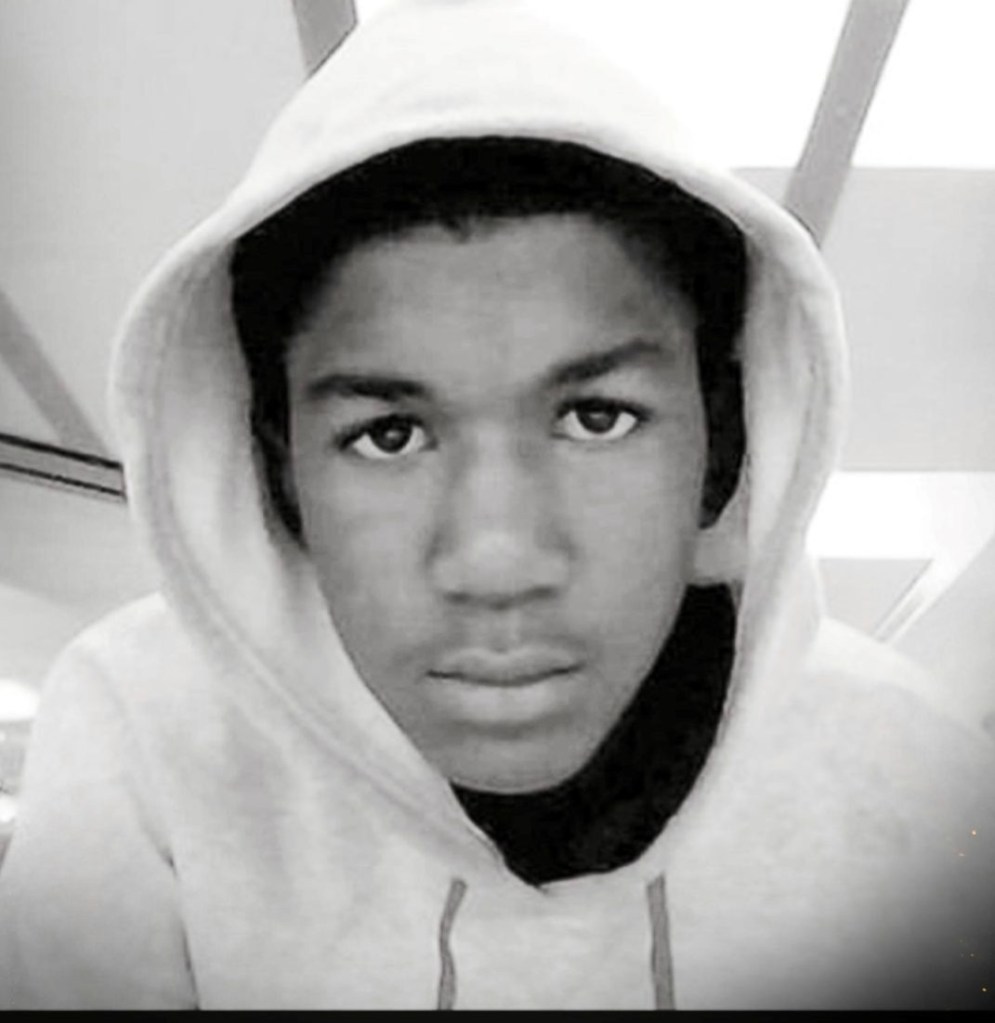
Black History Month: Trayvon Martin – A Life Stolen, A Nation Awakened.

Trayvon Benjamin Martin was born on February 5, 1995, in Miami, Florida. He was a young African American teenager known by his family and friends as kind-hearted, playful, and full of potential. Trayvon enjoyed sports, especially football and basketball, and aspired to become an aviation mechanic. Like many young Black boys in America, his life reflected both ordinary youthful dreams and the inherited weight of navigating a society shaped by racial stereotypes and systemic inequality.


What Happened to Trayvon Martin

On the evening of February 26, 2012, Trayvon Martin was walking back to his father’s fiancée’s home in Sanford, Florida, after purchasing snacks from a convenience store. He was unarmed, wearing a hoodie, and talking on the phone with a friend. George Zimmerman, a neighborhood watch volunteer, reported Trayvon as “suspicious” to police, followed him despite being advised not to, and ultimately shot and killed him.

Zimmerman claimed self-defense and was later acquitted of all charges in 2013. The verdict sparked national and international outrage, as many saw the case as a reflection of how Black bodies are often criminalized, feared, and devalued within American society.


His Impact on the World

Though his life was tragically cut short at just 17 years old, Trayvon Martin’s death became a historical turning point. His name became a symbol of racial injustice and the dangerous consequences of racial profiling. The case helped ignite the modern civil rights movement known as Black Lives Matter, founded in 2013 by Alicia Garza, Patrisse Cullors, and Opal Tometi in response to Trayvon’s killing and Zimmerman’s acquittal.

Trayvon’s story forced America to confront uncomfortable truths about race, surveillance, fear, and the unequal application of justice. His hoodie became a global symbol of protest, representing how something as simple as clothing could become a perceived threat when worn by a Black male.


He Would Have Been 31 This Year

In 2026, Trayvon Martin would have been 31 years old. He could have been a husband, a father, a professional, or a leader in his community. Instead, his life exists in collective memory as a reminder of stolen futures and unrealized potential. His age now represents not just time passed, but the depth of loss — a life that never had the chance to fully begin.


Racism in America: A Broader Context

Trayvon Martin’s death cannot be understood in isolation. It exists within a long historical continuum of racial violence in America, from slavery and lynching to mass incarceration and police brutality. Sociologists describe this phenomenon as systemic racism — a structure in which laws, institutions, and cultural narratives disproportionately harm Black people.

The fear that led to Trayvon’s death reflects what scholars call implicit racial bias, where Black males are often subconsciously associated with danger, criminality, and threat. These biases influence everything from policing and surveillance to legal outcomes and media portrayals.

Trayvon’s case exposed how even in the absence of a crime, Black existence itself can be treated as suspicious. His death became a mirror held up to American society, forcing the nation to ask: Who is allowed to be innocent? Who is allowed to be safe? And whose life is presumed valuable?


Legacy

Trayvon Martin’s legacy is not defined by his death, but by the global movement that arose because of it. His name is spoken alongside others — Michael Brown, Tamir Rice, Sandra Bland, Breonna Taylor, George Floyd — as part of a growing historical archive of racial injustice.

Yet Trayvon remains unique: he was not arrested, not resisting, not committing a crime. He was simply walking home.

His life and death continue to educate, mobilize, and challenge the world to build a society where Black children can exist without fear, where justice is not selective, and where no family must bury a child for simply being seen as “out of place.”


References

Alexander, M. (2012). The new Jim Crow: Mass incarceration in the age of colorblindness. The New Press.

Bonilla-Silva, E. (2018). Racism without racists: Color-blind racism and the persistence of racial inequality in America (5th ed.). Rowman & Littlefield.

CBS News. (2013). George Zimmerman acquitted in Trayvon Martin case.

Garza, A. (2014). A herstory of the #BlackLivesMatter movement. The Feminist Wire.

Newman, K. S., & Cohen, A. (2014). Race, place, and building a youth movement: The case of Trayvon Martin. American Sociological Review, 79(3), 449–476.

Pew Research Center. (2016). On views of race and inequality, Blacks and Whites are worlds apart.

U.S. Department of Justice. (2013). Investigation of the Sanford Police Department’s handling of the Trayvon Martin shooting.
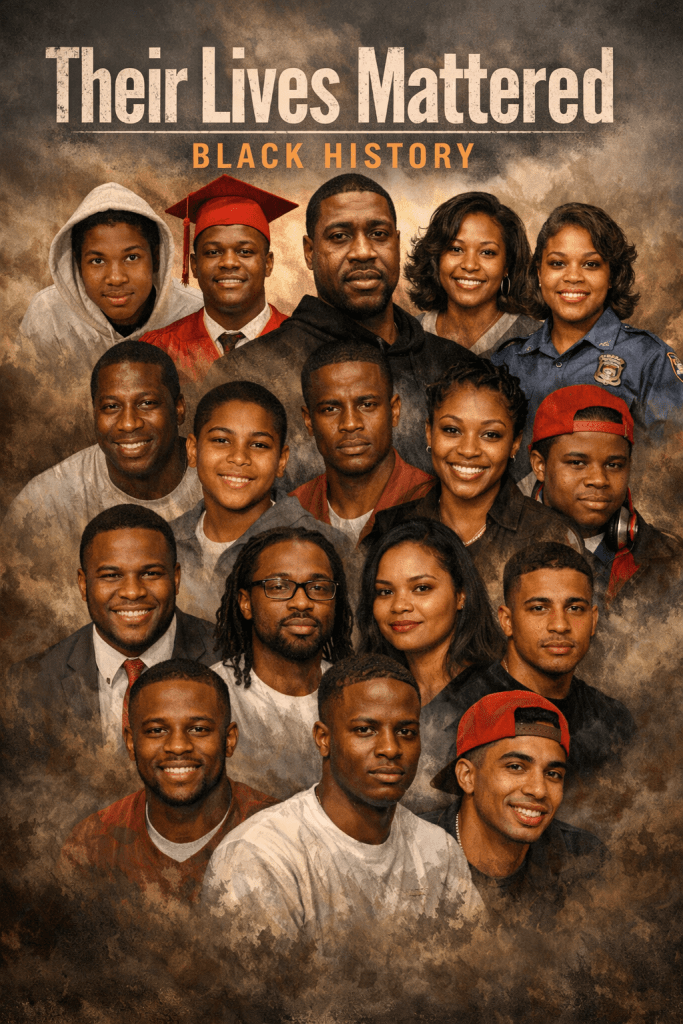
Their Lives Mattered: A Black History Lament.

Their lives mattered not as statistics, not as hashtags, not as passing headlines, but as human beings whose existence was violently interrupted by systems meant to protect. The stories of Trayvon Martin, La’Quan McDonald, Sonya Massey, George Floyd, Breonna Taylor, Eric Garner, Tamir Rice, Freddie Gray, Sandra Bland, Michael Brown, Botham Jean, Philando Castile, Atatiana Jefferson, Stephon Clark, Daunte Wright, and countless others reveal a recurring pattern of racialized state violence, criminalization of Black bodies, and the persistent failure of American justice.

Trayvon Martin was a 17-year-old unarmed Black teenager who was fatally shot in 2012 by George Zimmerman in Sanford, Florida, while walking home from a convenience store. Despite being unarmed and posing no threat, Trayvon was followed, confronted, and killed under the logic of “suspicion.” Zimmerman was acquitted under Florida’s “Stand Your Ground” law, igniting national outrage and becoming a catalyst for the Black Lives Matter movement.

La’Quan McDonald was a 17-year-old Black teenager who was shot 16 times by Chicago police officer Jason Van Dyke in 2014. Dashcam footage later revealed that La’Quan was walking away from police when he was killed, contradicting official police reports. The city suppressed the video for over a year. Van Dyke was eventually convicted of second-degree murder, a rare outcome in police killings.

Sonya Massey, a 36-year-old Black woman, was killed in 2024 by an Illinois sheriff’s deputy after calling 911 for help. While experiencing a mental health crisis, she was shot in her own home. Her death raised renewed concerns about how Black women, especially those in psychological distress, are treated as threats rather than victims in need of care.

George Floyd was a 46-year-old Black man killed in 2020 after Minneapolis police officer Derek Chauvin knelt on his neck for over nine minutes while Floyd was handcuffed and pleading for his life. His death was captured on video and sparked the largest global protests against racial injustice in modern history. Chauvin was later convicted of murder, marking a rare moment of legal accountability.

Breonna Taylor was a 26-year-old Black emergency medical technician who was shot and killed in her Louisville apartment in 2020 when police executed a no-knock warrant while she was asleep. Officers fired over 30 bullets, killing her in her own home. No officer was charged directly for her death, reinforcing public outrage over the lack of accountability.

Eric Garner was a 43-year-old Black man who died in 2014 after being placed in a chokehold by NYPD officer Daniel Pantaleo for allegedly selling loose cigarettes. Garner’s final words, “I can’t breathe,” became a global symbol of police brutality. A grand jury declined to indict the officer, and Pantaleo was only fired years later.

Tamir Rice was a 12-year-old Black child who was shot and killed by Cleveland police in 2014 while playing with a toy gun in a park. Officers arrived and shot him within seconds, without attempting de-escalation. No criminal charges were filed, despite Tamir being a minor posing no imminent threat.

Freddie Gray was a 25-year-old Black man who died in 2015 from a spinal injury sustained while in police custody in Baltimore. He had been arrested and transported in a police van without being properly restrained. His death led to mass protests, but none of the officers involved were ultimately convicted.

Sandra Bland was a 28-year-old Black woman found dead in a Texas jail cell in 2015 after being arrested during a traffic stop. Her death was ruled a suicide, but her treatment, arrest, and the circumstances of her death raised serious questions about racial profiling, police aggression, and custodial negligence.

Michael Brown was an 18-year-old Black teenager shot and killed by police officer Darren Wilson in Ferguson, Missouri, in 2014. Brown was unarmed at the time. His body was left in the street for hours, igniting national protests. A grand jury declined to indict Wilson, fueling global outrage.

Botham Jean was a 26-year-old Black accountant who was shot and killed in his own apartment in 2018 by off-duty Dallas police officer Amber Guyger, who claimed she mistook his home for hers. Guyger was convicted of murder, but her sentence was widely criticized as lenient.

Philando Castile was a 32-year-old Black school cafeteria worker who was shot and killed by police during a traffic stop in Minnesota in 2016. He had calmly informed the officer that he was legally carrying a firearm. His girlfriend livestreamed the aftermath. The officer was acquitted.

Atatiana Jefferson was a 28-year-old Black woman shot and killed by police in 2019 while inside her home in Fort Worth, Texas, after a neighbor requested a wellness check. She was playing video games with her nephew when she was killed. The officer was later convicted of manslaughter.

Stephon Clark was a 22-year-old Black man shot and killed by Sacramento police in 2018 while standing in his grandmother’s backyard. Officers claimed he had a gun; he was holding a cellphone. He was shot 20 times. No officers were charged.

Daunte Wright was a 20-year-old Black man killed in 2021 during a traffic stop in Minnesota when an officer claimed she mistakenly drew her gun instead of her taser. Wright’s death occurred during the trial of Derek Chauvin and reignited national protests. The officer was convicted of manslaughter.

These deaths are not isolated incidents but part of a historical continuum rooted in slavery, Jim Crow, mass incarceration, and racialized policing. The criminal justice system has repeatedly failed to protect Black lives while excusing or minimizing state violence through qualified immunity, grand jury non-indictments, and legal doctrines that prioritize police narratives over Black testimony.

Their lives mattered because they were sons, daughters, parents, workers, students, and dreamers. They mattered because their deaths exposed the moral contradictions of a nation that proclaims liberty while systematically devaluing Black existence. To remember them is not simply an act of mourning, but a political demand for truth, accountability, and structural transformation.

Their names and many others live on not only in memory but in resistance. They have become ancestral witnesses to injustice and sacred symbols in a global struggle for Black dignity. Their blood cries out from the ground, demanding not silence, but justice.


References

Alexander, M. (2012). The New Jim Crow: Mass incarceration in the age of colorblindness. The New Press.

Black Lives Matter. (n.d.). Say Their Names. https://blacklivesmatter.com

Equal Justice Initiative. (2020). Lynching in America: Confronting the legacy of racial terror. https://eji.org

Garner, E. (2014). NYPD case files and DOJ Civil Rights Investigation. U.S. Department of Justice.

Mapping Police Violence. (2023). Police killings database. https://mappingpoliceviolence.org

New York Times. (2014–2024). Police brutality and racial justice reporting.

U.S. Department of Justice. (2020). Investigation into the Minneapolis Police Department.

Washington Post. (2015–2024). Fatal force: Police shootings database. https://www.washingtonpost.com/graphics/investigations/police-shootings-database/

Williams, P. J. (1991). The Alchemy of Race and Rights. Harvard University Press.