
A memoir written by © Scientist Arieyah Naseek
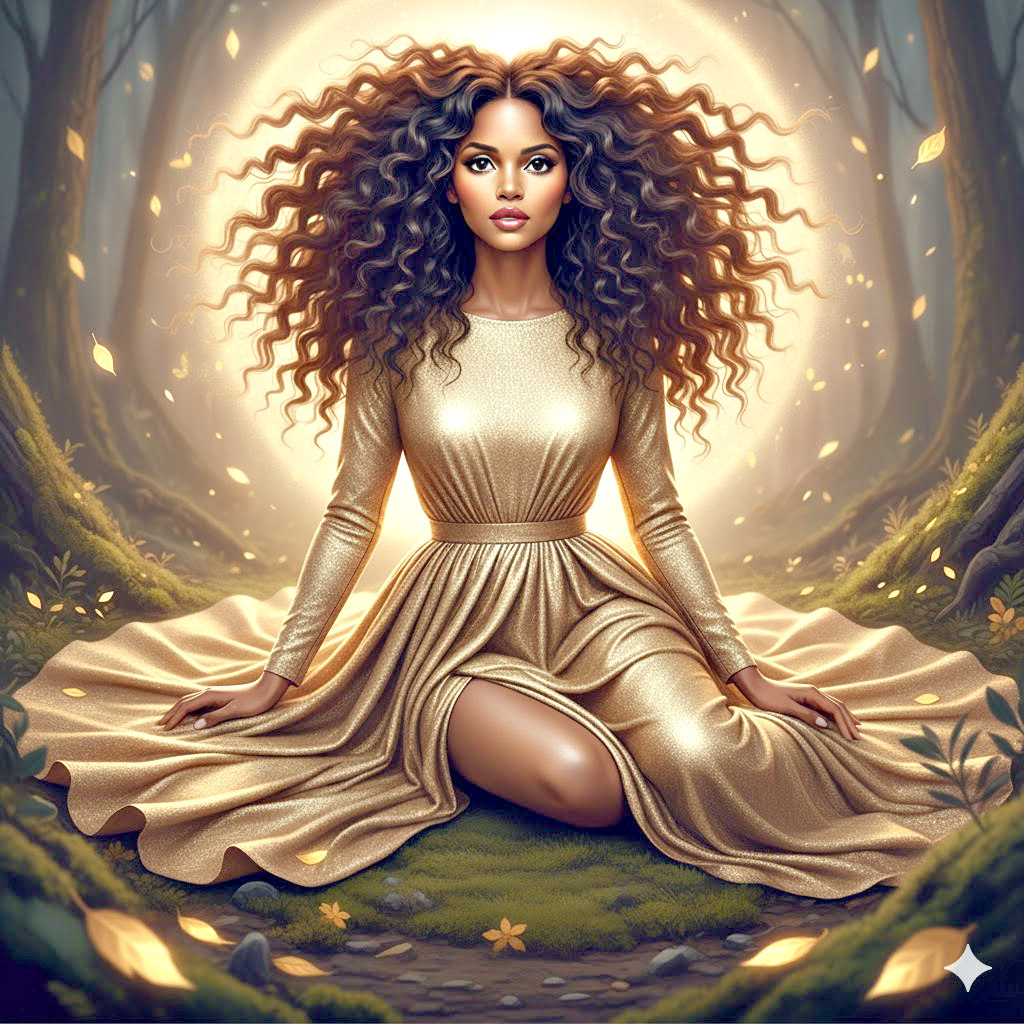
She makes beauty envious, and perfection wants to commit suicide.
Golden Café Au Lait is the color of her skin. “Beauty” is her name, christened by an African king who once declared that her birth name simply would not do. To him, she was the embodiment of perfection and beauty, the woman who defines what divine beauty could look like in human form. From that day forward, she was known only as Beauty, the woman whose very presence seemed regal yet ethereal, human yet divine. From the time she was a child, the world seemed to pause when she entered a room. Beauty’s aura filled every room, commanding attention without uttering a word. Her light golden skin shimmered like polished bronze infused with honeyed sunlight, and her presence drew admiration as naturally as flowers turn toward the sun.
By adolescence, photographers and artists vied for the chance to capture her likeness. They said her skin tone was “liquid light caramel,” a hue that defied description and reflected every ray of light. She was only sixteen when she appeared in her first major advertising campaign in Germany. The image—a portrait of her smiling softly against a gold backdrop—was sold around the world, inspiring a generation of young Black girls to see beauty reflected in their own skin for the first time.
Everywhere she went, people stared. In college, professors remembered her face before her name. Boys competed for her attention as if her affection were a trophy. Even when she spoke with depth and intelligence, the conversation always circled back to her looks. “You could be a model,” they’d say—never realizing she already was. Her image had graced global billboards, her likeness immortalized in ad campaigns that declared her “the most beautiful woman on earth.”
Her face became both a blessing and a burden. When she entered a room, all eyes gravitated toward her. Teachers remembered her beauty before her brilliance. Classmates praised her appearance but never asked about her dreams. Men admired her, women studied her, and somewhere in between, Beauty lost the comfort of simply being herself.
Her family, especially her grandmother and aunt, adored her beauty and never hesitated to remind her of it. “You’re our precious jewel,” her grandmother would say, smoothing Beauty’s hair. “God must’ve taken His time with you.” Beauty would smile but quietly wonder if being admired meant being understood. Her aunt always stated that she had that kind of beauty that could knock a man to his knees.
There was a time when she became almost protective of her appearance—guarded about who touched her, half-jokingly insisting she didn’t want anyone’s skin to “rub off” on her. It wasn’t arrogance but armor. She had learned how beauty could invite both praise and envy, love and projection. People either worshipped her or resented her—few ever simply saw her.
The men around her had placed her on pedestals and showered her with gifts. Jewelry, flowers, promises—affection often disguised as possession. Later in life came the grander gestures: extravagant marriage proposals and gifts.
Beauty became an international model. Her image adorned billboards around the world. She became the face of the Black Diamond. Yet, even as the world praised her, she remained deeply grounded. When reporters asked what made her beautiful, she often smiled and said, “I am simply who my Creator designed me to be—nothing more, nothing less.”
Even as her modeling career soared—her likeness becoming known to the world—Beauty carried that ache. She could pose for hours, mastering every angle, yet behind the lens, she wondered if anyone cared who she was when the camera stopped clicking. People spoke about her beauty as though it existed separately from her soul.
Behind the flawless photos and radiant smiles was a woman quietly questioning: Is this all they see?
Yet the more people praised her beauty, the more Beauty learned to shrink herself. She noticed how other women tensed around her, how conversations would shift, laughter turn brittle, and compliments become comparisons. So she began to downplay her glow—wearing looser clothes, softening her speech, dimming her confidence—just to make others feel comfortable in her presence. What the world called a blessing often felt like a burden she had to manage carefully.
Beauty’s beauty was not only admired—it was studied. Photographers, sculptors, and scientists alike sought to capture her essence, though many admitted that no lens could ever fully translate the magnitude of her allure. Her face appeared on billboards across continents, representing extraordinary beauty, grace, luxury, and timeless splendor. She was not simply a model; she was a symbol—a vision of Black femininity both celebrated and contested.
For her, beauty was both a crown and a cage. She loved God, studied His Word, and lived by faith, yet the world continued to measure her by her reflection instead of her revelation. No matter how much she achieved—degrees, philanthropy, ministry work—people always returned to her modeling days as though they defined her entirely. It was as if her face spoke louder than her voice.
Her complexion, a rare golden café au lait tone, became her signature, along with her large, mesmerizing eyes, which have a mirror effect to them, small nose, and full lips. Some described it as sunlight kissing caramel; others said it was a color that could only exist in dreams. A male friend said that her beauty is like a sunset. But beyond the admiration lay whispers—jealousy, envy, and critique. Beauty’s rise to the public eye became a mirror reflecting society’s long, complicated relationship with color and beauty within the Black diaspora.
Women were envious of Beauty. She often felt the weight of her own appearance, learning early that her beauty, though praised, was also isolating. “I had to learn to downplay myself,” she once confided in an interview. “Sometimes I’d hide behind plain clothes, no makeup, just to make others feel comfortable.” Her light skin was both her blessing and her burden.
People often said that her success came easily because of her skin tone. “She got this or that because she’s light,” they whispered, reducing her years of effort to the shade of her skin. Yet, even under such scrutiny, Beauty carried herself with humility. She made it her mission to celebrate darker-skinned women, reminding them that their melanin was not a disadvantage but a divine hue in its own right.
In one of her most iconic speeches after being crowned Miss Ultimate Beauty, she addressed the audience directly: “Beauty does not belong to a single shade. Every complexion comes from God.” The crowd erupted in applause, not because of her ethereal face, but because of her truth.
Her reign as Miss Ultimate Beauty made global headlines. Everyone clamored to work with her, seeing in Beauty a living canvas of light and depth. Yet amid the attention, she remained grounded—returning often to her roots in the United States, where she visited schools to mentor young girls about confidence and inner worth.
A group of Scientists and a famous film director, captivated by her ethereal features, began production on a documentary series titled Beauty about her and The Science of Beauty. They described her beauty as “so spectacular she looks unreal—a genetic masterpiece, a visual phenomenon.” The documentary, already in development, aimed to explore not just her life but also the science, art, and sociology behind human attraction. The Documentary Series set to be released in 2028 or 2029.
Beauty’s face became synonymous with the title of “the most beautiful woman in the world” and “Genetic Masterpiece.” She has the kind of beauty that transcends time, evoking comparisons to the great black beauties of this world, yet distinctly her own—look, extraordinary, astonishing, rare, unique, unparalleled, regal, and radiant. Her dark coal curls danced in the wind like liquid fire while cascading down her back like sheets of molasses, and her eyes—large, expressive, hypnotic, piercing, and filled with quiet wisdom—invited the world to see beyond the surface.
Her gold gown, worn at a world foundation gala, became legendary. The fabric rippled like sunlight on water, modest yet magnetic. No skin was exposed, yet all eyes were on her. The designer later confessed, “It wasn’t the dress that shone—it was Beauty herself.”
But Beauty knew beauty was never enough. She wrestled with loneliness, aware that admiration often lacked understanding. “People love what they see,” she said, “but they rarely ask who I am beneath the gold.” Her journals, later published in a book, revealed her deepest dilemmas and her wish to be valued for her soul as much as her beauty or skin.
In private moments, Beauty admitted she sometimes wished to be ordinary—to walk into a room without the echo of awe or envy following her. Yet destiny would not allow her anonymity; she was born to be seen.
Her story became the heart of global conversations about colorism and representation. Scholars cited her as a living paradox—a woman praised for beauty that both challenged and reinforced societal bias. Her beauty sparked debates in articles, classrooms, and beauty forums worldwide.
When asked about her thoughts on colorism, Beauty said, “Lightness does not make me better, darkness does not make you lesser. We are all tones of God’s imagination.” Her words inspired campaigns that began redefining beauty standards across Africa and the diaspora.
Her influence extended beyond modeling. Beauty launched a foundation supporting young women of all complexions in creative industries. She funded scholarships for photographers and artists to challenge color bias through their work.
Years later, at a major art exhibition in Africa, her portrait was unveiled—a depiction of her draped in gold and crowned with sunlight. The Gold Standard of Beauty. Critics called it “The Eighth Wonder of the Modern World.” It wasn’t vanity; it was legacy.
In interviews, she reflected, “If I’m to be remembered, let it not be for my face, but for the love I inspired in those who once doubted their reflection and my love and devotion to the Most High God of Israel.”
Beauty’s name became immortalized, not as an object of beauty, but as a force of healing in the ongoing dialogue of identity and self-worth. Her beauty—golden, astonishing, glowing, godlike—became less about appearance and more about awakening.
In every photo, in every glimmer of light touching her light cafe au lait skin, Beauty’s message remains—beauty is not what you see; this is temporal. True beauty comes from within, and only the things you do for Christ will last.
As her faith deepened, Beauty began to see her reflection differently. The same face that once burdened her became a vessel of purpose. She no longer viewed her features as random genetics but as a deliberate brushstroke from a divine Artist. Genesis 1:27 reminded her: “So God created man in his own image.” That meant her beauty was not hers to idolize or to fear—it was His signature on her soul.
She began to use her platform to speak about inner worth, teaching young women that outward beauty without spiritual grounding is like perfume on an empty bottle—sweet for a moment, but fading fast. Her favorite verse, Proverbs 31:30, became her mantra: “Favour is deceitful, and beauty is vain: but a woman that feareth the Lord, she shall be praised.”
Through faith, Beauty learned to laugh at the irony of her journey—that the woman called “The 8th Wonder of the World” was never truly seeking wonder at all. She was seeking wisdom. And she found it in Christ, who taught her that beauty is not what the world sees, but what Heaven recognizes.
Now, as she walks in purpose, her glow feels different. Her presence unsettles the superficial and awakens the meaningful. It’s not the shimmer of camera lights but the radiance of peace. She is still breathtaking, but not because of her symmetry—because of her spirit. Her beauty no longer introduces her; her light does.
In Beauty’s story, we see that beauty is neither a curse nor a crown—it is temporal. When surrendered to God, even the most admired woman learns that the truest form of grace is not in being seen, but in being sanctified.
Written by © Scientist Arieyah Naseek
 THE BROWN GIRL DILEMMA