
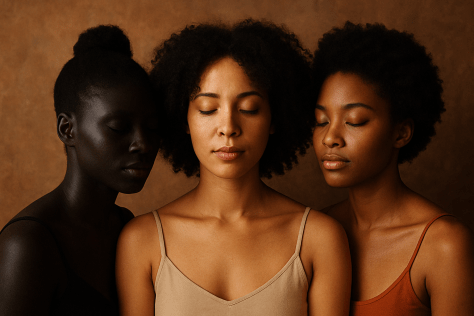
The Hue Complex is more than a matter of color; it is a condition of the soul shaped by centuries of conditioning. It is the silent division within the Black community, where shades of brown become social currency and beauty is measured not by character but by complexion. This phenomenon, born from colonialism and nurtured by white supremacy, continues to infiltrate families, friendships, and faith communities, leaving behind a trail of fractured identities and quiet resentments.
The roots of the Hue Complex trace back to the plantation, where skin tone determined proximity to privilege. Light-skinned enslaved Africans, often the children of their oppressors, were granted limited access to education, domestic labor, or marginal comfort—while darker-skinned individuals were condemned to the fields. This systematic stratification planted seeds of psychological division that outlived the physical chains of slavery. Generations later, those same hierarchies echo in boardrooms, classrooms, and even pews.
Colorism became the unspoken language of belonging and exclusion. Lighter skin, associated with refinement and desirability, became a silent passport to perceived opportunity, while darker skin was stigmatized as inferior, aggressive, or undesirable. This distorted lens, internalized and repeated, fractured Black unity. The Hue Complex, therefore, is not simply external oppression—it is the internalization of racial hierarchy that turns community against itself.
In families, this complex often shows up subtly. Grandmothers call one grandchild “high yellow” and another “pretty chocolate,” unaware that both compliments are loaded with comparison. Schoolgirls whisper about whose skin “glows” more, while boys casually describe their preference for “redbones.” What may seem harmless becomes harmful, teaching young hearts that worth is conditional and shade-dependent. The cycle continues because the lie has been normalized.
Spiritually, the Hue Complex contradicts the very essence of divine creation. Scripture declares that all humankind was made in the image of God (Genesis 1:27, KJV). Yet colonial theology distorted that truth, promoting a Eurocentric image of divinity—pale, narrow, and exclusive. The result was a subconscious association between whiteness and holiness, and between darkness and sin. This spiritual miseducation continues to shape how many perceive God and themselves.
Psychologically, colorism fuels low self-esteem, identity confusion, and even depression. Dark-skinned women often report feeling overlooked in love and employment, while light-skinned women express guilt and alienation from their community. Both suffer under the same oppressive system, though in different ways. The Hue Complex thus operates as a two-edged sword—cutting both directions and leaving scars that bleed silently.
Media perpetuates this imbalance. In films, music videos, and advertisements, lighter-skinned individuals are often cast as the romantic lead, while darker tones are relegated to supporting or antagonistic roles. Even within Black entertainment, the preference persists, shaping the subconscious of global audiences. It teaches viewers, subtly yet consistently, that to be lighter is to be lovable, and to be darker is to be tolerated.
The solution to the Hue Complex begins with confrontation. It demands honest conversations about bias, confession of internal prejudice, and unlearning of generational myths. It requires elders to stop repeating phrases that pit shades against one another and parents to raise children who celebrate their skin as sacred. Healing begins where silence ends. As James 5:16 (KJV) says, “Confess your faults one to another… that ye may be healed.”
The Church, too, must confront its role. True ministry cannot ignore the psychological residue of slavery and colonialism. Pastors and leaders must teach that divine image is not color-coded. Christ was not European; His message transcends complexion. By re-centering theology in historical and cultural truth, the Church can help dismantle the Hue Complex and restore dignity to all shades of Blackness.
Culturally, the reclamation of melanin is already underway. Movements like “Black Girl Magic” and “Melanin Poppin” serve as affirmations of beauty long denied. Yet even within these affirmations, vigilance is needed to ensure inclusivity. True liberation celebrates the full spectrum—from the deepest ebony to the fairest brown—without hierarchy or exclusion. Unity, not uniformity, is the goal.
Socially, education and representation must intersect. When dark-skinned women are celebrated on magazine covers, in film, and in leadership, cultural equilibrium begins to form. When light-skinned women stand against colorism rather than benefit from it, solidarity becomes possible. Each shade has a role to play in dismantling the system that once defined them.
Emotionally, healing the Hue Complex means reclaiming the right to love oneself without apology. It means standing before the mirror and declaring, “I am fearfully and wonderfully made” (Psalm 139:14, KJV). It means understanding that one’s hue is not happenstance but heritage—each tone a reflection of God’s intentional design.
Historically, it requires acknowledgment that colorism is not self-created but systemically imposed. The Hue Complex is the residue of colonization—a social poison meant to divide and conquer. Recognizing its origin empowers the community to rewrite the narrative, transforming shame into pride and competition into kinship.
The ultimate revelation is that the Hue Complex cannot survive where love reigns. Love, in its truest biblical form, “beareth all things, believeth all things, hopeth all things, endureth all things” (1 Corinthians 13:7, KJV). It does not compare, compete, or categorize. In divine love, every hue is holy, every shade is sacred, and every soul is seen.
When the Hue Complex is dismantled, the community becomes whole again. Blackness, in all its radiant variations, stands as testimony to divine artistry and ancestral strength. What once divided now unites; what once caused shame now inspires pride. The complex dissolves, and in its place rises a truth long suppressed—that the hues of Blackness are not hierarchies but harmonies, each singing a different note of the same beautiful song.
References
- The Holy Bible, King James Version. (1611).
- Banks, T. A. (2019). Colorism and the politics of beauty. Journal of Black Studies, 50(3), 243–261.
- Hunter, M. (2007). The persistent problem of colorism: Skin tone, status, and inequality. Sociology Compass, 1(1), 237–254.
- Walker-Barnes, C. (2020). Too heavy a yoke: Black women and the burden of strength. Cascade Books.
- Russell, K., Wilson, M., & Hall, R. (2013). The color complex: The politics of skin color in a new millennium. Anchor Books.
- West, C. (1993). Race matters. Beacon Press.
 THE BROWN GIRL DILEMMA