
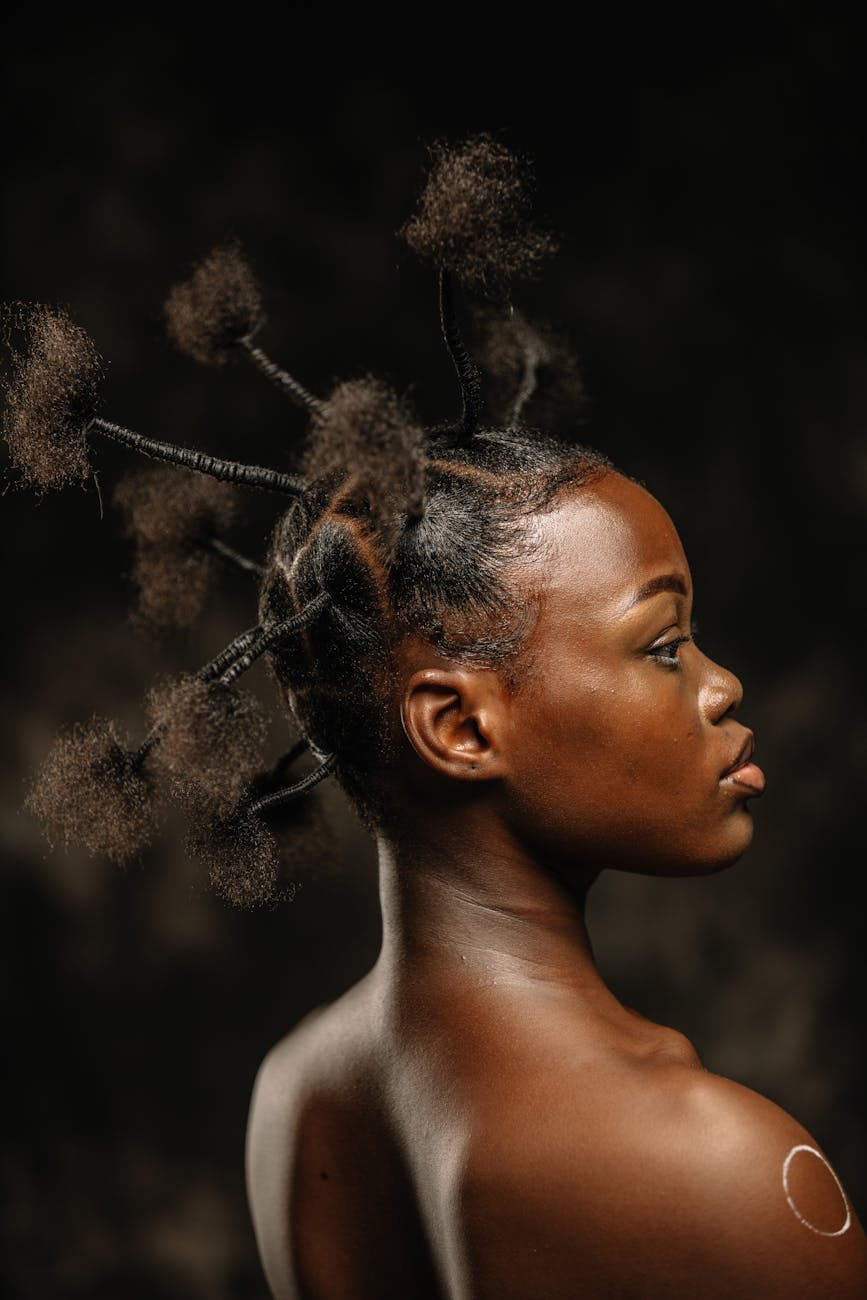
The story of Black beauty is one of resilience, transformation, and self-definition. It is a history woven through genetics, culture, struggle, and celebration. The evolution of Black beauty reflects not only the physical adaptations of African-descended peoples but also the social forces that sought to erase them and the courageous reclamation that continues today. From the golden courts of African kingdoms to the global stage of fashion and film, Black beauty has endured as both a natural inheritance and a cultural statement of identity.
The origins of Black beauty are rooted in biology and the African environment. Dark skin rich in eumelanin evolved as a protective adaptation against intense ultraviolet radiation, safeguarding against skin cancer and preserving folate levels vital for reproduction (Jablonski & Chaplin, 2010). Afro-textured hair, with its coiled structure, served as insulation, cooling the scalp in hot climates. Broader noses and fuller lips facilitated air regulation and hydration. These features were not only functional but celebrated within ancient African societies, where adornment, scarification, and hairstyles carried spiritual and cultural meaning. Beauty was a reflection of harmony with nature and community.
In African kingdoms such as Nubia, Kush, and Mali, beauty was also tied to power and refinement. Women adorned themselves with jewelry, intricate hairstyles, and natural cosmetics made from minerals and plants. Mansa Musa’s Mali, for example, valued the elegance of dress and presentation as signs of wealth and spiritual dignity. Ancient Egypt revered dark skin as a symbol of fertility and divine blessing, with goddesses like Hathor often represented with rich pigmentation. Within these societies, beauty was never divorced from identity; it was both natural and sacred.
The transatlantic slave trade fractured this organic celebration. Enslaved Africans were torn from cultural practices of adornment and subjected to Eurocentric hierarchies that devalued their features. Skin tone, hair texture, and facial structure became grounds for stereotyping and degradation. Lighter-skinned individuals were often given preferential treatment under slavery, planting the seeds of colorism that persist today (Hunter, 2007). Black beauty, once celebrated, was weaponized as a marker of inferiority.
Despite these oppressive systems, enslaved Africans and their descendants found ways to preserve beauty as resistance. Hair braiding carried coded maps and messages of escape. Sunday church services became occasions for dignified dress, asserting humanity against the indignities of bondage. Beauty practices were acts of survival—quiet rebellions against erasure, affirmations that their bodies held value and dignity beyond the gaze of the oppressor.
The early 20th century introduced new challenges and opportunities. The rise of segregation-era media continued to glorify whiteness, relegating Black features to caricature. Yet, in the Harlem Renaissance of the 1920s, Black artists, writers, and performers redefined beauty through cultural pride. Figures like Josephine Baker challenged stereotypes with her iconic performances, while Black publications such as Ebony and Jet celebrated darker skin, natural hair, and African-inspired fashion. Beauty became intertwined with racial pride and cultural awakening.
The Civil Rights and Black Power movements of the 1960s and 1970s propelled this evolution further. The slogan “Black is Beautiful” declared an unapologetic embrace of African aesthetics. Natural hairstyles such as afros symbolized liberation and self-love, rejecting chemical straightening as a symptom of imposed Eurocentric standards (Byrd & Tharps, 2014). Black beauty shifted from mere aesthetics to political activism, a visible challenge to centuries of marginalization.
Even as these movements gained momentum, mainstream media continued to impose narrow ideals. Black women were often excluded from global standards of beauty unless they fit lighter-skinned, straighter-haired molds. Supermodels like Naomi Sims and later Naomi Campbell carved spaces within the fashion industry, but representation remained limited and conditional. The struggle for full recognition persisted.
The late 20th and early 21st centuries, however, have marked a new renaissance. Celebrities such as Erykah Badu, Lauryn Hill, and later Lupita Nyong’o redefined beauty on their own terms, celebrating natural features and melanin-rich skin. Social media platforms further amplified diverse representations, allowing Black creators to showcase beauty outside of mainstream filters. The natural hair movement gained traction globally, encouraging millions of women to embrace their textured hair as beautiful and worthy.
Corporate industries began to take notice. Rihanna’s Fenty Beauty disrupted cosmetics in 2017 by offering 40 foundation shades, directly addressing the exclusion of darker tones from the beauty market. This inclusivity sparked a revolution in the industry, forcing major brands to rethink representation. Black-owned beauty companies also flourished, ensuring that definitions of beauty were set by the community itself rather than imposed from outside.
The evolution of Black beauty is not merely external—it is psychological and spiritual. Centuries of denigration created scars of internalized racism and colorism, but communities have turned toward healing. Celebrating melanin, natural features, and cultural adornments has become a path to collective empowerment. Scripture reinforces this deeper understanding, reminding us that true beauty is not only in appearance but in spirit: “The king’s daughter is all glorious within” (Psalm 45:13, KJV). This truth has grounded generations of Black people who find strength in both inner character and outer identity.
Yet, challenges remain. Media continues to perpetuate colorism, often privileging lighter-skinned models and actresses. Eurocentric beauty standards still influence surgery trends, skin-lightening practices, and hair straightening industries, especially in regions of Africa and the Caribbean. The battle for holistic acceptance of Black beauty is ongoing, demanding vigilance and continued cultural affirmation (Tate, 2009).
Still, progress cannot be denied. From the braided crowns of ancestors to the afros of revolutionaries and the natural hair influencers of today, Black beauty has proven to be ever-evolving and self-renewing. It is a beauty that adapts without losing its roots, a beauty that radiates resilience even under pressure. Its evolution is not linear but cyclical—always returning to the truth that Black beauty is whole, worthy, and divine.
In conclusion, the evolution of Black beauty is a testament to survival and self-definition. From biological origins to ancient kingdoms, from the horrors of slavery to the triumphs of cultural renaissance, Black beauty has endured and blossomed. Today, it stands as both a scientific marvel and a cultural force, reminding the world that beauty is not dictated by dominance but by dignity. Black beauty, in its many forms, continues to evolve—not toward assimilation but toward liberation, glowing with the radiance of resilience.
References
- Byrd, A., & Tharps, L. (2014). Hair story: Untangling the roots of Black hair in America. St. Martin’s Press.
- Hunter, M. (2007). The persistent problem of colorism: Skin tone, status, and inequality. Sociology Compass, 1(1), 237–254.
- Jablonski, N. G., & Chaplin, G. (2010). Human skin pigmentation as an adaptation to UV radiation. Proceedings of the National Academy of Sciences, 107(Suppl 2), 8962–8968.
- Mercer, K. (1994). Welcome to the jungle: New positions in Black cultural studies. Routledge.
- Tate, S. A. (2009). Black beauty: Aesthetics, stylization, politics. Ashgate.
 THE BROWN GIRL DILEMMA