
Tag Archives: The Emancipation Proclamation

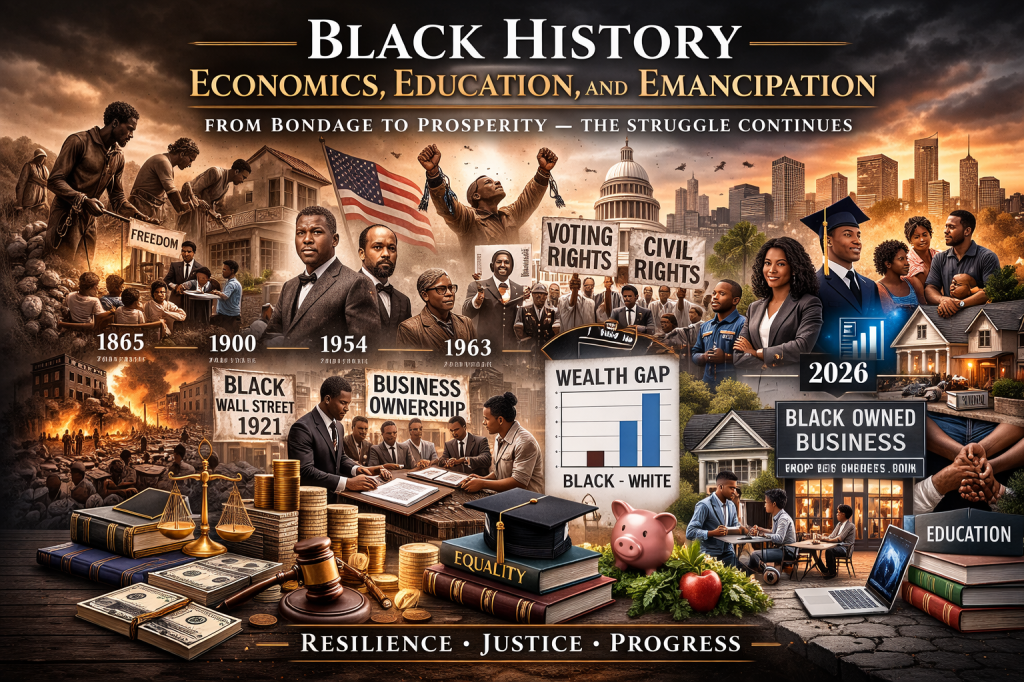
Black History: Economics, Education, and Emancipation.

Black history in the United States is not merely a litany of events; it is the story of a people’s persistent struggle for dignity, self-determination, and economic justice. From the systemic deprivations of slavery to the present day, the economic condition of Black Americans has been profoundly shaped by centuries of exclusion, exploitation, and resistance (McKinsey & Company, 2025). The interplay of economic opportunity, access to education, and emancipation has defined both individual lives and collective possibilities.

The legacy of slavery and Reconstruction laid the groundwork for persistent racial inequalities. Even at the formal end of slavery in 1865, Black Americans held virtually no wealth; over a century and a half later, that gap persists. Black households possess only a small fraction of national wealth compared with White households, illustrating how historical racial injustice still translates into economic precarity (LendingTree, 2026; Brookings Institution, 2024).

Structural discrimination continues to influence economic outcomes through labor markets that systematically disadvantage Black workers. Black Americans are overrepresented in lower-wage occupations and underrepresented in higher-paying managerial and professional roles, reinforcing income inequality (McKinsey & Company, 2019). This occupational segregation, rooted in historical discrimination, limits economic mobility and widens the wealth gap across generations.

Education has long been touted as a pathway to economic advancement, yet disparities in educational access and outcomes persist. Predominantly Black school districts receive significantly less funding than predominantly White districts, perpetuating cycles of unequal opportunity and limiting access to high-quality schooling (Black Wall Street Organization, 2025). In this context, education becomes not simply a means of individual uplift but a battleground for equity.

Higher education, while expanding enrollment for Black students over recent decades, also exposes students to disproportionate levels of debt. Black college graduates carry higher student loan burdens than their White counterparts, constraining their capacity to accumulate wealth through homeownership, savings, and investments (Black Wall Street Organization, 2025). Thus, the very institution that promises empowerment can become another vector of economic strain.

Despite the barriers, African Americans have demonstrated remarkable resilience. Historic models of Black economic self-help—mutual aid societies, Black-owned banks, business collectives, and cooperative enterprises—reflect a long tradition of economic self-determination. Yet these efforts have often faced hostile responses, from discriminatory lending practices to overt violence, as in the destruction of Black Wall Street in 1921 (Black Wall Street Organization, 2025).

Homeownership remains a key indicator of wealth building in America, yet the Black homeownership rate lags significantly behind that of White Americans, reflecting a century of housing discrimination and unequal access to mortgage capital (Washington Post, 2026). Even when Black families do own homes, properties often appraise for lower values due to enduring patterns of segregation and appraisal bias, further limiting generational wealth accumulation.

As of recent data, Black homeownership stands well below the rate for White families, and median wages for Black workers are substantially lower across industries. Black workers commonly earn about 70 percent of what White workers earn in comparable sectors, underscoring persistent wage disparities (LendingTree, 2026). These gaps are not accidental; they reflect longstanding structural inequities embedded in the economy.

Economic Data Tables: Black–White Disparities (2025–2026)

Median Household Income & Wealth

IndicatorBlack HouseholdsWhite HouseholdsSource
Median Household Income (2024)~$56,020~$88,010LendingTree (2026)
Median Household Wealth (% of U.S. total)~3.4%~83.5%LendingTree (2026)
Racial Wealth Ratio (White : Black)~8:1ZipDo (2026)
Median Wealth (Black vs White)~$24,100 vs $188,200ZipDo (2026)

Employment & Labor Market Disparities

IndicatorBlack WorkersWhite WorkersSource
Unemployment Rate (Q3, 2025)~7.8%~3.8%LendingTree (2026)
Black Unemployment (Nov 2025 spike)8.3%Reuters (2025)
Earnings Gap (Median wages)~70–75% of White wages100%WorldMetrics (2026)

Homeownership & Wealth Building

IndicatorBlack HouseholdsWhite HouseholdsSource
Homeownership Rate (2026)~43.6%~70.3%Washington Post (2026)
Homeownership Gap (Historical Persistence)Negligible improvement over decadesWashington Post (2026)
Access to Favorable Mortgage TermsHigher denial & biasLower denialLendingTree (2026)

These data illustrate several core structural truths:

  • Persistent Racial Wealth Gap: Black households hold a disproportionately small share of U.S. total wealth (about 3.4%), even though Black Americans represent ~13–14% of the population. Meanwhile, White households control over 80% of the national wealth. Economic inequality is thus not only about income but also about historical asset accumulation and generational transfer of wealth.
  • Income Inequality Across Sectors: Black workers earn approximately 70–75 cents for every dollar earned by White workers across major sectors, with the gap widening in higher‑paying occupations.
  • Employment Barriers: The unemployment rate for Black Americans in late 2025 and early 2026 was more than double the national rate, a persistent pattern indicating structural labor market discrimination and vulnerability during economic contractions.
  • Homeownership & Wealth Building: Black homeownership remains far below White rates, with only about 44% of Black households owning homes — a primary vehicle for middle‑class wealth — compared with around 70% of White households. Appraisal bias, mortgage denial disparities, and historical segregation play significant roles in this enduring gap

The wealth gap also manifests in broader national terms: White Americans hold the vast majority of U.S. wealth, while Black Americans hold only a small sliver despite representing a significant portion of the population (LendingTree, 2026). This imbalance illustrates how historical exclusion has compounded over time, making wealth accumulation a generational challenge.

In the labor market of 2025–2026, the unemployment rate for Black Americans has risen disproportionately higher than the national average, signaling troubling economic trends that scholars and civil rights analysts describe as a “Black recession.” Black unemployment climbed to levels nearly double those of White workers amid broader economic slowdown and policy reversals that eroded programs designed to address racial inequality (State of the Dream Report, 2026).

Economic policy and labor market shifts have gutted diversity and inclusion initiatives in federal agencies, removing support mechanisms that previously helped mitigate racial disparities in employment. As a result, Black workers have borne the brunt of federal job cuts, particularly Black women, who historically are overrepresented in public sector employment (State of the Dream Report, 2026).

The racial wealth gap is not simply an issue of income but of cumulative assets: investments, property equity, business ownership, and inheritance. White families disproportionately benefit from stock market gains and home equity appreciation, while Black families have historically had limited access to these primary vehicles of wealth growth (Investopedia, 2025). This structural imbalance inhibits intergenerational economic security.

The persistence of these disparities challenges the myth that formal emancipation was sufficient to equalize economic outcomes. Rather, emancipation began a long struggle against structural barriers that have constrained Black economic agency. This ongoing reality reveals that legal freedom without equitable economic opportunity remains incomplete.
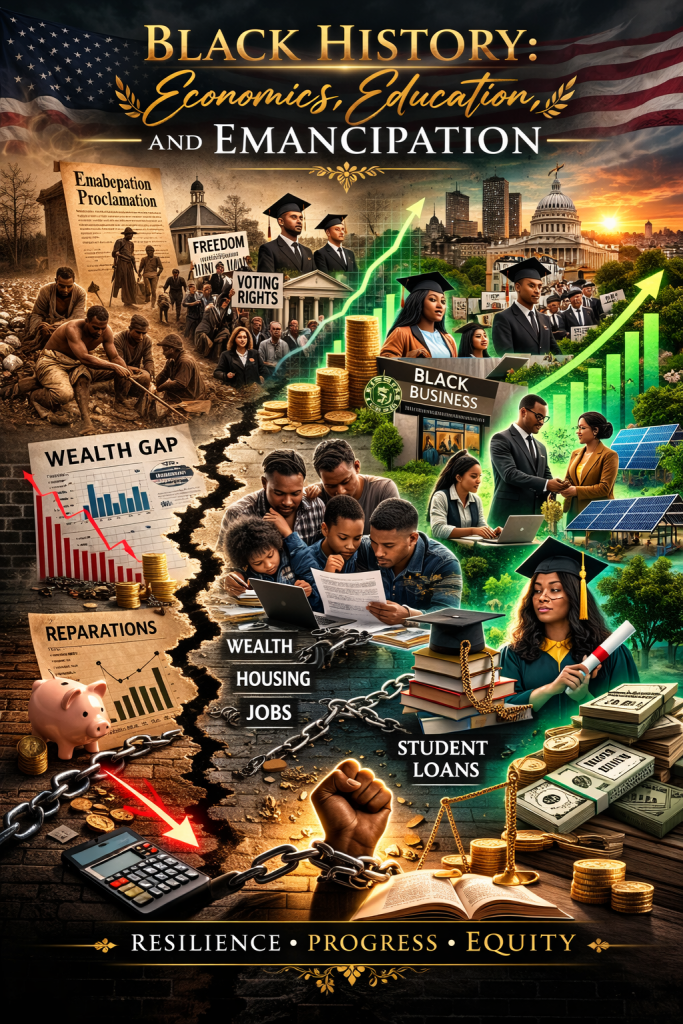
Economic suffering among Black Americans in 2026 highlights the continuing legacy of these structural inequalities. Rising unemployment, growing wealth concentration among white households, and barriers to capital for Black entrepreneurs all point to an economy in which racial disparities remain entrenched. Scholars argue that the effects of these disparities are so profound that closing the racial wealth gap could significantly benefit the U.S. economy as a whole (McKinsey & Company, 2019).

Educational disparities remain deeply intertwined with economic outcomes. Black students often attend schools with fewer resources, lower teacher salaries, and less access to advanced coursework, hindering academic achievement and future earnings potential. These inequities underscore how education and economic status are mutually reinforcing.

At the same time, economic inequality among Black communities intersects with health, housing, and social stability. The lack of access to quality healthcare increases medical expenses and economic vulnerability, and housing instability remains a persistent threat for families with limited economic resources (Black Wall Street Organization, 2025).

Yet, in spite of systemic barriers, Black economic empowerment initiatives continue to evolve. Black-owned businesses, though smaller and less capitalized than their White counterparts, represent a significant force for community development. Support for entrepreneurship and access to capital remain key strategies for building Black economic resilience (Black Wall Street Organization, 2025).

Historically and in the present day, education has served as both a means of empowerment and a site of struggle. The promise of education as a path to economic freedom remains contested, as disparities in funding, access, and outcomes continue to shape life chances for Black Americans.

To confront the entrenched economic disparities of 2026 and beyond, scholars and policy advocates emphasize the need for structural reforms that address labor market discrimination, broaden access to capital, and ensure equitable educational opportunity. Without such reforms, the legacy of racial economic inequality will persist, limiting the full realization of emancipation.

In sum, Black history—rooted in economics, education, and emancipation—is a testament to both the enduring injustice of systemic exclusion and the persistent struggle for full economic citizenship. The story of Black America’s economic journey reveals deep structural challenges but also the resilience and ingenuity that have propelled this nation toward a more inclusive future.


References

Brookings Institution. (2024). Black wealth is increasing, but so is the racial wealth gap. Retrieved from https://www.brookings.edu/articles/black-wealth-is-increasing-but-so-is-the-racial-wealth-gap/

LendingTree. (2026). Snapshots of Black and White disparities in income, wealth, and employment. Retrieved from https://www.lendingtree.com/debt-consolidation/black-and-white-disparities-study/

McKinsey & Company. (2019). The economic state of Black America: What is and what could be. Retrieved from https://www.mckinsey.com/featured-insights/diversity-and-inclusion/the-economic-state-of-black-america-what-is-and-what-could-be

State of the Dream Report. (2026). From regression to signs of a Black recession. The EDU Ledger. Retrieved from https://www.theeduledger.com/demographics/african-american/article/15815124/state-of-the-dream-2026-from-regression-to-signs-of-a-black-recession

The Washington Post. (2026). Why does Black homeownership lag White ownership in every major city? Retrieved from https://www.washingtonpost.com/business/2026/02/21/black-homeownership-singletary/
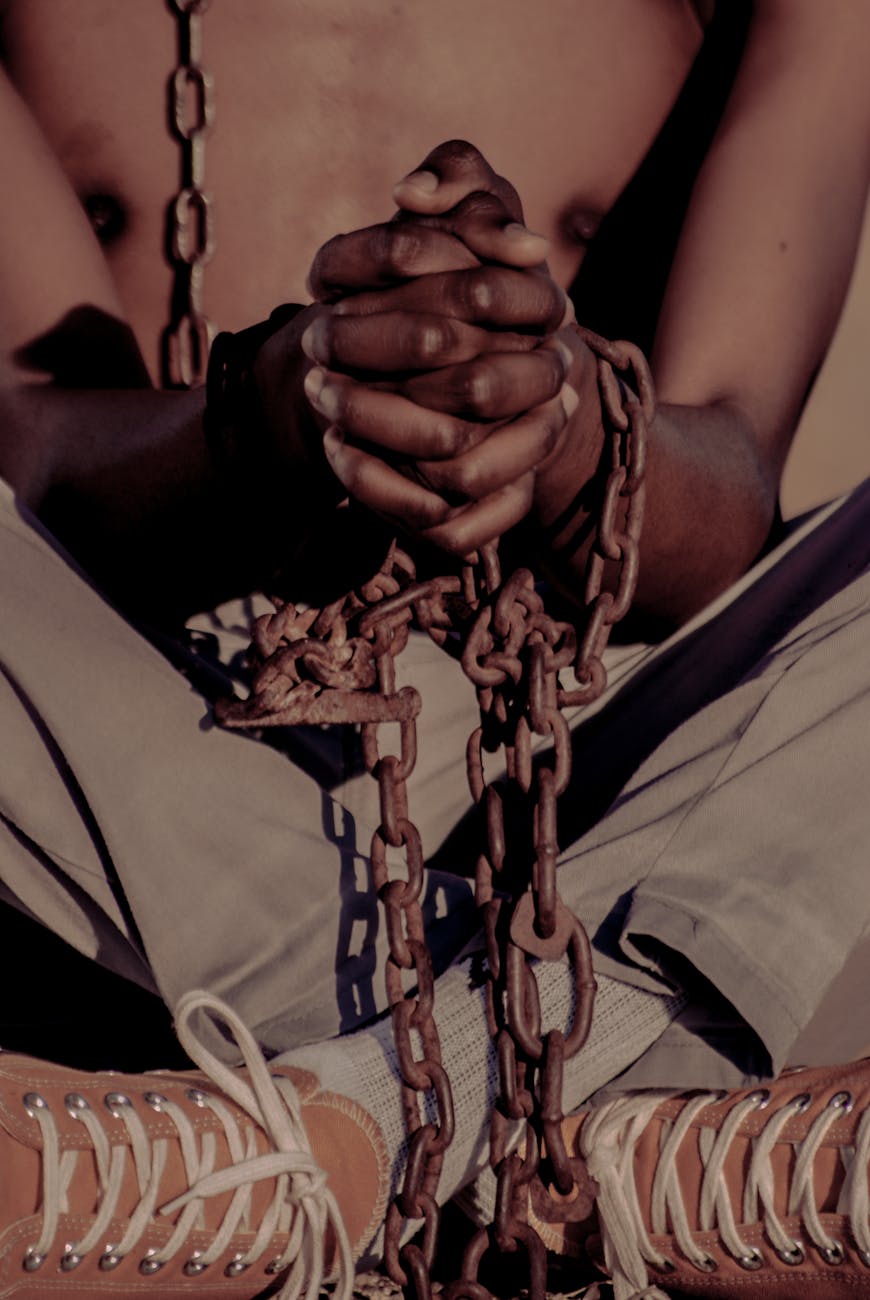
Dilemma: Slavery – Chains Across the Waters: The Transatlantic Slave Trade, Biblical Prophecy, and the Legacy of Black Enslavement

Photo by Thato Moiketsi on Pexels.com

“We Came in the Bottom of Ships”

(A Poem About Slavery)

We came in the bottom of ships, not dreams,
Chained like thunder beneath wooden beams,
Torn from kingdoms kissed by the sun,
From the drums of Dahomey, to the rivers of the Congo run.

We were Igbo, Ashanti, Hebrew, and Ewe,
Mothers of wisdom, warriors of sway,
Fathers of iron, scribes of the scroll,
Our names were gold—but they bartered our soul.

The wind was not freedom but fury and foam,
As they stacked our breath in a floating tomb.
“Amistad,” “Brookes,” and “Jesus” they sailed,
Yet Christ wept each time those hulls prevailed.

We sang in the dark where no sun reached,
We prayed in a tongue they could not breach.
Deuteronomy cried from the sacred page,
“You shall go into Egypt again”—the prophecy aged.

They whipped us at dawn, and raped through the night,
Took our children, and robbed us of sight.
Taught us to bow and forget who we were,
Yet our blood remembered—we came from the Word.

On blocks we stood like cattle and coin,
Sold by the pound, bruised in the groin.
Names lost—Tamar, Kofi, Yaira, Adebayo—
Now called Jack, or Belle, or Uncle Sam’s shadow.

We built this land—its wealth, its walls,
With cotton-picked hands and freedom’s calls.
We bled in silence, we ran, we fought,
We learned to read, though they said we could not.

They broke our backs, but not our will,
For Harriet moved by the Spirit still.
And Frederick wrote fire with a bleeding pen,
While Nat Turner rose like a lion again.

Now we dance in Juneteenth’s flame,
Remembering each forgotten name.
From chains to chants, from songs to speech,
Still reaching the freedom they dared not teach.


Closing Lines

So when you ask where our story begins,
It does not start in chains or sins—
But in a garden, in a scroll, in ancient breath—
Slavery was a shadow. But we are not death.
We are prophecy walking. We are Judah’s drum.
We are the voice that says: “Let my people come.”

.


The transatlantic slave trade remains one of the darkest stains in human history—marked by over four centuries of systemic oppression, brutality, and the forced migration of millions of African men, women, and children. Black people were enslaved in the Americas for approximately 246 years, from 1619 to 1865, and the aftershocks of this atrocity continue to reverberate in modern society. The origin, scale, and spiritual context of this historical trauma require a deep examination—of not only the ships and auction blocks but also the prophetic echoes found in Scripture, particularly Deuteronomy 28.


Origins of African Slavery: Historical and Spiritual Roots

The transatlantic slave trade began in the late 15th century, with European powers—especially Portugal, Britain, Spain, France, and the Netherlands—establishing trading posts along the western coasts of Africa. Africans were kidnapped or sold by rival tribes, many through warfare or debt bondage, and transported across the Atlantic Ocean in horrific conditions.

According to Deuteronomy 28:68 (KJV):

“And the Lord shall bring thee into Egypt again with ships, by the way whereof I spake unto thee, Thou shalt see it no more again: and there ye shall be sold unto your enemies for bondmen and bondwomen, and no man shall buy you.”

This verse is widely cited in Hebraic Israelite theology as a prophetic reference to the transatlantic slave trade, wherein descendants of the biblical Israelites—believed by many to be the so-called African Americans—would be carried in ships to a new “Egypt” (a house of bondage).


Slave Ports and African Origins

Most of the enslaved Africans came from West and Central Africa, regions that include modern-day:

  • Ghana
  • Nigeria
  • Benin
  • Senegal
  • Angola
  • Sierra Leone

The major slave embarkation points were on the Ivory Coast, Gold Coast, Slave Coast, and Bight of Biafra.

There is evidence that Shemites—descendants of Shem, one of Noah’s sons—lived in parts of Africa, particularly among Hebrew-speaking tribes such as the Igbo of Nigeria, the Akan of Ghana, and others who retained oral traditions, circumcision practices, and laws similar to ancient Israel (Hotep, 2016).


Slave Ships and Death at Sea

The names of infamous slave ships included:

  • The Brookes
  • The Henrietta Marie
  • The Jesus of Lübeck (ironically owned by Queen Elizabeth I)
  • La Amistad

Conditions aboard these ships were inhumane. Africans were shackled, stacked tightly in cargo holds with little air, and barely fed. It is estimated that at least 1.8 million of the 12.5 million enslaved Africans died during the Middle Passage (Eltis & Richardson, 2010).

The story of La Amistad (1839) stands out as one of resistance. Enslaved Mende Africans, led by Sengbe Pieh (Cinqué), rebelled against their Spanish captors. The case reached the U.S. Supreme Court, which ruled in favor of the Africans’ freedom—marking a rare legal victory for Black resistance.


Slavery in America and the World

Slavery existed globally, but the transatlantic slave trade was uniquely brutal and racialized. Other nations that held African slaves included:

  • Brazil
  • Cuba
  • The Caribbean colonies
  • Spain
  • Portugal
  • France
  • The Netherlands

In North America, enslaved people were forced into:

  • Plantation labor (cotton, sugar, tobacco)
  • Domestic service
  • Skilled crafts
  • Childbearing (as a source of wealth)

They were often sold at public slave auctions, stripped naked, examined like livestock, and renamed with European or Anglo-Christian names. Most were forced to abandon their original Hebrew names, cultural identities, and languages, such as Ewe, Igbo, Wolof, Yoruba, and Akan.


Sexual Violence and Psychological Warfare

Slavery in America was not only physical but psychological and sexual. “Buck breaking” was a barbaric method where enslaved Black men were raped or publicly humiliated to break their spirit and deter rebellion. It is hard to quantify, but tens of thousands of Black women were also raped by white slave masters, often forced to bear children who were legally still enslaved under the status of the mother (partus sequitur ventrem).


The Abolition of Slavery

Slavery in the United States was abolished in 1865 with the ratification of the 13th Amendment, pushed forward by the efforts of abolitionists like Frederick Douglass, Harriet Tubman, and William Lloyd Garrison, as well as President Abraham Lincoln‘s Emancipation Proclamation (1863).


Slave Narratives and Overcoming

One of the most famous narratives is that of Harriet Jacobs, author of Incidents in the Life of a Slave Girl, who detailed her harrowing experiences as a sexually abused enslaved woman.

Another is Frederick Douglass, who escaped slavery, taught himself to read, and became one of the greatest orators and writers in American history. His book Narrative of the Life of Frederick Douglass (1845) exposed the cruelty of slavery and helped ignite the abolitionist movement.


Modern Black Celebration and Resilience

Today, Black Americans honor their ancestors and freedom through:

  • Juneteenth (June 19th, the date when the last slaves in Texas were freed in 1865)
  • Black History Month
  • Kwanzaa
  • Passover Celebrations (among Hebrew Israelites)

Is the Condition of Black People Better Today?

While legal slavery is abolished, systemic racism, mass incarceration, police brutality, and economic disparities persist. Nevertheless, the resilience, innovation, and cultural power of Black people have reshaped nations—from political powerhouses like Barack Obama to cultural icons like Maya Angelou and Malcolm X.


Conclusion

Slavery was not merely a historical event; it was a fulfillment of biblical prophecy, a global enterprise fueled by greed and racial supremacy, and a foundational trauma in the American story. Understanding its full scope—both physically and spiritually—allows us to honor those who perished, those who resisted, and those who still rise today.


References

  • Berlin, I. (2003). Generations of Captivity: A History of African-American Slaves. Harvard University Press.
  • Deuteronomy 28:68. (n.d.). The Holy Bible, King James Version.
  • Eltis, D., & Richardson, D. (2010). Atlas of the Transatlantic Slave Trade. Yale University Press.
  • Douglass, F. (1845). Narrative of the Life of Frederick Douglass, an American Slave. Boston: Anti-Slavery Office.
  • Jacobs, H. (1861). Incidents in the Life of a Slave Girl. Boston: Thayer & Eldridge.
  • Hotep, D. (2016). The African Hebrews: Biblical Israelites in Africa. Afrikan Mind Publishing.
  • Lovejoy, P. E. (2000). Transformations in Slavery: A History of Slavery in Africa. Cambridge University Press.

“The Emancipation Proclamation: Abraham Lincoln’s Fight to Free a Divided Nation”

Photo by Thato Moiketsi on Pexels.com

The Emancipation Proclamation and Its Impact

The Emancipation Proclamation, issued on January 1, 1863, was a wartime executive order that declared all enslaved people in Confederate-held territory to be free (Foner, 2010). Although it did not immediately free all enslaved people, it transformed the character of the war, shifting its aim from merely preserving the Union to also including the abolition of slavery. It allowed Black men to enlist in the Union Army, leading to the formation of over 180,000 Black soldiers who fought for their freedom and the Union cause.

The Emancipation Proclamation did not apply to the border slave states (Delaware, Kentucky, Maryland, Missouri) or areas of the Confederacy already under Union control. It applied only to states in active rebellion. Here’s what it declared:

That on the first day of January, A.D. 1863, all persons held as slaves within any State or designated part of a State, the people whereof shall then be in rebellion against the United States, shall be then, thenceforward, and forever free.

Main Points:

  1. Freedom for enslaved people in Confederate-controlled territories (not the entire U.S.).
  2. Authorized Black men to serve in the Union Army and Navy, transforming the war into a fight for human liberty.
  3. Called for the U.S. military to recognize and maintain the freedom of formerly enslaved people.
  4. Framed as a “fit and necessary war measure” for suppressing the rebellion.

Lincoln concluded with a solemn declaration:

“And upon this act, sincerely believed to be an act of justice, warranted by the Constitution, upon military necessity, I invoke the considerate judgment of mankind and the gracious favor of Almighty God.”


Limitations of the Emancipation Proclamation

Despite its powerful rhetoric, the Proclamation did not immediately free a single slave in practice. Why?

  • It only applied to areas outside of Union control.
  • It excluded the border states and certain regions within Confederate states that had already surrendered or been reclaimed.
  • Enforcement depended entirely on Union military success.

However, its symbolic and legal significance was profound.


Impact on Black Americans and the War

  1. Moral Clarity: It transformed the Civil War from a battle for union into a crusade against slavery, giving the war a moral imperative that resonated globally.
  2. Black Enlistment: Over 180,000 Black men joined the Union Army and Navy, shifting the tide of the war and demonstrating extraordinary valor (Berlin et al., 1992).
  3. Pathway to the 13th Amendment: Though not a constitutional law, the Emancipation Proclamation paved the way for the 13th Amendment (ratified in 1865), which permanently abolished slavery in the United States.
  4. Global Message: It discouraged foreign powers (especially Britain and France) from supporting the Confederacy, as they had already abolished slavery in their own empires.

Historical Interpretation

  • Frederick Douglass called the Emancipation Proclamation “the immortal paper” that turned a war for Union into a war for freedom.
  • Historian Eric Foner notes that although it was limited in scope, it was “a revolutionary act of immense consequence” (Foner, 2010).
  • Lincoln later said, “I never, in my life, felt more certain that I was doing right, than I do in signing this paper.”

Though legally narrow and strategically calculated, the Emancipation Proclamation was a turning point in American history. It elevated the struggle of enslaved African Americans onto the national and international stage, set the foundation for constitutional abolition, and forced the United States to reckon with its original sin—slavery.

It was not merely a document of war; it was a moral declaration that the U.S. could no longer be a nation divided between slavery and freedom.

Abraham Lincoln: The Reluctant Liberator and the Legacy of Freedom

Abraham Lincoln, the 16th President of the United States, stands as one of the most pivotal figures in American history. Born on February 12, 1809, in a log cabin in Hardin County, Kentucky, Lincoln rose from humble beginnings to the nation’s highest office. Self-taught and profoundly principled, he guided the country through its most divisive era—the Civil War—preserving the Union and paving the way toward the abolition of slavery.

Lincoln’s motivations were both moral and strategic. While he personally opposed slavery, he prioritized saving the Union. In a famous letter to Horace Greeley in 1862, Lincoln wrote, “If I could save the Union without freeing any slave, I would do it… and if I could save it by freeing all the slaves, I would do it” (Lincoln, 1862). The proclamation was as much a military strategy as a moral statement—aimed at weakening the Confederacy’s economic base and preventing foreign nations from supporting the South.

Why Lincoln Helped Black People: A Shift in Moral Clarity

Lincoln’s evolution on slavery was gradual. Initially, he supported compensated emancipation and colonization schemes to send freed slaves to Africa or the Caribbean. However, as the war progressed, he began to recognize the moral and constitutional necessity of abolition. Influenced by abolitionists like Frederick Douglass and the courage of Black soldiers, Lincoln’s policies matured, culminating in his push for the Thirteenth Amendment, which permanently abolished slavery in the United States.

The Division Between North and South

The Civil War exposed the deep ideological divide between the industrialized North and the agrarian, slaveholding South. The North viewed slavery as economically backward and morally indefensible, while the South saw it as integral to its economy and social order. Lincoln’s leadership during this period forced the issue to the national forefront, resulting in radical social and constitutional changes that reshaped American society.

His Rise to the Presidency

Lincoln’s political career began in the Illinois State Legislature, and he later served a single term in Congress. It was his debates with Senator Stephen Douglas during the 1858 Illinois Senate race that catapulted him to national prominence. Though he lost that race, his powerful oratory and moral conviction caught the attention of the newly-formed Republican Party, which nominated him for President in 1860. His election triggered Southern secession, plunging the nation into civil war.

Family, Legacy, and Lineage

Lincoln married Mary Todd, a woman from a wealthy Kentucky family, and together they had four sons—Robert, Edward, William, and Thomas (Tad). Only Robert lived to adulthood. Lincoln’s ancestry was primarily English, and while there have been unsubstantiated rumors that he had African ancestry, there is no verified genealogical evidence supporting this claim (Oates, 1977). However, the cultural symbolism of his role in ending slavery has often led Black Americans to claim a spiritual kinship with him.

Was Lincoln the Greatest President for Black Americans?

While Lincoln is often hailed as the “Great Emancipator,” his legacy is nuanced. He took critical steps toward ending slavery, but not always out of an abolitionist conviction. Later presidents such as Lyndon B. Johnson, who signed the Civil Rights Act of 1964 and the Voting Rights Act of 1965, also played pivotal roles in advancing Black civil rights. Barack Obama, the first Black president, holds a symbolic and historical significance that echoes Lincoln’s foundational impact.

The Tragic End: Assassination by John Wilkes Booth

Lincoln was assassinated on April 14, 1865, by John Wilkes Booth, a Confederate sympathizer, at Ford’s Theatre in Washington, D.C., just days after the Confederate surrender at Appomattox. Booth believed Lincoln’s actions had destroyed the South and sought to avenge its downfall. Lincoln died the next morning, becoming a martyr for the Union and for liberty.


Conclusion

Abraham Lincoln remains one of the most consequential leaders in American history. His legacy, especially in the Black community, is one of complex admiration. Though not without contradictions, his leadership during the Civil War and his eventual commitment to abolition fundamentally reshaped the nation. His decisions laid the groundwork for future civil rights advancements, and his vision of a united, free America continues to inspire generations.


References

  • Foner, E. (2010). The Fiery Trial: Abraham Lincoln and American Slavery. W. W. Norton & Company.
  • Lincoln, A. (1862). Letter to Horace Greeley, August 22, 1862.
  • Oates, S. B. (1977). With Malice Toward None: A Life of Abraham Lincoln. Harper & Row.
  • Berlin, I., Reidy, J. P., & Rowland, L. (1992). Freedom: A Documentary History of Emancipation, 1861–1867. Cambridge University Press.
  • Foner, E. (2010). The Fiery Trial: Abraham Lincoln and American Slavery. W. W. Norton & Company.
  • Lincoln, A. (1863). The Emancipation Proclamation. U.S. National Archives.