
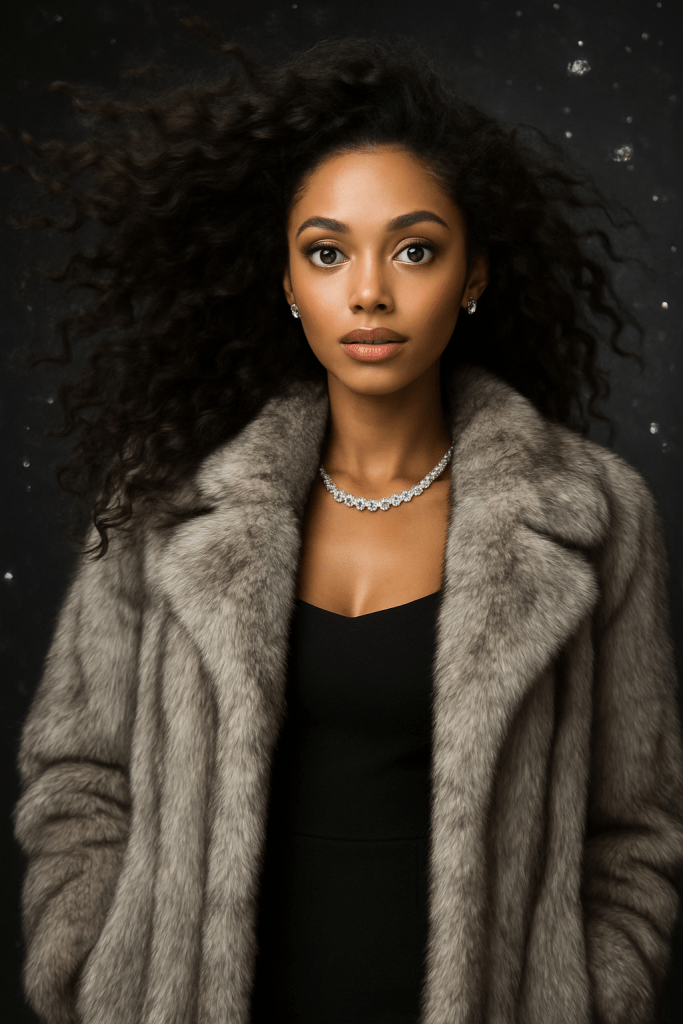
The lived experience of a beautiful brown woman in today’s world is layered with complexity, triumph, and contradiction. She exists in a space where beauty is simultaneously a blessing and a battlefield—a lens through which society sees her, yet often fails to truly know her. The beautiful brown paradox is the tension between being visually adored but socially dismissed, culturally exalted but systemically constrained, desired yet rarely protected. In this paradox, beauty does not erase oppression; instead, it often highlights it.
Within the Black and brown community, beauty is a cultural inheritance—an embodied legacy of ancestry, geography, and divine artistry. From rich melanin tones to textured hair and regal facial architecture, brown beauty is rooted in history older than empires. Yet colonialism distorted this reality, making brown beauty invisible, inferior, or conditional. The beautiful brown woman today carries not only the gift of her appearance but the weight of reclaiming its truth.
Society weaponizes beauty standards, often rewarding proximity to whiteness. Even when brown beauty is praised, it is sometimes praised selectively—lighter shades, looser curls, delicate features. The brown woman whose beauty does not align with Eurocentric norms may find herself celebrated within her culture but overlooked in mainstream spaces. This hierarchy shapes identity and experience, forcing her to navigate the politics of complexion and attractiveness.
In public perception, the beautiful brown woman is often exoticized. She is labeled “different,” “rare,” or “special”—descriptors cloaked as compliments yet rooted in the idea that brown beauty is exceptional rather than foundational. She becomes spectacle instead of standard, admired but othered, desired yet misunderstood. Her identity becomes an aesthetic, not a humanity.
Social desirability does not translate into social safety. A beautiful brown woman may attract attention but not advocacy. She may be admired in music videos, but ignored in boardrooms. Emulated in style and beauty trends, yet excluded from leadership. Loved on screen, but unprotected in real life when injustice strikes. Her beauty, instead of armor, becomes exposure.
Colorism complicates her world further. Privilege may come with lighter complexion, yet scrutiny may intensify with deeper melanin. Brown beauty exists on a spectrum where each shade bears its own burdens. Light-skinned women may face accusations of arrogance or “passing privilege,” while dark-skinned women may fight invisibility and devaluation. Each lives a different verse of the same song: beauty politicized.
The paradox extends to relationships. The beautiful brown woman may be desired romantically, yet objectified more than cherished. She may attract suitors fascinated by her appearance but intimidated by her intellect or strength. Love becomes a negotiation between being adored and being truly seen. Her heart longs for recognition beyond the physical—a love that honors her essence, not just her allure.
In professional spaces, her beauty can be double-edged. It may draw opportunity but also unwanted assumption. She may be seen as capable because she “looks polished,” or underestimated because beauty is mistaken for superficiality. She must work twice as hard to prove she is not merely ornamental. Intelligence becomes her shield, and excellence her language.
Psychologically, beauty can become a mask. The world applauds her appearance but often overlooks her pain. She learns early that vulnerability contradicts image, so she smiles when tired, succeeds when overwhelmed, and forgives when wounded. She carries grace because she must, but inside, she seeks safe spaces to rest her soul and remove the armor of expectation.
Spiritually, her journey carries deep significance. Scripture reminds us that external beauty is fleeting, but inward beauty—wisdom, humility, and faith—endures (1 Peter 3:3–4, KJV). The beautiful brown woman’s strength lies not only in how she looks, but in the resilience she embodies. Her radiance is divine, not merely cosmetic. Her worth is eternal, not algorithmic.
Modern beauty culture complicates her reflection. Filters, trends, and visibility metrics tell her that beauty must be perfected, performed, and proven. Yet ancestral wisdom whispers that true beauty is rooted in identity and dignity—not validation. Her challenge is to see herself clearly in a world that constantly distorts mirrors.
In media, representation grows but remains incomplete. When she sees herself, it is often in curated roles—strong, sensual, supportive. Rarely soft, complex, or unguarded. She longs to see narratives where brown women exist without stereotype or performance; where they breathe fully, laugh freely, and heal publicly.
Community plays a healing role. Among other brown women, she finds recognition without explanation. Shared experience becomes sanctuary. Yet even within community, internalized color hierarchies must be dismantled so beauty becomes celebration, not competition.
The beautiful brown paradox teaches resilience. She learns to define herself rather than be defined. She cultivates internal wealth: character, purpose, vision. Beauty becomes her introduction, not her identity. Her value is no longer measured by perception, but by purpose.
She raises daughters and sons with new language—affirmation rooted in heritage and holiness. She reminds them that melanin is majesty, hair is crown, and beauty is inheritance, not achievement. In doing so, she interrupts generations of distortion and chooses liberation over imitation.
Her presence challenges the world. Brown beauty stands as testimony: that Blackness is not deviation from beauty but the blueprint of it. That her body carries history, culture, and divine intention. That she is not anomaly but origin.
Ultimately, the paradox dissolves in truth: she is more than the gaze that looks at her. She is soul, mind, spirit, destiny. She is chosen, crafted, and crowned by God—not by trends or opinions. Her beauty is not dilemma, but design.
In this revelation, the brown woman walks boldly. She no longer asks for space—she embodies it. She no longer seeks validation—she knows who she is. She no longer battles identity—she rests in it. Her beauty becomes witness to a greater glory: that she is fearfully and wonderfully made (Psalm 139:14, KJV).
The beautiful brown paradox becomes, ultimately, a beautiful brown awakening. And in her awakening, she redefines beauty not only for herself, but for the world.
References
Hunter, M. (2007). The persistent problem of colorism: Skin tone, status, and inequality. Sociology Compass, 1(1), 237–254.
Nash, J. C. (2019). Black feminism reimagined: After intersectionality. Duke University Press.
Russell, K., Wilson, M., & Hall, R. (2013). The color complex: The politics of skin color in a new millennium. Anchor Books.
Wolf, N. (1991). The beauty myth: How images of beauty are used against women. HarperCollins.
Psalm 139:14 (KJV); 1 Peter 3:3–4 (KJV).
 THE BROWN GIRL DILEMMA