
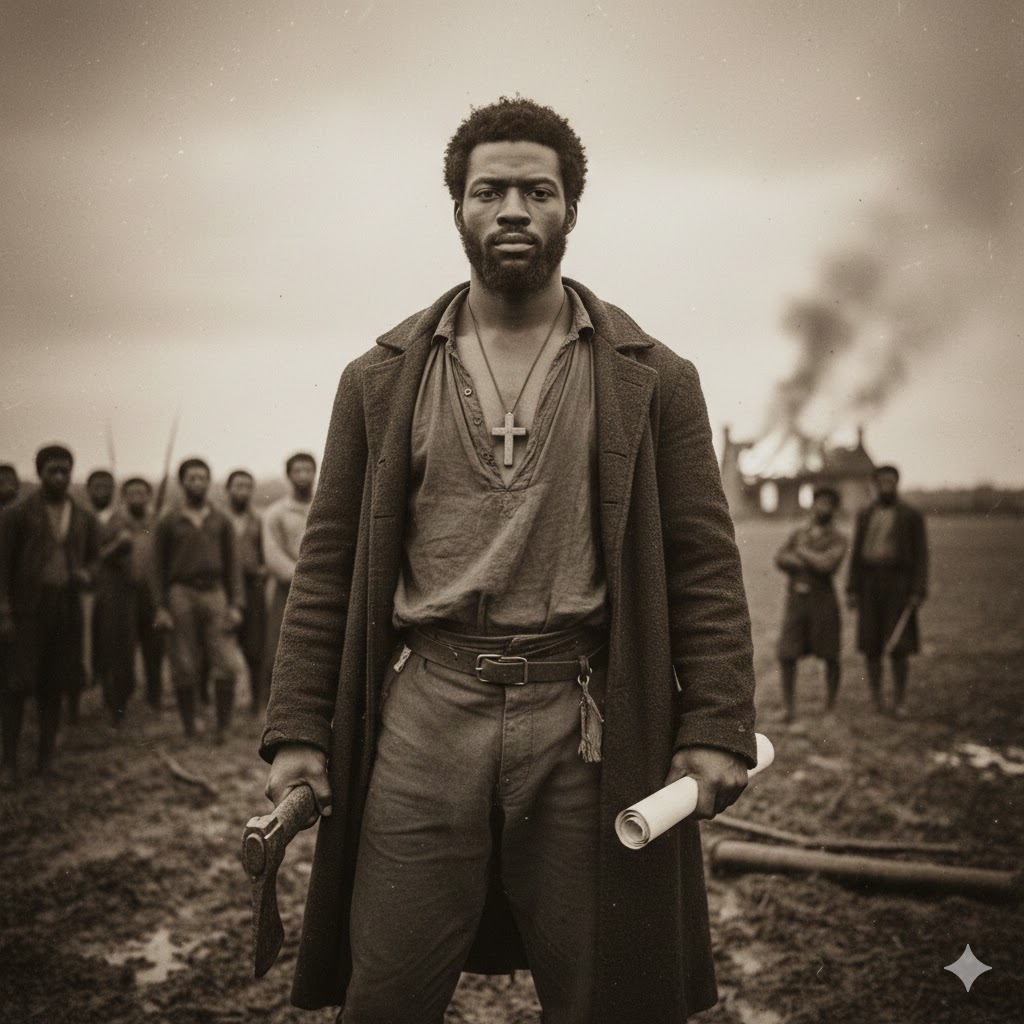
Nat Turner remains one of the most riveting, misunderstood, and fiercely debated figures in American history. His life, marked by enslavement, spiritual conviction, and violent rebellion, exposes the brutal underpinnings of slavery and the relentless pursuit of freedom among the enslaved. Born into bondage yet convinced that God spoke directly to him, Turner’s life becomes both a historical record and a moral indictment of an evil system built on racism, violence, and domination. His story is not merely an episode of revolt—it is a penetrating look into the psychology of oppression and the spiritual courage of a man who believed liberation was his divine mandate.
Nat Turner was born on October 2, 1800, in Southampton County, Virginia, on the Benjamin Turner plantation. Because he was enslaved, his last name “Turner” was not his by heritage but by ownership—a reminder of a system that erased African identities and imposed White surnames as marks of property. He was raised among enslaved people who maintained fragments of African culture while living under the constant threat of punishment, sale, and family separation. Early accounts describe him as highly intelligent, deeply introspective, and gifted with an unusual memory, demonstrating literary and spiritual aptitude uncommon among enslaved children, not because Black children were incapable, but because literacy was violently suppressed.
Turner’s early life was shaped by stories of Africa passed down through elders who remembered freedom. His mother and grandmother reportedly told him he was destined for greatness, strengthening his own belief that he was chosen by God. Because enslavers feared educated Black people, Turner’s intellectual and spiritual gifts were viewed as unsettling. Still, he was allowed to read and interpret scripture, which laid the foundation for his prophetic worldview. Turner believed the Holy Spirit communicated with him through visions and signs—an inner call that would later justify his resistance.
Throughout his enslavement, Turner worked on several plantations due to sale and transfer among enslavers. After Benjamin Turner’s death, Nat was passed to Samuel Turner, and later hired out to others in the region. Ultimately, he lived on the plantation of Joseph Travis—his final enslaver—where he labored in the fields, observed the conditions of fellow enslaved laborers, and cultivated a quiet but fiercely burning resentment toward the system of slavery. Though some enslavers described him as “meek” and “intelligent,” these words reveal more about the blindness of slaveholding ideology than Turner’s true convictions. Beneath the silence was clarity: he was not property but a man.
Nat Turner was married to an enslaved woman named Cherry (also recorded as “Cherie” in some sources), though records of their union are scarce due to the erasure and negligence inherent in slave documentation. They were separated by work arrangements and plantation boundaries, illustrating how marriage among enslaved people was vulnerable to sale, distance, and the will of slaveholders. Turner also had children, though their names and fates are not fully documented, a tragic reminder of how slavery destabilized Black family structures. Enslaved parenthood carried constant fear—a child could be sold, abused, or killed with no recourse.
The racism of Turner’s era was not subtle; it was law, culture, and religion weaponized. Enslavers justified their brutality through pseudo-Christian doctrine and racial myths that claimed African people were inferior. Turner, however, read the Bible for himself and saw deliverance where enslavers preached obedience. His spiritual interpretations defied the slaveholding church and pointed instead to liberation theology: God does not sanctify oppression. Turner began to see visions—blood on corn, heavenly signs, eclipses—as divine symbols that the time for judgment had come.
By 1828, Turner reported having a decisive vision in which “the Spirit spoke” and commanded him to lead a rebellion against slaveholders. He believed God chose him as a prophet, and that enslaved people would gain their freedom through an act of divine justice. This belief was not madness but a theological response to a world where law and society left no pathway to liberation. Slavery had destroyed every peaceful option—Turner saw rebellion as the only moral course.
On August 21, 1831, Nat Turner launched what would become the most significant slave rebellion in American history. Together with a group of enslaved men, he moved silently from plantation to plantation, killing approximately 55 White men, women, and children. While the violence was severe, it must be understood within the context of an institution that killed, raped, and brutalized enslaved people for centuries with complete impunity. Turner’s rebellion exposed the fear underlying slaveholding society—that enslaved people, given the chance, would fight for their freedom with the same intensity with which they had been oppressed.
The rebellion lasted nearly two days before being suppressed by militias and federal troops. What followed was even worse: White mobs and militias killed an estimated 100–200 Black people indiscriminately, many who had nothing to do with the uprising. This retaliatory slaughter revealed how deeply racism governed the South—Black life was disposable, whether rebellious or innocent.
Turner evaded capture for almost two months, hiding in woods and swamps familiar to enslaved laborers. His eventual capture on October 30, 1831, led to a swift trial. During his confinement, attorney Thomas R. Gray interviewed him, producing The Confessions of Nat Turner, a document that remains historically significant but must be read critically. While it gives insight into Turner’s thoughts, it was also shaped by White interpretation, editing, and sensationalism. Still, Turner remained confident in his divine mission, stating that he felt no regret for attempting to overthrow slavery.
On November 11, 1831, Nat Turner was hanged in Jerusalem, Virginia. His body was desecrated, and his remains scattered—a final attempt to erase him from history. But the rebellion had already shaken the South to its core. Slave laws intensified, restrictions on Black movement and literacy increased, and fear spread among White slaveholders. Yet among abolitionists and enslaved people, Turner became a symbol of courage, resistance, and the demand for freedom.
Turner’s life raises profound questions about morality, justice, and the lengths to which oppressed people must go to reclaim their humanity. His story is not merely about violence—it is about the conscience of a nation built on slavery. Whether viewed as a liberator, prophet, revolutionary, or extremist, the truth remains: Nat Turner forced America to confront the evil it tried to normalize. His biography is a testament to the enduring truth that freedom, once imagined, can never be contained.
His wife and children suffered the consequences of his rebellion in silence, surviving in a world that punished Black families for acts of resistance. Their story represents the generational trauma imposed on Black families, whose love existed under the constant threat of separation and sale. Turner’s rebellion was not just for himself—it was for them, and for millions whose cries went unrecorded.
Nat Turner’s legacy has evolved over time. To some, he is a martyr; to others, a warning. But to scholars, theologians, and descendants of the enslaved, he is a complex figure who embodies the deep wounds and righteous anger born of slavery. His rebellion is part of a larger narrative of Black resistance—from maroon communities to uprisings in the Caribbean to civil rights struggles centuries later.
Today, Turner stands as a reminder of how oppression will always birth resistance. His life forces us to examine how deeply racism shaped America’s foundations and how fiercely enslaved people fought for freedom in every generation. His story is not one of defeat but of defiance—an unbroken declaration that slavery could not crush the human spirit.
Turner’s biography invites us to grapple with the uncomfortable truth: righteousness and rebellion often walk hand in hand in the fight against injustice. His actions reflected a spiritual conviction grounded in the belief that God sides with the oppressed, not the oppressor. Whether read as prophecy or desperation, his rebellion demanded that the world acknowledge the humanity of the enslaved, whose blood built the nation.
The Slave Files on Nat Turner remind us that history is not clean, orderly, or polite. It is raw, painful, and shaped by people who refused to accept bondage as destiny. Turner’s story challenges modern readers not to sanitize the past but to confront it with honesty. The scars of slavery remain, but so does the legacy of those who fought against it with unwavering resolve.
Nat Turner was a slave, a husband, a father, a preacher, a visionary, and a revolutionary. His life cannot be reduced to a single moment of violence—it must be understood as the culmination of centuries of suffering and centuries of hope. The Slave Files preserve his memory not to glorify conflict but to honor the courage of a man who believed freedom was worth everything, even his life.
References
Aptheker, H. (1993). American Negro slave revolts. International Publishers.
Gray, T. R. (1831). The confessions of Nat Turner. Baltimore: T. R. Gray.
Greenberg, K. S. (2003). Nat Turner: A slave rebellion in history and memory. Oxford University Press.
Oates, S. B. (1975). The fires of jubilee: Nat Turner’s fierce rebellion. Harper & Row.
Tragle, H. L. (1971). The Southampton slave revolt of 1831: A compilation of source material. University of Massachusetts Press.
 THE BROWN GIRL DILEMMA