
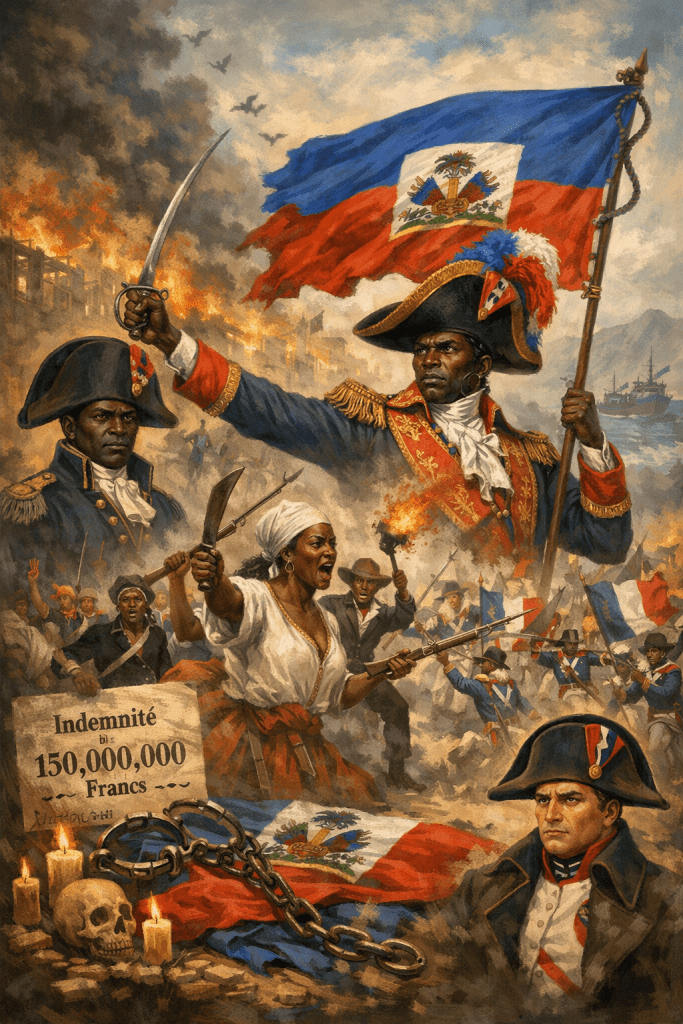
The Haitian Revolution stands as one of the most transformative uprisings in world history, culminating in 1804 with the birth of the first Black republic. It was a revolution unlike any other, led by enslaved Africans who not only resisted their bondage but dismantled an entire colonial system built on racial exploitation.
Before the revolution, Haiti—then known as Saint-Domingue—was a French colony and one of the wealthiest territories in the Caribbean. France’s prosperity was deeply tied to the brutal labor of enslaved Africans who cultivated sugar, coffee, and indigo under inhumane conditions. This economic success came at a devastating human cost.
The population of Saint-Domingue was sharply divided along racial and social lines. White French colonists, known as grands blancs and petits blancs, occupied the highest tier, while free people of color and enslaved Africans endured systemic oppression. These divisions created tension that would eventually ignite a revolution.
The enslaved population, largely composed of West and Central Africans, brought with them rich cultural traditions, spiritual systems, and languages. Many Haitians today trace their ancestry to regions such as Dahomey, the Congo, and Senegal, carrying forward a legacy of resilience and cultural continuity.
The revolution began in 1791 with a massive slave uprising in the northern plains. Inspired in part by the ideals of the French Revolution, enslaved Africans demanded liberty, equality, and justice. However, unlike in France, these ideals had to be seized through bloodshed and resistance.
One of the most prominent leaders to emerge during the revolution was Toussaint Louverture, a formerly enslaved man who became a brilliant military strategist. Louverture organized disciplined armies and fought against French, Spanish, and British forces, seeking autonomy for the colony.
Louverture’s leadership laid the groundwork for independence, though he was eventually captured by French forces under Napoleon Bonaparte and died in a French prison. His vision, however, did not perish with him.
Following Louverture’s capture, leadership passed to Jean-Jacques Dessalines, who would ultimately declare Haiti’s independence on January 1, 1804. This marked the successful end of the revolution and the beginning of a new nation forged through sacrifice.
The victory of Haiti sent shockwaves throughout the world. It was the first time enslaved people had overthrown a colonial power and established a sovereign state. For enslaved populations across the Americas, Haiti became a symbol of hope and resistance.
However, Haiti’s independence came at a steep and unjust price. In 1825, France demanded that Haiti pay an indemnity as compensation for lost property, including enslaved people. This demand was formalized under King Charles X of France.
The indemnity imposed on Haiti was initially set at 150 million francs, later reduced to 90 million. This staggering debt crippled the nation’s economy for generations, forcing Haiti into a cycle of poverty and dependency that persisted well into the 20th century.
This “compensation” was, in reality, a punishment for Black liberation. Haiti was forced to pay its former oppressors for the loss of their enslaved labor force, an act widely regarded by historians as one of the greatest economic injustices in modern history.
The language of Haiti reflects its complex colonial past. Today, Haitians primarily speak Haitian Creole, a language rooted in French but enriched with African linguistic influences. French is also an official language, used in formal settings and government.
Haitian Creole emerged as a unifying language among enslaved Africans from diverse ethnic backgrounds. It became a powerful symbol of identity, resistance, and cultural survival, bridging the gap between multiple African traditions and the imposed French structure.
Religion in Haiti also reflects this blending of cultures. Many Haitians practice a combination of Christianity and Vodou, a spiritual system with deep African roots. Vodou played a significant role in the revolution, offering both spiritual guidance and communal strength.
Despite its historical significance, Haiti has often been marginalized in global narratives. Western powers, particularly France and the United States, isolated the nation diplomatically and economically due to fears of slave rebellions spreading.
The legacy of the Haitian Revolution continues to influence discussions on race, freedom, and justice. It challenges dominant historical narratives by centering the agency and humanity of enslaved Africans who fought for their liberation.
Modern Haiti still grapples with the consequences of its past, including economic instability and political challenges. Many scholars argue that the indemnity imposed by France significantly hindered Haiti’s development and should be acknowledged and addressed.
The revolution also redefined concepts of citizenship and human rights. Haiti’s constitution declared that all citizens, regardless of color, were Black—a radical assertion of unity and resistance against racial hierarchy.
In understanding the Haitian Revolution, one must recognize both its triumph and its trials. It is a story of courage, resilience, and the relentless pursuit of freedom against overwhelming odds.
Ultimately, the Haitian Revolution is not just a chapter in history—it is a testament to the enduring spirit of a people who refused to remain in chains and reshaped the course of the modern world.
References
Dubois, L. (2004). Avengers of the New World: The Story of the Haitian Revolution. Harvard University Press.
Geggus, D. P. (2002). Haitian Revolutionary Studies. Indiana University Press.
James, C. L. R. (1989). The Black Jacobins: Toussaint L’Ouverture and the San Domingo Revolution. Vintage Books.
Popkin, J. D. (2010). You Are All Free: The Haitian Revolution and the Abolition of Slavery. Cambridge University Press.
Trouillot, M.-R. (1995). Silencing the Past: Power and the Production of History. Beacon Press.
 THE BROWN GIRL DILEMMA