Tag Archives: sexism

The Weight of Two Worlds: Racism, Sexism, and the Burden Carried by Black Women.

Black women in the United States have historically navigated a complex social landscape shaped by the intersecting forces of racism and sexism. These overlapping systems of inequality have produced a unique set of challenges that influence the economic, social, and psychological realities of Black womanhood. Scholars across sociology, gender studies, and African American studies emphasize that the experiences of Black women cannot be fully understood through the lens of race alone or gender alone, but through the interaction of both.

One of the most influential frameworks for understanding this dynamic is intersectionality, a term developed by legal scholar Kimberlé Crenshaw. Intersectionality describes how different systems of oppression overlap and compound one another. For Black women, discrimination may occur simultaneously along racial and gender lines, creating experiences that differ significantly from those faced by Black men or white women.

Historically, Black women have faced social stereotypes that shape how they are perceived and treated within American society. Images such as the “mammy,” the “jezebel,” and the “angry Black woman” have long circulated within media and cultural narratives. These stereotypes not only distort public perceptions but also influence workplace dynamics, healthcare interactions, and broader social relationships.

The historical roots of these stereotypes can be traced back to the era of slavery in the United States. During slavery, Black women were often forced into labor roles while simultaneously being subjected to sexual exploitation and dehumanization. These experiences contributed to long-standing myths about Black women’s strength, sexuality, and emotional resilience that persist in modern society.

Economic inequality represents another significant challenge. Black women participate in the labor force at high rates, yet they often encounter wage disparities and occupational segregation. According to data from the U.S. Bureau of Labor Statistics, Black women on average earn less than white men, white women, and in many cases Black men, highlighting the intersection of racial and gender pay gaps.

These economic disparities have broader implications for household wealth and financial stability. Because income inequality accumulates over time, Black women frequently face greater barriers to building generational wealth through homeownership, investment, and retirement savings.

In the realm of healthcare, Black women experience notable disparities in medical outcomes. Studies from the Centers for Disease Control and Prevention indicate that Black women face significantly higher rates of maternal mortality compared with women from other racial groups in the United States. Researchers attribute these disparities to factors including unequal healthcare access, systemic bias within medical institutions, and chronic stress associated with discrimination.

Mental health is also shaped by these pressures. Many scholars discuss the cultural expectation that Black women must embody resilience and emotional strength, often referred to as the “Strong Black Woman” archetype. While strength is widely celebrated, this expectation can discourage individuals from expressing vulnerability or seeking mental health support.

Black feminist scholars have long examined these social pressures. Thinkers such as Patricia Hill Collins and bell hooks have explored how Black women develop intellectual traditions and cultural strategies to resist systems of domination while affirming their identities and experiences.

Education represents both a challenge and a space of remarkable achievement for Black women. In recent decades, Black women have become one of the fastest-growing groups earning college and graduate degrees in the United States. Despite these accomplishments, barriers to leadership positions and career advancement remain present in many professional fields.

Media representation plays a powerful role in shaping public perception. Historically, film and television have portrayed Black women through narrow character types. While representation has improved in recent decades, scholars continue to argue that media portrayals influence broader social attitudes and expectations.

Another dimension of inequality involves the criminal justice system. Black women are disproportionately affected by policing, incarceration, and legal inequities compared with women of other racial groups. These patterns reflect broader systemic disparities within the justice system.

Housing inequality also affects many Black women and their families. Historical policies such as housing discrimination and segregation contributed to patterns of residential inequality that continue to shape access to resources such as schools, healthcare facilities, and employment opportunities.

Despite these structural barriers, Black women have historically served as leaders in social justice movements. Figures such as Harriet Tubman, Ida B. Wells, and Fannie Lou Hamer played transformative roles in abolitionism, anti-lynching campaigns, and the civil rights movement.

In politics, Black women have continued to break barriers and influence national conversations about equity and representation. Their leadership has expanded discussions around voting rights, criminal justice reform, healthcare access, and economic opportunity.

Culturally, Black women have shaped American music, literature, art, and fashion. Their contributions have influenced global culture while also serving as forms of creative resistance and self-expression.

Community networks and faith institutions have also historically provided support systems for Black women navigating systemic challenges. Churches, civic organizations, and grassroots movements have played central roles in fostering solidarity and empowerment.

Scholars emphasize that understanding the experiences of Black women requires acknowledging both struggle and resilience. While structural inequalities persist, Black women have continuously demonstrated leadership, creativity, and perseverance in confronting social barriers.

Addressing the challenges facing Black women requires systemic change. Policies aimed at reducing wage inequality, improving healthcare access, strengthening educational opportunity, and addressing discrimination are essential components of achieving social equity.

Ultimately, the experiences of Black women illustrate the broader consequences of intersecting forms of inequality within society. Recognizing and addressing these complexities is crucial for building a more just and inclusive future.


References

Collins, P. H. (2000). Black feminist thought: Knowledge, consciousness, and the politics of empowerment. Routledge.

Crenshaw, K. (1989). Demarginalizing the intersection of race and sex. University of Chicago Legal Forum.

hooks, b. (1981). Ain’t I a woman: Black women and feminism. South End Press.

Jones, C. P. (2000). Levels of racism: A theoretical framework. American Journal of Public Health.

Centers for Disease Control and Prevention. (2023). Maternal health disparities in the United States.

U.S. Bureau of Labor Statistics. (2023). Labor force statistics by race and gender.
Dilemma: The Isms

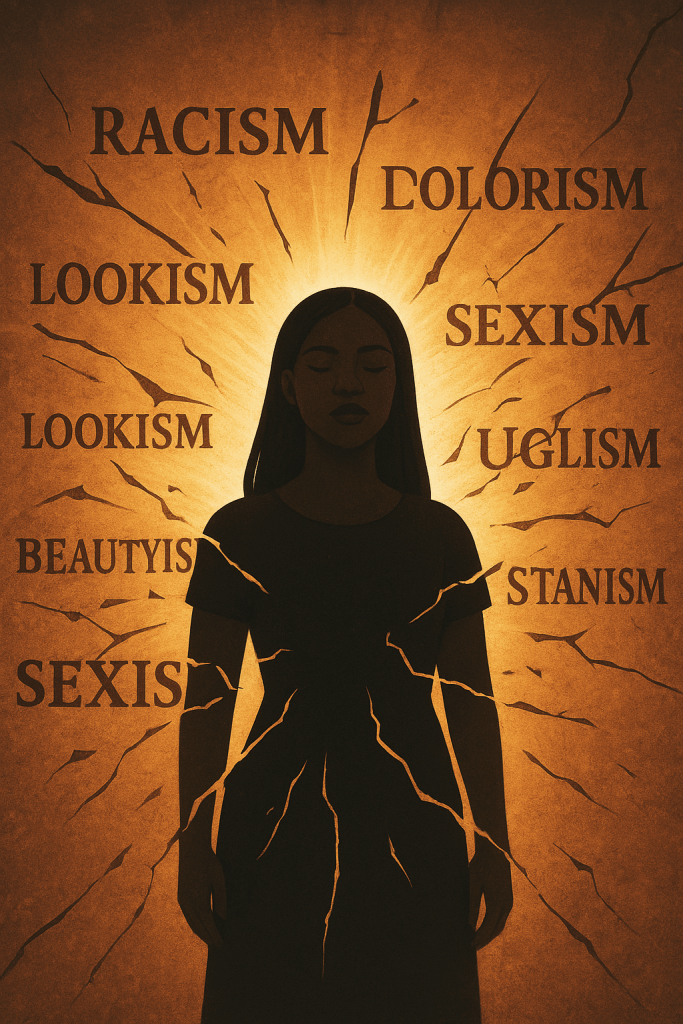
In the grand theater of human existence, few scripts are as persistent and poisonous as the “isms.” Racism, colorism, lookism, beautyism, sexism, oldism, shadeism, uglyism, and even satanism—all are manifestations of a fallen world obsessed with hierarchy, appearance, and power. Each “ism” reflects the corrosion of love and the rebellion of pride. Together, they create a network of deception that distorts identity, destroys unity, and desecrates the divine image in which humanity was made. Nowhere are the scars of these “isms” more deeply etched than within the Black experience. For centuries, Black people have stood at the crossroads of all these prejudices, bearing their weight in body, mind, and soul.

Racism remains the root—a centuries-old ideology that devalues melanin while exalting whiteness. It began as a tool of control and exploitation, branding Blackness as inferior to justify enslavement, colonization, and systemic oppression. The result is a world where Black people must constantly prove their worth in spaces that were built to exclude them. Yet God created man “of one blood” (Acts 17:26, KJV), and He did not rank His creation by hue or heritage. Racism, therefore, is not merely a social construct—it is a sin against divine design.

Colorism, birthed from the same soil, has fractured the Black community itself. It is the preference for lighter skin tones and the degradation of darker shades, a poison inherited from colonialism and slavery. Within entertainment, corporate spaces, and even family structures, darker-skinned individuals often face invisibility or bias. The pain of colorism is internal and generational—it teaches people to love themselves in fragments. Blackness, in all its shades, becomes a battlefield instead of a brotherhood.

Shadeism, a close cousin to colorism, digs deeper into the nuances of melanin politics. It is not just about dark or light, but about the subtle gradients that dictate beauty, opportunity, and social treatment. A few shades lighter can mean a world of difference in media representation or romantic desirability. This artificial hierarchy was never God’s plan. The Bible declares that “we are fearfully and wonderfully made” (Psalm 139:14, KJV), yet man continues to divide what God made whole.

Lookism extends these divisions into the realm of physical features. Society’s obsession with symmetrical faces, certain nose shapes, or body proportions reinforces Eurocentric ideals and marginalizes Black aesthetics. African features—broad noses, full lips, coily hair—have been mocked, exoticized, or appropriated, rarely celebrated for their divine authenticity. For Black people, lookism means being measured by standards that were never meant to reflect them.

Beautyism makes this discrimination even more insidious. It teaches that worth is equal to desirability and that physical beauty is a form of social capital. This idolization of beauty enslaves both the admired and the overlooked. The Black woman, in particular, stands at the intersection of racial, aesthetic, and gender bias—praised for her strength but rarely protected, desired for her body but dismissed for her humanity. Proverbs 31:30 (KJV) reminds us that “beauty is vain,” yet the world worships it as god.

Sexism compounds these struggles by defining womanhood through subservience and silence. Within the Black experience, sexism manifests uniquely. Black women are often denied softness, labeled as too strong, too loud, or too masculine. Their pain is minimized, their brilliance overlooked. Meanwhile, Black men face a different battle—emasculated by stereotypes yet pressured to perform dominance to prove their manhood. Both genders suffer when the divine order of respect and balance is replaced with competition and oppression.

Oldism, or ageism, is another hidden form of injustice. It affects the elders of the Black community, whose wisdom and history are often ignored by a youth-obsessed culture. In Western societies, aging is seen as decline rather than dignity. Yet Scripture says, “The hoary head is a crown of glory, if it be found in the way of righteousness” (Proverbs 16:31, KJV). Elders are living libraries, but oldism silences their stories, causing younger generations to repeat cycles of trauma.

Uglyism is perhaps the cruelest of the superficial “isms.” It labels people as unworthy of admiration based on arbitrary ideals of attractiveness. Within Black culture, uglyism often targets those with the darkest complexions or most African features. This cruel bias leads to deep-seated self-hate, psychological wounds, and lifelong insecurities. The truth, however, is that beauty cannot be defined by the eye of man—it must be defined by the heart of God. What the world calls “ugly,” God often calls chosen.

Satanism, though seemingly distinct from the others, undergirds them all. These “isms” are not merely social patterns—they are spiritual strategies. They divide humanity through pride, envy, and hatred, which are tools of the adversary. Satanism glorifies self-worship, vanity, and hierarchy—all principles seen in the other “isms.” The adversary’s goal is to make creation despise itself, to pit shade against shade, gender against gender, and soul against soul. Ephesians 6:12 (KJV) warns us that “we wrestle not against flesh and blood, but against principalities.” The “isms” are not random—they are orchestrated.

For Black people, the impact of these “isms” is multiplied. Racism devalues them, colorism divides them, lookism mocks them, and beautyism excludes them. Sexism silences their women, oldism forgets their elders, uglyism shames their features, and satanism blinds their spiritual identity. The Black experience becomes a battlefield not just for equality, but for wholeness.

Generational trauma has taught many Black individuals to conform in order to survive. Skin bleaching, hair alteration, and assimilation into Western beauty norms are all symptoms of a deeper wound—the internalized belief that to be accepted, one must erase oneself. But God never intended for His people to conform to the image of man. Romans 12:2 (KJV) commands, “Be not conformed to this world: but be ye transformed by the renewing of your mind.”

Each “ism” robs something sacred. Racism steals dignity. Colorism steals unity. Lookism steals authenticity. Beautyism steals peace. Sexism steals purpose. Oldism steals legacy. Uglyism steals confidence. Shadeism steals harmony. And satanism steals souls. Together, they create a system of distraction—a matrix designed to keep people fixated on the external rather than the eternal.

Healing begins with awareness but is completed through righteousness. God calls His people to live beyond the world’s labels. The Kingdom of Heaven does not rank based on skin tone, age, or beauty; it honors righteousness and humility. The true mark of greatness is not appearance, but obedience.

Black people, as descendants of resilience and divine heritage, must reclaim their image through the eyes of the Creator. Melanin is not a curse but a covering. Afrocentric features are not imperfections but imprints of glory. Elders are not outdated but anointed. Every shade, every texture, every curve is a verse in the poetry of creation.

The path to liberation lies in spiritual reprogramming—replacing the lies of the “isms” with the truth of divine identity. When Black people remember who they are and whose they are, the “isms” lose their grip. For the Most High sees not as man sees. He looks on the heart.

In the end, the true enemy is not color, beauty, or gender—it is corruption. The ultimate “ism” is ego, the self elevated above God. But those who walk in love, humility, and righteousness will transcend the world’s systems. As it is written, “If any man be in Christ, he is a new creature” (2 Corinthians 5:17, KJV).

Let the “isms” fall away, and let divine identity rise. For when we see ourselves and others as God sees us—fearfully, wonderfully, and equally made—the chains of vanity, prejudice, and pride are broken forever.


References

  • The Holy Bible, King James Version (KJV) – Genesis 1:27; Psalm 139:14; Acts 17:26; 1 Samuel 16:7; Proverbs 31:30; Proverbs 16:31; Romans 12:2; Galatians 5:22–23; Ephesians 6:12; 2 Corinthians 5:17.
  • hooks, b. (1981). Ain’t I a Woman: Black Women and Feminism. South End Press.
  • Hill Collins, P. (2000). Black Feminist Thought. Routledge.
  • Russell, K., Wilson, M., & Hall, R. (2013). The Color Complex: The Politics of Skin Color Among African Americans. Anchor Books.
  • Wolf, N. (1991). The Beauty Myth: How Images of Beauty Are Used Against Women. HarperCollins.
  • West, C. (1993). Race Matters. Beacon Press.
  • Bailey, C. (2020). Misogynoir Transformed: Black Women’s Digital Resistance. NYU Press.

Dilemma: Misogynoir

The Unique Discrimination Against Black Women

Photo by Bave Pictures on Pexels.com

Misogynoir—a term coined by Moya Bailey (2010)—captures the specific intersection of racism and sexism that Black women face. Unlike generalized sexism or racism, misogynoir uniquely blends both to create social, cultural, and psychological burdens for Black women. It is manifested in harmful stereotypes that distort their humanity and confine them to demeaning roles. The “angry Black woman” trope frames Black women as hostile, aggressive, and perpetually dissatisfied, disregarding the legitimate roots of their frustration in systemic injustice. The hypersexualized “jezebel” stereotype objectifies Black women, reducing them to their bodies and marking them as sexually available. Meanwhile, the “mammy” archetype portrays Black women as self-sacrificing caretakers, expected to prioritize others’ needs at the expense of their own. These stereotypes have persisted from slavery into the present day, shaping workplace dynamics, media representation, and interpersonal relationships (Collins, 2000).

From a psychological standpoint, these stereotypes function as a form of “stereotype threat” (Steele, 1997), in which awareness of negative perceptions can hinder performance, increase stress, and damage self-concept. Black women often navigate “double consciousness” (Du Bois, 1903), a fractured identity where they see themselves through both their own cultural lens and the distorted gaze of a white, patriarchal society. This duality can lead to anxiety, depression, and diminished self-esteem (Watson-Singleton, 2017). Furthermore, the internalization of misogynoir reinforces cycles of silence, guilt, or perfectionism, where Black women feel compelled to “work twice as hard” to prove their worth. Psychology affirms that such sustained exposure to stress produces physical consequences, often termed “weathering” (Geronimus, 1992), leading to earlier onset of health disparities such as hypertension and heart disease.

The King James Bible reminds us that stereotypes and false witness are contrary to God’s commandments. Proverbs 31:10–31 exalts the virtuous woman, describing her as strong, wise, and industrious—not angry, oversexualized, or expendable. God calls women to be valued as His image-bearers (Genesis 1:27), not diminished by human prejudice. Ephesians 4:29 warns, “Let no corrupt communication proceed out of your mouth, but that which is good to the use of edifying.” Thus, speech and actions rooted in misogynoir are not only socially destructive but also spiritually sinful. The Bible underscores that all slander and demeaning words are falsehoods, and in God’s sight, women are honored creations with divine purpose.

Overcoming misogynoir requires both personal and collective strategies. Spiritually, Black women and communities are called to reclaim identity in God’s truth, remembering that liberation begins with obedience to His commandments and the refusal to internalize lies. As Romans 12:2 reminds, “Be not conformed to this world: but be ye transformed by the renewing of your mind.” Healing begins by rejecting false stereotypes and embracing God’s definition of worth. Psychologically, access to therapy, affirming spaces, and intergenerational support networks counter the damage of stereotype threat and provide avenues for resilience. Collective affirmation of beauty, intelligence, and dignity serves as a cultural shield against internalized oppression.

Socially, dismantling misogynoir means challenging media portrayals, workplace discrimination, and community dynamics that recycle harmful tropes. Black men in particular bear responsibility for rejecting narratives that demean Black women, while allies of all backgrounds must amplify voices that resist sexist-racist imagery. Policy reforms addressing wage gaps, healthcare disparities, and violence against Black women also play a crucial role in reducing the systemic roots of misogynoir. Building unity within the Black community, rooted in love and respect, strengthens collective resistance and ensures that oppressive frameworks are not perpetuated internally.

Ultimately, the dilemma of misogynoir is overcome by centering truth—biblical truth that affirms dignity, psychological truth that validates lived experiences, and social truth that reclaims narrative power. As Michelle Obama (2018) once said, “We need to do a better job of putting ourselves higher on our own ‘to-do list.’” Black women must be honored as full, complex beings, not limited by stereotypes. When society begins to see Black women through the lens of God’s truth and not historical lies, healing, restoration, and justice can emerge for future generations.


📚 References

  • Bailey, M. (2010). They aren’t talking about me… Misogynoir in hip-hop culture.
  • Collins, P. H. (2000). Black feminist thought. Routledge.
  • Du Bois, W. E. B. (1903). The Souls of Black Folk.
  • Geronimus, A. T. (1992). The weathering hypothesis. Ethnicity & Disease, 2(3), 207–221.
  • Steele, C. (1997). A threat in the air: How stereotypes shape intellectual identity. American Psychologist, 52(6), 613–629.
  • Watson-Singleton, N. (2017). Strong Black woman schema and mental health. Journal of Black Psychology, 43(8), 771–789.