
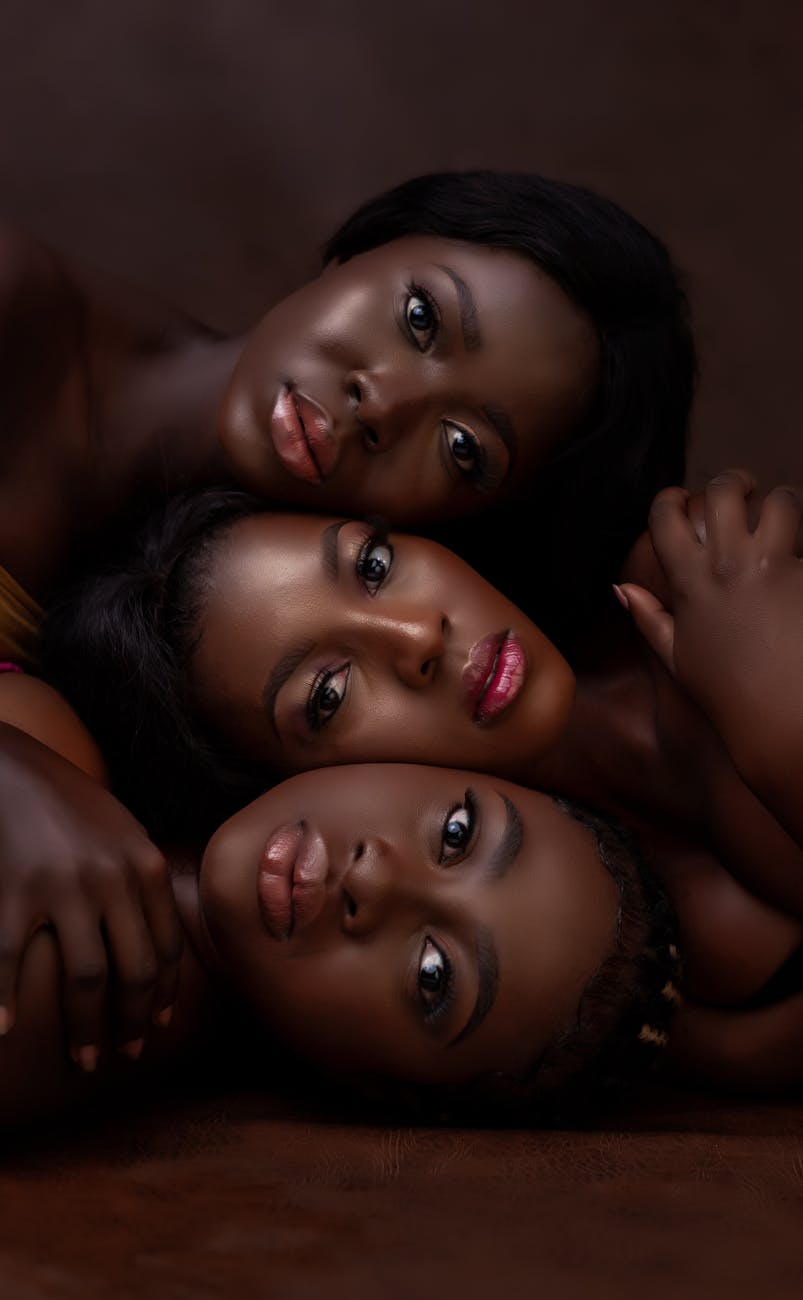
The phrase “pretty for a dark-skinned girl” is one of the most backhanded compliments directed at Black women. It implies that beauty and dark skin are mutually exclusive, and that attractiveness in a darker-skinned woman is a rare exception rather than a norm. This statement does more than critique — it reinforces the colonial hierarchy that places lighter skin at the top of beauty standards (Hunter, 2007).
Historically, European colonization promoted a racialized beauty ideal where whiteness represented purity, refinement, and superiority. Darker skin was associated with servitude, labor, and inferiority. This mindset was internalized within colonized societies, leading to colorism — discrimination not only from outside forces but also within the Black community itself (Smedley, 1999).
During the transatlantic slave trade, enslaved women with lighter complexions were often brought into the house to serve domestically, while darker women were left in the fields. This created a divide, associating lighter skin with proximity to whiteness and privilege. The legacy of that division continues to affect how people perceive beauty today, particularly when it comes to women (Williams, 1987).
When someone says, “You’re pretty for a dark-skinned girl,” they are subconsciously affirming the idea that beauty is unexpected when attached to deep melanin. The phrase suggests that light skin is the default standard of beauty and that darker skin is a deviation from the norm. This not only harms dark-skinned girls but also perpetuates self-hate across generations (Russell, Wilson, & Hall, 2013).
Psychologically, hearing this phrase can have devastating effects on self-esteem. Dark-skinned women internalize the belief that they must work harder to prove their beauty or worthiness. Studies show that darker-skinned women report lower levels of self-confidence and higher rates of body image issues compared to lighter-skinned peers (Hill, 2002).
The phrase also reveals a deeper issue in romantic desirability. Dark-skinned women are often told they are “cute” but not necessarily “wife material.” This stereotype contributes to colorist dating preferences where light-skinned women are chosen more frequently, reinforcing the notion that dark-skinned women must settle for less (Wilder, 2010).
Media representation has historically fueled this narrative. For decades, darker-skinned women were rarely cast as love interests in films and TV shows. When they were included, they were often portrayed as the sassy friend, the struggling single mother, or the antagonist, while lighter-skinned women were framed as the romantic ideal (Bogle, 2016).
Even in music culture, the phrase “pretty for a dark-skinned girl” became a subtle lyrical motif. Hip-hop and R&B songs have historically glorified “redbones” or “yellow bones,” with little praise for deep-skinned women, except when fetishized for exotic appeal (Neal, 2013).
The phrase is also tied to Western beauty marketing. Beauty companies historically failed to create makeup shades that matched darker complexions, essentially excluding dark-skinned women from mainstream beauty campaigns. This exclusion reinforced the idea that darker women were not part of the beauty conversation until recent years (Tate, 2016).
In schools, dark-skinned girls often face color-based bullying. Research has found that darker-skinned children are more likely to be teased by peers and even disciplined more harshly by teachers, further embedding the message that they are less valued (Monk, 2014).
Religiously and spiritually, this phrase contradicts biblical teaching. Song of Solomon 1:5 affirms, “I am black, but comely,” a declaration of beauty and dignity. God’s word establishes that beauty is not skin-deep, and partiality based on complexion contradicts James 2:1-4, which condemns favoritism.
Cultural movements have begun to reclaim and resist this narrative. Actresses like Lupita Nyong’o, Viola Davis, and Danai Gurira have spoken openly about their journeys to self-acceptance and the rejection of the idea that their beauty is rare or conditional. Lupita in particular has stated that seeing supermodel Alek Wek changed her perception of herself, showing the power of representation (Nyong’o, 2014).
Social media campaigns like #MelaninPoppin and #BlackGirlMagic have played a crucial role in affirming the beauty of darker-skinned women. These campaigns have helped normalize seeing deep-skinned women as glamorous, intelligent, and powerful — not just beautiful “for their complexion.”
The entertainment industry has also started to shift, though slowly. Recent shows and films like Insecure, The Woman King, and Queen & Slim feature dark-skinned women as romantic leads and complex protagonists. This marks a cultural correction, pushing back against decades of erasure.
Testimonies of Dark-Skinned Women Who Reclaimed Their Beauty
The phrase “pretty for a dark-skinned girl” has left deep scars on generations of Black women. But many have turned that pain into power by speaking publicly about their experiences with colorism and self-acceptance. Their testimonies serve as both education and liberation for younger girls still wrestling with the same wounds.
Academy Award-winning actress Lupita Nyong’o is one of the most influential voices in this conversation. In her viral 2014 Essence speech, Lupita shared that as a child, she prayed to God for lighter skin, believing it was the key to beauty and love. Seeing Sudanese supermodel Alek Wek on magazine covers transformed her view of herself: “She was dark as night and was in all the magazines and on runways. … Seeing someone who looked like me being celebrated gave me permission to embrace myself” (Nyong’o, 2014).
Viola Davis, one of Hollywood’s most acclaimed actresses, has also been candid about her journey. Growing up poor in Rhode Island, she recalls being called “ugly” and “Black” as insults. “I internalized that for a long time. I felt like I was invisible,” Davis told Essence. Today, she proudly wears her natural hair on red carpets and uses her platform to tell authentic stories about dark-skinned women in roles like Annalise Keating in How to Get Away with Murder.
Gabrielle Union has spoken about her early struggles with colorism in Hollywood. She admitted to being told she was “too dark” for certain roles, even as casting directors praised her acting skills. In her book We’re Going to Need More Wine (2017), she reflects on how she had to unlearn the idea that lighter skin equaled better opportunities. “I had to get comfortable in the skin I was in, even when the world was telling me that it wasn’t enough,” she writes.
Grammy-winning singer India.Arie has long celebrated deep brown skin in her music, particularly in her anthem “Brown Skin.” She has said the song was a direct response to being told early in her career to lighten her skin in photoshoots. Her music reclaims dark skin as sensual, beautiful, and worthy of praise.
Even Beyoncé has acknowledged the issue. In her visual album Black Is King (2020), she deliberately cast women with deep melanin to center their beauty and royalty. Her project was widely praised for providing images that dark-skinned girls could see themselves in — regal, loved, and celebrated.
Supermodel Duckie Thot, often called the “Black Barbie,” has shared her painful experience of being bullied for her skin tone in Australia. “People called me names like ‘burnt’ and ‘charcoal,’” she told Teen Vogue. Today, she has flipped the narrative by becoming one of the most sought-after models in the fashion industry, walking for major designers and starring in global campaigns.
Actress Danielle Brooks, known for her role as Taystee on Orange Is the New Black, has also spoken about the microaggressions she faced as a dark-skinned woman in entertainment. “I had to learn that my worth is not based on someone else’s perception of me,” she said in a Glamour interview.
Author and activist Michaela Angela Davis has long worked to dismantle colorism in media. She argues that changing the conversation starts with visibility: “If little girls never see themselves in commercials, on magazine covers, or in love stories, they’ll grow up thinking they’re unworthy of being seen.”
Social media influencer Nia the Light created the viral hashtag #MelaninPoppin to celebrate darker-skinned beauty worldwide. Her online platform has encouraged thousands of women to share unfiltered images of themselves, redefining beauty norms without relying on mainstream approval.
Even within academia, women like Dr. Yaba Blay have taken a stand. In her groundbreaking project Pretty. Period., Dr. Blay compiled portraits and testimonies of dark-skinned women to affirm that their beauty needs no qualifiers. She writes, “Dark-skinned women are not beautiful in spite of their complexion. They are beautiful because of it.”
These testimonies demonstrate that healing from colorism is both personal and collective. It begins with rejecting harmful language and reclaiming identity, but it is sustained by building communities of affirmation where dark-skinned girls can thrive.
Many of these women highlight the importance of representation for the next generation. Lupita Nyong’o’s children’s book Sulwe tells the story of a dark-skinned girl who learns to see her beauty as divine. Books like this offer children tools to combat internalized bias before it takes root.
The faith community also plays a role in this restoration. Scriptures like Psalm 139:14 — “I am fearfully and wonderfully made” — remind dark-skinned women that their beauty is intentional and crafted by the Creator. This spiritual affirmation helps counteract the social messages that try to devalue them.
Healing also requires systemic change. Media producers must continue to cast dark-skinned women in leading roles, beauty brands must maintain inclusive shade ranges, and schools must educate children about colorism as a form of bias (Monk, 2014).
Feminist scholars argue that embracing dark-skinned beauty is revolutionary because it challenges both patriarchy and white supremacy. Loving oneself in a world that profits from self-hate is an act of defiance and liberation (Hunter, 2007).
Each testimony is a seed that plants confidence in others. When dark-skinned women publicly speak their truth, they dismantle the lie that their beauty is conditional. They empower the next generation to walk unapologetically in their natural skin.
Society must move from tolerating dark skin to celebrating it — not as a trend but as a constant truth. Dark-skinned beauty has always existed and always will, regardless of shifting cultural aesthetics.
In the end, the phrase “pretty for a dark-skinned girl” must be buried. These testimonies show that dark-skinned girls are not exceptions to beauty; they are the embodiment of it. Their stories remind the world that melanin is not a limitation but a crown.
Still, the phrase continues to surface in subtle ways. In dating apps, social media comment sections, and everyday conversation, darker-skinned women still encounter qualifiers when praised. This reveals that society has yet to fully dismantle the internalized belief that light is superior (Charles, 2003).
Economic data also demonstrates that darker-skinned women face a “beauty penalty” in the workforce. Research shows they earn less than lighter-skinned Black women and are less likely to be promoted, even with the same qualifications (Goldsmith, Hamilton, & Darity, 2006).
The burden of this phrase also creates tension between women of different shades. Dark-skinned women may feel resentment, while light-skinned women may struggle with guilt over the privilege they did not seek. These tensions must be addressed honestly to foster unity and healing within the Black community (Hall, 1992).
Education and open dialogue are crucial. Parents, teachers, and mentors must teach young girls to reject backhanded compliments and affirm that their beauty is not conditional. Community-based programs can help shift cultural language from divisive to affirming.
Ultimately, to say someone is “pretty for a dark-skinned girl” is to miss the truth that she is simply pretty, period. Dismantling this phrase is not just about affirming beauty but about affirming humanity, dignity, and equality for all women of African descent.
The future demands a culture where dark-skinned beauty is not an exception but a celebrated expression of God’s creativity. When society no longer needs to qualify the beauty of dark-skinned girls, we will know that pretty privilege has been replaced by true, holistic acceptance.
References
- Bogle, D. (2016). Toms, Coons, Mulattoes, Mammies, and Bucks: An Interpretive History of Blacks in American Films. Bloomsbury.
- Charles, C. (2003). Skin Bleaching, Self-Hate, and Black Identity in Jamaica. Journal of Black Studies, 33(6), 711–728.
- Goldsmith, A., Hamilton, D., & Darity, W. (2006). Shades of Discrimination: Skin Tone and Wages. American Economic Review, 96(2), 242–245.
- Hall, R. E. (1992). Bias Among African Americans Regarding Skin Color: Implications for Social Work Practice. Research on Social Work Practice, 2(4), 479–486.
- Hill, M. (2002). Skin Color and the Perception of Attractiveness Among African Americans. Social Psychology Quarterly, 65(1), 77–91.
- Hunter, M. (2007). The Persistent Problem of Colorism: Skin Tone, Status, and Inequality. Sociology Compass, 1(1), 237–254.
- Monk, E. P. (2014). Skin Tone Stratification among Black Americans, 2001–2003. Social Forces, 92(4), 1313–1337.
- Neal, M. A. (2013). What the Music Said: Black Popular Music and Black Public Culture. Routledge.
- Nyong’o, L. (2014). Speech at Essence Black Women in Hollywood Luncheon. Essence.
- Russell, K., Wilson, M., & Hall, R. (2013). The Color Complex: The Politics of Skin Color Among African Americans. Anchor Books.
- Smedley, A. (1999). Race in North America: Origin and Evolution of a Worldview. Westview Press.
- Tate, S. (2016). Black Beauty: Aesthetics, Stylization, Politics. Routledge.
- Wilder, J. (2010). Revisiting “Color Names and Color Notions”: A Contemporary Examination of the Language and Attitudes of Skin Color among Young Black Women. Journal of Black Studies, 41(1), 184–206.
- Williams, E. (1987). Capitalism and Slavery. UNC Press.
- Blay, Y. (2013). Pretty. Period. Retrieved from https://prettyperiod.me
- Davis, V. (2015). Interview with Essence Magazine.
- Hunter, M. (2007). The Persistent Problem of Colorism: Skin Tone, Status, and Inequality. Sociology Compass, 1(1), 237–254.
- Union, G. (2017). We’re Going to Need More Wine. HarperCollins.
- Vogue Teen. (2018). Duckie Thot: How I Learned to Love My Dark Skin. Teen Vogue.
 THE BROWN GIRL DILEMMA