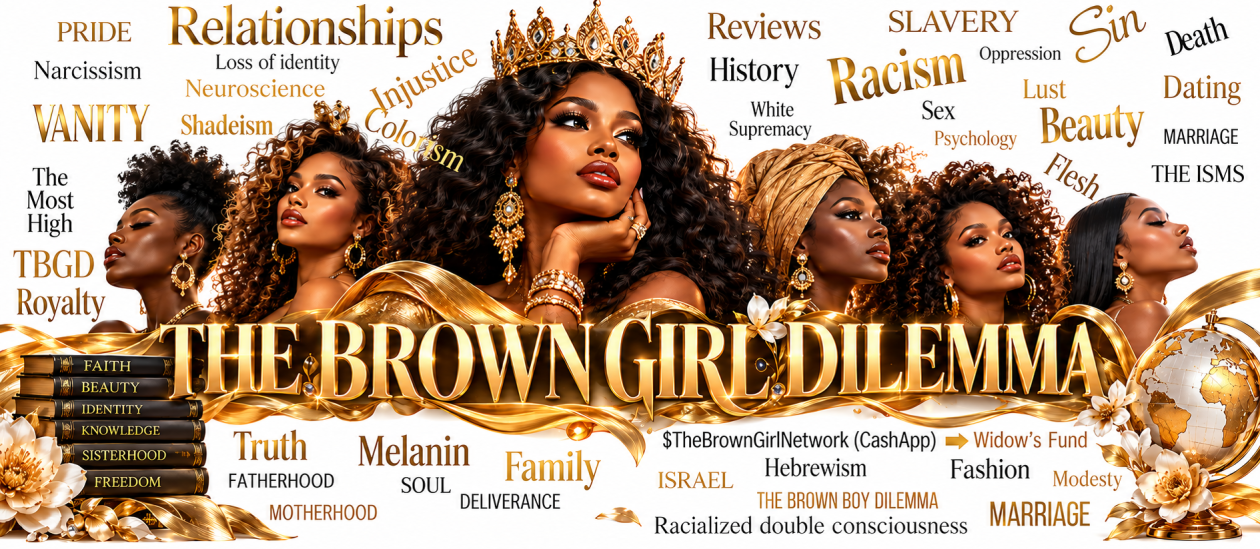

Dear Brown girl, before the world told you what you were not, you existed in completeness. You were not born questioning your worth, your beauty, or your belonging. Those doubts were taught, reinforced through images, language, and silence. This letter is not simply a reminder—it is a restoration of truth.
From an early age, you were introduced to a hierarchy of beauty that did not place you at the center. Research on colorism reveals that darker-skinned individuals, particularly women, are often subjected to bias that associates lighter skin with attractiveness, intelligence, and social value (Hunter, 2007). These messages, repeated over time, can distort self-perception in profound ways.
Healing from rejection in a world obsessed with image requires first recognizing that the rejection was never purely personal—it was systemic. When standards are narrow, exclusion becomes inevitable. Psychological studies indicate that repeated social rejection can impact self-esteem and identity formation, particularly during formative years (Leary, 2001).
The pain you felt when overlooked, dismissed, or compared was real. It was not imagined, nor was it an overreaction. It was the natural human response to being told, directly or indirectly, that you did not meet a constructed ideal. Acknowledging this pain is not weakness—it is the beginning of healing.
Unlearning self-hate in a culture that profits from it is a radical act. The global beauty industry generates billions of dollars annually, often by reinforcing insecurities and offering products as solutions (Wolf, 1991). When you begin to question these narratives, you disrupt a system designed to keep you doubting yourself.
Internalized bias is one of the most insidious outcomes of this system. Over time, external messages become internal beliefs. Studies in social psychology show that individuals can unconsciously adopt societal prejudices, even when those prejudices are directed at their own group (Speight, 2007). This is not a personal failure—it is evidence of how powerful conditioning can be.
Your shade is not your struggle—society made it one. Skin tone, in its natural form, carries no inherent disadvantage. It is the social meanings attached to it that create barriers. Colorism, rooted in historical systems of oppression, continues to influence opportunities in areas such as employment, media representation, and relationships (Keith & Herring, 1991).
Reclaiming your identity requires separating yourself from these imposed narratives. This involves actively challenging the beliefs you were taught and replacing them with affirmations grounded in truth. Cognitive restructuring, a technique in psychology, has been shown to help individuals reframe negative self-perceptions and improve mental health outcomes (Beck, 1976).
Representation also plays a crucial role in this process. Seeing individuals who reflect your features, your complexion, and your essence in positions of beauty and power can reshape internal narratives. Media representation has been linked to self-esteem and identity development, particularly among marginalized groups (Tiggemann & Slater, 2013).
However, true healing goes beyond external validation. It requires cultivating an internal sense of worth that is not contingent on societal approval. Self-compassion, defined as treating oneself with kindness and understanding, has been associated with greater emotional resilience and reduced self-criticism (Neff, 2003).
There is also a spiritual dimension to this journey. Understanding that your creation was intentional—that your features, your skin, and your essence were designed with purpose—can provide a deeper sense of peace. Spiritual frameworks often emphasize inherent worth, independent of societal standards (Koenig, 2012).
The journey of healing is not linear. There will be moments when old thoughts resurface, when comparison creeps in, and when doubt whispers familiar lies. These moments do not negate your progress; they are part of the process. Growth often involves revisiting and reprocessing past experiences.
Community can be a powerful source of healing. Connecting with others who share similar experiences can provide validation and support. Collective healing spaces allow individuals to challenge dominant narratives and build new ones rooted in empowerment (Watkins, 2018).
Education is another tool for liberation. Understanding the historical and social roots of colorism can shift the narrative from self-blame to systemic awareness. Knowledge transforms personal pain into critical insight, allowing you to see the larger context of your experiences.
It is also important to redefine beauty on your own terms. Rather than striving to fit into a predefined mold, you can expand the definition to include your unique features. This redefinition is not about exclusion—it is about inclusion and authenticity.
Your worth is not negotiable. It is not something to be earned through conformity or diminished by rejection. Psychological theories of self-worth emphasize that intrinsic value is a fundamental human need, not a conditional reward (Deci & Ryan, 2000).
As you unlearn self-hate, you may also experience grief—for the years spent doubting yourself, for the opportunities missed, for the versions of yourself that felt unworthy. This grief is valid. It is a testament to your awareness and your desire for something better.
Yet, within that grief lies power. The same awareness that allows you to see the injustice also equips you to resist it. You are not only healing yourself—you are challenging a system that has persisted for generations.
Dear Brown girl, you were never the problem. The standards were flawed, the narratives were incomplete, and the system was biased. Your existence does not need justification. Your beauty does not require validation.
And as you continue this journey, remember that healing is not about becoming someone new—it is about returning to who you were before the world told you otherwise.
References
Beck, A. T. (1976). Cognitive therapy and the emotional disorders. International Universities Press.
Deci, E. L., & Ryan, R. M. (2000). The “what” and “why” of goal pursuits: Human needs and the self-determination of behavior. Psychological Inquiry, 11(4), 227–268.
Hunter, M. (2007). The persistent problem of colorism: Skin tone, status, and inequality. Sociology Compass, 1(1), 237–254.
Keith, V. M., & Herring, C. (1991). Skin tone and stratification in the Black community. American Journal of Sociology, 97(3), 760–778.
Koenig, H. G. (2012). Religion, spirituality, and health: The research and clinical implications. ISRN Psychiatry.
Leary, M. R. (2001). Toward a conceptualization of interpersonal rejection. Social Psychology Review, 5(1), 3–20.
Neff, K. D. (2003). Self-compassion: An alternative conceptualization of a healthy attitude toward oneself. Self and Identity, 2(2), 85–101.
Speight, S. L. (2007). Internalized racism: One more piece of the puzzle. The Counseling Psychologist, 35(1), 126–134.
Tiggemann, M., & Slater, A. (2013). NetGirls: The Internet, Facebook, and body image concern in adolescent girls. International Journal of Eating Disorders, 46(6), 630–633.
Watkins, D. C. (2018). Improving the living, learning, and thriving of young Black men: A conceptual framework for reflection and projection. International Journal of Environmental Research and Public Health, 15(4), 1–12.
Wolf, N. (1991). The beauty myth: How images of beauty are used against women. HarperCollins.